REVIEW 3 major objections 6 minor 44 references
Theme-Aware Aesthetic Distribution Prediction With Full-Resolution Photographs
T0 review · 3 major / 6 minor · reviewed 2026-08-14 · deepseek-v4-flash
Pith's one-line read Full-resolution aesthetic scoring is possible for arbitrary-sized photos: pad the image to a common canvas, let a region-of-interest pooling layer discard the padding before classification, and condition the prediction on the photo's…
desk verdict A clever ROI-pooling idea for full-resolution AQA, but the theme-aware model leaks per-theme label statistics and the SOTA claim doesn't survive. read the letter →
The pith
A machine-rendered reading of the paper's core claim, the machinery that carries it, and where it could break.
The reading
What carries the argument
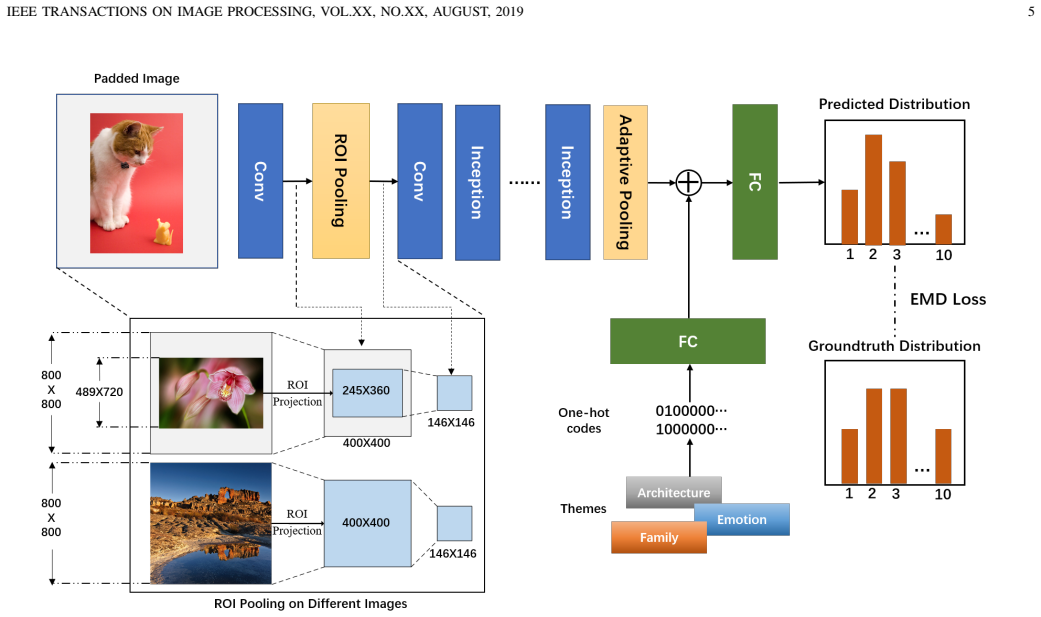
The mechanism that carries the argument is ROI pooling on padded full-resolution inputs: zero-padding equalizes image sizes for batching, and the ROI pooling layer, placed where Inception-v3's first pooling layer would be, max-pools only the feature-map region corresponding to the original image, producing a uniform output while discarding padding activations. The second mechanism is theme conditioning, where a 1397-way one-hot theme code is passed through a fully connected layer to 256 dimensions and concatenated with visual features before the final classifier. The third is the loss: earth mover distance between the predicted and ground-truth cumulative score distributions, chosen because ordered score bins make cumulative distance more meaningful than raw cross-entropy.
What would settle it
Run the early convolutional layers of the same network on a photograph alone and on that photograph zero-padded to the training canvas, then compare the two feature maps inside the photograph's rectangle; any difference above numerical roundoff shows that padding still shapes the features the ROI pooling layer keeps.
Extended reading notes
Core claim
The central claim is that the fixed-input restriction of deep aesthetic networks is best handled at the feature-map level, not the pixel level, and that the aesthetic criterion itself is theme-dependent. The authors pad each photo to an 800-by-800 canvas, let the early layers of Inception-v3 process the canvas, then apply ROI pooling only to the rectangle containing the true image; in their words, this cuts off the forward propagation of padding features. They double the usual pooled size to 146 by 146 to relax the information bottleneck. A one-hot contest-theme code is reduced to 256 dimensions and concatenated with the visual features, so the network can learn different criteria for different themes. On Photo.net, which lacks theme labels, the ROI-pooling part alone still improves over the prior distribution model. The claimed outcome is that this model sets the best published numbers on AVA and Photo.net for aesthetic distribution prediction and mean-score regression.
Load-bearing premise
The argument assumes that cropping the feature map to the original image's rectangle after the first layers completely removes the influence of the zero border, yet the padding runs through several convolutional layers first and may have already leaked into the image's own features.
Editorial extensions
If this is right
- Arbitrary-aspect-ratio photos can be scored end to end in normal batches, without resizing, cropping, multi-size training, or batch-size-one training.
- Theme-aware conditioning substantially improves standard-deviation prediction, so the model captures some of the spread of human opinions, not only the average score.
- Both full-resolution inputs and larger pooled feature maps improve SRCC and distribution distances, confirming that information loss from fixed small inputs hurts aesthetic judgments.
- Because ROI align and ROI pooling perform nearly identically here, quantization error from pooling whole-image regions is not a practical concern for this use.
Reading between the lines
- The same padding-then-ROI construction should transfer to other image-level regression problems with mixed aspect ratios, such as general image quality, document quality, or medical-image scoring; the main risk would be early-layer padding contamination.
- A direct check of the paper's central assumption is to compare early convolutional feature maps of a photo run alone versus the same photo on a padded canvas; if the overlapping region differs by more than roundoff, padding still shapes the pooled features.
- The theme branch could be extended from a one-hot challenge index to textual or attribute-based theme descriptions, which would let the model score photos for unseen themes by interpolating between known criteria.
- Editorial flag: the abstract promises an attention-based fusion module and aspect-ratio encoding, but the method text describes only concatenation of visual and theme features; those components need to be specified before the reported architecture is reproducible.
Signed reviews
Editorial analysis
A structured set of objections, weighed in public.
Referee Report
Summary. The paper proposes a full-resolution aesthetic quality assessment method. Arbitrary-size images are zero-padded to a uniform size and passed through Inception-v3, whose first pooling layer is replaced by ROI pooling so that features are pooled only from the original image region. The authors argue this preserves aspect ratio and resolution while eliminating padding side effects. A second contribution is a theme-aware branch: in the AVA dataset, the challenge theme is encoded as a one-hot vector, projected to 256 dimensions, concatenated with visual features, and used to predict an aesthetic score distribution under an EMD loss. The method is evaluated on AVA and Photo.net for distribution prediction and mean/std-dev score prediction, with ablations over input transformation, theme information, feature-map size, and data augmentation.
Significance. If the claims hold, the ROI-padding scheme is a practically useful way to train on full-resolution, variable-aspect-ratio images in batches, and the theme-aware formulation highlights a real source of criterion bias in crowdsourced aesthetic ratings. The paper has clear strengths: the architecture is simple and well motivated, the ablation study covers the main design choices (Table III), the feature-map-size analysis (Table IV) is informative, and the ROI-align comparison supports the quantization-error discussion. The main risk is that the headline state-of-the-art comparisons are confounded by theme-label information that competing methods do not receive, and the theoretical claim that padding side effects are fully eliminated is not exact. The reported gains, especially on standard-deviation prediction, are large enough that the confound must be resolved before the central claim can be accepted.
major comments (3)
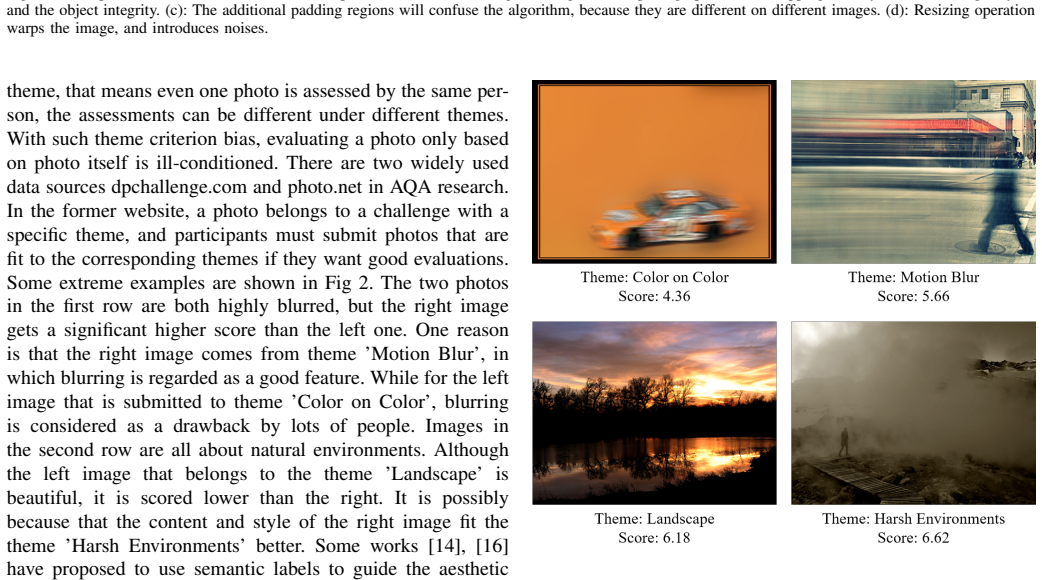
- [III-B, Tables I-III] Section III-B introduces a theme branch fed with the one-hot challenge theme, and the experiments use the standard image-wise AVA split (Section IV-A). Under this split, a large fraction of the test-set themes also occur in training, so the fully connected theme embedding can memorize per-theme rating statistics (mean and, especially, variance) rather than learning a visual criterion per theme. The ablation in Table III is consistent with this: adding theme raises the std-dev SRCC from 0.3424 to 0.6918 while the mean SRCC increases only from 0.7438 to 0.7611. Because none of the compared methods in Tables I and II receive theme labels, the state-of-the-art comparisons are not apples-to-apples. I request a held-out-theme evaluation (e.g., no test theme seen in training) and a theme-conditioned baseline that gives the same one-hot theme input to a standard architecture, so the contribution of the visual theme-aware mechanism can be separated from per-theme label statistics.
- [III-A, Eq. (4)] Equation (4), P(Ac,R)=P(aimg), treats the image and padding regions as cleanly separable at the ROI-pooling layer, but the convolutional layers between the padded input and the ROI-pooling layer have receptive fields that cross the image/padding boundary. Zero-valued padding therefore influences activations inside the image region near its border, and this boundary contamination is propagated into the pooled features. The claim that ROI pooling 'eliminates the side effects of padding' and that the network predicts 'based on only image features' is thus only approximately true. Please quantify the boundary effect (e.g., by ablating with non-zero padding values or by comparing interior and border crops) or soften the claim accordingly.
- [Abstract, Section III] The abstract states that 'the image aspect ratios are encoded and fused with visual features to remedy the shape information loss of RoM pooling,' but Section III contains no aspect-ratio encoding, no aspect-ratio feature, and no experiment manipulating aspect-ratio information. The only auxiliary input described is the theme one-hot vector (Section III-B). Either implement and evaluate the aspect-ratio encoding or remove this claim from the abstract and the list of contributions.
minor comments (6)
- [Tables I-III] All reported metrics are single-run point estimates. Please report standard deviations across multiple runs or state how many runs were averaged, especially because several gaps over baselines are small (e.g., Table II, mean SRCC 0.7611 vs. Hosu et al. 0.7450).
- [Table VI, Section IV-G] The EMD value reported for Kong et al. [43] is unexpected because [43] is a ranking/attribute method rather than a distribution predictor; please clarify how this EMD was computed.
- [Abstract] The abstract uses 'region of image (RoM) pooling' while the rest of the paper uses 'ROI (region of interest) pooling'; please make the terminology consistent.
- [III-D, II-B] There are typographical errors, including 'wuth' for 'with' in Section III-D and 'roi poooling' in Section II-B; please proofread the manuscript.
- [IV-A] The paper says the AVA split is 'as in [40]' but does not describe the number of training and test images; for reproducibility, give the exact split statistics or release the split.
- [III-C] The EMD formula is numbered Eq. (7), but the text refers to 'equ (4)'; please fix the cross-reference.
Circularity Check
No circularity: the ROI-padding and theme-conditioned model are evaluated as an empirical learning pipeline, with ablations and external benchmarks; the only concerns are evaluation fairness, not derivation-from-inputs.
full rationale
The paper's derivation chain is self-contained and empirically grounded. The central architectural step—padding images to a uniform size and applying ROI pooling at the first Inception-v3 pooling layer so that features from padding regions are discarded (Section III-A)—is implemented and ablated against Resize, Resized Pad, Random Crop, and Pad+ROI (Table III), and the claims about image/feature-map size are tested in Table IV and Table V. The theme-aware component (Section III-B) takes the AVA challenge theme as a separate one-hot input, reduces it through a learned fully-connected layer, and concatenates it with visual features; this is a conditional input to a supervised distribution predictor, not a post-hoc fit of the target distribution, and its contribution is directly measured by the Pad+ROI versus Pad+ROI+Theme rows. Self-citations [16], [42] are ordinary related-work references to semantic AQA and hierarchical AQA and do not supply any premise needed to derive the reported results. The strongest concern—that test-time theme labels may allow the model to memorize per-theme rating statistics because the standard AVA split is image-wise rather than theme-wise—is a comparison-fairness/confounding issue about the benchmark, not a circularity in the sense of an equation reducing to its input or a fitted parameter being renamed as a prediction. No load-bearing step in the paper is justified solely by a self-citation, and no claimed prediction is equivalent by construction to its training input. The evaluation against published numbers and the internal ablations provide independent grounding for the stated contributions.
Assumptions & free parameters
free parameters (4)
- ROI pooling output feature map size =
146 x 146
- Theme feature embedding dimension =
256
- Padding size =
800 x 800
- Data augmentation crop amount =
1/8 of a side
assumptions (4)
- domain assumption Convolutional feature maps preserve spatial correspondence with the input image.
- standard math ROI pooling with the mapping of Eq. (1) and max pooling of Eq. (2) can pool features from arbitrary rectangular regions with bounded quantization error.
- domain assumption The challenge theme assigned to an AVA image is a valid proxy for the rating criterion used by the annotators.
- domain assumption The official AVA train/test split and the random Photo.net split used in Section IV-A are unbiased and are compared under the standard protocol.
Cite this review
Pith. "Pith review of Theme-Aware Aesthetic Distribution Prediction With Full-Resolution Photographs." pith.science (2026). https://pith.science/paper/BHBOER3Z
@misc{pith2026190801308,
  author       = {Pith},
  title        = {Pith review of: Theme-Aware Aesthetic Distribution Prediction With Full-Resolution Photographs},
  year         = {2026},
  howpublished = {\url{https://pith.science/paper/BHBOER3Z}},
  note         = {Machine review of arXiv:1908.01308}
}
read the original abstract
Aesthetic quality assessment (AQA) is a challenging task due to complex aesthetic factors. Currently, it is common to conduct AQA using deep neural networks that require fixed-size inputs. Existing methods mainly transform images by resizing, cropping, and padding or employ adaptive pooling to alternately capture the aesthetic features from fixed-size inputs. However, these transformations potentially damage aesthetic features. To address this issue, we propose a simple but effective method to accomplish full-resolution image AQA by combining image padding with region of image (RoM) pooling. Padding turns inputs into the same size. RoM pooling pools image features and discards extra padded features to eliminate the side effects of padding. In addition, the image aspect ratios are encoded and fused with visual features to remedy the shape information loss of RoM pooling. Furthermore, we observe that the same image may receive different aesthetic evaluations under different themes, which we call theme criterion bias. Hence, a theme-aware model that uses theme information to guide model predictions is proposed. Finally, we design an attention-based feature fusion module to effectively utilize both the shape and theme information. Extensive experiments prove the effectiveness of the proposed method over state-of-the-art methods.
Figures

Figures from the paper (5 more)



Reference graph
Works this paper leans on
-
[40]
Ava: A large- scale database for aesthetic visual analysis
Naila Murray, Luca Marchesotti, and Florent Perronnin. Ava: A large- scale database for aesthetic visual analysis. In Proceedings of the IEEE Conference on Computer Vision and Pattern Recognition , pages 2408– 2415, 2012
work page 2012
-
[1]
Aesthetic-driven image enhancement by adversarial learning
Yubin Deng, Chen Change Loy, and Xiaoou Tang. Aesthetic-driven image enhancement by adversarial learning. In 2018 ACM Multimedia Conference on Multimedia Conference , pages 870–878. ACM, 2018
work page 2018
-
[2]
The design of high-level features for photo quality assessment
Yan Ke, Xiaoou Tang, and Feng Jing. The design of high-level features for photo quality assessment. In 2006 IEEE Computer Society Conference on Computer Vision and Pattern Recognition (CVPR’06) , volume 1, pages 419–426. IEEE, 2006
work page 2006
-
[3]
Content-based photo quality assessment
Xiaoou Tang, Wei Luo, and Xiaogang Wang. Content-based photo quality assessment. IEEE Transactions on Multimedia , 15(8):1930– 1943, 2013
work page 1930
-
[4]
A framework for photo-quality assessment and enhancement based on visual aesthetics
Subhabrata Bhattacharya, Rahul Sukthankar, and Mubarak Shah. A framework for photo-quality assessment and enhancement based on visual aesthetics. In Proceedings of the 18th ACM international conference on Multimedia , pages 271–280. ACM, 2010
work page 2010
-
[5]
High level describable attributes for predicting aesthetics and interestingness
Sagnik Dhar, Vicente Ordonez, and Tamara L Berg. High level describable attributes for predicting aesthetics and interestingness. In CVPR 2011, pages 1657–1664. IEEE, 2011
work page 2011
-
[6]
Scenic photo quality assessment with bag of aesthetics- preserving features
Hsiao-Hang Su, Tse-Wei Chen, Chieh-Chi Kao, Winston H Hsu, and Shao-Yi Chien. Scenic photo quality assessment with bag of aesthetics- preserving features. In Proceedings of the 19th ACM international conference on Multimedia , pages 1213–1216. ACM, 2011
work page 2011
-
[7]
Towards aesthetics: A photo quality assessment and photo selection system
Congcong Li, Alexander C Loui, and Tsuhan Chen. Towards aesthetics: A photo quality assessment and photo selection system. In Proceedings of the 18th ACM international conference on Multimedia , pages 827–
Show all 44 references
-
[8]
Lin, Xiaohui Shen, Radom ´ır Mech, and James Zijun Wang
Xin Lu, Zhe L. Lin, Xiaohui Shen, Radom ´ır Mech, and James Zijun Wang. Deep multi-patch aggregation network for image style, aesthet- ics, and quality estimation. 2015 IEEE International Conference on Computer Vision (ICCV) , pages 990–998, 2015
2015
-
[9]
A-lamp: Adaptive layout- aware multi-patch deep convolutional neural network for photo aesthetic assessment
Shuang Ma, Jing Liu, and Chang Wen Chen. A-lamp: Adaptive layout- aware multi-patch deep convolutional neural network for photo aesthetic assessment. 2017 IEEE Conference on Computer Vision and Pattern Recognition (CVPR), pages 722–731, 2017. IEEE TRANSACTIONS ON IMAGE PROCESS...
2017
-
[10]
Fully convolutional networks for semantic segmentation
Jonathan Long, Evan Shelhamer, and Trevor Darrell. Fully convolutional networks for semantic segmentation. In Proceedings of the IEEE conference on computer vision and pattern recognition , pages 3431– 3440, 2015
2015
-
[11]
Spatial pyra- mid pooling in deep convolutional networks for visual recognition
Kaiming He, Xiangyu Zhang, Shaoqing Ren, and Jian Sun. Spatial pyra- mid pooling in deep convolutional networks for visual recognition. IEEE transactions on pattern analysis and machine intelligence , 37(9):1904– 1916, 2015
1904
-
[12]
Image aesthetic distribution prediction with fully convolutional network
Huidi Fang, Chaoran Cui, Xiang Deng, Xiushan Nie, Muwei Jian, and Yilong Yin. Image aesthetic distribution prediction with fully convolutional network. In International Conference on Multimedia Modeling, pages 267–278. Springer, 2018
2018
-
[13]
Image aesthetics assessment using fully convolutional neural networks
Konstantinos Apostolidis and Vasileios Mezaris. Image aesthetics assessment using fully convolutional neural networks. In International Conference on Multimedia Modeling , pages 361–373. Springer, 2019
2019
-
[14]
Distribution-oriented aesthetics assessment with semantic-aware hybrid network
Chaoran Cui, Huihui Liu, Tao Lian, Liqiang Nie, Lei Zhu, and Yilong Yin. Distribution-oriented aesthetics assessment with semantic-aware hybrid network. IEEE Transactions on Multimedia , 2018
2018
-
[15]
Fast r-cnn
Ross Girshick. Fast r-cnn. In Proceedings of the IEEE international conference on computer vision , pages 1440–1448, 2015
2015
-
[16]
Deep aesthetic quality assessment with semantic information
Yueying Kao, Ran He, and Kaiqi Huang. Deep aesthetic quality assessment with semantic information. IEEE Transactions on Image Processing, 26(3):1482–1495, 2017
2017
-
[17]
Predicting aesthetic score distribution through cumulative jensen-shannon divergence
Xin Jin, Le Wu, Xiaodong Li, Siyu Chen, Siwei Peng, Jingying Chi, Shiming Ge, Chenggen Song, and Geng Zhao. Predicting aesthetic score distribution through cumulative jensen-shannon divergence. In Thirty- Second AAAI Conference on Artificial Intelligence , 2018
2018
-
[18]
Nima: Neural image assessment
Hossein Talebi and Peyman Milanfar. Nima: Neural image assessment. IEEE Transactions on Image Processing , 27(8):3998–4011, 2018
2018
-
[19]
A gated peripheral- foveal convolutional neural network for unified image aesthetic predic- tion
Xiaodan Zhang, Xinbo Gao, Wen Lu, and Lihuo He. A gated peripheral- foveal convolutional neural network for unified image aesthetic predic- tion. IEEE Transactions on Multimedia , 2019
2019
-
[20]
Photo and video quality evaluation: Focusing on the subject
Yiwen Luo and Xiaoou Tang. Photo and video quality evaluation: Focusing on the subject. In European Conference on Computer Vision , pages 386–399. Springer, 2008
2008
-
[21]
Modeling the shape of the scene: A holistic representation of the spatial envelope
Aude Oliva and Antonio Torralba. Modeling the shape of the scene: A holistic representation of the spatial envelope. International journal of computer vision, 42(3):145–175, 2001
2001
-
[22]
Distinctive image features from scale-invariant key- points
David G Lowe. Distinctive image features from scale-invariant key- points. International journal of computer vision , 60(2):91–110, 2004
2004
-
[23]
Assessing the aesthetic quality of photographs using generic image descriptors
Luca Marchesotti, Florent Perronnin, Diane Larlus, and Gabriela Csurka. Assessing the aesthetic quality of photographs using generic image descriptors. In 2011 International Conference on Computer Vision , pages 1784–1791. IEEE, 2011
2011
-
[24]
Rapid: Rating pictorial aesthetics using deep learning
Xin Lu, Zhe Lin, Hailin Jin, Jianchao Yang, and James Z Wang. Rapid: Rating pictorial aesthetics using deep learning. In Proceedings of the 22nd ACM international conference on Multimedia , pages 457–466. ACM, 2014
2014
-
[25]
Rating image aesthetics using deep learning
Xin Lu, Zhe Lin, Hailin Jin, Jianchao Yang, and James Z Wang. Rating image aesthetics using deep learning. IEEE Transactions on Multimedia, 17(11):2021–2034, 2015
2021
-
[26]
Visual aesthetic quality assessment with a regression model
Yueying Kao, Chong Wang, and Kaiqi Huang. Visual aesthetic quality assessment with a regression model. In Proceedings of the IEEE International Conference on Image Processing, pages 1583–1587, 2015
2015
-
[27]
Photo quality assessment with dcnn that understands image well
Zhe Dong, Xu Shen, Houqiang Li, and Xinmei Tian. Photo quality assessment with dcnn that understands image well. In International Conference on Multimedia Modeling , pages 524–535. Springer, 2015
2015
-
[28]
Query-dependent aesthetic model with deep learning for photo quality assessment
Xinmei Tian, Zhe Dong, Kuiyuan Yang, and Tao Mei. Query-dependent aesthetic model with deep learning for photo quality assessment. IEEE Transactions on Multimedia , 17(11):2035–2048, 2015
2015
-
[29]
Aspect-ratio-preserving multi-patch image aesthetics score prediction
Lijie Wang, Xueting Wang, Toshihiko Yamasaki, and Kiyoharu Aizawa. Aspect-ratio-preserving multi-patch image aesthetics score prediction. In Proceedings of the IEEE Conference on Computer Vision and Pattern Recognition Workshops, pages 0–0, 2019
2019
-
[30]
Composition-preserving deep photo aesthetics assessment
Long Mai, Hailin Jin, and Feng Liu. Composition-preserving deep photo aesthetics assessment. 2016 IEEE Conference on Computer Vision and Pattern Recognition (CVPR), pages 497–506, 2016
2016
-
[31]
Effective aesthetics prediction with multi-level spatially pooled features
Vlad Hosu, Bastian Goldlucke, and Dietmar Saupe. Effective aesthetics prediction with multi-level spatially pooled features. arXiv preprint arXiv:1904.01382, 2019
1904 arXiv
-
[32]
Learning to predict the perceived visual quality of photos
Ou Wu, Weiming Hu, and Jun Gao. Learning to predict the perceived visual quality of photos. In 2011 International Conference on Computer Vision, pages 225–232. IEEE, 2011
2011
-
[33]
Image aesthetic predictors based on weighted cnns
Bin Jin, Maria V Ortiz Segovia, and Sabine S ¨usstrunk. Image aesthetic predictors based on weighted cnns. In 2016 IEEE International Confer- ence on Image Processing (ICIP) , pages 2291–2295. Ieee, 2016
2016
-
[34]
Rich feature hierarchies for accurate object detection and semantic segmen- tation
Ross Girshick, Jeff Donahue, Trevor Darrell, and Jitendra Malik. Rich feature hierarchies for accurate object detection and semantic segmen- tation. In Proceedings of the IEEE conference on computer vision and pattern recognition, pages 580–587, 2014
2014
-
[35]
Mask r-cnn
Kaiming He, Georgia Gkioxari, Piotr Doll ´ar, and Ross Girshick. Mask r-cnn. In Proceedings of the IEEE international conference on computer vision, pages 2961–2969, 2017
2017
-
[36]
R-fcn: Object detection via region-based fully convolutional networks
Jifeng Dai, Yi Li, Kaiming He, and Jian Sun. R-fcn: Object detection via region-based fully convolutional networks. In Advances in neural information processing systems , pages 379–387, 2016
2016
-
[37]
Feature pyramid networks for object detection
Tsung-Yi Lin, Piotr Doll ´ar, Ross Girshick, Kaiming He, Bharath Hariha- ran, and Serge Belongie. Feature pyramid networks for object detection. In Proceedings of the IEEE conference on computer vision and pattern recognition, pages 2117–2125, 2017
2017
-
[38]
Cascade r-cnn: Delving into high quality object detection
Zhaowei Cai and Nuno Vasconcelos. Cascade r-cnn: Delving into high quality object detection. In Proceedings of the IEEE conference on computer vision and pattern recognition , pages 6154–6162, 2018
2018
-
[39]
Rethinking the inception architecture for computer vision
Christian Szegedy, Vincent Vanhoucke, Sergey Ioffe, Jon Shlens, and Zbigniew Wojna. Rethinking the inception architecture for computer vision. In Proceedings of the IEEE conference on computer vision and pattern recognition, pages 2818–2826, 2016
2016
-
[41]
Algorithmic inferencing of aesthetics and emotion in natural images: An exposition
Ritendra Datta, Jia Li, and James Z Wang. Algorithmic inferencing of aesthetics and emotion in natural images: An exposition. In 2008 15th IEEE International Conference on Image Processing , pages 105–108. IEEE, 2008
2008
-
[42]
Hierarchical aesthetic quality assessment using deep convolutional neural networks
Yueying Kao, Kaiqi Huang, and Steve Maybank. Hierarchical aesthetic quality assessment using deep convolutional neural networks. Signal Processing: Image Communication , 47:500–510, 2016
2016
-
[43]
Photo aesthetics ranking network with attributes and content adaptation
Shu Kong, Xiaohui Shen, Zhe Lin, Radomir Mech, and Charless Fowlkes. Photo aesthetics ranking network with attributes and content adaptation. In European Conference on Computer Vision , pages 662–
-
[44]
Mlans: Image aesthetic assessment via multi-layer aggregation networks
Xuantong Meng, Fei Gao, Shengjie Shi, Suguo Zhu, and Jingjie Zhu. Mlans: Image aesthetic assessment via multi-layer aggregation networks. In 2018 Eighth International Conference on Image Processing Theory, Tools and Applications (IPTA) , pages 1–6. IEEE, 2018
2018
Reviewed August 14, 2026 · model on record in the stance chip above.
Discussion (0). Continue with ORCID to comment.