REVIEW 3 major objections 7 minor 34 references
Fully Automatic Video Colorization with Self-Regularization and Diversity
T0 review · 3 major / 7 minor · reviewed 2026-08-14 · deepseek-v4-flash
Pith's one-line read This paper claims that a dedicated self-regularized deep network can colorize entire videos automatically while keeping colors consistent across frames, and that viewers prefer it over frame-by-frame image colorization followed by…
desk verdict A genuine first deep model for fully automatic video colorization, but the headline 'outperforms' claim rests on a small user study with a best-of-four saturation selection that could explain the margin. read the letter →
The pith
A machine-rendered reading of the paper's core claim, the machinery that carries it, and where it could break.
The reading
What carries the argument
The load-bearing object is the self-regularization loss, which has three parts. The bilateral loss finds, for every pixel in a ground-truth color frame, its K nearest neighbors in the five-dimensional bilateral space $(r,g,b,\lambda x, \lambda y)$ with $K=5$, and penalizes the colorization network when the output colors of paired pixels disagree, thereby propagating color information globally within a frame. The temporal loss warps the colorized frame $t+1$ back to frame $t$ using optical flow and masks occluded pixels, penalizing color mismatches at corresponding pixels. The confidence-based refinement network takes two colorized frames, their warped versions, and confidence maps derived from color and grayscale differences, and outputs a refined frame; applying it repeatedly along the video propagates color across non-local frames. Finally, the diversity loss, adapted from a ranked diversity formulation, encourages the $d=4$ outputs of the colorization network to spread over distinct perceptual modes while keeping each candidate close to a plausible solution.
What would settle it
Train or fine-tune the model on synthetic videos in which a single-color region has strong internal grayscale texture, for example a checkerboard painted one uniform color. Because the bilateral KNN graph is built on ground-truth color, it will link pixels across the texture boundary. If, on a held-out video with similar geometry but new colors, the network fails to color the whole region uniformly and instead bleeds or washes out the boundary, the assumption that ground-truth color neighborhoods transfer to grayscale input is violated.
Extended reading notes
Core claim
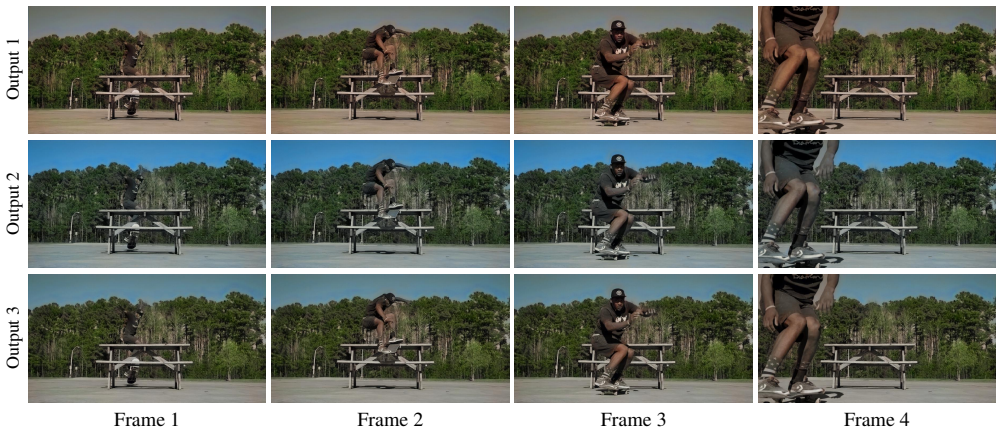
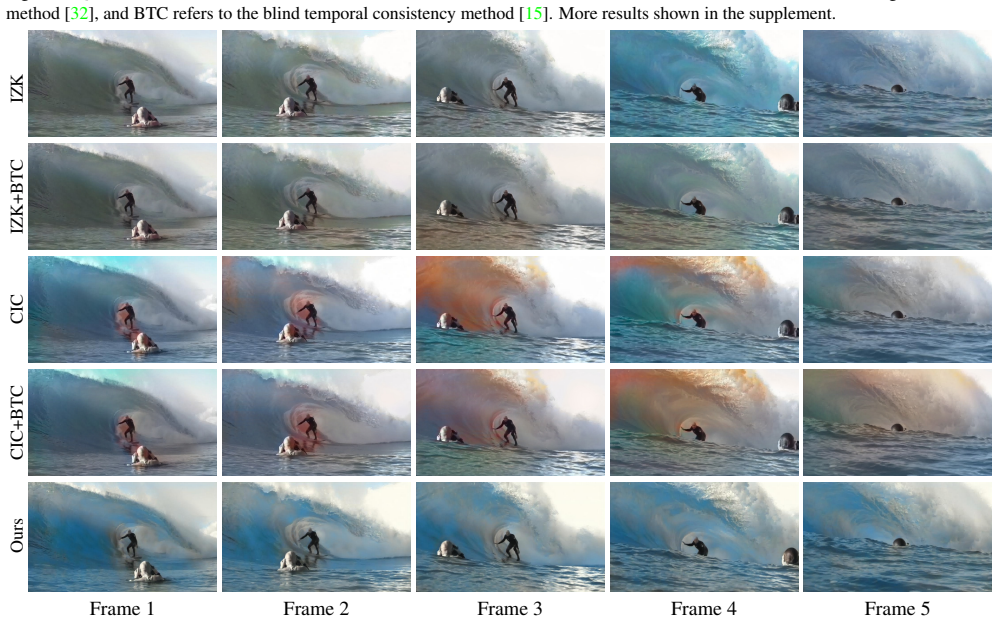
The paper's central claim is that spatiotemporal color consistency in a colorized video can be enforced by training with self-regularization instead of supervision: a bilateral loss builds a K-nearest-neighbor graph in the space $(r,g,b,\lambda x, \lambda y)$ over the ground-truth color frame and asks the colorization network to give those pixel pairs the same output color, while a temporal loss warps frames along optical flow and penalizes color differences at non-occluded corresponding pixels. A second, confidence-based refinement network then propagates colors between nearby frames with weights that flag inconsistent pixels, and applying it repeatedly gives long-range temporal consistency. To address the one-to-many nature of colorization, the colorization network outputs several candidate frames and is trained with a ranked diversity loss on perceptual features, so the candidates occupy different modes of the solution space. On two public video test sets, perceptual user studies report that the method is preferred over the two image colorization baselines even when those baselines are post-processed by blind temporal consistency, with preference rates of 80.0% and 88.8% in one comparison and 72.8% and 63.3% in the other.
Load-bearing premise
The load-bearing assumption is that pixel pairs that are close in the ground-truth color frame's bilateral space should receive the same output color, even though the colorization network only ever sees the grayscale video.
Editorial extensions
If this is right
- Dedicated video colorization can be trained from the video's own color statistics and motion, so black-and-white footage could be colorized in one automatic pass instead of frame by frame.
- Temporal coherence needs to be built into the colorization network itself; the comparison suggests that post-processing a frame-by-frame colorizer with blind temporal consistency is not enough.
- Outputting several candidate colorizations turns the one-to-many nature of colorization into an explicit choice, and a simple high-saturation rule gives a single usable result.
- The bilateral loss provides global within-frame color consistency without semantic segmentation or user scribbles, and the diversity loss also stabilizes training and temporal coherence.
Reading between the lines
- The same two-part recipe of bilateral color-affinity regularization plus flow-based temporal warping could transfer to other video-to-video tasks with multiple plausible outputs, such as style transfer or low-light enhancement.
- A natural test the paper does not run is to replace the ground-truth-color KNN graph with one built from grayscale appearance and optical flow; if that variant matches the reported quality, the color prior itself is not the active ingredient.
- The saturation-based selection rule is a heuristic; a learned selector over the candidate videos, or letting the user choose among them, could replace it.
Signed reviews
Editorial analysis
A structured set of objections, weighed in public.
Referee Report
Summary. The paper proposes a fully automatic video colorization model composed of a colorization network and a refinement network. The colorization network is trained with a bilateral self-regularization loss that enforces color similarity between K-nearest-neighbor pixel pairs in the ground-truth color space, and a temporal loss that uses optical flow to enforce consistency across frames. A diversity loss inspired by Li et al. is used to generate multiple plausible colorizations (d=4), and a confidence-based refinement network further improves temporal coherence. At inference, the most saturated output is automatically selected. The authors evaluate on DAVIS and Videvo datasets against two image colorization baselines enhanced with blind temporal consistency (BTC), reporting user study preferences, PSNR, LPIPS, and ablations. The central claim is that this approach outperforms state-of-the-art fully automatic video colorization methods.
Significance. If the central claim is established, the paper would make a useful contribution: a dedicated deep-learning model for fully automatic video colorization that explicitly addresses spatiotemporal consistency and produces diverse outputs, which is a step beyond frame-wise image colorization plus post-hoc temporal smoothing. The underlying ideas—bilateral nearest-neighbor regularization, confidence-based temporal refinement, and ranked diversity loss—are sensible and the combination is nontrivial. The paper includes comparisons with strong baselines and an ablation study. However, the evidence for the headline claim is currently weak: the user study has only 10 participants and no significance testing, and the evaluation protocol selects the most saturated of four outputs against deterministic baselines, which introduces a potential bias. The paper also overstates the absence of labeled data, since the bilateral, temporal-refinement, and diversity losses all use ground-truth color frames at training time. These issues are fixable with additional analysis and revision, but they currently preclude acceptance.
major comments (3)
- [Section 7.2, Tables 1 and 2] The main claim of superiority rests on a perceptual user study with only 10 participants (15 in the ablation) and no significance tests or confidence intervals. Preference rates such as 67.9% and 61.5% could be consistent with chance given small samples. Moreover, Section 7.2 states that 'we choose the video with high saturation for evaluation' for our method, while the baselines are deterministic single outputs. Since saturation is a salient cue for colorfulness, this selection asymmetry alone could explain a substantial part of the reported preference. Please report per-comparison counts, provide exact binomial tests or confidence intervals for each preference rate, and analyze sensitivity to the saturation rule—for example, by reporting preference rates for each of the d outputs separately or by applying an analogous selection procedure to the baselines.
- [Abstract; Sections 4.1 and 6; Eqs. (2), (5), (7)] The claim that the model is trained 'without any labeled data' is contradicted by the loss definitions. Eq. (2) constructs the KNN graph N_{Y^t} from the ground-truth color frame Y^t; Eq. (5) is a supervised loss that directly compares the refinement network output to the ground-truth frame Y_s; and Eq. (7) uses Y_t in both the min and the weighted-sum terms of the diversity loss. The training therefore uses color ground truth as supervision, and the bilateral and temporal losses act as additional regularizers rather than as label-free training signals. This overstatement is load-bearing for the paper's framing as 'self-regularization without labeled data' and should be corrected throughout the text.
- [Section 4.1, Eq. (2)] The bilateral loss assumes that pixel pairs that are K-nearest neighbors in the ground-truth color space (r,g,b,\lambda x,\lambda y) provide the correct color-similarity structure to impose on the colorized output. This premise is plausible but not validated. If the ground-truth color neighborhoods do not transfer to the grayscale input (e.g., in regions with texture or ambiguous colors), the loss could enforce arbitrary uniform colors on those regions. Since the ablation study supporting this component shares the evaluation weaknesses noted above, additional evidence is needed—for example, a quantitative comparison of KNN graphs built on ground-truth colors versus those built on the grayscale input, or a targeted analysis of failure cases.
minor comments (7)
- [Section 2, Related Work] The sentence 'To the best of our knowledge, there are no deep learning models dedicated to fully automatic video colorization' is contradicted by the cited reference [29] (Vondrick et al., 'Tracking emerges by colorizing videos'), which is a deep learning model for fully automatic video colorization; please qualify the claim.
- [Section 7.1, Experimental procedure] The sentence 'Their pre-trained models are trained on the DA VIS dataset [24] and the Videvo dataset [2, 15]' is ambiguous: it is unclear whether this refers to the baseline colorization models, the BTC method, or both, and on which data each component was trained. Please clarify the exact training data for each baseline.
- [Section 4.1, Eq. (2)] The notation N_{Y^t} should be defined explicitly as a set of unordered pixel pairs (or a directed graph) to avoid ambiguity in the summation over (p,q).
- [Section 5, Eq. (7) and Section 6] The paper does not describe how the colorization network f is modified to output d images, nor how the decreasing sequence {\beta_i} is chosen; please provide these architectural and hyperparameter details for reproducibility.
- [Section 7.2, Table 3] There are several typos in Table 3 and its caption: 'LILPS' should be 'LPIPS', and 'similirity' should be 'similarity'; please proofread the manuscript carefully.
- [Section 7.2, Perceptual experiments] Please specify the exact number of comparisons each participant made in the user study and the total number of pairwise comparisons for each entry in Tables 1 and 2; this is necessary for readers to assess the statistical power of the reported preference rates.
- [Section 5, Diverse Colorization] The statement 'the diversity loss also contributes a lot to the temporal coherence because it reduces the ambiguity of colorization' is not substantiated by any quantitative evidence; either provide a supporting analysis or soften the claim.
Circularity Check
No significant circularity: the training and evaluation pipeline is standard supervised learning with external held-out benchmarks.
full rationale
None of the paper's equations makes a predicted output equal to a fitted input. Equation (2) uses the ground-truth color frame only to construct the KNN graph that selects which pixel pairs should agree; it does not feed target color values into the colorization network, and at test time that graph is unavailable, so the network must generalize from the grayscale input. Equations (5) and (7) regress to ground-truth color and to VGG features of the ground-truth color, but that is ordinary supervised training rather than a 'prediction' that reduces to a fitted parameter. The comparative claims are evaluated on held-out DAVIS and Videvo clips against external pretrained baselines with PSNR, LPIPS, and a user study, so the central claim is not a restatement of the training objective. The only overlaps worth noting are that VGG features appear both in the diversity loss and in the LPIPS evaluation metric, and that two method components cite prior work by one of the authors (KNN matting and the ranked diversity loss); neither overlap is load-bearing, because the user study is the main evidence and no unverified uniqueness theorem or self-citation chain is invoked. The user-study design concerns raised by a skeptical reading, such as choosing the most saturated of four outputs for evaluation and using only ten participants, are statistical and methodological caveats rather than circular derivation; they do not make the model's output equal by construction to an input or fitted value. The paper is therefore self-contained against external benchmarks, and the honest circularity finding is no significant circularity.
Assumptions & free parameters
free parameters (5)
- K (number of bilateral nearest neighbors) =
5
- alpha (confidence map sensitivity) =
15
- d (number of diverse colorization outputs) =
4
- lambda temporal window =
1
- beta_i decreasing sequence in diversity loss =
not specified
assumptions (5)
- domain assumption Pixels that are K-nearest neighbors in the bilateral space of a ground-truth color frame should receive similar colors in the colorized output.
- domain assumption Optical flow from PWC-Net on the grayscale frames correctly identifies correspondences between nearby frames.
- domain assumption Ground-truth color frames from ImageNet and DAVIS are valid supervision for learning natural video colorization.
- domain assumption VGG-19 features provide a perceptually meaningful space for comparing colorizations in the diversity loss and in the LPIPS metric.
- ad hoc to paper Among the d candidate colorizations, the one with the highest average saturation is the most appropriate for evaluation.
Cite this review
Pith. "Pith review of Fully Automatic Video Colorization with Self-Regularization and Diversity." pith.science (2026). https://pith.science/paper/XFKUDMY4
@misc{pith2026190801311,
  author       = {Pith},
  title        = {Pith review of: Fully Automatic Video Colorization with Self-Regularization and Diversity},
  year         = {2026},
  howpublished = {\url{https://pith.science/paper/XFKUDMY4}},
  note         = {Machine review of arXiv:1908.01311}
}
read the original abstract
We present a fully automatic approach to video colorization with self-regularization and diversity. Our model contains a colorization network for video frame colorization and a refinement network for spatiotemporal color refinement. Without any labeled data, both networks can be trained with self-regularized losses defined in bilateral and temporal space. The bilateral loss enforces color consistency between neighboring pixels in a bilateral space and the temporal loss imposes constraints between corresponding pixels in two nearby frames. While video colorization is a multi-modal problem, our method uses a perceptual loss with diversity to differentiate various modes in the solution space. Perceptual experiments demonstrate that our approach outperforms state-of-the-art approaches on fully automatic video colorization. The results are shown in the supplementary video at https://youtu.be/Y15uv2jnK-4
Figures


Figures from the paper (4 more)


Reference graph
Works this paper leans on
-
[1]
http://www.guinnessworldrecords.com/world- records/highest-box-office-film-gross-inflation-adjusted
Highest-grossing film at the global box office (inflation-adjusted) — guinness world records. http://www.guinnessworldrecords.com/world- records/highest-box-office-film-gross-inflation-adjusted. 1
- [2]
-
[3]
G. Charpiat, M. Hofmann, and B. Sch ¨olkopf. Automatic im- age colorization via multimodal predictions. InECCV, 2008. 2
work page 2008
-
[4]
Q. Chen, D. Li, and C. Tang. KNN matting. IEEE Trans. Pattern Anal. Mach. Intell., 35(9), 2013. 4
work page 2013
-
[5]
X. Chen, D. Zou, Q. Zhao, and P. Tan. Manifold preserving edit propagation. ACM Trans. Graph., 31(6), 2012. 2
work page 2012
- [6]
-
[7]
A. Y . S. Chia, S. Zhuo, R. K. Gupta, Y . Tai, S. Cho, P. Tan, and S. Lin. Semantic colorization with internet images.ACM Trans. Graph., 30(6), 2011. 2
work page 2011
-
[8]
J. Deng, W. Dong, R. Socher, L. Li, K. Li, and F. Li. Ima- genet: A large-scale hierarchical image database. In CVPR,
Show all 34 references
-
[9]
Deshpande, J
A. Deshpande, J. Lu, M. Yeh, M. J. Chong, and D. A. Forsyth. Learning diverse image colorization. In CVPR,
-
[10]
R. K. Gupta, A. Y . S. Chia, D. Rajan, E. S. Ng, and Z. Huang. Image colorization using similar images. In Proceedings of the 20th ACM Multimedia Conference, 2012. 2
2012
-
[11]
M. He, D. Chen, J. Liao, P. V . Sander, and L. Yuan. Deep exemplar-based colorization. ACM Trans. Graph. , 37(4),
-
[12]
Iizuka, E
S. Iizuka, E. Simo-Serra, and H. Ishikawa. Let there be Color!: Joint End-to-end Learning of Global and Local Im- age Priors for Automatic Image Colorization with Simulta- neous Classification. ACM Trans. Graph., 35(4), 2016. 2, 3, 6, 7, 8
2016
-
[13]
Ironi, D
R. Ironi, D. Cohen-Or, and D. Lischinski. Colorization by example. In Proceedings of the Eurographics Symposium on Rendering Techniques, 2005. 2
2005
-
[14]
Jampani, R
V . Jampani, R. Gadde, and P. V . Gehler. Video propagation networks. In IEEE Conf. on Computer Vision and Pattern Recognition (CVPR), 2017. 3
2017
-
[15]
Lai, J.-B
W.-S. Lai, J.-B. Huang, O. Wang, E. Shechtman, E. Yumer, and M.-H. Yang. Learning blind video temporal consistency. In ECCV, 2018. 1, 3, 6, 7, 8
2018
-
[16]
Larsson, M
G. Larsson, M. Maire, and G. Shakhnarovich. Learning rep- resentations for automatic colorization. In ECCV, 2016. 1, 3
2016
-
[17]
Larsson, M
G. Larsson, M. Maire, and G. Shakhnarovich. Colorization as a proxy task for visual understanding. In CVPR, 2017. 1
2017
-
[18]
Levin, D
A. Levin, D. Lischinski, and Y . Weiss. Colorization using optimization. ACM Trans. Graph., 23(3), 2004. 1, 2
2004
-
[19]
Z. Li, Q. Chen, , and V . Koltun. Interactive image segmenta- tion with latent diversity. In CVPR, 2018. 2, 3, 4, 5, 6
2018
-
[20]
S. Liu, G. Zhong, S. D. Mello, J. Gu, M. Yang, and J. Kautz. Switchable temporal propagation network. In ECCV, 2018. 3
2018
-
[21]
X. Liu, L. Wan, Y . Qu, T. Wong, S. Lin, C. Leung, and P. Heng. Intrinsic colorization. ACM Trans. Graph., 27(5),
-
[22]
Q. Luan, F. Wen, D. Cohen-Or, L. Liang, Y . Xu, and H. Shum. Natural image colorization. In Proceedings of the Eurographics Symposium on Rendering Techniques, 2007. 2
2007
-
[23]
Meyer, V
S. Meyer, V . Cornill`ere, A. Djelouah, C. Schroers, and M. H. Gross. Deep video color propagation. In BMVC, 2018. 1, 3
2018
-
[24]
Perazzi, J
F. Perazzi, J. Pont-Tuset, L. McWilliams, B.and Van Gool, M. Gross, and A. Sorkine-Hornung. A benchmark dataset and evaluation methodology for video object segmentation. In CVPR, 2016. 6, 8
2016
-
[25]
Y . Qu, T. Wong, and P. Heng. Manga colorization. ACM Trans. Graph., 25(3), 2006. 1, 2
2006
-
[26]
Ronneberger, P
O. Ronneberger, P. Fischer, and T. Brox. U-net: Convolu- tional networks for biomedical image segmentation. InMIC- CAI, 2015. 5
2015
-
[27]
Simonyan and A
K. Simonyan and A. Zisserman. Very deep convolutional networks for large-scale image recognition. In ICLR, 2015. 5
2015
-
[28]
D. Sun, X. Yang, M.-Y . Liu, and J. Kautz. PWC-Net: CNNs for optical flow using pyramid, warping, and cost volume. In CVPR, 2018. 6
2018
-
[29]
V ondrick, A
C. V ondrick, A. Shrivastava, A. Fathi, S. Guadarrama, and K. Murphy. Tracking emerges by colorizing videos. In ECCV, 2018. 1, 3
2018
-
[30]
Welsh, M
T. Welsh, M. Ashikhmin, and K. Mueller. Transferring color to greyscale images. ACM Trans. Graph., 21(3), 2002. 2
2002
-
[31]
Yatziv and G
L. Yatziv and G. Sapiro. Fast image and video colorization using chrominance blending. IEEE Trans. Image Processing, 15(5), 2006. 2, 3
2006
-
[32]
Zhang, P
R. Zhang, P. Isola, and A. A. Efros. Colorful image coloriza- tion. In ECCV, 2016. 1, 2, 3, 6, 7, 8
2016
-
[33]
Zhang, P
R. Zhang, P. Isola, A. A. Efros, E. Shechtman, and O. Wang. The unreasonable effectiveness of deep features as a percep- tual metric. 2018. 2, 7
2018
-
[34]
Zhang, J
R. Zhang, J. Zhu, P. Isola, X. Geng, A. S. Lin, T. Yu, and A. A. Efros. Real-time user-guided image colorization with learned deep priors. ACM Trans. Graph., 36(4), 2017. 2
2017
Reviewed August 14, 2026 · model on record in the stance chip above.
Discussion (0). Continue with ORCID to comment.