REVIEW 2 major objections 4 minor 62 references
Low-Rank Pairwise Alignment Bilinear Network For Few-Shot Fine-Grained Image Classification
T0 review · 2 major / 4 minor · reviewed 2026-08-14 · deepseek-v4-flash
Pith's one-line read This paper claims that few-shot fine-grained classification is most effectively done by comparing each query image with each support image through a low-rank pairwise bilinear pooling operation, preceded by a learned feature-alignment…
desk verdict A useful incremental few-shot fine-grained method with a likely typo in the alignment loss that must be fixed before acceptance. read the letter →
The pith
A machine-rendered reading of the paper's core claim, the machinery that carries it, and where it could break.
The reading
What carries the argument
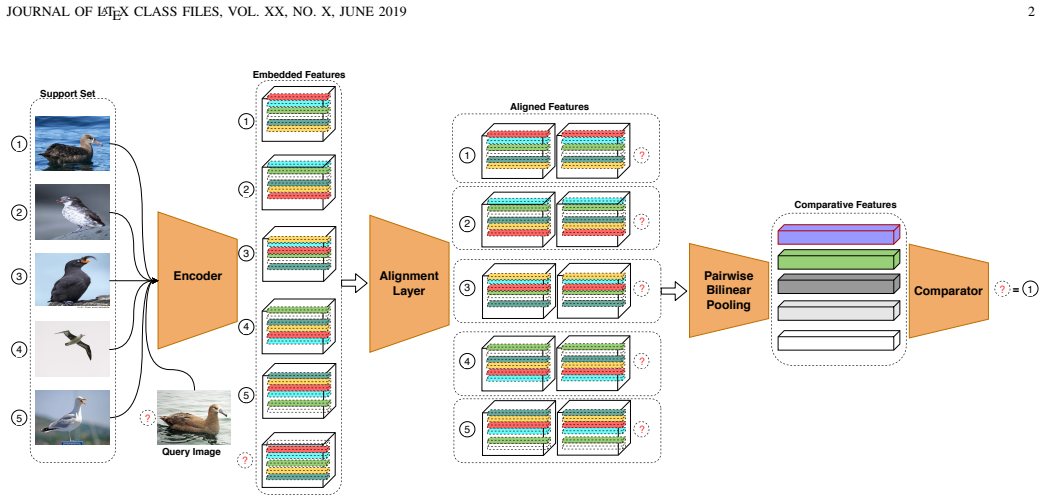
The load-bearing object is the low-rank pairwise bilinear pooling layer of Equation (6): it replaces the $c\times c$ outer product $E(I_A)E(I_B)^T$ with a Hadamard product of two low-rank projected features, cutting the parameter count from $O(nc^2)$ to $O(nc)$. The second load-bearing component is the alignment layer, a shallow MLP that predicts a position-permutation matrix $T$ with $T^T T=I$ to rearrange the support feature into correspondence with the query feature, supervised by two optional mean-squared-error alignment losses. Together they convert a support-query image pair into a compact comparative descriptor that feeds the comparator network.
What would settle it
A direct test is to re-run the CUB 1-shot experiment with the alignment losses implemented exactly as Equations (8) and (9) are written; because the encoder produces a 64-channel, 25-position feature map, the two tensors being subtracted have incompatible shapes, so the implementation must either fail, reshape the tensors, or use a different encoder. Checking which of these happens settles whether the published loss is the trained loss, and comparing that run against one without the alignment layer settles whether the reported gains come from the losses, the position-rearrangement transform, or neither.
Extended reading notes
Core claim
The paper's core discovery is that the comparative signal between a support image and a query image is best captured as a factorized bilinear product rather than as a matrix outer product or a channel-wise concatenation. Concretely, for embedded features $X_A$ and $X_B$, the model forms per-position comparisons $z_j=(x_j^A)^T U_i V_i^T x_j^B = U_i^T x_j^A \circ V_i^T x_j^B$ and stacks them into a 512-dimensional comparative feature that a two-layer relation network maps to a score. The authors argue that this low-rank factorized form learns a global dictionary over the whole feature space, avoiding the burstiness of the rank-one outer-product pooling used in their earlier PABN model. They further claim that a learned orthogonal position-rearrangement layer, applied to the support feature before pooling together with two alignment losses, makes the compared feature pairs spatially consistent, and that this alignment contribution is confirmed by their ablations.
Load-bearing premise
The load-bearing premise is that the alignment-loss formulas can actually be evaluated on the feature tensors produced by the encoder; in the experiments the feature map has 64 channels and 25 spatial positions, so the two matrices the loss subtracts have different shapes and the formula as written is not valid.
Editorial extensions
If this is right
- If the central claim holds, pairwise second-order comparison should replace self-bilinear pooling as the feature extractor of choice for few-shot fine-grained matching.
- The 512-dimensional low-rank descriptor matches or beats the 4096-dimensional outer-product descriptor while reducing the bilinear feature dimension eightfold and cutting per-query inference time roughly threefold.
- The alignment layer's consistent ablative gains imply that spatial correspondence between support and query features is a separable and reusable improvement for pairwise comparators.
- The one-shot advantage over DN4, together with DN4's five-shot advantage on some datasets, indicates that pair-level comparison is most valuable when each class has a single exemplar.
- The compactness of the low-rank descriptor makes the method practical for resource-limited deployment, since its inference cost is far below the local-descriptor search used by DN4.
Reading between the lines
- As an editorial check, the alignment losses as written are shape-incompatible with the 64-channel, 25-position encoder used in the experiments, so the reported alignment gains may be driven by the position-rearrangement transform or by an unspecified implementation detail rather than by the published loss formulas.
- The same low-rank pairwise comparison could be dropped into other pair-based recognition settings—person re-identification, instance retrieval, or face verification—where the input is already two images and spatial alignment matters.
- A natural extension the paper does not pursue is using the pairwise bilinear descriptor inside a transductive or label-propagation step, which could strengthen the one-shot regime where the method already leads.
- Another testable extension is applying the low-rank pairwise comparator to generic few-shot object recognition to determine whether its advantage is specific to fine-grained categories or generalizes to all pair-comparison tasks.
Signed reviews
Editorial analysis
A structured set of objections, weighed in public.
Referee Report
Summary. The paper proposes LRPABN, an end-to-end few-shot fine-grained classification model. The method extracts first-order features with a Conv4 encoder, applies a feature alignment layer that combines a learned position-rearrangement matrix with two MSE-based alignment losses, computes a low-rank pairwise bilinear feature between support and query images via factorized projection matrices, and feeds the comparative features to a relation comparator. Experiments are conducted on CUB Birds, DOGS, CARS, and NABirds under two data-split protocols, with 5-way 1-shot and 5-way 5-shot settings. The reported tables show improvements over PCM, CovaMNet, PABN variants, and RelationNet on most 1-shot settings and some 5-shot settings, together with ablations on the bilinear feature dimension, input resolution, model size, and inference time.
Significance. If the method is reproducible and the reported gains are reliable, the paper makes a useful contribution to few-shot fine-grained classification: it demonstrates that pairwise second-order features can be made compact through low-rank factorization, and that explicit feature alignment can improve matching when the two inputs are not perfectly registered. The evaluation is broad, includes confidence intervals, and compares against several strong baselines, including the authors' own PABN, which is properly disclosed as prior work. The efficiency comparison with DN4 is also informative. The main weakness is that the alignment losses, which the ablation credits with a real performance gain, are not well defined as written, and no code is released to resolve the ambiguity. The central claim of 'superior performances' is also stronger than the 5-shot results against DN4 suggest.
major comments (2)
- [Section III-B2, Eq. (7)] The alignment losses are not computable with the stated architecture. In Eq. (8), Alignloss1 compares E(IA), which is in R^{c x hw}, with E(IB)^T, which is in R^{hw x c}; the element-wise MSE is defined only when c = hw. For the Conv4 encoder described in Section III-C with 84x84 inputs, the final feature map is 15x15 (hw=225) if no padding is used or 21x21 (hw=441) if padding=1, while c=64, so the shapes do not match. In Eq. (9), O(I) has length hw, so MSE(O(IA), O(IB)^T) compares a 1 x hw vector with an hw x 1 vector; even under broadcasting this would compute a different loss from the described per-position alignment. The paper gives no reshape, flattening, or broadcasting rule, and no code is released. Since Table V attributes a 1.25-point improvement on CUB 1-shot to Alignloss2 (LRPABNcpt vs. LRPABNonly cpt), the actual trained alignment loss must be specified precisely for the central empirical claim to be reproducible.
- [Section III-B2 and Section III-B4] The feature alignment transform is underspecified. Equation (7) imposes T^T T = I, but no mechanism is described for enforcing this constraint during training; the total loss in Eq. (11) contains no orthogonality regularizer, and the text does not say whether T is re-parameterized or projected. The MLP that predicts T is also not specified in terms of input, output dimensionality, or where it attaches in the forward pass, even though T is a potentially large hw x hw matrix (for hw=225 this is over 50,000 outputs). In addition, Section III-B4 says the model is updated twice per iteration when the optional alignment losses are used, but it does not give the loss weights or the exact update order. These details are needed to reproduce the alignment component that the ablation study identifies as important.
minor comments (4)
- [Abstract and Section IV-C] The unqualified statement that the model 'achieves the superior performances compared to state-of-the-art methods' is contradicted by Table IV, where DN4 obtains the highest accuracy on all four datasets in the 5-shot setting (e.g., 88.65% vs. 73.29% on CARS). The text in Section IV-C does qualify this observation, but the abstract should be revised to reflect that the advantage is primarily in the 1-shot setting and that DN4 is stronger in 5-shot.
- [Table III] In Table III, the 5-shot CUB result for LRPABNniv is printed as '78.26+0.22' with a plus sign instead of the plus-minus symbol used elsewhere; this should be corrected.
- [Section III-B2, Eq. (6)] In Eq. (6), the dependence of U_i and V_i on the index i is left implicit, and the notation does not make clear that z_j is an n-dimensional vector whose i-th entry is (U_i^T x_j^A) * (V_i^T x_j^B). Making this explicit would improve readability and avoid confusion with the scalar z_j in Eq. (5).
- [Section III-B2, Eq. (9)] The phrase 'sum all the embedded features along with the channel dimension' should say 'along the channel dimension'; as written it suggests summing over the spatial dimension instead.
Circularity Check
No significant circularity: LRPABN's claims are supported by external benchmark evaluations and disclosed ablations; self-citations are not load-bearing.
full rationale
The paper's central claims are empirical: LRPABN outperforms prior few-shot fine-grained methods on four external benchmarks. The proposed model is a combination of factorized low-rank pairwise bilinear pooling (Eq. 6) and a feature alignment layer (Eqs. 7-9), evaluated with the standard Conv4 encoder and a RelationNet-style comparator. No parameter is fitted to test labels in a way that makes a reported accuracy equal to a fit by construction; all accuracy numbers come from episodic evaluation on held-out categories. The authors' own PABN papers are used as transparent baselines and ablations, not as evidence that the new components work, and the improvement over PABN is the claimed contribution rather than a renamed input. The theoretical appeal to coding-pooling theory [25,26] is an external citation used for motivation and interpretation, not a derivation whose conclusion is the paper's own measured result. The dimensional ill-posedness of Alignloss1/Alignloss2 for c != hw is a reproducibility and correctness concern, but it is not circularity: even if the alignment loss as written is undefined for the Conv4 encoder, the reported performance gains are not identical by construction to the loss definition. No circular step can be exhibited under the required standard of quoting a specific reduction of a claimed prediction to its own input.
Assumptions & free parameters
free parameters (2)
- bilinear feature dimension n =
512
- alignment loss weight(s) =
not reported
assumptions (4)
- standard math Factorized bilinear pooling with Hadamard product provides a low-rank approximation of full bilinear pooling (Kim et al. 2017).
- domain assumption Pairwise second-order features between support and query capture fine-grained discriminative information better than self-bilinear features.
- domain assumption The feature alignment transform T with T^T T = I can be learned by a shallow MLP and improves matching.
- domain assumption Auxiliary dataset A transfers to target categories T under episodic meta-learning.
Cite this review
Pith. "Pith review of Low-Rank Pairwise Alignment Bilinear Network For Few-Shot Fine-Grained Image Classification." pith.science (2026). https://pith.science/paper/MB2TA7BL
@misc{pith2026190801313,
  author       = {Pith},
  title        = {Pith review of: Low-Rank Pairwise Alignment Bilinear Network For Few-Shot Fine-Grained Image Classification},
  year         = {2026},
  howpublished = {\url{https://pith.science/paper/MB2TA7BL}},
  note         = {Machine review of arXiv:1908.01313}
}
read the original abstract
Deep neural networks have demonstrated advanced abilities on various visual classification tasks, which heavily rely on the large-scale training samples with annotated ground-truth. However, it is unrealistic always to require such annotation in real-world applications. Recently, Few-Shot learning (FS), as an attempt to address the shortage of training samples, has made significant progress in generic classification tasks. Nonetheless, it is still challenging for current FS models to distinguish the subtle differences between fine-grained categories given limited training data. To filling the classification gap, in this paper, we address the Few-Shot Fine-Grained (FSFG) classification problem, which focuses on tackling the fine-grained classification under the challenging few-shot learning setting. A novel low-rank pairwise bilinear pooling operation is proposed to capture the nuanced differences between the support and query images for learning an effective distance metric. Moreover, a feature alignment layer is designed to match the support image features with query ones before the comparison. We name the proposed model Low-Rank Pairwise Alignment Bilinear Network (LRPABN), which is trained in an end-to-end fashion. Comprehensive experimental results on four widely used fine-grained classification datasets demonstrate that our LRPABN model achieves the superior performances compared to state-of-the-art methods.
Figures


Figures from the paper (3 more)


Reference graph
Works this paper leans on
-
[1]
Compare more nuanced: Pairwise alignment bilinear network for few-shot fine-grained learning,
H. Huang, J. Zhang, J. Zhang, Q. Wu, and J. Xu, “Compare more nuanced: Pairwise alignment bilinear network for few-shot fine-grained learning,” in 2019 IEEE International Conference on Multimedia and Expo (ICME). IEEE, 2019, pp. 91–96
work page 2019
-
[2]
The Caltech-UCSD Birds-200-2011 Dataset,
C. Wah, S. Branson, P. Welinder, P. Perona, and S. Belongie, “The Caltech-UCSD Birds-200-2011 Dataset,” California Institute of Tech- nology, Tech. Rep. CNS-TR-2011-001, 2011
work page 2011
-
[3]
G. Van Horn, S. Branson, R. Farrell, S. Haber, J. Barry, P. Ipeirotis, P. Perona, and S. Belongie, “Building a bird recognition app and large scale dataset with citizen scientists: The fine print in fine-grained dataset collection,” in CVPR, June 2015
work page 2015
-
[4]
Novel dataset for fine-grained image categorization,
A. Khosla, N. Jayadevaprakash, B. Yao, and L. Fei-Fei, “Novel dataset for fine-grained image categorization,” in First Workshop on Fine- Grained Visual Categorization, CVPR , Colorado Springs, CO, June 2011
work page 2011
-
[5]
3d object representations for fine-grained categorization,
J. Krause, M. Stark, J. Deng, and L. Fei-Fei, “3d object representations for fine-grained categorization,” in 4th International IEEE Workshop on 3D Representation and Recognition (3dRR-13), Sydney, Australia, 2013
work page 2013
-
[6]
Part-based r-cnns for fine-grained category detection,
N. Zhang, J. Donahue, R. Girshick, and T. Darrell, “Part-based r-cnns for fine-grained category detection,” in ECCV. Springer, 2014, pp. 834–849
work page 2014
-
[7]
J. Fu, H. Zheng, and T. Mei, “Look closer to see better: Recurrent atten- tion convolutional neural network for fine-grained image recognition,” in CVPR, July 2017
work page 2017
-
[8]
Bilinear cnn models for fine-grained visual recognition,
T.-Y . Lin, A. RoyChowdhury, and S. Maji, “Bilinear cnn models for fine-grained visual recognition,” in ICCV, December 2015
work page 2015
Show all 62 references
-
[9]
Kernel pooling for convolutional neural networks,
Y . Cui, F. Zhou, J. Wang, X. Liu, Y . Lin, and S. Belongie, “Kernel pooling for convolutional neural networks,” in CVPR, July 2017
2017
-
[10]
Towards faster training of global covariance pooling networks by iterative matrix square root normalization,
P. Li, J. Xie, Q. Wang, and Z. Gao, “Towards faster training of global covariance pooling networks by iterative matrix square root normalization,” in CVPR, June 2018
2018
-
[11]
Fine-grained recognition without part annotations,
J. Krause, H. Jin, J. Yang, and L. Fei-Fei, “Fine-grained recognition without part annotations,” in CVPR, June 2015
2015
-
[12]
Wildfish: A large benchmark for fish recognition in the wild,
P. Zhuang, Y . Wang, and Y . Qiao, “Wildfish: A large benchmark for fish recognition in the wild,” in MM. ACM, 2018, pp. 1301–1309
2018
-
[13]
The inaturalist species classifi- cation and detection dataset,
G. Van Horn, O. Mac Aodha, Y . Song, Y . Cui, C. Sun, A. Shepard, H. Adam, P. Perona, and S. Belongie, “The inaturalist species classifi- cation and detection dataset,” in CVPR, June 2018
2018
-
[14]
One-shot learning of object categories,
L. Fei-Fei, R. Fergus, and P. Perona, “One-shot learning of object categories,” IEEE TPAMI, vol. 28, no. 4, pp. 594–611, 2006
2006
-
[15]
Matching networks for one shot learning,
O. Vinyals, C. Blundell, T. Lillicrap, D. Wierstra et al. , “Matching networks for one shot learning,” in NIPS, 2016, pp. 3630–3638
2016
-
[16]
Prototypical networks for few-shot learning,
J. Snell, K. Swersky, and R. Zemel, “Prototypical networks for few-shot learning,” in NIPS, 2017, pp. 4077–4087
2017
-
[17]
Learning to compare: Relation network for few-shot learning,
F. Sung, Y . Yang, L. Zhang, T. Xiang, P. H. Torr, and T. M. Hospedales, “Learning to compare: Relation network for few-shot learning,” in CVPR, June 2018
2018
-
[18]
Learning to propagate labels: Transductive propagation network for few-shot learning,
Y . Liu, J. Lee, M. Park, S. Kim, E. Yang, S. Hwang, and Y . Yang, “Learning to propagate labels: Transductive propagation network for few-shot learning,” in ICLR, 2019. JOURNAL OF LATEX CLASS FILES, VOL. XX, NO. X, JUNE 2019 14
2019
-
[19]
Distribution consistency based covariance metric networks for few-shot learning,
W. Li, J. Xu, J. Huo, L. Wang, G. Yang, and J. Luo, “Distribution consistency based covariance metric networks for few-shot learning,” in AAAI, 2019
2019
-
[20]
Revisiting local descriptor based image-to-class measure for few-shot learning,
W. Li, L. Wang, J. Xu, J. Huo, G. Yang, and J. Luo, “Revisiting local descriptor based image-to-class measure for few-shot learning,” in CVPR, 2019
2019
-
[21]
The development of memory: Knowing, knowing about knowing, and knowing how to know,
A. L. Brown, “The development of memory: Knowing, knowing about knowing, and knowing how to know,” in Advances in child development and behavior. Elsevier, 1975, vol. 10, pp. 103–152
1975
-
[22]
Age differences in information processing: Understanding deficits in young and elderly consumers,
D. R. John and C. A. Cole, “Age differences in information processing: Understanding deficits in young and elderly consumers,” Journal of consumer research, vol. 13, no. 3, pp. 297–315, 1986
1986
-
[23]
Piecewise classifier mappings: Learning fine-grained learners for novel categories with few examples,
X.-S. Wei, P. Wang, L. Liu, C. Shen, and J. Wu, “Piecewise classifier mappings: Learning fine-grained learners for novel categories with few examples,” IEEE TIP, 2019
2019
-
[24]
Bilinear convolutional neural networks for fine-grained visual recognition,
T.-Y . Lin, A. RoyChowdhury, and S. Maji, “Bilinear convolutional neural networks for fine-grained visual recognition,” IEEE TPAMI , vol. 40, no. 6, pp. 1309–1322, 2018
2018
-
[25]
Hierarchical models of object recogni- tion in cortex,
M. Riesenhuber and T. Poggio, “Hierarchical models of object recogni- tion in cortex,” Nature neuroscience, vol. 2, no. 11, p. 1019, 1999
1999
-
[26]
Revisiting bilinear pooling: A coding perspective,
Z. Gao, Y . Wu, X. Zhang, J. Dai, Y . Jia, and M. Harandi, “Revisiting bilinear pooling: A coding perspective,” in AAAI, 2020
2020
-
[27]
Spatial pooling of heteroge- neous features for image classification,
L. Xie, Q. Tian, M. Wang, and B. Zhang, “Spatial pooling of heteroge- neous features for image classification,” IEEE TIP , vol. 23, no. 5, pp. 1994–2008, 2014
1994
-
[28]
Learning category-specific dictio- nary and shared dictionary for fine-grained image categorization,
S. Gao, I. W.-H. Tsang, and Y . Ma, “Learning category-specific dictio- nary and shared dictionary for fine-grained image categorization,” IEEE TIP, vol. 23, no. 2, pp. 623–634, 2014
2014
-
[29]
Fused one-vs-all features with semantic alignments for fine-grained visual categorization,
X. Zhang, H. Xiong, W. Zhou, and Q. Tian, “Fused one-vs-all features with semantic alignments for fine-grained visual categorization,” IEEE TIP, vol. 25, no. 2, pp. 878–892, 2016
2016
-
[30]
Multi-label learning with fused multimodal bi-relational graph,
J. Xu, V . Jagadeesh, and B. Manjunath, “Multi-label learning with fused multimodal bi-relational graph,”IEEE TMM, vol. 16, no. 2, pp. 403–412, 2014
2014
-
[31]
Deep residual learning for image recognition,
K. He, X. Zhang, S. Ren, and J. Sun, “Deep residual learning for image recognition,” in IEEE CVPR, 2016, pp. 770–778
2016
-
[32]
Dropout as a bayesian approximation: Representing model uncertainty in deep learning,
Y . Gal and Z. Ghahramani, “Dropout as a bayesian approximation: Representing model uncertainty in deep learning,” in ICML, 2016, pp. 1050–1059
2016
-
[33]
Discovering and distinguishing multiple visual senses for web learning,
Y . Yao, F. Shen, J. Zhang, L. Liu, Z. Tang, and L. Shao, “Discovering and distinguishing multiple visual senses for web learning,” IEEE TMM, 2018
2018
-
[34]
Multilabel image classification with regional latent semantic dependencies,
J. Zhang, Q. Wu, C. Shen, J. Zhang, and J. Lu, “Multilabel image classification with regional latent semantic dependencies,” IEEE TMM, vol. 20, no. 10, pp. 2801–2813, 2018
2018
-
[35]
Few-shot image recognition by predicting parameters from activations,
S. Qiao, C. Liu, W. Shen, and A. L. Yuille, “Few-shot image recognition by predicting parameters from activations,” in IEEE CVPR , 2018, pp. 7229–7238
2018
-
[36]
Mind your neighbours: Image annotation with metadata neighbourhood graph co-attention net- works,
J. Zhang, Q. Wu, C. Shen, J. Zhang, and J. Lu, “Mind your neighbours: Image annotation with metadata neighbourhood graph co-attention net- works,” IEEE CVPR, 2018
2018
-
[37]
Pbc: Polygon-based classifier for fine-grained categorization,
C. Huang, H. Li, Y . Xie, Q. Wu, and B. Luo, “Pbc: Polygon-based classifier for fine-grained categorization,” IEEE TMM , vol. 19, no. 4, pp. 673–684, 2016
2016
-
[38]
Friend or foe: Fine-grained categorization with weak supervision,
Z. Xu, D. Tao, S. Huang, and Y . Zhang, “Friend or foe: Fine-grained categorization with weak supervision,” IEEE TIP , vol. 26, no. 1, pp. 135–146, 2017
2017
-
[39]
Weakly supervised fine-grained categorization with part-based image representation,
Y . Zhang, X.-S. Wei, J. Wu, J. Cai, J. Lu, V .-A. Nguyen, and M. N. Do, “Weakly supervised fine-grained categorization with part-based image representation,” IEEE TIP, vol. 25, no. 4, pp. 1713–1725, 2016
2016
-
[40]
Diversified visual attention networks for fine-grained object classification,
B. Zhao, X. Wu, J. Feng, Q. Peng, and S. Yan, “Diversified visual attention networks for fine-grained object classification,” IEEE TMM , vol. 19, no. 6, pp. 1245–1256, 2017
2017
-
[41]
Coarse-to-fine description for fine-grained visual categorization,
H. Yao, S. Zhang, Y . Zhang, J. Li, and Q. Tian, “Coarse-to-fine description for fine-grained visual categorization,” IEEE TIP , vol. 25, no. 10, pp. 4858–4872, 2016
2016
-
[42]
Object-part attention model for fine- grained image classification,
Y . Peng, X. He, and J. Zhao, “Object-part attention model for fine- grained image classification,” IEEE TIP, vol. 27, no. 3, pp. 1487–1500, 2018
2018
-
[43]
Detecting densely distributed graph patterns for fine-grained image categorization,
L. Zhang, Y . Yang, M. Wang, R. Hong, L. Nie, and X. Li, “Detecting densely distributed graph patterns for fine-grained image categorization,” IEEE TIP, vol. 25, no. 2, pp. 553–565, 2016
2016
-
[44]
A comparison of dense region detectors for image search and fine-grained classification,
A. Iscen, G. Tolias, P.-H. Gosselin, and H. J ´egou, “A comparison of dense region detectors for image search and fine-grained classification,” IEEE TIP, vol. 24, no. 8, pp. 2369–2381, 2015
2015
-
[45]
Compact bilinear pooling,
Y . Gao, O. Beijbom, N. Zhang, and T. Darrell, “Compact bilinear pooling,” in CVPR, June 2016
2016
-
[46]
Low-rank bilinear pooling for fine-grained classification,
S. Kong and C. Fowlkes, “Low-rank bilinear pooling for fine-grained classification,” in CVPR, July 2017
2017
-
[47]
Part-aligned bilinear representations for person re-identification,
Y . Suh, J. Wang, S. Tang, T. Mei, and K. Mu Lee, “Part-aligned bilinear representations for person re-identification,” in ECCV, September 2018
2018
-
[48]
Hierarchical bilinear pooling for fine-grained visual recognition,
C. Yu, X. Zhao, Q. Zheng, P. Zhang, and X. You, “Hierarchical bilinear pooling for fine-grained visual recognition,” in ECCV, September 2018
2018
-
[49]
Rich feature hierarchies for accurate object detection and semantic segmentation,
R. Girshick, J. Donahue, T. Darrell, and J. Malik, “Rich feature hierarchies for accurate object detection and semantic segmentation,” in CVPR, June 2014
2014
-
[50]
Fast and scalable polynomial kernels via explicit feature maps,
N. Pham and R. Pagh, “Fast and scalable polynomial kernels via explicit feature maps,” in ACM SIGKDD. ACM, 2013, pp. 239–247
2013
-
[51]
Hadamard Product for Low-rank Bilinear Pooling,
J.-H. Kim, K. W. On, W. Lim, J. Kim, J.-W. Ha, and B.-T. Zhang, “Hadamard Product for Low-rank Bilinear Pooling,” in ICLR, 2017
2017
-
[52]
Model-agnostic meta-learning for fast adaptation of deep networks,
C. Finn, P. Abbeel, and S. Levine, “Model-agnostic meta-learning for fast adaptation of deep networks,” in ICML, vol. 70. International Convention Centre, Sydney, Australia: PMLR, 06–11 Aug 2017, pp. 1126–1135
2017
-
[53]
Optimization as a model for few-shot learning,
R. Sachin and L. Hugo, “Optimization as a model for few-shot learning,” in ICLR, 2017
2017
-
[54]
Evolutionary principles in self-referential learning, or on learning how to learn: The meta-meta-... hook,
J. Schmidhuber, “Evolutionary principles in self-referential learning, or on learning how to learn: The meta-meta-... hook,” Diplomarbeit, Technische Universitt Mnchen, Mnchen, 1987
1987
-
[55]
Thrun and L
S. Thrun and L. Pratt, Eds., Learning to Learn . Norwell, MA, USA: Kluwer Academic Publishers, 1998
1998
-
[56]
A closer look at few-shot classification,
W.-Y . Chen, Y .-C. Liu, Z. Kira, Y .-C. F. Wang, and J.-B. Huang, “A closer look at few-shot classification,” ICLR, 2019
2019
-
[57]
A closer look at few-shot classification,
W.-Y . Chen, Y .-C. Liu, Z. Kira, Y .-C. Wang, and J.-B. Huang, “A closer look at few-shot classification,” in ICLR, 2019
2019
-
[58]
Cross-modal hallucination for few-shot fine-grained recognition,
F. Pahde, P. J ¨ahnichen, T. Klein, and M. Nabi, “Cross-modal hallucination for few-shot fine-grained recognition,” arXiv preprint arXiv:1806.05147, 2018
2018 arXiv
-
[59]
Imagenet classification with deep convolutional neural networks,
A. Krizhevsky, I. Sutskever, and G. E. Hinton, “Imagenet classification with deep convolutional neural networks,” in NIPS, 2012
2012
-
[60]
Pointnet: Deep learning on point sets for 3d classification and segmentation,
C. R. Qi, H. Su, K. Mo, and L. J. Guibas, “Pointnet: Deep learning on point sets for 3d classification and segmentation,” in CVPR, July 2017
2017
-
[61]
One-shot fine-grained instance retrieval,
H. Yao, S. Zhang, Y . Zhang, J. Li, and Q. Tian, “One-shot fine-grained instance retrieval,” in MM. ACM, 2017, pp. 342–350
2017
-
[62]
Visualizing data using t-sne,
L. v. d. Maaten and G. Hinton, “Visualizing data using t-sne,” JMLR, vol. 9, no. Nov, pp. 2579–2605, 2008
2008
Reviewed August 14, 2026 · model on record in the stance chip above.
Discussion (0). Continue with ORCID to comment.