REVIEW 3 major objections 5 minor 35 references
Exact BER Performance Analysis for Downlink NOMA Systems Over Nakagami-m Fading Channels
T0 review · 3 major / 5 minor · reviewed 2026-08-14 · deepseek-v4-flash
Pith's one-line read This paper derives exact bit-error-rate expressions for two- and three-user downlink NOMA over Nakagami-m fading with imperfect successive interference cancellation.
desk verdict The exact BER expressions for the three-user case and the Rayleigh closed-forms violate probability bounds (BER > 1/2 at zero SNR, negative at high SNR), so the central claim fails as written despite a systematic derivation. read the letter →
The pith
A machine-rendered reading of the paper's core claim, the machinery that carries it, and where it could break.
The reading
What carries the argument
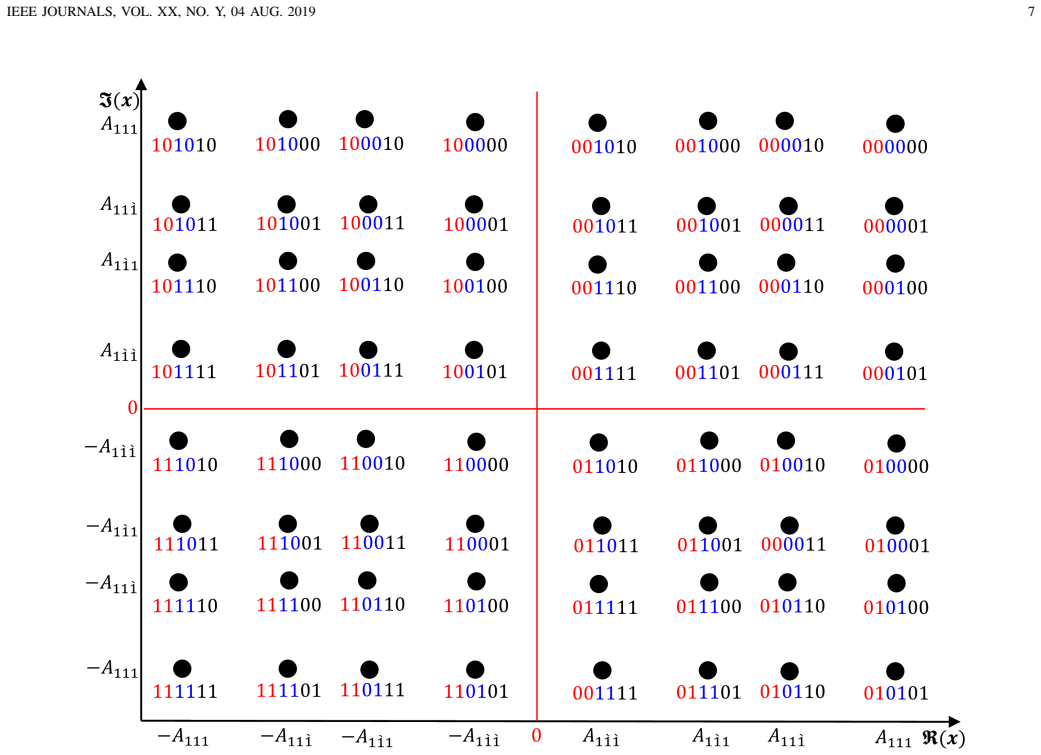
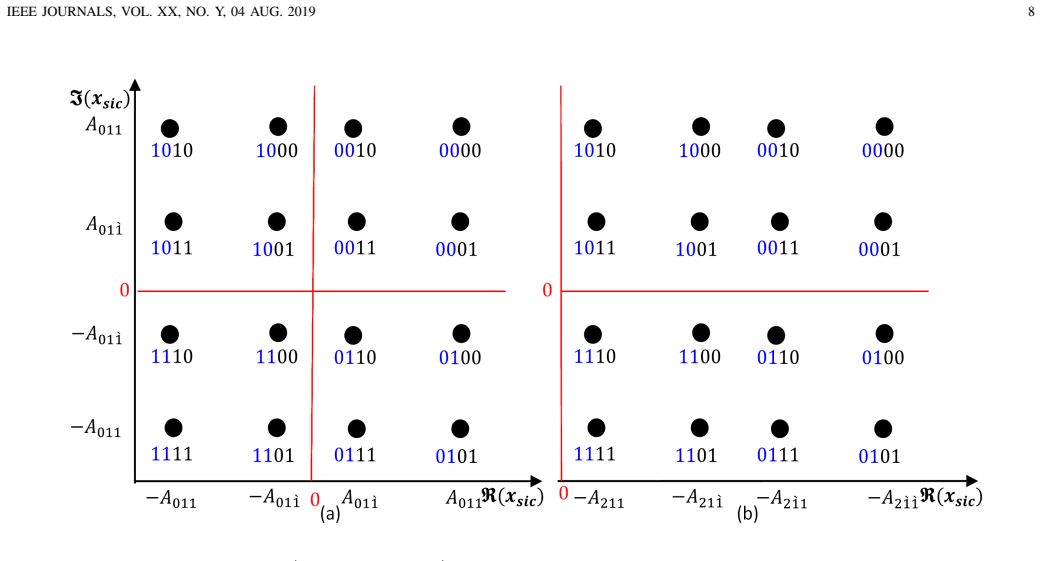
The argument is carried by the superimposed QPSK constellation and by the ordered Nakagami-$m$ order-statistic density. Each transmitted superposition is one of 16 points for $N=2$ and 64 points for $N=3$, and every error event reduces to the probability that a Gaussian noise component crosses one of the amplitude levels $A_{u_1u_2u_3}=u_1\sqrt{\beta_1}+u_2\sqrt{\beta_2}+u_3\sqrt{\beta_3}$, $u_i\in\{0,1,-1,2\}$, so the conditional error rate is a Q function $Q(\sqrt{\gamma})$. The averaging step uses the ordered PDF in (93), which contains powers of the lower incomplete gamma function; the infinite-series expansion (94)--(95) and binomial expansion (96) turn it into a gamma-like density, and Craig's integral representation of the Q function together with the identity $\int_0^\infty x^t e^{-bx}\,dx = t!/b^{t+1}$ produces the final average-BER expressions.
What would settle it
Run a two- or three-user Monte Carlo BER test with strongly asymmetric average channel powers, such as $\Omega_1=1$, $\Omega_2=5$, and $\Omega_3=25$, at a fixed SNR and power split, and compare with (36)--(37) or (82)--(87): a clear mismatch would show that the i.i.d.-power ordering assumption, not the conditional Q-function derivation, is the limit of the claim.
Extended reading notes
Core claim
The central claim is that the exact BER of each user in a downlink power-domain NOMA system with QPSK and imperfect SIC is a signed sum of Gaussian Q functions whose arguments are functions of the power coefficients. For $N=2$, the second user's conditional BER is a five-term sum with coefficient vector $[2,1,-1,-1,1]$; for $N=3$, the second user needs ten terms and the third user eighteen terms. The conditional sums are then averaged over the ordered Nakagami-$m$ channel statistics, giving the expressions (36), (37), and (82)--(84), and for the Rayleigh special case $m=1$ the closed forms (38), (39), and (85)--(87). Throughout, "imperfect SIC" means the receiver explicitly accounts for the possibility that a previously decoded user's symbol is wrong, so the resulting terms reflect both correct and incorrect SIC outcomes. The paper reports that these analytical results match Monte Carlo simulation closely, and that the same expressions allow power allocation either to equalize BER among users or to minimize the average BER.
Load-bearing premise
The load-bearing assumption is that all user links experience the same Nakagami-$m$ fading law with the same average power, so a single order-statistic formula can describe the ordering of weak to strong users; if the users sit at different distances with different average received powers, the averaging formulas stop applying.
Editorial extensions
If this is right
- At $m=1$ (Rayleigh fading), the BER formulas become closed forms, so per-user error rates and power-optimization costs can be evaluated without numerical integration.
- The fairness-optimal power allocation gives almost all the power to the weakest user at high signal-to-noise ratio (over 98% for $N=2$ at 30 dB), so equalizing BER is expensive and requires accurate knowledge of operating SNR.
- The exact results differ from the union-bound approximation by up to about 3 dB in the low-SNR regime, so designers using the bound can underestimate the power needed to hit a target BER.
- Imperfect SIC has a large effect on the farthest user in the three-user case; assuming perfect SIC overstates reliability most where SIC errors are common.
Reading between the lines
- The same conditioning recipe suggests a general structural pattern: for any $N$-user system the per-user conditional BER should be a signed sum of Q functions over constellation amplitudes, with coefficients fixed by the combinatorics of SIC error events; the two- and three-user formulas are then instances of one larger family.
- Because the average-BER formulas use an ordered density built from identical link distributions, a natural extension is to non-identically distributed Nakagami links, where the users have different average powers; that would require an order-statistic density for non-i.i.d. channels and would likely change the power-allocation tables.
- The near-monopoly of power assigned to the weakest user under fairness suggests that in practice a NOMA system might combine the exact BER expressions with adaptive modulation to avoid extreme power splits.
- The closed-form Rayleigh results could be inverted to give, for a target BER, the required power split as a function of SNR; such an explicit design rule is not written out in the paper but follows directly from (38), (39), (85)--(87).
Signed reviews
Editorial analysis
A structured set of objections, weighed in public.
Referee Report
Summary. The paper analyzes the bit error rate (BER) of downlink power-domain NOMA with imperfect successive interference cancellation over Nakagami-m flat fading channels, for two-user and three-user scenarios. Exact conditional BER expressions are derived by averaging over the QPSK symbol combinations and the SIC error events, and the average BER is obtained by averaging over ordered Nakagami-m statistics. For the special case m=1 (Rayleigh fading), closed-form average BER expressions are claimed for all users. The derived BER expressions are then used to formulate two optimal power allocation problems, one minimizing the average BER and one achieving equal BER among users. Numerical results and Monte Carlo simulations are presented for various m and power allocations, with claims of perfect agreement between analysis and simulation.
Significance. If correct, the paper would provide the first exact BER analysis of downlink NOMA with imperfect SIC over Nakagami-m fading, including closed forms for Rayleigh fading, and would enable BER-aware optimal power allocation. The conditional-error-probability derivation is a substantial combinatorial exercise, and the general-m averaging framework using ordered Nakagami-m statistics is a useful contribution. However, the claimed Rayleigh closed forms contain serious algebraic errors that make them invalid as probabilities, so the central contribution is not currently established. The paper also silently assumes i.i.d. channel statistics, which limits the scope of the claims.
major comments (3)
- [Sec. III.C, Eq. (39); Sec. IV.D, Eqs. (85)-(87)] The Rayleigh closed-form expressions (39), (85), (86), and (87) are not valid BER probabilities. For (39), if all γ_{2,c}=Γ and Γ→0, each bracket tends to 1, so the expression tends to (1/2)∑_{c=1}^5 v_c = 1; but the conditional BER in (35) at zero SNR is (1/2)∑ v_c Q(0) = 1/2. Similarly, (85) tends to 1 as Γ→0, whereas the conditional expression (44) gives 1/2; (86) also tends to 1 as Γ→0; and (87) tends to (1/4)·7·(-1/2) = -7/8 as Γ→∞ because ∑ v_c = 7 and the bracket tends to -1/2. A BER must lie in [0,1] and, for Gray-coded QPSK at zero SNR, must equal 1/2. Thus these closed forms are internally inconsistent with the conditional expressions from which they are supposedly derived, and the simulation matches claimed in Sec. VI for (39),(85)-(87) cannot be correct as stated.
- [Appendix I, Eq. (93); Sec. VI] The ordered channel PDF in (93) is derived under the assumption that the N channel gains are i.i.d. Nakagami-m random variables, which is why it factors as f(α)[F(α)]^{n-1}[1-F(α)]^{N-n}. The system model in Sec. II does not state this i.i.d. assumption, and in a downlink NOMA setting users generally have different average powers (different Ω_n). For non-identically distributed Nakagami-m gains, the order-statistics PDF does not have this simple product form, so the average BER expressions (36)-(37), (82)-(84), and (101) do not apply to the general downlink NOMA scenario. The paper should either explicitly restrict all claims and simulations to the i.i.d. case or extend the analysis to non-identical fading parameters.
- [Sec. VI, Figs. 6-12] The simulation validation is not reproducible from the information given: no number of Monte Carlo trials, no description of how the ordered channels are generated when users have different average SNRs, and no code or pseudocode for the SIC detector are provided. Moreover, the claimed 'perfect match' between the analytical curves (39),(85)-(87) and simulation cannot be true given the invalid probability limits identified above. The figures and the optimization tables in Sec. V must be regenerated with corrected closed forms, and the simulation methodology should be described in enough detail to allow independent verification.
minor comments (5)
- [Fig. 7 caption] The caption says 'N = 2' but the text and the figure refer to the three-user scenario; this should be 'N = 3'.
- [Eq. (11)] The subscript in γ_{1,2} is written as α_{2n}; it should be α_1 (the channel gain of the first user).
- [Appendix I, Eq. (92)] The function Φ(a,z) is called the lower incomplete gamma function in (92) but is described as the upper incomplete Gamma function in the surrounding text; the terminology should be made consistent.
- [Appendix I, Eqs. (94)-(95)] The infinite series representation of [Φ(m,·)]^μ uses coefficients S_i that depend on μ, but this dependence is not indicated in (99), where S_i appears for each k without a subscript denoting the exponent n+k-1; the notation should be clarified.
- [Sec. VI] The phrase 'perfectly match' should be replaced with a quantitative statement of agreement (e.g., maximum deviation or confidence bounds), since no simulation parameters or error bars are given.
Circularity Check
No circularity: BER expressions are derived by averaging conditional Q-function decision probabilities over the ordered Nakagami-m density, with no target result used as input.
full rationale
The derivation chain is self-contained. The conditional BERs in Secs. III and IV are built from exact nearest-neighbor decision regions of the superimposed QPSK constellation (e.g., Eq. (12): PU1 = 1/2[Q(sqrt(gamma_1,1)) + Q(sqrt(gamma_1,2))], and Eq. (35) for U2), and the average BER in Appendix I (Eq. (101)) is obtained by integrating these Q-functions against the ordered Nakagami-m density (Eqs. (90)-(93)). The Rayleigh closed forms (38), (39), (85)-(87) are algebraic specializations m=1 of those averages, not fitted quantities. The optimal power allocation in Sec. V uses the derived BER as the objective function in a constrained optimization; this is an application of the derived result, not a hidden input. Monte Carlo simulations in Sec. VI are external numerical validation. The self-citations in the paper ([2] and [21]) are background and comparison material: the union bound of [21] is benchmarked against the exact expression in Fig. 8, not used to justify it. The reader's noted i.i.d. channel-order limitation and the algebraic validity of the printed Rayleigh formulas are correctness/scope concerns, not circularity: no equation is defined in terms of the quantity it claims to predict, and no fitted parameter is renamed as a prediction.
Assumptions & free parameters
assumptions (5)
- domain assumption User channel gains are i.i.d. Nakagami-m before ordering.
- domain assumption Perfect channel phase compensation at receivers.
- standard math AWGN is circularly symmetric with independent equal-variance real and imaginary parts.
- standard math Infinite series for [Phi(m,x)]^mu in (94) converges and can be integrated termwise.
- domain assumption b12 errors do not affect U2 detection and b12/b22 errors do not affect U3 detection.
Cite this review
Pith. "Pith review of Exact BER Performance Analysis for Downlink NOMA Systems Over Nakagami-m Fading Channels." pith.science (2026). https://pith.science/paper/7QQELFUV
@misc{pith2026190801357,
  author       = {Pith},
  title        = {Pith review of: Exact BER Performance Analysis for Downlink NOMA Systems Over Nakagami-m Fading Channels},
  year         = {2026},
  howpublished = {\url{https://pith.science/paper/7QQELFUV}},
  note         = {Machine review of arXiv:1908.01357}
}
read the original abstract
In this paper, the performance of a promising technology for the next generation wireless communications, non-orthogonal multiple access (NOMA), is investigated. In particular, the bit error rate (BER) performance of downlink NOMA systems over Nakagami-m flat fading channels, is presented. Under various conditions and scenarios, the exact BER of downlink NOMA systems considering successive interference cancellation (SIC) is derived. The transmitted signals are randomly generated from quadrature phase shift keying (QPSK) and two NOMA systems are considered; two users' and three users' systems. The obtained BER expressions are then used to evaluate the optimal power allocation for two different objectives, achieving fairness and minimizing average BER. The two objectives can be used in a variety of applications such as satellite applications with constrained transmitted power. Numerical results and Monte Carlo simulations perfectly match with the derived BER analytical results and provide valuable insight into the advantages of optimal power allocation which show the full potential of downlink NOMA systems.
Figures


Figures from the paper (9 more)


Reference graph
Works this paper leans on
-
[1]
An overview of 5G requirements and future wireless net- works: Accommodating scaling technology,
S. Mattisson, “An overview of 5G requirements and future wireless net- works: Accommodating scaling technology,” IEEE Solid-State Circuits Mag., vol. 10, no. 3, pp. 54–60, May 2018
work page 2018
-
[2]
Error probability analysis of NOMA-based relay networks with SWIPT,
L. Bariah, S. Muhaidat, and A. Al-Dweik, “Error probability analysis of NOMA-based relay networks with SWIPT,” IEEE Commun. Lett. , vol. 23, no. 7, pp. 1223–1226, Jul. 2019
work page 2019
-
[3]
5G cellular: key enabling technologies and research challenges,
E. Hossain and M. Hasan, “5G cellular: key enabling technologies and research challenges,” IEEE Instrum. Meas. Mag. , vol. 18, no. 3, pp. 11–21, Jun. 2015
2015
-
[4]
M. Kalil, A. Al-Dweik, M. F. Abu Sharkh, A. Shami, and A. Refaey, “A framework for joint wireless network virtualization and cloud radio access networks for next generation wireless networks,” IEEE Access , vol. 5, pp. 20 814–20 827, 2017
work page 2017
-
[5]
Efficient low- complexity scheduler for wireless resource virtualization,
M. Kalil, A. Moubayed, A. Shami, and A. Al-Dweik, “Efficient low- complexity scheduler for wireless resource virtualization,” IEEE Wire- less Commun. Lett. , vol. 5, no. 1, pp. 56–59, Feb. 2016
work page 2016
-
[6]
Design of 5G full dimension massive MIMO systems,
Q. Nadeem, A. Kammoun, M. Debbah, and M. Alouini, “Design of 5G full dimension massive MIMO systems,”IEEE Trans. Commun., vol. 66, no. 2, pp. 726–740, Feb. 2018
work page 2018
-
[7]
Turbo product codes: Applications, challenges, and future directions,
H. Mukhtar, A. Al-Dweik, and A. Shami, “Turbo product codes: Applications, challenges, and future directions,” IEEE Commun. Surveys Tuts., vol. 18, no. 4, pp. 3052–3069, 4th Quart. 2016
work page 2016
-
[8]
A survey of non-orthogonal multiple access for 5G,
L. Dai, B. Wang, Z. Ding, Z. Wang, S. Chen, and L. Hanzo, “A survey of non-orthogonal multiple access for 5G,” IEEE Commun. Surveys Tuts. , vol. 20, no. 3, pp. 2294–2323, 3rd Quart. 2018
work page 2018
Show all 35 references
-
[9]
Power-domain non-orthogonal multiple access (NOMA) in 5G systems: Potentials and challenges,
S. M. R. Islam, N. Avazov, O. A. Dobre, and K. Kwak, “Power-domain non-orthogonal multiple access (NOMA) in 5G systems: Potentials and challenges,” IEEE Commun. Surveys Tuts , vol. 19, no. 2, pp. 721–742, 2nd Quart. 2017
2017
-
[10]
An improved coalition game approach for MIMO-NOMA clustering integrating beamforming and power alloca- tion,
J. Ding, J. Cai, and C. Yi, “An improved coalition game approach for MIMO-NOMA clustering integrating beamforming and power alloca- tion,” IEEE Trans. Veh. Technol. , vol. 68, no. 2, pp. 1672–1687, Feb. 2019
2019
-
[11]
Subcarrier and power allocation for LDS-OFDM system,
M. Al-Imari, M. A. Imran, R. Tafazolli, and D. Chen, “Subcarrier and power allocation for LDS-OFDM system,” in Proc. IEEE Veh. Technol. Conf. (VTC), May 2011, pp. 1–5
2011
-
[12]
On the error performance of cooperative-NOMA with statistical CSIT,
F. Kara and H. Kaya, “On the error performance of cooperative-NOMA with statistical CSIT,” IEEE Commun. Lett., vol. 23, no. 1, pp. 128–131, Jan. 2019
2019
-
[13]
On the achievable rate region of NOMA under outage probability constraints,
Z. Tang, J. Wang, J. Wang, and J. Song, “On the achievable rate region of NOMA under outage probability constraints,” IEEE Commun. Lett. , vol. 23, no. 2, pp. 370–373, Feb. 2019
2019
-
[14]
On the ergodic capacity of MIMO NOMA systems,
Q. Sun, S. Han, C. I, and Z. Pan, “On the ergodic capacity of MIMO NOMA systems,” IEEE Wireless Commun. Lett., vol. 4, no. 4, pp. 405– 408, Aug. 2015
2015
-
[15]
A novel multi-user grouping scheme for downlink non-orthogonal multiple access systems,
L. Yao, J. Mei, H. Long, L. Zhao, and K. Zheng, “A novel multi-user grouping scheme for downlink non-orthogonal multiple access systems,” in Proc. IEEE Wireless Commun. Netw. Conf. , Apr. 2016, pp. 1–6
2016
-
[16]
Proportional fairness-based power allocation and user set selection for downlink NOMA systems,
F. Liu, P. Mah ˜onen, and M. Petrova, “Proportional fairness-based power allocation and user set selection for downlink NOMA systems,” in Proc. Conf. Commun. (ICC) , May 2016, pp. 1–6
2016
-
[17]
The application of MIMO to non- orthogonal multiple access,
Z. Ding, F. Adachi, and H. V . Poor, “The application of MIMO to non- orthogonal multiple access,” IEEE Trans. Wireless Commun. , vol. 15, no. 1, pp. 537–552, Jan. 2016
2016
-
[18]
Capacity and fairness trade-off in an outage situation over multiuser diversity systems,
C. Park, H. Lee, and J. Lim, “Capacity and fairness trade-off in an outage situation over multiuser diversity systems,”IEEE Commun. Lett., vol. 15, no. 2, pp. 184–186, Feb. 2011
2011
-
[19]
Impact of user pairing on 5G nonorthogonal multiple-access downlink transmissions,
Z. Ding, P. Fan, and H. V . Poor, “Impact of user pairing on 5G nonorthogonal multiple-access downlink transmissions,” IEEE Trans. Veh. Technol., vol. 65, no. 8, pp. 6010–6023, Aug. 2016
2016
-
[20]
On the power allocation of non-orthogonal multiple access for 5G wireless networks,
M. B. Shahab, M. F. Kader, and S. Y . Shin, “On the power allocation of non-orthogonal multiple access for 5G wireless networks,” in Proc. Int. Conf. Open Source Syst. Technol. (ICOSST) , Dec. 2016, pp. 89–94
2016
-
[21]
Error probability analysis of non-orthogonal multiple access over nakagami- m fading channels,
L. Bariah, S. Muhaidat, and A. Al-Dweik, “Error probability analysis of non-orthogonal multiple access over nakagami- m fading channels,” IEEE Trans. Commun. , vol. 67, no. 2, pp. 1586–1599, Feb. 2019
2019
-
[22]
Performance analysis of SSK-NOMA,
F. Kara and H. Kaya, “Performance analysis of SSK-NOMA,” IEEE Trans. Veh. Technol., vol. 68, no. 7, pp. 6231 – 6242, May 2019
2019
-
[23]
Closed-form symbol error rate expressions for non-orthogonal multiple access systems,
Q. He, Y . Hu, and A. Schmeink, “Closed-form symbol error rate expressions for non-orthogonal multiple access systems,” IEEE Trans. Veh. Technol., vol. 68, no. 7, pp. 6775 – 6789, Jul. 2019
2019
-
[24]
Average symbol error rate analysis for non- orthogonal multiple access with M-ary QAM signals in rayleigh fading channels,
I. Lee and J. Kim, “Average symbol error rate analysis for non- orthogonal multiple access with M-ary QAM signals in rayleigh fading channels,” IEEE Commun. Lett. , pp. 1–1, Jun. 2019
2019
-
[25]
Closed-form BER expressions of QPSK constellation for uplink non-orthogonal multiple access,
X. Wang, F. Labeau, and L. Mei, “Closed-form BER expressions of QPSK constellation for uplink non-orthogonal multiple access,” IEEE Commun. Lett., vol. 21, no. 10, pp. 2242–2245, Oct. 2017
2017
-
[26]
Performance of non-orthogonal multiple access with a novel asynchronous interference cancellation technique,
H. Haci, H. Zhu, and J. Wang, “Performance of non-orthogonal multiple access with a novel asynchronous interference cancellation technique,” IEEE Trans. Commun. , vol. 65, no. 3, pp. 1319–1335, Mar. 2017
2017
-
[27]
BER performances of downlink and uplink NOMA in the presence of SIC errors over fading channels,
F. Kara and H. Kaya, “BER performances of downlink and uplink NOMA in the presence of SIC errors over fading channels,” IET Commun., vol. 12, no. 15, pp. 1834–1844, Sep. 2018
2018
-
[28]
J. G. Proakis and M. Salehi, Digital Communications, 5th ed. McGraw Hill, 2007
2007
-
[29]
An interior trust region approach for nonlinear minimization subject to bounds,
T. Coleman and Y . Li, “An interior trust region approach for nonlinear minimization subject to bounds,” SIAM J on Optimiz. , vol. 6, no. 2, pp. 418–445, Dec. 1996
1996
-
[30]
On the error performance bound of ordered statistics decoding of linear block codes,
P. Dhakal, R. Garello, S. K. Sharma, S. Chatzinotas, and B. Ottersten, “On the error performance bound of ordered statistics decoding of linear block codes,” in Proc. IEEE Int. Conf. Commun. (ICC) , May 2016, pp. 1–6
2016
-
[31]
Fraczek, Selberg Zeta Functions and Transfer Operators: An Exper- imental Approach to Singular Perturbations , 1st ed
M. Fraczek, Selberg Zeta Functions and Transfer Operators: An Exper- imental Approach to Singular Perturbations , 1st ed. Springer, 2017
2017
-
[32]
Power allocation for robust distributed best-linear- unbiased estimation against sensing noise variance uncertainty,
J. Wu and T. Wang, “Power allocation for robust distributed best-linear- unbiased estimation against sensing noise variance uncertainty,” IEEE Wireless Commun. Lett., vol. 12, no. 6, pp. 2853–2869, Jun. 2013
2013
-
[33]
Gradshteyn and I
I. Gradshteyn and I. Ryzhik, Table of Integrals, Series, and Products , 7th ed. Academic Press, 2007
2007
-
[34]
A new, simple and exact result for calculating the probability of error for two-dimensional signal constellations,
J. Craig, “A new, simple and exact result for calculating the probability of error for two-dimensional signal constellations,” in Proc. Military Commun. Conf. (MILCOM91) , Nov. 1991. Tasneem Assaf (S’14) received the B.Sc. degree in com- munications engineering from Khalifa Un...
1991
-
[2005]
He joined Vestas Wind Systems, Arhus, Denmark, in the Technology R&D with the Wind Power Plant Group
He joined McGill University as a Postdoctoral Fellow with the Power Electronics Group. He joined Vestas Wind Systems, Arhus, Denmark, in the Technology R&D with the Wind Power Plant Group. He was with TRANSCO, UAE, as a Senior Study and Planning Engineer. He is currently a Pro...
1999
Reviewed August 14, 2026 · model on record in the stance chip above.
Discussion (0). Continue with ORCID to comment.