REVIEW 3 major objections 5 minor 20 references
Decay widths at the scission point in nuclear fission
T0 review · 3 major / 5 minor · reviewed 2026-08-14 · deepseek-v4-flash
Pith's one-line read For 236U, the decay width of a pre-scission configuration into a diabatically connected continuum channel is about 2–3 MeV, while pairing-mediated decays to a specific channel are 5–60 keV.
desk verdict A plausible first GCM estimate of scission decay widths, but the headline 2–3 MeV vs 5–60 keV gap rests partly on an unquantified extrapolated continuum tail. read the letter →
The pith
A machine-rendered reading of the paper's core claim, the machinery that carries it, and where it could break.
The reading
What carries the argument
The load-bearing object is the Generator Coordinate Method (GCM) representation of the two-fragment continuum as a chain of constrained mean-field configurations labeled by the relative fragment coordinate $z_{\mathrm{rel}}$ and by a conserved K-partition, the set of occupied single-particle states in an axially symmetric mean field. Overlap and Hamiltonian matrix elements between neighboring configurations are computed from the energy density functional; beyond the last explicitly calculated configuration, the authors extrapolate them using a Gaussian overlap ansatz and a quadratic intrinsic term with a fitted parameter $B$, effectively placing the separated fragments in a flat potential. Decay widths are then extracted from the strength function of the chosen initial configuration in the eigenstates of this finite space, either as the full width at half maximum of the smoothed strength function or from the golden rule applied to the off-diagonal matrix elements after an orthogonalization step based on tridiagonalization. The chain construction and the extrapolation together supply the final-state wave function that is needed to define a two-fragment decay in a many-body Hamiltonian framework.
What would settle it
Recompute the 236U Glider decay chain with explicit constraints on the relative momentum of the fragments, so that the kinetic energy beyond the scission point is treated exactly instead of through the Gaussian ansatz; if the diabatic golden-rule width drops from the MeV range into the keV range, the reported hierarchy would be an artifact of the extrapolation.
Extended reading notes
Core claim
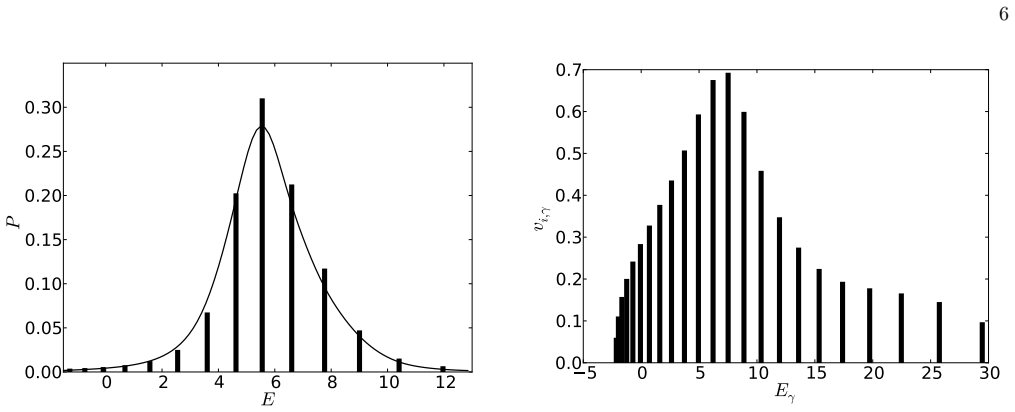
The central numerical discovery is a hierarchy of decay widths at the scission point of 236U. The authors construct a continuum channel, labeled Glider, from five GCM configurations near scission plus five extrapolated states at larger fragment separations, and take the pre-scission Glider configuration at $z_{\mathrm{rel}} = 16.71$ fm as the decaying state. For the diabatic decay, in which the K-partition is preserved along the whole chain, the smoothed strength function gives $\Gamma_{\mathrm{FWHM}} \approx 3$ MeV and the golden-rule estimate gives 2.2 MeV. For two non-diabatic decays that first require a pair jump—configurations A and B connecting the bound configuration Buenavista to Glider—the widths are 5 keV and 60 keV. The paper concludes that diabatically allowed transitions can have widths up to several MeV, while non-diabatic decays through the pairing interaction to a specific final channel are two to three orders of magnitude smaller.
Load-bearing premise
The calculation's weakest point is the extrapolation that replaces the real potential between separated fragments with a flat potential and a simple Gaussian overlap model controlled by one fitted parameter; if that extrapolation is wrong, the computed widths could shift by more than the reported two-to-three-order-of-magnitude separation.
Editorial extensions
If this is right
- When a diabatic channel is open, the scission step is fast: the computed 2–3 MeV widths imply decay times of order $10^{-22}$ seconds, so there is no significant pause at the rupture point.
- Pairing-mediated decay into a specific final channel is slow by comparison, with widths of 5–60 keV, so such channels can only matter through the cumulative effect of many open channels or through large fluctuations in their matrix elements.
- The roughly 20 keV width implied by the approximately $10^4$ fm/c scission delay seen in time-dependent Hartree-Fock-Bogoliubov calculations lies between the two pairing widths, which the paper reads as confirmation of the microscopic estimates.
- If a representative sample of final channels can be constructed, the same machinery would give branching ratios among exit channels and thus predictions for fluctuations in mass yields and total kinetic energies.
Reading between the lines
- If the same calculation is repeated in other actinides, a natural expectation is that the MeV-versus-keV separation holds whenever a diabatic channel exists, making diabatic paths the generic doorway for fast scission.
- A momentum-constrained version of the chain would provide a sharper test: the paper's effective-mass ratio $M^*/M = 0.87$ puts the Gaussian kinetic energy off by roughly 13 percent, far too small to erase the hierarchy unless the correction is strongly channel-dependent.
- Because the current GCM space contains no quasiparticle excitations, real pre-scission states carrying internal excitation could reach the continuum through additional pairing channels; whether those extra paths close the order-of-magnitude gap is left open by the paper.
Signed reviews
Editorial analysis
A structured set of objections, weighed in public.
Referee Report
Summary. The paper develops a Generator Coordinate Method (GCM) treatment of the final stage of nuclear fission, focusing on 236U and the pre-scission configuration labeled Glider. The authors construct a discretized continuum channel from GCM configurations along the relative-fragment coordinate and compute decay widths by Fermi’s Golden Rule and by the width of the Lanczos strength function. For the diabatic case (Glider decaying into the Glider continuum) they obtain Γ_FWHM ≈ 3 MeV and Γ_FGR = 2.2 MeV. For two pairing-mediated transitions from intermediate configurations A and B into the Glider channel they obtain 5 keV and 60 keV, from which they conclude that non-diabatic widths to a specific channel are 2–3 orders of magnitude smaller than diabatic widths. The continuum is partly built by extrapolating overlap and Hamiltonian matrix elements via Eqs. (12)–(13), introducing a parameter B, and the external potential is approximated as flat beyond the last computed GCM configuration.
Significance. If the order-of-magnitude separation between diabatic and pairing-mediated decay widths is robust, this is an important step toward a fully microscopic, quantum-mechanical description of scission dynamics. The paper provides a concrete framework for estimating partial widths in a realistic Gogny-D1S mean-field basis, and it connects the widths to independent physics: the TDHFB scission delay of order 10000 fm/c corresponds to Γ ≈ 20 keV, bracketed by the two pairing-mediated widths. The manuscript is also exemplary in stating its approximations openly and in giving enough detail to reproduce the construction. However, the central quantitative claim rests on an extrapolated, flat-potential continuum whose controlling parameter B is not reported and for which no sensitivity study is given; at present the several-MeV versus tens-of-keV separation is a plausible estimate rather than a firmly established result.
major comments (3)
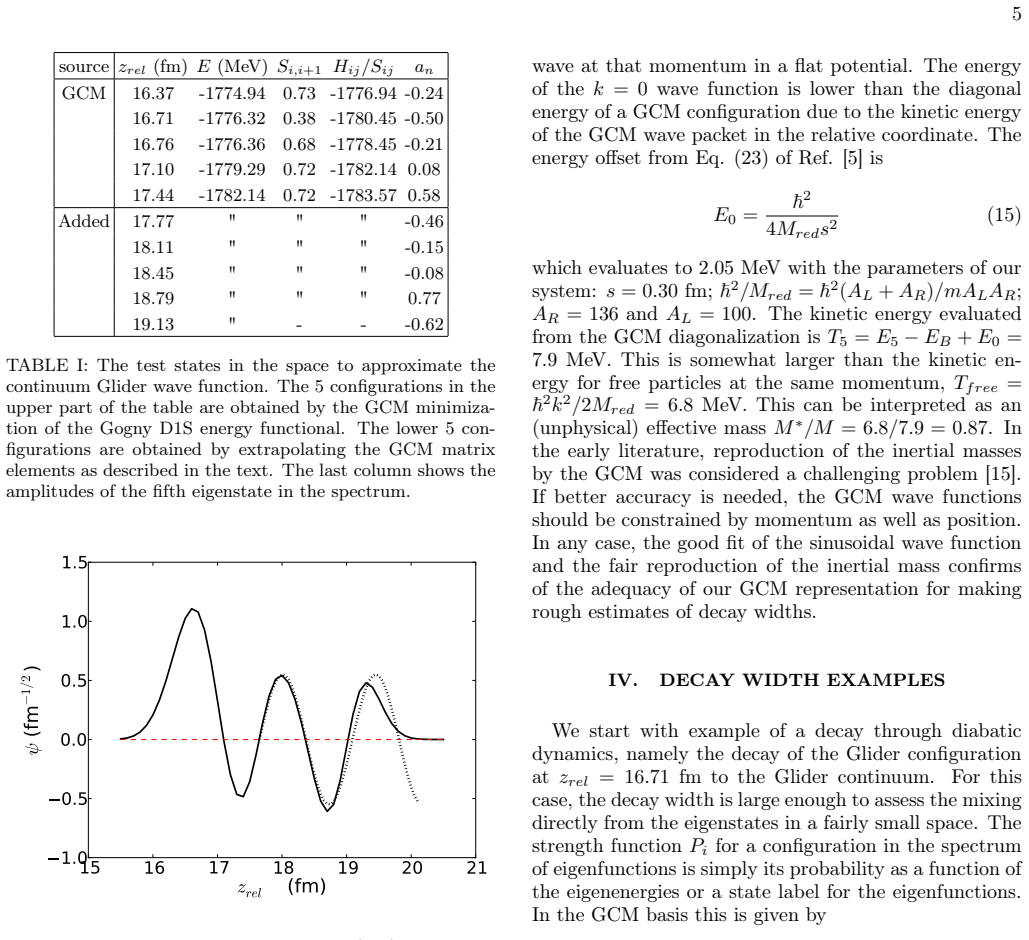
- [III, Eq. (13), Table I] The central claim (Γ_diabatic ≈ 2–3 MeV vs Γ_pairing ≈ 5–60 keV) is controlled by the extrapolated part of the continuum. The selected eigenstate has its largest weights on the two farthest added states (a_n = 0.77 at 18.79 fm and −0.62 at 19.13 fm), so both the FGR matrix element and the level spacing ΔE are dominated by entries generated from Eq. (13). The parameter B is introduced without reporting its value or the promised comparison between its two estimates, and no sensitivity study is given. Because the two-order-of-magnitude separation is the central result, the manuscript should show how Γ_diabatic and Γ_pairing change when B is varied over a plausible range and when the number or spacing of added states is changed. Without such a study, the abstract's 'several MeV' and '2–3 orders of magnitude' statements rest on an unquantified modeling choice.
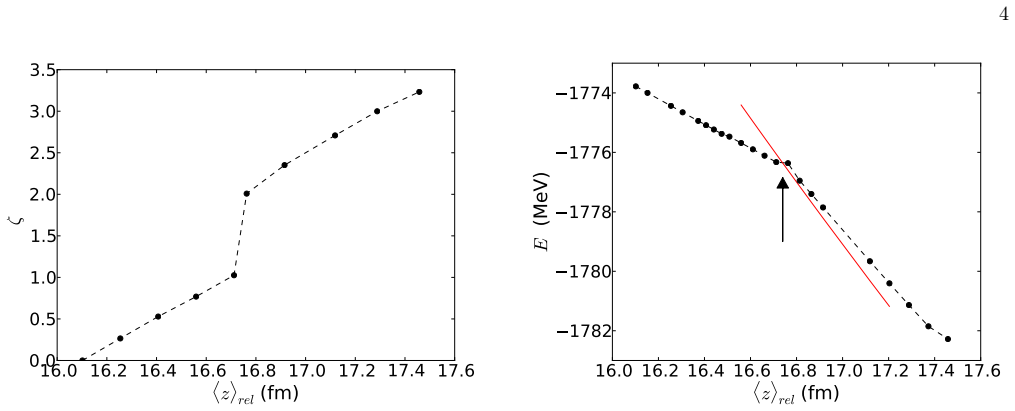
- [III, flat-potential assumption] Fig. 3 shows that the HF energy beyond scission follows the Coulomb law with a slope of order 10 MeV/fm, yet the continuum is constructed with H''_{j,j} = H_{k,k}, i.e., a flat potential beyond zrel ≈ 17.44 fm. For a repulsive Coulomb field the local momentum and density of states at the initial-state energy differ substantially from plane-wave values, so the wave function in Fig. 5 and the ΔE used in Eq. (26) are model-dependent precisely in the region that determines the width. The authors should either justify that the flat-bottom approximation preserves the relevant density of states to within the claimed factor, or repeat the calculation with the Coulomb tail included, for example by matching to Coulomb wave functions or using WKB normalization.
- [Abstract and IV, Table II] The abstract asserts that 'typical widths to a specific final state channel are 2–3 orders of magnitude smaller,' but only two pairing-mediated channels are computed (5 keV and 60 keV), and the paper's own Discussion cautions against drawing general conclusions from just three examples. The FGR estimates in Table II also use a single nearest-neighbor matrix element and a local spacing in a small discretized space (Appendix), so the 'typical' claim is not strongly supported. The abstract should either be softened to match the exploratory status of the calculation or additional examples and/or averaged widths should be provided to justify the word 'typical.'
minor comments (5)
- [IV, paragraph after Eq. (18)] The text says '20 configurations constructed with Eq. (14,15)'; the correct references are Eqs. (12)–(13), which define the extrapolated overlaps and Hamiltonian matrix elements, not the normalization condition and energy offset.
- [IV, text before Eq. (19)] The phrase 'the estimated decay with is' should read 'the estimated decay width is'.
- [Appendix, Eq. (20)] The Breit-Wigner expression appears malformed: the form given by 'P ∼ 1/((E−E_i)^2+(Γ/2)^2)^2' is not a standard Lorentzian and likely contains a typographical error; please correct it.
- [Table I] The repeated ' ' entries for the added states are ambiguous; please state explicitly that the diagonal energies and H/S ratios are set according to H''_{j,j}=H_{k,k} and Eq. (13).
- [Fig. 5] The sinusoidal fit is shown only over zrel = 17.5–18.5 fm, while the largest eigenfunction amplitudes are at 18.79 and 19.13 fm; fitting the full asymptotic region would be more persuasive evidence for the plane-wave representation.
Circularity Check
No significant circularity: the calculated widths follow from GCM Hamiltonian matrix elements, and the extrapolation parameter B is a modeling assumption rather than a fitted prediction of the target widths.
full rationale
The paper's central quantitative results, the diabatic width of about 2–3 MeV and the pairing-mediated widths of 5 keV and 60 keV, are obtained by diagonalizing a GCM Hamiltonian and applying the Fermi Golden Rule to the resulting matrix elements and level spacings. No experimental decay width is used as input, and no output quantity is refit into the calculation. The extrapolation of the continuum channel beyond the fully computed GCM configurations introduces an explicit parameter B in Eq. (13), and the potential in the external region is approximated as flat; these are physically motivated modeling choices, and the paper itself notes the associated limitations. The absence of a reported sensitivity study for B is a legitimate robustness concern, but it is not circularity because B is estimated from known GCM Hamiltonian and overlap matrix elements, not from the decay widths being predicted. The paper relies on prior work by the same authors for the Glider path, the pair-jump identification of initial states, and the GCM continuum methodology (Refs. [2], [5], [13]), but those citations provide independent computational ingredients rather than importing the target result. No equation in the paper reduces by construction to an input assumption, and no fitted parameter is renamed as a prediction. The derivation is therefore self-contained in the relevant sense.
Assumptions & free parameters
free parameters (1)
- B
assumptions (3)
- domain assumption The two-fragment final state wave function factorizes into center-of-mass and internal wave functions, and the center-of-mass wave functions are Gaussian (Eqs. 8 and 9).
- domain assumption The energy density functional (Gogny D1S) can be treated as a Hamiltonian in the GCM matrix elements (Eq. 6).
- ad hoc to paper The external potential in the relative coordinate beyond the last GCM configuration is flat, and the Hamiltonian matrix elements are extrapolated with a quadratic form in overlap distance (Eq. 13).
Cite this review
Pith. "Pith review of Decay widths at the scission point in nuclear fission." pith.science (2026). https://pith.science/paper/SBCRABQ2
@misc{pith2026190801368,
  author       = {Pith},
  title        = {Pith review of: Decay widths at the scission point in nuclear fission},
  year         = {2026},
  howpublished = {\url{https://pith.science/paper/SBCRABQ2}},
  note         = {Machine review of arXiv:1908.01368}
}
read the original abstract
An outstanding problem in the theory of nuclear fission is understanding the Hamiltonian dynamics at the scission point. Here we apply the Generator Coordinate Method to calculate decay widths for pre-scission configurations into the two-fragment continuum. Transitions that are allowed under diabatic dynamics can have widths up to several MeV. For non-diabatic decays through the pairing interaction, typical widths to a specific final state channel are 2-3 orders of magnitude smaller. The nucleus U-236 is taken as a representative example in the calculations.
Figures


Figures from the paper (2 more)
Reference graph
Works this paper leans on
- [1]
-
[2]
G.F. Bertsch, W. Younes, and L.M. Robledo, arXiv:1904.06751 (2019); to be published in Phys. Rev. C
work page Pith review arXiv 2019
- [3]
-
[4]
L.M. Robledo, T. Rodriguez, R. Rodriguez-Guzman J. Phys G 46, 013001 (2019)
work page 2019
- [5]
-
[6]
E. Caurier, G. Martinez-Pinedo, F. Nowacki, et al., Rev. Mod. Phys. 77 427 (2005)
work page 2005
- [7]
- [8]
Show all 20 references
-
[9]
Robledo, unpublished
L.M. Robledo, unpublished. Directions for accessing the code are in the Supplementary Material
-
[10]
Robledo, unpublished; the code configured for the model space used for the present study is provided in the Supplementary Material
L.M. Robledo, unpublished; the code configured for the model space used for the present study is provided in the Supplementary Material
-
[11]
Balian and E
R. Balian and E. Brezin, Nuovo Cim. B64 37 (1969)
1969
-
[12]
G. F. Bertsch and L. M. Robledo Phys. Rev. Lett.108, 042505 (2012)
2012
-
[13]
A" and “B
we found that Glider was populated from the bound configuration Buenavista by two pair jumps. The or- bitals involved are shown in Table II. The intermediate configuration labeled “A" and “B” will be treated as the initial states for the FGR width calculations. The coor- dinatez...
-
[14]
Bertsch, W
G.F. Bertsch, W. Younes and L.M. Robledo, Phys. Rev. C 97 064619 (2018)
2018
-
[15]
Warda and L
M. Warda and L. M. Robledo Phys. Rev. C84, 044608 (2011)
2011
-
[16]
Peierls and D
R. Peierls and D. Thouless, Nucl. Phys.38 154 (1962)
1962
-
[17]
Bertsch, David Brown, and E.D
G.F. Bertsch, David Brown, and E.D. Davis, Phys. Rev. 9 C 98, 014611 (2018)
2018
-
[18]
Bulgac, P
A. Bulgac, P. Magierski, K. Roche and I. Stetcu, Phys. Rev. Lett. 116 063628 (2015)
2015
-
[19]
Goutee, J.-F
H. Goutee, J.-F. Berger, P. Casoli, and D. Gongy, Phys. Rev. C 71 024316 (2005)
2005
-
[20]
Bernard, H
R. Bernard, H. Goutte, D. Gogny, and W. Younes, Phys. Rev. C 84, 044308 (2011)
2011
Reviewed August 14, 2026 · model on record in the stance chip above.
Discussion (0). Continue with ORCID to comment.