REVIEW 3 major objections 4 minor 1 cited by
Gradient sub-grid-scale model for relativistic MHD Large Eddy Simulations
T0 review · 3 major / 4 minor · reviewed 2026-08-14 · deepseek-v4-flash
Pith's one-line read Gradient model supplies the missing small-scale terms in relativistic MHD turbulence.
desk verdict Novel and useful derivation of a relativistic MHD gradient SGS closure, but the a-priori validation is compromised by an apparent error in Eq. (62) and by missing code or a-posteriori tests, so the resolution-gain claim is overstated. read the letter →
The pith
A machine-rendered reading of the paper's core claim, the machinery that carries it, and where it could break.
The reading
What carries the argument
The load-bearing object is the double-gradient operator $H(X)=\nabla(dX/dC^b)\cdot\nabla C^b$, obtained from the gradient expansion of the inverse Gaussian filter $G^{-1}=1+\xi\nabla^2+O(\xi^2)$. It has the property $H(C^a)=0$ for conserved fields and obeys a generalized Leibniz rule $H(XY)=XH(Y)+YH(X)+2\nabla X\cdot\nabla Y$, which is what lets products like $hW^2 v^i v^k$ be expanded without explicitly inverting $C^a(P)$. The whole SGS model is the statement $\tau_X \simeq -\xi H(X)$ for any field $X$, with equations (47)--(54) giving the explicit $H$ terms for the relativistic MHD fluxes.
What would settle it
Run an actual coarse-grid LES with the SGS tensors (47)--(54) for the same Kelvin-Helmholtz setup and compare its kinetic and magnetic energy spectra with the $1024^3$ DNS; if adding the model fails to reproduce the magnetic-energy growth and spectra of the fine run, or if it destabilizes the scheme, the central claim is refuted. A cheaper check is to compute the Pearson coefficient for a filter factor above 16 or across a strong shock, where the gradient expansion and the shock-capturing dissipation are expected to break down.
Extended reading notes
Core claim
The claim is that for a generic system of conservation laws $\partial_t C^a + \partial_k F^a_k(P)=0$, including the relativistic ideal MHD case where the map $C^a=f^a(P)$ is not analytically invertible, every sub-filter-scale residual can be approximated to first order in the filter width by an expression of the form $\tau^a_k=-\xi\,\nabla(dF^a_k/dC^b)\cdot\nabla C^b$, with $\xi$ determined by the filter width. Applied to special-relativistic ideal MHD, this yields the SGS tensors in Eqs. (47)--(50) together with the auxiliary double-gradient terms (51)--(54), which involve the primitive fields, their gradients, and the Jacobian of the inverse transformation. The a-priori comparison against filtered high-resolution Kelvin-Helmholtz turbulence shows high correlation and order-one coefficients, which the authors take as evidence that the functional form captures the unresolved dynamics for filter factors up to 16.
Load-bearing premise
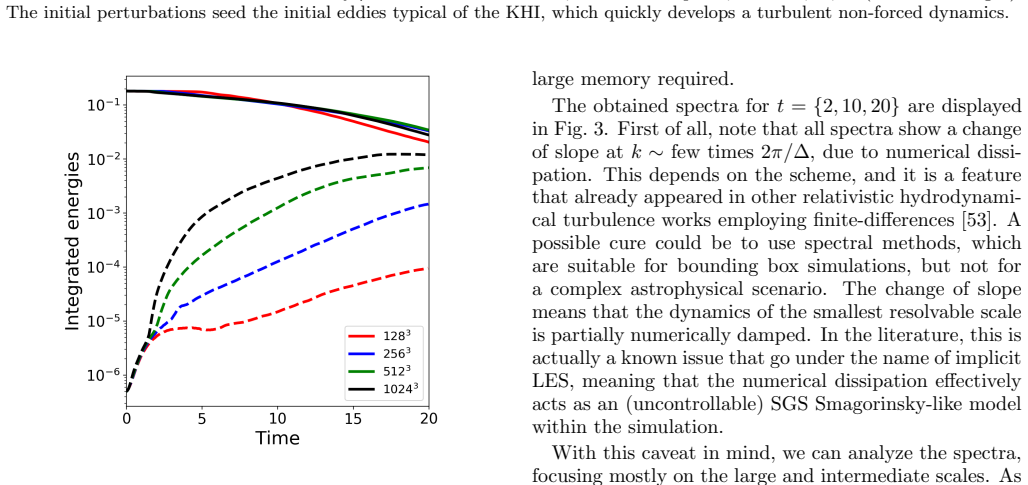
The validation assumes that the residuals computed by filtering a high-resolution simulation over scale factors up to 16 are a faithful stand-in for the unresolved terms a coarser LES would actually need, while the true sub-grid scales below the grid spacing and the extra numerical dissipation of the high-resolution run are not part of the comparison; no a-posteriori LES is performed.
Editorial extensions
If this is right
- For any equation of state, the filtered relativistic ideal MHD equations can be closed with explicit SGS terms that require only gradients of the primitive fields and the Jacobian of the conserved-to-primitive map, so implementation is a matter of adding terms to an existing code.
- Because best-fit pre-coefficients stay close to 1 and vary little in time, a fixed pre-factor, without a dynamic Germano-type procedure, is sufficient in this Kelvin-Helmholtz regime.
- The retained correlation at $S_f=16$ indicates the model can substitute for a resolution increase of a factor 4 to 8, which translates directly into a computational-cost saving in production simulations.
- Extending the derivation from Minkowski to a curved background is expected to be straightforward because the metric varies more smoothly than the turbulent fields, so the same SGS tensors can be used in GRMHD binary-neutron-star simulations.
- The model is not a substitute for resolution near strong shocks, where the numerical dissipation of high-resolution shock-capturing schemes overwhelms the SGS terms.
Reading between the lines
- The a-priori test establishes correlation, not causation: the decisive evidence would be an a-posteriori LES in which the SGS tensors are actually evolved, and that test is the natural next step implied by this paper.
- The formulation assigns a SGS term to the continuity equation while the energy equation gets none; if that asymmetry is physical, it predicts that unresolved dynamics preferentially alter rest-mass transport, which could be checked by comparing coarse LES and fine DNS mass-flux statistics.
- Because the filtering operation is tied to the 3+1 foliation, a gauge-independent SGS model for GRMHD may be impossible by construction; implementations will likely need to recompute the tensors for each gauge choice.
- The model's backscatter capability is its main advantage over purely dissipative closures, but it also means stability is not guaranteed; a testable extension is to quantify how much numerical dissipation must be added to offset the model's anti-diffusive contributions.
Signed reviews
Editorial analysis
A structured set of objections, weighed in public.
Referee Report
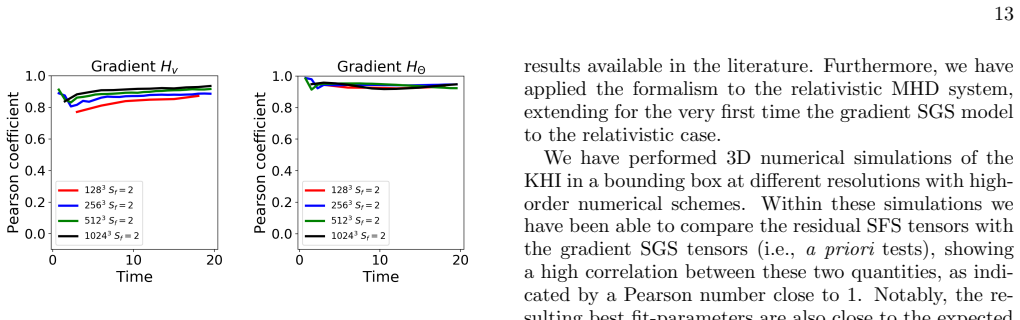
Summary. The manuscript extends the gradient sub-grid-scale (SGS) model to special-relativistic ideal MHD. Starting from a Gaussian-filter expansion of a generic conservative system, it derives closed-form SGS tensors for the continuity, momentum, energy, and induction equations [Eqs. (47)-(54)], checks the non-relativistic limit, and presents an a-priori validation using filtered snapshots of decaying Kelvin-Helmholtz turbulence at resolutions 128^3-1024^3. The validation reports Pearson correlations P≈0.8 or higher for filter factor S_f=2 and P≳0.5 for S_f=16, with best-fit coefficients Cbest≈1, and the authors infer an effective resolution gain of 4 to 8. The derivation is a mathematical closure and is not a fit to the simulation data, but the a-priori test is the only numerical evidence for the model's performance.
Significance. If the quantitative claims hold, this would be the first gradient SGS formulation for relativistic MHD with a general equation of state, with a plausible path to GRMHD binary-merger simulations and a possible factor-of-four-to-eight effective resolution gain. The derivation is a genuine extension: it confronts the nontrivial conserved-to-primitive inversion and reproduces known non-relativistic results as a consistency check. The model contains no fitted free parameters in its functional form; only the empirical amplitude Cbest is adjusted in the validation, which is an appropriate a-priori procedure. However, the numerical evidence is not yet reliable and no code or analysis scripts are provided, so the central validation must be regarded as unverified.
major comments (3)
- [§VII.A, Eq. (62)] The formula used to evaluate the a-priori SFS residual is inconsistent with the box-filter definition stated in the same section. With bar-f = (1/S_f^3) sum_i f_i and overline{fg} = (1/S_f^3) sum_i f_i g_i, the printed right-hand side equals S_f^3 bar-f bar-g - overline{fg}, not the SFS residual bar-f bar-g - overline{fg} of Eq. (20) and the preceding illustrative definition. For constant fields it returns S_f^3 - 1 instead of 0. Since Figs. 4 and 5 and the reported values P≥0.8 and Cbest≈1 are computed from this expression, the central quantitative claim is not supported as printed. The authors should correct Eq. (62) (or clarify the normalization of the sums), rerun the fits, and, preferably, release the analysis code so that the implemented expression can be checked.
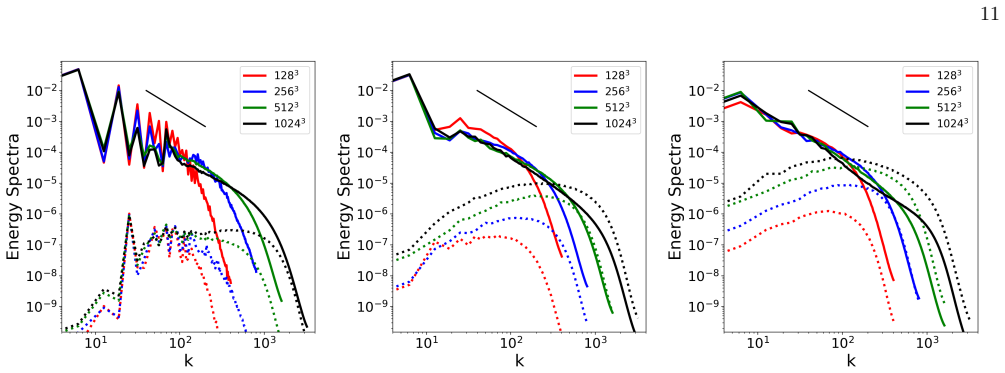
- [§VIII vs. §VI.C] The validation is purely a-priori, and the conclusion overreaches when it states that the model yields a gain in effective resolution of at least a factor 4 and possibly up to a factor 8. The high-resolution reference runs are not a clean representation of the unresolved scales: §VI.C reports a change of slope in all energy spectra at high k due to numerical dissipation and describes the discretization as an implicit LES. The filtered residuals from such runs therefore mix numerical dissipation with true sub-filter physics. An a-posteriori LES with the SGS terms included, or at least a convergence study showing that the fitted residuals are insensitive to the reference resolution, is needed before the resolution-gain estimate can be taken as established.
- [§III and §VII.B] The first-order gradient expansion is applied for filter factors up to S_f=16, for which the expansion parameter xi k^2 is not small relative to unity at the resolved grid scale. The paper does not test whether the second-order terms in Eqs. (15)-(16) change the predicted tensors, so the regime of validity of the truncation is unclear. The reported P≥0.5 at S_f=16 is encouraging but should be accompanied by a filter-size convergence check before the model is claimed to represent scales up to 16 grid cells.
minor comments (4)
- [§V.B, after Eq. (50)] The auxiliary expressions (51)-(54) are presented without derivation or verification; a short appendix showing how they follow from the inverse-function-theorem Jacobians would help readers trust and reimplement them.
- [§VI.A, Eq. (59)] The initial-condition line 'Bx = Bx0, Bx = By0, Bz = Bz0' contains a typo: the second equality should presumably be By = By0.
- [§VII.B] The statement that 'we have explored different initial conditions, finding mainly the same results' is not supported by any figure or table; please show at least one representative additional case or remove the claim.
- [§II] Minor typos include 'Large-Eddie-Simulations' and 'Minkovski metric' in the abstract/introduction; these should be corrected.
Circularity Check
No circularity: the relativistic gradient SGS tensors are derived from parameter-free filter expansions, and the a-priori validation tests the functional form independently of fitted amplitudes.
full rationale
The central derivation is self-contained. The gradient SGS model follows from the Gaussian-filter Taylor expansions, Eqs. (15)-(16), and the algebraic identities (17), (22)-(26), together with the inverse function theorem. The relativistic SGS tensors, Eqs. (47)-(54), are obtained by substituting the special-relativistic MHD conserved-to-primitive relations; this is parameter-free algebra that does not use the simulation data. The a-priori validation in Section VII compares these closed-form expressions with residuals computed from high-resolution KHI runs. Although Eq. (64) fits the pre-coefficient Cbest to the same residual data, the paper's central claim is the Pearson correlation coefficient P, Eq. (63), which is invariant under scalar rescaling and therefore tests the functional form of the model rather than a fitted amplitude. Cbest is explicitly a best-fit diagnostic, not an independent prediction. Self-citations to the authors' non-relativistic work [28] are used for context, comparison, and estimating a possible resolution gain, but the relativistic claim rests on the algebra in Section V.B and on the current a-priori tests; no load-bearing conclusion is imported solely from a self-citation. One non-circular but serious caveat should be flagged: Eq. (62), as printed, evaluates the SFS tensor as (1/S_f^3) times [(sum of f)(sum of g) - sum of f g] = S_f^3 times (average of f)(average of g) - average of f g, which is not the residual (average of f g) - (average of f)(average of g) defined in Eq. (20); for constant fields it gives S_f^3 - 1 instead of zero. This is a validation-target inconsistency that could affect the reported Pearson values and Cbest, but it is a computational/formula mismatch, not a case of the derivation being equivalent to its own input. The model itself is not derived from, fitted to, or defined in terms of the residuals it claims to approximate, so no circularity is found.
Assumptions & free parameters
free parameters (1)
- Cbest (best-fit amplitude per SGS tensor component) =
reported as O(1), varying with time and resolution (Figs. 4 and 5)
assumptions (5)
- domain assumption The discretization over a finite grid is equivalent to a Gaussian filter of width Delta_f, and first-order truncation in xi is adequate.
- standard math The filtering operator commutes with spatial and time derivatives and can be applied at the 3+1 level.
- domain assumption The ideal MHD condition E_i = -epsilon_ijk v^j B^k and a given equation of state close the system; no physical viscosity or resistivity acts.
- domain assumption Sub-filter information below the grid scale Delta is assumed negligible or captured by the leading-order model; a-priori residuals only cover scales [Delta, S_f Delta].
- standard math The inverse function theorem for the conserved-to-primitive inversion is locally valid.
Cite this review
Pith. "Pith review of Gradient sub-grid-scale model for relativistic MHD Large Eddy Simulations." pith.science (2026). https://pith.science/paper/RN7Z5MOP
@misc{pith2026190801419,
  author       = {Pith},
  title        = {Pith review of: Gradient sub-grid-scale model for relativistic MHD Large Eddy Simulations},
  year         = {2026},
  howpublished = {\url{https://pith.science/paper/RN7Z5MOP}},
  note         = {Machine review of arXiv:1908.01419}
}
read the original abstract
MHD turbulence is likely to play an important role in several astrophysical scenarios where the magnetic Reynolds is very large. Numerically, these cases can be studied efficiently by means of Large Eddy Simulations, in which the computational resources are used to evolve the system only up to a finite grid size. The resolution is not fine enough to capture all the relevant small-scale physics at play, which is instead effectively modeled by a set of additional terms in the evolution equations, dubbed as sub-grid-scale model. Here we extend such approach, commonly used in non-relativistic/non-magnetic/incompressible fluid dynamics, applying the so-called gradient model to a general set of balance-law equations, that includes the relevant case in which a non-trivial inversion of conserved to primitive fields is needed. In particular, we focus on the relativistic compressible ideal MHD scenario, providing for the first time (and for any equation of state) all the additional sub-grid-scale terms. As an application, we consider box simulations of the relativistic Kelvin-Helmholtz instability, which is also the first mechanism responsible for the magnetic field amplification in binary neutron star mergers and cannot yet be fully captured by the finest-grid and longest simulations available. The performance of our model is numerically assessed by comparing it to the residuals arising from the filtering of high-resolution simulations. We find that the model can fit very well those residuals from resolutions a few times higher. Although the application shown here explicitly considers the Minkowski metric, it can be directly extended to general relativity, thus settling the basis to implement the gradient sub-grid model in a GRMHD binary merger. Our results suggest that this approach will be potentially able to unveil much better the small-scale dynamics achievable in full GRMHD simulations.
Figures

Figures from the paper (2 more)

Forward citations
Cited by 1 Pith paper
-
Transport Properties of the MRI in Differentially Rotating Neutron Stars
Saturated MRI turbulence in differentially rotating neutron stars yields ℓ_mix ≈ (0.01–0.1) λ_MRI, largely independent of density, so standard GRLES mixing-length prescriptions overestimate transport by about an order...
Reference graph
Works this paper leans on
-
[28]
Fitting of ex- tended sub-grid scale models in compressible turbulent MHD
Daniele Vigan` o and Carlos Palenzuela. Fitting of ex- tended sub-grid scale models in compressible turbulent MHD. arXiv e-prints, page arXiv:1904.04099, Apr 2019
arXiv 1904
-
[1]
B. P. Abbott, R. Abbott, T. D. Abbott, F. Acernese, K. Ackley, C. Adams, T. Adams, P. Addesso, R. X. Ad- hikari, V. B. Adya, and et al. GW170817: Observation of Gravitational Waves from a Binary Neutron Star In- spiral. Physical Review Letters, 119(16):161101, October 2017
work page 2017
-
[2]
B. P. Abbott, R. Abbott, T. D. Abbott, F. Acernese, K. Ackley, C. Adams, T. Adams, P. Addesso, R. X. Ad- hikari, V. B. Adya, and et al. Multi-messenger Observa- tions of a Binary Neutron Star Merger. ApJL, 848:L12, October 2017
work page 2017
-
[3]
B. D. Metzger. Kilonovae. Living Reviews in Relativity , 20:3, May 2017
work page 2017
- [4]
-
[5]
B. Margalit and B. D. Metzger. Constraining the Max- 14 imum Mass of Neutron Stars from Multi-messenger Ob- servations of GW170817.ApJL, 850:L19, December 2017
work page 2017
-
[6]
M. Ruiz, S. L. Shapiro, and A. Tsokaros. GW170817, general relativistic magnetohydrodynamic simulations, and the neutron star maximum mass. Phys. Rev. D , 97(2):021501, January 2018
work page 2018
-
[7]
A. Bauswein, O. Just, H.-T. Janka, and N. Stergioulas. Neutron-star Radius Constraints from GW170817 and Future Detections. ApJL, 850:L34, December 2017
work page 2017
Show all 58 references
-
[8]
Perego, D
A. Perego, D. Radice, and S. Bernuzzi. AT 2017gfo: An Anisotropic and Three-component Kilonova Counterpart of GW170817. ApJL, 850:L37, December 2017
2017
-
[9]
Cˆ ot´ e, C
B. Cˆ ot´ e, C. L. Fryer, K. Belczynski, O. Korobkin, M. Chru´ sli´ nska, N. Vassh, M. R. Mumpower, J. Lip- puner, T. M. Sprouse, R. Surman, and R. Wollaeger. The Origin of r-process Elements in the Milky Way.ApJ, 855:99, March 2018
2018
-
[10]
B. P. Abbott, R. Abbott, T. D. Abbott, F. Acernese, K. Ackley, C. Adams, T. Adams, P. Addesso, R. X. Ad- hikari, V. B. Adya, and et al. Estimating the Contri- bution of Dynamical Ejecta in the Kilonova Associated with GW170817. ApJL, 850:L39, December 2017
2017
-
[11]
D. J. Price and S. Rosswog. Producing Ultrastrong Mag- netic Fields in Neutron Star Mergers. Science, 312:719– 722, May 2006
2006
-
[12]
Hirschmann, Luis Lehner, Steven L
Matthew Anderson, Eric W. Hirschmann, Luis Lehner, Steven L. Liebling, Patrick M. Motl, David Neilsen, Car- los Palenzuela, and Joel E. Tohline. Magnetized Neutron- Star Mergers and Gravitational-Wave Signals.Phys. Rev. Lett., 100(19):191101, May 2008
2008
-
[13]
Giacomazzo, J
B. Giacomazzo, J. Zrake, P. C. Duffell, A. I. MacFadyen, and R. Perna. Producing Magnetar Magnetic Fields in the Merger of Binary Neutron Stars. ApJ, 809:39, August 2015
2015
-
[14]
Kiuchi, P
K. Kiuchi, P. Cerd´ a-Dur´ an, K. Kyutoku, Y. Sekiguchi, and M. Shibata. Efficient magnetic-field amplification due to the Kelvin-Helmholtz instability in binary neutron star mergers. Phys. Rev. D , 92(12):124034, December 2015
2015
-
[15]
S. A. Balbus and J. F. Hawley. A powerful local shear instability in weakly magnetized disks. I - Linear analysis. II - Nonlinear evolution. ApJ, 376:214–233, July 1991
1991
-
[16]
Lazzati, R
D. Lazzati, R. Perna, B. J. Morsony, D. L´ opez-C´ amara, M. Cantiello, R. Ciolfi, B. giacomazzo, and J. C. Work- man. Late time afterglow observations reveal a collimated relativistic jet in the ejecta of the binary neutron star merger GW170817. ArXiv e-prints, December 2017
2017
-
[17]
R. Ciolfi. Short gamma-ray burst central engines. ArXiv e-prints, April 2018
2018
-
[18]
M. Ruiz, R. N. Lang, V. Paschalidis, and S. L. Shapiro. Binary Neutron Star Mergers: A Jet Engine for Short Gamma-Ray Bursts. ApJL, 824:L6, June 2016
2016
-
[19]
Kawamura, B
T. Kawamura, B. Giacomazzo, W. Kastaun, R. Ciolfi, A. Endrizzi, L. Baiotti, and R. Perna. Binary neutron star mergers and short gamma-ray bursts: Effects of magnetic field orientation, equation of state, and mass ratio. Phys. Rev. D , 94(6):064012, September 2016
2016
-
[20]
Shibata, K
M. Shibata, K. Kiuchi, and Y.-i. Sekiguchi. General rel- ativistic viscous hydrodynamics of differentially rotating neutron stars. Phys. Rev. D , 95(8):083005, April 2017
2017
-
[21]
Shibata and K
M. Shibata and K. Kiuchi. Gravitational waves from remnant massive neutron stars of binary neutron star merger: Viscous hydrodynamics effects. Phys. Rev. D , 95(12):123003, June 2017
2017
-
[22]
Palenzuela, S
C. Palenzuela, S. L. Liebling, D. Neilsen, L. Lehner, O. L. Caballero, E. O’Connor, and M. Anderson. Effects of the microphysical equation of state in the mergers of magne- tized neutron stars with neutrino cooling. Phys. Rev. D , 92(4):044045, August 2015
2015
-
[23]
Miesch, W
M. Miesch, W. Matthaeus, A. Brandenburg, A. Pet- rosyan, A. Pouquet, C. Cambon, F. Jenko, D. Uzdensky, J. Stone, S. Tobias, J. Toomre, and M. Velli. Large- Eddy Simulations of Magnetohydrodynamic Turbulence in Heliophysics and Astrophysics. Space Science Review, 194:97–137, No...
2015
-
[24]
D. Radice. General-relativistic Large-eddy Simulations of Binary Neutron Star Mergers. ApJL, 838:L2, March 2017
2017
-
[25]
Smagorinsky
J. Smagorinsky. General Circulation Experiments with the Primitive Equations. Monthly Weather Review , 91:99, 1963
1963
-
[26]
A. Leonard. Energy Cascade in Large-Eddy Simula- tions of Turbulent Fluid Flows. Advances in Geophysics, 18:237–248, 1975
1975
-
[27]
M¨ uller and D
W.-C. M¨ uller and D. Carati. Dynamic gradient- diffusion subgrid models for incompressible magnetohy- drodynamic turbulence. Physics of Plasmas , 9:824–834, March 2002
2002
-
[29]
Large-eddy simulation: A critical review of the technique
Paul J Mason. Large-eddy simulation: A critical review of the technique. Quarterly Journal of the Royal Meteo- rological Society, 120(515):1–26, 1994
1994
-
[30]
New trends in large- eddy simulations of turbulence
Marcel Lesieur and Olivier Metais. New trends in large- eddy simulations of turbulence. Annual review of fluid mechanics, 28(1):45–82, 1996
1996
-
[31]
Large eddy simulation for incompressible flows: an introduction
Pierre Sagaut. Large eddy simulation for incompressible flows: an introduction . Springer Science & Business Me- dia, 2006
2006
-
[32]
Mathematics of large eddy simulation of turbulent flows
LC Berselli, T Iliescu, and WJ Layton. Mathematics of large eddy simulation of turbulent flows. 2006
2006
-
[33]
Labovsky and C
A. Labovsky and C. Trenchea. Large eddy simulation for turbulent magnetohydrodynamic flows. Journal of Math- ematical Analysis and Applications , 377(2):516 – 533, 2011
2011
-
[34]
Numerical methods for high-speed flows
Sergio Pirozzoli. Numerical methods for high-speed flows. Annual Review of Fluid Mechanics , 43(1):163–194, 2011
2011
-
[35]
M D. Love. Subgrid modeling studies with burgers equa- tion. Journal of Fluid Mechanics , 100:87 – 110, 09 1980
1980
-
[36]
Germano, U
M. Germano, U. Piomelli, P. Moin, and W. H. Cabot. A dynamic subgrid-scale eddy viscosity model. Physics of Fluids A, 3:1760–1765, July 1991
1991
-
[37]
D. G. Vlaykov, P. Grete, W. Schmidt, and D. R. G. Schle- icher. A nonlinear structural subgrid-scale closure for compressible MHD. I. Derivation and energy dissipation properties. Physics of Plasmas, 23(6):062316, June 2016
2016
-
[38]
Grete, D
P. Grete, D. G. Vlaykov, W. Schmidt, and D. R. G. Schleicher. A nonlinear structural subgrid-scale closure for compressible MHD. II. A priori comparison on turbu- lence simulation data. Physics of Plasmas , 23(6):062317, June 2016
2016
-
[39]
Grete, D
P. Grete, D. G. Vlaykov, W. Schmidt, and D. R. G. Schle- icher. Comparative statistics of selected subgrid-scale models in large-eddy simulations of decaying, supersonic magnetohydrodynamic turbulence. PRE, 95(3):033206, March 2017
2017
-
[40]
Obergaulinger, M
M. Obergaulinger, M. A. Aloy, and E. M¨ uller. Local sim- 15 ulations of the magnetized Kelvin-Helmholtz instability in neutron-star mergers. A&A, 515:A30, June 2010
2010
-
[41]
Beckwith and J
K. Beckwith and J. M. Stone. A Second-order Godunov Method for Multi-dimensional Relativistic Magnetohy- drodynamics. ApJS, 193:6, March 2011
2011
-
[42]
Hornung and Scott R
Richard D. Hornung and Scott R. Kohn. Managing ap- plication complexity in the samrai object-oriented frame- work. Concurrency and Computation: Practice and Ex- perience, 14(5):347–368, 2002
2002
-
[43]
Gunney and Robert W
Brian T.N. Gunney and Robert W. Anderson. Ad- vances in patch-based adaptive mesh refinement scala- bility. Journal of Parallel and Distributed Computing , 89:65 – 84, 2016
2016
-
[44]
Arbona, A
A. Arbona, A. Artigues, C. Bona-Casas, J. Mass´ o, B. Mi˜ nano, A. Rigo, M. Trias, and C. Bona. Simflowny: A general-purpose platform for the management of phys- ical models and simulation problems. Computer Physics Communications, 184:2321–2331, October 2013
2013
-
[45]
Arbona, B
A. Arbona, B. Mi˜ nano, A. Rigo, C. Bona, C. Palenzuela, A. Artigues, C. Bona-Casas, and J. Mass´ o. Simflowny 2: An upgraded platform for scientific modelling and simu- lation. Computer Physics Communications, 229:170–181, August 2018
2018
-
[46]
Palenzuela, B
C. Palenzuela, B. Mi˜ nano, D. Vigan` o, A. Arbona, C. Bona-Casas, A. Rigo, M. Bezares, C. Bona, and J. Mass´ o. A Simflowny-based finite-difference code for high-performance computing in numerical relativity. Classical and Quantum Gravity , 35(18):185007, Septem- ber 2018
2018
-
[47]
Pons, Carlos Palenzuela, Federico Carrasco, Borja Mi˜ nano, Antoni Arbona, Carles Bona, and Joan Mass´ o
Daniele Vigan` o, David Mart´ ınez-G´ omez, Jos´ e A. Pons, Carlos Palenzuela, Federico Carrasco, Borja Mi˜ nano, Antoni Arbona, Carles Bona, and Joan Mass´ o. A Simflowny-based high-performance 3D code for the gen- eralized induction equation. Computer Physics Commu- nications...
2019
-
[48]
E.F. Toro. Riemann Solvers and Numerical Methods for Fluid Dynamics: A Practical Introduction . Springer, 1997
1997
-
[49]
Essentially non-oscillatory and weighted essentially non-oscillatory schemes for hyperbolic conser- vation laws, pages 325–432
Chi-Wang Shu. Essentially non-oscillatory and weighted essentially non-oscillatory schemes for hyperbolic conser- vation laws, pages 325–432. Springer Berlin Heidelberg, Berlin, Heidelberg, 1998
1998
-
[50]
An improved weighted essentially non- oscillatory scheme for hyperbolic conservation laws
Rafael Borges, Monique Carmona, Bruno Costa, and Wai Sun Don. An improved weighted essentially non- oscillatory scheme for hyperbolic conservation laws. Journal of Computational Physics , 227(6):3191 – 3211, 2008
2008
-
[51]
Durran, J
D. Durran, J. A. Weyn, and M. Q. Menchaca. Practical Considerations for Computing Dimensional Spectra from Gridded Data. Monthly Weather Review, 145:3901–3910, September 2017
2017
-
[52]
Mortensen
M. Mortensen. Massively parallel implementation in Python of a pseudo-spectral DNS code for turbulent flows. arXiv e-prints, July 2016
2016
-
[53]
Radice and L
D. Radice and L. Rezzolla. Universality and Intermit- tency in Relativistic Turbulent Flows of a Hot Plasma. ApJL, 766:L10, March 2013
2013
-
[54]
A. P. Kazantsev. Enhancement of a Magnetic Field by a Conducting Fluid. Soviet Journal of Experimental and Theoretical Physics, 26:1031, May 1968
1968
-
[55]
Grete, D
P. Grete, D. G. Vlaykov, W. Schmidt, D. R. G. Schle- icher, and C. Federrath. Nonlinear closures for scale sep- aration in supersonic magnetohydrodynamic turbulence. New Journal of Physics , 17(2):023070, February 2015
2015
-
[56]
Grete, B
P. Grete, B. W. O’Shea, K. Beckwith, W. Schmidt, and A. Christlieb. Energy transfer in compressible magnetohydrodynamic turbulence. Physics of Plasmas , 24(9):092311, September 2017
2017
-
[57]
P. Grete. Large eddy simulations of compressible mag- netohydrodynamic turbulence. PhD thesis, Max-Planck- Institut f¨ ur Sonnensystemforschung, 2017
2017
-
[58]
Kessar, G
M. Kessar, G. Balarac, and F. Plunian. The effect of subgrid-scale models on grid-scale/subgrid-scale en- ergy transfers in large-eddy simulation of incompressible magnetohydrodynamic turbulence. Physics of Plasmas , 23(10):102305, October 2016
2016
Reviewed August 14, 2026 · model on record in the stance chip above.
Discussion (0). Continue with ORCID to comment.