REVIEW 3 major objections 5 minor 32 references
Restricted Linearized Augmented Lagrangian Method for Euler's Elastica Model
T0 review · 3 major / 5 minor · reviewed 2026-08-14 · deepseek-v4-flash
Pith's one-line read Switching off one dependency makes elastica denoising faster and easier to tune.
desk verdict A useful practical trick for Euler's elastica solvers, but the cutting-off is a heuristic that changes the problem being solved. read the letter →
The pith
A machine-rendered reading of the paper's core claim, the machinery that carries it, and where it could break.
The reading
What carries the argument
The central mechanism is the cutting-off strategy applied inside the alternating augmented Lagrangian iteration. In the $p$-subproblem, the terms involving the auxiliary normal field $n$ are dropped, so the update for $p$ is driven only by $u$ and the multiplier $\lambda_2$; this makes $p$ independent of $n$ and makes the $(u,p)$ updates form a closed cycle identical to the augmented Lagrangian method for the ROF model when $b=0$. A second component is replacing the relaxed constraint $p=|p|n$ by the original constraint $n=p/|p|$, so that the penalty for $n$ remains meaningful when $|p|$ is small. The linearization of the quadratic penalty terms yields closed-form updates, including a shrinkage step for $p$, which is what makes the algorithm inexpensive.
What would settle it
A decisive test would be to run RALM and the linearized baseline on the same images while sweeping the curvature weight from a small positive value down to exactly zero, checking two things: first, that RALM's iterates at zero weight coincide exactly with a direct augmented Lagrangian ROF solver's iterates; second, that RALM's advantage in iteration count and final PSNR grows as the weight shrinks. If the iterates do not coincide at zero weight, or the advantage disappears for small weights, the paper's explanation of why the cutting-off helps would be falsified even if RALM still performs well empirically.
Extended reading notes
Core claim
The central claim is that the practical difficulties of augmented Lagrangian methods for Euler's elastica trace to a structural inconsistency rather than just to nonconvexity. When the curvature weight $b\to 0$, the elastica energy $\int_\Omega (a+b\kappa^2)|\nabla u| + \frac{\lambda}{2}\int_\Omega (u-f)^2$ reduces to the ROF energy $\int_\Omega a|\nabla u| + \frac{\lambda}{2}\int_\Omega (u-f)^2$, so a consistent solver should reduce to an augmented Lagrangian ROF solver. The paper shows that conventional formulations violate this: the subproblem for $p$ retains terms involving the auxiliary normal field $n$ through the constraint $p=|p|n$, so $p$ stays coupled to $n$ even at $b=0$. Cutting those terms out of the $p$-subproblem and imposing $n=p/|p|$ in its original form makes the iteration close on $(u,p)$ at $b=0$, and numerical tests report faster convergence, easier parameter tuning, and higher restoration quality than the linearized augmented Lagrangian baseline.
Load-bearing premise
The whole motivation rests on the design principle that an elastica solver should turn into the ROF solver when the curvature term is switched off; if that limiting behavior does not carry over to positive curvature weights, the reason for cutting the connection between $p$ and $n$ loses its force, even though the empirical performance of RALM could still stand on its own.
Editorial extensions
If this is right
- At $b=0$, the RALM iteration for $(u,p)$ reduces exactly to the augmented Lagrangian method for the ROF model, so the elastica solver inherits the convergence behavior of a well-studied TV solver in that limit.
- Because $p$ no longer depends on $n$, the auxiliary variables form a one-directional chain $p\to n\to h$; this ordered dependence means parameters tied to $n$ and $h$ cannot disturb the $(u,p)$ core, explaining the reduced sensitivity to parameter choices.
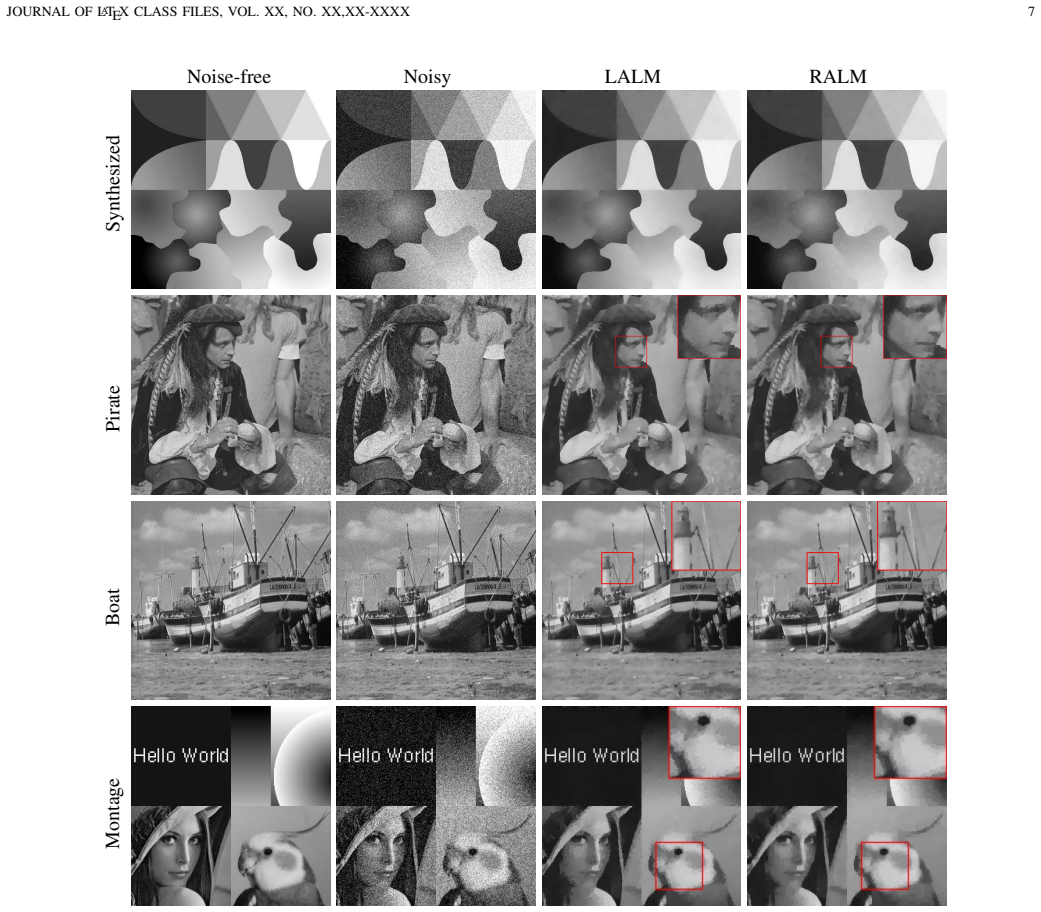
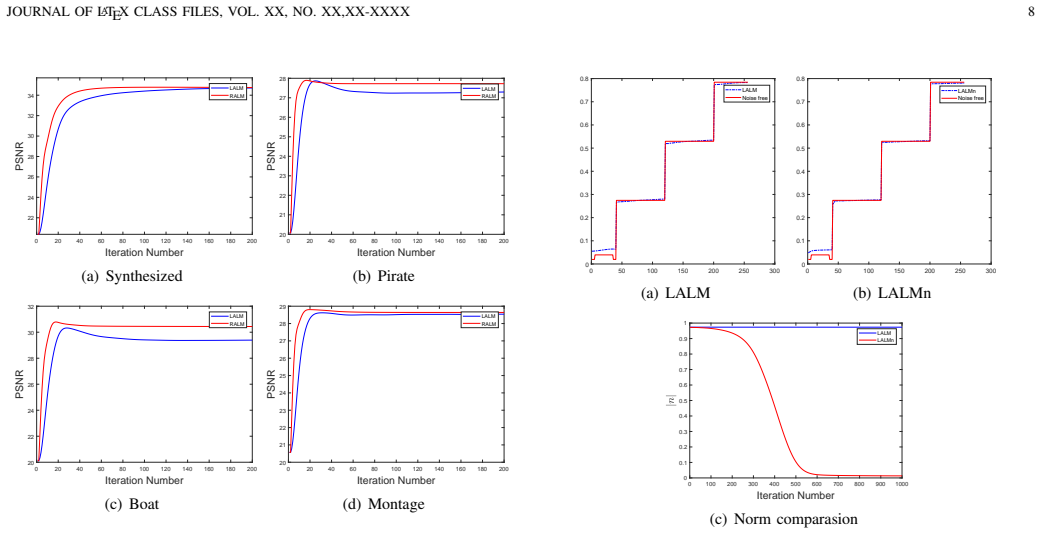
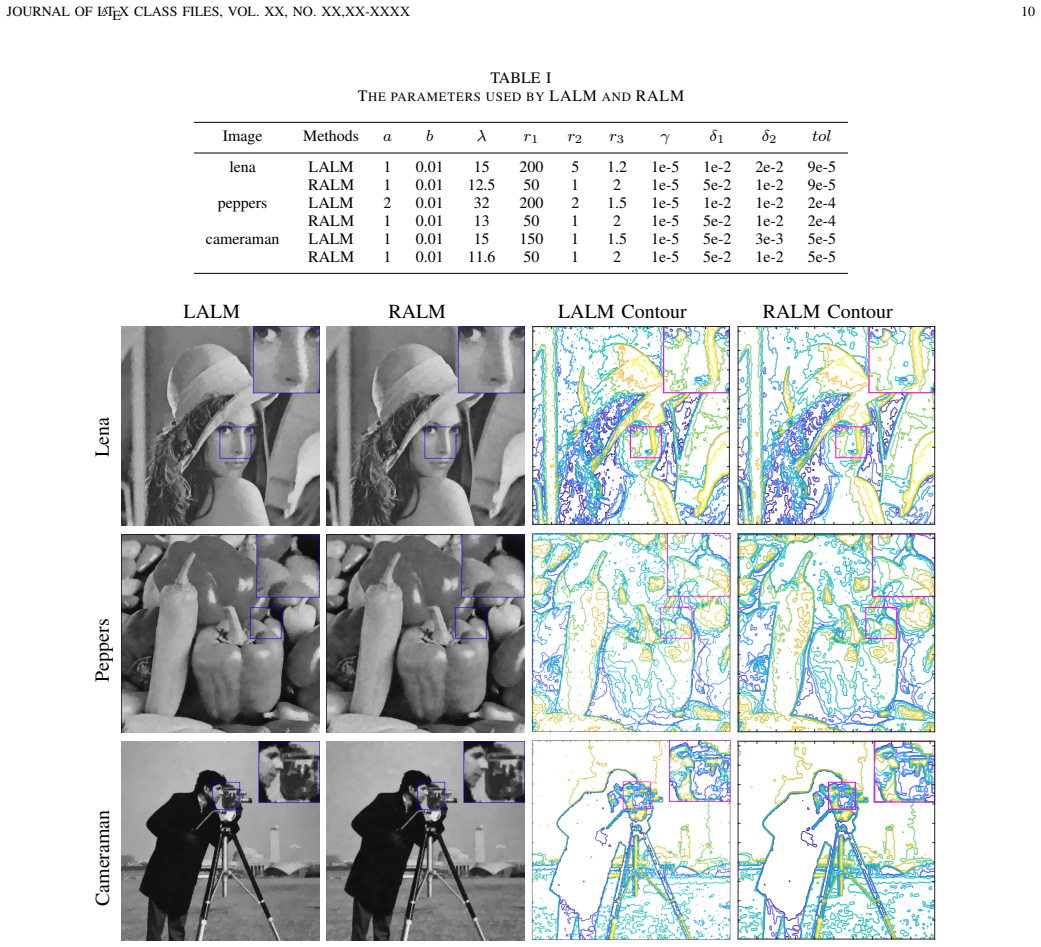
- Images restored by RALM are reported to have higher PSNR, lower NRMSE and NMAD, and less fragmented isophotes than the linearized augmented Lagrangian baseline on the tested images, with far fewer iterations.
- The same cutting-off idea can be applied to other augmented Lagrangian methods for elastica that use different auxiliary splittings, since the inconsistency lies in the formulation rather than in a particular solver.
Reading between the lines
- Not tested in the paper: if the $b\to 0$ consistency is the real driver, RALM's advantage over the baseline should widen as $b$ is made smaller; sweeping $b$ across a range would cleanly test the mechanism rather than just the method.
- The geometric interpretation of $n$ as a normal field whose norm vanishes on flat regions suggests a diagnostic the authors only sketch: monitoring $\|n\|$ could serve as a convergence indicator for elastica solvers, independent of image content.
- The ordered-dependence principle, namely that an essential variable should not depend on variables derived from it, could be stated as a design rule for other high-order variational models with multiple auxiliary variables, such as mean-curvature or inpainting models.
Signed reviews
Editorial analysis
A structured set of objections, weighed in public.
Referee Report
Summary. The paper proposes a restricted linearized augmented Lagrangian method (RALM) for minimizing Euler's elastica energy in image restoration. The authors identify what they call an inconsistency in conventional augmented Lagrangian formulations: when the curvature weight b goes to zero, the elastica functional reduces to the ROF model, but the p-subproblem in the conventional algorithm still depends on the auxiliary variable n and thus does not reduce to the ROF solver. They address this by using the original constraint n = p/|p| instead of p = |p| n and by cutting off the terms in the p-subproblem that couple p to n. They combine this with a linearization technique so that all subproblems have closed-form updates. Numerical experiments on synthetic and real images compare RALM with the linearized augmented Lagrangian method (LALM) of Zhang et al. and report easier parameter tuning, faster convergence, and slightly better PSNR, NRMSE, and NMAD.
Significance. If the algorithm is sound, the paper's core observation about the b-to-zero inconsistency is genuinely thought-provoking and the reported empirical gains in tuning robustness and speed are practically valuable. The paper is commendably explicit in giving pseudocode, parameter tables, and sensitivity/transfer experiments, and it monitors the original elastica energy as well as PSNR. However, the central theoretical status of RALM is not established: the cutting-off strategy changes the augmented Lagrangian being minimized, and no convergence or fixed-point characterization is provided. The design principle behind the cut is an aesthetic consistency requirement rather than a theorem, so the paper currently supports a heuristic algorithm rather than a proven solver for Euler's elastica. The empirical comparison is limited to the authors' own LALM baseline and to four real images, which is not enough to distinguish faster minimization of the original model from convergence to a different limit.
major comments (3)
- [Eqs. (23)-(24) and (26)-(27)] The closed-form updates do not solve the stated Euler-Lagrange equations. For Eq. (23), the solution of (u-u^k)/δ1 + λu = g1 is u^{k+1} = (u^k + δ1 g1)/(1+δ1 λ), not u^{k+1} = u^k + δ1 g1/(1+δ1 λ); the same algebraic error appears in the n-update, where the correct solution of Eq. (26) is n^{k+1} = (n^k + δ2 g2)/(1+δ2(γ+r1)). As printed, Algorithm 1 is inconsistent with the subproblems it is supposed to solve, and this must be corrected or clarified with the intended definition of g1 and g2.
- [Section II-B, Eq. (17)] The p-subproblem is obtained by deleting the terms λ1·(n - p/|p|_ε) and (r1/2)|n - p/|p|_ε|^2 from the augmented Lagrangian L in Eq. (15). RALM is therefore not an alternating minimization scheme for L, and no fixed-point or KKT argument is given to show that a converged iterate satisfies the stationarity conditions of the elastica model (14). At a fixed point with n = s(p) = p/|p|_ε, the p-stationarity condition of L retains the term -(∂s/∂p)^T [λ1 + r1(n-s)], which the algorithm never drives to zero. The claim that RALM minimizes Euler's elastica is thus unsupported; it may solve a modified problem. The authors should either provide a convergence/optimality analysis for RALM or explicitly reframe it as a heuristic solver.
- [Section II-A and Section III-C] The b-to-zero consistency requirement in Observation 2 is an aesthetic design principle rather than a theorem. The experiments in Section III-C show that LALM's iterates depend on r1 when b=0, but this does not establish that enforcing the ROF limit improves optimization of the original elastica model for b>0. Combined with the modified p-subproblem, the lower energy and higher PSNR reported in Figure 8 could reflect convergence to a different limit rather than faster minimization of the same objective. Comparing RALM against at least one additional elastica solver (for example, the methods of Tai et al. [27] or Duan et al. [30]) and reporting the original energy (30) at matched stopping criteria would substantially strengthen the central claim.
minor comments (5)
- [General] There are several typographical errors: 'deinfed' in Section III, 'direclty' in Section III, and 'looses' in Section II-A should be corrected.
- [Eq. (32)] The NRMSE formula appears to omit squares inside the sums; as printed, it is not the standard normalized root-mean-square error, and this should be checked since it is used for quantitative comparisons.
- [Section III-B] In the discussion of Figure 4, the text says 'the norm for RALM should have converged to zero,' but Figure 4(c) compares LALM and LALMn; the sentence is confusing and should refer to the correct algorithm.
- [Section II-A, Observation 1] The phrase 'when p→0, p≠0' is self-contradictory; the intended meaning is presumably 'when |p| is small but nonzero.'
- [Section II-C, Eq. (26)] Depending on the linearization convention, the sign of the ∇λ3 term in Eq. (26) may be inconsistent with the first-order optimality condition for Eq. (18); please verify the sign and, if necessary, correct the expression.
Circularity Check
No significant circularity: the b=0 reduction of RALM is a designed consistency property, and the claimed practical advantages are tested on external images rather than derived from the same assumption.
full rationale
The paper's main derivation is self-contained. The elastica model is reformulated with the original constraint n = p/|p| in (14), the augmented Lagrangian is written in (15), and RALM is defined by cutting off the n-dependent terms in the p-subproblem, giving (17). The b=0 reduction is therefore explicit by construction: when b=0, equations (16)-(17) form a closed iteration that coincides with the ROF augmented Lagrangian iteration. This is a design property, not a fitted prediction. The paper does not tune parameters to manufacture the claimed improvements; the numerical claims about easier parameter tuning, faster convergence, and higher restoration quality are validated on standard images (pirate, boat, montage, lena, peppers, cameraman) by running both algorithms in-house. The only self-citational element is the use of the authors' own LALM [31] as the baseline and the statement that RALM need not be compared with Duan et al. because LALM was already compared with it in [31]. That comparison is not load-bearing for the central derivation: the RALM-vs-LALM experiments are reproduced directly in this paper, and the linearization technique of [31] is re-derived in equations (23)-(27) rather than merely imported as an unverified black box. The skeptical concern that RALM is not a true alternating-minimization solver for the augmented Lagrangian (15) is a correctness or convergence question about whether the fixed point minimizes the elastica energy; it is not a circularity, because the paper does not claim to prove convergence to (14) from the cut subproblem. Overall, no prediction is equivalent to an input by construction, and no load-bearing argument reduces to a self-citation.
Assumptions & free parameters
free parameters (8)
- b =
0.01 or 0.02
- a =
1 or 2
- lambda =
11 to 15.5
- r1 =
10 to 5000
- r2 =
1 to 5
- r3 =
1.2 to 2
- gamma =
1e-5
- delta1, delta2 =
1e-3 to 5e-2
assumptions (3)
- ad hoc to paper For b→0, an augmented Lagrangian solver for elastica should reduce to the augmented Lagrangian solver for ROF.
- domain assumption Alternating minimization applied to the augmented Lagrangian converges to a stationary point of the nonconvex elastica energy.
- standard math The linearization approximation of the quadratic penalty terms preserves the solution of each subproblem.
Cite this review
Pith. "Pith review of Restricted Linearized Augmented Lagrangian Method for Euler's Elastica Model." pith.science (2026). https://pith.science/paper/OO7EJXQY
@misc{pith2026190801429,
  author       = {Pith},
  title        = {Pith review of: Restricted Linearized Augmented Lagrangian Method for Euler's Elastica Model},
  year         = {2026},
  howpublished = {\url{https://pith.science/paper/OO7EJXQY}},
  note         = {Machine review of arXiv:1908.01429}
}
read the original abstract
Euler's elastica model has been extensively studied and applied to image processing tasks. However, due to the high nonlinearity and nonconvexity of the involved curvature term, conventional algorithms suffer from slow convergence and high computational cost. Various fast algorithms have been proposed, among which, the augmented Lagrangian based ones are very popular in the community. However, parameter tuning might be very challenging for these methods. In this paper, a simple cutting-off strategy is introduced into the augmented Lagrangian based algorithms for minimizing the Euler's elastica energy, which leads to easy parameter tuning and fast convergence. The cutting-off strategy is based on an observation of inconsistency inside the augmented Lagrangian based algorithms. When the weighting parameter of the curvature term goes to zero, the energy functional boils down to the ROF model. So, a natural requirement is that its augmented Lagrangian based algorithms should also approach the augmented Lagrangian based algorithms formulated directly for solving the ROF model from the very beginning. Unfortunately, this is not the case for certain existing augmented Lagrangian based algorithms. The proposed cutting-off strategy helps to decouple the tricky dependence between the auxiliary splitting variables, so as to remove the observed inconsistency. Numerical experiments suggest that the proposed algorithm enjoys easier parameter-tuning, faster convergence and even higher quality of image restorations.
Figures

Figures from the paper (4 more)


Reference graph
Works this paper leans on
-
[27]
A fast algorithm for euler’s elastica model using augmented lagrangian method,
X.-C. Tai, J. Hahn, and G. J. Chung, “A fast algorithm for euler’s elastica model using augmented lagrangian method,” SIAM Journal on Imaging Sciences, vol. 4, no. 1, pp. 313–344, 2011
2011
-
[30]
A fast augmented lagrangian method for eulers elastica models,
Y . Duan, Y . Wang, and J. Hahn, “A fast augmented lagrangian method for eulers elastica models,” Numerical Mathematics: Theory, Methods and Applications, vol. 6, no. 1, pp. 47–71, 2013
work page 2013
-
[1]
Nonlinear total variation based noise removal algorithms,
L. I. Rudin, S. Osher, and E. Fatemi, “Nonlinear total variation based noise removal algorithms,” Physica D: Nonlinear Phenomena , vol. 60, no. 1-4, pp. 259–268, 1992
1992
-
[2]
An algorithm for total variation minimization and applications,
A. Chambolle, “An algorithm for total variation minimization and applications,” Journal of Mathematical imaging and vision , vol. 20, no. 1, pp. 89–97, 2004
work page 2004
-
[3]
The split bregman method for l1-regularized problems,
T. Goldstein and S. Osher, “The split bregman method for l1-regularized problems,” SIAM journal on imaging sciences , vol. 2, no. 2, pp. 323– 343, 2009
work page 2009
-
[4]
C. Wu and X.-C. Tai, “Augmented lagrangian method, dual methods, and split bregman iteration for rof, vectorial tv, and high order models,” SIAM Journal on Imaging Sciences , vol. 3, no. 3, pp. 300–339, 2010
work page 2010
-
[5]
An admm algorithm for a class of total variation regularized estimation problems,
B. Wahlberg, S. Boyd, M. Annergren, and Y . Wang, “An admm algorithm for a class of total variation regularized estimation problems,” IFAC Proceedings Volumes, vol. 45, no. 16, pp. 83–88, 2012
2012
-
[6]
D. Mumford, “Elastica and computer vision,” in Algebraic geometry and its applications. Springer, 1994, pp. 491–506
work page 1994
Show all 32 references
-
[7]
Level lines based disocclusion,
S. Masnou and J.-M. Morel, “Level lines based disocclusion,” in Image Processing, 1998. ICIP 98. Proceedings. 1998 International Conference on. IEEE, 1998, pp. 259–263
1998
-
[8]
High-order total variation-based image restoration,
T. Chan, A. Marquina, and P. Mulet, “High-order total variation-based image restoration,”SIAM Journal on Scientific Computing, vol. 22, no. 2, pp. 503–516, 2000
2000
-
[9]
Noise removal using fourth- order partial differential equation with applications to medical magnetic resonance images in space and time,
M. Lysaker, A. Lundervold, and X.-C. Tai, “Noise removal using fourth- order partial differential equation with applications to medical magnetic resonance images in space and time,” IEEE Transactions on image processing, vol. 12, no. 12, pp. 1579–1590, 2003
2003
-
[10]
Multigrid algorithm for high order denoising,
C. Brito-Loeza and K. Chen, “Multigrid algorithm for high order denoising,” SIAM Journal on Imaging Sciences , vol. 3, no. 3, pp. 363– 389, 2010
2010
-
[11]
Unconditionally stable schemes for higher order inpainting,
C.-b. Sch ¨onlieb and A. Bertozzi, “Unconditionally stable schemes for higher order inpainting,” Commun. Math. Sci, vol. 9, no. 2, pp. 413–457, 2011
2011
-
[12]
Augmented lagrangian method for a mean curvature based image denoising model,
W. Zhu, X.-C. Tai, and T. Chan, “Augmented lagrangian method for a mean curvature based image denoising model,” Inverse problems and imaging, vol. 7, no. 4, pp. 1409–1432, 2013
2013
-
[13]
Fast numerical algorithms for eulers elastica inpainting model,
C. Brito-Loeza and K. Chen, “Fast numerical algorithms for eulers elastica inpainting model,” Int. J. Modern Math , vol. 5, no. 2, pp. 157– 182, 2010
2010
-
[14]
A fast relaxed normal two split method and an effective weighted tv approach for euler’s elastica image inpainting,
M. Yashtini and S. H. Kang, “A fast relaxed normal two split method and an effective weighted tv approach for euler’s elastica image inpainting,” SIAM Journal on Imaging Sciences , vol. 9, no. 4, pp. 1552–1581, 2016. JOURNAL OF LATEX CLASS FILES, VOL. XX, NO. XX,XX-XXXX 10 TAB...
2016
-
[15]
A simple fast algorithm for minimization of the elastica energy combing binary and level set representations,
X.-c. Tai and J. Duan, “A simple fast algorithm for minimization of the elastica energy combing binary and level set representations,” UCLA CAM Report, pp. 1–13, 2017
2017
-
[16]
Augmented lagrangian method for an eulers elastica based segmentation model that promotes convex contours,
E. Bae, X.-C. Tai, and W. Zhu, “Augmented lagrangian method for an eulers elastica based segmentation model that promotes convex contours,” Inverse Problems and Imaging, vol. 11, no. 1, pp. 1–23, 2017
2017
-
[17]
Alternating direction method of multiplier for eulers elastica-based denoising,
M. Yashtini and S. H. Kang, “Alternating direction method of multiplier for eulers elastica-based denoising,” in International Conference on Scale Space and Variational Methods in Computer Vision . Springer, 2015, pp. 690–701
2015
-
[18]
Eulers elastica strategy for limited-angle computed tomography image reconstruction,
H. Zhang, L. Wang, Y . Duan, L. Li, G. Hu, and B. Yan, “Eulers elastica strategy for limited-angle computed tomography image reconstruction,” IEEE Transactions on Nuclear Science , vol. 64, no. 8, pp. 2395–2405, 2017
2017
-
[19]
Euler elastica regularized logistic regression for whole-brain decoding of fmri data,
C. Zhang, L. Yao, S. Song, X. Wen, X. Zhao, and Z. Long, “Euler elastica regularized logistic regression for whole-brain decoding of fmri data,” IEEE Transactions on Biomedical Engineering , 2017
2017
-
[20]
Filtering, segmentation and depth,
D. Mumford, M. Nitzberg, and T. Shiota, “Filtering, segmentation and depth,” Lecture Notes in Computer Science , vol. 662, 1993
1993
-
[21]
Euler’s elastica and curvature- based inpainting,
J. Shen, S. H. Kang, and T. F. Chan, “Euler’s elastica and curvature- based inpainting,” SIAM Journal on Applied Mathematics, vol. 63, no. 2, pp. 564–592, 2003
2003
-
[22]
Ni, Variational PDE-based image segmentation and inpainting with applications in computer graphics
K.-Y . Ni, Variational PDE-based image segmentation and inpainting with applications in computer graphics . University of California at JOURNAL OF LATEX CLASS FILES, VOL. XX, NO. XX,XX-XXXX 11 0 100 200 300 400 500 600 700 800 900 1000 Iteration Number 1.5 2 2.5 3 3.5 4 4.5 5 ...
2008
-
[23]
Graph cuts for curvature based image denoising,
E. Bae, J. Shi, and X.-C. Tai, “Graph cuts for curvature based image denoising,” IEEE Transactions on Image Processing , vol. 20, no. 5, pp. 1199–1210, 2011
2011
-
[24]
A two-stage image segmentation method using euler’s elastica regularized mumford- shah model,
Y . Duan, W. Huang, J. Zhou, H. Chang, and T. Zeng, “A two-stage image segmentation method using euler’s elastica regularized mumford- shah model,” in Pattern Recognition (ICPR), 2014 22nd International Conference on. IEEE, 2014, pp. 118–123
2014
-
[25]
Chen, Augmented Lagrangian method for Euler’s elastica based variational models
M. Chen, Augmented Lagrangian method for Euler’s elastica based variational models. The University of Alabama, 2016
2016
-
[26]
A New Operator Splitting Method for Euler’s Elastica Model,
L.-J. Deng, R. Glowinski, and X.-C. Tai, “A New Operator Splitting Method for Euler’s Elastica Model,” arXiv e-prints , p. arXiv:1811.07091, Nov 2018
2018 arXiv
-
[28]
A new augmented lagrangian primal dual algorithm for elastica regularization,
J. Zhang and K. Chen, “A new augmented lagrangian primal dual algorithm for elastica regularization,” Journal of Algorithms & Com- putational Technology, vol. 10, no. 4, pp. 325–338, 2016
2016
-
[29]
Fast algorithms for p-elastica energy with the application to image inpainting and curve reconstruction
J. Hahn, G. J. Chung, Y . Wang, and X.-C. Tai, “Fast algorithms for p-elastica energy with the application to image inpainting and curve reconstruction.” SSVM, vol. 11, pp. 169–182, 2011
2011
-
[31]
Fast linearized augmented lagrangian method for euler’s elastica model,
J. Zhang, R. Chen, C. Deng, and S. Wang, “Fast linearized augmented lagrangian method for euler’s elastica model,” Numerical Mathematics: Theory, Methods and Applications , vol. 10, no. 1, pp. 98–115, 2017
2017
-
[32]
Image denoising using mean curvature of image surface,
W. Zhu and T. Chan, “Image denoising using mean curvature of image surface,” SIAM Journal on Imaging sciences , vol. 5, no. 1, pp. 1–32, 2012
2012
Reviewed August 14, 2026 · model on record in the stance chip above.
Discussion (0). Continue with ORCID to comment.