REVIEW 3 major objections 4 minor 32 references
Image to Video Domain Adaptation Using Web Supervision
T0 review · 3 major / 4 minor · reviewed 2026-08-14 · deepseek-v4-flash
Pith's one-line read This paper claims that a two-stage, appearance-first training procedure turns noisy search-engine images and videos into a video action classifier that reaches 74.9% top-1 on UCF-101 and 42.8% on Kinetics-400.
desk verdict A neat two-stage transfer design whose headline numbers rest on an unstated evaluation boundary that could inflate the reported gains. read the letter →
The pith
A machine-rendered reading of the paper's core claim, the machinery that carries it, and where it could break.
The reading
What carries the argument
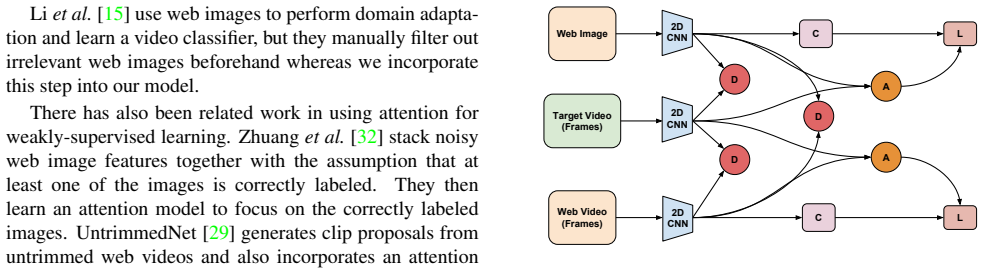
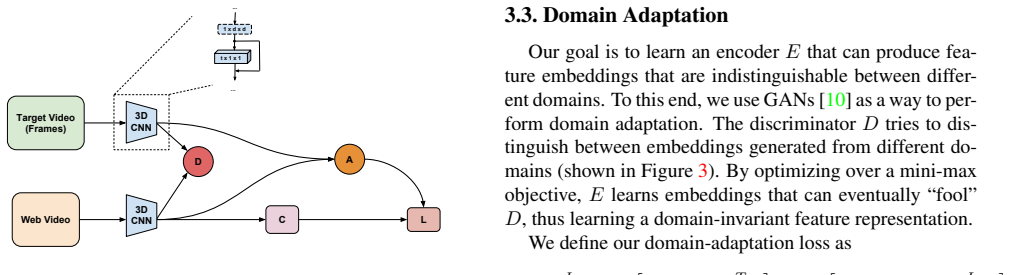
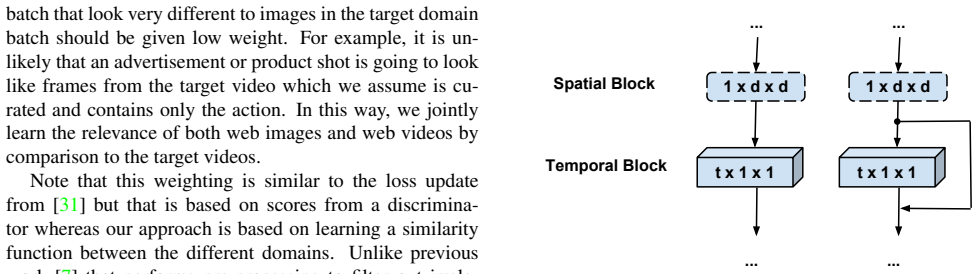
The load-bearing machinery is a combination of two losses optimized jointly with the classifier. A domain-adversarial loss uses a multi-layer discriminator with gradient reversal to make the encoder's embeddings indistinguishable across web images, web video frames, and unlabeled target frames. An attention loss computes, for each web example, a learned similarity $E(x_i) W E(x_k)^\top$ to target frames, keeps the top-$T$ scores per example, softmaxes them, and uses the resulting $\alpha_i$ weights to reweight the cross-entropy classification loss. The video stage starts from the learned spatial filters, fixes them, appends temporal filters initialized to zero with a residual connection, and applies the same attention and domain-adaptation losses to web video chunks versus target chunks.
What would settle it
Run a lower-threshold cosine search or exact-frame matching between the cleaned web images/videos and the official UCF-101 and Kinetics test clips; if even a small percentage of the claimed web-only training data is actually copied from the test set, removing those items would drop the 74.9% and 42.8% figures. A second check is to retrain with target test clips explicitly excluded from the unlabeled batches and confirm the accuracy is unchanged.
Extended reading notes
Core claim
The central claim is that separating appearance learning from motion learning makes webly-supervised video classification tractable: a 2D-CNN first learns domain-invariant, noise-filtered appearance features from web images and frames, and its spatial weights are transferred to a 3D-CNN whose temporal filters are initialized to zero and trained through a residual connection. The paper reports that both auxiliary components help on their own, and together they lift the image model to 72.6% and the video model to 74.9% top-1 on UCF-101, while a model initialized from ImageNet weights and trained directly on web videos reaches only 59.1%, supporting the two-stage ordering.
Load-bearing premise
The result depends on the cleaned web data truly having no duplicate or near-duplicate UCF-101/Kinetics clips, and on the unlabeled target frames used during training being separate from the clips used for the final accuracy measurement; if either is violated, the reported numbers rise.
Editorial extensions
If this is right
- If the two-stage claim is right, obtaining a video classifier for a new action class may require only search-engine images and videos plus unlabeled target clips, not manually annotated target videos.
- The appearance-first transfer means the same 2D image model can be reused as initialization for many video-model instantiations, lowering training cost.
- Because attention and domain adaptation are trained jointly with classification, noisy web data can be filtered during training instead of in a separate preprocessing stage.
- The reported numbers imply that the gap from webly-supervised to fully supervised action recognition on UCF-101 is roughly 23 points, a clear target for the next method.
Reading between the lines
- If the attention mechanism is compared against human relevance judgments on a noisy target domain, one could test whether the learned $\alpha$ weights really track which web images/frames contain the action.
- An audit that checks the cleaned web data against UCF-101 and Kinetics at several cosine thresholds, and verifies that unlabeled target clips are disjoint from test clips, would settle how much of the reported gain depends on the deduplication step.
- The same appearance-first with fixed spatial filters and zero-initialized temporal filters could be tried with stronger video backbones; if the gains persist, the contribution would be the training decomposition plus the two auxiliary losses rather than the specific backbone.
Signed reviews
Editorial analysis
A structured set of objections, weighed in public.
Referee Report
Summary. The paper proposes a two-stage, webly-supervised video classification pipeline. In the first stage, a 2D CNN image model is trained on web images and web video frames with a triplet architecture, a domain-adversarial loss, and a target-relative attention component. In the second stage, the spatial weights of this image model are transferred to a 3D CNN video model, whose temporal filters are trained on web video chunks while the spatial filters are kept fixed; the video model also includes domain adaptation and attention. The method is evaluated on UCF-101 and Kinetics-400, reporting 74.9% and 42.8% top-1 accuracy respectively, and is compared with prior webly-supervised and fully supervised approaches. The central claim is that separating appearance and temporal learning, together with the proposed attention and domain-adaptation components, yields competitive webly-supervised performance while simplifying training relative to multi-stage pipelines such as LeadExceed.
Significance. If the results hold, the paper makes a useful practical contribution: it shows that a two-stage image-to-video transfer procedure with integrated attention and domain adaptation can match, within about 1.4%, a more complex five-stage webly-supervised method on UCF-101, and it provides the first reported webly-supervised results on Kinetics-400. The ablation studies are informative and the two-stage design is supported by the large drop in accuracy when the video model is initialized from ImageNet instead of the web-trained image model. The paper is clearly written and the method is well motivated. However, the absolute gains from the two central components are small, no statistical significance is reported, and the evaluation protocol leaves a potentially load-bearing ambiguity about whether the unlabeled target videos used during training are disjoint from the videos used for scoring.
major comments (3)
- [Sections 3.3, 3.4, and 4.1]
- [Tables 1 and 2, Section 4.3]
- [Abstract, Section 5, and Table 3]
minor comments (4)
- [Section 3.4]
- [Tables 1 and 2]
- [Section 4.2]
- [Tables 3 and 4]
Circularity Check
No circularity found: the central result is an empirical comparison on external benchmarks, not a derivation from its own inputs.
full rationale
The paper's central claim—74.9% top-1 on UCF-101 and 42.8% on Kinetics-400 from webly-supervised data—is an empirical result evaluated against public benchmarks, not a quantity derived from a fitted parameter or from a self-citation. The DA loss (Eqs. 1-4) and attention weighting (Sec. 3.4) are trainable components whose contributions are measured by ablations in Tables 1 and 2; none of these ablations redefines the target metric as a training objective. The two-stage image-to-video design is motivated by external work (R(2+1)D, ResNet) and tested by an ImageNet-initialization comparison, so it is not assumed into existence by citation. The only self-citation is [22], used to justify the Hecate keyframe-extraction tool; this is a minor implementation detail and not load-bearing for the accuracy claim. The paper does leave a possible evaluation-boundary ambiguity: it does not state whether the unlabeled target frames used in DA/attention (Section 3.3-3.4) are disjoint from the UCF-101/Kinetics clips used for scoring, and Section 4.1's cosine-similarity cleanup filters web items rather than target items. That is a potential data-leakage/correctness concern, but it is not a circular derivation: no equation or fitted value in the paper reduces the reported accuracy to its own input by construction. Under the rule that circularity must be exhibited by a specific reduction, no such step exists here.
Assumptions & free parameters
free parameters (5)
- beta tradeoff parameter =
not reported
- tau temperature in attention softmax =
not reported
- Top-T target scores in attention =
not reported
- cosine similarity threshold =
0.9
- web data collection sizes =
800-900 images and 25-50 videos per class
assumptions (7)
- domain assumption Webly-supervised labels and images carry enough semantic signal to learn appearance features.
- domain assumption Curated target videos contain only the target concept and have little noise.
- domain assumption Spatial appearance features transfer from 2D image models to 3D video models, and fixing them while learning temporal filters is beneficial.
- standard math R(2+1)D factorization into spatial then temporal convolutions preserves video modeling capacity.
- domain assumption Adversarial feature alignment across web image, web video, and target video domains improves target classification.
- domain assumption The cosine similarity cleanup at threshold 0.9 removes all overlapping web and target data.
- domain assumption Transductive use of unlabeled target videos during training does not bias evaluation.
Cite this review
Pith. "Pith review of Image to Video Domain Adaptation Using Web Supervision." pith.science (2026). https://pith.science/paper/WQOP3F47
@misc{pith2026190801449,
  author       = {Pith},
  title        = {Pith review of: Image to Video Domain Adaptation Using Web Supervision},
  year         = {2026},
  howpublished = {\url{https://pith.science/paper/WQOP3F47}},
  note         = {Machine review of arXiv:1908.01449}
}
read the original abstract
Training deep neural networks typically requires large amounts of labeled data which may be scarce or expensive to obtain for a particular target domain. As an alternative, we can leverage webly-supervised data (i.e. results from a public search engine) which are relatively plentiful but may contain noisy results. In this work, we propose a novel two-stage approach to learn a video classifier using webly-supervised data. We argue that learning appearance features and then temporal features sequentially, rather than simultaneously, is an easier optimization for this task. We show this by first learning an image model from web images, which is used to initialize and train a video model. Our model applies domain adaptation to account for potential domain shift present between the source domain (webly-supervised data) and target domain and also accounts for noise by adding a novel attention component. We report results competitive with state-of-the-art for webly-supervised approaches on UCF-101 (while simplifying the training process) and also evaluate on Kinetics for comparison.
Figures

Figures from the paper (3 more)

Reference graph
Works this paper leans on
-
[1]
D. Bahdanau, K. Cho, and Y . Bengio. Neural machine trans- lation by jointly learning to align and translate. In ICLR,
-
[2]
K. Bousmalis, N. Silberman, D. Dohan, D. Erhan, and D. Kr- ishnan. Unsupervised pixel-level domain adaptation with generative adversarial networks. In Computer Vision and Pattern Recognition, 2017. 3
work page 2017
-
[3]
J. Carreira and A. Zisserman. Quo vadis, action recognition? A new model and the kinetics dataset. CVPR, 2017. 3, 8
work page 2017
-
[4]
J. Chen, Y . Cui, G. Ye, D. Liu, and S.-F. Chang. Event-driven semantic concept discovery by exploiting weakly tagged in- ternet images. In Proceedings of International Conference on Multimedia Retrieval, 2014. 2
work page 2014
-
[5]
J. Deng, W. Dong, R. Socher, L.-J. Li, K. Li, and L. Fei- Fei. Imagenet: A large-scale hierarchical image database. In Proceedings of the IEEE Conference on Computer Vision and Pattern Recognition, 2009. 7
work page 2009
-
[6]
C. Feichtenhofer, H. Fan, J. Malik, and K. He. Slowfast net- works for video recognition. CoRR, 2018. 8
work page 2018
-
[7]
C. Gan, C. Sun, L. Duan, and B. Gong. Webly-supervised video recognition by mutually voting for relevant web im- ages and web video frames. In European Conference on Computer Vision (ECCV), 2016. 2, 5, 6, 8
work page 2016
-
[8]
C. Gan, T. Yao, K. Yang, Y . Yang, and T. Mei. You lead, we exceed: Labor-free video concept learning by jointly exploit- ing web videos and images. In Computer Vision and Pattern Recognition (CVPR), 2016. 2, 6, 7, 8
work page 2016
Show all 32 references
-
[9]
Ganin, E
Y . Ganin, E. Ustinova, H. Ajakan, P. Germain, H. Larochelle, F. Laviolette, M. Marchand, and V . Lempitsky. Domain- adversarial training of neural networks. Journal of Machine Learning Research, 17(59):1–35, 2016. 2, 3, 5
2016
-
[10]
Goodfellow, J
I. Goodfellow, J. Pouget-Abadie, M. Mirza, B. Xu, D. Warde-Farley, S. Ozair, A. Courville, and Y . Bengio. Gen- erative adversarial nets. In Advances in neural information processing systems, 2014. 2, 3, 4
2014
-
[11]
K. He, X. Zhang, S. Ren, and J. Sun. Deep residual learning for image recognition. In Proceedings of the IEEE Confer- ence on Computer Vision and Pattern Recognition, 2016. 2, 4, 6
2016
-
[12]
Ioffe and C
S. Ioffe and C. Szegedy. Batch normalization: Accelerating deep network training by reducing internal covariate shift. In ICML, 2015. 6
2015
-
[13]
W. Kay, J. Carreira, K. Simonyan, B. Zhang, C. Hillier, S. Vijayanarasimhan, F. Viola, T. Green, T. Back, A. Nat- sev, M. Suleyman, and A. Zisserman. The kinetics human action video dataset. CoRR, abs/1705.06950, 2017. 6, 7, 8
2017 arXiv
-
[14]
Lecun, L
Y . Lecun, L. Bottou, Y . Bengio, and P. Haffner. Gradient- based learning applied to document recognition. In Proceed- ings of the IEEE, pages 2278–2324, 1998. 2
1998
-
[15]
J. Li, Y . Wong, Q. Zhao, and M. S. Kankanhalli. Attention transfer from web images for video recognition. ACM Mul- timedia, 2017. 3, 8
2017
-
[16]
Z. Luo, Y . Zou, J. Hoffman, and L. Fei-Fei. Label efficient learning of transferable representations across domains and tasks. In Conference on Neural Information Processing Sys- tems (NIPS), 2017. 3, 4
2017
-
[17]
S. Ma, S. A. Bargal, J. Zhang, L. Sigal, and S. Sclaroff. Do less and achieve more: Training cnns for action recognition utilizing action images from the web. Pattern Recognition,
-
[18]
Paszke, S
A. Paszke, S. Gross, S. Chintala, G. Chanan, E. Yang, Z. De- Vito, Z. Lin, A. Desmaison, L. Antiga, and A. Lerer. Auto- matic differentiation in pytorch. In NIPS-W, 2017. 6
2017
-
[19]
Z. Qiu, T. Yao, and T. Mei. Learning spatio-temporal repre- sentation with pseudo-3d residual networks. In ICCV, 2017. 3
2017
-
[20]
Simonyan and A
K. Simonyan and A. Zisserman. Two-stream convolutional networks for action recognition in videos. In NIPS, 2014. 8
2014
-
[21]
Singh, X
B. Singh, X. Han, Z. Wu, V . I. Morariu, and L. S. Davis. Selecting relevant web trained concepts for automated event retrieval. In IEEE International Conference on Computer Vision (ICCV), 2015. 2
2015
-
[22]
Y . Song, M. Redi, J. Vallmitjana, and A. Jaimes. To click or not to click: Automatic selection of beautiful thumbnails from videos. In CIKM, 2016. 6
2016
-
[23]
Soomro, A
K. Soomro, A. R. Zamir, and M. Shah. UCF101: A dataset of 101 human actions classes from videos in the wild.CRCV- TR-12-01, 2012. 2, 6, 7, 8
2012
-
[24]
D. Tran, L. Bourdev, R. Fergus, L. Torresani, and M. Paluri. Learning spatiotemporal features with 3d convolutional net- works. In Proceedings of the 2015 IEEE lInternational Con- ference on Computer Vision (ICCV), 2015. 3, 8
2015
-
[25]
D. Tran, H. Wang, L. Torresani, J. Ray, Y . LeCun, and M. Paluri. A closer look at spatiotemporal convolutions for action recognition. In CVPR, 2018. 1, 3, 5, 8
2018
-
[26]
Tzeng, J
E. Tzeng, J. Hoffman, T. Darrell, and K. Saenko. Simultane- ous deep transfer across domains and tasks. In ICCV, 2015. 3
2015
-
[27]
Tzeng, J
E. Tzeng, J. Hoffman, T. Darrell, and K. Saenko. Adversarial discriminative domain adaptation. In Computer Vision and Pattern Recognition (CVPR), 2017. 2, 3
2017
-
[28]
van der Maaten and G
L. van der Maaten and G. Hinton. Visualizing data using t-SNE. Journal of Machine Learning Research, 2008. 2
2008
-
[29]
L. Wang, Y . Xiong, D. Lin, and L. Van Gool. Untrimmednets for weakly supervised action recognition and detection. In CVPR, 2017. 2, 3
2017
-
[30]
X. Wang, R. Girshick, A. Gupta, and K. He. Non-local neural networks. In CVPR, 2018. 8
2018
-
[31]
Zhang, Z
J. Zhang, Z. Ding, W. Li, and P. Ogunbona. Importance weighted adversarial nets for partial domain adaptation. In Computer Vision and Pattern Recognition (CVPR), 2018. 3, 5
2018
-
[32]
Zhuang, L
B. Zhuang, L. Liu, Y . Li, C. Shen, and I. D. Reid. Attend in groups: a weakly-supervised deep learning framework for learning from web data. In CVPR, 2017. 3, 5
2017
Reviewed August 14, 2026 · model on record in the stance chip above.
Discussion (0). Continue with ORCID to comment.