REVIEW 2 major objections 4 minor 17 references
Minimum Energy Analysis for Robust Gaussian Joint Source-Channel Coding with a Square-Law Profile
T0 review · 2 major / 4 minor · reviewed 2026-08-14 · deepseek-v4-flash
Pith's one-line read This paper claims that the minimum energy for the square-law distortion-noise profile lies between $0.9057\sqrt{\alpha}$ and $2.3203\sqrt{\alpha}$, significantly tightening previously known bounds.
desk verdict Genuine improvement on both bounds for the square-law profile, with a real but fixable gap in the upper-bound proof. read the letter →
The pith
A machine-rendered reading of the paper's core claim, the machinery that carries it, and where it could break.
The reading
What carries the argument
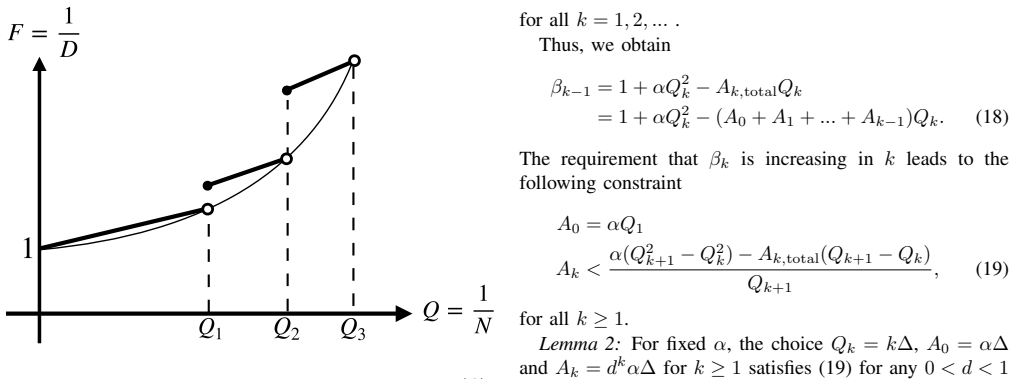
The load-bearing object for the upper bound is the inclined staircase fidelity function. On each noise-quality interval $Q_k\le Q<Q_{k+1}$, the scheme's achieved fidelity is piecewise linear, $F(Q)=\beta_k+Q A_{k+1,\mathrm{total}}$, where $\beta_k$ is the inverse quantization-error variance and $A_{k+1,\mathrm{total}}$ is the cumulative uncoded energy sent in the first $k+1$ layers. If that staircase remains at or above the convex profile $1+\alpha Q^2$ and touches it at the jump points $Q_k$, then summing the uncoded energies $A_k/\beta_k$ and digital energies $B_k$ gives the upper bound. The lower bound rests on the $K=2$ case of a general $K$-receiver outer bound for Gaussian source broadcast, converted into a two-variable numerical optimization.
What would settle it
Evaluate the inclined staircase $F(Q)=\beta_k+Q A_{k+1,\mathrm{total}}$ with the paper's optimized parameters $d^*=0.999$ and $c^*=0.00137$ (so $Q_k=k c^*\sqrt{\alpha}$) on each interval $[Q_k,Q_{k+1})$; if for any $k$ and any $Q$ in that interval $F(Q)<1+\alpha Q^2$, then the proof of the upper bound as written is incomplete, and if no such dip exists, the missing monotonicity check is satisfied.
Extended reading notes
Core claim
The paper's central claim is that the minimum energy for the square-law profile is proportional to $\sqrt{\alpha}$ with a constant between $0.9057$ and $2.3203$. The lower bound comes from a two-receiver version of a broadcast-channel converse bound: optimizing the auxiliary parameters yields $0.9057\sqrt{\alpha}$. The upper bound comes from a $K$-layer coding scheme in which the source is successively quantized, each quantization error is also sent uncoded, and the digital indices are sent with binning against receiver side information; as $K\to\infty$ and after numerical optimization of the layer spacings and energies, the total energy is no more than $2.3203\sqrt{\alpha}$. The paper positions this as a significant tightening of the earlier bounds rather than an exact characterization.
Load-bearing premise
The upper bound stands on the assumption that the inclined staircase fidelity function stays above the convex square-law profile for all channel qualities, meeting it only at the chosen jump points; the proof shows only that the staircase parameters are increasing, not that the staircase never dips below the profile.
Editorial extensions
If this is right
- For any square-law distortion-noise profile, no transmission scheme can use less than $0.9057\sqrt{\alpha}$ energy per source symbol, and the proposed layered scheme achieves $2.3203\sqrt{\alpha}$.
- The gap between the best known lower and upper bounds shrinks from about a factor of 7.1 to about 2.56, so the true minimum-energy constant is pinned to a much narrower interval.
- Because both bounds scale linearly with $\sqrt{\alpha}$, doubling the profile parameter doubles the energy budget's scale: the required energy scales as the square root of the fidelity-curve curvature.
- The upper-bound construction generalizes the earlier uncoded-first-layer scheme: setting all but the first uncoded energy to zero recovers the previous scheme, so the improvement is a strict generalization rather than a separate method.
Reading between the lines
- The same inclined-staircase construction should extend to any convex fidelity-quality profile: if one can prove the piecewise-linear majorization condition, the energy sum will give an upper bound; the square-law profile is the first test case.
- Running the same numerical lower-bound optimization with $K=3$ or more receivers is a natural next step and could push the lower constant further toward the true value.
- The unproved above-curve condition in Theorem 4 is checkable by direct computation for the optimized parameters; if it fails, the numerical constant $2.3203$ would need to be re-derived, though the general scheme may still work with adjusted parameters.
- The model assumes the receiver knows the noise variance exactly; relaxing that to estimated noise would likely require a different robust-coding formulation, so the energy bounds here are a baseline for unknown-channel design rather than a full solution.
Signed reviews
Editorial analysis
A structured set of objections, weighed in public.
Referee Report
Summary. The paper considers the minimum energy per source symbol required for robust transmission of a unit-variance Gaussian source over an AWGN channel whose noise variance may be any positive value, subject to a distortion-noise profile D(N). Working with the fidelity-quality profile F(Q)=1/D(1/Q), the authors study the square-law profile F(Q)=1+alpha Q^2. They prove an improved lower bound E_min(F) >= 0.9057 sqrt(alpha) (Theorem 3) by instantiating the K=2 case of a multi-receiver broadcast outer bound from prior work, and they propose a layered joint source-channel coding scheme with multiple uncoded transmissions and Wyner-Ziv binning that yields an improved upper bound E_min(F) <= 2.3203 sqrt(alpha) (Theorem 4). The main results are supported by algebraic derivations and by numerical optimization of the free parameters.
Significance. If the bounds are correct, the paper meaningfully tightens the previously known constants for a nontrivial robustness profile, and the coding scheme is an elegant extension of the hybrid digital-analog approach: sending each quantization error uncoded adds energy but enriches the side information for the subsequent digital layers. The lower-bound technique demonstrates a clean adaptation of a broadcast outer bound to the energy-limited setting, and the paper provides explicit algebraic expressions for the achievable fidelity function. The main concerns are a gap in the proof of the upper bound's dominance property and the lack of a reproducible numerical verification of the claimed constants; both appear addressable in revision and do not undermine the underlying approach.
major comments (2)
- [IV-B (Theorem 4 proof, Eqs. (16)-(19))] The claim that the piecewise-linear function F(Q)=beta_k + Q A_{k+1,total} is always above the profile F(Q)=1+alpha Q^2 is not established by the argument given. Equality at the jump points, expressed in (17), fixes the right endpoint of each segment, and condition (19) only ensures that beta_k is increasing. A linear segment with these parameters can dip below a convex parabola inside the interval unless the left-endpoint value is also checked. The proof must explicitly verify, for each k, that beta_k + Q_k A_{k+1,total} >= 1+alpha Q_k^2, equivalently A_{k+1,total} <= alpha(Q_{k+1}+Q_k). With the choices Q_k=k*Delta, A_0=alpha*Delta, and A_k=d^k*alpha*Delta for k>=1, this reduces to (1-d^{k+1})/(1-d) <= 2k+1. This inequality in fact follows from the condition proved in Lemma 2 after rearrangement, but the paper does not show that connection; the reader cannot reconstruct the above-profile claim without doing additional work. Because the upper bound's achievability rests on this domination property, this is a load-bearing gap in the proof of Theorem 4.
- [Theorems 3 and 4] The numerical constants 0.9057 and 2.3203 are presented as results of numerical optimization, but the manuscript does not provide a verifiable calculation. For Theorem 3, the paper should state explicitly that evaluating the expression in (8) at the reported q1*, q2*, tau* yields a value equal to 0.9057 sqrt(alpha) (or at least >= 0.9057 sqrt(alpha)). For Theorem 4, the infinite series in (27) at c*=0.00137, d*=0.999 needs to be evaluated with a rigorous bound on the truncation error, or the authors should provide the partial-sum data or code. Without this, the claimed constants are not formally supported by the text, even though they are likely correct and easily checkable from the explicit formulas.
minor comments (4)
- [Introduction] The sentence containing 'Furthermore,it is represented that exponential profiles are not achievable' should read 'Furthermore, it is reported that exponential profiles are not achievable'.
- [Introduction] The phrase 'we can point military situation, indoor fires and emergency conditions' should be reworded, for example 'we can point to military situations, indoor fires, and emergency conditions'.
- [IV-B (proof of Theorem 4)] The phrase 'In other words, (17)' after stating that the fidelity-quality tradeoff is 'always above the profile' is misleading: equation (17) only imposes equality at the jump points, not dominance over each interval. The dominance condition should be stated and proved separately.
- [Lemma 2 proof, Eq. (20)] The expression '(d^k-1)/(d-1)' is written without parentheses in the displayed equation; it should be typeset as (d^k-1)/(d-1) or, since d<1, preferably as (1-d^k)/(1-d) to avoid sign ambiguity.
Circularity Check
No significant circularity: the improved bounds follow from an independent broadcast-channel outer bound and an explicit constructive coding scheme.
full rationale
The paper's claimed contributions are improved constants for E_min(1+alpha Q^2). The lower bound in Theorem 3 is obtained by specializing the independent broadcast outer bound of Tian et al./Reznic et al. as stated in Lemma 1 (originally proved in [10]); the optimization over q1, q2, and tau is a numerical maximization of a fixed expression, not a fit to the target constant. The upper bound in Theorem 4 is an explicit K-layer quantize-and-bin scheme; the energy expression in (27) is minimized over c and d, and the resulting 2.3203 sqrt(alpha) is a valid upper bound if the stated inclined-staircase coverage condition holds. No quantity in the derivation is defined in terms of the constant being proved, no fitted value is relabeled as a prediction, and no uniqueness claim is imported from the authors' prior work. The only concern evident from inspection is a missing explicit verification that the linear segments in (16) stay above the convex profile between jump points; this is a proof gap in the manuscript, not circularity, because the scheme and energy calculation do not presuppose the bound. The self-citation [10] supplies Lemma 1 and previous bounds, but Lemma 1 is grounded in external broadcast-channel converses, so it constitutes independent support and does not raise the circularity score.
Assumptions & free parameters
free parameters (3)
- q* (K=1 lower bound optimizer) =
2.01
- q1*, q2*, τ* (K=2 lower bound optimizers) =
1.5496, 5.6679, 0.1285
- c*, d* (upper bound optimizers) =
0.00137, 0.999
assumptions (5)
- domain assumption For a fixed noise variance N, the minimum energy to achieve distortion D is N log(1/D) (source-channel separation for Gaussian source and AWGN channel).
- domain assumption The broadcast channel outer bound of Lemma 1, taken from [10] and ultimately [15] and [16], holds for the Gaussian source broadcasting setting.
- standard math Wyner-Ziv binning achieves the rate R_k = I(S_{k-1}; S_hat_k | side information) as stated in the coding scheme.
- domain assumption The infinite-bandwidth AWGN channel capacity per source symbol with energy B and noise N is B/(2N) nats.
- standard math Matrix determinant lemma and Sherman-Morrison-Woodbury identity are valid.
Cite this review
Pith. "Pith review of Minimum Energy Analysis for Robust Gaussian Joint Source-Channel Coding with a Square-Law Profile." pith.science (2026). https://pith.science/paper/PG7EDQWH
@misc{pith2026190801463,
  author       = {Pith},
  title        = {Pith review of: Minimum Energy Analysis for Robust Gaussian Joint Source-Channel Coding with a Square-Law Profile},
  year         = {2026},
  howpublished = {\url{https://pith.science/paper/PG7EDQWH}},
  note         = {Machine review of arXiv:1908.01463}
}
read the original abstract
A distortion-noise profile is a function indicating the maximum allowed source distortion value for each noise level in the channel. In this paper, the minimum energy required to achieve a distortion noise profile is studied for Gaussian sources which are transmitted robustly over Gaussian channels. We provide improved lower and upper bounds for the minimum energy behavior of the square-law profile using a family of lower bounds and our proposed coding scheme.
Figures
Reference graph
Works this paper leans on
-
[10]
On minimum energy for robust Gaussian joint source-channel coding with a distortion-noise profile,
E. Koken and E. Tuncel, “On minimum energy for robust Gaussian joint source-channel coding with a distortion-noise profile,” IEEE International Symposium on Information Theory , Aachen, Germany, June 2017
work page 2017
-
[1]
Sending a bivariate Gaussian over a Gaussian MAC,
A. Lapidoth and S. Tinguely, “Sending a bivariate Gaussian over a Gaussian MAC,” IEEE Transactions on Information Theory , vol. 56, no. 6, pp. 2714 - 2752, Jun. 2010
work page 2010
-
[2]
Joint source-channel coding via hybrid coding,
P. Minero, S. Lim, and Y .-H. Kim, “Joint source-channel coding via hybrid coding,” IEEE International Symposium on Information Theory Proceedings (ISIT), pp. 781-785, Jul. 2011
work page 2011
-
[3]
Interference channels with arbitrarily correlated sources,
W. Liu and B. Chen, “Interference channels with arbitrarily correlated sources,” IEEE Transactions on Information Theory , vol. 57, no. 12, pp. 8027-8037, Dec. 2011
work page 2011
-
[4]
Joint source channel coding with side information using hybrid digital analog codes,
M. P. Wilson, K. Narayanan, and G. Caire, “Joint source channel coding with side information using hybrid digital analog codes,” IEEE Transactions on Information Theory , vol. 56, no. 10, pp. 49224940, Oct. 2010
work page 2010
-
[5]
Hybrid digital-analog transmission for the Gaussian one-helper problem,
I. Estella and D. Gunduz, “Hybrid digital-analog transmission for the Gaussian one-helper problem,” IEEE Global Telecommunications Conference (GLOBECOM 2010) , pp. 1 -5, Dec. 2010
work page 2010
-
[6]
Energy- distortion tradeoffs in Gaussian joint source-channel coding problems,
A. Jain, D. Gunduz, S. R. Kulkarni, H. V . Poor, and S. Verd, “Energy- distortion tradeoffs in Gaussian joint source-channel coding problems,” IEEE Transactions on Information Theory , vol. 58, no. 5, pp. 3153- 3168, May 2012
work page 2012
-
[7]
On the minimum energy of sending correlated sources over the Gaussian MAC,
N. Jiang, Y . Yang, A. Host-Madsen, and Z. Xiong, “On the minimum energy of sending correlated sources over the Gaussian MAC,” IEEE Transactions on Information Theory , vol. 60, no. 10, pp. 6254-6275, Aug. 2014
work page 2014
Show all 17 references
-
[8]
On the energy-distortion tradeoff for the Gaussian broadcast problem,
E. Koken and E. Tuncel, “On the energy-distortion tradeoff for the Gaussian broadcast problem,” IEEE International Symposium on Information Theory, Barcelona, Spain, Jul. 2016
2016
-
[9]
Energy-distortion exponents in lossy transmission of Gaussian sources over Gaussian channels,
E. Koken, D. Gunduz, and E. Tuncel, “Energy-distortion exponents in lossy transmission of Gaussian sources over Gaussian channels,” IEEE Transactions on Information Theory , vol. 63, no. 2, pp. 1227-1236, Feb. 2017
2017
-
[11]
Comments on unknown channels,
K. Woyach, K. Harrison, G. Ranade, and A. Sahai, “Comments on unknown channels,” IEEE Information Theory Workshop (ITW) , pp. 172-176, Sep. 2012
2012
-
[12]
Using zero-rate feedback on binary additive channels with individual noise sequences,
K. Eswaran, A. D. Sarwate, A. Sahai, and M. Gastpar, “Using zero-rate feedback on binary additive channels with individual noise sequences,” IEEE International Symposium on Information Theory , Nice, France, Jun. 2007
2007
-
[13]
The porosity of additive noise se- quences,
V . Misra and T. Weissman, “The porosity of additive noise se- quences,” IEEE International Symposium on Information Theory , Istanbul, Turkey, Jul. 2012
2012
-
[14]
Communication over individual channels,
Y . Lomnitz and M. Feder, “Communication over individual channels,” IEEE Transactions on Information Theory , vol. 57, no. 11, pp. 7333- 7358, Nov. 2011
2011
-
[15]
Approximate characterization for the Gaussian source broadcast distortion region,
C. Tian, S. Diggavi, S. Shamai, “Approximate characterization for the Gaussian source broadcast distortion region,” IEEE Transactions on Information Theory, vol. 57, no. 8, pp. 124-136, Jan. 2011
2011
-
[16]
Distortion bounds for broadcast- ing with bandwidth expansion,
Z. Reznic, M. Feder, and R. Zamir, “Distortion bounds for broadcast- ing with bandwidth expansion,” IEEE Transactions on Information Theory, vol. 52, no. 8, pp. 3778-3788, Aug. 2006
2006
-
[17]
Eigenvalues of rank-one updated matrices with some applications,
J. Ding and A. Zhou, “Eigenvalues of rank-one updated matrices with some applications,” Applied Mathematics Letters , vol. 20, no. 12, pp. 1223-1226, 2007
2007
Reviewed August 14, 2026 · model on record in the stance chip above.
Discussion (0). Continue with ORCID to comment.