REVIEW 3 major objections 6 minor 40 references
CameraNet: A Two-Stage Framework for Effective Camera ISP Learning
T0 review · 3 major / 6 minor · reviewed 2026-08-14 · deepseek-v4-flash
Pith's one-line read CameraNet splits the camera ISP pipeline into restoration and enhancement stages, outperforming one-stage networks and standard raw converters on HDR+, SID, and FiveK.
desk verdict The two-stage restoration/enhancement decomposition is a genuinely useful architectural idea and is fairly supported by ablations, but the headline claim of beating traditional ISP pipelines rests on a comparison where the groundtruths and baselines come from the same tool family. read the letter →
The pith
A machine-rendered reading of the paper's core claim, the machinery that carries it, and where it could break.
The reading
What carries the argument
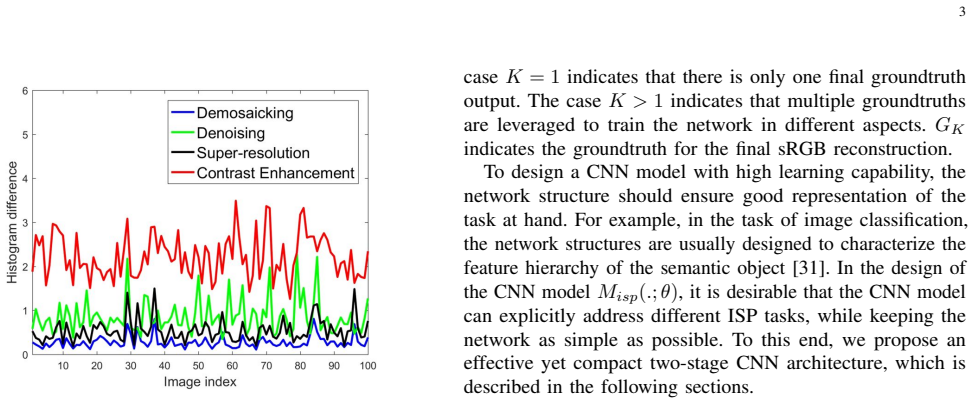
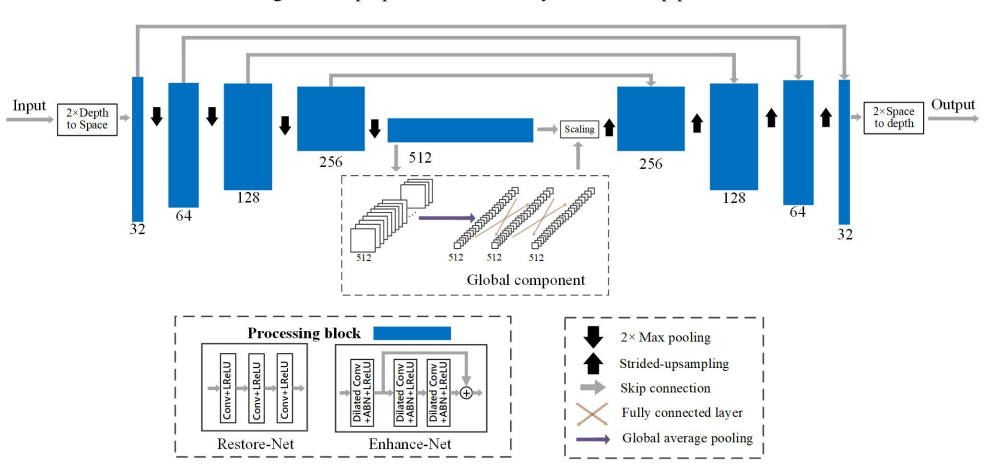
The load-bearing idea is the two-stage grouping of ISP subtasks into weakly correlated clusters: restoration tasks (demosaicking, denoising, white balance) versus enhancement tasks (tone mapping, contrast, color style). The authors support this split with a histogram test showing that enhancement operators change the pixel-value distribution far more strongly than restoration operators do. The machinery that carries the argument is a pair of U-Net modules with a global pooling branch that applies per-channel scaling; Restore-Net operates in CIE XYZ space, Enhance-Net in sRGB space, and both are trained in three steps: separate $\ell^1$ losses for the two stages followed by a joint loss that balances the restoration and enhancement terms. The two groundtruths make the intermediate restoration target explicit, which is why the two networks can be trained in parallel before the joint fine-tune.
What would settle it
Train a one-stage network with the same total parameter count, epochs, and $\ell^1$ loss on the same HDR+, SID, and FiveK splits; the two-stage claim would collapse if that network matched or beat CameraNet's PSNR, SSIM, and color error. A sharper variant would rebuild the SID and HDR+ enhancement groundtruths with several independent retouchers and check whether the two-stage advantage persists across all styles or only under the Adobe/HDR+ looks.
Extended reading notes
Core claim
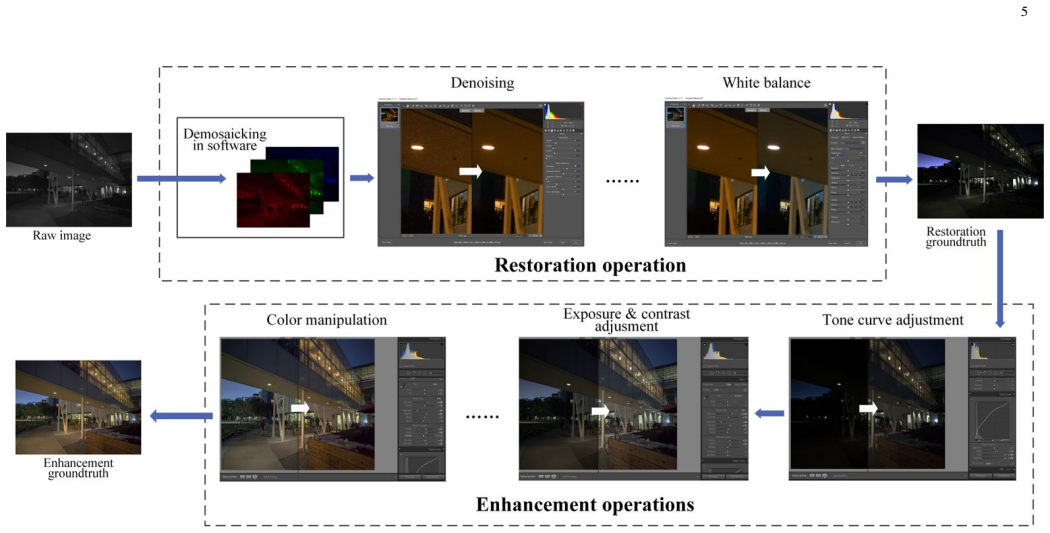
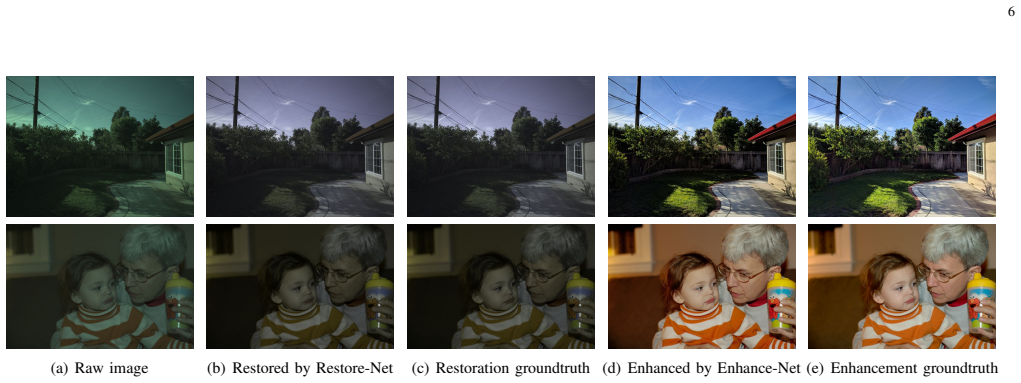
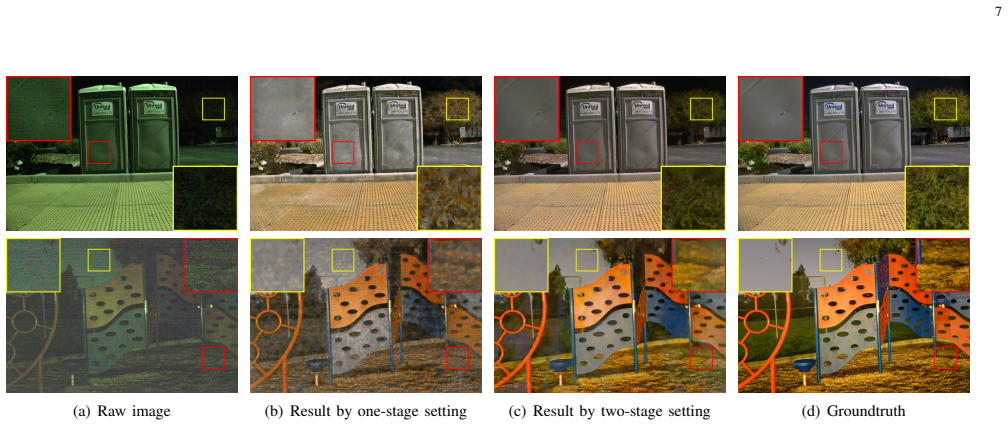
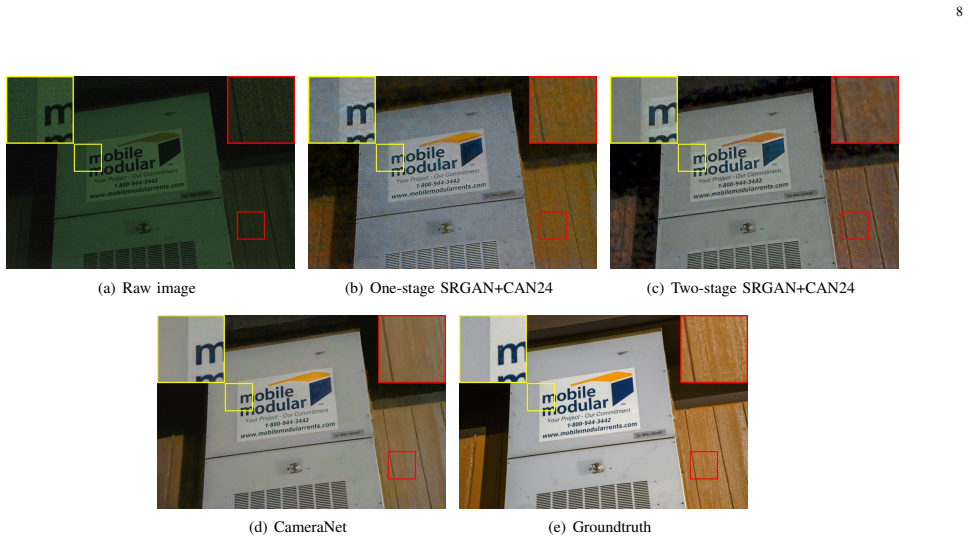
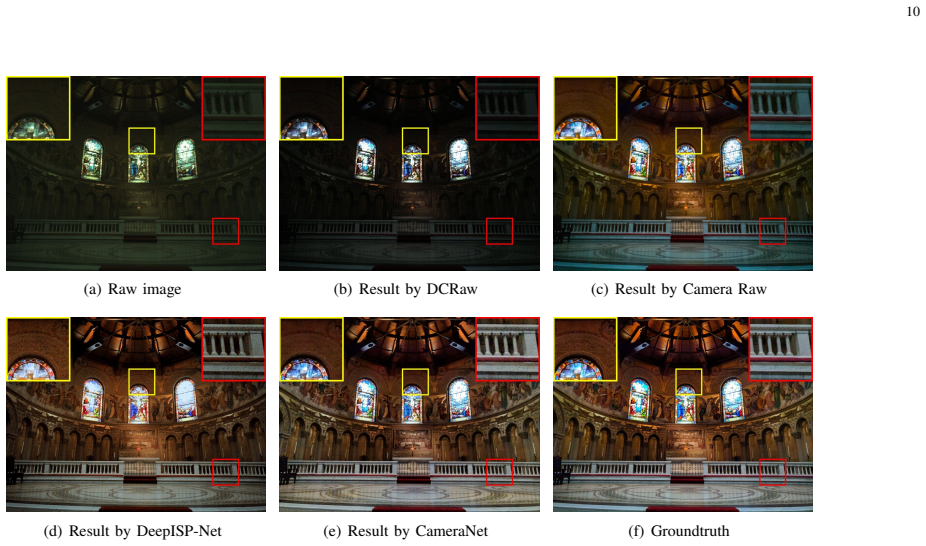
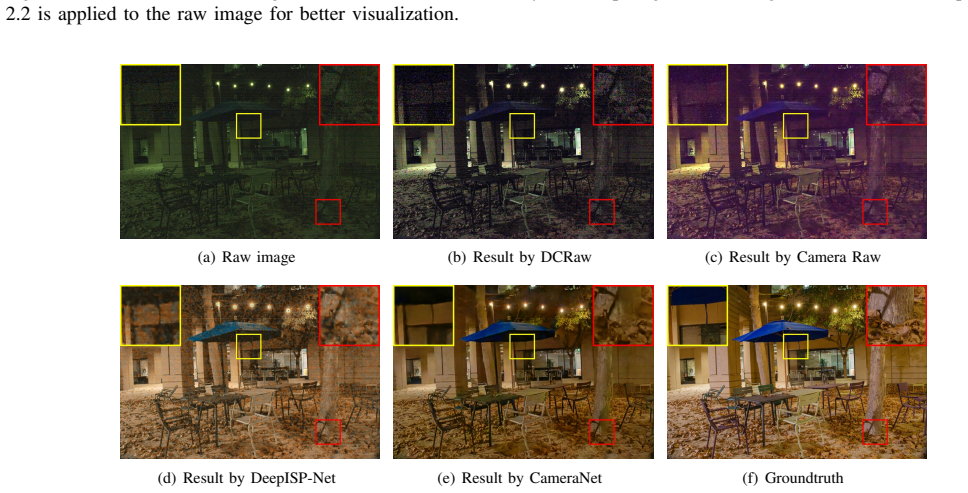
The central claim is that the structure of an ISP pipeline, not just the depth or capacity of the network, determines how well raw-to-sRGB reconstruction can be learned. CameraNet models the pipeline as two sequential CNN modules: Restore-Net first turns the prepared raw image into a white-balanced, denoised, demosaicked image in CIE XYZ space, and Enhance-Net then turns that restored image into the final sRGB image, applying tone mapping, detail enhancement, and color-style manipulation. The two modules are trained with two groundtruths that arise naturally in photography workflows: a restoration groundtruth produced by demosaicking, denoising, white balancing, and color conversion, and an enhancement groundtruth produced by retouching that restored image. The authors report that this explicit separation, trained independently with $\ell^1$ losses and then jointly fine-tuned, outperforms a one-stage network of comparable size, the one-stage DeepISP network, and the traditional DCRaw and Adobe Camera Raw pipelines on all three datasets, with the clearest margins in the low-light SID data.
Load-bearing premise
The training and evaluation assume that the enhancement groundtruths created with DCRaw plus Adobe tools or the HDR+ algorithm are valid targets for a high-quality sRGB image; if those styling choices are arbitrary, the reported quality gains measure fidelity to particular editing styles, not absolute image quality.
Editorial extensions
If this is right
- New cameras could adopt the same two-stage architecture and only regenerate the two groundtruths for their sensor and editing style, avoiding hand-tuning of individual ISP blocks.
- The largest margins over one-stage learning appear in low-light scenes where restoration dominates, so separating denoising from enhancement should be a default design for night-mode photography.
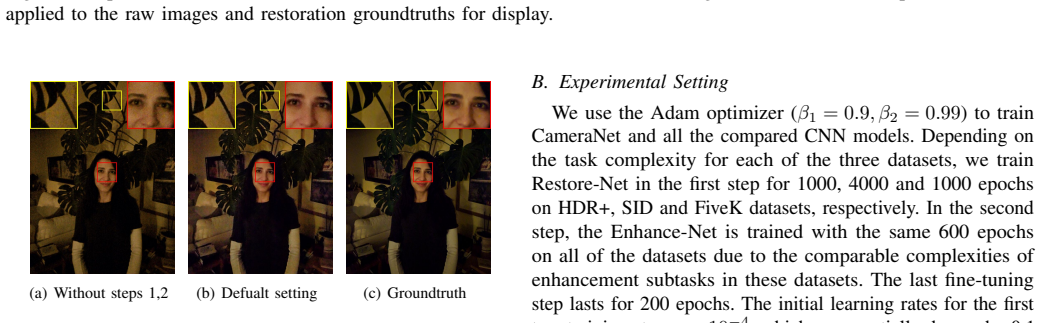
- The joint fine-tuning step is what lets the restoration network contribute to the final look; removing it produces localized color artifacts such as the sky-region discontinuity shown in the paper.
- The two-stage advantage holds across two different backbone choices, U-Net and SRGAN+CAN24, indicating the benefit comes from the task split rather than from one specific architecture.
Reading between the lines
- The same restore-then-enhance separation could generalize to video ISP, where a single network would risk amplifying temporal noise during tone mapping; a two-stage design could denoise first and stylize second.
- Because the enhancement groundtruth encodes a particular retouching workflow, the reported numerical gains are relative to the Adobe/HDR+ look; a stronger test would train and evaluate against multiple independent photographers' styles and report the spread.
- The cross-camera color stability reported for CameraNet suggests a practical path to camera-agnostic models: keep the XYZ-space restoration stage fixed and adapt only the sRGB enhancement stage per device.
- An immediate experimental extension is to search over the stage boundary itself, for instance moving white balance into the enhancement stage or splitting tone mapping out of enhancement, to test whether the two-cluster grouping is optimal or merely sufficient.
Signed reviews
Editorial analysis
A structured set of objections, weighed in public.
Referee Report
Summary. The paper proposes CameraNet, a two-stage CNN framework for learning a full camera ISP pipeline from raw sensor data. The pipeline first restores the raw image in CIE XYZ space with a U-Net (Restore-Net), then performs tone mapping, detail enhancement, and color manipulation in sRGB space with a second U-Net (Enhance-Net). Two groundtruths are generated for training: a restoration groundtruth produced by DCRaw and an enhancement groundtruth produced by Adobe Lightroom/Photoshop or the HDR+ retouching pipeline. The networks are trained in three steps: separate training of each module, followed by joint fine-tuning with a weighted loss. Experiments on HDR+, SID, and FiveK compare CameraNet with DeepISP-Net, DCRaw, and Adobe Camera Raw, and include ablations and cross-camera generalization tests.
Significance. If validated, the two-stage design is a useful contribution to data-driven ISP learning: it explicitly separates restoration and enhancement, and the ablations in Table I support the claim that this separation improves over a one-stage model with comparable capacity. The cross-camera experiment in Table III is informative and suggests a practical advantage of operating in a perceptually motivated color space. The paper also evaluates on three public benchmarks and compares with external baselines rather than only self-comparisons. However, the headline claim of outperforming traditional ISP pipelines is weakened by the fact that the training targets are themselves produced by the same DCRaw/Adobe tool family used as baselines, so the reported margins are partly by construction. The lack of multiple runs and error bars further limits the strength of the quantitative claims.
major comments (3)
- [IV-D, Table II] The comparison with DCRaw and Adobe Camera Raw is confounded by the way the groundtruths are constructed. Section III-D and Section IV-A state that the restoration groundtruths on all three datasets are created with DCRaw, and the enhancement groundtruths are created with Lightroom/Photoshop auto-enhancement or the HDR+ retouching algorithm. Table II then compares CameraNet against DCRaw and Camera Raw using those same groundtruths as reference. A model trained to regress to those exact targets is expected to score higher PSNR/SSIM and lower color error than default DCRaw or Camera Raw auto-mode, which do not reproduce that specific editing style. The abstract's claim that CameraNet 'outperforms traditional ISP pipelines' should therefore be qualified. I would suggest either adding an independent evaluation criterion (e.g., a human preference study or a test where the traditional pipelines are given the same target editing style) or explicitly reframing the claim as 'more accurately reproduces the specified target ISP style.'
- [Tables I-III] All quantitative results are reported from single training runs without error bars, confidence intervals, or significance tests. For the larger margins in Table II this may be acceptable, but several numbers that support the paper's claims are close: the FiveK SSIM values in Table II are 0.848 vs. 0.845, and the cross-camera PSNR values for Canon EOS 40D in Table III are 20.98 vs. 20.87. Run-to-run variation in CNN training can easily be of this magnitude. Please report the mean and standard deviation over multiple runs, or otherwise justify why the reported differences are stable. This is directly relevant to the word 'consistently' in the abstract.
- [IV-D] DeepISP-Net is reimplemented without official code, but the manuscript does not provide the implementation details used for the reimplementation (architecture variants, training schedule, loss function, or hyperparameters beyond 'trained until convergence'). This makes the comparison difficult to reproduce and leaves open the possibility that the baseline is unintentionally weakened. Please provide the full reimplementation details or release the reimplemented code.
minor comments (6)
- [Fig. 2] The histogram-change experiment demonstrates that contrast enhancement changes the image intensity distribution more than demosaicking, denoising, or super-resolution, but it does not directly establish that restoration and enhancement are 'weakly correlated' as task clusters. Consider strengthening this motivation with an analysis of error correlation between the two groups of operations.
- [Footnote 2] The color error metric excludes image regions with luminance outside (0.05, 0.95). Since different pipelines handle underexposed and overexposed regions very differently, this exclusion may bias the reported color error comparisons. Please report full-range values as well, or justify the masking choice.
- [III-E, Eq. (6)] The expression 'log(max(I_xyz_rest), epsilon)' appears to be a typo; it should likely be 'log(max(I_xyz_rest, epsilon))' so that the maximum is taken element-wise with epsilon.
- [IV-D] The description of the Adobe Camera Raw baseline as 'manually look for the best noise reduction setting for each compared image' is not a reproducible protocol. Please specify the exact settings or the search procedure used.
- [III-E, Eq. (9)] The joint loss weight lambda is set differently for each dataset (0.5, 0.9, and 0.1). The choice is explained qualitatively, but a small sensitivity analysis on lambda would help the reader understand how robust the method is to this hyperparameter.
- [IV-D, SID paragraph] There is a typo: 'we can the that CameraNet outperforms' should read 'we can see that CameraNet outperforms.'
Circularity Check
No significant circularity: the two-stage CameraNet claim is empirically supported by external benchmarks and ablations; the DCRaw/Adobe groundtruth overlap is a benchmark caveat, not a circular reduction.
full rationale
CameraNet's central claim is an empirical learning result, not a theorem derived from its own premises. The two losses, Lrest (Eq. 6) and Lenh (Eq. 7), compare network outputs to independently created groundtruths G_xyz_rest and G_srgb_enh; no fitted parameter is later renamed as a prediction. The two-stage advantage is established by ablations (Table I) that hold training data and losses fixed while varying only the architecture and training scheme, so the measured gains are not forced by construction. The cross-camera experiments (Table III) transfer a fixed network to unseen sensors and are a genuine generalization test. Self-citations such as [11], [15], and [19] appear only as related work or as implementation choices (e.g., initial demosaicking kernels), and they are not load-bearing for the main conclusion. The DCRaw/Adobe overlap between groundtruth generation and the DCRaw/Camera Raw baselines is a legitimate benchmarking caveat: on SID and FiveK, enhancement targets are produced with Adobe tools while Adobe Camera Raw is a baseline, and DCRaw contributes to restoration targets while also being a baseline. This gives CameraNet the advantage of regressing toward the same target style it is scored against. However, this is not circularity in the derivation chain: the network outputs are not equal to the targets by construction, and all methods are evaluated against the same reference images. The paper itself acknowledges the subjectivity of G_srgb_enh in Section III-D. No derivation step reduces to its own input.
Assumptions & free parameters
free parameters (4)
- lambda in joint loss (Eq. 9) =
0.5 (HDR+), 0.9 (SID), 0.1 (FiveK)
- Color error measurement luminance range =
0.05 to 0.95
- RGB-to-XYZ color matrix =
average of ColorMatrix1 and ColorMatrix2 from metadata
- Restore-Net training epochs =
1000 (HDR+), 4000 (SID), 1000 (FiveK)
assumptions (4)
- domain assumption ISP subtasks can be partitioned into two weakly correlated clusters: restoration and enhancement.
- domain assumption The subjective enhancement groundtruth images (Photoshop auto-enhance, Lightroom expert C, HDR+ algorithm outputs) are valid targets for training and evaluation.
- domain assumption XYZ color space is appropriate for restoration and sRGB for enhancement, with fixed linear conversions.
- standard math L1 losses in linear and log domains are sufficient supervision for ISP learning.
Cite this review
Pith. "Pith review of CameraNet: A Two-Stage Framework for Effective Camera ISP Learning." pith.science (2026). https://pith.science/paper/3MLZ5N3T
@misc{pith2026190801481,
  author       = {Pith},
  title        = {Pith review of: CameraNet: A Two-Stage Framework for Effective Camera ISP Learning},
  year         = {2026},
  howpublished = {\url{https://pith.science/paper/3MLZ5N3T}},
  note         = {Machine review of arXiv:1908.01481}
}
read the original abstract
Traditional image signal processing (ISP) pipeline consists of a set of individual image processing components onboard a camera to reconstruct a high-quality sRGB image from the sensor raw data. Due to the hand-crafted nature of the ISP components, traditional ISP pipeline has limited reconstruction quality under challenging scenes. Recently, the convolutional neural networks (CNNs) have demonstrated their competitiveness in solving many individual image processing problems, such as image denoising, demosaicking, white balance and contrast enhancement. However, it remains a question whether a CNN model can address the multiple tasks inside an ISP pipeline simultaneously. We make a good attempt along this line and propose a novel framework, which we call CameraNet, for effective and general ISP pipeline learning. The CameraNet is composed of two CNN modules to account for two sets of relatively uncorrelated subtasks in an ISP pipeline: restoration and enhancement. To train the two-stage CameraNet model, we specify two groundtruths that can be easily created in the common workflow of photography. CameraNet is trained to progressively address the restoration and the enhancement subtasks with its two modules. Experiments show that the proposed CameraNet achieves consistently compelling reconstruction quality on three benchmark datasets and outperforms traditional ISP pipelines.
Figures


Figures from the paper (13 more)




Reference graph
Works this paper leans on
-
[1]
Color image processing pipeline,
R. Ramanath, W. E. Snyder, Y . Yoo, and M. S. Drew, “Color image processing pipeline,” IEEE Signal Processing Magazine , vol. 22, no. 1, pp. 34–43, Jan 2005
work page 2005
-
[2]
A software platform for manipulating the camera imaging pipeline,
H. C. Karaimer and M. S. Brown, “A software platform for manipulating the camera imaging pipeline,” in European Conference on Computer Vision (ECCV), 2016
work page 2016
-
[3]
Flexisp: A flexible camera image processing framework,
F. Heide, M. Steinberger, Y .-T. Tsai, M. Rouf, D. Paj ˛ ak, D. Reddy, O. Gallo, J. Liu, W. Heidrich, K. Egiazarian, J. Kautz, and K. Pulli, “Flexisp: A flexible camera image processing framework,” ACM Trans- actions on Graphics (TOG) , vol. 33, no. 6, pp. 231:1–231:13, Nov. 2014
work page 2014
-
[4]
Burst photography for high dynamic range and low-light imaging on mobile cameras,
S. W. Hasinoff, D. Sharlet, R. Geiss, A. Adams, J. T. Barron, F. Kainz, J. Chen, and M. Levoy, “Burst photography for high dynamic range and low-light imaging on mobile cameras,” ACM Transactions on Graphics (Proc. SIGGRAPH Asia) , vol. 35, no. 6, 2016
work page 2016
-
[5]
X. T. M. U. Ziwei Liu, Lu Yuan and J. Sun, “Fast burst images denoising,” ACM Transactions on Graphics (TOG) , vol. 33, no. 6, 2014
work page 2014
-
[6]
Burst denoising with kernel prediction networks,
B. Mildenhall, J. T. Barron, J. Chen, D. Sharlet, R. Ng, and R. Car- roll, “Burst denoising with kernel prediction networks,” in The IEEE Conference on Computer Vision and Pattern Recognition (CVPR) , June 2018
work page 2018
-
[7]
Ffdnet: Toward a fast and flexible solution for cnn-based image denoising,
K. Zhang, W. Zuo, and L. Zhang, “Ffdnet: Toward a fast and flexible solution for cnn-based image denoising,” IEEE Transactions on Image Processing, vol. 27, no. 9, pp. 4608–4622, Sept 2018
work page 2018
-
[8]
Beyond a Gaussian denoiser: Residual learning of deep CNN for image denoising,
K. Zhang, W. Zuo, Y . Chen, D. Meng, and L. Zhang, “Beyond a Gaussian denoiser: Residual learning of deep CNN for image denoising,” IEEE Transactions on Image Processing , vol. 26, no. 7, pp. 3142–3155, 2017
work page 2017
Show all 40 references
-
[9]
Fc4: Fully convolutional color constancy with confidence-weighted pooling,
Y . Hu, B. Wang, and S. Lin, “Fc4: Fully convolutional color constancy with confidence-weighted pooling,” in Proceedings of the IEEE Confer- ence on Computer Vision and Pattern Recognition (CVPR) , 2017, pp. 4085–4094
2017
-
[10]
Color constancy using cnns,
S. Bianco, C. Cusano, and R. Schettini, “Color constancy using cnns,” in 2015 IEEE Conference on Computer Vision and Pattern Recognition Workshops, CVPR Workshops 2015, Boston, MA, USA, June 7-12, 2015 , 2015, pp. 81–89
2015
-
[11]
Color image demosaicking via deep residual learning,
R. Tan, K. Zhang, W. Zuo, and L. Zhang, “Color image demosaicking via deep residual learning,” in 2017 IEEE International Conference on Multimedia and Expo (ICME) . IEEE, 2017, pp. 793–798
2017
-
[12]
Deep joint demo- saicking and denoising,
M. Gharbi, G. Chaurasia, S. Paris, and F. Durand, “Deep joint demo- saicking and denoising,” ACM Transactions on Graphics (TOG) , vol. 35, no. 6, pp. 191:1–191:12, Nov. 2016
2016
-
[13]
Deep photo enhancer: Unpaired learning for image enhancement from photographs with gans,
Y .-S. Chen, Y .-C. Wang, M.-H. Kao, and Y .-Y . Chuang, “Deep photo enhancer: Unpaired learning for image enhancement from photographs with gans,” in Proceedings of IEEE International Conference on Computer Vision and Pattern Recognition (CVPR) , June 2018, pp. 6306– 6314
2018
-
[14]
Deep bilateral learning for real-time image enhancement,
M. Gharbi, J. Chen, J. T. Barron, S. W. Hasinoff, and F. Durand, “Deep bilateral learning for real-time image enhancement,” ACM Transactions on Graphics (TOG) , vol. 36, no. 4, pp. 118:1–118:12, 2017
2017
-
[15]
Learning a deep single image contrast enhancer from multi-exposure images,
J. Cai, S. Gu, and L. Zhang, “Learning a deep single image contrast enhancer from multi-exposure images,” IEEE Transactions on Image Processing, vol. 27, no. 4, pp. 2049–2062, 2018
2018
-
[16]
Learning to see in the dark,
C. Chen, Q. Chen, J. Xu, and V . Koltun, “Learning to see in the dark,” in The IEEE Conference on Computer Vision and Pattern Recognition (CVPR), June 2018
2018
-
[17]
Deepisp: Toward learning an end-to-end image processing pipeline,
E. Schwartz, R. Giryes, and A. M. Bronstein, “Deepisp: Toward learning an end-to-end image processing pipeline,” IEEE Transactions on Image Processing, vol. 28, no. 2, pp. 912–923, 2019
2019
-
[18]
Learning photographic global tonal adjustment with a database of input / output image pairs,
V . Bychkovsky, S. Paris, E. Chan, and F. Durand, “Learning photographic global tonal adjustment with a database of input / output image pairs,” in The IEEE Conference on Computer Vision and Pattern Recognition (CVPR), 2011, pp. 97–104
2011
-
[19]
Color demosaicking by local directional interpolation and nonlocal adaptive thresholding,
L. Zhang, X. Wu, A. Buades, and X. Li, “Color demosaicking by local directional interpolation and nonlocal adaptive thresholding,” Journal of Electronic imaging, vol. 20, p. 023016, 2011
2011
-
[20]
Image denoising by sparse 3-d transform-domain collaborative filtering,
K. Dabov, A. Foi, V . Katkovnik, and K. Egiazarian, “Image denoising by sparse 3-d transform-domain collaborative filtering,” IEEE Transactions on Image Processing , vol. 16, no. 8, pp. 2080–2095, Aug 2007
2007
-
[21]
Beyond white: Ground truth colors for color constancy correction,
D. Cheng, B. Price, S. Cohen, and M. S. Brown, “Beyond white: Ground truth colors for color constancy correction,” in 2015 IEEE International Conference on Computer Vision (ICCV) , Dec 2015, pp. 298–306
2015
-
[22]
Automatic exposure correction of consumer photographs,
L. Yuan and J. Sun, “Automatic exposure correction of consumer photographs,” in Computer Vision – ECCV 2012 . Berlin, Heidelberg: Springer Berlin Heidelberg, 2012, pp. 771–785
2012
-
[23]
Learning the image processing pipeline,
H. Jiang, Q. Tian, J. Farrell, and B. A. Wandell, “Learning the image processing pipeline,” IEEE Transactions on Image Processing , vol. 26, no. 10, pp. 5032–5042, Oct 2017
2017
-
[24]
Learning a deep convolutional network for image super-resolution,
C. Dong, C. C. Loy, K. He, and X. Tang, “Learning a deep convolutional network for image super-resolution,” in Computer Vision – ECCV 2014 . Cham: Springer International Publishing, 2014, pp. 184–199
2014
-
[25]
Fast image processing with fully- convolutional networks,
Q. Chen, J. Xu, and V . Koltun, “Fast image processing with fully- convolutional networks,” in The IEEE International Conference on Computer Vision (ICCV) , Oct 2017
2017
-
[26]
Deep residual network for joint demosaicing and super-resolution,
R. Zhou, R. Achanta, and S. Süsstrunk, “Deep residual network for joint demosaicing and super-resolution,” CoRR, vol. abs/1802.06573, 2018
2018 arXiv
-
[27]
Trinity of pixel enhancement: a joint solution for demosaicking, denoising and super-resolution,
G. Qian, J. Gu, J. S. Ren, C. Dong, F. Zhao, and J. Lin, “Trinity of pixel enhancement: a joint solution for demosaicking, denoising and super-resolution,” CoRR, vol. abs/1905.02538, 2019
1905 arXiv
-
[28]
Joint demosaicing and super-resolution imaging from a set of unregistered aliased images,
P. Vandewalle, K. Krichane, D. Alleysson, and S. Süsstrunk, “Joint demosaicing and super-resolution imaging from a set of unregistered aliased images,” in Digital Photography III, San Jose, CA, USA, January 29-30, 2007 , 2007, p. 65020A
2007
-
[29]
Naturalness preserved enhancement algorithm for non-uniform illumination images,
S. Wang, J. Zheng, H. Hu, and B. Li, “Naturalness preserved enhancement algorithm for non-uniform illumination images,” IEEE Transactions on Image Processing, vol. 22, no. 9, pp. 3538–3548, 2013
2013
-
[30]
A database of human segmented natural images and its application to evaluating segmentation algorithms and measuring ecological statistics,
D. R. Martin, C. C. Fowlkes, D. Tal, and J. Malik, “A database of human segmented natural images and its application to evaluating segmentation algorithms and measuring ecological statistics,” in Proceedings of the Eighth International Conference On Computer Vision (ICCV-01), ...
2001
-
[31]
Visualizing and understanding convolutional networks,
M. D. Zeiler and R. Fergus, “Visualizing and understanding convolutional networks,” in Computer Vision - ECCV 2014 - 13th European Conference, Zurich, Switzerland, September 6-12, 2014, Proceedings, Part I , 2014, pp. 818–833
2014
-
[32]
Revisiting radiometric calibration for color computer vision,
H. T. Lin, S. J. Kim, S. Süsstrunk, and M. S. Brown, “Revisiting radiometric calibration for color computer vision,” in IEEE International Conference on Computer Vision, ICCV 2011, Barcelona, Spain, November 6-13, 2011 , 2011, pp. 129–136
2011
-
[33]
An empirical camera model for internet color vision
A. Chakrabarti, D. Scharstein, and T. Zickler, “An empirical camera model for internet color vision.” in BMVC, vol. 1, no. 2. Citeseer, 2009, p. 4
2009
-
[34]
Joint demosaicing and denoising,
K. Hirakawa and T. W. Parks, “Joint demosaicing and denoising,” IEEE Transactions on Image Processing , vol. 15, no. 8, pp. 2146–2157, 2006
2006
-
[35]
Why you should forget luminance conversion and do something better,
R. H. M. Nguyen and M. S. Brown, “Why you should forget luminance conversion and do something better,” in 2017 IEEE Conference on Computer Vision and Pattern Recognition (CVPR) , 2017, pp. 5920–5928
2017
-
[36]
U-net: Convolutional networks for biomedical image segmentation,
O. Ronneberger, P. Fischer, and T. Brox, “U-net: Convolutional networks for biomedical image segmentation,” in Medical Image Computing and Computer-Assisted Intervention – MICCAI 2015 . Cham: Springer International Publishing, 2015, pp. 234–241
2015
-
[37]
Perceptual losses for real-time style transfer and super-resolution,
J. Johnson, A. Alahi, and L. Fei-Fei, “Perceptual losses for real-time style transfer and super-resolution,” in Computer Vision - ECCV 2016 - 14th European Conference, Amsterdam, The Netherlands, October 11-14, 2016, Proceedings, Part II , 2016, pp. 694–711
2016
-
[38]
Photo-realistic single image super-resolution using a generative adversarial network,
C. Ledig, L. Theis, F. Huszar, J. Caballero, A. Cunningham, A. Acosta, A. P. Aitken, A. Tejani, J. Totz, Z. Wang, and W. Shi, “Photo-realistic single image super-resolution using a generative adversarial network,” in 2017 IEEE Conference on Computer Vision and Pattern Recognit...
2017
-
[39]
Loss functions for image restoration with neural networks,
H. Zhao, O. Gallo, I. Frosio, and J. Kautz, “Loss functions for image restoration with neural networks,” IEEE Transactions on Computational Imaging, vol. 3, no. 1, pp. 47–57, March 2017
2017
-
[40]
HDR image reconstruction from a single exposure using deep cnns,
G. Eilertsen, J. Kronander, G. Denes, R. K. Mantiuk, and J. Unger, “HDR image reconstruction from a single exposure using deep cnns,” ACM Transactions on Graphics (TOG) , vol. 36, no. 6, pp. 178:1–178:15, 2017
2017
Reviewed August 14, 2026 · model on record in the stance chip above.
Discussion (0). Continue with ORCID to comment.