REVIEW 4 major objections 7 minor 54 references
Pixel2Mesh++: Multi-View 3D Mesh Generation via Deformation
T0 review · 4 major / 7 minor · reviewed 2026-08-14 · deepseek-v4-flash
Pith's one-line read The paper claims that multi-view 3D shape generation improves when a graph network deforms a coarse mesh by scoring local candidate vertex moves with cross-view feature statistics, and that this beats prior multi-view methods on ShapeNet.
desk verdict Solid, well-executed extension of Pixel2Mesh with a genuine multi-view gain, but the fixed 0.02 deformation step makes the robustness-to-initialization claims the weak spot that should be pinned down before the paper is taken at face value. read the letter →
The pith
A machine-rendered reading of the paper's core claim, the machinery that carries it, and where it could break.
The reading
What carries the argument
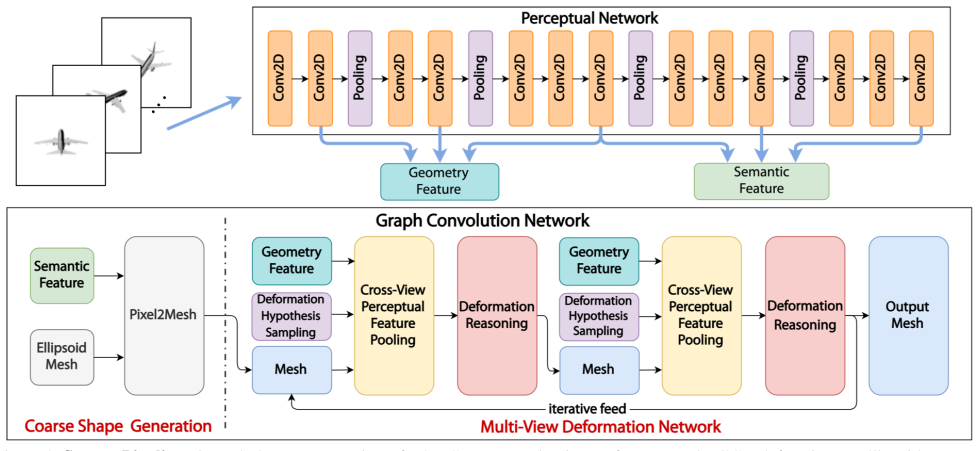
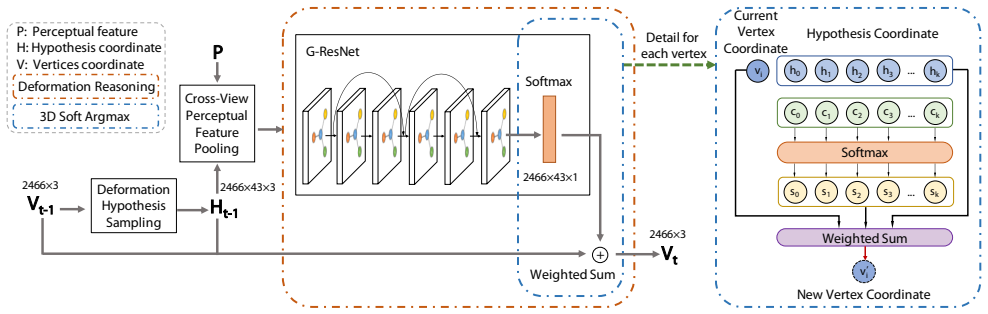
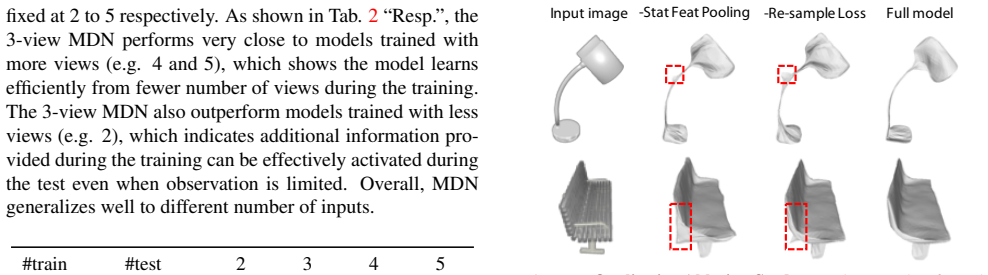
The load-bearing object is the Multi-View Deformation Network (MDN), a per-vertex local graph of 43 hypothesis nodes: the current vertex plus the 42 points of a level-1 icosahedron at scale $0.02$. Each node carries a $1347$-dimensional feature built from the 3D vertex coordinate and the mean, max, and standard deviation of early-layer perceptual features pooled from all views at that node's projected location; six shared graph-residual layers score every hypothesis, softmax normalizes the scores, and the updated vertex is the weighted sum of all hypothesis positions. This turns a multi-view-geometry-style correspondence search into a trainable layer that is invariant to the number and order of input views. A secondary mechanism, a re-sampled Chamfer loss that uniformly samples predicted mesh faces by area, suppresses flying-vertex artifacts and is reported to be necessary for the full gain.
What would settle it
A decisive test is to feed the trained model a coarse mesh whose vertices are systematically translated by, say, $0.1$ (five times the $0.02$ hypothesis radius) and compare the output with ground truth; if the model cannot recover the shift within its three iterations, the bounded local search is the limiting factor. A complementary check is to measure the distribution of distances from MVP2M coarse vertices to the nearest ground-truth surface: if a large fraction of vertices are farther than $0.06$ (three iterations times the per-step radius), the reported gains cannot be fully explained by the deformation search alone and must rely on priors or on re-sampling luck.
Extended reading notes
Core claim
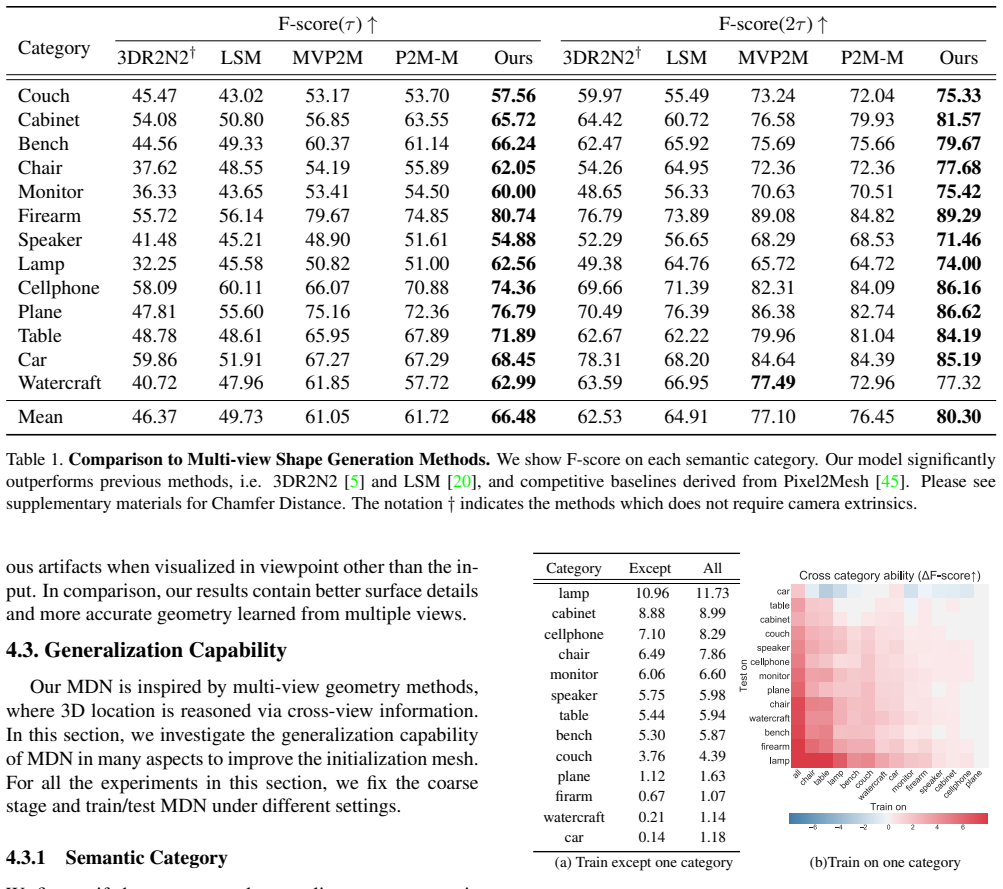
On its own terms, the paper claims that the Multi-View Deformation Network (MDN) is a better multi-view shape generator than previous direct-prediction models because it treats shape generation as iterative local refinement instead of hallucination. For every vertex of a coarse mesh, the network places 42 candidate locations on a level-1 icosahedron of radius $0.02$ around the vertex, pools early-layer VGG features at each candidate from all input views through bilinear interpolation, compresses the pooled features into order-invariant statistics (mean, max, and standard deviation), and scores the candidates with a shared graph convolutional network. Softmax turns the scores into weights and the vertex moves to their weighted sum, a differentiable 3D soft-argmax that can be trained end-to-end. The paper reports that on the ShapeNet benchmark this refinement raises F-score from 61.05 for the multi-view Pixel2Mesh baseline to 66.48 and lowers Chamfer distance from 0.541 to 0.486, while also improving results when the coarse mesh is noisy, translated, or taken from a voxel-based reconstruction.
Load-bearing premise
The argument rests on every required vertex correction being reachable by repeated small jumps of at most $0.02$ per iteration from the current mesh, because the network can only move a vertex inside the convex hull of its 42 local candidate positions.
Editorial extensions
If this is right
- Multi-view mesh generation can be structured as a refinement module on top of any coarse shape generator, rather than as a single learned mapping from pixels to mesh.
- A network trained with three views can accept two, four, or five views at test time and keeps improving as views are added, because statistics pooling keeps the feature dimension fixed.
- The same refinement network repairs coarse meshes from other systems, including voxel reconstructions converted by marching cubes, so the method is not tied to its own initialization.
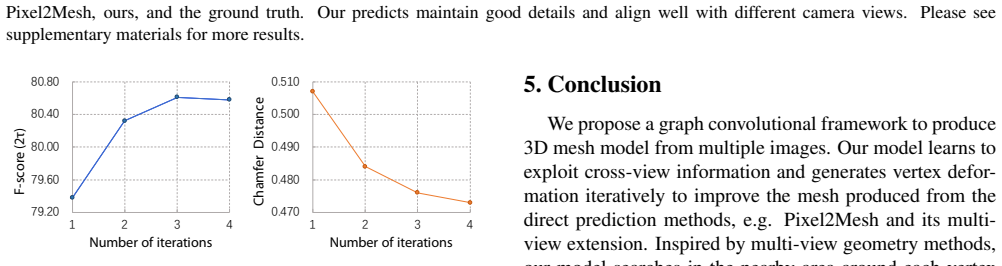
- More refinement iterations continue to improve accuracy until roughly three iterations, after which gains saturate.
- Replacing the vertex-only Chamfer loss with an area-uniform re-sampled version removes flying-vertex spikes and is required for the reported gains.
Reading between the lines
- Editorial inference: the fixed $0.02$ hypothesis radius makes MDN a local refinement operator; an adaptive or scheduled radius across iterations could extend it to correct large global misalignments such as an off-center or wrongly scaled object.
- Editorial inference: because the scoring network is shared across vertices and categories, the learned operator may approximate a generic photo-consistency measure on early visual features; if so, it should transfer to novel categories beyond the 13-class ShapeNet set, a claim the paper does not test.
- Editorial inference: the hypothesis-scoring plus statistics pattern could be applied to other per-vertex mesh attributes, such as per-face texture or part labels, wherever cross-view consistency is a useful signal.
- Editorial inference: feeding deliberately conflicting views (for example, views of two different object instances) would separate genuine geometric reasoning from category-level shape priors; the paper's framing predicts the statistics pooling should favor geometrically consistent evidence.
Signed reviews
Editorial analysis
A structured set of objections, weighed in public.
Referee Report
Summary. The paper proposes Pixel2Mesh++, a method for generating 3D meshes from a few color images with known camera poses. The pipeline first produces a coarse mesh using a multi-view extension of Pixel2Mesh (MVP2M), then iteratively refines it with a Multi-View Deformation Network (MDN). MDN samples deformation hypotheses from a level-1 icosahedron of scale 0.02 around each vertex, pools perceptual features from the input views via mean/max/std statistics, and uses a graph convolutional scoring network with a soft-argmax to update vertex positions. The model is trained end-to-end with a re-sampled Chamfer loss. On ShapeNet, the authors report state-of-the-art F-score and Chamfer distance against 3DR2N2 and LSM, and they provide ablations on feature statistics, the re-sampled loss, number of views, iterations, and initialization robustness.
Significance. If the results hold, the paper presents a solid engineering contribution: an iterative, view-count-invariant deformation network that improves mesh quality over strong baselines, together with a re-sampled Chamfer loss that reduces surface artifacts. The feature-statistics pooling is a clean solution for variable numbers of views, and the experiments span multiple categories, view counts, ablations, and initialization sources. The main weaknesses are that the empirical claims lack statistical validation and that the generalization-to-initialization claim is not supported by displacement analysis or an ablation of the fixed hypothesis scale.
major comments (4)
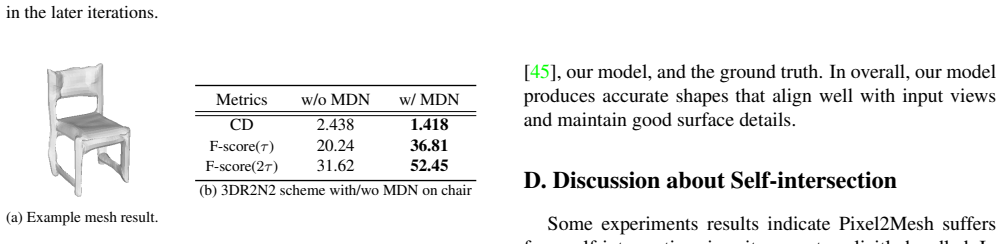
- [Section 3.1.1 and Section 4.3.3] The deformation hypothesis scale is fixed at 0.02 in a level-1 icosahedron, which bounds the per-iteration vertex displacement; with the three inference iterations used in Section 4.4.3, any vertex can move at most ~0.06 in normalized coordinates. The paper claims generalization to 'quality of mesh initialization' (abstract, Section 1, and Section 4.3.3) but never measures the actual per-vertex displacement errors of the coarse initializations, never specifies the translation/noise magnitudes in Fig. 6, and never ablates the hypothesis scale. The only quantitative non-ellipsoid experiment (3DR2N2 initialization on chair, Supp. C.2.3) shows CD improving from 2.438 to 1.418, still about three times worse than the ellipsoid-initialized result (0.486), which is consistent with a local-refinement bound. Please add an ablation over the hypothesis scale (e.g., 0.01, 0.02, 0.04), report the displacement error distributions of the coarse meshes used, and either provide evidence of correcting larger global errors or temper the generalization claim.
- [Section 4.1, Tables 1-3 and 5] No error bars or statistical significance tests are reported for any of the metrics. The improvement of the full model over the MVP2M baseline (e.g., F-score(τ) 66.48 vs 61.05; CD 0.486 vs 0.541) is presented as 'significantly further improves', but with single runs the reader cannot distinguish a real effect from run-to-run variance. Please report means and standard deviations over at least three independent runs or bootstrap resamples, and run a paired significance test for the key comparisons (Ours vs MVP2M and Ours vs P2M-M).
- [Section 3.3 and Section 4.4.3] The paper does not specify whether MDN is trained with a single deformation iteration or with multiple unrolled iterations. The text states that inference uses three iterations and that performance improves with more iterations (Fig. 12), but if the network was trained for only one iteration, then the second and third test-time iterations operate on inputs outside the training distribution. This is a train-test mismatch that should be addressed: either unroll K iterations during training (and report K) or analyze and justify the distribution shift. This point is essential for the iterative-refinement claim and for reproducibility.
- [Section 1 and Section 4.3] The 'physically driven' characterization overstates the method. MDN samples local hypotheses around each vertex and uses a learned scoring function on pooled CNN features; it does not enforce multi-view geometry constraints such as epipolar consistency, photo-consistency, or triangulation. Claims that the model 'imitates correspondences search' and 'reasons shapes according to correlations across different views' (Section 1) should be softened to describe a learned local search with aggregated perceptual features, which is still valuable but not physically grounded in the traditional sense.
minor comments (7)
- [Section 3.2, Eq. (2)] In the re-sampled Chamfer loss formula, the third term is written as √r1 r2 v1; it should be √r1 r2 v3. As written, the interpolation is incorrect.
- [Section 4.1] The threshold τ used for F-score is never defined. Please state its value (and units) in the evaluation setup.
- [Section 4.3.2] The text says 'we train five MDNs with the input view number fixed at 2 to 5 respectively', but the listed numbers 2, 3, 4, 5 are four settings; 'five' should be 'four'.
- [Section 2] The name 'Kuryenkov et al.' is a misspelling of 'Kurenkov et al.' (reference [24]).
- [Section 4.2 and Table 1] The text refers to 'Tab. 5' for the F-score comparison, but the table is labeled 'Table 1'. Internal cross-references should be corrected throughout (e.g., 'Tab. 2' vs 'Table 2', 'Fig. 13' vs the supplementary figure numbering).
- [Figure 5 caption] The caption for Figure 5 is confusing: it lists (a) and (b) but the table layout is not described, and the table contains a typo 'firarm' for 'firearm'.
- [Section 4.3.3, Figure 6] The robustness experiments to translation and noise are presented only qualitatively; no magnitudes or quantitative metrics are given for these perturbations. Reporting the perturbation amounts and the resulting F-score/CD would make the experiment reproducible.
Circularity Check
No significant circularity: the reported gains are evaluated on held-out ShapeNet test data against independent baselines, and the self-cited Pixel2Mesh component is an initialization module rather than a premise that forces the improvements.
full rationale
This paper is an empirical supervised learning system, not a derivation that reduces to its own assumptions. The Multi-View Deformation Network samples 42 deformation hypotheses from a level-1 icosahedron at a fixed scale of 0.02 around each vertex (Section 3.1.1), and updates the vertex as a weighted sum of hypotheses via a learned soft-argmax (Section 3.1.3); none of these quantities is a fitted parameter that is later renamed as a prediction. The central comparisons are made against independent external baselines (3DR2N2 and LSM) and against controlled Pixel2Mesh-derived baselines, using held-out ShapeNet test data with standard CD and F-score metrics. The only self-cited component, Pixel2Mesh, is used both as the coarse initialization and as a baseline; this overlap is not load-bearing because the reported improvements are measured empirically and the generalization experiments fix the coarse stage and vary category, view count, or initialization, so the results are not forced by construction. The fixed 0.02 deformation scale is a legitimate design parameter that bounds per-iteration movement and may be a limitation or correctness risk, but it is not circularity. No circular step was found.
Assumptions & free parameters
free parameters (4)
- Deformation hypothesis scale =
0.02
- Icosahedron subdivision level for hypotheses =
level-1 (42 hypotheses)
- Number of deformation iterations at inference =
3
- Training view count =
3
assumptions (5)
- domain assumption Camera intrinsics and extrinsics are known and accurate for every input image.
- domain assumption VGG-16 features, especially early layers, encode geometry-relevant appearance information sufficient to score deformations.
- ad hoc to paper Mean, max, and standard deviation statistics across views preserve the cross-view information needed to infer deformations.
- domain assumption ShapeNet rendered images and CAD models are a representative training and evaluation domain for general 3D shape generation.
- standard math The graph-convolution soft-argmax formulation is a valid differentiable approximation of the desired vertex selection.
Cite this review
Pith. "Pith review of Pixel2Mesh++: Multi-View 3D Mesh Generation via Deformation." pith.science (2026). https://pith.science/paper/25RF5YOP
@misc{pith2026190801491,
  author       = {Pith},
  title        = {Pith review of: Pixel2Mesh++: Multi-View 3D Mesh Generation via Deformation},
  year         = {2026},
  howpublished = {\url{https://pith.science/paper/25RF5YOP}},
  note         = {Machine review of arXiv:1908.01491}
}
read the original abstract
We study the problem of shape generation in 3D mesh representation from a few color images with known camera poses. While many previous works learn to hallucinate the shape directly from priors, we resort to further improving the shape quality by leveraging cross-view information with a graph convolutional network. Instead of building a direct mapping function from images to 3D shape, our model learns to predict series of deformations to improve a coarse shape iteratively. Inspired by traditional multiple view geometry methods, our network samples nearby area around the initial mesh's vertex locations and reasons an optimal deformation using perceptual feature statistics built from multiple input images. Extensive experiments show that our model produces accurate 3D shape that are not only visually plausible from the input perspectives, but also well aligned to arbitrary viewpoints. With the help of physically driven architecture, our model also exhibits generalization capability across different semantic categories, number of input images, and quality of mesh initialization.
Figures


Figures from the paper (13 more)






Reference graph
Works this paper leans on
-
[1]
icosahedron2sphere. http://3dvision. princeton.edu/pvt/icosahedron2sphere/ icosahedron2sphere.m. Accessed: 2009. 11
work page 2009
-
[2]
Bronstein, Joan Bruna, Yann LeCun, Arthur Szlam, and Pierre Vandergheynst
Michael M. Bronstein, Joan Bruna, Yann LeCun, Arthur Szlam, and Pierre Vandergheynst. Geometric deep learning: Going beyond euclidean data. IEEE Signal Process. Mag. , 34(4):18–42, 2017. 3
work page 2017
-
[3]
Shapenet: An information-rich 3d model repository
Angel X Chang, Thomas Funkhouser, Leonidas Guibas, Pat Hanrahan, Qixing Huang, Zimo Li, Silvio Savarese, Manolis Savva, Shuran Song, Hao Su, et al. Shapenet: An information-rich 3d model repository. arXiv preprint arXiv:1512.03012, 2015. 5
arXiv 2015
-
[4]
Learning implicit fields for generative shape modeling
Zhiqin Chen and Hao Zhang. Learning implicit fields for generative shape modeling. In Proceedings of the IEEE Con- ference on Computer Vision and Pattern Recognition , pages 5939–5948, 2019. 2
work page 2019
-
[5]
3d-r2n2: A unified approach for single and multi-view 3d object reconstruction
Christopher B Choy, Danfei Xu, JunYoung Gwak, Kevin Chen, and Silvio Savarese. 3d-r2n2: A unified approach for single and multi-view 3d object reconstruction. In ECCV,
-
[6]
Meshlab: an open-source mesh processing tool
Paolo Cignoni, Marco Callieri, Massimiliano Corsini, Mat- teo Dellepiane, Fabio Ganovelli, and Guido Ranzuglia. Meshlab: an open-source mesh processing tool. In Euro- graphics Italian chapter conference , volume 2008, pages 129–136, 2008. 11
work page 2008
-
[7]
A volumetric method for building complex models from range images
Brian Curless and Marc Levoy. A volumetric method for building complex models from range images. 1996. 5, 11
work page 1996
-
[8]
Numerical methods for shape-from-shading: A new survey with benchmarks
Jean-Denis Durou, Maurizio Falcone, and Manuela Sagona. Numerical methods for shape-from-shading: A new survey with benchmarks. Computer Vision and Image Understand- ing, 109(1):22–43, 2008. 2
work page 2008
Show all 54 references
-
[9]
A point set generation network for 3d object reconstruction from a single image
Haoqiang Fan, Hao Su, and Leonidas J Guibas. A point set generation network for 3d object reconstruction from a single image. In CVPR, 2017. 2, 5
2017
-
[10]
A geometric approach to shape from defocus
Paolo Favaro and Stefano Soatto. A geometric approach to shape from defocus. IEEE Trans. Pattern Anal. Mach. Intell., 27(3):406–417, 2005. 2
2005
-
[11]
Fouhey, Mikel Rodriguez, and Ab- hinav Gupta
Rohit Girdhar, David F. Fouhey, Mikel Rodriguez, and Ab- hinav Gupta. Learning a predictable and generative vector representation for objects. In ECCV, 2016. 2
2016
-
[12]
Choy, Manmohan Chan- draker, Animesh Garg, and Silvio Savarese
JunYoung Gwak, Christopher B. Choy, Manmohan Chan- draker, Animesh Garg, and Silvio Savarese. Weakly super- vised 3d reconstruction with adversarial constraint. In 3DV,
-
[13]
Hi- erarchical surface prediction for 3d object reconstruction
Christian Hane, Shubham Tulsiani, and Jitendra Malik. Hi- erarchical surface prediction for 3d object reconstruction. In 3DV, 2017. 2
2017
-
[14]
Multiple view ge- ometry in computer vision (2
Andrew Harltey and Andrew Zisserman. Multiple view ge- ometry in computer vision (2. ed.) . Cambridge University Press, 2006. 1, 2
2006
-
[15]
Deepmvs: Learning multi-view stereopsis
Po-Han Huang, Kevin Matzen, Johannes Kopf, Narendra Ahuja, and Jia-Bin Huang. Deepmvs: Learning multi-view stereopsis. In CVPR, 2018. 2
2018
-
[16]
Single-view reconstruction via joint analysis of image and shape collec- tions
Qixing Huang, Hai Wang, and Vladlen Koltun. Single-view reconstruction via joint analysis of image and shape collec- tions. ACM Trans. Graph., 34(4):87:1–87:10, 2015. 2
2015
-
[17]
Dpsnet: End-to-end deep plane sweep stereo
Sunghoon Im, Hae-Gon Jeon, Stephen Lin, and In So Kweon. Dpsnet: End-to-end deep plane sweep stereo. In ICLR, 2018. 2
2018
-
[18]
Adrian Johnston, Ravi Garg, Gustavo Carneiro, and Ian D. Reid. Scaling cnns for high resolution volumetric reconstruc- tion from a single image. In ICCV, 2017. 2
2017
-
[19]
Efros, and Jitendra Malik
Angjoo Kanazawa, Shubham Tulsiani, Alexei A. Efros, and Jitendra Malik. Learning category-specific mesh reconstruc- tion from image collections. In ECCV, 2018. 2
2018
-
[20]
Learning a multi-view stereo machine
Abhishek Kar, Christian H ¨ane, and Jitendra Malik. Learning a multi-view stereo machine. In Advances in neural infor- mation processing systems , pages 365–376, 2017. 2, 5, 6, 14
2017
-
[21]
Neu- ral 3d mesh renderer
Hiroharu Kato, Yoshitaka Ushiku, and Tatsuya Harada. Neu- ral 3d mesh renderer. In CVPR, 2018. 2
2018
-
[22]
End-to-end learning of geometry and context for deep stereo regression
Alex Kendall, Hayk Martirosyan, Saumitro Dasgupta, and Peter Henry. End-to-end learning of geometry and context for deep stereo regression. In ICCV, 2017. 2
2017
-
[23]
Kipf and Max Welling
Thomas N. Kipf and Max Welling. Semi-supervised classi- fication with graph convolutional networks. In ICLR, 2016. 3
2016
-
[24]
Deformnet: Free-form deformation network for 3d shape re- construction from a single image
Andrey Kurenkov, Jingwei Ji, Animesh Garg, Viraj Mehta, JunYoung Gwak, Christopher Choy, and Silvio Savarese. Deformnet: Free-form deformation network for 3d shape re- construction from a single image. In WACV, pages 858–866,
-
[25]
From point clouds to mesh using regression
Lubor Ladicky, Olivier Saurer, SoHyeon Jeong, Fabio Man- inchedda, and Marc Pollefeys. From point clouds to mesh using regression. In Proceedings of the IEEE International Conference on Computer Vision, pages 3893–3902, 2017. 4
2017
-
[26]
Lorensen and Harvey E
William E. Lorensen and Harvey E. Cline. Marching cubes: A high resolution 3d surface construction algorithm. In SIG- GRAPH, 1987. 5, 7, 11
1987
-
[27]
Shape from tex- ture: the homogeneity hypothesis
Constantinos Marinos and Andrew Blake. Shape from tex- ture: the homogeneity hypothesis. In ICCV, pages 350–353,
-
[28]
Occupancy networks: Learning 3d reconstruction in function space
Lars Mescheder, Michael Oechsle, Michael Niemeyer, Se- bastian Nowozin, and Andreas Geiger. Occupancy networks: Learning 3d reconstruction in function space. In CVPR, pages 4460–4470, 2019. 2
2019
-
[29]
Im2struct: Recovering 3d shape structure from a single RGB image
Chengjie Niu, Jun Li, and Kai Xu. Im2struct: Recovering 3d shape structure from a single RGB image. In CVPR, 2018. 2
2018
-
[30]
Deepsdf: Learning con- tinuous signed distance functions for shape representation
Jeong Joon Park, Peter Florence, Julian Straub, Richard Newcombe, and Steven Lovegrove. Deepsdf: Learning con- tinuous signed distance functions for shape representation. In CVPR, June 2019. 2, 8
2019
-
[31]
Qi, Wei Liu, Chenxia Wu, Hao Su, and Leonidas J
Charles R. Qi, Wei Liu, Chenxia Wu, Hao Su, and Leonidas J. Guibas. Frustum pointnets for 3d object detec- tion from RGB-D data. In CVPR, 2018. 2
2018
-
[32]
Charles Ruizhongtai Qi, Hao Su, Kaichun Mo, and Leonidas J. Guibas. Pointnet: Deep learning on point sets for 3d classification and segmentation. In CVPR, 2017. 2
2017
-
[33]
Richter and Stefan Roth
Stephan R. Richter and Stefan Roth. Matryoshka networks: Predicting 3d geometry via nested shape layers. In CVPR,
-
[34]
Octnet: Learning deep 3d representations at high resolutions
Gernot Riegler, Ali Osman Ulusoy, and Andreas Geiger. Octnet: Learning deep 3d representations at high resolutions. In CVPR, 2017. 2 9
2017
-
[35]
Surfnet: Generating 3d shape surfaces using deep residual networks
Ayan Sinha, Asim Unmesh, Qixing Huang, and Karthik Ra- mani. Surfnet: Generating 3d shape surfaces using deep residual networks. In CVPR, 2017. 2
2017
-
[36]
Learning shape completion from bounding boxes with cad shape priors
David Stutz. Learning shape completion from bounding boxes with cad shape priors. http://davidstutz.de/, Septem- ber 2017. 11
2017
-
[37]
Learning 3d shape com- pletion from laser scan data with weak supervision
David Stutz and Andreas Geiger. Learning 3d shape com- pletion from laser scan data with weak supervision. In IEEE Conference on Computer Vision and Pattern Recognition (CVPR). IEEE Computer Society, 2018. 11
2018
-
[38]
Mitra, Yangyan Li, and Leonidas J
Hao Su, Qixing Huang, Niloy J. Mitra, Yangyan Li, and Leonidas J. Guibas. Estimating image depth using shape col- lections. ACM Trans. Graph., 33(4):37:1–37:11, 2014. 2
2014
-
[39]
Learned-Miller
Hang Su, Subhransu Maji, Evangelos Kalogerakis, and Erik G. Learned-Miller. Multi-view convolutional neural networks for 3d shape recognition. In ICCV, 2015. 4
2015
-
[40]
Multi-view 3d models from single images with a convolu- tional network
Maxim Tatarchenko, Alexey Dosovitskiy, and Thomas Brox. Multi-view 3d models from single images with a convolu- tional network. In ECCV, 2016. 2
2016
-
[41]
Octree generating networks: Efficient convolutional archi- tectures for high-resolution 3d outputs
Maxim Tatarchenko, Alexey Dosovitskiy, and Thomas Brox. Octree generating networks: Efficient convolutional archi- tectures for high-resolution 3d outputs. In ICCV, 2017. 2
2017
-
[42]
What do single-view 3d reconstruction networks learn? In CVPR, 2019
Maxim Tatarchenko, Stephan Richter, Ren ´e Ranftl, Zhuwen Li, Vladlen Koltun, and Thomas Brox. What do single-view 3d reconstruction networks learn? In CVPR, 2019. 2
2019
-
[43]
Learning category-specific deformable 3d models for object reconstruction
Shubham Tulsiani, Abhishek Kar, Jo ˜ao Carreira, and Jiten- dra Malik. Learning category-specific deformable 3d models for object reconstruction. IEEE Trans. Pattern Anal. Mach. Intell., 39(4):719–731, 2017. 2
2017
-
[44]
Guibas, Alexei A
Shubham Tulsiani, Hao Su, Leonidas J. Guibas, Alexei A. Efros, and Jitendra Malik. Learning shape abstractions by assembling volumetric primitives. In CVPR, 2017. 2
2017
-
[45]
Pixel2mesh: Generating 3d mesh models from single rgb images
Nanyang Wang, Yinda Zhang, Zhuwen Li, Yanwei Fu, Wei Liu, and Yu-Gang Jiang. Pixel2mesh: Generating 3d mesh models from single rgb images. In ECCV, 2018. 1, 2, 3, 4, 5, 6, 14
2018
-
[46]
O-cnn: Octree-based convolutional neu- ral networks for 3d shape analysis
Peng-Shuai Wang, Yang Liu, Yu-Xiao Guo, Chun-Yu Sun, and Xin Tong. O-cnn: Octree-based convolutional neu- ral networks for 3d shape analysis. ACM Transactions on Graphics (TOG), 36(4):72, 2017. 2
2017
-
[47]
Pentakis icosidodecahedron — Wikipedia, the free encyclopedia
Wikipedia. Pentakis icosidodecahedron — Wikipedia, the free encyclopedia. http://en.wikipedia. org/w/index.php?title=Pentakis% 20icosidodecahedron&oldid=874013415,
-
[48]
Learning a probabilistic latent space of object shapes via 3d generative-adversarial modeling
Jiajun Wu, Chengkai Zhang, Tianfan Xue, Bill Freeman, and Josh Tenenbaum. Learning a probabilistic latent space of object shapes via 3d generative-adversarial modeling. In Neurips, 2016. 2
2016
-
[49]
Image-based street-side city modeling
Jianxiong Xiao, Tian Fang, Peng Zhao, Maxime Lhuillier, and Long Quan. Image-based street-side city modeling. In ACM transactions on Graphics (TOG), volume 28, page 114. ACM, 2009. 11
2009
-
[50]
Mvsnet: Depth inference for unstructured multi-view stereo
Yao Yao, Zixin Luo, Shiwei Li, Tian Fang, and Long Quan. Mvsnet: Depth inference for unstructured multi-view stereo. In ECCV, 2018. 2
2018
-
[51]
Shape from shading: A survey
Ruo Zhang, Ping-Sing Tsai, James Edwin Cryer, and Mubarak Shah. Shape from shading: A survey. IEEE Trans. Pattern Anal. Mach. Intell., 21(8):690–706, 1999. 2
1999
-
[52]
Activestereonet: End-to-end self-supervised learn- ing for active stereo systems
Yinda Zhang, Sameh Khamis, Christoph Rhemann, Julien Valentin, Adarsh Kowdle, Vladimir Tankovich, Michael Schoenberg, Shahram Izadi, Thomas Funkhouser, and Sean Fanello. Activestereonet: End-to-end self-supervised learn- ing for active stereo systems. In Proceedings of the Eur...
2018
-
[54]
C.2.2 Effect of More Iterations In our main submission, we show the numerical improve- ments with more iterations
As can be seen in the zoom-in areas, our re-sampled Chamfer loss can effectively penalize large flying triangles caused by a few flying vertices , and thus the results of our full model are free from such artifacts. C.2.2 Effect of More Iterations In our main submission, we show...
-
[2019]
[Online; accessed 29-March-2019]. 11
2019
Reviewed August 14, 2026 · model on record in the stance chip above.
Discussion (0). Continue with ORCID to comment.