REVIEW 4 major objections 6 minor 35 references
Angle rigidity and its usage to stabilize planar formations
T0 review · 4 major / 6 minor · reviewed 2026-08-14 · deepseek-v4-flash
Pith's one-line read Angle rigidity gives a rank test for when signed angles determine a planar formation up to translation, rotation, and scaling.
desk verdict A promising angle-rigidity framework for angle-only formation control, but the paper contains a load-bearing inconsistency between its two definitions of the angle rigidity matrix that must be fixed before the rank test is trustworthy. read the letter →
The pith
A machine-rendered reading of the paper's core claim, the machinery that carries it, and where it could break.
The reading
What carries the argument
The angle rigidity matrix $B(p) \in \mathbb{R}^{M \times 2N}$ is the central object: for each angle constraint $(i,j,k)$ it records the gradient of the signed angle with respect to the three involved vertices, with blocks of the form $(p_i-p_j)^\perp/l_{ij}^2$ and a factor $1/\sin(\beta)$; its null space always contains the four similarity infinitesimal motions, and infinitesimal angle rigidity means the null space is exactly that span. The paper also introduces the combinatorial structure of an angularity—a vertex set $V$, an angle set $\mathcal{A}$ of ordered triples, and an embedding $p$—and defines Type-I and Type-II vertex addition operations that give sufficient conditions for global and local rigidity, respectively. The rank identity $\operatorname{rank}(B(p)) = 2N-4$ is the load-bearing algebraic criterion that converts the geometric question of shape determination into a checkable linear-algebra test.
What would settle it
Take the collinear three-vertex example the paper itself gives (vertices on a line, single angle constraint equal to $0$, Fig. 3(b)). The angle rigidity matrix formulas contain $\sin(\beta)$ in every denominator, so at $\beta=0$ the matrix is undefined; any limiting construction yields rank $0$, far below $2N-4=2$, yet the paper calls this configuration angle rigid. Computing $B(p)$ explicitly for this case and checking whether a nontrivial angle-preserving flex exists would settle the scope of Theorem 4 and whether a non-collinearity hypothesis is needed.
Extended reading notes
Core claim
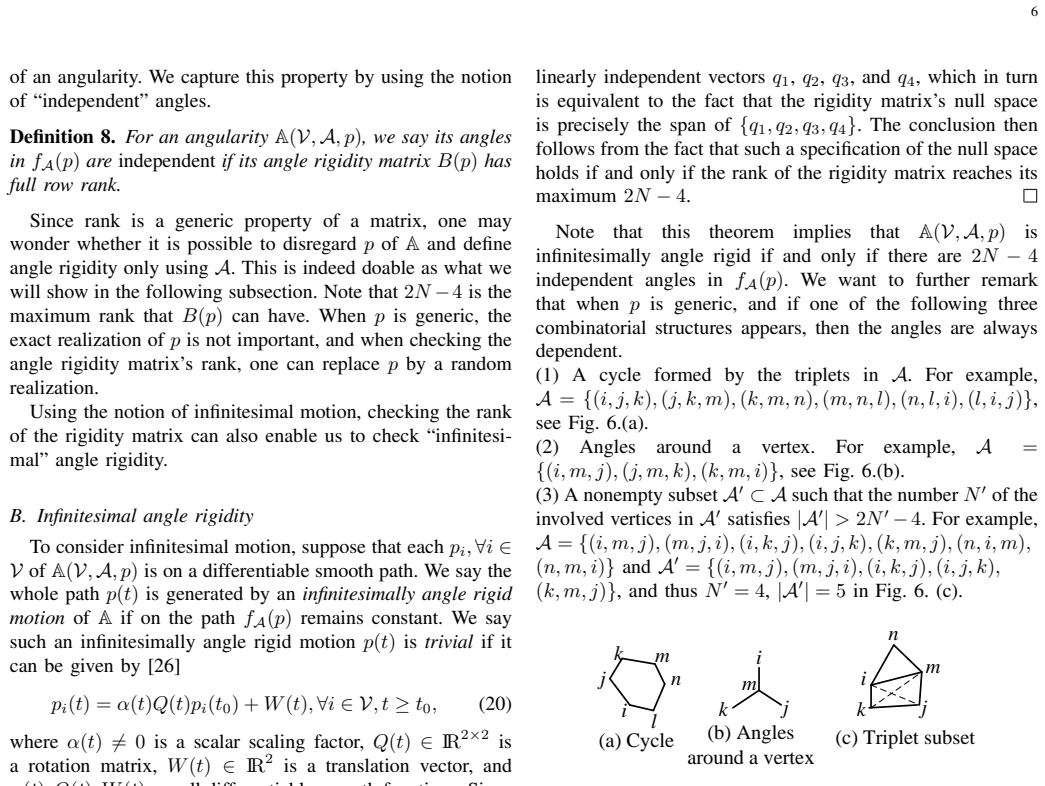
The central claim is that an angularity $\mathcal{A}(V,\mathcal{A},p)$—a planar framework whose constraints are ordered triples of vertices specifying signed angles—is infinitesimally angle rigid if and only if the rank of its angle rigidity matrix $B(p)$ equals $2N-4$. Since the null space of $B(p)$ always contains the four similarity motions (two translations, one rotation, one scaling), reaching this maximal rank means no other infinitesimal deformations preserve the listed angles. The paper further shows that, unlike bearing rigidity, angle rigidity is only a local property: an angle-rigid angularity may admit a non-congruent but equivalent realization far away (flex ambiguity), and this distinction persists even for generic configurations. For generic positions, angle rigidity and infinitesimal angle rigidity are equivalent, so the rank test doubles as a test for finite rigidity of typical configurations. A minimal angle-rigid angularity needs exactly $2N-4$ angles, and any vertex in such a minimal configuration is incident to at least two and at most five angle constraints.
Load-bearing premise
The rank test assumes that near the chosen formation the set of configurations with the same listed angles is a smooth family consisting exactly of the translations, rotations, and scalings; this smoothness breaks down when one of the constrained angles is exactly $0$ or $\pi$, and the genericity condition is not spelled out for every theorem.
Editorial extensions
If this is right
- Any angle-constrained planar framework whose angle rigidity matrix has full rank $2N-4$ is locally shaped-locked up to translation, rotation, and scaling, so the rank test provides a direct algebraic certificate for angle-based shape determination.
- For generic configurations, angle rigidity and infinitesimal angle rigidity coincide (Theorem 6), meaning the rank test also decides finite rigidity for typical embeddings.
- A minimally angle-rigid planar formation requires exactly $2N-4$ angles, and in such minimal formations every vertex must be incident to at least two and at most five angle constraints—a concrete structural bound on minimal angle-only sensing graphs.
- Using the Type-I vertex addition construction, a globally angle-rigid $N$-agent formation can be grown from a generically rigid triangle, and the proposed angle-only control law $u_i = -\sum_{(j,i,k)\in\mathcal{A}}(\alpha_{jik}-\alpha^*_{jik})(z_{ij}+z_{ik})$ locally exponentially stabilizes the desired shape in each agent's local coordinate frame.
- The control law depends only on local bearing measurements converted to angles, so it removes the usual requirements of GPS, inter-agent distance sensing, or aligned coordinate frames for formation stabilization.
Reading between the lines
- The rank test suggests a practical sensor-placement algorithm: add angle constraints incrementally until the angle rigidity matrix of a random realization reaches rank $2N-4$, relying on the genericity of rank to certify all generic positions.
- The paper's minimality result is only a necessary condition; proving a Laman-type combinatorial characterization for generic infinitesimal angle rigidity, or finding a counterexample, is a natural next step that the paper explicitly leaves open.
- The convergence analysis is sequential (agents 1–3 first, then agent 4 onward) and local; a distributed simultaneous version might inherit exponential convergence for any angle-rigid graph with small initial errors, but the paper does not assert this.
- The angle-only controllers use cosines of angles via dot products of local bearings, so a plausible extension is robustness to bounded noise in angle measurements; this is testable but not analyzed in the paper.
Signed reviews
Editorial analysis
A structured set of objections, weighed in public.
Referee Report
Summary. The manuscript develops a theory of signed-angle rigidity for planar frameworks. It introduces an 'angularity' as a vertex set together with ordered triplet angle constraints, defines angle rigidity and global angle rigidity, and shows that angle rigidity does not imply global angle rigidity through a four-vertex example. It then defines an angle rigidity matrix and claims, in Theorem 4, that an angularity is infinitesimally angle rigid if and only if this matrix has rank 2N-4. The paper also gives sufficient conditions for global rigidity via Type-I vertex additions and a necessary combinatorial condition for minimal infinitesimal angle rigidity. The final section applies the theory to formation control: a triangular formation controller and a sequential vertex-addition controller are proposed, with claims of exponential convergence and collision avoidance using only local angle measurements.
Significance. If the main results are correct, the paper offers a useful coordinate-free rigidity notion for angle-only formation control, together with a computable rank test. The example in Fig. 2 correctly illustrates that signed-angle rigidity is a local, not global, property, which is a useful distinction from bearing rigidity. The control law in (77) is simple and naturally expressed in local coordinates. The paper also makes explicit contributions: an infinitesimal rigidity rank condition, vertex-addition constructions, and an exponential-convergence proof for the triangular formation. However, the central definition of the angle rigidity matrix is internally inconsistent as written, and several load-bearing proofs are omitted or circular, so the current manuscript does not establish its claims.
major comments (4)
- [Section III.A, Eqs. (11)-(13) and (14)-(15)] The two displayed definitions of the angle rigidity matrix row are not consistent. Equations (11)-(13) define a row with coefficients A = (pi-pj)_perp/(l_ij l_jk sin beta), B = -(pi-pj)_perp/(l_ij l_jk sin beta) + (pk-pj)_perp/(l_kj l_ij sin beta), and C = (pj-pk)_perp/(l_kj l_ij sin beta), while the matrix display (14)-(15) defines a row with entries N_ij = (pi-pj)_perp/l_ij^2 at vertex i, N_ji + N_kj at vertex j, and N_jk at vertex k. These rows are not proportional except in special cases. For the concrete configuration p1=(2,0), p2=(0,0), p3=(0,1) with angle (1,2,3)=pi/2, the rotation vector v=( (0,2), 0, (-1,0) ) is annihilated by the row from (14)-(15), which is the correct first-order condition for angle preservation, but the row from (11)-(13) evaluates to 3/2 on v. Consequently, under the definition in (11)-(13), Lemma 2 is false because the rotation vector is not in the null space. Since Theorem 4 is literally a rank test on B(p), this inconsistency is load-bearing: the paper must state which row is the angle rigidity matrix and correct the derivation of (10)-(13).
- [Section III.B, Lemma 3 and Theorem 6] Lemma 3 is stated without proof, with only a reference to the analogous distance-rigidity result [1, Proposition 5.1]. That analogue requires the measurement map to be a smooth map with constant-rank derivative near p, which is not verified for the signed-angle function f_A and in fact fails at collinear configurations where sin(beta)=0. Theorem 6 depends on Lemma 3, and its sufficiency proof uses Lemma 3 to assert that M and f_A^{-1}(f_A(p)) coincide near p before angle rigidity has been established, making that step circular. The necessity proof also assumes, without proof, that any nearby equivalent configuration can be connected to p by a continuous path along which f_A remains constant. In addition, the converse direction of Theorem 4 has a related gap: a nonzero vector in the null space of B(p) that is not in the span of the four trivial motions gives only a first-order infinitesimal motion, but the paper does not prove that such a vector can be integrated to a curve along which f_A is exactly constant. These gaps should be addressed by proving the needed submersion/constant-rank property of f_A at generic p or by restricting the claims accordingly.
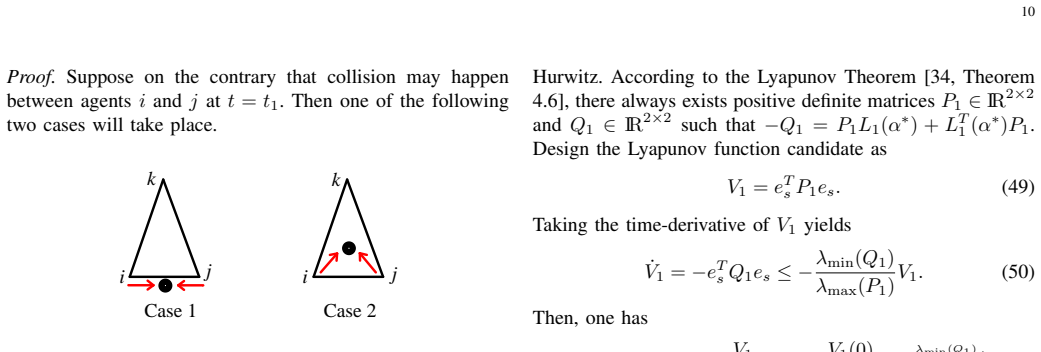
- [Section IV.B, Theorem 8 and Lemma 8] The induction step in the proof of Theorem 8 is described only as 'similar to the proof from (54) to (74)' and does not verify that the hypotheses--small initial distances, small initial angle errors, and the inequalities l*_{j1 i} > l*_{j2 i}, l*_{j3 i} > l*_{j2 i}--are satisfied for the (k+1)-agent step. The collision-avoidance argument in Lemma 8 extends T to infinity by citing [35, Theorem 2.1], but the hypotheses of that theorem are not checked; inequality (76) only proves positivity at a finite time and does not establish the absence of finite escape or the uniform boundedness needed for extension to all t > 0. The exponential-convergence theorem for the full N-agent formation is therefore not fully supported.
- [Section IV.B, Theorem 8 assumptions] The conditions l*_{ij1} > l*_{ij2} and l*_{ij3} > l*_{ij2} are introduced without geometric justification. For a desired formation obtained through Type-I vertex additions, nothing in the construction guarantees that such an ordering holds, and relabeling agents to enforce it may disrupt the triangular sub-formation assumptions. Since these inequalities are used in the determinant computation in Lemma 8, the applicability of the control theorem to the intended class of angle-rigid formations is narrower than claimed and should be discussed explicitly.
minor comments (6)
- [Section II.A, Definition 5] In Definition 5, the text says 'pj is constrained to be on a ray starting from pj', which appears to be a typo; it should say that pi is constrained to lie on a ray starting from pj.
- [Section III.A, Eq. (9)] The symbols l_ij, l_ji, l_jk, and l_kj are used without a single consistent definition; since l_ij and l_ji denote the same length, the derivation would be easier to follow if all edge lengths were defined once.
- [Section III, Proposition 3] Proposition 3 is a formal result, but its proof is merely described as 'can be easily constructed following similar arguments'; this is not a proof and should be replaced with a complete argument or explicitly labeled as a sketch.
- [Section IV.A, Lemma 6] The boundary argument in Lemma 6 sets epsilon1 = epsilon2 + epsilon3 without explaining why this exhausts the relevant boundary of the set M_a, and the definitions of alpha_i and alpha*_i near this boundary are not fully specified.
- [Throughout] There are several typographical errors, including 'sectoin' in the Section III header and 'minimaly' in Lemma 5; these should be corrected.
- [Section II.B, Theorem 1] The proof of Theorem 1 asserts local uniqueness of the intersection of the ray and the circle; this is plausible but would benefit from a short analytic argument rather than relying only on the figure.
Circularity Check
No significant circularity: the angle-rigidity rank test is derived from first-order differential conditions on the angle constraints, with no fitted parameter or load-bearing self-citation.
full rationale
The paper's central result, Theorem 4, characterizes infinitesimal angle rigidity by the rank of the angle rigidity matrix B(p). That matrix is constructed by differentiating the cosine form of the signed-angle constraints, and the proof of Theorem 4 directly relates the null space of B(p) to the four trivial motions of translation, rotation, and scaling. This is a standard infinitesimal-rigidity characterization rather than a circular reduction: the rank condition is not assumed and is not equivalent to the definition by construction beyond the usual Jacobian-to-infinitesimal-motion correspondence. Lemma 3 is stated with a proof omitted as 'similar to that for distance rigidity in [1, Proposition 5.1]'; this is an appeal to an external standard result, not a self-citation, and it is not the target conclusion of the paper. The formation-control section introduces control laws based on angle errors and proves local exponential convergence using Lyapunov analysis; no parameter is fitted to data and then renamed a prediction. The paper also acknowledges prior angle-based work in [21], distinguishing its own use of angle-only measurements. No load-bearing self-citation appears, and no 'uniqueness theorem' from the authors' own prior work is invoked. There is an apparent inconsistency between the row coefficients in equations (11)-(13) and the displayed matrix row in (14)-(15), but that is a correctness or consistency concern about which matrix is actually meant, not a circularity: it does not make a fitted input masquerade as a prediction or make the derivation depend on its own conclusion. Therefore the circularity score is 0.
Assumptions & free parameters
assumptions (6)
- domain assumption Vertices have distinct positions and no pair of triplets in A are explementary.
- domain assumption Generic position: components of p are algebraically independent.
- domain assumption The angle function f_A is a smooth map and its level set near p is a manifold (Lemma 3).
- domain assumption Desired formations are generated by Type-I vertex additions (Case 3) from a generically angle rigid 3-vertex angularity.
- ad hoc to paper For each added agent, the desired geometry satisfies l*_ij1 > l*_ij2 and l*_ij3 > l*_ij2.
- domain assumption Initial angle errors are sufficiently small and initial inter-agent distances are bounded away from zero.
Cite this review
Pith. "Pith review of Angle rigidity and its usage to stabilize planar formations." pith.science (2026). https://pith.science/paper/OHT5P5EX
@misc{pith2026190801542,
  author       = {Pith},
  title        = {Pith review of: Angle rigidity and its usage to stabilize planar formations},
  year         = {2026},
  howpublished = {\url{https://pith.science/paper/OHT5P5EX}},
  note         = {Machine review of arXiv:1908.01542}
}
read the original abstract
Motivated by the challenging formation stabilization problem for mobile robotic teams when no distance or relative displacement measurements are available and each robot can only measure some of those angles formed by rays towards its neighbors, we develop the notion of ``angle rigidity" for a multi-point framework, named ``angularity", consisting of a set of nodes embedded in a Euclidean space and a set of angle constraints among them. Different from bearings or angles defined with respect to a global axis, the angles we use do not rely on the knowledge of a global coordinate system and are signed according to the counter-clockwise direction. Here \emph{angle rigidity} refers to the property specifying that under proper angle constraints, the angularity can only translate, rotate or scale as a whole when one or more of its nodes are perturbed locally. We first demonstrate that this angle rigidity property, in sharp comparison to bearing rigidity or other reported rigidity related to angles of frameworks in the literature, is \emph{not} a global property since an angle rigid angularity may allow flex ambiguity. We then construct necessary and sufficient conditions for \emph{infinitesimal} angle rigidity by checking the rank of an angularity's rigidity matrix. We develop a combinatorial necessary condition for infinitesimal minimal angle rigidity. Using the developed theories, a formation stabilization algorithm is designed for a robotic team to achieve a globally angle rigid formation, in which only angle measurements are needed.
Figures


Figures from the paper (7 more)



Reference graph
Works this paper leans on
-
[1]
B. Roth, “Rigid and flexible frameworks,” The American Mathematical Monthly, vol. 88, no. 1, pp. 6–21, 1981
work page 1981
-
[2]
Conditions for unique graph realizations,
B. Hendrickson, “Conditions for unique graph realizations,” SIAM Journal on Computing , vol. 21, no. 1, pp. 65–84, 1992
work page 1992
-
[3]
Rigid graph control architectures for autonomous formations,
B. D. Anderson, C. Yu, B. Fidan, and J. M. Hendrickx, “Rigid graph control architectures for autonomous formations,” IEEE Control Systems Magazine, vol. 28, no. 6, pp. 48–63, 2008
work page 2008
-
[4]
B. Ildefonse, D. Sokoutis, and N. S. Mancktelow, “Mechanical interac- tions between rigid particles in a deforming ductile matrix. analogue experiments in simple shear flow,” Journal of Structural Geology , vol. 14, no. 10, pp. 1253–1266, 1992
work page 1992
-
[5]
Rigid biological composite materials: structural examples for biomimetic design,
G. Mayer and M. Sarikaya, “Rigid biological composite materials: structural examples for biomimetic design,” Experimental Mechanics , vol. 42, no. 4, pp. 395–403, 2002
work page 2002
-
[6]
L. Asimow and B. Roth, “The rigidity of graphs, II,” Journal of Mathematical Analysis and Applications , vol. 68, no. 1, pp. 171–190, 1979
work page 1979
-
[7]
L. Asimow and B. Roth, “The rigidity of graphs,” Transactions of the American Mathematical Society , vol. 245, pp. 279–289, 1978
work page 1978
-
[8]
T. Eren, W. Whiteley, A. S. Morse, P. N. Belhumeur, and B. D. Anderson, “Sensor and network topologies of formations with direction, bearing, and angle information between agents,” in 2003 42nd IEEE Conference on Decision and Control , vol. 3, 2003, pp. 3064–3069
work page 2003
Show all 35 references
-
[9]
Bearing rigidity and almost global bearing- only formation stabilization,
S. Zhao and D. Zelazo, “Bearing rigidity and almost global bearing- only formation stabilization,” IEEE Transactions on Automatic Control , vol. 61, no. 5, pp. 1255–1268, 2016
2016
-
[10]
Formation shape control based on bearing rigidity,
T. Eren, “Formation shape control based on bearing rigidity,” Interna- tional Journal of Control , vol. 85, no. 9, pp. 1361–1379, 2012
2012
-
[11]
Distributed formation control with relaxed motion requirements,
A. N. Bishop, M. Deghat, B. Anderson, and Y . Hong, “Distributed formation control with relaxed motion requirements,” International Journal of Robust and Nonlinear Control , vol. 25, no. 17, pp. 3210– 3230, 2015
2015
-
[12]
Bearing-only formation control using an SE (2) rigidity theory,
D. Zelazo, P. R. Giordano, and A. Franchi, “Bearing-only formation control using an SE (2) rigidity theory,” in 2015 54th IEEE Conference on Decision and Control . IEEE, 2015, pp. 6121–6126
2015
-
[13]
Bearing rigidity theory in SE (3),
G. Michieletto, A. Cenedese, and A. Franchi, “Bearing rigidity theory in SE (3),” in 2016 55th IEEE Conference on Decision and Control . IEEE, 2016, pp. 5950–5955
2016
-
[14]
Robust adaptive control of uncertain force/motion constrained nonholonomic mobile manipulators,
Z. Li, S. S. Ge, M. Adams, and W. S. Wijesoma, “Robust adaptive control of uncertain force/motion constrained nonholonomic mobile manipulators,” Automatica, vol. 44, no. 3, pp. 776–784, 2008
2008
-
[15]
Integrated multi-agent system framework: decentralised search, tasking and tracking,
W. Meng, Z. He, R. Teo, R. Su, and L. Xie, “Integrated multi-agent system framework: decentralised search, tasking and tracking,” IET Control Theory & Applications , vol. 9, no. 3, pp. 493–502, 2014
2014
-
[16]
Spacecraft formation flying: Dynamics and control,
V . Kapila, A. G. Sparks, J. M. Buffington, and Q. Yan, “Spacecraft formation flying: Dynamics and control,” Journal of Guidance, Control, and Dynamics, vol. 23, no. 3, pp. 561–564, 2000
2000
-
[17]
A survey of multi-agent formation control,
K.-K. Oh, M.-C. Park, and H.-S. Ahn, “A survey of multi-agent formation control,” Automatica, vol. 53, pp. 424–440, 2015
2015
-
[18]
Bearing rigidity theory and its applications for control and estimation of network systems: Life beyond distance rigidity,
S. Zhao and D. Zelazo, “Bearing rigidity theory and its applications for control and estimation of network systems: Life beyond distance rigidity,” IEEE Control Systems Magazine , vol. 39, no. 2, pp. 66–83, 2019
2019
-
[19]
A vision-based formation control framework,
A. K. Das, R. Fierro, V . Kumar, J. P. Ostrowski, J. Spletzer, and C. J. Taylor, “A vision-based formation control framework,” IEEE Transactions on Robotics and Automation , vol. 18, no. 5, pp. 813–825, 2002
2002
-
[20]
Translational and scaling formation maneuver control via a bearing-based approach,
S. Zhao and D. Zelazo, “Translational and scaling formation maneuver control via a bearing-based approach,” IEEE Transactions on Control of Network Systems, vol. 4, no. 3, pp. 429–438, 2017
2017
-
[21]
Angle-based shape determination theory of planar graphs with application to formation stabilization,
G. Jing, G. Zhang, H. W. J. Lee, and L. Wang, “Angle-based shape determination theory of planar graphs with application to formation stabilization,” Automatica, vol. 105, pp. 117–129, 2019
2019
-
[22]
Rigidity of distance-based formations with additional subtended-angle constraints,
M.-C. Park, H.-K. Kim, and H.-S. Ahn, “Rigidity of distance-based formations with additional subtended-angle constraints,” in 2017 17th International Conference on Control, Automation and Systems (ICCAS) . IEEE, 2017, pp. 111–116
2017
-
[23]
Infinites- imal weak rigidity, formation control of three agents, and extension to 3-dimensional space,
S.-H. Kwon, M. H. Trinh, K.-H. Oh, S. Zhao, and H.-S. Ahn, “Infinites- imal weak rigidity, formation control of three agents, and extension to 3-dimensional space,” arXiv preprint arXiv:1803.09545 , 2018
2018 arXiv
-
[24]
Infinites- imal Weak rigidity and stability analysis on three-agent formations,
S.-H. Kwon, M. H. Trinh, K.-H. Oh, S. Zhao, and H.-S. Ahn, “Infinites- imal Weak rigidity and stability analysis on three-agent formations,” in 2018 57th Annual Conference of the Society of Instrument and Control Engineers of Japan (SICE) . IEEE, 2018, pp. 266–271
2018
-
[25]
Generic global rigidity,
R. Connelly, “Generic global rigidity,” Discrete & Computational Ge- ometry, vol. 33, no. 4, pp. 549–563, 2005
2005
-
[26]
Frameworks, tensegrities and symmetry: understanding stable structures,
R. Connelly and S. Guest, “Frameworks, tensegrities and symmetry: understanding stable structures,” Cornell University, College of Arts and Sciences, 2015
2015
-
[27]
Generating isostatic frameworks,
T.-S. Tay and W. Whiteley, “Generating isostatic frameworks,”Structural Topology 1985 N ´um 11, 1985
1985
-
[28]
Some matroids from discrete applied geometry,
W. Whiteley, “Some matroids from discrete applied geometry,” Contem- porary Mathematics, vol. 197, pp. 171–312, 1996
1996
-
[29]
On graphs and rigidity of plane skeletal structures,
G. Laman, “On graphs and rigidity of plane skeletal structures,” Journal of Engineering mathematics , vol. 4, no. 4, pp. 331–340, 1970
1970
-
[30]
Necessary and sufficient graphical conditions for formation control of unicycles,
Z. Lin, B. Francis, and M. Maggiore, “Necessary and sufficient graphical conditions for formation control of unicycles,” IEEE Transactions on Automatic Control, vol. 50, no. 1, pp. 121–127, 2005
2005
-
[31]
Formation shape control with distance and area constraints,
B. D. Anderson, Z. Sun, T. Sugie, S.-i. Azuma, and K. Sakurama, “Formation shape control with distance and area constraints,” IFAC Journal of Systems and Control , vol. 1, pp. 2–12, 2017
2017
-
[32]
Bearing-based formation control of a group of agents with leader-first 14 follower structure,
M. H. Trinh, S. Zhao, Z. Sun, D. Zelazo, B. D. Anderson, and H.-S. Ahn, “Bearing-based formation control of a group of agents with leader-first 14 follower structure,” IEEE Transactions on Automatic Control , vol. 64, no. 2, pp. 598–613, 2019
2019
-
[33]
Distributed control of triangular formations with angle-only constraints,
M. Basiri, A. N. Bishop, and P. Jensfelt, “Distributed control of triangular formations with angle-only constraints,” Systems and Control Letters, vol. 59, no. 2, pp. 147–154, 2010
2010
-
[34]
H. K. Khalil and J. Grizzle, Nonlinear systems . Prentice hall Upper Saddle River, NJ, 2002, vol. 3
2002
-
[35]
J. K. Hale, Ordinary differential equations . Robert E, Wiley-Inter- science, New York, 1980
1980
Reviewed August 14, 2026 · model on record in the stance chip above.
Discussion (0). Continue with ORCID to comment.