REVIEW 3 major objections 5 minor 30 references
Spin-Orbit Coupling Induced Degeneracy in the Anisotropic Unconventional Superconductor UTe$_2$
T0 review · 3 major / 5 minor · reviewed 2026-08-14 · deepseek-v4-flash
Pith's one-line read UTe2's Fermi surface states are dominated by a degenerate, half-filled pair of spin-orbit orbitals that can leave half the carriers ungapped in the superconducting state.
desk verdict Useful DFT+U platform for UTe2, but the central jz=±1/2 degeneracy is only shown in the U=J limit and the two sectors are not numerically equal, so the claim needs a sensitivity check. read the letter →
The pith
A machine-rendered reading of the paper's core claim, the machinery that carries it, and where it could break.
The reading
What carries the argument
The load-bearing object is the uranium $5f$ shell in the $j=5/2$ angular-momentum basis, specifically the degenerate, half-filled $m_j=\pm 1/2$ sectors at the Fermi level. The calculation is done with a density-functional plus Hubbard $U$ method in the orbital-polarization limit ($U=J$), which removes the spherically averaged interaction and keeps the spin-orbit-induced anisotropic terms. On top of the band structure, the paper constructs linear combinations $\Phi_+$ and $\Phi_-$ of the two degenerate orbitals such that the common $Y_{3,0}$ orbital carries equal spin-up and spin-down amplitude and no orbital moment along the easy axis; the two parts then carry weights $25/49$ and $24/49$ (51% versus 49%). This combination is the mechanism that converts the calculated degeneracy into a concrete explanation for the observed 50% ungapped fraction.
What would settle it
Resolve the normal-state Fermi surface just above $T_c$ with quantum oscillations or angle-resolved photoemission on clean UTe2 samples and compare with the calculated four-sheet ferromagnetic Fermi surface. If the observed sheets match the small-gap nonmagnetic band structure instead, the local-ferromagnetic assumption and the associated $m_j=\pm 1/2$ degeneracy do not describe the physical normal state. Likewise, if the residual specific-heat coefficient vanishes as $T\to 0$ below $T_c$, the half-gapped Bogoliubov Fermi surface scenario is falsified.
Extended reading notes
Core claim
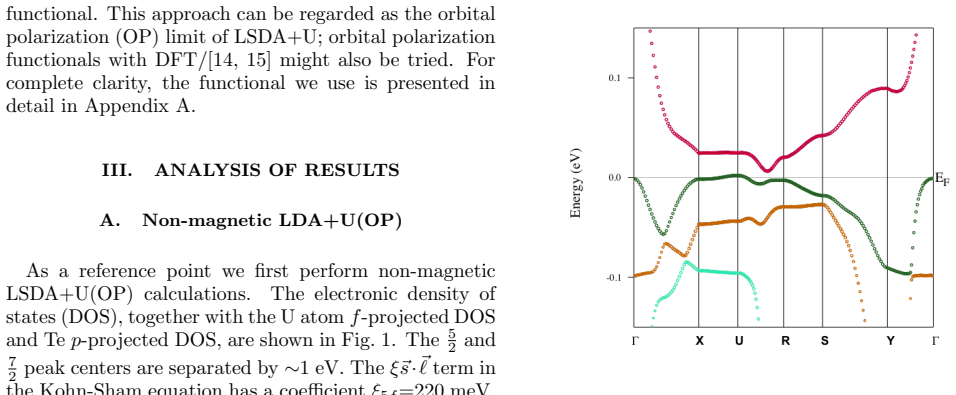
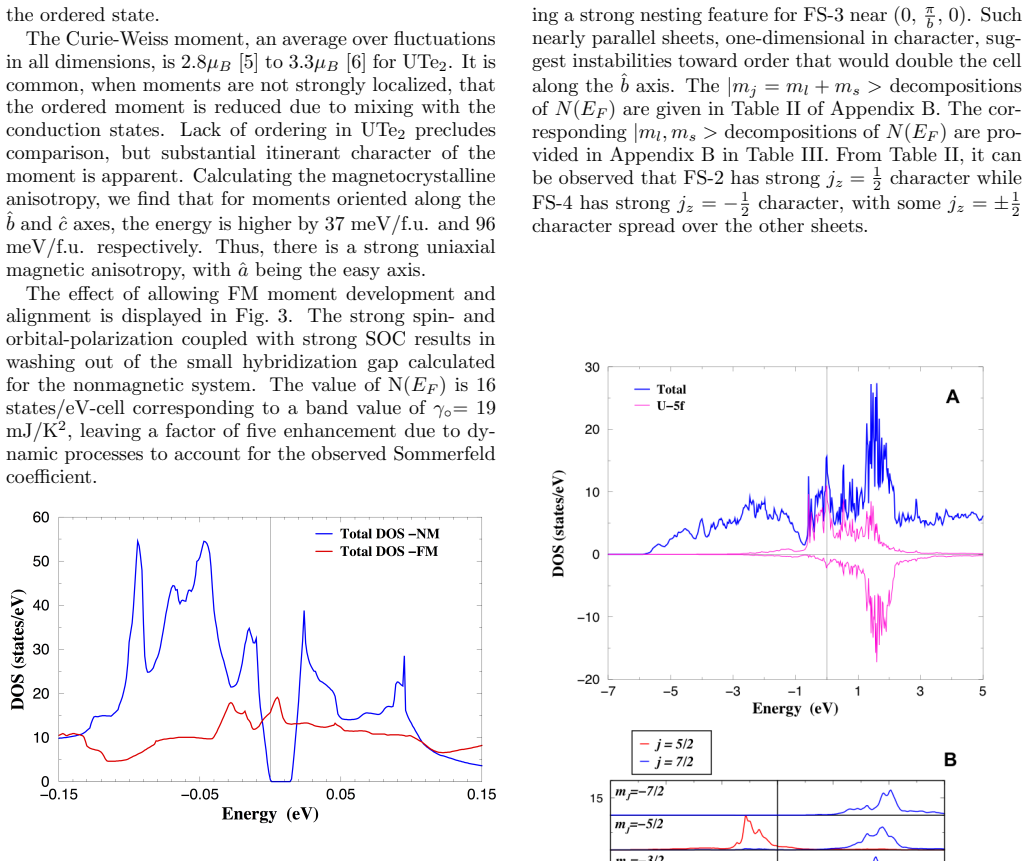
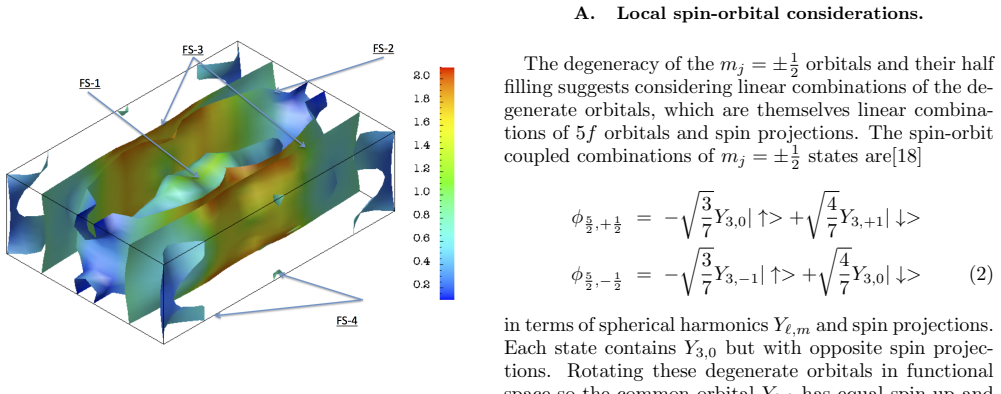
The paper's central claim is that the correlated normal state of UTe2 is a strongly metallic Fermi liquid built from a uranium $5f^3$ configuration, and that spin-orbit coupling plus strong local ferromagnetic correlations produce an effective degeneracy at the Fermi level. In the fully spin-polarized $j=5/2$ manifold, the $m_j=-5/2$ and $-3/2$ states are fully occupied, the $m_j=\pm 1/2$ states are degenerate and half-filled, and the higher states are empty. The four-sheet Fermi surface computed for ferromagnetic alignment along the $a$ axis replaces the small-gap nonmagnetic semimetal, and the $m_j=\pm 1/2$ sectors dominate its spectral weight. The authors then propose that pairing in one channel of the triplet order parameter, acting on these degenerate spin-orbit states, gaps one half of the carriers while the other half remains on a Bogoliubov Fermi surface, consistent with the heat-capacity observation that 50% of carriers stay ungapped below $T_c$.
Load-bearing premise
The calculation assumes that the low-temperature normal state of UTe2 can be represented as locally ferromagnetic along the $a$ axis even though static magnetic order is absent, and that the orbital-polarization $U=J$ limit is the right correlated description; if magnetic fluctuations are too fast or too short-ranged to freeze into such a configuration, the computed Fermi surfaces and the $\pm 1/2$ degeneracy would not describe the physical state.
Editorial extensions
If this is right
- If this band structure is the right starting point, UTe2's normal state is a multi-sheeted Fermi liquid, not the small-gap semimetal obtained without magnetism, so future pairing calculations should be built on these sheets.
- The half-filled, degenerate $m_j=\pm 1/2$ sectors give a natural orbital origin for a 50% ungapped fraction: triplet pairing in one $J$ channel leaves the other half on a Bogoliubov Fermi surface.
- The calculated $f^3$ configuration, with a local $f^2$ moment plus itinerant $j_z=\pm 1/2$ electrons, links UTe2 to the ferromagnetic uranium superconductors and points to a common microscopic platform.
- The nesting feature of one Fermi-surface sheet near $(0,\pi/b,0)$ suggests a possible additional instability that doubles the unit cell along $b$, a prediction that can be checked by searching for a superlattice modulation.
Reading between the lines
- Beyond the paper, the scenario predicts that an external magnetic field along the easy $a$ axis will perturb the near-degeneracy of the $m_j=\pm 1/2$ sectors and thereby change the ungapped fraction; measuring the residual specific-heat coefficient as a function of field direction across $T_c$ would test this.
- The coincidence between the 49/51 weight split and the observed half-and-half carriers suggests to this reader that the 50% fraction is not symmetry-protected, so modest pressure, doping, or disorder could shift it measurably; a systematic study of the Sommerfeld coefficient below $T_c$ in alloys would be a direct extension.
- If the same spin-orbit degeneracy logic applies to other orthorhombic uranium Kondo-lattice superconductors with strong easy-axis anisotropy, half-gapped behavior may be a common signature of the $f^3$ configuration; comparing the $m_j$ decomposition for related compounds is an obvious next step.
Signed reviews
Editorial analysis
A structured set of objections, weighed in public.
Referee Report
Summary. The manuscript reports LSDA+U calculations for the heavy-fermion superconductor UTe2, performed in the orbital-polarization (U=J) limit, with a focus on a ferromagnetic state with moments along the a-axis. The authors find that the Fermi level is dominated by j=5/2 states, with the mj=±1/2 sectors nearly degenerate and half-filled, and they propose that this provides the microscopic platform for the experimentally suggested half-gapped superconducting state (Bogoliubov Fermi surface). The nonmagnetic calculation reproduces the semimetallic LDA result, and the FM calculation is benchmarked against UGe2.
Significance. If the near-degeneracy of the mj=±1/2 sectors survives scrutiny, the paper provides a concrete and falsifiable orbital picture for the half-gapped normal-fluid component in UTe2. The DFT+U methodology is described in detail, the code is established, and the benchmark against UGe2's ordered moment gives confidence in the technical execution. The paper also connects to the general theory of Bogoliubov Fermi surfaces and makes a specific prediction about the orbital character of the Fermi surface. Its main weakness is that the central result is established only in a singular Coulomb-interaction limit and lacks a robustness analysis.
major comments (3)
- [Section II and Table II] The central claim of an effective degeneracy between the j=5/2, mj=+1/2 and mj=-1/2 sectors is obtained exclusively in the U=J orbital-polarization limit of LSDA+U. This choice removes all spherically symmetric contributions to the Hubbard correction, leaving only anisotropic terms; it is not the conventional U range (U≈2-4 eV, J≈0.51 eV) for uranium 5f electrons. Since time reversal is broken in the FM state, no symmetry forces E(+1/2)=E(-1/2), and Table II itself shows N(EF) projections of 2.79 states/eV versus 2.44 states/eV for the two sectors (a 14% difference). The paper should present a sensitivity study over U and J, and ideally a symmetry analysis, to demonstrate that the near-degeneracy is not an artifact of the singular U=J choice.
- [Section III B] The statement that the jz=±1/2 states are 'half-filled' is not supported by quoted numbers. Table II only lists projected densities of states at the Fermi energy, not integrated occupations. To sustain the f^2 local-moment plus itinerant half-filled orbital picture, the authors should provide occupation numbers obtained by integrating the projected DOS for each mj component up to EF. These occupations are also needed to substantiate the claim that the mj=+1/2 and -1/2 orbitals are 'effectively degenerate'.
- [Section III B and IV] The local-ferromagnetic modeling assumption is a strong premise: UTe2 does not order magnetically down to 25 mK (Ref. [26]), and the paper's Fermi surface and the mj=±1/2 decomposition depend on this assumption. The text acknowledges 'slow long-range FM correlations' but provides no quantitative handle on their validity. The authors should either (i) test the near-degeneracy in a paramagnetic or antiferromagnetic calculation, or (ii) state explicitly that all central conclusions are contingent on the local-FM picture and discuss how they would change if the moments fluctuate. Without one of these, the platform claim is conditional.
minor comments (5)
- [References] Reference [7] (the review by Aoki, Ishida, and Floquet) is listed with the same journal, volume, page, and year as Ref. [6]; please verify and correct.
- [Abstract and Sec. I] The Sommerfeld coefficient is quoted as 'γ≈120 mJ/K2'; the units should be mJ/mol K^2.
- [Sec. IV A] The sentence 'these fractions are experimentally indistinguishable from one half' is imprecise, since no experimental uncertainty is attached; consider rephrasing to state that the numbers are close to 1/2.
- [Fig. 4 caption] The phrase 'plotted upward in red, and j=7/2, plotted downward' is ambiguous; specify that the two manifolds are stacked in opposite directions for clarity.
- [Eq. (3)] The sign convention for β=i in the second term should be made explicit, since the resulting spin expectation value <s>=(0,±1,0) depends on this choice.
Circularity Check
No significant circularity: the central degeneracy and half-filling are computed outputs of an independent DFT+U calculation, with no parameter fitted to the 50% heat-capacity anomaly or to the j_z=±1/2 result.
full rationale
The paper's derivation is self-contained as a first-principles electronic-structure study. The central assertions—j=5/2 dominance, jz=±1/2 near-degeneracy, and half-filling—are outputs of an LSDA+U(OP) calculation whose functional and parameters are fixed in Sec. II and Appendix A (U=J, Slater integrals from Ref. [13], with a UGe2 benchmark in Sec. III B) before any comparison with the 50% heat-capacity anomaly. No quantity is fitted to the heat-capacity fraction: the 49%/51% weights in Sec. IV A are closed-form Clebsch-Gordan coefficients from Eqs. (2)-(3), and Table II even shows the computed jz=+1/2 and jz=-1/2 densities differ slightly (2.79 vs 2.44 states/eV), so the 'effective degeneracy' is not enforced by construction. The FM-a-axis ansatz is explicitly presented as a modeling assumption ('To model this low T phase...'), and the paper refrains from claiming the pairing mechanism as a demonstrated result ('remains for further studies'). Self-citations (Refs. [8,9,11,12]) concern the DFT+U implementation and nonspherical double-counting corrections; these are standard methodological tools, and the UGe2 comparison provides an external benchmark. No self-definitional, fitted-input, uniqueness-imported, or ansatz-by-citation circular step is exhibited.
Assumptions & free parameters
free parameters (2)
- Hubbard U (=F0) =
0.51 eV (set equal to Hund's J)
- Slater integrals F2, F4, F6 =
6.20, 4.03, 2.94 eV
assumptions (3)
- domain assumption The LSDA+U(OP) functional with U=J accurately captures the correlated 5f electronic structure of UTe2.
- ad hoc to paper The low-temperature state is locally ferromagnetic along the a-axis.
- domain assumption The heat-capacity-derived 50% ungapped fraction is accurate and reflects a BFS phase.
Cite this review
Pith. "Pith review of Spin-Orbit Coupling Induced Degeneracy in the Anisotropic Unconventional Superconductor UTe$_2$." pith.science (2026). https://pith.science/paper/MXTGL4TZ
@misc{pith2026190801558,
  author       = {Pith},
  title        = {Pith review of: Spin-Orbit Coupling Induced Degeneracy in the Anisotropic Unconventional Superconductor UTe$_2$},
  year         = {2026},
  howpublished = {\url{https://pith.science/paper/MXTGL4TZ}},
  note         = {Machine review of arXiv:1908.01558}
}
abstract
The orthorhombic uranium dichalcogenide UTe$_2$ displays superconductivity below 1.7 K, with the anomalous feature of retaining 50$\%$ of normal state (ungapped) carriers, according to heat capacity data from two groups. Incoherent transport that crosses over from above 50 K toward a low temperature, Kondo lattice Fermi liquid regime indicates strong magnetic fluctuations and the need to include correlation effects in theoretical modeling. We report density functional theory plus Hubbard U (DFT+U) results for UTe$_2$ to provide a platform for modeling its unusual behavior, focusing on ferromagnetic (FM, time reversal breaking) long range correlations along the ${\hat a}$ axis as established by magnetization measurements and confirmed by our calculations. States near the Fermi level are dominated by the $j=\frac{5}{2}$ configuration, with the $j_z=\pm\frac{1}{2}$ sectors being effectively degenerate and half-filled. Unlike the small-gap insulating nonmagnetic electronic spectrum, the FM Fermi surfaces are large (strongly metallic) and display low dimensional features, reminiscent of the FM superconductor UGe$_2$.
Figures

Figures from the paper (3 more)


Reference graph
Works this paper leans on
-
[26]
125Te-NMR Study on a Single Crystal of Heavy Fermion Superconductor UTe2
Y. Tokunaga et al., 125Te-NMR Study on a Single Crystal of Heavy Fermion Superconductor UTe 2, J. Phys. Soc. Japan (in press), arXiv:1906.01303
work page Pith review arXiv 1906
-
[1]
D. F. Agterberg, P. M. R. Brydon, and C. Timm, Bo- goliubov Fermi Surfaces in Superconductors with Broken Time-reversal Symmetry, Phys. Rev. Lett. 118, 127001 (2017)
work page 2017
-
[2]
The jz =± 1 2 states are half-filled, a point we return to below; higher jz states are unfilled. The U atom configuration can thus be char- acterized as an f 2 local moment, with jz =± 1 2 orbitals that are itinerant and whose spins compensate. The Fermi surface for FM order is displayed in Fig. 5. It has 4 sheets, with the most obvious characteristic be- in...
-
[3]
Y. Sato, S. Kasahara, T. Taniguchi, X. Xing, Y, Kasahara, Y. Tokiwa, Y. Yamakawa, H. Kontani, T. Shibauchi, and Y. Matsuda, Abrupt change of the super- conducting gap structure at the nematic critical point in FeSe1xSx, PNAS 115, 1227 (2018)
work page 2018
-
[4]
Topological Ultranodal pair states in iron-based superconductors
C. Setty, S. Bhattacharyya, A. Kreisel, and P. Hirschfeld, Ultranodal pair states in iron-based superconductors, arXiv:1903.00481
work page Pith review arXiv 1903
- [5]
-
[6]
S. Ran, C. Eckberg, Q.-P. Ding, Y. Furukawa, T. Metz, S. R. Saha, I.-L. Liu, M. Zic, J. Paglione, and N. P. Butch, Spontaneously polarized half-gapped superconductivity, arXiv:1811.11808
-
[7]
D. Aoki, A. Nakamura, F. Honda, D. Li, Y. Homma, Y. Shimizu, Y. J. Sato, G. Knebel, J.-P. Brison, A. Pour- ret, D. Braithwaite, G. Lapertot, Q. Niu, M. Valiska, H. Harima, and J. Flouquet, Unconventional Superconduc- tivity in Heavy Fermion UTe 2, J. Phys. Soc. Japan 88, 043702 (2019); arXiv:1903.02410
work page Pith review arXiv 2019
Show all 30 references
-
[8]
D. Aoki, k. Ishida, and J. Floquet, Review of U-based Ferromagnetic Superconductors: Comparison between UGe2, URhGe, and UCoGe, J. Phys. Soc. Japan 88, 043702 (2019)
2019
-
[9]
E. R. Ylvisaker, K. Koepernik, and W. E. Pickett, Anisotropy and Magnetism in the LSDA+U Method, Phys. Rev. B 79, 035103 (2009)
2009
-
[10]
A. B. Shick, A. I. Liechtenstein, and W. E. Pickett, Implementation of the LDA+U method using the full- potential linearized augmented plane-wave basis, Phys. Rev. B 60 , 10763 (1999)
1999
-
[11]
S. L. Dudarev, G. A. Botton, S. Y. Savrasov, C. J. Humphreys, and A. P. Sutton, Electron-energy-loss spectra and the structural stability of nickel oxide:An LSDA+U study Phys. Rev. B 57 , 1505 (1998)
1998
-
[12]
A. B. Shick, V. Janis, V. Drchal, W. E. Pickett, Spin and orbital magnetic state of UGe2 under pressure, Phys. Rev. B 70 , 134506 (2004)
2004
-
[13]
Kristanovski, A
O. Kristanovski, A. B. Shick, F. Lechermann, and A. I. Lichtenstein, Role of nonspherical double counting in DFT+DMFT: total energy and structural optimization of pnictide superconductors, Phys. Rev. B 97, 201116(R) (2018)
2018
-
[14]
K. T. Moore and G. van der Laan, Nature of the 5f states in actinide metals, Rev. Mod. Phys. 81, 235 (2009)
2009
-
[15]
Eriksson, M
O. Eriksson, M. S. S. Brooks, and B. Johansson, Orbital polarization in narrow-band systems: Application to vol- ume collapses in light lanthanides, Phys. Rev.B 41, 7311 (1990)
1990
-
[16]
Eschrig, M
H. Eschrig, M. Sargolzaei, K. Koepernik, and M. Richter, Orbital polarization in the Kohn-Sham-Dirac theory, EPL 72, 611 (2005)
2005
-
[17]
excitonic
B. A. Volkov, Yu. V. Kopaev, and A. I. Rusinov, Theory of “excitonic” ferromagnetism, Zh. Eksp. Teor. Fiz. 68, 1899 (1975)
1975
-
[18]
Kernavanois, B
N. Kernavanois, B. Grenier, A. Huxley, E. Ressouche, J.- P. Sanchez, and J. Flouquet, Neutron scattering study of the ferromagnetic superconductor UGe 2, Phys. Rev. B 64, 174509 (2001)
2001
-
[19]
L. D. Landau and I. M. Lifshitz, Quantum Mechanics: Non-relativistic Theory (Pergamon, Oxford, 1958), p. 408
1958
-
[20]
C. S. Wang, H. Krakauer, and W. E. Pickett, Electronic structure and mass enhancement of the heavy fermion superconductor UPt 3, Physica B&C 135, 34 (1985)
1985
-
[21]
C. S. Wang, H. Krakauer and W. E. Pickett, Unconven- tional superconductivity and normal-state properties in the heavy fermion superconductor UPt 3, J. Phys. F 16, L287 (1986)
1986
-
[22]
M. R. Norman, R. C. Albers, A. M. Boring, and N. E. Christensen, Fermi surface and effective masses for the heavy-electron superconductor UPt 3, Solid State Com- mun. 68, 245 (1988)
1988
-
[23]
C. S. Wang, M. R. Norman, R. C. Albers, A. M. Boring, W. E. Pickett, H. Krakauer, and N. E. Christensen, Fermi surface of UPt 3 within the local-density approximation, Phys. Rev. B 35, 7260 (1987)
1987
-
[24]
G. J. McMullan, P. M. C. Rourke, M. R. Norman, A. D. Huxley, N. Doiron-Leyraud, J. Flouquet, G. G. Lon- zarich, A. McCollam and S. R. Julian, New J. Phys. 10, 053029 (2008). Electronic structure and hyperfine interactions for light actinide impurities in bcc Fe: Spin-polarized ...
2008
-
[25]
I. V. Solovyev, A. I. Liechtenstein, and K. Terakura, Is Hund’s Second Rule Responsible for the Orbital Mag- netism in Solids? Phys. Rev. Lett. 80, 5758 (1998)
1998
-
[27]
Sudar et al
S. Sudar et al. , Coexistence of ferromagnetic fluctua- tions and superconductivity in the actinide superconduc- tor UTe2, arXiv:1905.06901
1905 arXiv
-
[28]
W. E. Pickett, Single Spin Superconductivity, Phys. Rev. Lett. 77, 3185 (1996)
1996
-
[29]
R. E. Rudd and W. E. Pickett, Single Spin Superconduc- tivity: Formulation and Ginzburg-Landau Theory, Phys. Rev. B 57, 557 (1998)
1998
-
[30]
V. P. Mineev, Superconductivity in uranium ferromag- nets, Physics - Uspekhi 60, 121 (2017). 9
2017
Reviewed August 14, 2026 · model on record in the stance chip above.
Discussion (0). Continue with ORCID to comment.