REVIEW 3 major objections 4 minor 40 references
Spectral and orbital survey of medium-sized meteoroids
T0 review · 3 major / 4 minor · reviewed 2026-08-14 · deepseek-v4-flash
Pith's one-line read Centimeter- to decimeter-sized meteoroids show higher sodium and a far lower iron fraction than millimeter-sized meteoroids.
desk verdict First cm-dm meteor spectral survey worth serious attention, but the headline Na/Mg size trend is an inference across an uncalibrated instrument/size gap, not a direct observation. read the letter →
The pith
A machine-rendered reading of the paper's core claim, the machinery that carries it, and where it could break.
The reading
What carries the argument
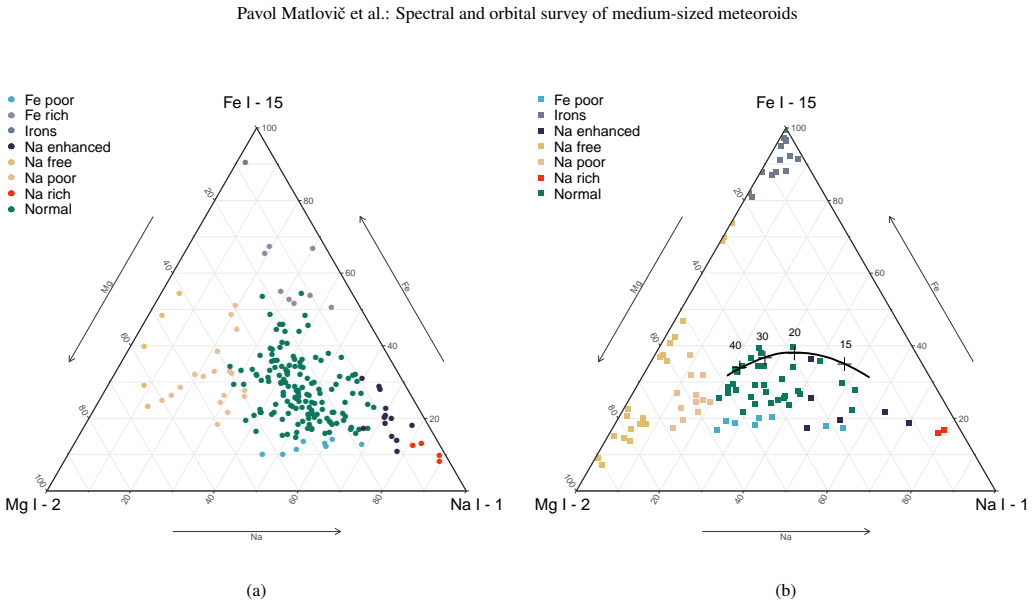
The argument is carried by the low-resolution spectral classification of meteor emission lines, which places each meteor on a ternary diagram according to the relative intensities of the Mg I-2, Na I-1, and Fe I-15 multiplets, with the expected chondritic position modelled as a function of meteor speed through a thermal equilibrium plasma model. Applying this classification, originally developed for fainter meteors, to brighter and larger meteoroids and comparing the two populations in the same Na/Mg/Fe space is what produces the size-dependence claim. The supporting apparatus includes the AMOS-Spec all-sky video spectrograph, Gaussian synthetic-spectrum fitting with atmospheric-line subtraction, empirical strength parameters $K_B$ and $P_E$ derived from beginning and terminal heights, and Tisserand-parameter grouping of orbits into asteroidal, Jupiter-family, and Halley-type classes.
What would settle it
Cross-calibrate the two surveys by observing the same meteor simultaneously with AMOS-Spec and the instrument used in the Borovička et al. (2005) survey and reducing both through one pipeline; if the Na/Mg offset between size populations disappears, the size trend is instrumental rather than compositional. In the laboratory, ablating chondritic and iron meteorite samples at controlled grain sizes under simulated meteor conditions could test whether larger bodies reproduce the observed sodium increase without invoking space weathering.
Extended reading notes
Core claim
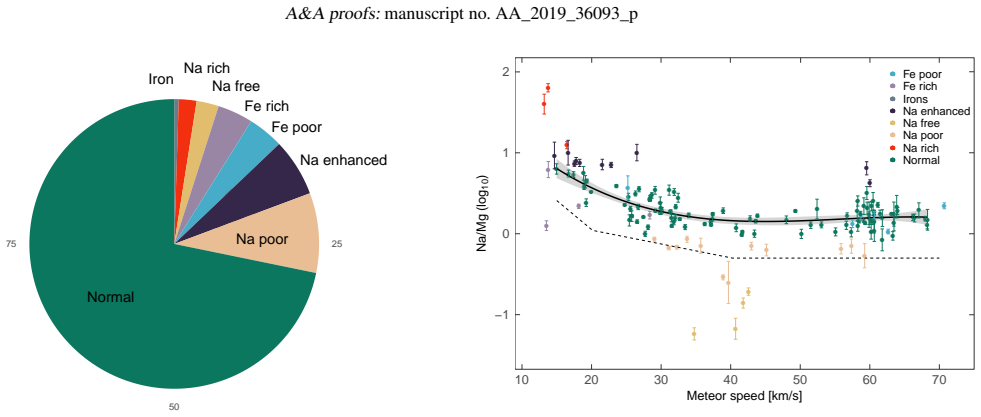
The central discovery claimed is a size-dependent compositional difference between mm-sized and cm- to dm-sized meteoroids, read from emission-line ratios. Comparing the AMOS-Spec sample of brighter meteors (-1 to -14 mag) with the fainter sample of Borovička et al. (2005), the paper finds an overall increase in the Na/Mg intensity ratio and a drop in Na-poor and Na-free meteoroids from about 34% to 11.5%, which it interprets as weaker space weathering and better volatile preservation in larger bodies. It reports only one pure iron meteoroid in 202 spectra, about 0.5%, versus roughly 14% in the mm-sized survey, and introduces a new Fe-rich spectral class between normal chondritic and iron compositions. On these grounds the paper concludes that most cm- to dm-sized meteoroids on asteroidal orbits are chondritic, consistent with main-belt transport models; the abundant mm-sized iron meteoroids must then be a size-specific phenomenon tied to the formation or ablation of small iron–nickel grains. Orbital and material-strength data for 146 meteoroids further show that Na-depleted bodies are among the strongest materials and that individual meteoroid streams such as Perseids, α-Capricornids, and δ-Aquarids are compositionally heterogeneous.
Load-bearing premise
The size-dependence conclusion collapses if the thermal-equilibrium plasma model calibrated on fainter meteors does not transfer to these brighter meteors, or if the AMOS-Spec intensity ratios are not directly comparable with those of the earlier millimeter-sized survey.
Editorial extensions
If this is right
- Spectral surveys across different magnitude ranges are not directly comparable without a size-dependent sodium correction.
- The near-absence of iron meteoroids at cm-dm sizes means the abundant small iron meteoroids must be produced or delivered by a size-specific mechanism, probably tied to iron–nickel grain sizes, rather than being representative of the asteroid belt.
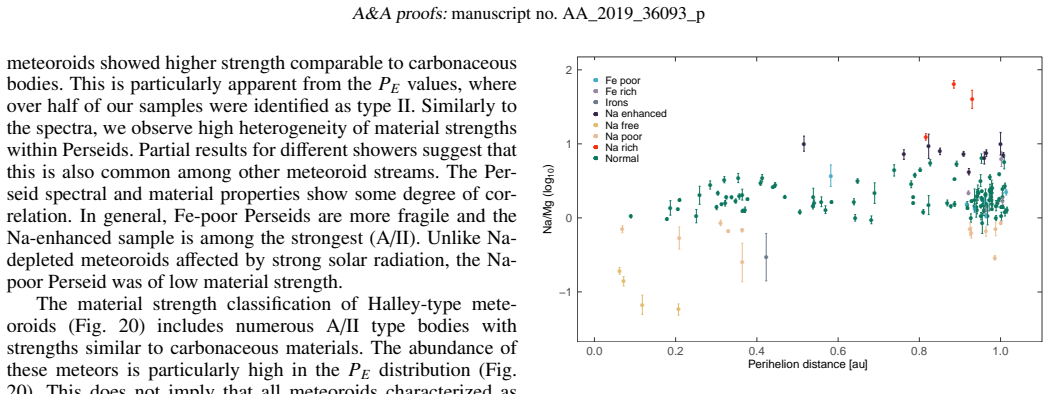
- Sodium depletion at small perihelion distances and the high material strength of Na-free and Na-poor meteoroids indicate that thermal desorption hardens meteoroid material, giving a measurable record of thermal history.
- Compositional heterogeneity within streams such as Perseids and α-Capricornids implies that single-meteor spectra are weak evidence about a parent body; characterizing a stream requires samples of about ten or more meteors.
Reading between the lines
- Beyond the paper, the proposed size trend predicts a smooth gradient across the mm-cm boundary; re-binning existing faint-meteor and fireball spectral surveys by photometric mass could locate the transition and separate a genuine size effect from instrumental offsets.
- If the iron fraction truly falls from about 14% at 1-10 mm to 0.5% at cm-dm sizes, a survey at intermediate magnitudes should find the transition size; measuring it would constrain how small iron meteoroids are formed or fragmented.
- Beyond the paper, the reported spectral similarity between κ-Cygnids and Taurids predicts that high-resolution spectra of κ-Cygnid meteors should match the refractory-element pattern of Taurids, and that a reflectance spectrum of the large remnant 2008 ED69, if obtained, should resemble primitive C- or D-type material.
Signed reviews
Editorial analysis
A structured set of objections, weighed in public.
Referee Report
Summary. The manuscript presents a spectral and orbital survey of 202 bright meteors (-1 to -14 mag, interpreted as millimeter- to decimeter-sized meteoroids) observed by the AMOS-Spec system between 2013 and 2017, with multi-station trajectory and orbit data for 146 events. The authors measure Na I/Mg I/Fe I intensity ratios, classify the meteors into the spectral classes of Borovička et al. (2005) plus a new Fe-rich class, and combine the classifications with orbital parameters and empirical material-strength indicators K_B and P_E. The central claims are (i) an overall increase in Na/Mg relative to the mm-sized population of Borovička et al. (2005), interpreted as better volatile preservation in larger meteoroids due to weaker space weathering; (ii) a very low fraction of pure iron meteoroids (1/202, 0.5%), implying that cm-dm asteroidal meteoroids are mostly chondritic; and (iii) significant spectral heterogeneity within several meteoroid streams, including Taurids, Perseids, alpha-Capricornids, and delta-Aquarids.
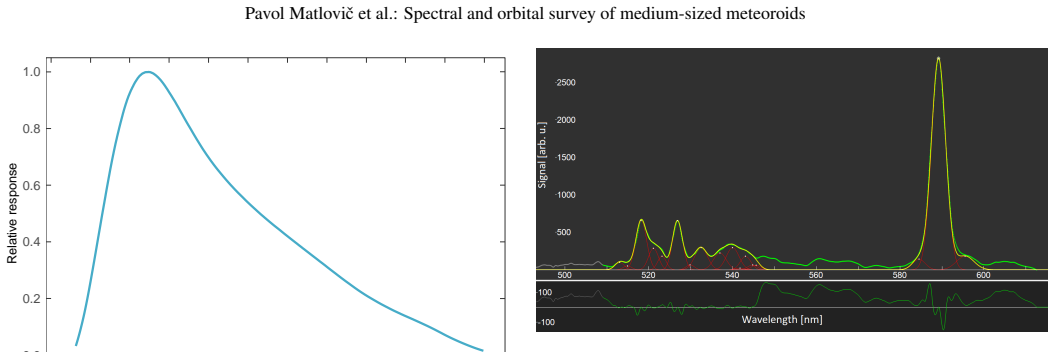
Significance. If the central claims hold, this is a valuable first large-spectral-sample bridge between the well-studied mm-sized video meteor population and bright fireballs, with implications for space weathering and for the apparent overabundance of iron meteoroids among small asteroidal meteoroids. The paper's strengths include a detailed description of the reduction pipeline, S/N-based line-intensity uncertainties, explicit checks of the instrumental response curve, exclusion of saturated and self-absorbed frames, and the delivery of orbital and atmospheric parameters for a large sample. The authors also candidly state limitations in Section 3, including the absence of a theoretical simulation for the normal-type locus. The main concerns are that the size-trend conclusion relies on an unvalidated extrapolation of the faint-meteor plasma model and on a cross-survey comparison without formal calibration, and that the empirical definition of the normal-type locus introduces a partly circular element into the class fractions.
major comments (3)
- [§2.2 and Fig. 8] The central claim of an increased Na/Mg ratio in larger meteoroids rests on two unvalidated transfers. The paper states in §2.2 that the thermal-equilibrium plasma model fitted to +3 to -1 mag meteors 'can also be assumed' for -1 to -14 mag events, but no evidence is given that mean plasma temperature, optical depth, and self-absorption behavior are invariant over this range; the low excitation potential of Na I (2.1 eV) versus Mg I (5.1 eV) makes Na/Mg strongly temperature sensitive. The comparison with Borovička et al. (2005) in Fig. 8 is likewise made without a formal cross-calibration of the two instruments and reduction chains; the response-curve check and frame-saturation check are necessary but not sufficient. Please add a quantitative validation, for example a comparison in an overlapping magnitude interval, a model calculation of the expected Na/Mg versus magnitude shift at fixed composition, or a cross-calibration against an independent bright-meteor spectral dataset. Without such a test, the statement that volatile preservation is 'directly observed' overstates the evidence; the size trend is currently a conditional inference.
- [§3 and Fig. 6] The normal-type/chondritic locus used for classification is partly empirical and sample-dependent. The paper states that the Borovička et al. (2005) chondritic curve 'might not accurately represent the characteristic chondritic area within our sample' and that 'no theoretical simulation was performed'; the normal-type position was 'simply inferred from the densest part of the distribution.' Because the fractions of Na-poor, Na-free, Na-enhanced, and Na-rich meteors are defined relative to this locus, the reported 11.5% versus 34% Na-depleted comparison is not fully independent of the classification choice. Please demonstrate the robustness of the class fractions and of the size-trend conclusion to plausible alternative normal-type loci defined from an independent model or from a fixed reference.
- [§7.2 and Fig. 7] The iron-fraction claim (0.5% versus ~14%) and the Na/Mg offset lack a selection-function and statistical treatment. The sample is magnitude-selected, not size-selected, and iron meteoroids have atypical ablation and luminous behavior; without a discussion of how cm-dm iron bodies would appear in AMOS-Spec, the low iron fraction could partly reflect detectability rather than abundance. In addition, the class fractions are reported without confidence intervals: 1/202 has a 95% Poisson interval of roughly [0.01%, 2.8%], and the offset between the running-average fits in Fig. 8 is not accompanied by a formal test that controls for meteor speed. Please provide confidence intervals for the class fractions, a quantitative speed-controlled comparison of Na/Mg between the two size populations, and a discussion of selection effects for iron bodies at these magnitudes.
minor comments (4)
- [Abstract and §3] The abstract says the sample contains 202 meteors of -1 to -14 mag, while §3 states the sample is -1 to -11 mag with the lower end possibly reaching -14; please harmonize the stated magnitude range.
- [§7.1 and Table 2] The text says the Kasuga et al. (2006) q >= 0.14 au limit 'is satisfied by three Na-free meteors', but only M20150829_015634 (q = 0.207 au) has q >= 0.14 au among the four Na-free meteors in Table 2; please correct or clarify.
- [§2.3] The phrase 'not well adapted to exceptionally bright fireballs (< -8 mag)' is ambiguous; it should be phrased as 'brighter than -8 mag' to avoid sign confusion.
- [Fig. 5] The histogram x-axis extends only to -12 mag even though the text and abstract mention -14; please indicate how the estimated -14 events are represented or note that only multi-station measured magnitudes are displayed.
Circularity Check
No significant circularity: the central Na/Mg size trend and iron fraction are measured ratios and counts compared with an external survey, not quantities forced by fitted parameters or self-citations.
full rationale
The paper's main results are empirical comparisons. Na/Mg and Fe/Mg intensity ratios are measured from synthetic-spectrum fits (§2.2, Fig. 4) and the size-dependent Na/Mg increase is read directly from Fig. 8 against the data of Borovička et al. (2005), an independently published external survey; the iron fraction (0.5%) is a count of classified spectra, not a fitted output. Classification follows definitions and the chondritic curve imported from Borovička et al. (2005), and although Section 3 admits that the normal-type locus was 'simply inferred from the densest part of the distribution' rather than modeled, this limits class-label accuracy; it does not generate the raw ratio shift or the iron count, so the central claims do not reduce to those boundary choices. Self-citations (Matlovič et al. 2017; Matlovič et al. 2019, in preparation; Tóth et al. 2015, 2019; Kornoš et al. 2015, 2018) describe instrumentation, reduction software, or previously published Taurid data; none is used as an authority to force the conclusions. The unvalidated transfer of the thermal-equilibrium plasma model to brighter meteors (§2.2) and the lack of cross-calibration with Borovička et al. (2005) are substantive correctness risks, but they are assumptions about transferability, not circular reductions of the results to their inputs.
Assumptions & free parameters
free parameters (1)
- Spectral class boundaries (normal, Na-enhanced, Na-poor, Fe-rich) =
undefined, set by inspection of ternary diagrams
assumptions (5)
- domain assumption The thermal equilibrium plasma model used for fainter meteors also holds for the brighter, larger meteoroids in this sample.
- domain assumption Line intensity ratios measured by AMOS-Spec are directly comparable to those of Borovička et al. (2005) after sensitivity correction.
- domain assumption Sodium depletion is primarily caused by space weathering, and Na/Mg ratio is a proxy for volatile content once speed effects are removed.
- domain assumption The Tisserand parameter classification (TJ > 3 asteroidal, 2 < TJ < 3 Jupiter-family, TJ < 2 Halley-type) separates source regions for these meteoroids.
- domain assumption Meteor beginning and terminal heights, and the empirical K_B and P_E parameters, reliably indicate relative material strength for these meteoroids.
Cite this review
Pith. "Pith review of Spectral and orbital survey of medium-sized meteoroids." pith.science (2026). https://pith.science/paper/DOUYOTBL
@misc{pith2026190801565,
  author       = {Pith},
  title        = {Pith review of: Spectral and orbital survey of medium-sized meteoroids},
  year         = {2026},
  howpublished = {\url{https://pith.science/paper/DOUYOTBL}},
  note         = {Machine review of arXiv:1908.01565}
}
abstract
We investigate the spectra, material properties, and orbital distribution of millimeter- to decimeter-sized meteoroids. Our study aims to distinguish the characteristics of populations of differently sized meteoroids and reveal the heterogeneity of identified meteoroid streams. We verify the surprisingly large ratio of pure iron meteoroids on asteroidal orbits detected among mm-sized bodies. Emission spectra and multi-station meteor trajectories were collected within the AMOS network observations. The sample is based on 202 meteors of -1 to -14 magnitude, corresponding to meteoroids of mm to dm sizes. Meteoroid composition is studied by relative intensity ratios of Na, Mg, and Fe. Heliocentric orbits, trajectory parameters, and material strengths inferred from empirical $K_B$ and $P_E$ parameters were determined for 146 meteoroids. An overall increase of Na content compared to the population of mm-sized meteoroids was detected, reflecting weaker effects of space weathering processes on larger meteoroids. We report a very low ratio of pure iron meteoroids and the discovery of a new spectral group of Fe-rich meteors. The majority of meteoroids on asteroidal orbits were found to be chondritic. Thermal processes causing Na depletion and physical processes resulting in Na-rich spectra are described and linked to characteristically increased material strengths. Numerous major and minor shower meteors were identified in our sample, revealing various degrees of heterogeneity within Halley-type, ecliptical, and sungrazing meteoroid streams. Our results imply a scattered composition of the fragments of comet 2P/Encke and 109P/Swift-Tuttle. The largest disparities were detected within the $\alpha$-Capricornids and $\delta$-Aquarids. We also find a spectral similarity between $\kappa$-Cygnids and Taurids, which could imply a similar composition of the parent objects of the two streams.
Figures


Figures from the paper (18 more)






Reference graph
Works this paper leans on
-
[1]
L., Lallement, R., Ferron, S., Boonne, C., & Bodichon, R
Bertaux, J. L., Lallement, R., Ferron, S., Boonne, C., & Bodichon, R. 2014, Astronomy & Astrophysics, 564, A46
work page 2014
-
[2]
Bloxam, K. & Campbell-Brown, M. 2017, Planet. Space Sci., 143, 28 Boroviˇcka, J. 1993, Astronomy & Astrophysics, 279, 627 Boroviˇcka, J. 2001, in ESA Special Publication, V ol. 495, Meteoroids 2001 Con- ference, ed. B. Warmbein, 203–208 Boroviˇcka, J. 2010, in Proceedings of the International Meteor Conference, 26th
work page 2017
-
[3]
IMC, Bareges, France, 2007, ed. J. Rendtel & J. Vaubaillon, 42–51 Boroviˇcka, J., Koten, P., Spurný, P., Boˇcek, J., & Štork, R. 2005, Icarus, 174, 15 Boroviˇcka, J., Spurný, P., & Brown, P. 2015, Small Near-Earth Asteroids as a Source of Meteorites, ed. P. Michel, F. E. DeMeo, & W. F. Bottke, 257–280 Boroviˇcka, J., Spurný, P., & Keclikova, J. 1995, Astr...
work page 2007
-
[4]
2012, Meteoritics and Planetary Sci- ence, 47, 453
Brownlee, D., Joswiak, D., & Matrajt, G. 2012, Meteoritics and Planetary Sci- ence, 47, 453
work page 2012
-
[5]
2015, Planetary and Space Science, 118, 8
Campbell-Brown, M. 2015, Planetary and Space Science, 118, 8
work page 2015
- [6]
-
[7]
1987, Bulletin of the Astronomical Institutes of Czechoslovakia, 38, 222
Ceplecha, Z. 1987, Bulletin of the Astronomical Institutes of Czechoslovakia, 38, 222
1987
-
[8]
1988, Bulletin of the Astronomical Institutes of Czechoslovakia, 39, 221
Ceplecha, Z. 1988, Bulletin of the Astronomical Institutes of Czechoslovakia, 39, 221
work page 1988
Show all 40 references
-
[9]
& McCrosky, R
Ceplecha, Z. & McCrosky, R. E. 1976, Journal of Geophysical Research, 81, 6257
1976
-
[10]
1993, Astronomy & Astrophysics, 279, 615
Ceplecha, Z., Spurny, P., Borovi ˇcka, J., & Keclikova, J. 1993, Astronomy & Astrophysics, 279, 615
1993
-
[11]
2018, Astronomy & Astrophysics, 613, A54
Drouard, A., Vernazza, P., Loehle, S., et al. 2018, Astronomy & Astrophysics, 613, A54
2018
-
[12]
2018, Astronomy & Astrophysics, 610, A73
Ferus, M., Koukal, J., Lenža, L., et al. 2018, Astronomy & Astrophysics, 610, A73
2018
-
[13]
Girin, O. G. 2017, Astronomy & Astrophysics, 606, A63
2017
-
[14]
2017, A&A, 598, A52
Granvik, M., Morbidelli, A., V okrouhlický, D., et al. 2017, A&A, 598, A52
2017
-
[15]
2006, Meteor Showers and their Parent Comets
Jenniskens, P. 2006, Meteor Showers and their Parent Comets
2006
-
[16]
2014, Meteoroids 2013, 117
Jenniskens, P., Gural, P., & Berdeu, A. 2014, Meteoroids 2013, 117
2014
-
[17]
H., Numan, D., et al
Jenniskens, P., Shaddad, M. H., Numan, D., et al. 2009, Nature, 458, 485
2009
-
[18]
& Vaubaillon, J
Jenniskens, P. & Vaubaillon, J. 2008, AJ, 136, 725
2008
-
[19]
& Vaubaillon, J
Jenniskens, P. & Vaubaillon, J. 2010, Astronomical Journal, 139, 1822
2010
-
[20]
Jopek, T. J. & Kaˇnuchová, Z. 2017, Planetary and Space Science, 143, 3
2017
-
[21]
2006, Astronomy & As- trophysics, 453, L17
Kasuga, T., Yamamoto, T., Kimura, H., & Watanabe, J. 2006, Astronomy & As- trophysics, 453, L17
2006
-
[22]
2011, Icarus, 212, 697 Kornoš, L., Matloviˇc, P., Rudawska, R., et al
Kohout, T., Kiuru, R., Montonen, M., et al. 2011, Icarus, 212, 697 Kornoš, L., Matloviˇc, P., Rudawska, R., et al. 2014, Meteoroids 2013, 225 Kornoš, L., ˇDuriš, F., & Tóth, J. 2015, in International Meteor Conference Mis- telbach, Austria, ed. J.-L. Rault & P. Roggemans, 101–...
2011
-
[23]
2004, Astronomy & Astrophysics, 428, 683
Koten, P., Boroviˇcka, J., Spurný, P., Betlem, H., & Evans, S. 2004, Astronomy & Astrophysics, 428, 683
2004
-
[24]
Ralchenko, Reader, J., & and NIST ASD Team
Kramida, A., Yu. Ralchenko, Reader, J., & and NIST ASD Team. 2018, NIST Atomic Spectra Database (ver. 5.6.1), [Online]. Available: https://physics.nist.gov/asd [2019, March 4]. National Institute of Standards and Technology, Gaithersburg, MD
2018
-
[25]
1979, Dynamical interrelations among comets and asteroids, ed
Kresak, L. 1979, Dynamical interrelations among comets and asteroids, ed. T. Gehrels, 289–309
1979
-
[26]
M., Trigo-Rodríguez, J
Madiedo, J. M., Trigo-Rodríguez, J. M., Konovalova, N., et al. 2013, Monthly Notices of the Royal Astronomical Society, 433, 571
2013
-
[27]
M., Trigo-Rodríguez, J
Madiedo, J. M., Trigo-Rodríguez, J. M., Ortiz, J. L., Castro-Tirado, A. J., & Cabrera-Caño, J. 2014b, Icarus, 239, 273 Matloviˇc, P., Tóth, J., & Kornoš, L. 2019, Icarus, in preparation Matloviˇc, P., Tóth, J., Rudawska, R., & Kornoš, L. 2017, Planetary and Space Science, 143, 104
2019
-
[28]
Moore, C. E. 1945, Contributions from the Princeton University Observatory, 20, 1
1945
-
[29]
Norton, O. R. 2002, The Cambridge Encyclopedia of Meteorites, 374
2002
-
[30]
Papike, J. J. 1998, Planetary materials, V ol. 36 (Mineralogical Society of Amer- ica)
1998
-
[31]
2016, Planetary and Space Science, 123, 25
Rudawska, R., Tóth, J., Kalmanˇcok, D., Zigo, P., & Matloviˇc, P. 2016, Planetary and Space Science, 123, 25
2016
-
[32]
2014, Earth Moon and Planets, 112, 45 SonotaCo
Rudawska, R., Zender, J., Jenniskens, P., et al. 2014, Earth Moon and Planets, 112, 45 SonotaCo. 2009, WGN, Journal of the International Meteor Organization, 37, 55
2014
-
[33]
Southworth, R. B. & Hawkins, G. S. 1963, Smithsonian Contributions to Astro- physics, 7, 261 Spurný, P., Haloda, J., Borovi ˇcka, J., Shrbený, L., & Halodová, P. 2014, A&A, 570, A39 Spurný, P., Oberst, J., & Heinlein, D. 2003, Nature, 423, 151 Tóth, J., Kornoš, L., Zigo, P., e...
1963
-
[34]
M., Llorca, J., Boroviˇcka, J., & Fabregat, J
Trigo-Rodriguez, J. M., Llorca, J., Boroviˇcka, J., & Fabregat, J. 2003, Meteorit- ics and Planetary Science, 38, 1283
2003
-
[35]
M., Madiedo, J
Trigo-Rodriguez, J. M., Madiedo, J. M., Williams, I. P., & Castro-Tirado, A. J. 2009, MNRAS, 392, 367
2009
-
[36]
2015, Astronomy & Astro- physics, 584, A97 ˇCapek, D
Tubiana, C., Snodgrass, C., Michelsen, R., et al. 2015, Astronomy & Astro- physics, 584, A97 ˇCapek, D. & Boroviˇcka, J. 2017, Planetary and Space Science, 143, 159
2015
-
[37]
G., & Campbell-Brown, M
Vida, D., Brown, P. G., & Campbell-Brown, M. 2018, MNRAS, 479, 4307 V ojáˇcek, V ., Boroviˇcka, J., Koten, P., Spurný, P., & Štork, R. 2015, Astronomy & Astrophysics, 580, A67 V ojáˇcek, V ., Boroviˇcka, J., Koten, P., Spurný, P., & Štork, R. 2019, Astronomy & Astrophysics, 621, A68
2018
-
[38]
Wasson, J. T. & Rubin, A. E. 1985, Nature, 318, 168
1985
-
[39]
2010, Journal of Applied Crystallography, 43, 1126
Wojdyr, M. 2010, Journal of Applied Crystallography, 43, 1126
2010
-
[40]
2013, in Proceedings of the International Meteor Conference, 31st IMC, La Palma, Canary Islands, Spain, 2012, ed
Zigo, P., Toth, J., & Kalmancok, D. 2013, in Proceedings of the International Meteor Conference, 31st IMC, La Palma, Canary Islands, Spain, 2012, ed. M. Gyssens & P. Roggemans, 18–20 Article number, page 19 of 19
2013
Reviewed August 14, 2026 · model on record in the stance chip above.
Discussion (0). Continue with ORCID to comment.