REVIEW 4 major objections 4 minor 30 references
Revisiting Feature Alignment for One-stage Object Detection
T0 review · 4 major / 4 minor · reviewed 2026-08-14 · deepseek-v4-flash
Pith's one-line read A one-stage detector's features and anchors can be aligned exactly by reinterpreting convolution as RoIAlign, yielding a plug-in operator that raises COCO mAP to 44.1.
desk verdict The im2col/RoIAlign observation and the RoIConv operator are genuinely neat and the controlled ablation supports them, but the motivating pilot experiment is confounded and the SOTA claim is overstated. read the letter →
The pith
A machine-rendered reading of the paper's core claim, the machinery that carries it, and where it could break.
The reading
What carries the argument
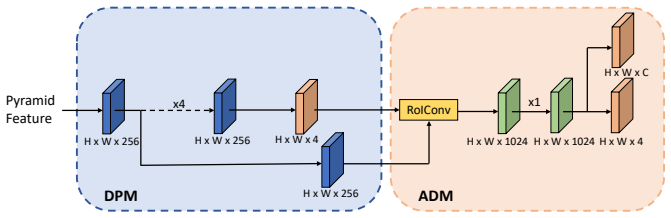
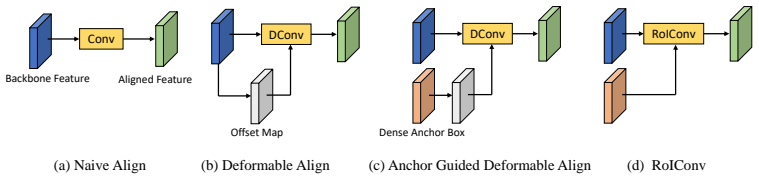
The load-bearing object is the RoIConv operator together with the identity that generates it. The identity, derived by equating the sampling locations of convolution (Equation 1) with those of RoIAlign (Equation 2), says im2col is RoIAlign with a fixed rectangle and convolution is that RoIAlign followed by a fully connected layer. RoIConv then sets the rectangle to the actual anchor box, producing offset maps from Equation 4; the offsets are exact and are generated by a $1\times 1$ convolution and an element-wise addition, so the operator remains fully convolutional and costs the same as ordinary convolution. This machinery does the argument's work because it converts the paper's diagnosis—misalignment—into a directly implemented operation and gives a mathematically guaranteed alignment that learned-offset alternatives lack.
What would settle it
A reader could train the single-scale P4 RetinaNet with a plain $3\times 3$ convolution of the same parameter count in place of RoIConv; if that plain layer recovers most of the 5.0 mAP gain, the gain is capacity-driven, not alignment-driven. Alternatively, compute the IoU between each anchor and the implicit RoI rectangle that RoIConv actually samples on the trained AlignDet; if the mean IoU is not close to 1, the claimed exact alignment fails.
Extended reading notes
Core claim
The central claim is that the longstanding feature-anchor misalignment in one-stage detectors has a principled fix: define the sampling region of a convolution as the implicit RoIAlign it performs, then shift those sampling points by the difference between that implicit rectangle and the anchor box. Concretely, a $h\times w$ convolution on a feature map of stride $S$ samples positions equivalent to an RoIAlign with a box of size $hS\times wS$ centered at each output location (Equation 3). Since each location is shared by anchors of many scales and aspect ratios, no single implicit rectangle fits them all, and multi-scale pyramids only cover scale. RoIConv replaces the fixed rectangle with the anchor box: the offset for sampling point $(i,j)$ at output location $(X,Y)$ is the closed-form difference between the anchor-aligned sampling location and the convolution sampling location (Equation 4), obtained by a $1\times 1$ convolution plus element-wise addition. The paper then demonstrates the payoff with AlignDet, a fully convolutional detector whose dense proposal module learns a single anchor per location and whose aligned detection module applies RoIConv: it improves over the RetinaNet baseline by 2.2 mAP (ResNet-50) and 2.0 mAP (ResNet-101) on COCO minival, and the full ResNeXt-101 model reaches 44.1 mAP on COCO test-dev.
Load-bearing premise
The paper assumes the 12-point mAP collapse of the single-scale RetinaNet relative to its multi-scale version is caused by feature-anchor misalignment, not by the lost spatial resolution or representational capacity of using one feature level; if the collapse has another cause, RoIConv is still effective but the diagnosis and the principled motivation weaken.
Editorial extensions
If this is right
- Single-scale one-stage detection is no longer inherently weak: one $3\times 3$ RoIConv layer recovers 5.0 mAP on the P4-only RetinaNet, so alignment is a substantial part of what multi-scale features buy.
- Learned anchors can replace hand-tuned anchor grids: AlignDet with one learned anchor per location beats RetinaNet's nine anchors by 2.2 mAP (ResNet-50) and 2.0 mAP (ResNet-101) on COCO minival.
- RoIConv is a cheap drop-in: it costs the same as vanilla convolution, and the $3\times 3$/1024 variant runs about 15% faster than RetinaNet while improving mAP by 1.0.
- Aligned features improve precise localization: AlignDet reports higher AP@0.75 (46.5 for ResNet-101, 48.9 for ResNeXt-101) than comparable one-stage detectors on COCO test-dev.
- The full system reaches 44.1 mAP on COCO test-dev with a ResNeXt-101 FPN backbone, improving the strong RetinaNet baseline by 3.3 mAP at comparable speed.
Reading between the lines
- The identity implies every dense convolutional layer has an implicit region of support, so alignment quality for any one-stage detector can be measured by comparing implicit regions with assigned anchors; this could serve as a diagnostic tool for future detector designs.
- Because RoIConv needs only a per-location box, anchor-free detectors that predict a box shape at each location could adopt the same closed-form offsets, turning their predicted boxes into exact alignment targets rather than heuristics.
- The paper's failure analysis of learned-offset alignment (classification supervision pulls offsets toward discriminative parts) suggests an auxiliary loss that supervises offsets directly from anchor geometry could strengthen deformable-convolution detectors.
Signed reviews
Editorial analysis
A structured set of objections, weighed in public.
Referee Report
Summary. The paper revisits feature alignment for one-stage object detectors. It establishes a mathematical equivalence between the im2col operator used in convolution and the RoIAlign operator, showing that a h×w convolution on a stride-S feature map is a special case of RoIAlign with an hS×wS box per location (Section 4.1). Based on this, it proposes RoIConv, which computes sampling offsets directly from the anchor box coordinates so that convolutional features are aligned with the corresponding anchors, at no additional learnable parameters beyond a 1×1 offset generation. The proposed AlignDet architecture combines a dense proposal module (DPM) that predicts/refines anchors with an aligned detection module (ADM) that applies RoIConv and then predicts classification and regression. Experiments on COCO show that AlignDet improves over RetinaNet by 2.2/2.1 mAP for ResNet-50/101 and reports 44.1 mAP on test-dev with a ResNeXt-101 backbone. The paper also includes ablations comparing RoIConv with vanilla, deformable, and anchor-guided deformable convolutions at equal parameter count.
Significance. If the technical results hold, the paper makes a useful contribution: a principled, plug-and-play operator that explicitly aligns features with anchors in dense one-stage detectors, with a clean derivation connecting convolution and RoIAlign. The controlled ablation in Table 4 is a genuine strength, showing that RoIConv outperforms alternatives at equal parameter count (36.2 vs. 35.2–35.3 AP). The method is also efficient: the 3×3 RoIConv variant is faster than RetinaNet in Table 6. However, the paper's motivational narrative, based on the single-scale pilot experiment, is not supported by the evidence as presented, and the state-of-the-art claim in the abstract is contradicted by numbers in the paper's own comparison table. These issues require correction before the central claims can be taken at face value.
major comments (4)
- [Section 5.2, Table 2] The pilot experiment does not establish that the 12.0 mAP drop of single-scale RetinaNet (32.4 to 20.4) is caused by feature-anchor misalignment. The comparison with Faster R-CNN's C4 model is confounded by multiple factors: (i) the P4-only RetinaNet has no P3 stride-8 feature, which directly explains the AP_s collapse from 17.5 to 7.3; (ii) the FPN feature is 256 channels while Faster R-CNN's C4 is 1024 channels, so capacity also differs; and (iii) one-stage detection is dense over the full image, while Faster R-CNN uses a small number of proposals and RoIAlign, so the operating point is different. Any of these factors could cause a large drop without invoking misalignment. The repair experiment in Table 2 adds a single RoIConv and recovers only 5.0 mAP (20.4 to 25.4), leaving about 7 points of the gap unexplained. A controlled experiment that isolates misalignment—for example, adding an RoIAlign-like alignment to a single-scale one-stage detector while keeping resolution and channel count fixed—is needed to support the causal claim.
- [Abstract and Section 5.5, Table 7] The single-scale RoIConv experiment is ambiguous about which anchor is used for alignment. The P4-only RetinaNet as described in Section 3.1 yields anchors of scales {2,4,8,16,32} at stride 16, i.e., five anchors per spatial location, but a single RoIConv output per location can align to at most one anchor box. The paper says 'pre-defined anchors as RoIs' without specifying which of the five anchors is chosen for each location, or how the single aligned feature is shared across the five anchors during classification and regression. This omission makes the experiment difficult to reproduce and weakens the interpretation of the 5.0 mAP recovery as evidence for alignment.
- [Section 4.2 and Table 6] The abstract claims 'state-of-the-art mAP of 44.1 on COCO test-dev with ResNeXt-101 backbone,' but Table 7 itself lists CenterNet (Duan et al., 2019) with 44.9 AP using a Hourglass-104 backbone. Even though AlignDet does not use flip test or soft NMS while CenterNet does, the claim as written is factually incorrect. The state-of-the-art statement should be qualified to the specific backbone and experimental conditions, or the comparison table should be updated with contemporaneous methods that may achieve higher AP.
- [Section 4.2 and Table 6] The statement in Section 4.2 that RoIConv 'requires no addition computation compared with the vanilla convolution' is misleading. Offsets are generated via a 1×1 convolution and an element-wise addition, which themselves add parameters and FLOPs, and the actual sampling at non-integer locations incurs bilinear interpolation overhead similar to deformable convolution. Table 6 shows that the 7×7 RoIConv variant is markedly slower than RetinaNet (86 ms vs. 58 ms), so the complexity claim should be reformulated, e.g., as 'no additional learnable parameters beyond a 1×1 conv' or 'same asymptotic complexity as deformable convolution.'
minor comments (4)
- [Section 3 heading] The heading 'Pilot Experiement' contains a typo; it should read 'Pilot Experiment.'
- [Table 7] In the table, 'CornetNet' should be 'CornerNet.'
- [Section 4.1, Eq. (2)] The notation h and w in Eq. (2) is used both for the RoI output size and for the anchor height/width; please disambiguate these, e.g., by using h_a, w_a for the anchor dimensions.
- [Section 5.1] The implementation details state that the DPM only does bounding box regression during test, but the training procedure for the DPM is not fully described (e.g., whether it also predicts classification during training). Please clarify.
Circularity Check
No circularity: RoIConv is an analytically constructed operator, and the reported gains are empirical ablations against independent baselines.
full rationale
The paper's core derivation (Sec. 4.1) starts from the independently defined sampling formulas for convolution (Eq. 1) and RoIAlign (Eq. 2), solves Loc_conv = Loc_RoI, and obtains Eq. 3. This is a mathematical equivalence between two pre-existing operations, not a result that assumes what it proves. The RoIConv offsets in Eq. 4 are then computed as the difference between the anchor box sampling locations and the vanilla convolution sampling locations; that is a construction, not a fitted parameter renamed as a prediction. The empirical claims (Tables 2-6) compare RoIConv against vanilla convolution, deformable convolution, and other variants on COCO; the improvements are measured, not forced by the definition of the operator. The pilot experiment in Sec. 3.1 supports motivation but is not the derivation of RoIConv; even if its causal interpretation is debatable, that is a correctness/experimental-design concern, not circularity. No load-bearing self-citation or imported uniqueness theorem is used: the related work and baselines are external. Therefore the derivation chain is self-contained and no circular step can be exhibited.
Assumptions & free parameters
free parameters (3)
- initial anchor scale =
4
- initial anchor aspect ratio =
1:1
- label assignment IoU thresholds =
DPM 0.4/0.3, ADM 0.6/0.6 (or 0.7/0.7)
assumptions (3)
- standard math Definition of convolution sampling locations as in Eq. (1)
- standard math Definition of RoIAlign sampling locations as in Eq. (2)
- domain assumption COCO annotations are reliable for training/evaluation
Cite this review
Pith. "Pith review of Revisiting Feature Alignment for One-stage Object Detection." pith.science (2026). https://pith.science/paper/JKWRZZUY
@misc{pith2026190801570,
  author       = {Pith},
  title        = {Pith review of: Revisiting Feature Alignment for One-stage Object Detection},
  year         = {2026},
  howpublished = {\url{https://pith.science/paper/JKWRZZUY}},
  note         = {Machine review of arXiv:1908.01570}
}
read the original abstract
Recently, one-stage object detectors gain much attention due to their simplicity in practice. Its fully convolutional nature greatly reduces the difficulty of training and deployment compared with two-stage detectors which require NMS and sorting for the proposal stage. However, a fundamental issue lies in all one-stage detectors is the misalignment between anchor boxes and convolutional features, which significantly hinders the performance of one-stage detectors. In this work, we first reveal the deep connection between the widely used im2col operator and the RoIAlign operator. Guided by this illuminating observation, we propose a RoIConv operator which aligns the features and its corresponding anchors in one-stage detection in a principled way. We then design a fully convolutional AlignDet architecture which combines the flexibility of learned anchors and the preciseness of aligned features. Specifically, our AlignDet achieves a state-of-the-art mAP of 44.1 on the COCO test-dev with ResNeXt-101 backbone.
Figures

Figures from the paper (1 more)

Reference graph
Works this paper leans on
-
[1]
Cascade R-CNN: Delving into high quality object detection
Zhaowei Cai and Nuno Vasconcelos. Cascade R-CNN: Delving into high quality object detection. In CVPR, 2018
work page 2018
-
[2]
Flexible, high performance convolutional neural networks for image classification
Kumar Chellapilla, Sidd Puri, and Patrice Simard. Flexible, high performance convolutional neural networks for image classification. In Workshop on Frontiers in Handwriting Recognition, 2006
work page 2006
-
[3]
R-FCN: Object detection via region-based fully convolutional networks
Jifeng Dai, Yi Li, Kaiming He, and Jian Sun. R-FCN: Object detection via region-based fully convolutional networks. In NIPS, 2016
work page 2016
-
[4]
Deformable convolutional networks
Jifeng Dai, Haozhi Qi, Yuwen Xiong, Yi Li, Guodong Zhang, Han Hu, and Yichen Wei. Deformable convolutional networks. In ICCV, 2017
2017
-
[5]
CenterNet: Keypoint triplets for object detection
Kaiwen Duan, Song Bai, Lingxi Xie, Honggang Qi, Qingming Huang, and Qi Tian. CenterNet: Keypoint triplets for object detection. arXiv:1904.08189, 2019
arXiv 1904
-
[6]
DSSD: Deconvolutional single shot detector
Cheng-Yang Fu, Wei Liu, Ananth Ranga, Ambrish Tyagi, and Alexander C Berg. DSSD: Deconvolutional single shot detector. arXiv:1701.06659, 2017. 9
arXiv 2017
-
[7]
Fast R-CNN
Ross Girshick. Fast R-CNN. In ICCV, 2015
2015
-
[8]
Rich feature hierarchies for accurate object detection and semantic segmentation
Ross Girshick, Jeff Donahue, Trevor Darrell, and Jitendra Malik. Rich feature hierarchies for accurate object detection and semantic segmentation. In CVPR, 2014
2014
Show all 30 references
-
[9]
Mask R-CNN
Kaiming He, Georgia Gkioxari, Piotr Dollár, and Ross Girshick. Mask R-CNN. In ICCV, 2017
2017
-
[10]
Delving deep into rectifiers: Surpassing human-level performance on imagenet classification
Kaiming He, Xiangyu Zhang, Shaoqing Ren, and Jian Sun. Delving deep into rectifiers: Surpassing human-level performance on imagenet classification. In ICCV, 2015
2015
-
[11]
Spatial pyramid pooling in deep convolutional networks for visual recognition
Kaiming He, Xiangyu Zhang, Shaoqing Ren, and Jian Sun. Spatial pyramid pooling in deep convolutional networks for visual recognition. IEEE Transactions on Pattern Analysis and Machine Intelligence, 37(9):1904–1916, 2015
1904
-
[12]
Densebox: Unifying landmark localization with end to end object detection
Lichao Huang, Yi Yang, Yafeng Deng, and Yinan Yu. Densebox: Unifying landmark localization with end to end object detection. arXiv:1509.04874, 2015
2015 arXiv
-
[13]
FoveaBox: Beyond anchor-based object detector
Tao Kong, Fuchun Sun, Huaping Liu, Yuning Jiang, and Jianbo Shi. FoveaBox: Beyond anchor-based object detector. arXiv:1904.03797Z, 2019
1904 arXiv
-
[14]
CornerNet: Detecting objects as paired keypoints
Hei Law and Jia Deng. CornerNet: Detecting objects as paired keypoints. In ECCV, 2018
2018
-
[15]
Feature pyramid networks for object detection
Tsung-Yi Lin, Piotr Dollár, Ross B Girshick, Kaiming He, Bharath Hariharan, and Serge J Belongie. Feature pyramid networks for object detection. In CVPR, 2017
2017
-
[16]
Focal loss for dense object detection
Tsung-Yi Lin, Priya Goyal, Ross Girshick, Kaiming He, and Piotr Dollar. Focal loss for dense object detection. In ICCV, 2017
2017
-
[17]
Microsoft COCO: Common objects in context
Tsung-Yi Lin, Michael Maire, Serge Belongie, James Hays, Pietro Perona, Deva Ramanan, Piotr Dollár, and C Lawrence Zitnick. Microsoft COCO: Common objects in context. In ECCV, 2014
2014
-
[18]
SSD: Single shot multibox detector
Wei Liu, Dragomir Anguelov, Dumitru Erhan, Christian Szegedy, Scott Reed, Cheng-Yang Fu, and Alexander C Berg. SSD: Single shot multibox detector. In ECCV, 2016
2016
-
[19]
You only look once: Unified, real-time object detection
Joseph Redmon, Santosh Divvala, Ross Girshick, and Ali Farhadi. You only look once: Unified, real-time object detection. In CVPR, 2016
2016
-
[20]
YOLOv3: An incremental improvement
Joseph Redmon and Ali Farhadi. YOLOv3: An incremental improvement. arXiv:1804.02767, 2018
2018 arXiv
-
[21]
Faster R-CNN: Towards real-time object detection with region proposal networks
Shaoqing Ren, Kaiming He, Ross Girshick, and Jian Sun. Faster R-CNN: Towards real-time object detection with region proposal networks. In NIPS, 2015
2015
-
[22]
Berg, and Li Fei-Fei
Olga Russakovsky, Jia Deng, Hao Su, Jonathan Krause, Sanjeev Satheesh, Sean Ma, Zhiheng Huang, Andrej Karpathy, Aditya Khosla, Michael Bernstein, Alexander C. Berg, and Li Fei-Fei. ImageNet large scale visual recognition challenge. International Journal of Computer Vision, 115...
2015
-
[23]
FCOS: Fully convolutional one-stage object detection
Zhi Tian, Chunhua Shen, Hao Chen, and Tong He. FCOS: Fully convolutional one-stage object detection. arXiv:1904.01355, 2019
1904 arXiv
-
[24]
Region proposal by guided anchoring
Jiaqi Wang, Kai Chen, Shuo Yang, Chen Change Loy, and Dahua Lin. Region proposal by guided anchoring. In CVPR, 2019
2019
-
[25]
MetaAnchor: Learning to detect objects with customized anchors
Tong Yang, Xiangyu Zhang, Zeming Li, Wenqiang Zhang, and Jian Sun. MetaAnchor: Learning to detect objects with customized anchors. In NIPS, 2018
2018
-
[26]
RepPoints: Point set representa- tion for object detection
Ze Yang, Shaohui Liu, Han Hu, Liwei Wang, and Stephen Lin. RepPoints: Point set representa- tion for object detection. arXiv:1904.11490, 2019
1904 arXiv
-
[27]
Single-shot refinement neural network for object detection
Shifeng Zhang, Longyin Wen, Xiao Bian, Zhen Lei, and Stan Z Li. Single-shot refinement neural network for object detection. In CVPR, 2018
2018
-
[28]
Objects as points
Xingyi Zhou, Dequan Wang, and Philipp Krähenbühl. Objects as points. arXiv:1904.07850, 2019. 10
1904 arXiv
-
[29]
Bottom-up object detection by grouping extreme and center points
Xingyi Zhou, Jiacheng Zhuo, and Philipp Krähenbühl. Bottom-up object detection by grouping extreme and center points. In CVPR, 2019
2019
-
[30]
Feature selective anchor-free module for single-shot object detection
Chenchen Zhu, Yihui He, and Marios Savvides. Feature selective anchor-free module for single-shot object detection. In CVPR, 2019. 11
2019
Reviewed August 14, 2026 · model on record in the stance chip above.
Discussion (0). Continue with ORCID to comment.