REVIEW 3 major objections 4 minor 47 references
Sub-Attosecond Metrology via X-Ray Hong-Ou-Mandel Effect
T0 review · 3 major / 4 minor · reviewed 2026-08-14 · deepseek-v4-flash
Pith's one-line read The paper proposes an x-ray Hong-Ou-Mandel interferometer whose coincidence dip reaches 0.6 attoseconds, enabling sub-angstrom path-difference measurements.
desk verdict A genuinely new x-ray HOM proposal with a plausible 0.6 as dip, but the paper's own bandwidth-to-width conversion is off by ~3x and the central integral needs an independent check. read the letter →
The pith
A machine-rendered reading of the paper's core claim, the machinery that carries it, and where it could break.
The reading
What carries the argument
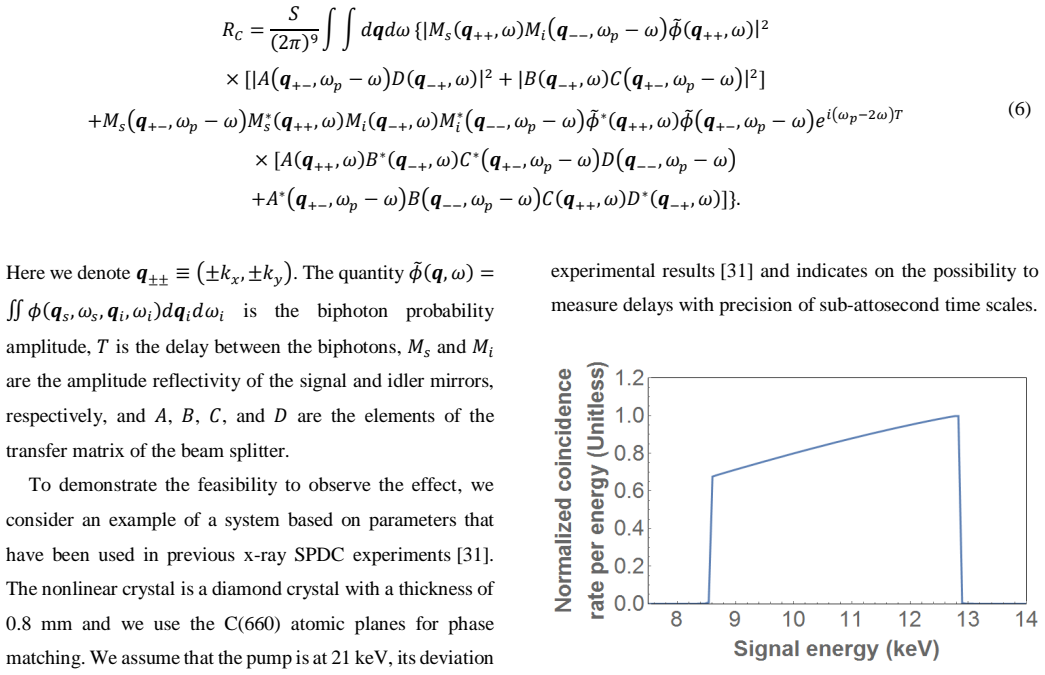
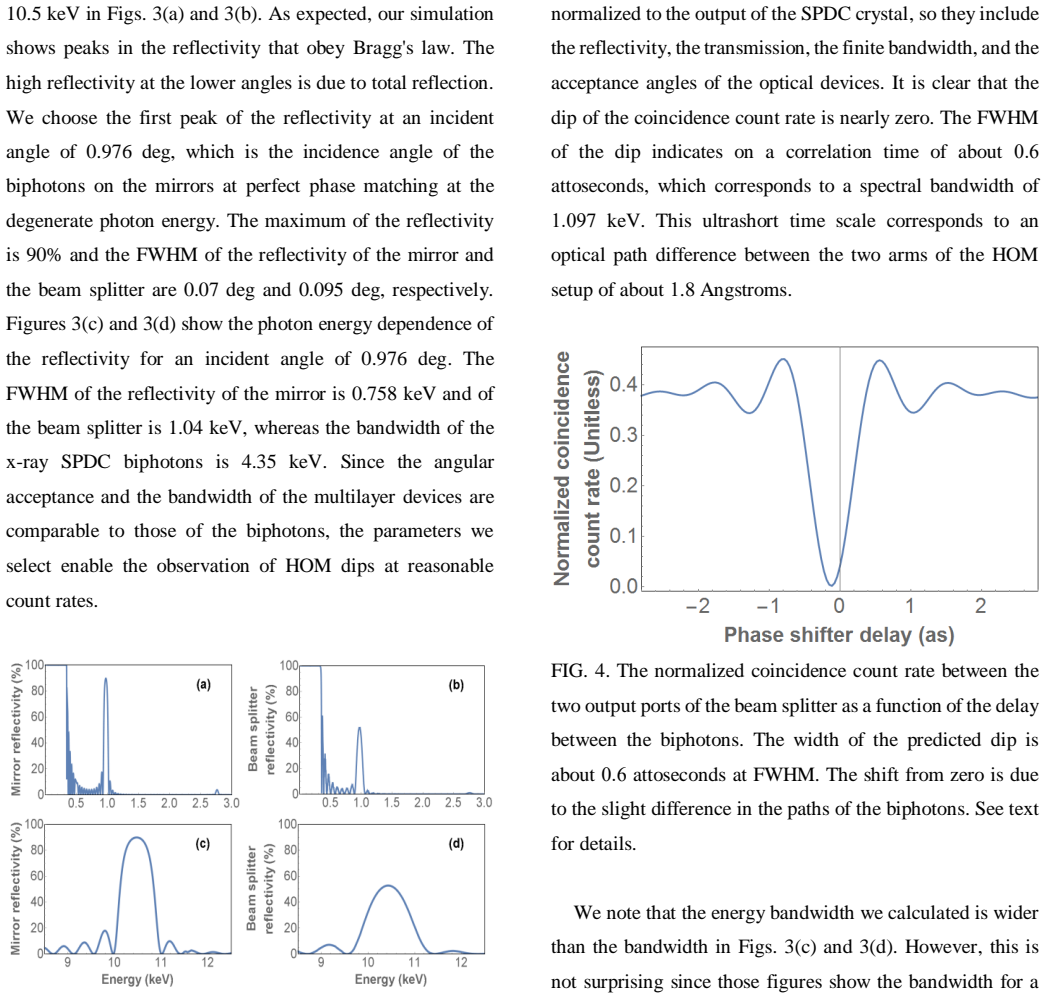
The load-bearing mechanism is two-photon interference at a multilayer beam splitter, fed by broadband x-ray biphotons from SPDC. The paper models the biphoton amplitude $\phi$ from the coupled operator equations for the signal and idler fields, propagates the operators through the multilayer mirrors and beam splitter using transfer matrices, and evaluates the coincidence rate (Eq. 6). The dip is the quantum-interference term: when the two photons are indistinguishable, the two alternative histories through the beam splitter cancel. Its width is set by the 4.35 keV biphoton bandwidth, giving a correlation time of about 0.6 attoseconds, and the multilayer elements are sized with Eq. 4 and matrix theory so that their acceptance does not destroy that bandwidth.
What would settle it
Compute the full complex amplitude reflectivities of the proposed platinum/carbon multilayer beam splitter from both sides over the 8.54–12.89 keV band and evaluate the coincidence-rate integral; if the relative phase between the two input-port paths departs substantially from the small-shift assumption, the predicted dip will be shallower or broader than 0.6 attoseconds. Experimentally, an x-ray HOM setup built with the paper's parameters would show a near-zero coincidence dip at zero delay with FWHM near 0.6 attoseconds, or the central claim fails.
Extended reading notes
Core claim
The central claim is that a concrete arrangement of existing technologies—x-ray SPDC in diamond, platinum/carbon multilayer mirrors and beam splitter, and photon-counting detectors—will show a Hong-Ou-Mandel coincidence dip with an FWHM of about 0.6 attoseconds. The dip comes from the near cancellation of the two indistinguishable two-photon paths through the beam splitter, and it remains nearly zero because the multilayer devices' reflectivity is high and their angular and spectral acceptances are comparable to the biphoton bandwidth of 4.35 keV. The substrate asymmetry of the beam splitter creates only a small phase difference and does not destroy indistinguishability, since the intensity reflectivity is nearly equal from both sides. The authors also show how to control the dip width through device design and note that matching the multilayer angular dispersion to the biphoton distribution could make the dip even shorter.
Load-bearing premise
The claim rests on the assumption that after reflection from the multilayer mirrors and passage through the beam-splitter substrate, the signal and idler photons remain indistinguishable—meaning the two ports' complex reflectivities are nearly equal in magnitude and differ only by a phase small enough not to wash out the dip.
Editorial extensions
If this is right
- A coincidence dip of 0.6 attoseconds FWHM gives delay sensitivity below 0.1 attosecond, so the setup can measure optical path differences on the scale of about 1.8 angstroms.
- Because HOM interference depends on photon indistinguishability rather than classical phase coherence, the source need not be spatially coherent and mechanical stability constraints are relaxed compared with x-ray interferometers.
- The same interference can serve as the basis for x-ray quantum optical coherence tomography, resolving tiny refractive-index differences and short spatial scales in biological samples.
- Narrower-band optics or detector apertures can trade dip width for vibration stability, while a monolithic implementation would stabilize the system without broadening the dip.
- Present-day x-ray sources should permit the measurement at moderate pair rates, and future high-repetition-rate free-electron lasers are expected to increase the count rate substantially.
Reading between the lines
- Going beyond the paper: if a measured dip confirms 0.6 attoseconds, the setup becomes a workable secondary length standard at the angstrom scale for samples that cannot tolerate high-coherence illumination.
- The paper's angle-energy correlation in SPDC suggests a design rule not fully developed there: chirped or graded multilayers whose angular dispersion mimics the biphoton correlation could shorten the dip below 0.6 attoseconds without increasing source bandwidth.
- An implicit corollary is that the timing information is carried by the coincidence dip rather than by detector time resolution, so detector jitter that is large compared with 0.6 attoseconds need not spoil the measurement; this is testable with slow but efficient x-ray detectors.
Signed reviews
Editorial analysis
A structured set of objections, weighed in public.
Referee Report
Summary. The paper proposes an x-ray Hong-Ou-Mandel (HOM) interferometer based on spontaneous parametric down-conversion (SPDC) in a diamond crystal, with multilayer mirrors and a multilayer beam splitter. The authors derive a general expression for the coincidence rate (Eq. 6), simulate the multilayer reflectivities, and numerically evaluate the coincidence dip for a specific set of parameters. They report a predicted HOM dip with FWHM of about 0.6 attoseconds, corresponding to an optical path difference of about 1.8 Angstroms, and claim that this enables sub-attosecond delay metrology with precision better than 0.1 attoseconds.
Significance. If the predicted 0.6 as dip is correct and the scheme is realizable, this would be a qualitatively new capability: quantum interference metrology at x-ray wavelengths with sub-attosecond temporal resolution and sub-Angstrom spatial resolution. The paper uses realistic SPDC parameters from prior x-ray SPDC experiments and standard multilayer matrix theory, which is a strength. However, the central numerical result is supported only by an unshown analytical calculation and a single figure; the stated time-bandwidth correspondence is questionable; and the indistinguishability condition at the beam splitter is asserted rather than quantitatively demonstrated. These issues are load-bearing because the entire sub-attosecond metrology claim rests on the 0.6 as dip width. The paper is a plausible feasibility proposal, but the current presentation does not yet provide sufficient support for the headline claim.
major comments (3)
- [Main result (Fig. 4)] The stated correspondence between the 0.6 as dip and the 1.097 keV spectral bandwidth is not consistent with the Fourier relation governing the HOM dip. In Eq. 6, the interference term is the Fourier transform of a spectral weight in the variable (ω_p - 2ω), so the FWHM of the dip is set by the time-bandwidth product of that weight. For a Gaussian spectral weight, the product is about 0.441 h ≈ 1.82 keV·as, whereas the paper's numbers give 1.097 keV × 0.6 as ≈ 0.658 keV·as, about 2.8 times smaller. The authors should either recompute the dip or explicitly present the effective spectral weight used in the numerical evaluation and show that the 0.6 as result is consistent with the Fourier transform of that weight. Without this, the central sub-attosecond claim is not verifiable.
- [Eq. (6)] Equation (6) is introduced as the result of 'a considerable but straightforward analytical calculation' that is not shown. Since the paper's main quantitative result is the numerical evaluation of this integral, the derivation should be supplied or at least outlined in sufficient detail (including the definitions of the transfer-matrix elements A, B, C, D and how the propagation through the multilayer devices is incorporated) so that an independent reader can reproduce the calculation. The present level of detail makes it impossible to check whether the 0.6 as dip is a genuine consequence of the model or an artifact of an approximation or coding error.
- [Beam splitter substrate asymmetry (paragraph after Fig. 4)] The paper dismisses the substrate asymmetry with the statement that 'the intensity reflectivity is nearly equal for both sides,' but the HOM dip visibility depends on the complex amplitude reflection and transmission coefficients and their relative phases, not just on intensity reflectivities. If the two input ports of the beam splitter have significantly different complex transfer-matrix phases, the coincidence dip could be shallower or shifted in a way that affects the claimed 0.6 as measurement. The authors should quantify the complex transfer matrices for both ports, including the phase accumulated in the substrate, and demonstrate that the interference term in Eq. 6 still yields near-zero coincidence at zero delay.
minor comments (4)
- [Fig. 4 caption] The caption should state explicitly that the plotted curve is the numerical evaluation of Eq. (6), and should specify the integration parameters (grid sizes, integration limits, and how the sinc function and multilayer transfer matrices were discretized).
- [Introduction / Experimental parameters] The claim of 'precision better than 0.1 attosecond' is not backed by a statistical analysis. With a predicted pair rate of about 0.15 pairs/s, the coincidence count rate in a real experiment would be low; a short estimate of the integration time needed to resolve a 0.6 as dip at the claimed precision would strengthen the metrology claim.
- [Notation in Eq. (6)] The shorthand q±± ≡ (±k_x, ±k_y) is introduced, but the argument structure of M_s, M_i, A, B, C, D (which variable depends on which sign) is left implicit. A brief explanation or a supplementary table of the argument assignments would improve readability.
- [References] Reference [42] is a URL; for a formal publication it should be replaced by a proper citation to the CXRO database or the relevant original literature.
Circularity Check
No significant circularity: the 0.6 as dip is a genuine numerical output of Eq. (6) from stated SPDC and multilayer inputs, not a fitted parameter or renamed input.
full rationale
The central prediction, a 0.6 as FWHM HOM dip, is obtained by numerically evaluating the coincidence-rate integral, Eq. (6), which combines the SPDC biphoton amplitude (Eq. 3), multilayer transfer matrices, and the delay T. The dip width is not an input that is later relabeled as a prediction; it emerges from the convolution of the SPDC bandwidth and the finite reflectivity/transmission spectra of the multilayer devices. No parameter is fitted to the claimed dip, and the paper does not invoke any uniqueness theorem or ansatz supplied solely by the same authors. The self-citations [20,31] supply standard SPDC equations and experimentally measured parameter values (coupling coefficient, crystal geometry, pump rate); these are external, falsifiable inputs rather than conclusions of this paper. The acknowledgement that substrate asymmetry introduces a small phase difference is a stated limitation, not a circular step, because the calculation still uses the full transfer-matrix model rather than assuming the desired result. The reported time-bandwidth inconsistency between 0.6 as and 1.097 keV is a numerical/correctness concern, not a circularity, and does not make the derivation equivalent to its inputs by construction.
Assumptions & free parameters
free parameters (5)
- SPDC coupling coefficient kappa =
~1e-19 m^{-1} (order of magnitude)
- Detector acceptance aperture =
0.4 deg
- Multilayer bilayer width and ratio =
d = 3.7 nm, Gamma = 0.5
- Number of bilayers =
20 for mirrors (90% reflectivity), 10 for beam splitter (50%)
- Pump parameters =
21 keV, 8 mdeg deviation, 1e13 photons/s, 0.4 mm^2 area
assumptions (4)
- standard math Low-gain, undepleted-pump, slowly-varying-envelope approximations for SPDC (Eq. 1)
- domain assumption Multilayer optics described by Bragg's law with refraction correction and recursive/matrix reflectivity theory (Eq. 4 and refs [38-40])
- domain assumption Biphoton indistinguishability is preserved through the multilayer optics
- standard math Glauber second-order correlation function (Eq. 5) describes the coincidence rate
Cite this review
Pith. "Pith review of Sub-Attosecond Metrology via X-Ray Hong-Ou-Mandel Effect." pith.science (2026). https://pith.science/paper/NZZQ5ZYT
@misc{pith2026190801592,
  author       = {Pith},
  title        = {Pith review of: Sub-Attosecond Metrology via X-Ray Hong-Ou-Mandel Effect},
  year         = {2026},
  howpublished = {\url{https://pith.science/paper/NZZQ5ZYT}},
  note         = {Machine review of arXiv:1908.01592}
}
read the original abstract
We show that sub-attosecond delays and sub-Angstrom optical path differences can be measured by using Hong-Ou-Mandel interference measurements with x-rays. We propose to use a system comprising a source based on spontaneous parametric down-conversion for the generation of broadband x-ray photon pairs and a multilayer-based interferometer. The correlation time of the photon pairs and the Hong-Ou-Mandel dip are shorter than 1 attosecond, hence the precision of the measurements is expected to be better than 0.1 attosecond. We anticipate that the scheme we describe in this work will lead to the development of various techniques of quantum measurements with ultra-high precision at x-ray wavelengths.
Figures

Reference graph
Works this paper leans on
-
[1]
C. K. Hong, Z. Y. Ou, and L. Mandel, Phys. Rev. Lett. 59, 2044 (1987)
1987
-
[2]
Y. H. Shih and C. O. Alley, Phys. Rev. Lett. 61, 2921 (1988)
work page 1988
-
[3]
J. G. Rarity, P. R. Tapster, E. Jakeman, T. Larchuk, R. A. Campos, M. C. Teich, and B. E. A. Saleh, Phys. Rev. Lett. 65, 1348 (1990)
work page 1990
-
[4]
J.-H. Kim, T. Cai, C. J. K. Richardson, R. P. Leavitt, and E. Waks, Optica 3, 577 (2016)
work page 2016
-
[5]
J. S. Sidhu and P. Kok, Phys. Rev. A 95, 063829 (2017)
work page 2017
- [6]
-
[7]
C. Santori, D. Fattal, J. Vučković, G. S. Solomon, and Y. Yamamoto, Nature 419, 594 (2002)
work page 2002
-
[8]
H. Lee, P. Kok, and J. P. Dowling, J. Mod. Opt. 49, 2325 (2002)
work page 2002
Show all 47 references
-
[9]
Walther, J.-W
P. Walther, J.-W. Pan, M. Aspelmeyer, R. Ursin, S. Gasparoni, and A. Zeilinger, Nature 429, 158 (2004)
2004
-
[10]
P. Kok, W. J. Munro, K. Nemoto, T. C. Ralph, J. P. Dowling, and G. J. Milburn, Rev. Mod. Phys. 79, 135 (2007)
2007
-
[11]
Z.-Y. J. Ou, Multi-Photon Quantum Interference (Springer US, New York, 2007)
2007
-
[12]
J. P. Dowling, Contemp. Phys. 49, 125 (2008)
2008
-
[13]
X. Ma, S. Zotter, J. Kofler, R. Ursin, T. Jennewein, Č. Brukner, and A. Zeilinger, N at. Phys. 8, 479 (2012)
2012
-
[14]
L. A. Rozema, J. D. Bateman, D. H. Mahler, R. Okamoto, A. Feizpour, A. Hayat, and A. M. Steinberg, Phys. Rev. Lett. 112, 223602 (2014)
2014
-
[15]
Branning, A
D. Branning, A. L. Migdall, and A. V . Sergienko, Phys. Rev. A 62, 063808 (2000)
2000
-
[16]
Dauler, G
E. Dauler, G. Jaeger, A. Muller, A. Migdall, and A. Sergienko, J. Res. Natl. Inst. Stand. Technol. 104, 1 (1999)
1999
-
[17]
Lyons, G
A. Lyons, G. C. Knee, E. Bolduc, T. Roger, J. Leach, E. M. Gauger, and D. Faccio, Sci. Adv. 4, eaap9416 (2018)
2018
-
[18]
Y. Chen, M. Fink, F. Steinlechner, J. P. Torres, and R. Ursin, Npj Quantum Inf. 5, 1 (2019)
2019
-
[19]
B. W. Adams et al., J. Mod. Opt. 60, 2 (2013)
2013
-
[20]
Shwartz, R
S. Shwartz, R. N. Coffee, J. M. Feldkamp, Y . Feng, J. B. Hastings, G. Y. Yin, and S. E. Harris, Phys. Rev. Lett. 109, 013602 (2012)
2012
-
[21]
Röhlsberger, H
R. Röhlsberger, H. C. Wille, K. Schlage, and B. Sahoo, Nature 482, 199 (2012)
2012
-
[22]
Röhlsberger, K
R. Röhlsberger, K. Schlage, B. Sahoo, S. Couet, and R. Ruffer, Science 328, 1248 (2010)
2010
-
[23]
Vagizov, V
F. Vagizov, V. Antonov, Y. V. Radeonychev, R. N. Shakhmuratov, and O. Kocharovskaya, Nature 508, 80 (2014)
2014
-
[24]
Schori, D
A. Schori, D. Borodin, K. Tamasaku, and S. Shwartz, Phys. Rev. A 97, 063804 (2018)
2018
-
[25]
Sofer, E
S. Sofer, E. Strizhevsky, A. Schori, K. Tamasaku, and S. Shwartz, Phys. Rev. X (to be published)
-
[26]
K. P. Heeg et al. , Phys. Rev. Lett. 111, 073601 (2013)
2013
-
[27]
Shwartz and S
S. Shwartz and S. E. Harris, Phys. Rev. Lett. 106, 080501 (2011)
2011
-
[28]
Schützhold, G
R. Schützhold, G. Schaller, and D. Habs, Phys. Rev. Lett. 100, 091301 (2008)
2008
-
[29]
Pálffy, C
A. Pálffy, C. H. Keitel, and J. Evers, Phys. Rev. Lett. 103, 017401 (2009)
2009
-
[30]
C. C. Gerry and P. L. Knight, Introductory Quantum Optics (Cambridge Univ. Press, Cambridge, 2004)
2004
-
[31]
Borodin, A
D. Borodin, A. Schori, F. Zontone, and S. Shw artz, Phys. Rev. A 94, 013843 (2016)
2016
-
[32]
A. F. Abouraddy, M. B. Nasr, B. E. A. Saleh, A. V . Sergienko, and M. C. Teich, Phys. Rev. A 65, 053817 (2002)
2002
-
[33]
M. B. Nasr, B. E. A. Saleh, A. V. Sergienko, and M. C. Teich, Opt. Express 12, 1353 (2004)
2004
-
[34]
Lopez-Mago and L
D. Lopez-Mago and L. Novotny, Opt. Lett. 37, 4077 (2012)
2012
-
[35]
M. D. Mazurek, K. M. Schreiter, R. Prevedel, R. Kaltenbaek, and K. J. Resch, Sci. Rep. 3, 1582 (2013)
2013
-
[36]
Attwood, Soft X -Rays and Extreme Ultraviolet Radiation: Principles and Application s (Cambridge Univ
D. Attwood, Soft X -Rays and Extreme Ultraviolet Radiation: Principles and Application s (Cambridge Univ. Press, Cambridge, 1999)
1999
-
[37]
Freund and B
I. Freund and B. F. Levine, Phys. Rev. Lett. 23, 854 (1969)
1969
-
[38]
Spiga, Development of Multilayer-Coated Mirrors for Future X-Ray Telescopes, University of Milano- Bicocca, 2004
D. Spiga, Development of Multilayer-Coated Mirrors for Future X-Ray Telescopes, University of Milano- Bicocca, 2004
2004
-
[39]
J. H. Underwood and T. W. Barbee, Appl. Opt. 20, 3027 (1981)
1981
-
[40]
B. E. A. Saleh and M. C. Teich, Fundamentals of Photonics (Wiley, New York, 2007)
2007
-
[41]
R. J. Glauber, Phys. Rev. 130, 2529 (1963)
1963
-
[42]
The material parameters are available online at: http://henke.lbl.gov/optical_constants/asf.html
-
[43]
Bonse and M
U. Bonse and M. Hart, Appl. Phys. Lett. 6, 155 (1965)
1965
-
[44]
Becker and U
P. Becker and U. Bonse, J. Appl. Crystallogr. 7, 593 (1974)
1974
-
[45]
Tamasaku, M
K. Tamasaku, M. Yabashi, and T. Ish ikawa, Phys. Rev. Lett. 88, 044801 (2002)
2002
-
[46]
Serkez, G
S. Serkez, G. Geloni, S. Tomin, G. Feng, E. V . Gryzlova, A. N. Grum-Grzhimailo, and M. Meyer, J. Opt. 20, 024005 (2018)
2018
-
[47]
R. W. Schoenlein, S. Boutet, M. P. Minitti, and A. M. Dunne, Appl. Sci. 7, 850 (2017)
2017
Reviewed August 14, 2026 · model on record in the stance chip above.
Discussion (0). Continue with ORCID to comment.