REVIEW 5 major objections 5 minor 36 references
Detailed Characterization of Rough Surfaces for Silica Materials
T0 review · 5 major / 5 minor · reviewed 2026-08-14 · deepseek-v4-flash
Pith's one-line read Nanoscale roughness of silica can be read from low-pressure adsorption isotherms, and the fractal dimension near 2.4 emerges from the correlated random surface model without self-similarity assumptions.
desk verdict The roughness-parameter inversion is plausible, but the paper's headline fractal dimension is a fitted exponent presented as a derivation, and the unproved cl ~ 1/d step breaks it. read the letter →
The pith
A machine-rendered reading of the paper's core claim, the machinery that carries it, and where it could break.
The reading
What carries the argument
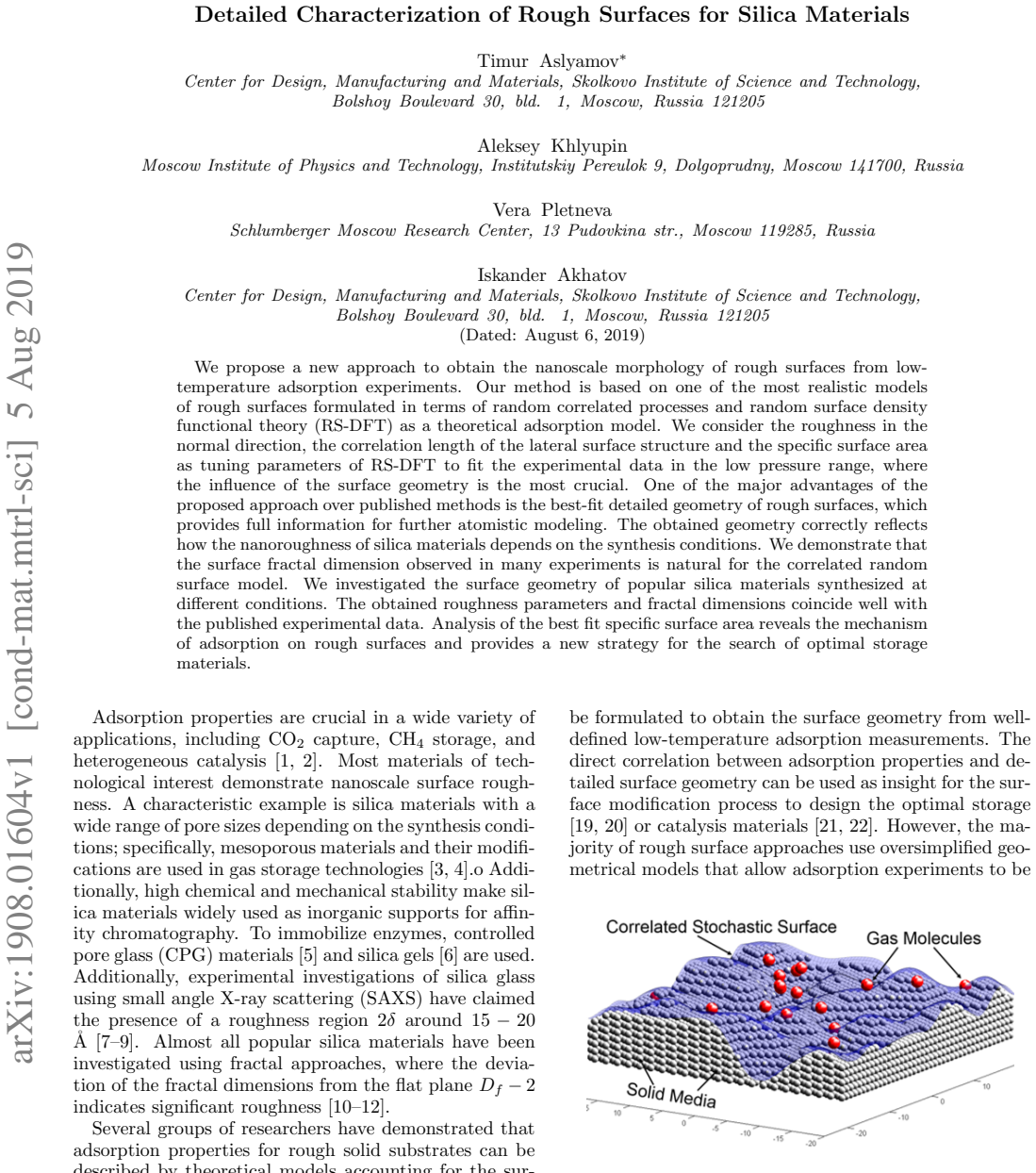
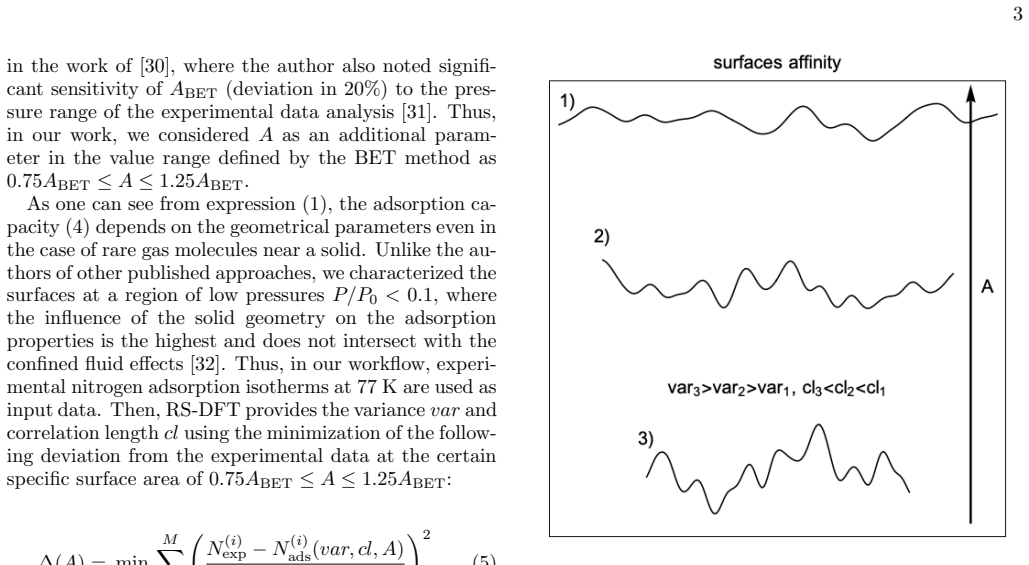
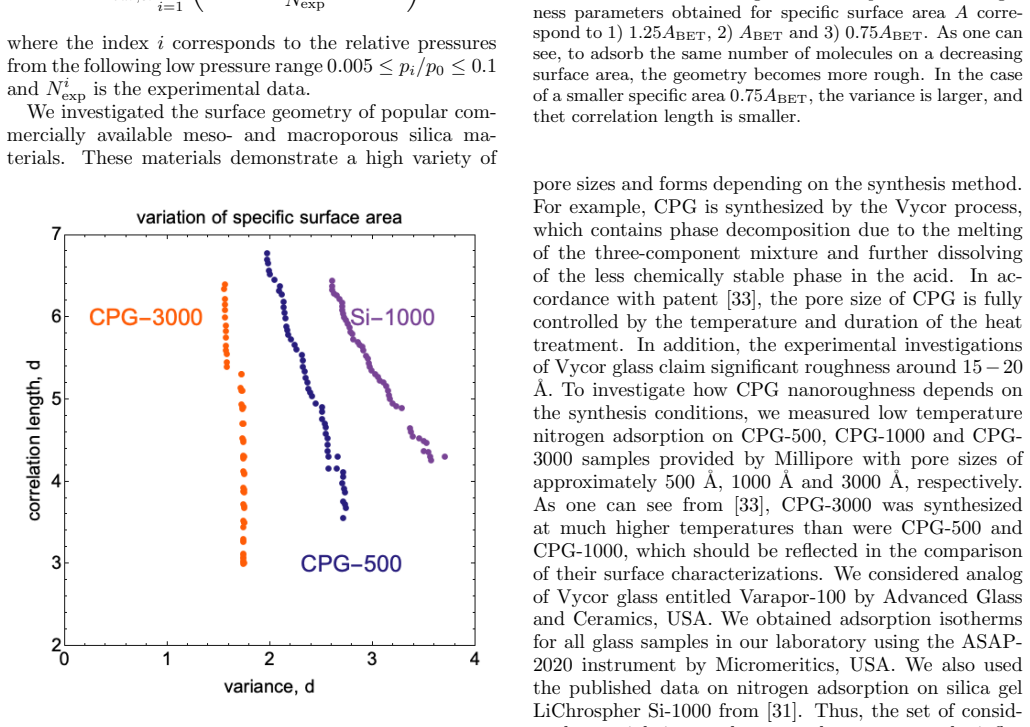
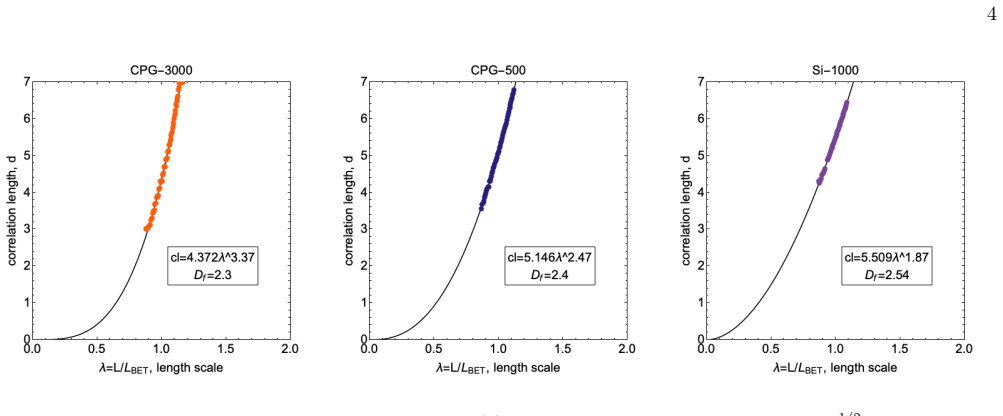
The load-bearing object is the RS-DFT adsorption model for a correlated Gaussian random surface, whose geometry is fixed by the outward variance $\mathrm{var}$, the lateral correlation length $c_l$, and the flat-plane area $A$. The effective wall potential $U_{\mathrm{eff}}(z,\mathrm{var},c_l)$ and the available-surface function $S(z) = A\left(1 - \tfrac{1}{2}\operatorname{erfc}\left(z/\sqrt{2\,\mathrm{var}}\right)\right)$ turn an isotherm into fitted $(\mathrm{var}, c_l, A)$ triplets. The identity $D_f = 2 + 1/\gamma$, obtained by fitting the inversion curve $c_l = k L^\gamma$ and assuming $c_l \propto 1/d$, converts a fitted exponent into a fractal dimension without any self-similarity assumption.
What would settle it
Measure adsorption isotherms for the same silica sample with two molecular sizes (e.g., N2 and Ar) and apply the paper's fitting scheme to each. Because the underlying surface is unchanged, Eq. (7) must yield the same fractal dimension for both; a systematic $D_f$ shift between adsorptives would falsify the $c_l \propto 1/d$ assumption and hence the derived fractal dimension. Alternatively, direct AFM or GISAXS imaging of the same samples should reproduce the best-fit $\mathrm{var}$ and $c_l$; if real-space correlation lengths disagree, the inversion is not recovering the actual geometry.
Extended reading notes
Core claim
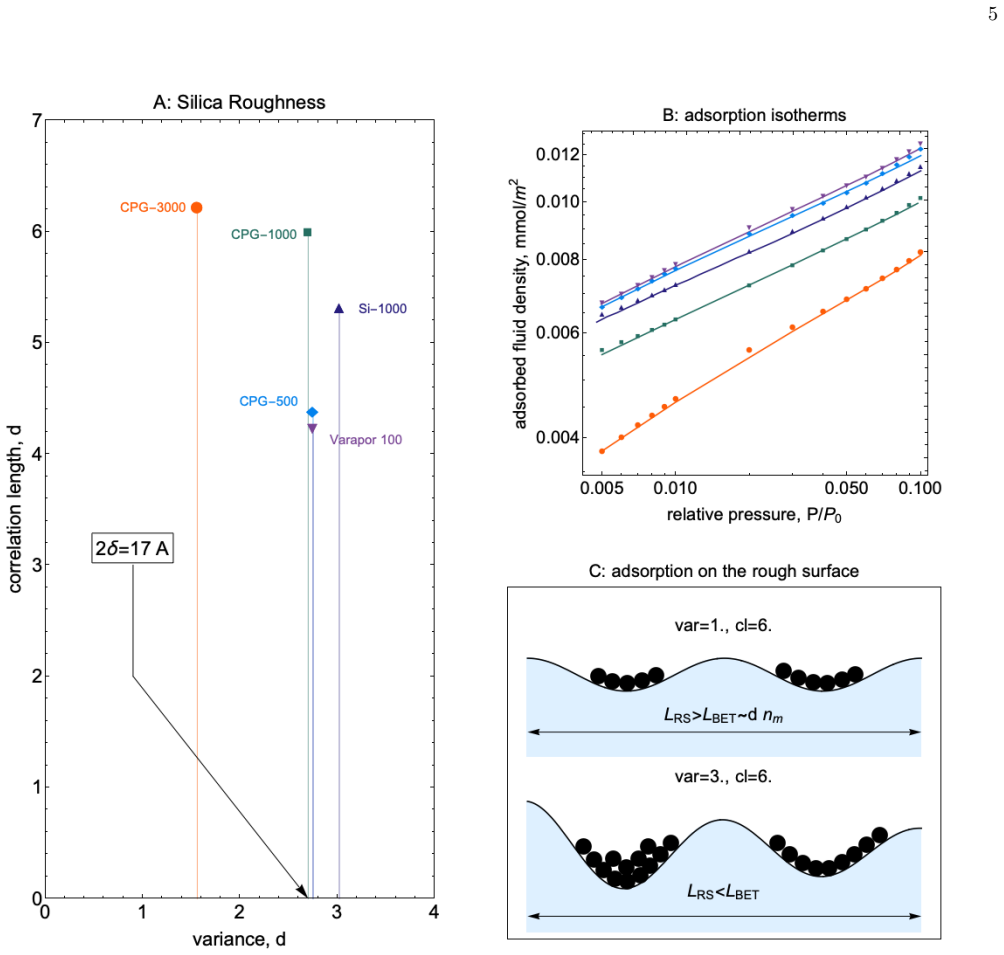
On the paper's own terms, the central discovery is that the fractal dimension seen in adsorption experiments on silica does not require a self-similar or self-affine surface; it emerges naturally from a correlated Gaussian random surface once the correlation length scales as $c_l = k L^\gamma$ with $L = \sqrt{A}$, and as $c_l \propto 1/d$ for the adsorbate molecular diameter $d$. Combining these scalings with the box-counting definition of fractal dimension gives $D_f = 2 + 1/\gamma$. Fitting low-pressure ($P/P_0 < 0.1$) nitrogen isotherms at 77 K for five silica materials yields $D_f$ values from 2.3 to 2.54, in good agreement with published values near 2.4, and the best-fit roughness region $2\delta \approx 17$ Å lies inside the 15–20 Å range reported for silica glass. The same fits return a specific surface area $A_{\mathrm{RS}}$ that can be larger or smaller than the BET area, which the authors interpret as a direct signature of how monolayer adsorption is distorted by surface roughness.
Load-bearing premise
The fractal dimension formula depends on the assumed power-law growth of correlation length with $\sqrt{A}$ and its inverse proportionality to the adsorbent molecule's diameter, both introduced as fits or assumptions rather than derived from the physics; if either scaling is a numerical artifact of the inversion, the predicted fractal dimension is not a real surface property.
Editorial extensions
If this is right
- Low-pressure adsorption isotherms ($P/P_0 < 0.1$) can be inverted into variance, correlation length, and specific surface area, yielding a complete rough-surface geometry for atomistic modelling.
- For silica glass, the correlated random surface model predicts fractal dimensions near 2.4, in line with SAXS/Porod experiments, without invoking scale self-similarity.
- The BET surface area is not a neutral measure: the model predicts $A_{\mathrm{BET}} > A_{\mathrm{RS}}$ on very rough surfaces and $A_{\mathrm{BET}} < A_{\mathrm{RS}}$ on smoother ones, quantifying when the monolayer assumption fails.
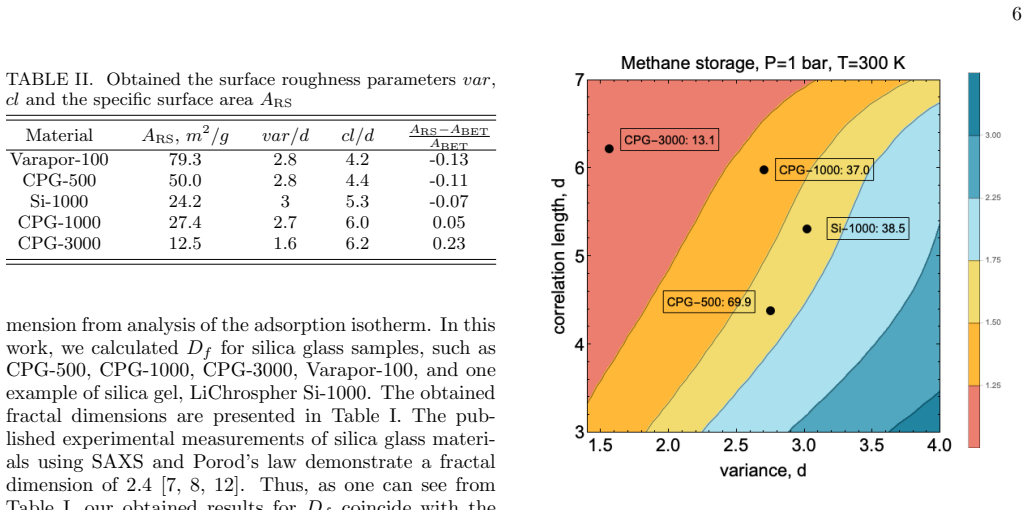
- The storage criterion $C = A_{\mathrm{RS}} N_{\mathrm{ads}}/N_0$ ranks mesoporous silica samples for methane uptake, showing that roughness enhances storage but the effect is offset by the true surface area.
Reading between the lines
- A direct test of the model's core assumption would be to measure the same silica sample's isotherm with several adsorptives (N2, Ar, CH4): if $c_l \propto 1/d$ is physical, Eq. (7) must return the same $D_f$ for each; any variation would locate the failure in the molecular-size scaling, not the density functional.
- If the $c_l = k L^\gamma$ scaling generalizes beyond silica, the same three-parameter fit could map roughness and fractal dimension for carbons, oxides, or polymers from routine adsorption data, making fractal analysis a lab-bench measurement rather than a synchrotron one.
- The paper's inversion treats each isotherm independently; coupling the fits across samples of the same material family (e.g., all CPG glasses) could tighten the constraint on $\gamma$ and reveal whether the power-law relation is a genuine material law or a numerical envelope of the fitting procedure.
Signed reviews
Editorial analysis
A structured set of objections, weighed in public.
Referee Report
Summary. The paper presents an inversion workflow in which low-pressure nitrogen adsorption isotherms on five silica materials are fitted with random-surface density functional theory (RS-DFT). The fitted parameters are the normal-direction roughness variance var, the lateral correlation length cl, and the specific surface area A, the last of which is scanned over a range centered on the BET value. The authors report best-fit roughness parameters, compare the resulting surface areas with BET values, propose a storage-capacity metric, and argue that the correlated random surface model yields a surface fractal dimension Df = 2 + 1/γ through the power-law cl = kL^γ with L = sqrt(A). The central claim is that the fractal dimensions observed in SAXS experiments are natural consequences of the model.
Significance. If the fractal-dimension derivation were rigorous, the paper would connect routine adsorption measurements to independently observed fractal dimensions and provide a route to realistic explicit surfaces for atomistic simulation. The use of a correlated random process model, the low-pressure fitting protocol, and the material-specific parameter tables are genuine strengths, and the comparison with published roughness parameters is useful. However, the central Df claim rests on two assumptions that are not derived: the power-law scaling cl = kL^γ extracted from a narrow scanning interval, and the inverse proportionality cl ∼ 1/d. Without these, Eq. (7) is a fitted exponent relabeled as a prediction rather than a model-derived result. The inversion and material characterization parts of the paper are more incremental but could stand after the fractal-dimension claim is either properly supported or removed.
major comments (5)
- [Paragraph following Fig. 4 and Eq. (7)] The step from cl = kL^γ to Df = 2 + 1/γ requires the assertion cl ∼ 1/d, which is stated without derivation. Since cl is a property of the solid surface, not of the adsorbate, the inverse proportionality to the molecular diameter is not a consequence of the RS-DFT model as presented. All fits use nitrogen at 77 K, so the d-dependence is never tested. Without a derivation of cl(d) or a multi-adsorbate experiment, Eq. (7) is an assumption, not a prediction of the model.
- [Fig. 4 and Table I] The power-law cl = kL^γ is fitted over A ∈ [0.75ABET, 1.25ABET], so L = sqrt(A) spans only a factor of about 1.29, while cl is restricted to [3d, 7d]. A two-parameter power-law exponent extracted from such a narrow, bound-limited window is not robust. No uncertainties, residuals, or goodness-of-fit measures are reported for γ, yet Df is quoted to two decimals. Provide a sensitivity analysis with respect to the fitting range and the imposed bounds on cl.
- [Eq. (6) and surrounding text] The definition Df = -lim log N_d/log d + 1 with N_d = L/d assumes a smooth one-dimensional measure. For a rough line one expects the number of segments of length d to scale as (L/d)^{D_line}. As written, Eq. (6) gives Df = 2 for any finite L that does not depend on d, so the entire fractal content is carried by the unproved relation L ∼ d^{-1/γ}. The derivation should be reconciled with the standard yardstick definition of fractal dimension.
- [Section 'Our analysis is similar...' and Fig. 2] The specific length L = sqrt(A) is defined from the fitted projected area A, which is itself a free parameter scanned over an arbitrary range. The scaling cl = kL^γ is therefore a relation between two outputs of the inversion procedure rather than a directly measured geometric relation of the material. The authors should clarify what physical length L represents and justify why a power-law relation between cl and sqrt(A) is expected from the model, rather than being an artifact of the chosen scanning interval.
- [Table I and Fig. 5A] The reported coincidence with SAXS values (Df ≈ 2.4 for silica glass) is presented as validation, but the extracted Df values all fall in the narrow range 2.30–2.54, so the comparison is not very discriminative. Moreover, because the Df values derive from fits to adsorption data on the same samples, agreement with independent SAXS measurements is only a consistency check; it does not validate the cl ∼ 1/d assumption.
minor comments (5)
- [Fig. 5 caption] The caption refers to 'the colors of the materials are the same as those in Fig. A', but Fig. A is not defined; the intended reference appears to be the left panel of Fig. 5.
- [Text between Fig. 5A and Fig. 5B] There is a duplicated paragraph beginning 'The best fit roughness parameters var and cl corresponding to the specific surface area ARS...'; one copy should be deleted.
- [Introduction and Fig. 3 caption] Typographical errors: 'o Additionally' in the introduction and 'thet correlation length' in the Fig. 3 caption should be corrected.
- [Section following Eq. (7)] The sentence 'the random surface model results in a fractal dimension without assumptions about spatial scale self-similarly or self-affinity' has a grammatical error; 'self-similarly' should be 'self-similarity'.
- [Table I] The fitting parameters k and γ are used in Table I before being introduced in the text; define them when the power-law ansatz cl = kL^γ is first presented.
Circularity Check
The claimed fractal-dimension derivation Df = 2 + 1/γ is a fitted exponent plus an unproved cl ~ 1/d assumption, so the central 'prediction' reduces to the inversion fit.
-
fitted input called prediction
[Fig. 4 and following paragraph, leading to Eq. (7)]
"Fig. 4 demonstrates how the points from Fig. 2 can be rewritten in terms of the correlation length cl as a function of the length L. Taking into account the condition cl(0) = 0, the correlation length cl can be represented as the power function cl =kLγ, where k> 0 and γ >0 are the fitting parameters."
γ is not derived from the correlated random surface model; it is obtained by fitting the cl(L) curve produced by the inversion of the same adsorption isotherms (minimization (5)) while scanning A over 0.75ABET to 1.25ABET. The final fractal dimension Df = 2 + 1/γ is then a function of this fitted exponent, so the 'prediction' is a relabeled fit parameter rather than an independent consequence of RS-DFT. The fit is made over a narrow L range (factor sqrt(1.25/0.75) ~ 1.29) with cl constrained to [3d,7d], so the power-law exponent is not established as a material property.
-
other
[Paragraph after Fig. 4, before Eq. (7)]
"However, for molecules with different sizes near a certain rough surface, one can obtain the proportionality for the correlation length as cl∼ 1/d."
This step is load-bearing: substituting cl ~ 1/d into cl = kL^γ gives L ~ d^{-1/γ}, which converts Eq. (6) into Df = 2 + 1/γ. The proportionality is asserted with no derivation and no test: in RS-DFT cl is a property of the solid surface, and all inversions in the paper use a single adsorbate (N2 at 77 K), so the adsorbate-size dependence is never measured. Without this unproved relation, Eq. (7) does not follow; the fractal dimension is effectively injected as an assumption, not derived.
1 more flagged steps
-
fitted input called prediction
[Table I and following paragraph]
"The published experimental measurements of silica glass materials using SAXS and Porod’s law demonstrate a fractal dimension of 2.4 [7, 8, 12]. Thus, as one can see from Table I, our obtained results for Df coincide with the experimental data well."
This agreement is presented as validation, but it is a consistency check rather than independent confirmation: the Df values compared are computed from γ, which was fitted to the adsorption isotherms of the same materials through the cl = kL^γ fit. The SAXS comparison does not break the fit-to-prediction loop; it only checks whether the fitted exponent reproduces a known number.
full rationale
The central claim that the experimentally observed fractal dimension is 'natural for the correlated random surface model' rests on Eq. (7), Df = 2 + 1/γ. The derivation chain is: fit RS-DFT parameters (var, cl, A) to nitrogen adsorption isotherms; scan A in 0.75ABET..1.25ABET; fit the resulting cl(A^{1/2}) curve as cl = kL^γ; assert without derivation that cl ~ 1/d; substitute to get L ~ d^{-1/γ}; then read off Df. Thus the 'prediction' is a function of the fitted exponent γ plus an ad hoc adsorbate-size scaling, not a consequence of the random-surface model alone. The paper does not test the cl ~ 1/d dependence with different adsorbates, and the cl(L) power law is extracted from a narrow, bound-limited portion of the model's own inversion curve. The agreement with SAXS Df ~ 2.4 is therefore a post-hoc consistency check, not an independent confirmation. The self-citations to prior RS-DFT work [17,25] are not themselves the problem; the circularity lies in relabeling an inversion-fit exponent as a derived fractal dimension.
Assumptions & free parameters
free parameters (5)
- variance var =
var/d = 1.6 to 3.0 (Table II)
- correlation length cl =
cl/d = 4.2 to 6.2 (Table II)
- specific surface area A =
ARS = 12.5 to 79.3 m2/g (Table II)
- power-law exponent gamma =
gamma = 1.87 to 3.37 (Table I)
- power-law prefactor k =
k = 4.37 to 5.64 (Table I)
assumptions (5)
- domain assumption RS-DFT as developed in refs [17] and [25] provides a correct description of adsorption on rough surfaces.
- domain assumption The surface can be represented as a correlated random Gaussian process with a single variance and correlation length.
- domain assumption The low-pressure range 0.005 <= P/P0 <= 0.1 is sufficient to characterize surface geometry.
- ad hoc to paper The correlation length is inversely proportional to the adsorbate molecular diameter (cl ~ 1/d).
- ad hoc to paper The power-law ansatz cl = k L^gamma is the correct scaling between correlation length and the square root of the surface area.
Cite this review
Pith. "Pith review of Detailed Characterization of Rough Surfaces for Silica Materials." pith.science (2026). https://pith.science/paper/T2F4A2GT
@misc{pith2026190801604,
  author       = {Pith},
  title        = {Pith review of: Detailed Characterization of Rough Surfaces for Silica Materials},
  year         = {2026},
  howpublished = {\url{https://pith.science/paper/T2F4A2GT}},
  note         = {Machine review of arXiv:1908.01604}
}
read the original abstract
We propose a new approach to obtain the nanoscale morphology of rough surfaces from low-temperature adsorption experiments. Our method is based on one of the most realistic models of rough surfaces formulated in terms of random correlated processes and random surface density functional theory (RS-DFT) as a theoretical adsorption model. We consider the roughness in the normal direction, the correlation length of the lateral surface structure and the specific surface area as tuning parameters of RS-DFT to fit the experimental data in the low pressure range, where the influence of the surface geometry is the most crucial. One of the major advantages of the proposed approach over published methods is the best-fit detailed geometry of rough surfaces, which provides full information for further atomistic modeling. The obtained geometry correctly reflects how the nanoroughness of silica materials depends on the synthesis conditions. We demonstrate that the surface fractal dimension observed in many experiments is natural for the correlated random surface model. We investigated the surface geometry of popular silica materials synthesized at different conditions. The obtained roughness parameters and fractal dimensions coincide well with the published experimental data. Analysis of the best fit specific surface area reveals the mechanism of adsorption on rough surfaces and provides a new strategy for the search of optimal storage materials.
Figures
Figures from the paper (3 more)
Reference graph
Works this paper leans on
-
[1]
G. F´ erey, C. Serre, T. Devic, G. Maurin, H. Jobic, P. L. Llewellyn, G. De Weireld, A. Vimont, M. Daturi, and J.-S. Chang, Chemical Society Reviews 40, 550 (2011)
work page 2011
-
[2]
Hartmann, Chemistry of materials 17, 4577 (2005)
M. Hartmann, Chemistry of materials 17, 4577 (2005)
work page 2005
-
[3]
L. Wei, S. Yan, H. Wang, and H. Yang, NPG Asia Ma- terials 10, 899 (2018)
work page 2018
-
[4]
E. Vilarrasa-Garc´ ıa, J. Cecilia, S. Santos, C. Cav- alcante Jr, J. Jim´ enez-Jim´ enez, D. Azevedo, and E. Rodr´ ıguez-Castell´ on, Microporous and Mesoporous Materials 187, 125 (2014)
work page 2014
-
[5]
H. H. Weetall, Applied biochemistry and biotechnology 41, 157 (1993)
work page 1993
- [6]
- [7]
-
[8]
A. C. Mitropoulos, J. Haynes, R. Richardson, and N. Kanellopoulos, Physical Review B 52, 10035 (1995)
work page 1995
Show all 36 references
-
[9]
Mitropoulos, K
A. Mitropoulos, K. Stefanopoulos, E. Favvas, E. Vansant, and N. Hankins, Scientific reports 5, 10943 (2015)
2015
-
[10]
Sonwane, S
C. Sonwane, S. Bhatia, and N. Calos, Langmuir 15, 4603 (1999)
1999
-
[11]
M. A. Smith and R. F. Lobo, Microporous and Meso- porous Materials 131, 204 (2010)
2010
-
[12]
Coasne and P
B. Coasne and P. Ugliengo, Langmuir 28, 11131 (2012)
2012
-
[13]
P. I. Ravikovitch and A. V. Neimark, Langmuir22, 11171 (2006)
2006
-
[14]
A. V. Neimark, Y. Lin, P. I. Ravikovitch, and M. Thommes, Carbon 47, 1617 (2009)
2009
-
[15]
Jagiello and J
J. Jagiello and J. P. Olivier, Adsorption 19, 777 (2013)
2013
-
[16]
Jagiello, C
J. Jagiello, C. Ania, J. B. Parra, and C. Cook, Carbon 91, 330 (2015)
2015
-
[17]
Aslyamov and A
T. Aslyamov and A. Khlyupin, The Journal of chemical physics 147, 154703 (2017)
2017
-
[18]
Aslyamov, V
T. Aslyamov, V. Pletneva, and A. Khlyupin, The Jour- nal of chemical physics 150, 054703 (2019)
2019
-
[19]
Serna-Guerrero, Y
R. Serna-Guerrero, Y. Belmabkhout, and A. Sayari, Chemical Engineering Science 65, 4166 (2010)
2010
-
[20]
C. Chen, S. Zhang, K. H. Row, and W.-S. Ahn, Journal of energy chemistry 26, 868 (2017)
2017
-
[21]
Galarneau, N
A. Galarneau, N. Calin, J. Iapichella, M. Barrande, R. Denoyel, B. Coasne, and F. Fajula, Chemistry of Materials 21, 1884 (2009)
2009
-
[22]
M. A. Smith, A. Zoelle, Y. Yang, R. M. Rioux, N. G. Hamilton, K. Amakawa, P. K. Nielsen, and A. Trun- schke, Journal of catalysis 312, 170 (2014)
2014
-
[23]
K. Shi, E. E. Santiso, and K. E. Gubbins, Langmuir 35, 5975 (2019)
2019
-
[24]
R. Carr, J. Comer, M. D. Ginsberg, and A. Aksimentiev, The journal of physical chemistry letters 2, 1804 (2011)
2011
-
[25]
Khlyupin and T
A. Khlyupin and T. Aslyamov, Journal of Statistical Physics 167, 1519 (2017)
2017
-
[26]
Herminghaus, Physical review letters 109, 236102 (2012)
S. Herminghaus, Physical review letters 109, 236102 (2012)
2012
-
[27]
Roth, Journal of Physics: Condensed Matter 22, 063102 (2010)
R. Roth, Journal of Physics: Condensed Matter 22, 063102 (2010)
2010
-
[28]
Thommes, K
M. Thommes, K. Kaneko, A. V. Neimark, J. P. Olivier, F. Rodriguez-Reinoso, J. Rouquerol, and K. S. Sing, Pure and Applied Chemistry 87, 1051 (2015)
2015
-
[29]
Khlyupin, Journal of Physics: Conference Series 774, 012024 (2016)
A. Khlyupin, Journal of Physics: Conference Series 774, 012024 (2016)
2016
-
[30]
Ustinov, D
E. Ustinov, D. Do, and M. Jaroniec, Applied surface science 252, 548 (2005)
2005
-
[31]
Jaroniec, M
M. Jaroniec, M. Kruk, and J. P. Olivier, Langmuir 15, 5410 (1999)
1999
-
[32]
E. A. Ustinov, Langmuir 24, 6668 (2008)
2008
-
[33]
Porous material and method of making the same,
W. Haller, “Porous material and method of making the same,” (1973), uS Patent 3,758,284
1973
-
[34]
Farin, S
D. Farin, S. Peleg, D. Yavin, and D. Avnir, Langmuir 1, 399 (1985)
1985
-
[35]
Ustinov, D
E. Ustinov, D. Do, and M. Jaroniec, The Journal of Physical Chemistry B 109, 1947 (2005)
2005
-
[1000]
In the case of significant roughness (CPG-500, Varapor-100, Si-1000) due to enhanced adsorption, the obtained sur- face coverage is smaller than the BET specific surface ARS < ABET
provide the specific surface area ARS > ABET. In the case of significant roughness (CPG-500, Varapor-100, Si-1000) due to enhanced adsorption, the obtained sur- face coverage is smaller than the BET specific surface ARS < ABET. As shown in Table II, this adsorption model is reflec...
Reviewed August 14, 2026 · model on record in the stance chip above.
Discussion (0). Continue with ORCID to comment.