REVIEW 3 major objections 5 minor 44 references
Multi-Contrast Super-Resolution MRI Through a Progressive Network
T0 review · 3 major / 5 minor · reviewed 2026-08-14 · deepseek-v4-flash
Pith's one-line read A two-level progressive network that fuses a reference MRI contrast in high-level feature space produces better 4× multi-contrast super-resolution than a one-step network.
desk verdict Solid multi-contrast MRI super-resolution paper with a useful high-level fusion ablation, but the headline progressive gain is confounded by model capacity and the abstract overstates PSNR superiority. read the letter →
The pith
A machine-rendered reading of the paper's core claim, the machinery that carries it, and where it could break.
The reading
What carries the argument
The load-bearing object is the two-level progressive generator: two encoder-decoder sub-networks in series, each up-sampling by a factor of 2, with the first level's ground truth being the 2× zero-filled low-resolution image and the second level's ground truth the original high-resolution image. A reference feature extraction network, structurally identical to the encoder, pulls features from the PD- or T1-weighted reference and injects them into the decoder in high-level feature space. Training uses a Wasserstein generative adversarial network with gradient penalty, plus a composite loss combining adversarial, mean-squared-error, perceptual (VGG16 feature maps at four layers), and texture-matching (Gram matrix) terms; in the constrained progressive model, all losses are evaluated at both levels.
What would settle it
Repeat the IXI and NAMIC experiments with low-resolution images generated by a different degradation—for example bicubic downsampling, or retrospectively undersampled k-space with added noise—and with small random misregistration between the T2 targets and the PD/T1 references; if the two-level progressive network does not consistently beat the one-level network in SSIM, PSNR, and IFC, the paper's central claim is falsified.
Extended reading notes
Core claim
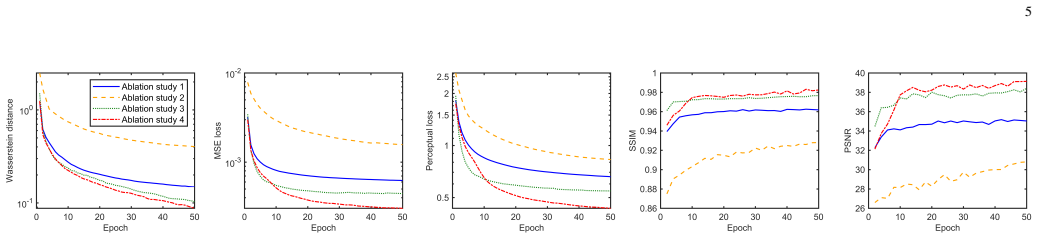
On the paper's own terms, the central discovery is that a WGAN-GP-based generator made of two cascaded encoder-decoder stages, each responsible for a 2× up-sampling and each supervised by ground truth at the corresponding resolution, produces 4× multi-contrast MR super-resolution images with higher SSIM, PSNR, and IFC than a single-stage network trained for direct 4× up-sampling. Four ablation studies on the IXI dataset support the further claim that using a high-resolution PD-weighted reference by extracting its features and injecting them into the decoder at high-level feature space outperforms single-image T2 super-resolution, direct PD-to-T2 synthesis, and low-level image-space concatenation of the two contrasts. On both IXI and NAMIC data, the proposed networks are reported to beat earlier multi-contrast super-resolution methods, and the constrained progressive variant, whose intermediate level is also supervised, achieves the best 4× results.
Load-bearing premise
The reported gains are measured on low-resolution images synthesized by cropping k-space and zero-filling already co-registered scans, so if real clinical low-resolution images come from a different acquisition or motion process, or if the reference and target contrasts are not registered, the progressive advantage may disappear.
Editorial extensions
If this is right
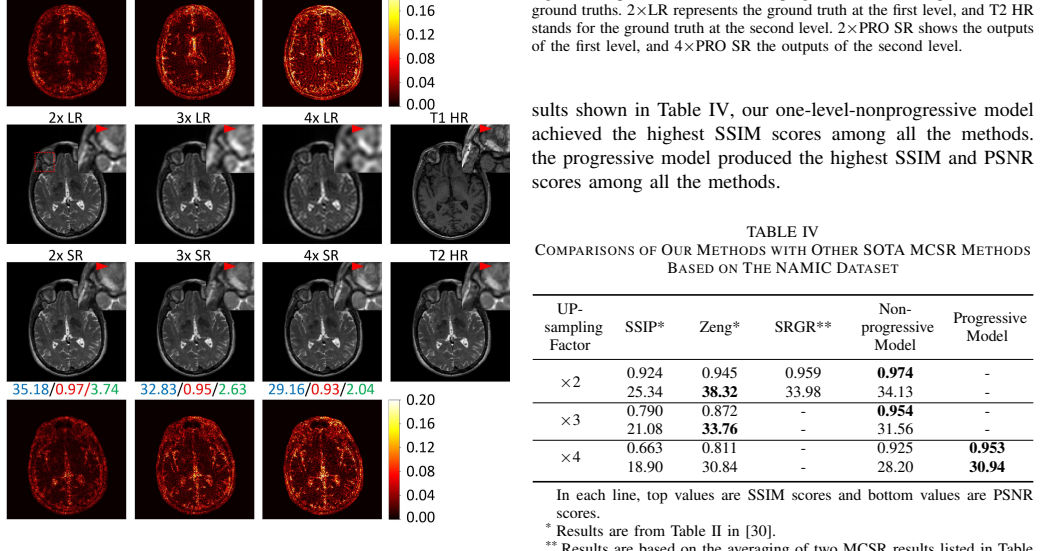
- For 4× up-sampling, the progressive model's scores approach those of a 3× non-progressive model, so stepping through smaller factors partly closes the quality gap caused by severe down-sampling.
- Multi-contrast reference information is best exploited through high-level feature fusion rather than early image concatenation, which gives future architectures a concrete integration point.
- Supervising the intermediate level of a progressive network improves final image quality relative to supervising only the final output.
- Including the texture-matching loss raises structural similarity while slightly lowering PSNR, indicating that perceptual and texture objectives trade pixel-level fidelity for visually sharper detail.
- The same design extends to larger up-sampling factors by adding more levels, provided additional contrasts or datasets are available.
Reading between the lines
- If the progressive advantage survives real acquisition conditions, the practical consequence is scan-time reduction: a lower-resolution T2 series could be upsampled using the higher-resolution T1/PD series already collected in the same exam.
- Because only k-space zero-filling was tested, a natural extension is to replace the first stage with an unrolled reconstruction from physically undersampled k-space, where the intermediate level could correspond to Rician noise or coil sensitivity structure.
- Since VGG16 was trained on natural images, its features may not be the most appropriate perceptual measure for MRI; a domain-specific feature extractor trained on multi-contrast MR data might change the reported ranking of fusion strategies.
- The much weaker performance of direct PD-to-T2 synthesis suggests the reference image contributes edge and texture priors rather than pixel values; this could be probed by selectively removing high-frequency content from the reference before fusion and measuring the drop in SR quality.
Signed reviews
Editorial analysis
A structured set of objections, weighed in public.
Referee Report
Summary. The paper proposes two neural network architectures for multi-contrast MRI super-resolution (MCSR): a one-level non-progressive network for 2x and 3x upscaling and a two-level progressive network for 4x upscaling. The target modality is T2-weighted MRI, guided by a higher-resolution reference image of another contrast (PD or T1). The generator is trained with a composite loss combining adversarial, MSE, perceptual, and texture-matching terms, with multi-contrast information fused in high-level feature space. Experiments on IXI and NAMIC datasets compare against SISR, image synthesis, and two feature-fusion strategies, and against published MCSR methods. The main reported findings are that the progressive network improves 4x MCSR quality over the non-progressive network, and that high-level feature-space fusion outperforms low-level image-space fusion.
Significance. If isolated properly, the paper's findings would constitute a useful empirical contribution to multi-contrast MRI super-resolution. The ablation framework is systematic, the evaluation uses two public datasets and multiple metrics, and the comparison of fusion strategies (SISR vs synthesis vs low-level vs high-level) is informative. The paper is generally clearly written and the experiments are reproducible in principle. However, the central claim of progressive superiority is confounded by model capacity, and the abstract's PSNR claim is internally contradicted by the paper's own comparison table. These issues need to be addressed before the paper can be recommended for publication.
major comments (3)
- [Section IV.D, Table III] The central claim that the two-level progressive network outperforms the one-level non-progressive network is confounded by model capacity. The non-progressive 4xSR model has one encoder-decoder network plus a reference feature extractor, whereas the progressive models (4xPRO U and 4xPRO C) contain two encoder-decoder networks plus the same reference extractor, roughly doubling the number of generator parameters. No one-level baseline with matched parameter count (e.g., a single larger encoder-decoder) is reported, so the observed gains in SSIM, PSNR, and IFC could be attributable to additional capacity rather than to the progressive decomposition itself. The within-architecture comparison of 4xPRO U versus 4xPRO C isolates intermediate supervision, but it does not isolate progressivity. The authors should add a matched-capacity non-progressive baseline or otherwise control for parameter count.
- [Abstract and Section IV.E, Table IV] The abstract states that the proposed networks 'outperform other multi-contrast super-resolution methods in terms of structural similarity and peak signal-to-noise ratio.' This is contradicted by the paper's own Table IV on the NAMIC dataset: at 2x upsampling, Zeng's method achieves PSNR 38.32 versus the non-progressive model's 34.13, and at 3x, Zeng achieves 33.76 versus 31.56. The proposed models have higher SSIM, but their PSNR is not consistently higher. The abstract's general claim should be corrected to specify SSIM superiority, or the PSNR claim restricted to the settings where it holds.
- [Section IV.E, Table IV] The state-of-the-art comparison reuses numerical results from prior publications ([30] and [25]) without describing whether the training/test splits, preprocessing, and evaluation protocols match those used for the authors' methods. Because the authors' results are obtained on their own split of the NAMIC dataset (180 test pairs), the comparison may not be apples-to-apples. The authors should either reproduce the baseline methods under identical settings or clearly document the protocol differences and discuss their potential impact on the comparison.
minor comments (5)
- [Section II.B] Equation (1) defines the LR image as having size n/s x n/s, but the text describes zero-filling that keeps the image size unchanged; this notational inconsistency should be clarified.
- [Section III.A] The paper mentions '10-fold cross-validation' for the IXI dataset, but the reported numbers (7,000 training and 1,955 testing pairs) do not correspond to a straightforward 10-fold split of the total 8,955 pairs; please clarify how the split was performed.
- [Section V] There are several typographical errors, including 'textual matching loss' (should be 'texture matching loss') and 'MSCR' (should be 'MCSR') in Section II.E.
- [Tables II and III] No statistical significance tests are reported for the mean differences between methods; given that some differences are small (e.g., SSIM 0.950 vs 0.958 in Table III), a paired test would strengthen the claims.
- [Figure 1] The caption of Figure 1 does not label the components of the progressive generator in enough detail; consider adding explicit labels for the two encoder-decoder networks and the reference feature extractor to aid readability.
Circularity Check
No circularity found: the paper's claims are empirical comparisons on held-out test data, not predictions derived from fitted inputs or self-cited theorems.
full rationale
This paper makes no claim of deriving a quantitative prediction from first principles; it presents a neural-network architecture and reports measured PSNR/SSIM/IFC on held-out test splits of the IXI and NAMIC datasets. The down-sampling model in Eq. (1) is a standard synthetic degradation used to create training and test data, not a fitted parameter that is later renamed as a prediction. The progressive network's intermediate supervision in Eqs. (9)-(11) uses 2-fold down-sampled images as training targets, which is a supervised training design rather than a circular derivation. The comparison against SSIP, SRGR, and Zeng's model in Table IV is an external benchmark comparison, and copying numbers from prior papers is an empirical-reporting issue, not circularity. Self-citations appear only as background or architecture references ([31], [33], [44]) and are not load-bearing evidence for the central claim that the progressive network improves 4x MCSR quality. The model-capacity confound noted by reviewers is a validity threat to the ablation, but it does not make the claim circular: the progressive model's output is still genuinely computed from its input images, not reproduced from any fitted constant. Hyperparameter tuning in Sec. III-B is standard model selection, not a fitted input renamed as a prediction. Therefore, no circularity step meets the evidence bar of Eq. X = Eq. Y by construction or a self-citation chain forcing the result.
Assumptions & free parameters
free parameters (3)
- lambda1 (MSE loss weight) =
0.1
- lambda2 (perceptual loss weight) =
1.0
- lambda3 (texture matching loss weight) =
0.1
assumptions (3)
- domain assumption Reference PD/T1 images are co-registered with the target T2 images.
- domain assumption The degradation model in Eq. (1), specifically k-space zero-filling at fixed central fractions, is the correct forward model for LR MRI.
- domain assumption VGG16 features pre-trained on ImageNet and Gram-matrix statistics are meaningful for MRI image quality.
Cite this review
Pith. "Pith review of Multi-Contrast Super-Resolution MRI Through a Progressive Network." pith.science (2026). https://pith.science/paper/FO47HOSU
@misc{pith2026190801612,
  author       = {Pith},
  title        = {Pith review of: Multi-Contrast Super-Resolution MRI Through a Progressive Network},
  year         = {2026},
  howpublished = {\url{https://pith.science/paper/FO47HOSU}},
  note         = {Machine review of arXiv:1908.01612}
}
read the original abstract
Magnetic resonance imaging (MRI) is widely used for screening, diagnosis, image-guided therapy, and scientific research. A significant advantage of MRI over other imaging modalities such as computed tomography (CT) and nuclear imaging is that it clearly shows soft tissues in multi-contrasts. Compared with other medical image super-resolution (SR) methods that are in a single contrast, multi-contrast super-resolution studies can synergize multiple contrast images to achieve better super-resolution results. In this paper, we propose a one-level non-progressive neural network for low up-sampling multi-contrast super-resolution and a two-level progressive network for high up-sampling multi-contrast super-resolution. Multi-contrast information is combined in high-level feature space. Our experimental results demonstrate that the proposed networks can produce MRI super-resolution images with good image quality and outperform other multi-contrast super-resolution methods in terms of structural similarity and peak signal-to-noise ratio. Also, the progressive network produces a better SR image quality than the non-progressive network, even if the original low-resolution images were highly down-sampled.
Figures


Figures from the paper (6 more)




Reference graph
Works this paper leans on
-
[30]
K. Zeng, H. Zheng, C. Cai, Y . Yang, K. Zhang, and Z. Chen, “Simulta- neous single-and multi-contrast super-resolution for brain MRI images based on a convolutional neural network,” Computers in biology and medicine, vol. 99, pp. 133–141, 2018
work page 2018
-
[25]
Multi-contrast brain MRI image super-resolution with gradient-guided edge enhancement,
H. Zheng, K. Zeng, D. Guo, J. Ying, Y . Yang, X. Peng, F. Huang, Z. Chen, and X. Qu, “Multi-contrast brain MRI image super-resolution with gradient-guided edge enhancement,” IEEE Access , vol. 6, pp. 57 856–57 867, 2018
work page 2018
-
[1]
E. Plenge, D. H. Poot, M. Bernsen, G. Kotek, G. Houston, P. Wielopol- ski, L. van der Weerd, W. J. Niessen, and E. Meijering, “Super-resolution methods in MRI: Can they improve the trade-off between resolution, signal-to-noise ratio, and acquisition time?” Magnetic resonance in medicine, vol. 68, no. 6, pp. 1983–1993, 2012
work page 1983
-
[2]
Super-resolution in magnetic resonance imaging: A review,
E. Van Reeth, I. W. Tham, C. H. Tan, and C. L. Poh, “Super-resolution in magnetic resonance imaging: A review,” Concepts in Magnetic Resonance Part A, vol. 40, no. 6, pp. 306–325, 2012
work page 2012
-
[3]
Super-resolution image reconstruction: a technical overview,
S. C. Park, M. K. Park, and M. G. Kang, “Super-resolution image reconstruction: a technical overview,”IEEE signal processing magazine, vol. 20, no. 3, pp. 21–36, 2003
2003
-
[4]
A fast image super-resolution algorithm using an adaptive Wiener filter,
R. Hardie, “A fast image super-resolution algorithm using an adaptive Wiener filter,” IEEE Transactions on Image Processing, vol. 16, no. 12, pp. 2953–2964, 2007
work page 2007
-
[5]
J. V . Manj ´on, P. Coup ´e, A. Buades, V . Fonov, D. L. Collins, and M. Robles, “Non-local MRI upsampling,” Medical image analysis , vol. 14, no. 6, pp. 784–792, 2010
work page 2010
-
[6]
Image super-resolution via sparse representation,
J. Yang, J. Wright, T. S. Huang, and Y . Ma, “Image super-resolution via sparse representation,” IEEE transactions on image processing , vol. 19, no. 11, pp. 2861–2873, 2010
2010
Show all 44 references
-
[7]
On single image scale-up using sparse-representations,
R. Zeyde, M. Elad, and M. Protter, “On single image scale-up using sparse-representations,” in International conference on curves and sur- faces. Springer, 2010, pp. 711–730
2010
-
[8]
A+: Adjusted anchored neighborhood regression for fast super-resolution,
R. Timofte, V . De Smet, and L. Van Gool, “A+: Adjusted anchored neighborhood regression for fast super-resolution,” in Asian conference on computer vision . Springer, 2014, pp. 111–126
2014
-
[9]
Image super-resolution using deep convolutional networks,
C. Dong, C. C. Loy, K. He, and X. Tang, “Image super-resolution using deep convolutional networks,” IEEE transactions on pattern analysis and machine intelligence , vol. 38, no. 2, pp. 295–307, 2015
2015
-
[10]
Accurate image super-resolution using very deep convolutional networks,
J. Kim, J. Kwon Lee, and K. Mu Lee, “Accurate image super-resolution using very deep convolutional networks,” in Proceedings of the IEEE conference on computer vision and pattern recognition, 2016, pp. 1646– 1654
2016
-
[11]
Fast, accurate, and lightweight super-resolution with cascading residual network,
N. Ahn, B. Kang, and K.-A. Sohn, “Fast, accurate, and lightweight super-resolution with cascading residual network,” in Proceedings of the European Conference on Computer Vision (ECCV) , 2018, pp. 252–268
2018
-
[12]
Image restoration using very deep convolutional encoder-decoder networks with symmetric skip connec- tions,
X. Mao, C. Shen, and Y .-B. Yang, “Image restoration using very deep convolutional encoder-decoder networks with symmetric skip connec- tions,” in Advances in neural information processing systems , 2016, pp. 2802–2810
2016
-
[13]
Deeply-recursive convolutional network for image super-resolution,
J. Kim, J. Kwon Lee, and K. Mu Lee, “Deeply-recursive convolutional network for image super-resolution,” in Proceedings of the IEEE confer- ence on computer vision and pattern recognition , 2016, pp. 1637–1645
2016
-
[14]
Image super-resolution via deep recursive residual network,
Y . Tai, J. Yang, and X. Liu, “Image super-resolution via deep recursive residual network,” in Proceedings of the IEEE conference on computer vision and pattern recognition , 2017, pp. 3147–3155
2017
-
[15]
Residual dense network for image super-resolution,
Y . Zhang, Y . Tian, Y . Kong, B. Zhong, and Y . Fu, “Residual dense network for image super-resolution,” in Proceedings of the IEEE Con- ference on Computer Vision and Pattern Recognition , 2018, pp. 2472– 2481
2018
-
[16]
Deep back-projection networks for super-resolution,
M. Haris, G. Shakhnarovich, and N. Ukita, “Deep back-projection networks for super-resolution,” in Proceedings of the IEEE conference on computer vision and pattern recognition , 2018, pp. 1664–1673
2018
-
[17]
A deep convolutional neural network with selection units for super-resolution,
J.-S. Choi and M. Kim, “A deep convolutional neural network with selection units for super-resolution,” in Proceedings of the IEEE Con- ference on Computer Vision and Pattern Recognition Workshops , 2017, pp. 154–160
2017
-
[18]
Image super- resolution using very deep residual channel attention networks,
Y . Zhang, K. Li, K. Li, L. Wang, B. Zhong, and Y . Fu, “Image super- resolution using very deep residual channel attention networks,” in Proceedings of the European Conference on Computer Vision , 2018, pp. 286–301
2018
-
[19]
Deep networks for image super-resolution with sparse prior,
Z. Wang, D. Liu, J. Yang, W. Han, and T. Huang, “Deep networks for image super-resolution with sparse prior,” in Proceedings of the IEEE international conference on computer vision , 2015, pp. 370–378
2015
-
[20]
Deep Laplacian pyramid networks for fast and accurate super-resolution,
W.-S. Lai, J.-B. Huang, N. Ahuja, and M.-H. Yang, “Deep Laplacian pyramid networks for fast and accurate super-resolution,” inProceedings of the IEEE conference on computer vision and pattern recognition , 2017, pp. 624–632
2017
-
[21]
Enhancenet: Single image super-resolution through automated texture synthesis,
M. S. Sajjadi, B. Scholkopf, and M. Hirsch, “Enhancenet: Single image super-resolution through automated texture synthesis,” in Proceedings of the IEEE International Conference on Computer Vision , 2017, pp. 4491–4500
2017
-
[22]
Photo-realistic single image super-resolution using a generative adversarial network,
C. Ledig, L. Theis, F. Husz ´ar, J. Caballero, A. Cunningham, A. Acosta, A. Aitken, A. Tejani, J. Totz, Z. Wang et al. , “Photo-realistic single image super-resolution using a generative adversarial network,” in Proceedings of the IEEE conference on computer vision and pattern...
2017
-
[23]
MRI upsampling using feature-based nonlocal means approach,
K. Jafari-Khouzani, “MRI upsampling using feature-based nonlocal means approach,”IEEE transactions on medical imaging, vol. 33, no. 10, pp. 1969–1985, 2014
1969
-
[24]
MRI super- resolution using multi-channel total variation,
M. Brudfors, Y . Balbastre, P. Nachev, and J. Ashburner, “MRI super- resolution using multi-channel total variation,” in Annual Conference on Medical Image Understanding and Analysis . Springer, 2018, pp. 217–228
2018
-
[26]
Promise: Parallel-imaging and compressed-sensing reconstruction of multicontrast imaging using sharable information,
E. Gong, F. Huang, K. Ying, W. Wu, S. Wang, and C. Yuan, “Promise: Parallel-imaging and compressed-sensing reconstruction of multicontrast imaging using sharable information,” Magnetic resonance in medicine , vol. 73, no. 2, pp. 523–535, 2015
2015
-
[27]
MRI superresolution using self-similarity and image priors,
J. V . Manj ´on, P. Coup ´e, A. Buades, D. L. Collins, and M. Robles, “MRI superresolution using self-similarity and image priors,” Journal of Biomedical Imaging , vol. 2010, p. 17, 2010
2010
-
[28]
Multi-contrast brain magnetic resonance image super-resolution using the local weight similarity,
H. Zheng, X. Qu, Z. Bai, Y . Liu, D. Guo, J. Dong, X. Peng, and Z. Chen, “Multi-contrast brain magnetic resonance image super-resolution using the local weight similarity,” BMC medical imaging , vol. 17, no. 1, p. 6, 2017
2017
-
[29]
MR image super-resolution via manifold regularized sparse learning,
X. Lu, Z. Huang, and Y . Yuan, “MR image super-resolution via manifold regularized sparse learning,” Neurocomputing, vol. 162, pp. 96–104, 2015
2015
-
[31]
MRI super-resolution with ensemble learning and complementary priors,
Q. Lyu, H. Shan, and G. Wang, “MRI super-resolution with ensemble learning and complementary priors,” arXiv preprint arXiv:1907.03063 , 2019
1907 arXiv
-
[32]
Improved training of Wasserstein GANs,
I. Gulrajani, F. Ahmed, M. Arjovsky, V . Dumoulin, and A. C. Courville, “Improved training of Wasserstein GANs,” in Advances in neural information processing systems , 2017, pp. 5767–5777
2017
-
[33]
3-D convolutional encoder-decoder network for low-dose CT via transfer learning from a 2-D trained network,
H. Shan, Y . Zhang, Q. Yang, U. Kruger, M. K. Kalra, L. Sun, W. Cong, and G. Wang, “3-D convolutional encoder-decoder network for low-dose CT via transfer learning from a 2-D trained network,” IEEE transactions on medical imaging , vol. 37, no. 6, pp. 1522–1534, 2018
2018
-
[34]
Image quality assessment: from error visibility to structural similarity,
Z. Wang, A. C. Bovik, H. R. Sheikh, E. P. Simoncelli et al. , “Image quality assessment: from error visibility to structural similarity,” IEEE transactions on image processing , vol. 13, no. 4, pp. 600–612, 2004
2004
-
[35]
Generating images with perceptual similar- ity metrics based on deep networks,
A. Dosovitskiy and T. Brox, “Generating images with perceptual similar- ity metrics based on deep networks,” in Advances in neural information processing systems, 2016, pp. 658–666
2016
-
[36]
Perceptual losses for real-time style transfer and super-resolution,
J. Johnson, A. Alahi, and L. Fei-Fei, “Perceptual losses for real-time style transfer and super-resolution,” inEuropean conference on computer vision. Springer, 2016, pp. 694–711
2016
-
[37]
Very deep convolutional networks for large-scale image recognition,
K. Simonyan and A. Zisserman, “Very deep convolutional networks for large-scale image recognition,” arXiv preprint arXiv:1409.1556 , 2014
2014 arXiv
-
[38]
Image style transfer using convolutional neural networks,
L. A. Gatys, A. S. Ecker, and M. Bethge, “Image style transfer using convolutional neural networks,” in Proceedings of the IEEE conference on computer vision and pattern recognition , 2016, pp. 2414–2423
2016
-
[39]
A deep journey into super- resolution: A survey,
S. Anwar, S. Khan, and N. Barnes, “A deep journey into super- resolution: A survey,” CoRR, vol. abs/1904.07523, 2019. [Online]. Available: http://arxiv.org/abs/1904.07523
1904 arXiv
-
[40]
An information fidelity criterion for image quality assessment using natural scene statistics,
H. R. Sheikh, A. C. Bovik, and G. De Veciana, “An information fidelity criterion for image quality assessment using natural scene statistics,” IEEE Transactions on image processing, vol. 14, no. 12, pp. 2117–2128, 2005
2005
-
[41]
[Online]
IXI. [Online]. Available: https://brain-development.org/ixi-dataset/
-
[42]
[Online]
NAMIC. [Online]. Available: http://insight-journal.org/midas/collection/ view/190
-
[43]
Adam: A method for stochastic optimization,
D. P. Kingma and J. Ba, “Adam: A method for stochastic optimization,” arXiv preprint arXiv:1412.6980 , 2014
2014 arXiv
-
[44]
Vision 20/20: Simultaneous CT-MRI – Next chapter of multimodality imaging,
G. Wang, M. Kalra, V . Murugan, Y . Xi, L. Gjesteby, M. Getzin, Q. Yang, W. Cong, and M. Vannier, “Vision 20/20: Simultaneous CT-MRI – Next chapter of multimodality imaging,” Medical physics, vol. 42, no. 10, pp. 5879–5889, 2015
2015
Reviewed August 14, 2026 · model on record in the stance chip above.
Discussion (0). Continue with ORCID to comment.