REVIEW 3 major objections 6 minor 57 references
The HiSPARC Experiment
T0 review · 3 major / 6 minor · reviewed 2026-08-14 · deepseek-v4-flash
Pith's one-line read A school-based network of cheap scintillator stations can reconstruct cosmic-ray showers to about 6 degrees.
desk verdict A solid instrument report for a long-running school-based array: the KASCADE cross-calibration makes the direction reconstruction credible, but the energy spectrum rests on a proton-only simulated LDF and should be treated as preliminary. read the letter →
The pith
A machine-rendered reading of the paper's core claim, the machinery that carries it, and where it could break.
The reading
What carries the argument
The load-bearing object is the modified NKG lateral distribution function with all shape parameters fixed, so that fitting the four measured particle densities determines only the core position and one energy scale. Around it, the paper builds a CORSIKA-based simulation chain for shower generation, a GEANT4 detector response simulation validated against single-muon measurements, and a flat-front triangulation algorithm for directions. The fixed LDF turns a four-point measurement into a one-parameter energy fit, which is what makes single-station energy reconstruction possible.
What would settle it
Take a four-detector station whose showers are also seen by a high-precision array with accurate core positions, and compare energy estimates for events with cores inside versus outside the station; if the fixed LDF is correct, the two classes agree after efficiency corrections, while a composition or shape bias would make them disagree systematically.
Extended reading notes
Core claim
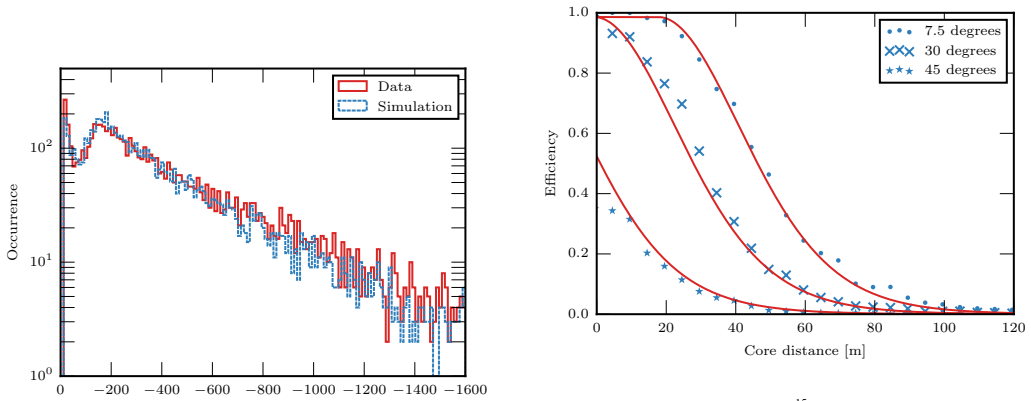
The central discovery is that a four-scintillator station, with detectors a few metres apart, samples enough of an air-shower footprint to reconstruct both direction and energy with useful accuracy. Direction reconstruction by flat-front triangulation of arrival times yields an average 1-$\sigma$ uncertainty of $6.1^\circ$ when validated against KASCADE, and the same algorithm applied to four closely spaced stations gives pairwise differences between $5.93^\circ$ and $6.37^\circ$. Energy reconstruction uses a modified NKG formula $N(r) = A (r/r_0)^a (1 + r/r_0)^b$ with fixed parameters $r_0=29.6$, $a=-0.566$, $b=-2.57$, an obliquity correction $A_\perp = A \exp[p(1/\cos\theta - 1)]$ with $p=6.937$, and $\log E = c(\log A_\perp + d)$ with $c=0.797$, $d=17.62$; the resulting spectrum has slopes 2.85 and 2.86 between $10^{14.8}$ and $10^{15.5}$ eV, close to the known 2.7, with a flux offset attributed to detection efficiency and analysis cuts.
Load-bearing premise
The energy reconstruction assumes that a lateral distribution function fitted to proton-only simulated showers, with its age parameter fixed, describes real showers of mixed composition when sampled at just four detector positions.
Editorial extensions
If this is right
- A four-detector station can serve as a standalone cosmic-ray observatory, producing direction and energy information for showers above roughly $10^{14.5}$ eV.
- The energy spectrum slope measured by such stations, 2.85-2.86, is consistent with the canonical value of 2.7 within the stated systematic simplifications, suggesting the method captures real spectral information.
- The trigger efficiency parametrisation in eq. (10) allows a station's effective exposure to be computed, so rates can be converted into fluxes.
- Clusters of stations, such as the Science Park cluster, can resolve the core-position ambiguity by comparing energy estimates from multiple stations.
Reading between the lines
- If the fixed proton-only LDF is applied to mixed-composition real showers, the energy scale will carry a composition-dependent bias; a natural extension is to include separate proton and iron templates and treat composition as a nuisance parameter.
- The same four-detector geometry could be used to test shower-front curvature: the 6-degree resolution is dominated by timing jitter and the flat-front assumption, so adding curvature parameters would be a direct, testable extension.
- The paper's validation method generalises: any small array can certify itself by embedding one station in a high-precision array or by cross-comparing overlapping stations, as done here with stations 501 and 510.
- A classroom network with this calibration path could in principle monitor transient phenomena, such as solar-particle events or lightning-related modulation, using the existing trigger and GPS infrastructure.
Signed reviews
Editorial analysis
A structured set of objections, weighed in public.
Referee Report
Summary. This paper presents the HiSPARC extensive air shower experiment, a distributed network of low-cost two- and four-scintillator stations hosted largely at high schools. It describes the detector hardware, GEANT4-based single-muon and EAS response simulations, DAQ and GPS timing, trigger efficiency parametrization, direction reconstruction, and a single-station energy reconstruction based on a modified NKG lateral distribution. The main quantitative claims are that a four-detector HiSPARC station reconstructs EAS directions with an average 1-sigma uncertainty of about 6.1 degrees (validated against KASCADE), that the same station can estimate primary energies using the modified NKG function, and that the resulting energy spectrum has fitted slopes of 2.85 and 2.86 between 10^14.8 and 10^15.5 eV, close to the expected value of 2.7.
Significance. The paper provides a detailed, honest characterization of a low-cost air-shower detector and demonstrates meaningful scientific validation: the GEANT4 detector model is checked against table-top and single-muon measurements; the direction reconstruction is compared with KASCADE (0.3-degree accuracy) and with independent station pairs; and the trigger efficiency is studied with CORSIKA. The open software and data access are genuine strengths for an education-linked project. If the energy-reconstruction claims can be supported against composition and systematic uncertainties, the paper would show that even a single four-detector HiSPARC station yields scientifically useful energy information. The authors also clearly state several limitations, which is commendable but does not by itself resolve the load-bearing issues described below.
major comments (3)
- [Section 7, Eqs. (7)-(9), Fig. 26] The authors should either add a systematic study of LDF variation (e.g., mixed-composition CORSIKA showers, several hadronic interaction models, varied age parameters), or explicitly reframe the energy spectrum as an illustrative demonstration and remove the implication that it validates the absolute energy scale.
- [Section 7, Fig. 28] As written, Fig. 28 gives the impression of a spectral-shape measurement, but the analysis is a relative demonstration whose selection efficiency has not been folded in or shown to be energy-flat.
- [Section 8.2, Eqs. (10)-(13), Figs. 32-33] This is closely related to the previous comment, but it identifies a specific missing ingredient in the chain from simulated efficiency to observed flux.
minor comments (6)
- [Section 2.2, Eq. (1)] The PMT response function in Eq. (1) is presented without units for the parameters a, b, c, d and for x; please specify the domain and units (volts, inferred pulse heights, etc.) so the parametrization is unambiguous.
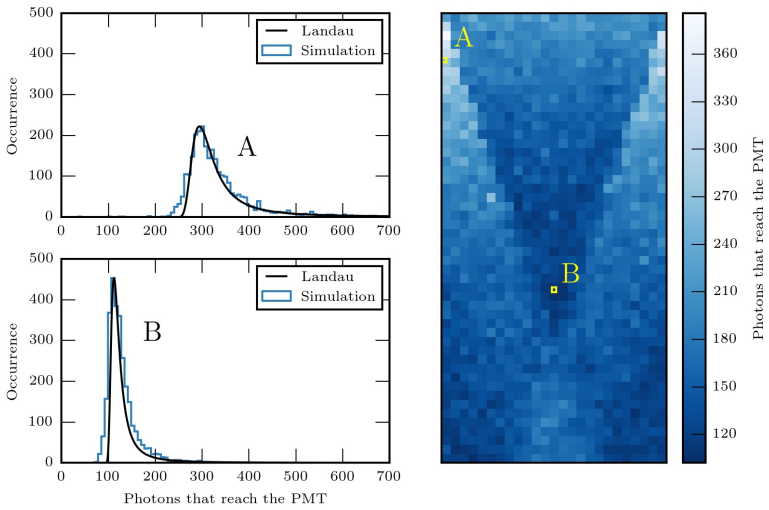
- [Fig. 10] The y-axis label 'Measured MIP-peak value [mVns]' and the x-axis label 'Simulated MIP-peak value [# photons]' mix units; please clarify how the simulated photon count is converted to the measured mVns scale.
- [Section 6, Figs. 24-25] The sentence 'the uncertainty obtained from the simulations slightly underestimates the real direction reconstruction performance' can be misread; since 7.7 degrees is larger than 6.1 degrees, the simulation gives a larger (more conservative) uncertainty. Please rephrase to make the direction of the comparison explicit.
- [Section 7, analysis cuts] The criterion 'If the best chi2 value of one of the two stations is below 5, the event is discarded' should be accompanied by the number of degrees of freedom in the fit, otherwise the cut value is not interpretable.
- [References [27] and [53]] Several quantitative statements (energy-dependent detection efficiencies, mini-shower contributions, and the four-station pair analysis) rely on unpublished or internal notes [27], [53]. Please either summarize the relevant numbers in the text or add a note that these results are preliminary.
- [Section 8.2] For the trigger-efficiency parametrization in Eqs. (10)-(13), the fitted values of alpha, sigma, lambda, chi, and rho are listed but without uncertainties or the number of simulated showers; please provide these details so readers can assess the fit quality.
Circularity Check
No significant circularity: direction and energy claims rest on external KASCADE and known-spectrum benchmarks; the only tuning step is disclosed and does not reduce a prediction.
full rationale
The paper's central claims are validated against external benchmarks rather than against its own fitted inputs. The direction-reconstruction accuracy is checked against KASCADE, which has 0.3-degree accuracy (Section 6, Figs. 24-25), and against independent inter-station pair differences (Table 1). The energy reconstruction is tested against the known cosmic-ray spectrum slope of 2.7, an external reference (Section 7, Fig. 28). The only calibration step is the GEANT4 aluminum reflectivity increase from 0.88 to 0.93 to match single-muon data, which the paper explicitly states "This only scales the number of photons" (Section 2.3); this is a disclosed fit, not a hidden prediction, and the EAS pulse-height comparisons in Section 8 use data not used for that tuning. The paper also honestly concedes in Section 7 that the KASCADE energy comparison was "too limited for a decisive analysis," which is a validity limitation, not circularity. No equation reduces to another by construction, and no load-bearing claim rests on an author self-citation. The proton-only CORSIKA lateral distribution function is model-dependent, but applying it to real data and comparing the derived spectrum with the known spectrum is an external test, not a tautology. The modest score of 1 reflects only the minor, disclosed detector-simulation tuning; overall, the derivation chain is self-contained against external benchmarks.
Assumptions & free parameters
free parameters (4)
- Aluminum reflectivity in GEANT4 detector model =
0.93 (raised from 0.88)
- Modified NKG LDF parameters r0, a, b, p, c, d =
29.6, -0.566, -2.57, 6.937, 0.797, 17.62
- Trigger-efficiency parametrization constants alpha, sigma, lambda, chi, rho =
2.15, 20.9, 7.22e-2, 7.84, 129
- PMT response function parameters a, b, c, d for two bases =
Nikhef: 0.237, 13.5, 9.34e4, 0.918; commercial: 1.42, 2.74, 4.13, 0.150
assumptions (5)
- domain assumption GEANT4 with the tuned aluminum reflectivity models light transport in the detector accurately enough for efficiency studies.
- domain assumption CORSIKA with QGSJET-II, GHEISHA, and EGS4 reproduces real air showers for the energies studied.
- ad hoc to paper The modified NKG lateral distribution with fixed age parameter describes the average particle density around the core for real showers.
- domain assumption The arrival directions of EASs are isotropic on the timescales used for timing-offset and acceptance calculations.
- standard math Single muons reaching the surface follow the parameterized momentum and angle spectrum of ref. 29.
Cite this review
Pith. "Pith review of The HiSPARC Experiment." pith.science (2026). https://pith.science/paper/4ZV7MJ3D
@misc{pith2026190801622,
  author       = {Pith},
  title        = {Pith review of: The HiSPARC Experiment},
  year         = {2026},
  howpublished = {\url{https://pith.science/paper/4ZV7MJ3D}},
  note         = {Machine review of arXiv:1908.01622}
}
read the original abstract
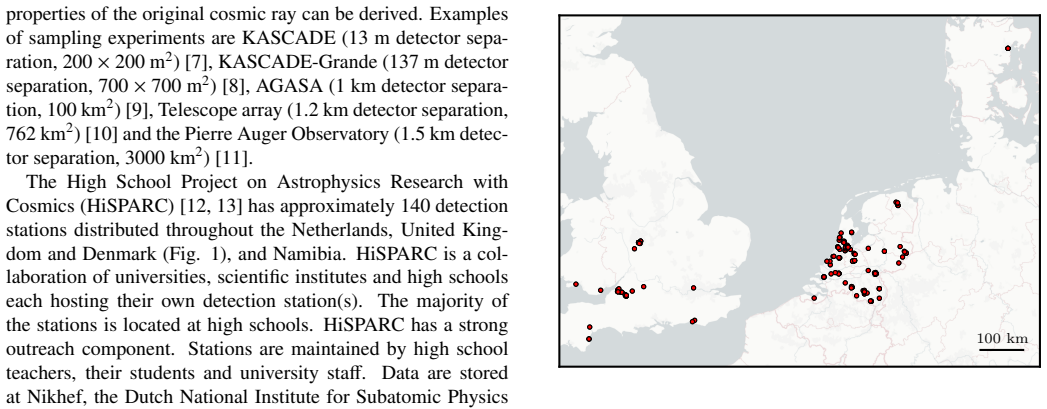
The High School Project on Astrophysics Research with Cosmics (HiSPARC) is a large extensive air shower (EAS) array with detection stations throughout the Netherlands, United Kingdom, Denmark and Namibia. HiSPARC is a collaboration of universities, scientific institutes and high schools. The majority of detection stations is hosted by high schools. A HiSPARC station consists of two or four scintillators placed inside roof boxes on top of a building. The measured response of a detector to single incoming muons agrees well with GEANT4 simulations. The response of a station to EASs agrees with simulations as well. A four-scintillator station was integrated in the KASCADE experiment and was used to determine the accuracy of the shower direction reconstruction. Using simulations, the trigger efficiency of a station to detect a shower as function of both distance to the shower core and zenith angle was determined. The HiSPARC experiment is taking data since 2003. The number of stations (~140 in 2019) still increases. The project demonstrates that its approach is viable for educational purposes and that scientific data can be obtained in a collaboration with high school students and teachers.
Figures

Figures from the paper (21 more)







Reference graph
Works this paper leans on
-
[1]
T. K. Gaisser, R. Engel, E. Resconi, Cosmic rays and particle physics, Cambridge University Press, 2016
work page 2016
-
[2]
A. J. Hundhausen, Coronal expansion and solar wind, V ol. 5, Springer Science & Business Media, 2012
work page 2012
- [3]
-
[4]
Blasi, The origin of galactic cosmic rays, The Astronomy and Astro- physics Review 21 (2013) 70
P. Blasi, The origin of galactic cosmic rays, The Astronomy and Astro- physics Review 21 (2013) 70
work page 2013
-
[5]
A. Aab, P. Abreu, M. Aglietta, et al., Observation of a large-scale anisotropy in the arrival directions of cosmic rays above 8 × 10¹⁸ eV, Science 357 (2017) 1266–1270
work page 2017
-
[6]
P. K. F. Grieder, Extensive Air Showers: High Energy Phenomena and Astrophysical Aspects - A Tutorial, Reference Manual and Data Book, Springer Science & Business Media, 2010
work page 2010
- [7]
-
[8]
W. D. Apel, J. C. Arteaga, A. F. Badea, et al., The KASCADE-Grande experiment, Nucl. Instrum. Methods Phys. Res. A 620 (2010) 202–216
work page 2010
Show all 57 references
-
[9]
Chiba, K
N. Chiba, K. Hashimoto, N. Hayashida, et al., Akeno giant air shower array (AGASA) covering 100 km2 area, Nucl. Instrum. Methods Phys. Res. A 311 (1992) 338–349
1992
-
[10]
Abu-Zayyad, R
T. Abu-Zayyad, R. Aida, M. Allen, et al., The surface detector array of the Telescope Array experiment, Nucl. Instrum. Methods Phys. Res. A 689 (2012) 87–97
2012
-
[11]
Pierre Auger Collaboration, The Pierre Auger cosmic ray observatory, Nucl. Instrum. Methods Phys. Res. A 798 (2015) 172–213
2015
-
[12]
HiSPARC website, https://www.hisparc.nl
-
[13]
D. B. R. A. Fokkema, The HiSPARC Experiment, Ph.D. thesis, Uni- versity of Twente, ISBN: 978-90-365-3438-3, https://www.nikhef. nl/pub/services/biblio/theses_pdf/thesis_D_Fokkema.pdf (2012)
2012
-
[14]
Nikhef website, https://www.nikhef.nl
-
[15]
T. Wada, N. Ochi, T. Kitamura, et al., Observation of time correlation in cosmic air shower network, in: Nuclear Physics B - Proceedings Supple- ments, V ol. 75, 1999, pp. 330–332
1999
-
[16]
Hofverberg, Imaging the high energy cosmic ray sky, Ph.D
P. Hofverberg, Imaging the high energy cosmic ray sky, Ph.D. thesis, KTH (2006)
2006
-
[17]
Brobeck, Measurement of ultra-high energy cosmic rays with CHICOS, Ph.D
E. Brobeck, Measurement of ultra-high energy cosmic rays with CHICOS, Ph.D. thesis, California Institute of Technology (2009)
2009
-
[18]
Abbrescia, A
M. Abbrescia, A. Agocs, S. Aiola, et al., The EEE experiment project: status and first physics results, The European Physical Journal Plus 128 (2013) 62
2013
-
[19]
Timmermans, J
C. Timmermans, J. Schotanus, B. van Eijk, et al., Wetenschappelijk on- derzoek voor scholieren, Nederlands Tijdschrift voor Natuurkunde 69 (2003) 230–234
2003
-
[20]
BC408 Data Sheet, Saint-Gobain Ceramics & Plastics, Inc (2016)
2016
-
[21]
9107B series data sheet, ET Enterprises Ltd (2010)
2010
-
[22]
R6094 data sheet, Hamamatsu (1996)
1996
-
[23]
Landau, On the energy loss of fast particles by ionization, J
L. Landau, On the energy loss of fast particles by ionization, J. Phys.(USSR) 8 (1944) 201–205
1944
-
[24]
HV3020 series data sheet, ET Enterprises Ltd (2018)
2018
-
[25]
Timmer, E
P. Timmer, E. Heine, H. Peek, Very low power, high voltage base for a Photo Multiplier Tube for the KM3NeT deep sea neutrino telescope, Journal of Instrumentation 5 (2010) C12049–C12049. 20
2010
-
[26]
Allison, K
J. Allison, K. Amako, J. Apostolakis, et al., Recent developments in Geant4, Nucl. Instrum. Methods Phys. Res. A 835 (2016) 186–225
2016
-
[27]
van Dam, et al., in preparation
K. van Dam, et al., in preparation
-
[28]
Jetter, D
S. Jetter, D. Dwyer, J. Wen-Qi, et al., PMT waveform modeling at the Daya Bay experiment, Chinese Physics C 36 (2012) 733
2012
-
[29]
Reyna, A Simple Parameterization of the Cosmic-Ray Muon Momen- tum Spectra at the Surface as a Function of Zenith Angle, arXiv preprint: arXiv:hep-ph/0604145
D. Reyna, A Simple Parameterization of the Cosmic-Ray Muon Momen- tum Spectra at the Surface as a Function of Zenith Angle, arXiv preprint: arXiv:hep-ph/0604145
-
[30]
W. K. Hastings, Monte Carlo sampling methods using Markov chains and their applications, Biometrika 57 (1970) 97–109
1970
-
[31]
D. Heck, J. Knapp, J. N. Capdevielle, et al., CORSIKA: a Monte Carlo code to simulate extensive air showers., Forschungszentrum Karlsruhe GmbH, Karlsruhe (Germany), 1998
1998
-
[32]
davisinstruments.com
Davis Vantage Pro, Davis Instruments, see https://www. davisinstruments.com
-
[33]
Kokkeler, Improvement of the pulse reconstruction and arrival direction estimation at the hisparc experiment, Bachelor thesis (2019)
T. Kokkeler, Improvement of the pulse reconstruction and arrival direction estimation at the hisparc experiment, Bachelor thesis (2019)
2019
-
[34]
Resolution T GPS Embedded Board User Guide, Trimble (2009)
2009
-
[35]
Elliott, V
C. Elliott, V . Vijayakumar, W. Zink, et al., National instruments Lab- VIEW: a programming environment for laboratory automation and mea- surement, JALA: Journal of the Association for Laboratory Automation 12 (2007) 17–24
2007
-
[36]
MySQL Reference Manual, Oracle Corporation, available at https:// www.mysql.com
-
[37]
Python Language Reference, version 2.7, Python Software Foundation, available at https://www.python.org
-
[38]
Nagios Core Documentation, Nagios Enterprises, LLC, available at https://www.nagios.org
-
[39]
openvpn.net
OpenVPN Documentation, OpenVPN Inc., available at https://www. openvpn.net
-
[40]
TightVNC Documentation, GlavSoft LLC, available at https:// tightvnc.com
-
[41]
J. G. Wilson, Progress in Cosmic Ray Physics, V ol. 3, North-Holland Publishing Company, 1956
1956
-
[42]
N. G. Schultheiss, The acceptance of the HiSPARC experiment, arXiv preprint: arXiv:1602.06799
-
[43]
The HDF5 library & file format, The HDF Group, available at https: //www.hdfgroup.org/solutions/hdf5
-
[44]
Django Documentation, Django Software Foundation, available at https://www.djangoproject.com
-
[45]
D. B. R. A. Fokkema, A. P. L. S. de Laat, T. Kooij, SAPPHiRE, https: //github.com/HiSPARC/sapphire (2012)
2012
-
[46]
jSparc website, https://docs.hisparc.nl/jsparc
-
[47]
Jupyter Notebook Documentation, Jupyter Team, available at https:// www.jupyter.org
-
[48]
A. M. Hillas, , in: Proceedings International Cosmic Ray Conference, V ol. 1, 1981, p. 193
1981
-
[49]
Ostapchenko, QGSJET-II: towards reliable description of very high energy hadronic interactions, in: Nuclear Physics B - Proceedings Sup- plements, V ol
S. Ostapchenko, QGSJET-II: towards reliable description of very high energy hadronic interactions, in: Nuclear Physics B - Proceedings Sup- plements, V ol. 151, 2006, pp. 143–146
2006
-
[50]
Fesefeldt, GHEISHA The Simulation of Hadronic Showers, Tech
H. Fesefeldt, GHEISHA The Simulation of Hadronic Showers, Tech. rep., RWTH Aachen, PITHA-85/02 (1985)
1985
-
[51]
W. R. Nelson, D. W. O. Rogers, H. Hirayama, The EGS4 code sys- tem, Tech. rep., Stanford Linear Accelerator Center, Stanford, California (1985)
1985
-
[52]
J. M. C. Montanus, The Observability of Jets in Cosmic Air Show- ers, Ph.D. thesis, University of Amsterdam, ISBN: 978-94-028-0549- 9, https://www.nikhef.nl/pub/services/biblio/theses_pdf/ thesis_H_M_Montanus.pdf (2017)
2017
-
[53]
J. J. M. Steijger, Het kwartet, Internal note (2019)
2019
-
[54]
N. M. Gerasimova, G. T. Zatsepin, Disintegration of cosmic ray nuclei by solar photons, JETP 38 (1960) 1245–1252
1960
-
[55]
Beekman, T
R. Beekman, T. Aldus, J. Steijger, Speelt kosmische straling een rol bij initiatie bliksem?, Nederlands Tijdschrift voor Natuurkunde 84 (2018) 18
2018
-
[56]
Schools at 10 20 eV and beyond, Nature 429 (2004) 685
2004
-
[57]
org/fileadmin/medias/1.fondation/documents/Foundation_ 2004_Award.pdf
2004 Altran award summary, http://www.altran-foundation. org/fileadmin/medias/1.fondation/documents/Foundation_ 2004_Award.pdf. 21
2004
Reviewed August 14, 2026 · model on record in the stance chip above.
Discussion (0). Continue with ORCID to comment.