REVIEW 3 major objections 5 minor 2 cited by
Topological nodal line in superfluid $^3$He and the Anderson theorem
T0 review · 3 major / 5 minor · reviewed 2026-08-14 · deepseek-v4-flash
Pith's one-line read The polar phase of superfluid helium-3 has a Dirac nodal line in its quasiparticle spectrum, and the line survives columnar disorder.
desk verdict First plausible experimental sighting of the polar-phase nodal line, but the T^3 evidence needs raw data and error bars before it fully lands. read the letter →
The pith
A machine-rendered reading of the paper's core claim, the machinery that carries it, and where it could break.
The reading
What carries the argument
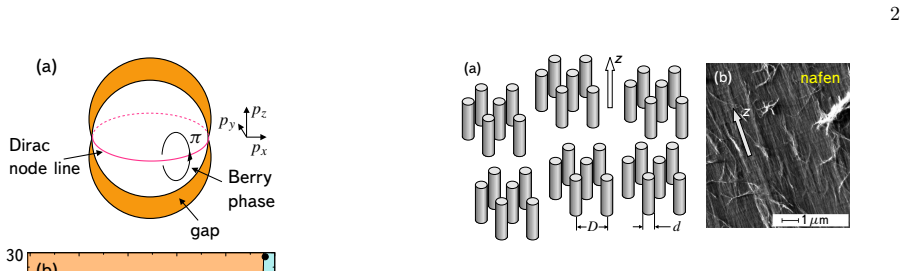
The load-bearing object is the Dirac nodal line: with gap function $\Delta(T)\cos\mu$, the gap vanishes at $\mu = \pi/2$, forming a circle on the Fermi surface around which the Berry phase winds by $\pi$. That line produces $N(\omega) \propto \omega$, which is what generates the cubic temperature dependence of the gap and of the NMR shift. The second mechanism is the columnar-confinement model of nafen: ideal impurities are infinitely long, straight, parallel, non-magnetic strands that scatter specularly and therefore conserve the quasiparticle momentum $p_z$ along the strand axis, so the polar phase splits into independent two-dimensional superconductors with gap $\Delta(p_z)$, each fully gapped and each protected by the Anderson theorem against non-magnetic scattering. The measured observable is the NMR frequency shift $\omega(T) - \omega_L = \Omega_P^2(T)/(2\omega_L)$, with $\Omega_P \propto \Delta(T)$, which turns the gap's $T^3$ law into a directly measurable relative shift.
What would settle it
Measure the low-temperature NMR frequency shift of the polar phase in nafen samples with deliberately increased strand misalignment: if the $T^3$ law, or its prefactor $a$, moves substantially outside the strong-coupling window $a = 0.38$–$0.57$ as disorder grows, then the conservation of $p_z$ and the Anderson-type protection are not what is being observed.
Extended reading notes
Core claim
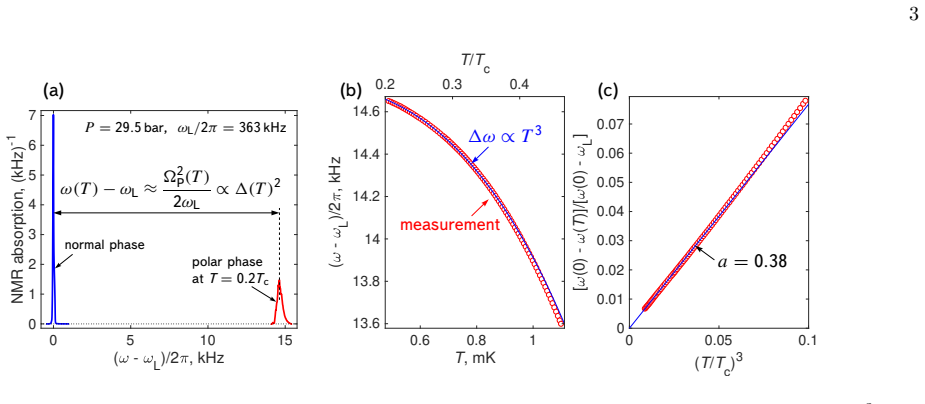
The central claim is that the polar phase of superfluid $^3$He, stabilized by confinement in the aligned nanoscale strands of the nafen material, has a topological Dirac nodal line in its Bogoliubov quasiparticle spectrum, and that this line is robust against the columnar defects of the confining material. The measured low-temperature NMR frequency shift follows $1 - \Delta^2(T)/\Delta^2(0) = 2a(T/T_c)^3$ with $a = 0.38$, in reasonable agreement with the weak-coupling BCS prediction $a = 0.57$; because the Leggett frequency entering the shift is proportional to $\Delta(T)$, this is the $T^3$ law expected when the density of states is linear in energy, $N(\omega) \propto \omega$. The same data imply $\Delta(0)/T_c$ is about 15% larger than the weak-coupling value, a deviation the authors attribute to strong-coupling effects, as known for other superfluid phases of $^3$He. On this evidence, the columnar defects act as an ensemble of independent two-dimensional subsystems, leaving the gap unmodified as predicted by the columnar-defect extension of the Anderson theorem.
Load-bearing premise
The load-bearing premise is that the real nafen material is close enough to the ideal model of perfectly straight, parallel, smooth, non-magnetic columns that quasiparticle momentum along the column direction is conserved; the paper itself notes that the actual orientational disorder of the strands somewhat violates this, producing the small $T_c$ suppression.
Editorial extensions
If this is right
- The low-energy density of states in the polar phase should be linear in energy, so thermodynamic probes such as heat capacity should show the same $T^3$ scaling as the gap.
- Under a superflow in the plane of the nodal line, the line should evolve into a Bogoliubov Fermi surface with two touching pseudo-Weyl points, and the gap at $T=0$ should be suppressed as $v_s^3/(3c^3)$.
- A surface cut normal to the strands should host a topological flat band of fermionic quasiparticles, a direct consequence of the bulk-boundary correspondence for Dirac lines.
- The disorder-protection mechanism implies that other nodal superconductors may be made robust to impurities by aligning the scatterers along a symmetry direction, not just by avoiding magnetic scattering.
- Deviations from the ideal columnar model, such as strand misalignment or magnetic surface layers, should show up as a small suppression of $T_c$ and a measurable change in the prefactor $a$.
Reading between the lines
- A testable extension: varying the distribution of strand tilts in nafen and tracking the prefactor $a$ would map how the Anderson-protected regime breaks down as $p_z$ conservation is lost, giving a quantitative test of the mechanism beyond the single material studied.
- If the mechanism is general, the same $T^3$ signature should appear in other columnar-confined unconventional superconductors, and possibly in ultracold atomic gases with engineered 1D disorder, where the polar-phase analogue can be tuned by hand.
- An alternative reading of the measured $a = 0.38$ versus weak-coupling $0.57$ is that residual disorder renormalises the effective gap, which could be checked by comparing the same NMR measurement in a cleaner or dirtier nafen sample.
- A design consequence the authors do not state: aligning disorder along a symmetry axis may be a practical route to protecting topological superconductivity, which could inform the fabrication of superconducting devices from disordered materials.
Signed reviews
Editorial analysis
A structured set of objections, weighed in public.
Referee Report
Summary. The manuscript reports NMR measurements of the frequency shift of superfluid 3He confined in nafen-243 and uses the low-temperature shift to infer the temperature dependence of the quasiparticle gap of the polar phase. The authors argue that the normalized shift follows 1 - Delta^2(T)/Delta^2(0) proportional to (T/Tc)^3 with prefactor a = 0.38, matching the expected T^3 law for a Dirac nodal line and comparable with the weak-coupling BCS value a = 0.57 derived in the Supplementary Material. From this they conclude that the Dirac nodal line exists in the polar phase and that columnar non-magnetic disorder does not destroy the gap, supporting Fomin's extension of the Anderson theorem. The Supplementary Material contains a self-contained BCS derivation of the prefactor, including Delta(0)/Tc = 2.46.
Significance. If the claims hold, this would be the first experimental evidence for the Dirac nodal line in the polar phase of superfluid 3He and an important demonstration of disorder-robust unconventional pairing, with implications for topological flat bands and Bogoliubov Fermi surfaces. The theoretical scaffold is a genuine strength: the Supplementary BCS derivation is parameter-free once Delta(0)/Tc is fixed, gives the explicit value a = 0.57, and the comparison with the measured a = 0.38 via a 15% strong-coupling enhancement of Delta(0)/Tc is a falsifiable quantitative statement. However, the experimental evidence as presented lacks the procedural and statistical detail needed to test the central T^3 claim, so the significance is conditional on the requested revisions.
major comments (3)
- [Experimental, Fig. 3(c)] The normalization of the y-axis in Fig. 3(c) uses omega(0), which the caption states was "determined by extrapolation of data in panel (b)," but neither the extrapolation function nor its uncertainty is given. If that extrapolation already assumes the cubic form in Eq. (3), then the linearity of the normalized plot is imposed by construction rather than independently tested. Please state the extrapolation procedure, plot the raw shift omega(T) - omega_L against (T/Tc)^n for n = 2, 3, and 4 over the full measured range, fit the raw data with a free exponent, and report the fitted exponent and its uncertainty.
- [Experimental, Eq. (3) and Fig. 3(c)] No error bars are shown anywhere in Fig. 3, and the stated prefactor a = 0.38 is reported without an uncertainty. The comparison with the theoretical a = 0.57 hinges on a strong-coupling correction to Delta(0)/Tc of about 15%, so without estimates of the uncertainties in Tc, omega(0), and the fitted slope it is impossible to judge whether the discrepancy is physically meaningful or instead indicates a breakdown of the clean-limit BCS description. Please add at least standard errors from the fits and a sensitivity analysis of the omega(0) extrapolation.
- [Experimental and Conclusion] The authors explicitly acknowledge that real nafen has orientational disorder of the strands and that this "somewhat violate[s] the Anderson theorem," yet the support for the Fomin-Anderson theorem is based on a comparison of the measured prefactor with the clean-limit value a = 0.57. The manuscript should quantify the expected effect of strand disorder on the T^3 prefactor (or on Delta(0)/Tc), or otherwise justify why the clean-limit comparison remains the relevant baseline. Without this, the conclusion that the Anderson theorem protects the polar phase in nafen is not fully supported.
minor comments (5)
- [Eq. (3)] The right-hand side "2a T^3/T_c^2" is dimensionally inconsistent with Eq. (1); it should read "2a (T/Tc)^3" or equivalently "2a T^3/T_c^3."
- [Supplementary Material, Eq. (21)] The displayed result "a T^3/T_c" should be "a (T/Tc)^3"; as written the equation is dimensionally incorrect.
- [Supplementary Material, after Eq. (13)] The statement that the x integration "has been extended to infinity" deserves one explanatory sentence: the exponential factor makes the extension harmless at low T, since contributions with x^2 + xi^2 much larger than (T/Delta(0))^2 are exponentially suppressed.
- [General] Several typographical errors remain, including "demonstartes" in the Conclusion, "againts" in the final paragraph, "supefluid" in the Conclusion, and "intergrals" in the Supplementary Material.
- [Fig. 3 caption] The caption introduces omega(0) without defining it as the zero-temperature extrapolated frequency shift; please define all symbols in the caption.
Circularity Check
No significant circularity: the T^3 law and a=0.57 are derived from the BCS gap equation, while the experimental prefactor a=0.38 is a measured quantity compared against that prediction.
full rationale
The paper's central claim rests on two independent legs. The theoretical leg is the Supplementary Material's derivation from the BCS gap equation with the polar-phase order parameter Delta(T,mu)=Delta(T)cos(mu): this yields 1 - Delta(T)/Delta(0) = 8.5 T^3 / Delta^3(0) and, using Delta(0)=2.46Tc from the same gap equation, a=0.57. No experimental data enter this calculation, so the prediction is not a fit nor an ansatz smuggled in via citation. The experimental leg measures the NMR frequency shift, related to Delta(T) through the Leggett-frequency relation of Eq. (2), and the reported prefactor a=0.38 comes from the slope in Fig. 3(c); it is not injected into the theory. Comparing the measured 0.38 with the weak-coupling 0.57 and attributing the difference to known strong-coupling effects is a genuine test, not a tautology. The Fomin-Anderson theorem is cited from the external work [11] and is the hypothesis under examination, not a fitted parameter. Self-citations by Volovik appear only in contextual statements about flat bands and Bogoliubov Fermi surfaces and do not carry the derivation. The acknowledged caveat that the caption says the zero-temperature normalization omega(0) was 'determined by extrapolation of data in panel (b)' without specifying the functional form is a methodological reporting gap; but the paper nowhere states that this extrapolation used Eq. (3), so asserting circularity on that basis would be speculation. The explicitly acknowledged orientational disorder in nafen weakens the ideal-columnar premise but is a sample-validity assumption, not a circular step. Overall, the derivation chain is self-contained and the central evidence is not equivalent to its inputs by construction.
Assumptions & free parameters
free parameters (2)
- experimental prefactor a =
0.38
- T=0 frequency shift extrapolation =
approximately 13.8 kHz
assumptions (6)
- domain assumption The polar-phase gap function is Delta(T) cos(mu), with a node at mu=pi/2 forming the Dirac nodal line.
- domain assumption The weak-coupling BCS gap equation applies to the polar phase and produces the T^3 law with a=0.57.
- domain assumption The NMR frequency shift is related to the gap by omega(T)-omega_L = Omega_P^2(T)/(2 omega_L) with Omega_P proportional to Delta(T).
- domain assumption Nafen strands approximate ideal non-magnetic columnar defects that conserve pz.
- domain assumption A 2.5 monolayer 4He preplating makes the strand surfaces non-magnetic and specular.
- domain assumption Fomin's extension of the Anderson theorem to the polar phase with columnar defects is correct and applicable to nafen.
Cite this review
Pith. "Pith review of Topological nodal line in superfluid $^3$He and the Anderson theorem." pith.science (2026). https://pith.science/paper/DTCFWFGZ
@misc{pith2026190801645,
  author       = {Pith},
  title        = {Pith review of: Topological nodal line in superfluid $^3$He and the Anderson theorem},
  year         = {2026},
  howpublished = {\url{https://pith.science/paper/DTCFWFGZ}},
  note         = {Machine review of arXiv:1908.01645}
}
abstract
Superconductivity and superfluidity with anisotropic pairing -- such as $d$-wave in cuprates and $p$-wave in superfluid $^3$He -- are strongly suppressed by impurities. Meanwhile, for applications, the robustness of Cooper pairs to disorder is highly desired. Recently, it has been suggested that unconventional systems become robust if the impurity scattering mixes quasiparticle states only within individual subsystems obeying the Anderson theorem that protects conventional superconductivity. Here, we experimentally verify this conjecture by measuring the temperature dependence of the energy gap in the polar phase of superfluid $^3$He. We show that oriented columnar non-magnetic defects do not essentially modify the energy spectrum, which has a Dirac nodal line. Although the scattering is strong, it preserves the momentum along the length of the columns and forms robust subsystems according to the conjecture. This finding may stimulate future experiments on the protection of topological superconductivity against disorder and on the nature of topological fermionic flat bands.
Figures

Figures from the paper (1 more)

Forward citations
Cited by 2 Pith papers
-
Robustness of unconventional $s$-wave superconducting states against disorder
In four-band superconductors, unconventional s-wave pairing states survive nonmagnetic disorder much better than single-band theory predicts, with resilience set by the superconducting fitness.
-
Impact of Strong Anisotropy on Phase Diagram of Superfluid $^3$He in Aerogels
For superfluid 3He in a model aerogel with finite uniaxial anisotropy, the polar-phase transition temperature stays nearly independent of impurity scattering, extending Anderson's theorem beyond the infinitely anisotr...
Reference graph
Works this paper leans on
-
[1]
S. Autti, V.V. Dmitriev, J.T. M¨ akinen, A.A. Solda- tov, G.E. Volovik, A.N. Yudin, V.V. Zavjalov, and V.B. Eltsov, Observation of half-quantum vortices in super- fluid 3He, Phys. Rev. Lett. 117, 255301 (2016)
work page 2016
- [2]
-
[3]
J.T. M¨ akinen, V.V. Dmitriev, J. Nissinen, J. Rysti, G.E. Volovik, A.N. Yudin, K. Zhang, V.B. Eltsov, Half- quantum vortices and walls bounded by strings in the polar-distorted phases of topological superfluid 3He, Nat. Comm. 10, 237 (2019)
work page 2019
-
[4]
L.P. Gor’kov and P.A. Kalugin, Defects and an unusual superconductivity, JETP Lett. 41, 208-210 (1985)
work page 1985
-
[5]
M. Buchhold, S. Diehl, A. Altland, Nodal points of Weyl semimetals survive the presence of moderate disorder, Phys. Rev. B 98, 205134 (2018)
work page 2018
-
[6]
B. Sbierski, K.A. Madsen, P.W. Brouwer, and C. Kar- rasch, Quantitative analytical theory for disordered nodal points, Phys. Rev. B 96, 064203 (2017); Erratum Phys. Rev. B 97, 139903 (2018)
work page 2017
-
[7]
A. A. Zyuzin, P. Simon, Disorder-induced exceptional points and nodal lines in Dirac superconductors, Phys. Rev. B 99, 165145 (2019)
work page 2019
-
[8]
G.E. Volovik, J. Rysti, J.T. Makinen, V.B. Eltsov, Spin, orbital, Weyl and other glasses in topological superfluids, J. Low Temp. Phys. 196, 82–101 (2019)
work page 2019
Show all 29 references
-
[9]
Syzranov and V
S.V. Syzranov and V. Gurarie, Duality between disor- dered nodal semimetals and systems with power-law hop- ping, arXiv:1907.08640
1907 arXiv
-
[10]
Zimmerman, M.D
A.M. Zimmerman, M.D. Nguyen, J.W. Scott, and W.P. Halperin, The effect of magnetic impurities on superfluid 3He in aerogel, arXiv:1908.01739
1908 arXiv
-
[11]
I. A. Fomin, Analog of Anderson theorem for the polar phase of liquid 3He in nematic aerogel, JETP 127, 933– 938 (2018)
2018
-
[12]
P. W. Anderson, Theory of dirty superconductors, J. Phys. Chem. Solids 11, 26–30 (1959)
1959
-
[13]
Dmitriev, A.A
V.V. Dmitriev, A.A. Senin, A.A. Soldatov, and A.N. Yudin, Polar phase of superfluid 3He in anisotropic aero- gel, Phys. Rev. Lett. 115, 165304 (2015)
2015
-
[14]
V. V. Dmitriev, A. A. Soldatov, A. N. Yudin, Influence of magnetic scattering on superfluidity of 3He in nematic aerogel, Phys. Rev. Lett. 120, 075301 (2018)
2018
-
[15]
Altland and M.R
A. Altland and M.R. Zirnbauer, Nonstandard symme- try classes in mesoscopic normal-superconducting hybrid structures, Phys. Rev. B 55, 1142 (1997)
1997
-
[16]
Schnyder, S
A.P. Schnyder, S. Ryu, A. Furusaki, and A.W.W. Lud- wig, Classification of topological insulators and super- conductors in three spatial dimensions, Phys. Rev. B 78, 195125 (2008)
2008
-
[17]
Thuneberg, Hydrostatic theory of superfluid 3He-B, J
E.V. Thuneberg, Hydrostatic theory of superfluid 3He-B, J. Low Temp. Phys. 122, 657–682 (2001)
2001
-
[18]
Todoshchenko, H
I.A. Todoshchenko, H. Alles, A. Babkin, A. Parshin and V. Tsepelin, Vibrating wire measurements in superfluid 3He at the melting curve down to 0.53 mK, J. Low Temp. Phys. 126, 1449–1455 (2002)
2002
-
[19]
de Graaf, V.B
R. de Graaf, V.B. Eltsov, P.J. Heikkinen, J.J. Hosio and M. Krusius, Textures of superfluid 3He-B in applied flow and comparison with hydrostatic theory, J. Low Temp. Phys. 163, 238–261 (2011)
2011
-
[20]
Volovik, The Universe in a Helium Droplet, Claren- don Press, Oxford (2003)
G.E. Volovik, The Universe in a Helium Droplet, Claren- don Press, Oxford (2003)
2003
-
[21]
Agterberg, P.M.R
D.F. Agterberg, P.M.R. Brydon, and C. Timm, Bo- goliubov Fermi surfaces in superconductors with broken time-reversal symmetry, Phys. Rev. Lett. 118, 127001 (2017)
2017
-
[22]
Muzikar and D
P. Muzikar and D. Rainer, Nonanalytic supercurrents in 3He-A Phys. Rev. B 27, 4243–4250 (1983)
1983
-
[23]
D. Xu, S. K. Yip, and J. A. Sauls, Nonlinear Meissner effect in unconventional superconductors, Phys. Rev. B 51, 16233–16253 (1995)
1995
-
[24]
Schnyder and Shinsei Ryu, Topological phases and surface flat bands in superconductors without inversion symmetry, Phys
A.P. Schnyder and Shinsei Ryu, Topological phases and surface flat bands in superconductors without inversion symmetry, Phys. Rev. B 84, 060504(R) (2011)
2011
-
[25]
Kopnin, T.T
N.B. Kopnin, T.T. Heikkil¨ a and G.E. Volovik, High- temperature surface superconductivity in topological flat-band systems, Phys. Rev. B 83, 220503(R) (2011)
2011
-
[26]
Ikeda and M
R. Ikeda and M. Tange, Impact of strong anisotropy on phase diagram of superfluid 3He in aerogels, arXiv:1908.10712
1908 arXiv
-
[27]
Andersen, A
L. Andersen, A. Ramires, Zhiwei Wang, T. Lorenz and Y. Ando, Generalized Anderson’s theorem for superconductors derived from topological insulators, arXiv:1908.08766
1908 arXiv
-
[28]
D. C. Cavanagh and P. M. R. Brydon, Robustness of un- conventionals-wave superconducting states against dis- order, arXiv:1908.09476
1908 arXiv
-
[29]
Nissinen and G.E
J. Nissinen and G.E. Volovik, Dimensional crossover of 5 effective orbital dynamics in polar distorted 3He-A: Tran- sitions to antispacetime, Phys. Rev. D97, 025018 (2018). SUPPLEMENTARY MATERIAL T 3 dependence of the superfluid gap in the nodal-line polar phase The gap equation...
2018
Reviewed August 14, 2026 · model on record in the stance chip above.
Discussion (0). Continue with ORCID to comment.