REVIEW 3 major objections 4 minor 1 cited by
Robustness of unconventional $s$-wave superconducting states against disorder
T0 review · 3 major / 4 minor · reviewed 2026-08-14 · deepseek-v4-flash
Pith's one-line read In multiband superconductors with four internal electron degrees of freedom, unconventional s-wave pairing states have a reduced effective disorder-scattering rate, making them more resilient than single-band theory predicts.
desk verdict A clean SCBA framework for multiband disorder, but the headline fitness formula is disputed by a concurrent paper and needs refereeing. read the letter →
The pith
A machine-rendered reading of the paper's core claim, the machinery that carries it, and where it could break.
The reading
What carries the argument
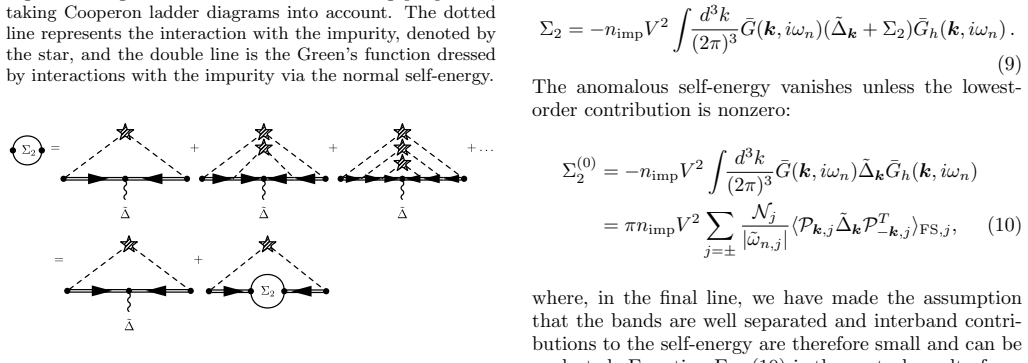
The central machinery is the anomalous impurity self-energy $\Sigma_2$ evaluated in the self-consistent Born approximation, whose key feature is that the Fermi-surface average of the band-projected pairing potential $P_{k,j}\tilde\Delta_k P^T_{-k,j}$ does not vanish because the projection operators $P_{k,\pm}=(1\pm\hat{\epsilon}_k\cdot\vec{\gamma})/2$ are momentum-dependent matrices. This yields the effective scattering rate formula Eq. (24) in terms of the Fermi-surface-averaged superconducting fitness, and the similarity parameter $\alpha_\nu$ of Eq. (18) that controls how much protection other states in the same irrep inherit.
What would settle it
Measure the suppression of the transition temperature in a single-band-Fermi-surface sample of Cu$_x$Bi$_2$Se$_3$ as nonmagnetic disorder is introduced by electron irradiation; if the effective scattering rate extracted from the suppression equals the normal-state rate rather than the reduced value in Eq. (21), the central claim fails. A complementary test is to use impurities with known orbital selectivity and check whether the protection weakens, which would expose the isotropic-potential assumption.
Extended reading notes
Core claim
In a time-reversal- and inversion-symmetric two-band system with four internal degrees of freedom, the anomalous self-energy generated by isotropic nonmagnetic impurities does not vanish for unconventional pairing states, because the band projection operators carry the nontrivial spin-orbital texture of the normal-state Hamiltonian. For an s-wave pairing channel $\nu$, the effective scattering rate that enters the $T_c$ suppression formula becomes $1/\tau_\nu = 1/\tau - (1/\tau_0)(1 - \bar F_C)$, where $\bar F_C$ is the Fermi-surface average of the normalized superconducting fitness $\tilde F_C(k)$ that measures the fraction of interband pairing. Thus a state with zero fitness is completely insensitive to nonmagnetic disorder, generalizing Anderson's theorem, while realistic states with small fitness retain a parametrically enhanced robustness. The same anomalous self-energy is nonzero and momentum-independent for every pairing state in the same irreducible representation, so the s-wave channel sets an upper bound on the disorder stability of all states in that irrep, quantified by the overlap $\alpha_\nu$ between the state and the s-wave gap at the Fermi surface.
Load-bearing premise
The calculation assumes impurities are identical point scatterers that affect all four internal electron states equally, and that the two bands are well separated in energy; if real disorder couples preferentially to particular orbital or spin states, or the bands are close enough to hybridize, the predicted reduction in the effective scattering rate could be overstated.
Editorial extensions
If this is right
- Nontrivial s-wave channels in any four-degrees-of-freedom multiband superconductor are generically more resilient to nonmagnetic disorder than sign-changing single-band states, with the resilience set by the Fermi-surface-averaged superconducting fitness.
- Other pairing states in the same irreducible representation share this protection; for example, the d-wave $E_g$ state in YPtBi is nearly as stable against disorder as the quintet s-wave $E_g$ states because of its high overlap with them at the Fermi surface.
- Systems with a nontrivial inversion operator are especially favorable: odd-parity s-wave states commute with three of the five gamma matrices in the generic Hamiltonian, typically giving smaller fitness and hence greater robustness, as seen in the comparison of Cu$_x$Bi$_2$Se$_3$ with YPtBi.
- The theory offers a practical diagnostic for materials search: evaluate the Fermi-surface-averaged fitness of the s-wave channel in each irreducible representation; a value $\bar F_C \ll 1$ identifies a candidate disorder-resistant unconventional superconductor.
Reading between the lines
- A practical next step would be to compute $\bar F_C$ from first-principles band structures for other candidate multiband superconductors, turning the fitness criterion into a screening tool that ranks materials by expected disorder tolerance before any irradiation experiment.
- The predicted difference in $T_c$ suppression between trivial and nontrivial s-wave channels is sharp enough that controlled electron-irradiation experiments on Cu$_x$Bi$_2$Se$_3$ or YPtBi could discriminate between candidate pairing symmetries.
- The theory assumes a scalar impurity potential in the orbital basis; real defects often couple selectively to orbitals or spins, so an extension to anisotropic impurity scattering would show whether the protection survives in actual materials or is a property of the simplest model.
Signed reviews
Editorial analysis
A structured set of objections, weighed in public.
Referee Report
Summary. This paper studies disorder effects on multiband superconductors with four internal degrees of freedom. Using the self-consistent Born approximation, the authors derive effective impurity scattering rates for unconventional s-wave pairing states [Eqs. (16) and (21)] and show that these rates are reduced relative to the normal-state rate. They express the reduction in terms of the Fermi-surface-averaged superconducting fitness [Eq. (24)], apply the formalism to YPtBi and CuxBi2Se3, and conclude that nontrivial s-wave channels are parametrically more robust against nonmagnetic disorder than single-band unconventional states. The paper also shows that this protection extends to other pairing states in the same irreducible representation, with the s-wave state providing an upper bound on the stability.
Significance. If Eq. (24) is established, the paper provides a simple, broadly applicable diagnostic for identifying disorder-robust unconventional pairing channels in multiband systems, connecting the concept of superconducting fitness to the observable T_c suppression. The applications to YPtBi and CuxBi2Se3, including tabulated λ_l assignments and numerical T_c curves, make the proposal concrete. The authors are careful to state their principal assumptions (isotropic impurity potential, well-separated bands) and to flag the disagreement with Ref. [26]. The clean derivation structure and explicit model-specific tables are definite strengths. However, because the disagreement with Ref. [26] directly concerns the content of the central formula, the paper's significance is currently conditional on resolving that discrepancy.
major comments (3)
- [Section V, final paragraph; Eq. (24)] The manuscript explicitly reports that a concurrent independent calculation (Ref. [26]) obtains an effective scattering rate based on the superconducting fitness with respect to the impurity Hamiltonian, yielding complete insensitivity for perfectly fit states, whereas Eq. (24) here uses the fitness with respect to the normal-state Hamiltonian and predicts only parametric enhancement. Because both calculations start from the same SCBA equations (8)-(10), this is a genuine unresolved discrepancy about the central result, not a cosmetic difference. The authors must identify the source of the discrepancy and either prove that the normal-state fitness is the correct quantity or revise Eq. (24) accordingly. This issue is load-bearing: Eq. (24) is the paper's main quantitative diagnostic and underpins the material-specific claims in Sections III and IV. The brief acknowledgment in the final paragraph is not sufficient to establish the central claim.
- [Section II, text following Eq. (10)] The reduction of the anomalous self-energy to Eq. (10) neglects interband contributions on the strength of the 'well separated bands' assumption. This assumption is not quantified, and it is particularly delicate for YPtBi, which is described as a zero-band-gap semimetal with the chemical potential in the lower band. The effective-rate formulas (16) and (21), and the universal form of Eq. (24), depend on this approximation. Please provide an estimate of the omitted interband terms for the two model Hamiltonians, or state explicitly the conditions under which they vanish by symmetry. Without this, the numerical T_c curves in Figs. 3 and 4 should be regarded as illustrative rather than quantitative.
- [Section V, derivation of Eq. (24)] The sentence 'This result follows from the observation that λ_l = +1 (−1) when γ_l ~∆_ν − ~∆_ν γ_{l,*} = 0 (2γ_l ~∆_ν)' is the entire derivation of the central formula. The connection between this commutator condition and the Fermi-surface average of the normalized fitness ~F_C is not shown. Given that Eq. (24) is the headline result, the paper should present the explicit algebra, or an appendix, that converts Eqs. (16) and (21) into Eq. (24), including the exact meaning of γ_{l,*} and the role of H^T_{-k} in the definition of F_C. This is needed both for verifiability and for resolving the relation to Ref. [26].
minor comments (4)
- [Introduction, second paragraph] The phrase 'it was it was shown in Ref. [20]' contains a duplicated clause, and 'psuedospin' should be 'pseudospin'.
- [Figures 3 and 4 captions] The captions state that the line τ_ν = τ applies to pairing states in all other nontrivial irreps, but the curves are not individually identified. Please add a legend or explicitly name the pairing state for each curve so the reader can connect the plots to Tables I and II.
- [Eq. (18)] The quantity α_ν is introduced without fully specifying the notation: please state that ~∆_ν is the s-wave basis state of channel ν and that the Fermi-surface average is taken over the band(s) at the Fermi energy.
- [Reference list] Reference [26] is cited as a preprint without journal, volume, or page details; the published version should include the full citation and a more detailed comparison in the text.
Circularity Check
No circularity found: the effective scattering-rate formulas are derived from the SCBA equations and independent model inputs, and the fitness relation in Eq. (24) is an algebraic identity rather than a fitted prediction.
full rationale
The paper's central result is obtained by an explicit self-consistent Born approximation calculation, not by importing the answer. Starting from the normal-state Hamiltonian (Eq. 1) and the isotropic impurity potential (Eq. 4), the authors evaluate the anomalous self-energy (Eq. 10, expanded in Eq. 11), solve the linearized gap equation, and obtain the effective scattering rates in Eqs. (16) and (21). The later relation to the superconducting fitness (Eq. 24) is presented as a consequence of the identity γ_l Δ_ν − Δ_ν γ_l* = 0 (or 2γ_l Δ_ν) for λ_l = +1 (−1); it is an algebraic rewrite of the already-derived scattering-rate formula, not a fitted parameter renamed as a prediction. The model parameters for YPtBi and Cu_xBi_2Se_3 are taken from Refs. [10], [29], and [30], and none are adjusted to reproduce the predicted T_c suppression. The self-citations (Refs. [10], [16], [25]) supply the model Hamiltonian or background results, but the gap equation and disorder renormalization are carried out in this paper itself; Ref. [25] is used as a basis expansion, not as a uniqueness theorem that forecloses alternatives. The appended disagreement with Ref. [26] over which operator enters the fitness is a substantive external dispute about correctness of the identification, not a case in which the paper's output is identical to its input; it therefore does not raise the circularity score.
Assumptions & free parameters
free parameters (2)
- YPtBi model parameters (alpha, beta1, beta2, mu) =
values from Ref. [10]
- CuxBi2Se3 model parameters (m, v_z, v, lambda, mu) =
values from Refs. [29, 30]
assumptions (5)
- domain assumption The normal-state Hamiltonian has the general TRS- and inversion-invariant four-band form H_k = epsilon_{k,0} 1_4 + vec(epsilon)_k . vec(gamma), with five mutually anticommuting gamma matrices.
- domain assumption Impurity scattering is isotropic in the spin-orbital basis, with momentum-independent potential V.
- domain assumption The bands are well separated, so interband contributions to the anomalous self-energy can be neglected.
- domain assumption The self-consistent Born approximation adequately describes the pair-breaking physics in the dilute impurity limit.
- domain assumption The anomalous self-energy is momentum independent and lies in one of the s-wave channels.
Cite this review
Pith. "Pith review of Robustness of unconventional $s$-wave superconducting states against disorder." pith.science (2026). https://pith.science/paper/VOR5RBPX
@misc{pith2026190809476,
  author       = {Pith},
  title        = {Pith review of: Robustness of unconventional $s$-wave superconducting states against disorder},
  year         = {2026},
  howpublished = {\url{https://pith.science/paper/VOR5RBPX}},
  note         = {Machine review of arXiv:1908.09476}
}
abstract
We investigate the robustness against disorder of superconductivity in multiband systems where the fermions have four internal degrees of freedom. This permits unconventional $s$-wave pairing states, which may transform nontrivially under crystal symmetries. Using the self-consistent Born approximation, we develop a general theory for the effect of impurities on the critical temperature, and find that the presence of these novel $s$-wave channels significantly modifies the conclusions of single-band theories. We apply our theory to two candidate topological superconductors, YPtBi and Cu$_x$Bi$_2$Se$_3$, and show that the novel $s$-wave states display an enhanced resilience against disorder, which extends to momentum-dependent pairing states with the same crystal symmetry. The robustness of the $s$-wave states can be quantified in terms of their superconducting fitness, which can be readily evaluated for model systems.
Figures


Figures from the paper (1 more)

Forward citations
Cited by 1 Pith paper
-
Topological nodal line in superfluid $^3$He and the Anderson theorem
Measurement of the polar-phase gap in 3He in nafen shows the predicted T^3 temperature law, providing the first experimental evidence for a Dirac nodal line and supporting a generalized Anderson theorem.
Reference graph
Works this paper leans on
-
[26]
Generalized Anderson's theorem for superconductors derived from topological insulators
L. Andersen, A. Ramires, Z. Wang, T. Lorenz, and Y. Ando, “Generalized Anderson’s theorem for super- conductors derived from topological insulators,” (2019), arXiv:1908.08766
work page Pith review arXiv 2019
-
[1]
V. P. Mineev and K. V. Samokhin, Introduction to Un- conventional Superconductivity (Gordon and Breach Sci- ence Publishers, 1999)
work page 1999
-
[2]
Theory of dirty superconductors,
P. W. Anderson, “Theory of dirty superconductors,” J. Phys. Chem. Solids 11, 26–30 (1959)
1959
-
[3]
Concealed d- wave pairs in the s± condensate of iron-based supercon- ductors,
T. Ong, P. Coleman, and J. Schmalian, “Concealed d- wave pairs in the s± condensate of iron-based supercon- ductors,” Proceedings of the National Academy of Sci- ences 113, 5486–5491 (2016)
work page 2016
-
[4]
O. Vafek and A. V. Chubukov, “Hund Interaction, Spin- Orbit Coupling, and the Mechanism of Superconductiv- ity in Strongly Hole-Doped Iron Pnictides,” Phys. Rev. Lett. 118, 087003 (2017)
work page 2017
-
[5]
Resilient Nodeless d-Wave Superconductivity in Monolayer FeSe,
D. F. Agterberg, T. Shishidou, J. O’Halloran, P. M. R. Brydon, and M. Weinert, “Resilient Nodeless d-Wave Superconductivity in Monolayer FeSe,” Phys. Rev. Lett. 119, 267001 (2017)
work page 2017
-
[6]
T. Kawakami, T. Okamura, S. Kobayashi, and M. Sato, “Topological Crystalline Materials of J = 3 /2 Elec- trons: Antiperovskites, Dirac Points, and High Winding Topological Superconductivity,” Phys. Rev. X 8, 041026 (2018)
work page 2018
-
[7]
Theory of su- perconductivity in hole-doped monolayer MoS 2,
R. Oiwa, Y. Yanagi, and H. Kusunose, “Theory of su- perconductivity in hole-doped monolayer MoS 2,” Phys. Rev. B 98, 064509 (2018)
work page 2018
Show all 32 references
-
[8]
Robust parity-mixed su- perconductivity in disordered monolayer transition metal dichalcogenides,
D. M¨ ockli and M. Khodas, “Robust parity-mixed su- perconductivity in disordered monolayer transition metal dichalcogenides,” Phys. Rev. B 98, 144518 (2018)
2018
-
[9]
Odd-Parity Topological Supercon- ductors: Theory and Application to Cu xBi2Se3,
L. Fu and E. Berg, “Odd-Parity Topological Supercon- ductors: Theory and Application to Cu xBi2Se3,” Phys. Rev. Lett. 105, 097001 (2010)
2010
-
[10]
Pairing of j = 3/2 Fermions in Half-Heusler Su- perconductors,
P. M. R. Brydon, L. Wang, M. Weinert, and D. F. Agter- berg, “Pairing of j = 3/2 Fermions in Half-Heusler Su- perconductors,” Phys. Rev. Lett. 116, 177001 (2016)
2016
-
[11]
Spin-rotation symmetry breaking in the super- conducting state of CuxBi2Se3,
K. Matano, M. Kriener, K. Segawa, Y. Ando, and G.-q. Zheng, “Spin-rotation symmetry breaking in the super- conducting state of CuxBi2Se3,” Nature Physics 12, 852 (2016)
2016
-
[12]
Thermodynamic evidence for nematic superconductivity in Cu xBi2Se3,
S. Yonezawa, K. Tajiri, S. Nakata, Y. Nagai, Z. Wang, K. Segawa, Y. Ando, and Y. Maeno, “Thermodynamic evidence for nematic superconductivity in Cu xBi2Se3,” Nature Physics 13, 123 (2016)
2016
-
[13]
Direct Visualization of the Nematic Superconductivity in Cu xBi2Se3,
R. Tao, Y.-J. Yan, X. Liu, Z.-W. Wang, Y. Ando, Q.-H. Wang, T. Zhang, and D.-L. Feng, “Direct Visualization of the Nematic Superconductivity in Cu xBi2Se3,” Phys. Rev. X 8, 041024 (2018)
2018
-
[14]
Odd-parity topological superconductor with ne- matic order: Application to Cu xBi2Se3,
L. Fu, “Odd-parity topological superconductor with ne- matic order: Application to Cu xBi2Se3,” Phys. Rev. B 90, 100509(R) (2014)
2014
-
[15]
Beyond Triplet: Un- conventional Superconductivity in a Spin-3 /2 Topolog- ical Semimetal,
H. Kim, K. Wang, Y. Nakajima, R. Hu, S. Ziemak, P. Syers, L. Wang, H. Hodovanets, J. D. Denlinger, P. M. R. Brydon, D. F. Agterberg, M. A. Tanatar, R. Prozorov, and J. Paglione, “Beyond Triplet: Un- conventional Superconductivity in a Spin-3 /2 Topolog- ical Semimetal,” Sci. A...
2018
-
[16]
Inflated nodes and surface states in super- conducting half-Heusler compounds,
C. Timm, A. P. Schnyder, D. F. Agterberg, and P. M. R. Brydon, “Inflated nodes and surface states in super- conducting half-Heusler compounds,” Phys. Rev. B 96, 094526 (2017)
2017
-
[17]
Models of superconducting Cu:Bi 2Se3: Single- versus two-band description,
S.-K. Yip, “Models of superconducting Cu:Bi 2Se3: Single- versus two-band description,” Phys. Rev. B 87, 104505 (2013)
2013
-
[18]
Analog of the Anderson Theorem for the Polar Phase of Liquid 3He in a Nematic Aerogel,
I. A. Fomin, “Analog of the Anderson Theorem for the Polar Phase of Liquid 3He in a Nematic Aerogel,” J. Exp. Theor. Phys 127, 933 (2018)
2018
-
[19]
Topological nodal line in superfluid 3He and the Ander- son theorem,
V. B. Eltsov, T. Kamppinen, J. Rysti, and G. E. Volovik, “Topological nodal line in superfluid 3He and the Ander- son theorem,” (2019), arXiv:1908.01645
2019 arXiv
-
[20]
Spin-Orbit Locking as a Pro- tection Mechanism of the Odd-Parity Superconducting State against Disorder,
K. Michaeli and L. Fu, “Spin-Orbit Locking as a Pro- tection Mechanism of the Odd-Parity Superconducting State against Disorder,” Phys. Rev. Lett. 109, 187003 (2012)
2012
-
[21]
Robust superconductivity with nodes in the superconducting topological insulator Cu xBi2Se3: Zee- man orbital field and nonmagnetic impurities,
Y. Nagai, “Robust superconductivity with nodes in the superconducting topological insulator Cu xBi2Se3: Zee- man orbital field and nonmagnetic impurities,” Phys. Rev. B 91, 060502(R) (2015)
2015
-
[22]
M. S. Scheurer, Mechanism, symmetry and topology of ordered phases in correlated systems, Ph.D. thesis (2016)
2016
-
[23]
Identifying detrimental ef- fects for multiorbital superconductivity: Application to Sr2RuO4,
A. Ramires and M. Sigrist, “Identifying detrimental ef- fects for multiorbital superconductivity: Application to Sr2RuO4,” Phys. Rev. B 94, 104501 (2016)
2016
-
[24]
Tailoring Tc by symmetry principles: The concept of supercon- ducting fitness,
A. Ramires, D. F. Agterberg, and M. Sigrist, “Tailoring Tc by symmetry principles: The concept of supercon- ducting fitness,” Phys. Rev. B 98, 024501 (2018)
2018
-
[25]
Bogoliubov Fermi surfaces: General theory, magnetic order, and topology,
P. M. R. Brydon, D. F. Agterberg, Henri Menke, and C. Timm, “Bogoliubov Fermi surfaces: General theory, magnetic order, and topology,” Phys. Rev. B 98, 224509 (2018)
2018
-
[27]
Pair break- ing in multiorbital superconductors: An application to oxide interfaces,
M. S. Scheurer, M. Hoyer, and J. Schmalian, “Pair break- ing in multiorbital superconductors: An application to oxide interfaces,” Phys. Rev. B 92, 014518 (2015)
2015
-
[28]
Effects of impuri- ties on superconductivity in noncentrosymmetric com- pounds,
V. P. Mineev and K. V. Samokhin, “Effects of impuri- ties on superconductivity in noncentrosymmetric com- pounds,” Phys. Rev. B 75, 184529 (2007)
2007
-
[29]
Model Hamiltonian for topological insula- tors,
C.-X. Liu, X.-L. Qi, H. J. Zhang, X. Dai, Z. Fang, and S.-C. Zhang, “Model Hamiltonian for topological insula- tors,” Phys. Rev. B 82, 045122 (2010). 8
2010
-
[30]
Bulk Electronic State of Superconducting Topological Insulator,
T. Hashimoto, K. Yada, A. Yamakage, M. Sato, and Y. Tanaka, “Bulk Electronic State of Superconducting Topological Insulator,” J. Phys. Soc. Jpn. 82, 044704 (2013)
2013
-
[31]
Impurity- induced states in conventional and unconventional super- conductors,
A. V. Balatsky, I. Vekhter, and Jian-Xin Zhu, “Impurity- induced states in conventional and unconventional super- conductors,” Rev. Mod. Phys. 78, 373 (2006)
2006
-
[32]
Enhancing superconductivity by disorder,
Maria N. Gastiasoro and Brian M. Andersen, “Enhancing superconductivity by disorder,” Phys. Rev. B 98, 184510 (2018)
2018
Reviewed August 14, 2026 · model on record in the stance chip above.
Discussion (0). Continue with ORCID to comment.