REVIEW 3 minor 1 cited by
Full two-loop QCD corrections to the Higgs mass in the MSSM with heavy superpartners
T0 review · 0 major / 3 minor · reviewed 2026-08-14 · deepseek-v4-flash
Pith's one-line read This paper completes the two-loop QCD threshold corrections to the Higgs quartic coupling in the MSSM and finds the new terms shift the predicted Higgs mass by about 100 MeV.
desk verdict Solid, complete-looking two-loop QCD threshold corrections that close a known gap in the MSSM EFT Higgs-mass program, with honest scoping of the numerical impact. read the letter →
The pith
A machine-rendered reading of the paper's core claim, the machinery that carries it, and where it could break.
The reading
What carries the argument
The central object is the two-loop mixed QCD-EW threshold correction $\Delta\lambda_{2\ell,\text{QCD-EW}}$ to the quartic Higgs coupling, which the paper splits into three pieces: two-loop one-particle-irreducible contributions from the effective potential, two-loop Higgs wave-function-renormalization contributions that require momentum-dependent self-energies, and a renormalization-scheme contribution that converts DR-renormalized MSSM couplings ($\lambda$, $g$, $g'$, and the top Yukawa) to the MS-renormalized SM couplings. In the degenerate superparticle limit these combine into the explicit formula in eq. (27). The machinery carries the argument because the momentum-dependent self-energy and scheme-conversion terms are the parts that the earlier gaugeless calculations could not see, and they are also the parts that turn the completed SUSY-scale matching into a genuine next-to-next-to-leading-logarithmic resummation step.
What would settle it
Repeat the matching in a split scenario with, for example, $m_{\tilde g}=10M_S$ and recompute the two-loop QCD-EW threshold correction including the gluino-mass-enhanced terms; if the predicted Higgs mass shifts by more than about 100 MeV relative to the degenerate-mass formula, or if the $\beta$-function check in eq. (28) fails, then the completeness and numerical-impact claims are confined to the degenerate-mass scenario.
Extended reading notes
Core claim
The central claim is that the class of two-loop threshold corrections of $O(g_{t,b}^2 g_s^2)$, $O(g^4 g_s^2)$ and $O(g'^4 g_s^2)$ to the quartic Higgs coupling has now been computed, so that, combined with the earlier $O(g_t^4 g_s^2)$ and $O(g_b^4 g_s^2)$ results, the two-loop QCD corrections at the SUSY scale are complete. The calculation goes beyond the effective-potential method used for the earlier gaugeless corrections: it requires the momentum-dependent two-loop self-energies of the Higgs and Z bosons, plus scheme-conversion terms between dimensional reduction and dimensional regularization and between MSSM and SM couplings. In the degenerate-mass limit the combined result is given by eq. (27), and it passes the consistency check of reproducing the SM $\beta$-function term for the quartic coupling that is proportional to $\lambda g_s^2(g_t^2+g_b^2)$. The paper further maintains that, in the EFT approach, the electroweak-scale determination of the pole Higgs mass should be performed at the same perturbative order, and shows that two existing full two-loop determinations agree to about 20 MeV near 125 GeV, within the quoted theoretical uncertainty of about 150 MeV.
Load-bearing premise
The quantitative results assume that all superparticles, including the gluino (the gluon's supersymmetric partner), and the heavy Higgs doublet share one common mass scale, with only the Standard Model below it; if the gluino is much heavier than the squarks, additional two-loop terms appear that the quoted 100 MeV numbers do not include.
Editorial extensions
If this is right
- The heavy-MSSM prediction for $m_h$ no longer has any missing two-loop strong-interaction matching terms, so the remaining SUSY-scale uncertainty is set by uncomputed electroweak-only two-loop pieces and by higher orders.
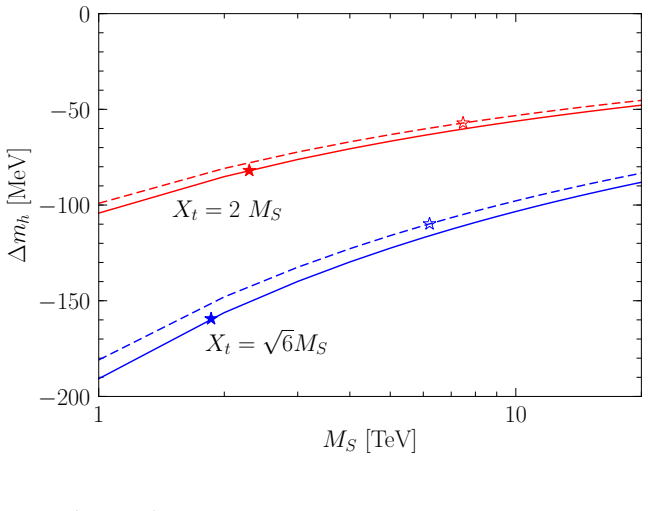
- In the degenerate scenario, the new corrections move the predicted Higgs mass down by about 100 MeV and move the common SUSY scale that yields $m_h = 125.09$ GeV up by about 100 GeV.
- The electroweak-scale comparison shows that the two full two-loop calculations of the quartic-to-pole-mass relation agree to about 20 MeV near the observed mass, so that side of the EFT chain is not the dominant uncertainty.
- This is a necessary step toward a full NNLL resummation of the logarithmically enhanced corrections to the MSSM Higgs mass.
- If superpartners are discovered in the TeV range, the Higgs mass becomes a sharper precision constraint on stop masses and mixing, with theoretical and experimental uncertainties of comparable size.
Reading between the lines
- The same computational pieces, momentum-dependent two-loop self-energies plus DR-MS scheme conversions, could be reused to compute the remaining electroweak-only two-loop matching corrections, which would complete the full two-loop matching rather than just its QCD part.
- The numerical direction of the shift, toward a slightly heavier SUSY scale for the same Higgs mass, suggests that if the MSSM is realized with stops near the current LHC reach, the mixed QCD-EW corrections slightly tighten the region of parameter space compatible with 125 GeV.
- A two-step EFT that decouples the gluino before the squarks would provide a direct test of the degenerate-scale assumption; in split-SUSY spectra the inferred value of $M_S$ could move by more than the quoted 100 GeV.
Editorial analysis
A structured set of objections, weighed in public.
Referee Report
Summary. This paper computes the two-loop threshold corrections to the quartic Higgs coupling in the MSSM-to-SM EFT matching that involve both the strong and electroweak gauge couplings (the mixed QCD-EW corrections). Section 2 decomposes the correction into 1PI, wave-function-renormalization, and renormalization-scheme pieces, and gives a complete combined result in the degenerate superpartner-mass limit in Eq. (27). Section 3 compares two independent full two-loop computations of the SM relation between the pole Higgs mass and the MS-renormalized quartic coupling, refs. [85] and [86] (the code mr), finding agreement at the level of about 20 MeV near m_h = 125 GeV. Section 4 quantifies the numerical impact in a common-scale SUSY scenario: roughly -100 MeV on the predicted Higgs mass and about +100 GeV on the inferred stop mass scale. Section 5 discusses limitations, including the case where the gluino is much heavier than the squarks and the scenario would require a separate decoupling step.
Significance. If correct, the result closes the last missing two-loop strong-interaction contribution to the quartic-coupling matching in the single-scale MSSM EFT, thereby completing the two-loop QCD part of the threshold correction. The paper's main strengths are the clean decomposition of the calculation, the explicit degenerate-mass formula in Eq. (27), the nontrivial cross-checks against the independent self-energy results of refs. [31-33], the cancellation of IR divergences between Eqs. (14)-(17), the DRED-DREG shift, and the RGE-consistency check in Eq. (28). The reported numerical impact is modest and honestly assessed as subdominant to the gaugeless two-loop corrections, while being comparable to current LHC Higgs-mass precision. The stated limitations—the common-scale numerical scenario, the neglect of first-two-generation Yukawa couplings, and the gluino-mass-hierarchy caveat in Sec. 5—are explicit and do not undermine the algebra of the correction, though they bound the domain of the completeness claim.
minor comments (3)
- [Sec. 2 and Sec. 5] The full generic-mass results are described as available on request, but they are not included in the manuscript or as an ancillary file; I request that they be provided as supplementary material so that the completeness claim for arbitrary superpartner masses can be independently checked and reused.
- [Abstract and Sec. 5] The phrase 'completes the calculation of the two-loop QCD corrections to the quartic coupling' should be explicitly qualified by the single-scale assumption under which the calculation is performed, given the paper's own discussion that a much heavier gluino would require an additional threshold-decoupling step.
- [Eq. (14)] The IR-divergent logarithm ln(-p^2/Q^2) should be accompanied by a standard +i0 prescription or an explicit statement of the convention used, since the expression as printed is ambiguous for p^2 < 0.
Circularity Check
No significant circularity: the new two-loop corrections are computed from scratch and checked against independent external results; reliance on prior work is normal, not a reduction.
full rationale
The central mixed QCD-EW two-loop threshold correction is not derived from the quantity it is used to predict. The paper computes the 1PI contribution from the two-loop squark effective potential (Eqs. (3)-(12)), the wave-function-renormalization contribution from an asymptotic expansion of two-loop Higgs self-energies generated with FeynArts/TRACER (Eqs. (13)-(17)), and the scheme/threshold pieces from DRED-DREG differences and gauge/Yukawa shifts (Eqs. (18)-(26)). Each piece is cross-checked against independently published results: the self-energies of refs. [31-33], the SM quartic beta function of ref. [103], and the EW-scale relation of refs. [85,86] via the mr code. The combined result in Eq. (27) is the sum of these pieces, not an ansatz or a fitted quantity. Reliance on the authors' earlier refs. [65,72] for the one-loop and gaugeless two-loop matching is a normal use of previously published parameter-free results; the present paper does not define its new quantities in terms of the target prediction, nor does it fit any parameter to the Higgs mass and then call the result a prediction. Stated limitations, such as the common SUSY scale in the numerical scenario, the neglect of first-two-generation Yukawa couplings, and the possible gluino-mass hierarchy, bound the numerical applications but do not create circularity. No circular step can be exhibited from the paper's own equations or citations.
Assumptions & free parameters
assumptions (4)
- domain assumption All MSSM superparticles and the heavy Higgs doublet decouple at a common scale MS, leaving the SM as the EFT below; O(v^2/MS^2) terms are negligible.
- domain assumption Yukawa couplings of the first two generations are neglected in the squark contributions.
- standard math The asymptotic expansion of the two-loop self-energies in the heavy superparticle masses is valid in the limit v to 0 (unbroken EW phase) and p^2 to 0.
- ad hoc to paper The relation between the pole Higgs mass and lambda(QEW) can be used at full two-loop EW accuracy even though the SUSY-scale side is only partially two-loop.
Cite this review
Pith. "Pith review of Full two-loop QCD corrections to the Higgs mass in the MSSM with heavy superpartners." pith.science (2026). https://pith.science/paper/RSWL2QDH
@misc{pith2026190801670,
  author       = {Pith},
  title        = {Pith review of: Full two-loop QCD corrections to the Higgs mass in the MSSM with heavy superpartners},
  year         = {2026},
  howpublished = {\url{https://pith.science/paper/RSWL2QDH}},
  note         = {Machine review of arXiv:1908.01670}
}
read the original abstract
We improve the determination of the Higgs-boson mass in the MSSM with heavy superpartners, by computing the two-loop threshold corrections to the quartic Higgs coupling that involve both the strong and the electroweak gauge couplings. Combined with earlier results, this completes the calculation of the two-loop QCD corrections to the quartic coupling at the SUSY scale. We also compare different computations of the relation between the quartic coupling and the pole mass of the Higgs boson at the EW scale. We find that the numerical impact of the new corrections on the prediction for the Higgs mass is modest, but comparable to the accuracy of the Higgs-mass measurement at the LHC.
Figures


Forward citations
Cited by 1 Pith paper
-
Higgs-Boson Masses and Mixings in the MSSM with CP Violation and Heavy SUSY Particles
In the MSSM with heavy SUSY particles and complex phases, the lightest Higgs mass can vary by up to about 20 GeV with the phase of the trilinear couplings, while its CP-odd admixture drops below 0.5% once the charged ...
Reference graph
Works this paper leans on
-
[85]
Buttazzo et al., Investigating the near-criticality of the Higgs boson
D. Buttazzo et al., Investigating the near-criticality of the Higgs boson . JHEP 12 (2013) 089, arXiv:1307.3536 [hep-ph]
arXiv 2013
-
[86]
B. A. Kniehl, A. F. Pikelner, and O. L. Veretin, Two-loop electroweak threshold corrections in the Standard Model. Nucl. Phys. B896 (2015) 19–51, arXiv:1503.02138 [hep-ph]
arXiv 2015
-
[1]
A TLASCollaboration, G. Aad et al., Observation of a new particle in the search for the Standard Model Higgs boson with the ATLAS detector at the LHC . Phys. Lett. B716 (2012) 1–29, arXiv:1207.7214 [hep-ex]
arXiv 2012
-
[2]
CMS Collaboration, S. Chatrchyan et al., Observation of a new boson at a mass of 125 GeV with the CMS experiment at the LHC . Phys. Lett. B716 (2012) 30–61, arXiv:1207.7235 [hep-ex]
arXiv 2012
-
[3]
A TLAS, CMS Collaboration, G. Aad et al., Measurements of the Higgs boson production and decay rates and constraints on its couplings from a combined ATLAS and CMS analysis of the LHC pp collision data at √s = 7 and 8 TeV. JHEP 08 (2016) 045, arXiv:1606.02266 [hep-ex]
arXiv 2016
-
[4]
A TLAS, CMS Collaboration, G. Aad et al., Combined Measurement of the Higgs Boson Mass in pp Collisions at √s = 7 and 8 TeV with the ATLAS and CMS Experiments . Phys. Rev. Lett. 114 (2015) 191803, arXiv:1503.07589 [hep-ex]
arXiv 2015
-
[5]
Okada, M
Y. Okada, M. Yamaguchi, and T. Yanagida, Upper bound of the lightest Higgs boson mass in the minimal supersymmetric standard model . Prog. Theor. Phys. 85 (1991) 1–6
1991
-
[6]
J. R. Ellis, G. Ridolfi, and F. Zwirner, Radiative corrections to the masses of supersymmetric Higgs bosons. Phys. Lett. B257 (1991) 83–91
1991
Show all 112 references
-
[7]
H. E. Haber and R. Hempfling, Can the mass of the lightest Higgs boson of the minimal supersymmetric model be larger than m(Z)? Phys. Rev. Lett. 66 (1991) 1815–1818
1991
-
[8]
Okada, M
Y. Okada, M. Yamaguchi, and T. Yanagida, Renormalization group analysis on the Higgs mass in the softly broken supersymmetric standard model . Phys. Lett. B262 (1991) 54–58
1991
-
[9]
J. R. Ellis, G. Ridolfi, and F. Zwirner, On radiative corrections to supersymmetric Higgs boson masses and their implications for LEP searches . Phys. Lett. B262 (1991) 477–484
1991
-
[10]
Brignole, J
A. Brignole, J. R. Ellis, G. Ridolfi, and F. Zwirner, The Supersymmetric charged Higgs boson mass and LEP phenomenology . Phys. Lett. B271 (1991) 123–132
1991
-
[11]
P. H. Chankowski, S. Pokorski, and J. Rosiek, Charged and neutral supersymmetric Higgs boson masses: Complete one loop analysis . Phys. Lett. B274 (1992) 191–198
1992
-
[12]
Brignole, Radiative corrections to the supersymmetric charged Higgs boson mass
A. Brignole, Radiative corrections to the supersymmetric charged Higgs boson mass . Phys. Lett. B277 (1992) 313–323
1992
-
[13]
Brignole, Radiative corrections to the supersymmetric neutral Higgs boson masses
A. Brignole, Radiative corrections to the supersymmetric neutral Higgs boson masses . Phys. Lett. B281 (1992) 284–294
1992
-
[14]
P. H. Chankowski, S. Pokorski, and J. Rosiek, Complete on-shell renormalization scheme for the minimal supersymmetric Higgs sector . Nucl. Phys. B423 (1994) 437–496, arXiv:hep-ph/9303309 [hep-ph] . 20
1994 arXiv
-
[15]
Dabelstein, The One loop renormalization of the MSSM Higgs sector and its application to the neutral scalar Higgs masses
A. Dabelstein, The One loop renormalization of the MSSM Higgs sector and its application to the neutral scalar Higgs masses . Z. Phys. C67 (1995) 495–512, arXiv:hep-ph/9409375 [hep-ph]
1995 arXiv
-
[16]
D. M. Pierce, J. A. Bagger, K. T. Matchev, and R.-j. Zhang, Precision corrections in the minimal supersymmetric standard model . Nucl. Phys. B491 (1997) 3–67, arXiv:hep-ph/9606211 [hep-ph]
1997 arXiv
-
[17]
Hempfling and A
R. Hempfling and A. H. Hoang, Two loop radiative corrections to the upper limit of the lightest Higgs boson mass in the minimal supersymmetric model . Phys. Lett. B331 (1994) 99–106, arXiv:hep-ph/9401219 [hep-ph]
1994 arXiv
-
[18]
Heinemeyer, W
S. Heinemeyer, W. Hollik, and G. Weiglein, QCD corrections to the masses of the neutral CP - even Higgs bosons in the MSSM . Phys. Rev. D58 (1998) 091701, arXiv:hep-ph/9803277 [hep-ph]
1998 arXiv
-
[19]
Heinemeyer, W
S. Heinemeyer, W. Hollik, and G. Weiglein, Precise prediction for the mass of the lightest Higgs boson in the MSSM . Phys. Lett. B440 (1998) 296–304, arXiv:hep-ph/9807423 [hep-ph]
1998 arXiv
-
[20]
Zhang, Two loop effective potential calculation of the lightest CP even Higgs boson mass in the MSSM
R.-J. Zhang, Two loop effective potential calculation of the lightest CP even Higgs boson mass in the MSSM . Phys. Lett. B447 (1999) 89–97, arXiv:hep-ph/9808299 [hep-ph]
1999 arXiv
-
[21]
Heinemeyer, W
S. Heinemeyer, W. Hollik, and G. Weiglein, The Masses of the neutral CP - even Higgs bosons in the MSSM: Accurate analysis at the two loop level . Eur. Phys. J. C9 (1999) 343–366, arXiv:hep-ph/9812472 [hep-ph]
1999 arXiv
-
[22]
J. R. Espinosa and R.-J. Zhang, MSSM lightest CP even Higgs boson mass to O(alpha(s) alpha(t)): The Effective potential approach . JHEP 03 (2000) 026, arXiv:hep-ph/9912236 [hep-ph]
2000 arXiv
-
[23]
J. R. Espinosa and R.-J. Zhang, Complete two loop dominant corrections to the mass of the lightest CP even Higgs boson in the minimal supersymmetric standard model . Nucl. Phys. B586 (2000) 3–38, arXiv:hep-ph/0003246 [hep-ph]
2000 arXiv
-
[24]
Degrassi, P
G. Degrassi, P. Slavich, and F. Zwirner, On the neutral Higgs boson masses in the MSSM for arbitrary stop mixing . Nucl. Phys. B611 (2001) 403–422, arXiv:hep-ph/0105096 [hep-ph]
2001 arXiv
-
[25]
Brignole, G
A. Brignole, G. Degrassi, P. Slavich, and F. Zwirner, On the O(alpha(t)**2) two loop corrections to the neutral Higgs boson masses in the MSSM . Nucl. Phys. B631 (2002) 195–218, arXiv:hep-ph/0112177 [hep-ph]
2002 arXiv
-
[26]
Brignole, G
A. Brignole, G. Degrassi, P. Slavich, and F. Zwirner, On the two loop sbottom corrections to the neutral Higgs boson masses in the MSSM . Nucl. Phys. B643 (2002) 79–92, arXiv:hep-ph/0206101 [hep-ph]
2002 arXiv
-
[27]
S. P. Martin, Two loop effective potential for the minimal supersymmetric standard model . Phys. Rev. D66 (2002) 096001, arXiv:hep-ph/0206136 [hep-ph] . 21
2002 arXiv
-
[28]
S. P. Martin, Complete two loop effective potential approximation to the lightest Higgs scalar boson mass in supersymmetry . Phys. Rev. D67 (2003) 095012, arXiv:hep-ph/0211366 [hep-ph]
2003 arXiv
-
[29]
Dedes, G
A. Dedes, G. Degrassi, and P. Slavich, On the two loop Yukawa corrections to the MSSM Higgs boson masses at large tan beta . Nucl. Phys. B672 (2003) 144–162, arXiv:hep-ph/0305127 [hep-ph]
2003 arXiv
-
[30]
Heinemeyer, W
S. Heinemeyer, W. Hollik, H. Rzehak, and G. Weiglein, High-precision predictions for the MSSM Higgs sector at O(alpha(b) alpha(s)) . Eur. Phys. J. C39 (2005) 465–481, arXiv:hep-ph/0411114 [hep-ph]
2005 arXiv
-
[31]
S. P. Martin, Evaluation of two loop selfenergy basis integrals using differential equations . Phys. Rev. D68 (2003) 075002, arXiv:hep-ph/0307101 [hep-ph]
2003 arXiv
-
[32]
S. P. Martin, Two loop scalar self energies in a general renormalizable theory at leading order in gauge couplings . Phys. Rev. D70 (2004) 016005, arXiv:hep-ph/0312092 [hep-ph]
2004 arXiv
-
[33]
S. P. Martin, Strong and Yukawa two-loop contributions to Higgs scalar boson self-energies and pole masses in supersymmetry . Phys. Rev. D71 (2005) 016012, arXiv:hep-ph/0405022 [hep-ph]
2005 arXiv
-
[34]
Borowka, T
S. Borowka, T. Hahn, S. Heinemeyer, G. Heinrich, and W. Hollik, Momentum-dependent two-loop QCD corrections to the neutral Higgs-boson masses in the MSSM . Eur. Phys. J. C74 (2014) no. 8, 2994, arXiv:1404.7074 [hep-ph]
2014 arXiv
-
[35]
Degrassi, S
G. Degrassi, S. Di Vita, and P. Slavich, Two-loop QCD corrections to the MSSM Higgs masses beyond the effective-potential approximation. Eur. Phys. J. C75 (2015) no. 2, 61, arXiv:1410.3432 [hep-ph]
2015 arXiv
-
[36]
R. V. Harlander, P. Kant, L. Mihaila, and M. Steinhauser, Higgs boson mass in supersymmetry to three loops. Phys. Rev. Lett. 100 (2008) 191602, arXiv:0803.0672 [hep-ph] . [Phys. Rev. Lett.101,039901(2008)]
2008 arXiv
-
[37]
P. Kant, R. V. Harlander, L. Mihaila, and M. Steinhauser, Light MSSM Higgs boson mass to three-loop accuracy. JHEP 08 (2010) 104, arXiv:1005.5709 [hep-ph]
2010 arXiv
-
[38]
R. V. Harlander, J. Klappert, and A. Voigt, Higgs mass prediction in the MSSM at three-loop level in a pure DR context. Eur. Phys. J. C77 (2017) no. 12, 814, arXiv:1708.05720 [hep-ph]
2017 arXiv
-
[39]
St¨ ockinger and J
D. St¨ ockinger and J. Unger,Three-loop MSSM Higgs-boson mass predictions and regularization by dimensional reduction. Nucl. Phys. B935 (2018) 1–16, arXiv:1804.05619 [hep-ph]
2018 arXiv
-
[40]
A. R. Fazio and E. A. Reyes R., The Lightest Higgs Boson Mass of the MSSM at Three-Loop Accuracy. Nucl. Phys. B942 (2019) 164–183, arXiv:1901.03651 [hep-ph]
2019 arXiv
-
[41]
E. A. Reyes R. and A. R. Fazio, Comparison of the EFT Hybrid and Three-Loop Fixed-Order Calculations of the Lightest MSSM Higgs Boson Mass . arXiv:1908.00693 [hep-ph] . 22
1908 arXiv
-
[42]
Pilaftsis and C
A. Pilaftsis and C. E. M. Wagner, Higgs bosons in the minimal supersymmetric standard model with explicit CP violation . Nucl. Phys. B553 (1999) 3–42, arXiv:hep-ph/9902371 [hep-ph]
1999 arXiv
-
[43]
S. Y. Choi, M. Drees, and J. S. Lee, Loop corrections to the neutral Higgs boson sector of the MSSM with explicit CP violation . Phys. Lett. B481 (2000) 57–66, arXiv:hep-ph/0002287 [hep-ph]
2000 arXiv
-
[44]
Carena, J
M. Carena, J. R. Ellis, A. Pilaftsis, and C. E. M. Wagner, Renormalization group improved effective potential for the MSSM Higgs sector with explicit CP violation . Nucl. Phys. B586 (2000) 92–140, arXiv:hep-ph/0003180 [hep-ph]
2000 arXiv
-
[45]
Frank, T
M. Frank, T. Hahn, S. Heinemeyer, W. Hollik, H. Rzehak, and G. Weiglein, The Higgs Boson Masses and Mixings of the Complex MSSM in the Feynman-Diagrammatic Approach . JHEP 02 (2007) 047, arXiv:hep-ph/0611326 [hep-ph]
2007 arXiv
-
[46]
Heinemeyer, W
S. Heinemeyer, W. Hollik, H. Rzehak, and G. Weiglein, The Higgs sector of the complex MSSM at two-loop order: QCD contributions . Phys. Lett. B652 (2007) 300–309, arXiv:0705.0746 [hep-ph]
2007 arXiv
-
[47]
Hollik and S
W. Hollik and S. Paßehr, Two-loop top-Yukawa-coupling corrections to the Higgs boson masses in the complex MSSM . Phys. Lett. B733 (2014) 144–150, arXiv:1401.8275 [hep-ph]
2014 arXiv
-
[48]
Hollik and S
W. Hollik and S. Paßehr, Higgs boson masses and mixings in the complex MSSM with two-loop top-Yukawa-coupling corrections. JHEP 10 (2014) 171, arXiv:1409.1687 [hep-ph]
2014 arXiv
-
[49]
Hollik and S
W. Hollik and S. Paßehr, Two-loop top-Yukawa-coupling corrections to the charged Higgs-boson mass in the MSSM . Eur. Phys. J. C75 (2015) no. 7, 336, arXiv:1502.02394 [hep-ph]
2015 arXiv
-
[50]
M. D. Goodsell and F. Staub, The Higgs mass in the CP violating MSSM, NMSSM, and beyond. Eur. Phys. J. C77 (2017) no. 1, 46, arXiv:1604.05335 [hep-ph]
2017 arXiv
-
[51]
Paßehr and G
S. Paßehr and G. Weiglein, Two-loop top and bottom Yukawa corrections to the Higgs-boson masses in the complex MSSM . Eur. Phys. J. C78 (2018) no. 3, 222, arXiv:1705.07909 [hep-ph]
2018 arXiv
-
[52]
Borowka, S
S. Borowka, S. Paßehr, and G. Weiglein, Complete two-loop QCD contributions to the lightest Higgs-boson mass in the MSSM with complex parameters . Eur. Phys. J. C78 (2018) no. 7, 576, arXiv:1802.09886 [hep-ph]
2018 arXiv
-
[53]
Barbieri, M
R. Barbieri, M. Frigeni, and F. Caravaglios, The Supersymmetric Higgs for heavy superpartners. Phys. Lett. B258 (1991) 167–170
1991
-
[54]
J. R. Espinosa and M. Quiros, Two loop radiative corrections to the mass of the lightest Higgs boson in supersymmetric standard models . Phys. Lett. B266 (1991) 389–396
1991
-
[55]
J. A. Casas, J. R. Espinosa, M. Quiros, and A. Riotto, The Lightest Higgs boson mass in the minimal supersymmetric standard model . Nucl. Phys. B436 (1995) 3–29, arXiv:hep-ph/9407389 [hep-ph] . [Erratum: Nucl. Phys.B439,466(1995)]. 23
1995 arXiv
-
[56]
H. E. Haber and R. Hempfling, The Renormalization group improved Higgs sector of the minimal supersymmetric model. Phys. Rev. D48 (1993) 4280–4309, arXiv:hep-ph/9307201 [hep-ph]
1993 arXiv
-
[57]
Carena, J
M. Carena, J. R. Espinosa, M. Quiros, and C. E. M. Wagner, Analytical expressions for radiatively corrected Higgs masses and couplings in the MSSM . Phys. Lett. B355 (1995) 209–221, arXiv:hep-ph/9504316 [hep-ph]
1995 arXiv
-
[58]
Carena, M
M. Carena, M. Quiros, and C. E. M. Wagner, Effective potential methods and the Higgs mass spectrum in the MSSM . Nucl. Phys. B461 (1996) 407–436, arXiv:hep-ph/9508343 [hep-ph]
1996 arXiv
-
[59]
H. E. Haber, R. Hempfling, and A. H. Hoang, Approximating the radiatively corrected Higgs mass in the minimal supersymmetric model . Z. Phys. C75 (1997) 539–554, arXiv:hep-ph/9609331 [hep-ph]
1997 arXiv
-
[60]
Carena, H
M. Carena, H. E. Haber, S. Heinemeyer, W. Hollik, C. E. M. Wagner, and G. Weiglein, Reconciling the two loop diagrammatic and effective field theory computations of the mass of the lightest CP - even Higgs boson in the MSSM . Nucl. Phys. B580 (2000) 29–57, arXiv:hep-ph/0001002 [hep-ph]
2000 arXiv
-
[61]
Degrassi, S
G. Degrassi, S. Heinemeyer, W. Hollik, P. Slavich, and G. Weiglein, Towards high precision predictions for the MSSM Higgs sector . Eur. Phys. J. C28 (2003) 133–143, arXiv:hep-ph/0212020 [hep-ph]
2003 arXiv
-
[62]
S. P. Martin, Three-loop corrections to the lightest Higgs scalar boson mass in supersymmetry . Phys. Rev. D75 (2007) 055005, arXiv:hep-ph/0701051 [hep-ph]
2007 arXiv
-
[63]
T. Hahn, S. Heinemeyer, W. Hollik, H. Rzehak, and G. Weiglein, High-Precision Predictions for the Light CP -Even Higgs Boson Mass of the Minimal Supersymmetric Standard Model . Phys. Rev. Lett. 112 (2014) no. 14, 141801, arXiv:1312.4937 [hep-ph]
2014 arXiv
-
[64]
Draper, G
P. Draper, G. Lee, and C. E. M. Wagner, Precise estimates of the Higgs mass in heavy supersymmetry. Phys. Rev. D89 (2014) no. 5, 055023, arXiv:1312.5743 [hep-ph]
2014 arXiv
-
[65]
Bagnaschi, G
E. Bagnaschi, G. F. Giudice, P. Slavich, and A. Strumia, Higgs Mass and Unnatural Supersymmetry. JHEP 09 (2014) 092, arXiv:1407.4081 [hep-ph]
2014 arXiv
-
[66]
Pardo Vega and G
J. Pardo Vega and G. Villadoro, SusyHD: Higgs mass Determination in Supersymmetry . JHEP 07 (2015) 159, arXiv:1504.05200 [hep-ph]
2015 arXiv
-
[67]
Lee and C
G. Lee and C. E. M. Wagner, Higgs bosons in heavy supersymmetry with an intermediate m A. Phys. Rev. D92 (2015) no. 7, 075032, arXiv:1508.00576 [hep-ph]
2015 arXiv
-
[68]
Bagnaschi, F
E. Bagnaschi, F. Br¨ ummer, W. Buchm¨ uller, A. Voigt, and G. Weiglein,Vacuum stability and supersymmetry at high scales with two Higgs doublets . JHEP 03 (2016) 158, arXiv:1512.07761 [hep-ph]
2016 arXiv
-
[69]
Bahl and W
H. Bahl and W. Hollik, Precise prediction for the light MSSM Higgs boson mass combining effective field theory and fixed-order calculations . Eur. Phys. J. C76 (2016) no. 9, 499, arXiv:1608.01880 [hep-ph] . 24
2016 arXiv
-
[70]
Athron, J.-h
P. Athron, J.-h. Park, T. Steudtner, D. St¨ ockinger, and A. Voigt,Precise Higgs mass calculations in (non-)minimal supersymmetry at both high and low scales . JHEP 01 (2017) 079, arXiv:1609.00371 [hep-ph]
2017 arXiv
-
[71]
Staub and W
F. Staub and W. Porod, Improved predictions for intermediate and heavy Supersymmetry in the MSSM and beyond . Eur. Phys. J. C77 (2017) no. 5, 338, arXiv:1703.03267 [hep-ph]
2017 arXiv
-
[72]
Bagnaschi, J
E. Bagnaschi, J. Pardo Vega, and P. Slavich, Improved determination of the Higgs mass in the MSSM with heavy superpartners . Eur. Phys. J. C77 (2017) no. 5, 334, arXiv:1703.08166 [hep-ph]
2017 arXiv
-
[73]
H. Bahl, S. Heinemeyer, W. Hollik, and G. Weiglein, Reconciling EFT and hybrid calculations of the light MSSM Higgs-boson mass . Eur. Phys. J. C78 (2018) no. 1, 57, arXiv:1706.00346 [hep-ph]
2018 arXiv
-
[74]
Athron, M
P. Athron, M. Bach, D. Harries, T. Kwasnitza, J.-h. Park, D. St¨ ockinger, A. Voigt, and J. Ziebell, FlexibleSUSY 2.0: Extensions to investigate the phenomenology of SUSY and non-SUSY models. Comput. Phys. Commun. 230 (2018) 145–217, arXiv:1710.03760 [hep-ph]
2018 arXiv
-
[75]
B. C. Allanach and A. Voigt, Uncertainties in the Lightest CP Even Higgs Boson Mass Prediction in the Minimal Supersymmetric Standard Model: Fixed Order Versus Effective Field Theory Prediction. Eur. Phys. J. C78 (2018) no. 7, 573, arXiv:1804.09410 [hep-ph]
2018 arXiv
-
[76]
Bahl and W
H. Bahl and W. Hollik, Precise prediction of the MSSM Higgs boson masses for low M A. JHEP 07 (2018) 182, arXiv:1805.00867 [hep-ph]
2018 arXiv
-
[77]
R. V. Harlander, J. Klappert, A. D. Ochoa Franco, and A. Voigt, The light CP-even MSSM Higgs mass resummed to fourth logarithmic order . Eur. Phys. J. C78 (2018) no. 10, 874, arXiv:1807.03509 [hep-ph]
2018 arXiv
-
[78]
Bahl, Pole mass determination in presence of heavy particles
H. Bahl, Pole mass determination in presence of heavy particles . JHEP 02 (2019) 121, arXiv:1812.06452 [hep-ph]
2019 arXiv
-
[79]
L. N. Mihaila, J. Salomon, and M. Steinhauser, Gauge Coupling Beta Functions in the Standard Model to Three Loops. Phys. Rev. Lett. 108 (2012) 151602, arXiv:1201.5868 [hep-ph]
2012 arXiv
-
[80]
K. G. Chetyrkin and M. F. Zoller, Three-loop beta-functions for top-Yukawa and the Higgs self-interaction in the Standard Model . JHEP 06 (2012) 033, arXiv:1205.2892 [hep-ph]
2012 arXiv
-
[81]
L. N. Mihaila, J. Salomon, and M. Steinhauser, Renormalization constants and beta functions for the gauge couplings of the Standard Model to three-loop order . Phys. Rev. D86 (2012) 096008, arXiv:1208.3357 [hep-ph]
2012 arXiv
-
[82]
A. V. Bednyakov, A. F. Pikelner, and V. N. Velizhanin, Yukawa coupling beta-functions in the Standard Model at three loops. Phys. Lett. B722 (2013) 336–340, arXiv:1212.6829 [hep-ph] . 25
2013 arXiv
-
[83]
K. G. Chetyrkin and M. F. Zoller, β-function for the Higgs self-interaction in the Standard Model at three-loop level. JHEP 04 (2013) 091, arXiv:1303.2890 [hep-ph] . [Erratum: JHEP09,155(2013)]
2013 arXiv
-
[84]
A. V. Bednyakov, A. F. Pikelner, and V. N. Velizhanin, Higgs self-coupling beta-function in the Standard Model at three loops. Nucl. Phys. B875 (2013) 552–565, arXiv:1303.4364 [hep-ph]
2013 arXiv
-
[87]
S. P. Martin and D. G. Robertson, Standard Model parameters in the tadpole-free pure MS scheme. arXiv:1907.02500 [hep-ph]
1907 arXiv
-
[88]
S. P. Martin, Three-loop Standard Model effective potential at leading order in strong and top Yukawa couplings. Phys. Rev. D89 (2014) no. 1, 013003, arXiv:1310.7553 [hep-ph]
2014 arXiv
-
[89]
S. P. Martin and D. G. Robertson, Higgs boson mass in the Standard Model at two-loop order and beyond. Phys. Rev. D90 (2014) no. 7, 073010, arXiv:1407.4336 [hep-ph]
2014 arXiv
-
[90]
S. P. Martin, Four-Loop Standard Model Effective Potential at Leading Order in QCD . Phys. Rev. D92 (2015) no. 5, 054029, arXiv:1508.00912 [hep-ph]
2015 arXiv
-
[91]
J. D. Wells and Z. Zhang, Effective field theory approach to trans-TeV supersymmetry: covariant matching, Yukawa unification and Higgs couplings . JHEP 05 (2018) 182, arXiv:1711.04774 [hep-ph]
2018 arXiv
-
[92]
Braathen, M
J. Braathen, M. D. Goodsell, and P. Slavich, Matching renormalisable couplings: simple schemes and a plot . arXiv:1810.09388 [hep-ph]
-
[93]
Gabelmann, M
M. Gabelmann, M. M¨ uhlleitner, and F. Staub, Automatised matching between two scalar sectors at the one-loop level . Eur. Phys. J. C79 (2019) no. 2, 163, arXiv:1810.12326 [hep-ph]
2019 arXiv
-
[94]
Degrassi and P
G. Degrassi and P. Slavich, On the radiative corrections to the neutral Higgs boson masses in the NMSSM. Nucl. Phys. B825 (2010) 119–150, arXiv:0907.4682 [hep-ph]
2010 arXiv
-
[95]
Hahn, Generating Feynman diagrams and amplitudes with FeynArts 3
T. Hahn, Generating Feynman diagrams and amplitudes with FeynArts 3 . Comput. Phys. Commun. 140 (2001) 418–431, arXiv:hep-ph/0012260 [hep-ph]
2001 arXiv
-
[96]
Hahn and C
T. Hahn and C. Schappacher, The Implementation of the minimal supersymmetric standard model in FeynArts and FormCalc . Comput. Phys. Commun. 143 (2002) 54–68, arXiv:hep-ph/0105349 [hep-ph]
2002 arXiv
-
[97]
Jamin and M
M. Jamin and M. E. Lautenbacher, TRACER: Version 1.1: A Mathematica package for gamma algebra in arbitrary dimensions . Comput. Phys. Commun. 74 (1993) 265–288
1993
-
[98]
Degrassi and P
G. Degrassi and P. Slavich, NLO QCD bottom corrections to Higgs boson production in the MSSM. JHEP 11 (2010) 044, arXiv:1007.3465 [hep-ph] . 26
2010 arXiv
-
[99]
M. E. Machacek and M. T. Vaughn, Two Loop Renormalization Group Equations in a General Quantum Field Theory. 1. Wave Function Renormalization . Nucl. Phys. B222 (1983) 83–103
1983
-
[100]
D. R. T. Jones, Asymptotic Behavior of Supersymmetric Yang-Mills Theories in the Two Loop Approximation. Nucl. Phys. B87 (1975) 127
1975
-
[101]
D. R. T. Jones and L. Mezincescu, The Beta Function in Supersymmetric Yang-Mills Theory . Phys. Lett. 136B (1984) 242–244
1984
-
[102]
S. P. Martin and M. T. Vaughn, Two loop renormalization group equations for soft supersymmetry breaking couplings. Phys. Rev. D50 (1994) 2282, arXiv:hep-ph/9311340 [hep-ph]. [Erratum: Phys. Rev.D78,039903(2008)]
1994 arXiv
-
[103]
M. E. Machacek and M. T. Vaughn, Two Loop Renormalization Group Equations in a General Quantum Field Theory. 3. Scalar Quartic Couplings . Nucl. Phys. B249 (1985) 70–92
1985
-
[104]
Sperling, D
M. Sperling, D. St¨ ockinger, and A. Voigt,Renormalization of vacuum expectation values in spontaneously broken gauge theories: Two-loop results . JHEP 01 (2014) 068, arXiv:1310.7629 [hep-ph]
2014 arXiv
-
[105]
Sirlin and R
A. Sirlin and R. Zucchini, Dependence of the Quartic Coupling H(m) on M( H) and the Possible Onset of New Physics in the Higgs Sector of the Standard Model . Nucl. Phys. B266 (1986) 389–409
1986
-
[106]
Degrassi, S
G. Degrassi, S. Di Vita, J. Elias-Miro, J. R. Espinosa, G. F. Giudice, G. Isidori, and A. Strumia, Higgs mass and vacuum stability in the Standard Model at NNLO . JHEP 08 (2012) 098, arXiv:1205.6497 [hep-ph]
2012 arXiv
-
[107]
Bezrukov, M
F. Bezrukov, M. Yu. Kalmykov, B. A. Kniehl, and M. Shaposhnikov, Higgs Boson Mass and New Physics. JHEP 10 (2012) 140, arXiv:1205.2893 [hep-ph]
2012 arXiv
-
[108]
B. A. Kniehl, A. F. Pikelner, and O. L. Veretin, mr: a C++ library for the matching and running of the Standard Model parameters . Comput. Phys. Commun. 206 (2016) 84–96, arXiv:1601.08143 [hep-ph]
2016 arXiv
-
[109]
arXiv:1403.4427 [hep-ex]
A TLAS, CDF, CMS, D0 Collaboration, First combination of Tevatron and LHC measurements of the top-quark mass . arXiv:1403.4427 [hep-ex]
-
[110]
Tanabashi et al., Review of Particle Physics
Particle Data Group Collaboration, M. Tanabashi et al., Review of Particle Physics . Phys. Rev. D98 (2018) no. 3, 030001
2018
-
[111]
Cid Vidal et al., Beyond the Standard Model Physics at the HL-LHC and HE-LHC
HL/HE-LHC Physics W orkshop Collaboration, X. Cid Vidal et al., Beyond the Standard Model Physics at the HL-LHC and HE-LHC . arXiv:1812.07831 [hep-ph]
-
[112]
Braathen, M
J. Braathen, M. D. Goodsell, and P. Slavich, Leading two-loop corrections to the Higgs boson masses in SUSY models with Dirac gauginos . JHEP 09 (2016) 045, arXiv:1606.09213 [hep-ph]. 27
2016 arXiv
Reviewed August 14, 2026 · model on record in the stance chip above.
Discussion (0). Continue with ORCID to comment.