REVIEW 4 major objections 5 minor 45 references
Spatially and Temporally Efficient Non-local Attention Network for Video-based Person Re-Identification
T0 review · 4 major / 5 minor · reviewed 2026-08-14 · deepseek-v4-flash
Pith's one-line read The paper claims that inserting non-local attention at multiple feature levels is what lets video person re-identification reach 90.0% rank-1 on MARS, and that an efficient variant keeps most of the gain at less than half the compute.
desk verdict Useful efficiency-oriented Re-ID paper whose SOTA claim is undercut by its own strong baseline; worth a careful referee, but the evaluation needs work. read the letter →
The pith
A machine-rendered reading of the paper's core claim, the machinery that carries it, and where it could break.
The reading
What carries the argument
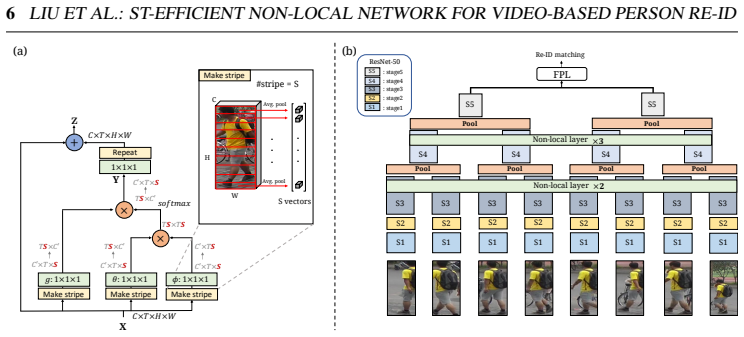
The load-bearing object is the non-local attention layer, an embedded-Gaussian self-attention operation over the full space-time tensor: for each query position $i$, the output is a weighted average of all positions $j$ with weights $\exp(\theta(x_i)^T \phi(x_j)) / \sum_j \exp(\theta(x_i)^T \phi(x_j))$, followed by a residual connection. The paper inserts five such layers at different semantic levels of a ResNet-50 backbone, and adds a Feature Pooling Layer that applies 3D average pooling then batch normalization. Efficiency comes from two reductions: a 'Make stripe' module that averages features into $S$ horizontal groups so attention cost no longer depends on $H$ and $W$, and a hierarchical temporal structure that max-pools adjacent frames after non-local stages, halving the temporal dimension twice from 8 frames down to 2.
What would settle it
Train a ResNet-50 whose FLOPs and parameters are matched to NVAN (about 60 G) by widening channels or adding residual blocks without non-local connections, and evaluate rank-1 and mAP on MARS. If the matched plain network reaches or exceeds 90.0% rank-1, the non-local layers are not the decisive component.
Extended reading notes
Core claim
The central claim is that refining intermediate features with global sequence context, rather than only pooling or attending at the final feature level, is what makes a video representation robust. To test this, the authors embed five non-local layers -- three in stage 4 and two in stage 3 of ResNet-50 -- so that each layer's output at position $i$ is a softmax-weighted mixture of all $T \times H \times W$ positions across frames and space. The sequence-level representation comes from 3D average pooling followed by batch normalization, trained with cross-entropy plus soft-margin batch-hard triplet loss. The paper reports that this multi-level design improves rank-1 by 2.7% and mAP by 3.7% over its ResNet-50 baseline on MARS, and it presents the efficiency variant STE-NVAN as evidence that the same benefits can be retained at a fraction of the computation.
Load-bearing premise
The main claim rests on comparing NVAN to a ResNet-50 baseline that has fewer parameters and half the FLOPs, so the measured improvement could partly come from extra model capacity rather than from non-local attention itself.
Editorial extensions
If this is right
- If multi-level non-local attention is the cause of the gain, then video representations for fine-grained retrieval should be built by injecting sequence context throughout the network, not only at the top.
- The stripe-based spatial reduction makes non-local video attention computationally affordable at lower feature levels, where spatial maps are large.
- The temporal hierarchy shows that after global temporal mixing, adjacent frames become redundant enough to be pooled without much loss, so frame-level computation can be cut as features mature.
- Raising the number of sampled frames from 4 to 8 improves both rank-1 and mAP, so richer temporal sampling is a direct lever on accuracy whenever memory permits.
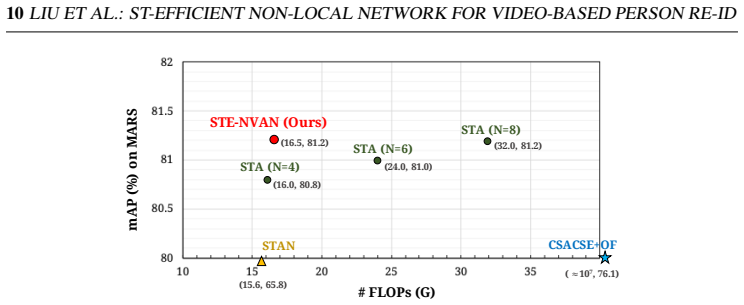
- On MARS, STE-NVAN's FLOPs (16.5 G) are below the no-attention ResNet-50 baseline (30.4 G) while rank-1 (88.9%) still exceeds all previously compared attention methods except its own full version.
Reading between the lines
- The paper's own tables compare NVAN against a ResNet-50 baseline with roughly half the FLOPs; a natural follow-up is to test a capacity-matched baseline (e.g., a wider ResNet-50 at about 60 G) to separate the effect of non-local attention from added model capacity.
- The horizontal-stripe reduction suggests a transferable principle: for objects with strong vertical structure (pedestrians, faces), coarse row-grouping can stand in for dense pixel-level affinities, a plausible extension the paper does not test.
- Because the non-local operation is agnostic to the backbone, the same five-layer placement and stripe/temporal reductions could be re-run on newer backbones; if the rank-1 gap over baselines persists, the multi-level placement claim is more general.
- The temporal hierarchy's max-pooling of adjacent frames may also act as a form of temporal augmentation, so the reported 1.1% drop may not scale linearly as more pooling stages are added.
Signed reviews
Editorial analysis
A structured set of objections, weighed in public.
Referee Report
Summary. The paper proposes two video-based person re-identification networks. NVAN inserts five non-local attention layers at multiple feature levels of a ResNet-50 backbone and uses a feature pooling layer with cross-entropy and triplet losses. STE-NVAN reduces the computation of NVAN by spatially grouping features into horizontal stripes and by temporally pooling frames in a hierarchical structure. The authors report rank-1/mAP of 90.0/82.8 on MARS and 96.3/94.9 on DukeMTMC-VideoReID for NVAN, and 88.9/81.2 and 95.2/93.5 for STE-NVAN, claiming a 3.8% rank-1 improvement over prior state of the art on MARS while cutting FLOPs from 60.0G to 16.5G.
Significance. If the central attribution holds, the paper makes a useful contribution by showing that non-local attention applied to intermediate feature levels improves video-based person re-identification and that spatial and temporal redundancy can reduce its computational cost. The strengths are the clear ablation structure, the honest inclusion of a non-local-free baseline, the consideration of FLOP counts in all comparisons, and the public release of code. However, the main claim is currently undercut by the paper's own baseline, which already exceeds the cited prior state of the art without any non-local layers; the quantitative support for the non-local mechanism is therefore weaker than the text suggests.
major comments (4)
- [Section 4.3, Table 6 and Table 1] The headline claim that NVAN outperforms prior state of the art by 3.8% rank-1 on MARS is undercut by the paper's own baseline. The ResNet-50+FPL baseline in Table 1 achieves 87.3 rank-1 on MARS, which is already above the cited STA result of 86.2 in Table 6. Consequently, the 3.8% margin over prior SOTA is produced by the overall training pipeline (RRS sampling, cross-entropy plus triplet loss, BN after 3D average pooling) rather than by the proposed non-local layers. The authors should either reword the claim to refer to the complete NVAN pipeline or provide a baseline that matches all other components and demonstrates that the non-local layers are the source of the improvement over prior methods.
- [Section 4.1 and Tables 2-5] Hyperparameters including T=8, the number of non-local layers, S=16, and the temporal pooling positions appear to be selected using the test sets of MARS and DukeMTMC-VideoReID, because no validation split is described in the experimental setup. This makes the reported results optimistically biased and weakens the ablation conclusions. A validation protocol should be added, for example, by splitting training identities into a training and a validation subset, and test-set results should be reported only after the hyperparameters are fixed.
- [Tables 1, 3, 4, and 5] All reported results are from single training runs with no standard deviations or significance tests. Several differences that support design choices are small, such as the 89.6 versus 89.7 rank-1 values for S=4 versus S=16 in Table 4 and the 89.2 versus 90.0 rank-1 values in Table 5, and could easily arise from random variation. The authors should report means and standard deviations over multiple random seeds for at least the main comparisons, and the performance-computation plot in Figure 3 should include error bars if available.
- [Table 1, ResNet-50 baseline versus NVAN] The principal ablation comparing ResNet-50 (30.4G FLOPs) to NVAN (60.0G FLOPs) confounds the non-local mechanism with added parameters and computation. The row 'NVAN+Spatial Reduc.' matches FLOPs to the baseline and shows a smaller but still positive gain, which is helpful, but it still adds non-local block parameters. A capacity-matched baseline without non-local operations, such as a wider or deeper ResNet-50 with comparable parameter count and FLOPs, is needed to support the attribution of the remaining gain specifically to the non-local layers.
minor comments (5)
- [Section 4.1, Implementation Detail] The layer names 'con3_3, con3_4' and 'con4_4, con4_5, con4_6' should be written consistently as 'conv3_3, conv3_4' and 'conv4_4, conv4_5, conv4_6' to match the standard ResNet terminology.
- [Table 4] The header of Table 4 lists 'MARS DukeV #FLOP R1 R1' and the rows contain only rank-1 values; no mAP column is reported, unlike the other ablation tables. Please add the missing mAP columns or state explicitly why mAP is omitted.
- [Table 5] The row label 'in 3DAP' is unclear; it should be clarified that this row is the full NVAN without hierarchical temporal pooling, and the caption should define the pooling-position notation used in the other rows.
- [References] References [35] and [36] appear to be the same paper ('Exploit the unknown gradually: One-shot video-based person re-identification by stepwise learning') with identical authors and venue; please merge them or correct the duplicate entry.
- [Section 3.1, Eq. (1)] The sentence 'The Equation 1 in non-local layer is a self-attention mechanism which is also mentioned in [33]' is awkward and should be rephrased; also, the normalization in the denominator of Eq. (1) should be made explicit as the sum of the same exponential terms used in the numerator.
Circularity Check
No significant circularity: the non-local mechanism is imported from external prior work, the efficiency reductions are heuristic engineering choices evaluated by ablation, and no fitted parameter is relabeled as a prediction.
full rationale
The paper's derivation chain is empirical rather than definitional. The non-local attention operation is explicitly adopted from Wang et al. [33], an external prior publication, and is not re-derived from the target result. The contributions are (i) inserting this known operation at multiple feature levels and (ii) proposing spatial and temporal reductions to lower FLOPs. The spatial reduction groups features into horizontal stripes using the stated heuristic that pixels in the same horizontal stripe share characteristics; the temporal reduction uses max-pooling across frames based on the authors' observation that non-local-refined features are temporally similar. Neither reduction is claimed to be implied by the target accuracy, and neither is defined in terms of the final rank-1/mAP values. Hyperparameters such as T, S, and the number of non-local layers are selected by comparing ablations on the benchmark datasets, which is a selection/multiple-comparisons concern rather than a circularity pattern: there is no equation in which an output is its own input, and no fitted parameter is later called a prediction. The baseline confusion noted by the reader (the ResNet-50 baseline already exceeds one compared SOTA method on MARS rank-1) weakens the causal attribution of the gain to non-local layers, but attribution weakness is not circularity. The external comparison against published methods and the explicit FLOP/performance trade-off plots provide independent empirical content. Therefore no circular step can be exhibited with the required specificity, and the honest finding is no significant circularity.
Assumptions & free parameters
free parameters (5)
- Number of input frames T =
8
- Number of non-local layers =
5
- Number of horizontal stripes S =
16
- Temporal pooling positions =
After 2nd and 5th non-local layers
- Backbone stride modification =
conv5_1 stride = 1
assumptions (4)
- domain assumption ImageNet pre-training of ResNet-50 provides a good initialization for Re-ID feature learning.
- domain assumption Non-local attention (Wang et al.) captures long-range spatial-temporal dependencies in video features.
- domain assumption Horizontal stripes in pedestrian images share similar characteristics, so pooling within stripes loses little information.
- domain assumption Temporal features at different stages are redundant, so max-pooling across frames preserves discriminative information.
Cite this review
Pith. "Pith review of Spatially and Temporally Efficient Non-local Attention Network for Video-based Person Re-Identification." pith.science (2026). https://pith.science/paper/MXERVPBC
@misc{pith2026190801683,
  author       = {Pith},
  title        = {Pith review of: Spatially and Temporally Efficient Non-local Attention Network for Video-based Person Re-Identification},
  year         = {2026},
  howpublished = {\url{https://pith.science/paper/MXERVPBC}},
  note         = {Machine review of arXiv:1908.01683}
}
read the original abstract
Video-based person re-identification (Re-ID) aims at matching video sequences of pedestrians across non-overlapping cameras. It is a practical yet challenging task of how to embed spatial and temporal information of a video into its feature representation. While most existing methods learn the video characteristics by aggregating image-wise features and designing attention mechanisms in Neural Networks, they only explore the correlation between frames at high-level features. In this work, we target at refining the intermediate features as well as high-level features with non-local attention operations and make two contributions. (i) We propose a Non-local Video Attention Network (NVAN) to incorporate video characteristics into the representation at multiple feature levels. (ii) We further introduce a Spatially and Temporally Efficient Non-local Video Attention Network (STE-NVAN) to reduce the computation complexity by exploring spatial and temporal redundancy presented in pedestrian videos. Extensive experiments show that our NVAN outperforms state-of-the-arts by 3.8% in rank-1 accuracy on MARS dataset and confirms our STE-NVAN displays a much superior computation footprint compared to existing methods.
Figures

Reference graph
Works this paper leans on
-
[1]
Dapeng Chen, Hongsheng Li, Tong Xiao, Shuai Yi, and Xiaogang Wang. Video per- son re-identification with competitive snippet-similarity aggregation and co-attentive snippet embedding. In Proceedings of the IEEE Conference on Computer Vision and Pattern Recognition, pages 1169–1178, 2018
work page 2018
-
[2]
Deep spatial- temporal fusion network for video-based person re-identification
Lin Chen, Hua Yang, Ji Zhu, Qin Zhou, Shuang Wu, and Zhiyong Gao. Deep spatial- temporal fusion network for video-based person re-identification. In Proceedings of the IEEE Conference on Computer Vision and Pattern Recognition Workshops , pages 63–70, 2017
work page 2017
-
[3]
Person re-identification by multi-channel parts-based cnn with improved triplet loss function
De Cheng, Yihong Gong, Sanping Zhou, Jinjun Wang, and Nanning Zheng. Person re-identification by multi-channel parts-based cnn with improved triplet loss function. In Proceedings of the IEEE Conference on Computer Vision and Pattern Recognition, pages 1335–1344, 2016
work page 2016
-
[4]
Custom pictorial structures for re-identification
Dong Seon Cheng, Marco Cristani, Michele Stoppa, Loris Bazzani, and Vittorio Murino. Custom pictorial structures for re-identification. In Bmvc, volume 1, page 6. Citeseer, 2011
work page 2011
-
[5]
Arcface: Additive angular margin loss for deep face recognition
Jiankang Deng, Jia Guo, Niannan Xue, and Stefanos Zafeiriou. Arcface: Additive angular margin loss for deep face recognition. arXiv preprint arXiv:1801.07698, 2018
arXiv 2018
-
[6]
Person re-identification by symmetry-driven accumulation of local features
Michela Farenzena, Loris Bazzani, Alessandro Perina, Vittorio Murino, and Marco Cristani. Person re-identification by symmetry-driven accumulation of local features. In 2010 IEEE Computer Society Conference on Computer Vision and Pattern Recogni- tion, pages 2360–2367. IEEE, 2010. LIU ET AL.: ST-EFFICIENT NON-LOCAL NETWORK FOR VIDEO-BASED PERSON RE-ID 11
work page 2010
-
[7]
A discriminatively trained, multiscale, deformable part model
Pedro F Felzenszwalb, David A McAllester, Deva Ramanan, et al. A discriminatively trained, multiscale, deformable part model. In Proceedings of the IEEE Conference on Computer Vision and Pattern Recognition, 2008
work page 2008
-
[8]
Sta: Spatial-temporal attention for large-scale video-based person re-identification
Yang Fu, Xiaoyang Wang, Yunchao Wei, and Thomas Huang. Sta: Spatial-temporal attention for large-scale video-based person re-identification. 2019
work page 2019
Show all 45 references
-
[9]
Viewpoint invariant pedestrian recognition with an ensem- ble of localized features
Douglas Gray and Hai Tao. Viewpoint invariant pedestrian recognition with an ensem- ble of localized features. In European conference on computer vision, pages 262–275. Springer, 2008
2008
-
[10]
Deep residual learning for image recognition
Kaiming He, Xiangyu Zhang, Shaoqing Ren, and Jian Sun. Deep residual learning for image recognition. In Proceedings of the IEEE conference on computer vision and pattern recognition, pages 770–778, 2016
2016
-
[11]
In defense of the triplet loss for person re-identification
Alexander Hermans, Lucas Beyer, and Bastian Leibe. In defense of the triplet loss for person re-identification. arXiv preprint arXiv:1703.07737, 2017
2017 arXiv
-
[12]
Person re- identification by descriptive and discriminative classification
Martin Hirzer, Csaba Beleznai, Peter M Roth, and Horst Bischof. Person re- identification by descriptive and discriminative classification. In Scandinavian con- ference on Image analysis, pages 91–102. Springer, 2011
2011
-
[13]
Batch normalization: Accelerating deep network training by reducing internal covariate shift
Sergey Ioffe and Christian Szegedy. Batch normalization: Accelerating deep network training by reducing internal covariate shift. arXiv preprint arXiv:1502.03167, 2015
2015 arXiv
-
[14]
Adam: A method for stochastic optimization
Diederik P Kingma and Jimmy Ba. Adam: A method for stochastic optimization. arXiv preprint arXiv:1412.6980, 2014
2014 arXiv
-
[15]
Large scale metric learning from equivalence constraints
Martin Koestinger, Martin Hirzer, Paul Wohlhart, Peter M Roth, and Horst Bischof. Large scale metric learning from equivalence constraints. In2012 IEEE Conference on Computer Vision and Pattern Recognition, pages 2288–2295. IEEE, 2012
2012
-
[16]
Learning deep context- aware features over body and latent parts for person re-identification
Dangwei Li, Xiaotang Chen, Zhang Zhang, and Kaiqi Huang. Learning deep context- aware features over body and latent parts for person re-identification. In Proceedings of the IEEE Conference on Computer Vision and Pattern Recognition, pages 384–393, 2017
2017
-
[17]
Diversity regularized spa- tiotemporal attention for video-based person re-identification
Shuang Li, Slawomir Bak, Peter Carr, and Xiaogang Wang. Diversity regularized spa- tiotemporal attention for video-based person re-identification. In Proceedings of the IEEE Conference on Computer Vision and Pattern Recognition, pages 369–378, 2018
2018
-
[18]
Deepreid: Deep filter pairing neural network for person re-identification
Wei Li, Rui Zhao, Tong Xiao, and Xiaogang Wang. Deepreid: Deep filter pairing neural network for person re-identification. In CVPR, 2014
2014
-
[19]
Harmonious attention network for person re- identification
Wei Li, Xiatian Zhu, and Shaogang Gong. Harmonious attention network for person re- identification. In Proceedings of the IEEE Conference on Computer Vision and Pattern Recognition, pages 2285–2294, 2018
2018
-
[20]
Person re-identification by local maximal occurrence representation and metric learning
Shengcai Liao, Yang Hu, Xiangyu Zhu, and Stan Z Li. Person re-identification by local maximal occurrence representation and metric learning. In Proceedings of the IEEE conference on computer vision and pattern recognition, pages 2197–2206, 2015. 12 LIU ET AL.: ST-EFFICIENT NON-...
2015
-
[21]
Sphereface: Deep hypersphere embedding for face recognition
Weiyang Liu, Yandong Wen, Zhiding Yu, Ming Li, Bhiksha Raj, and Le Song. Sphereface: Deep hypersphere embedding for face recognition. In Proceedings of the IEEE conference on computer vision and pattern recognition, pages 212–220, 2017
2017
-
[22]
Person re-identification by manifold ranking
Chen Change Loy, Chunxiao Liu, and Shaogang Gong. Person re-identification by manifold ranking. In 2013 IEEE International Conference on Image Processing, pages 3567–3571. IEEE, 2013
2013
-
[23]
Recurrent convolu- tional network for video-based person re-identification
Niall McLaughlin, Jesus Martinez del Rincon, and Paul Miller. Recurrent convolu- tional network for video-based person re-identification. In Proceedings of the IEEE conference on computer vision and pattern recognition, pages 1325–1334, 2016
2016
-
[24]
Features for multi-target multi-camera tracking and re-identification
Ergys Ristani and Carlo Tomasi. Features for multi-target multi-camera tracking and re-identification. In Proceedings of the IEEE Conference on Computer Vision and Pattern Recognition, pages 6036–6046, 2018
2018
-
[25]
Deep co-occurrence feature learning for visual object recognition
Ya-Fang Shih, Yang-Ming Yeh, Yen-Yu Lin, Ming-Fang Weng, Yi-Chang Lu, and Yung-Yu Chuang. Deep co-occurrence feature learning for visual object recognition. In Proceedings of the IEEE Conference on Computer Vision and Pattern Recognition, pages 4123–4132, 2017
2017
-
[26]
Springer
MARS: A Video Benchmark for Large-Scale Person Re-identification, 2016. Springer
2016
-
[27]
Svdnet for pedestrian retrieval
Yifan Sun, Liang Zheng, Weijian Deng, and Shengjin Wang. Svdnet for pedestrian retrieval. In Proceedings of the IEEE International Conference on Computer Vision , pages 3800–3808, 2017
2017
-
[28]
Beyond part models: Person retrieval with refined part pooling (and a strong convolutional baseline)
Yifan Sun, Liang Zheng, Yi Yang, Qi Tian, and Shengjin Wang. Beyond part models: Person retrieval with refined part pooling (and a strong convolutional baseline). In Proceedings of the European Conference on Computer Vision (ECCV), pages 480–496, 2018
2018
-
[29]
Attention is all you need
Ashish Vaswani, Noam Shazeer, Niki Parmar, Jakob Uszkoreit, Llion Jones, Aidan N Gomez, Łukasz Kaiser, and Illia Polosukhin. Attention is all you need. In Advances in neural information processing systems, pages 5998–6008, 2017
2017
-
[30]
Cosface: Large margin cosine loss for deep face recognition
Hao Wang, Yitong Wang, Zheng Zhou, Xing Ji, Dihong Gong, Jingchao Zhou, Zhifeng Li, and Wei Liu. Cosface: Large margin cosine loss for deep face recognition. In Proceedings of the IEEE Conference on Computer Vision and Pattern Recognition , pages 5265–5274, 2018
2018
-
[31]
Temporal segment networks: Towards good practices for deep action recog- nition
Limin Wang, Yuanjun Xiong, Zhe Wang, Yu Qiao, Dahua Lin, Xiaoou Tang, and Luc Van Gool. Temporal segment networks: Towards good practices for deep action recog- nition. In European conference on computer vision, pages 20–36. Springer, 2016
2016
-
[32]
Person re- identification by discriminative selection in video ranking
Taiqing Wang, Shaogang Gong, Xiatian Zhu, and Shengjin Wang. Person re- identification by discriminative selection in video ranking. IEEE transactions on pat- tern analysis and machine intelligence, 38(12):2501–2514, 2016
2016
-
[33]
Non-local neural networks
Xiaolong Wang, Ross Girshick, Abhinav Gupta, and Kaiming He. Non-local neural networks. In Proceedings of the IEEE Conference on Computer Vision and Pattern Recognition, pages 7794–7803, 2018. LIU ET AL.: ST-EFFICIENT NON-LOCAL NETWORK FOR VIDEO-BASED PERSON RE-ID 13
2018
-
[34]
Person transfer gan to bridge domain gap for person re-identification
Longhui Wei, Shiliang Zhang, Wen Gao, and Qi Tian. Person transfer gan to bridge domain gap for person re-identification. In Proceedings of the IEEE Conference on Computer Vision and Pattern Recognition, pages 79–88, 2018
2018
-
[35]
Exploit the unknown gradually: One-shot video-based person re-identification by stepwise learn- ing
Yu Wu, Yutian Lin, Xuanyi Dong, Yan Yan, Wanli Ouyang, and Yi Yang. Exploit the unknown gradually: One-shot video-based person re-identification by stepwise learn- ing. In The IEEE Conference on Computer Vision and Pattern Recognition (CVPR) , June 2018
2018
-
[36]
Exploit the unknown gradually: One-shot video-based person re-identification by stepwise learn- ing
Yu Wu, Yutian Lin, Xuanyi Dong, Yan Yan, Wanli Ouyang, and Yi Yang. Exploit the unknown gradually: One-shot video-based person re-identification by stepwise learn- ing. In Proceedings of the IEEE Conference on Computer Vision and Pattern Recogni- tion, pages 5177–5186, 2018
2018
-
[37]
Learning deep fea- ture representations with domain guided dropout for person re-identification
Tong Xiao, Hongsheng Li, Wanli Ouyang, and Xiaogang Wang. Learning deep fea- ture representations with domain guided dropout for person re-identification. In Pro- ceedings of the IEEE conference on computer vision and pattern recognition , pages 1249–1258, 2016
2016
-
[38]
Jointly attentive spatial-temporal pooling networks for video-based person re-identification
Shuangjie Xu, Yu Cheng, Kang Gu, Yang Yang, Shiyu Chang, and Pan Zhou. Jointly attentive spatial-temporal pooling networks for video-based person re-identification. In Proceedings of the IEEE International Conference on Computer Vision , pages 4733– 4742, 2017
2017
-
[39]
Person re-identification via recurrent feature aggregation
Yichao Yan, Bingbing Ni, Zhichao Song, Chao Ma, Yan Yan, and Xiaokang Yang. Person re-identification via recurrent feature aggregation. In European Conference on Computer Vision, pages 701–716. Springer, 2016
2016
-
[40]
Hierarchical bilinear pooling for fine-grained visual recognition
Chaojian Yu, Xinyi Zhao, Qi Zheng, Peng Zhang, and Xinge You. Hierarchical bilinear pooling for fine-grained visual recognition. InProceedings of the European Conference on Computer Vision (ECCV), pages 574–589, 2018
2018
-
[41]
Gmcp-tracker: Global multi-object tracking using generalized minimum clique graphs
Amir Roshan Zamir, Afshin Dehghan, and Mubarak Shah. Gmcp-tracker: Global multi-object tracking using generalized minimum clique graphs. In European Con- ference on Computer Vision, pages 343–356. Springer, 2012
2012
-
[42]
Scal- able person re-identification: A benchmark
Liang Zheng, Liyue Shen, Lu Tian, Shengjin Wang, Jingdong Wang, and Qi Tian. Scal- able person re-identification: A benchmark. In Proceedings of the IEEE International Conference on Computer Vision, pages 1116–1124, 2015
2015
-
[43]
Person re-identification: Past, present and future
Liang Zheng, Yi Yang, and Alexander G Hauptmann. Person re-identification: Past, present and future. arXiv preprint arXiv:1610.02984, 2016
2016 arXiv
-
[44]
Person re-identification in the wild
Liang Zheng, Hengheng Zhang, Shaoyan Sun, Manmohan Chandraker, Yi Yang, and Qi Tian. Person re-identification in the wild. In Proceedings of the IEEE Conference on Computer Vision and Pattern Recognition, pages 1367–1376, 2017
2017
-
[45]
See the forest for the trees: Joint spatial and temporal recurrent neural networks for video-based person re- identification
Zhen Zhou, Yan Huang, Wei Wang, Liang Wang, and Tieniu Tan. See the forest for the trees: Joint spatial and temporal recurrent neural networks for video-based person re- identification. In Proceedings of the IEEE Conference on Computer Vision and Pattern Recognition, pages 4747...
2017
Reviewed August 14, 2026 · model on record in the stance chip above.
Discussion (0). Continue with ORCID to comment.