REVIEW 4 major objections 3 minor 46 references
Anomalous energy diffusion in two-dimensional nonlinear lattices
T0 review · 4 major / 3 minor · reviewed 2026-08-14 · deepseek-v4-flash
Pith's one-line read Energy diffusion in 2D momentum-conserving nonlinear lattices is anomalous and follows Lévy-stable distributions.
desk verdict Worth refereeing: the 2D energy-vs-momentum decoupling is a real observation, but the quartic lattice's Lévy-stable claim is not quantitatively established. read the letter →
The pith
A machine-rendered reading of the paper's core claim, the machinery that carries it, and where it could break.
The reading
What carries the argument
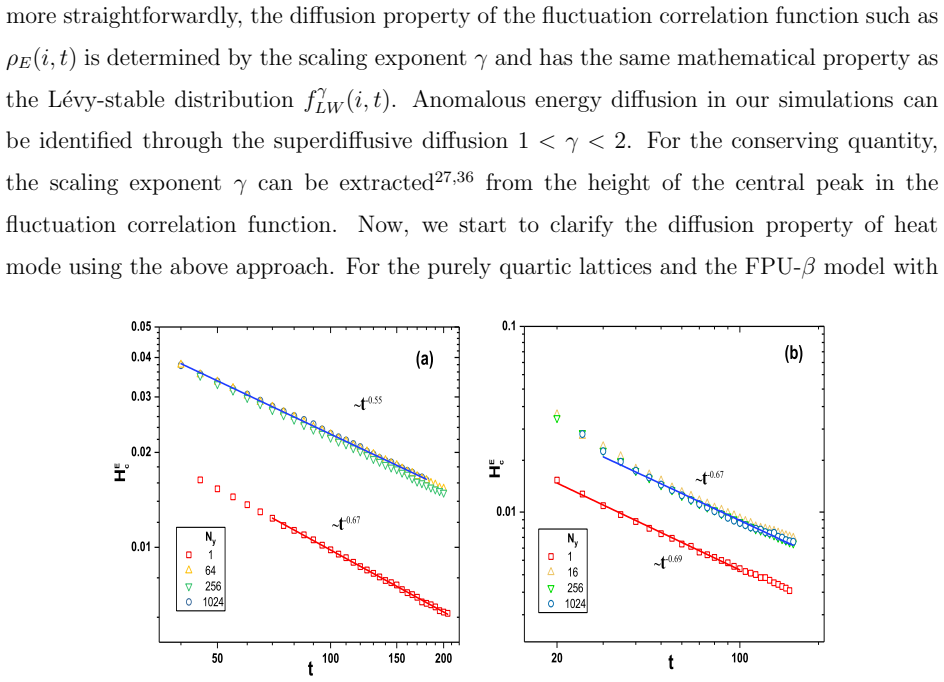
The central object is the spatiotemporal correlation function of energy fluctuations, $\rho_E(i,t)$, whose central heat-mode peak rescales as $t^{1/\gamma}\rho_E(i/t^{1/\gamma},t)$ and is fitted by the Lévy-stable distribution $f_{\rm LW}^{\gamma}$; the companion momentum correlation $\rho_P(i,t)$ tracks sound modes. The scaling exponent $\gamma$ extracted from the peak-height decay $H_c^E \sim t^{-1/\gamma}$, together with the MSD exponent $\beta$ from $\langle \Delta x^2(t)\rangle_E \sim t^{\beta}$, carries the classification: $1<\gamma<2$ and $\beta>1$ mark superdiffusion.
What would settle it
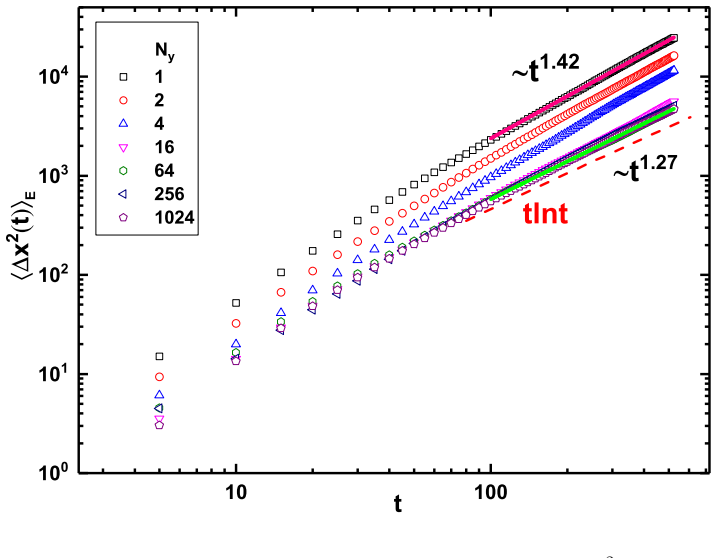
Extend the equilibrium simulation of the purely quartic 2D lattice (width 1024) to correlation times beyond $t=200$ and compare the MSD $\langle \Delta x^2(t)\rangle_E$ against $t^{1.27}$ and $t\ln t$: if the data bend toward $t\ln t$, the power-law diffusion exponent claimed for the quartic lattice is a finite-window artifact rather than the asymptotic law.
Extended reading notes
Core claim
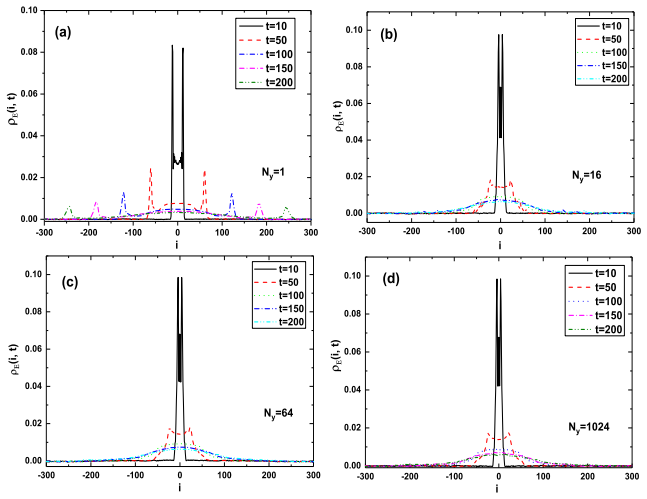
Using equilibrium energy and momentum fluctuation correlation functions in two-dimensional square lattices with vector displacements, the paper finds that energy diffusion in the momentum-conserving purely quartic and FPU-$\beta$ lattices is superdiffusive: the heat-mode profile rescales with exponents $\gamma = 1.818$ and $\gamma = 1.504$ for width 1024 and is well fitted by Lévy-stable distributions, while the mean-square displacement grows as $t^{1.27}$ and $t^{1.51}$, respectively. In the same 2D systems the momentum correlation peaks decay with exponent $\mu = 0.402$ (quartic case), i.e. momentum diffusion is no longer superdiffusive, so the 1D rule that anomalous heat transport is corroborated by momentum superdiffusion does not extend to 2D. The $\phi^4$ lattice with an on-site potential shows Gaussian normal diffusion regardless of width.
Load-bearing premise
The fitted exponents $\gamma$ and $\beta$ come from power-law fits over times up to $t=200$ and are assumed to be asymptotic; for the quartic lattice, $t^{1.27}$ and $t\ln t$ cannot be told apart, so the quantitative exponents could be logarithmic corrections in disguise.
Editorial extensions
If this is right
- In the 2D FPU-$\beta$ lattice, thermal conductivity should diverge as a power law, roughly $\kappa \sim N^{0.51}$, matching direct nonequilibrium simulations with vector displacements.
- In the 2D purely quartic lattice, the conductivity divergence is at least logarithmic; whether it is exactly $\ln N$ or a weak power law is left unresolved.
- The 1D criterion that anomalous heat transport is corroborated by momentum superdiffusion does not hold in 2D, where momentum spreads normally or subdiffusively while energy remains superdiffusive.
- Harmonic interactions accelerate energy diffusion, so the nature of the divergence depends on the balance between harmonic and purely anharmonic forces.
- Adding a $\phi^4$ on-site potential gives normal diffusion in both 1D and 2D, confirming that momentum conservation is the key ingredient for anomalous 2D heat transport.
Reading between the lines
- A testable next step is to apply the same fluctuation-correlation analysis to a 2D coupled-rotator lattice with momentum conservation but normal 1D conduction; if its energy diffusion is normal, momentum conservation would be necessary but not sufficient for anomalous 2D heat transport, mirroring the 1D rotator exception.
- The reported $\mu = 0.402$ subdiffusive momentum decay in 2D suggests that sound-mode damping, not the heat mode itself, carries the dimensional crossover; comparing $\mu$ across widths could give a sharper diagnostic than $\gamma$.
- If logarithmic corrections are genuine for the quartic lattice, the apparent power-law spread $t^{1.27}$ could be an effective exponent drifting toward $t\ln t$; a clean way to test this is to plot $\langle\Delta x^2\rangle_E/(t\ln t)$ versus time and look for a plateau.
Signed reviews
Editorial analysis
A structured set of objections, weighed in public.
Referee Report
Summary. This paper studies energy and momentum diffusion in two-dimensional nonlinear lattices (purely quartic, FPU-β, and φ4) by computing spatiotemporal correlation functions of energy and momentum fluctuations in equilibrium. For the momentum-conserving lattices, the authors extract a scaling exponent γ from the decay of the central peak height of the energy correlation and report superdiffusive values γ=1.818 (2D quartic) and γ=1.504 (2D FPU-β), both in the range 1<γ<2, and they claim that the rescaled profiles are well described by Lévy-stable distributions. The mean-square displacement (MSD) of the energy distribution grows as t^β with β=1.27 (quartic) and β=1.51 (FPU-β), supporting anomalous diffusion, while for the φ4 model the MSD grows linearly, indicating normal diffusion. The authors also find that momentum diffusion, superdiffusive in 1D, becomes normal or subdiffusive when the width Ny is increased to 1024, which contradicts the 1D hypothesis that anomalous heat transport is accompanied by momentum superdiffusion. They conclude that energy diffusion in 2D momentum-conserving lattices is anomalous and infer possible logarithmic (quartic) or power-law (FPU-β) divergence of thermal conductivity.
Significance. If the conclusions hold, this is one of the first direct numerical characterizations of energy diffusion in 2D momentum-conserving lattices using fluctuation correlation functions, and it clarifies that the 1D momentum-superdiffusion criterion does not extend to 2D. The 1D benchmarking against the nonlinear fluctuating hydrodynamics prediction γ=3/2 is a useful validation, and the use of two diagnostics (peak-height scaling and MSD) is a strength. However, the quantitative support for the Lévy-stable description is incomplete: for the quartic lattice the measured β=1.27 is inconsistent with the stated Lévy relation β=3−γ (which would give 1.18), and the paper explicitly acknowledges that t^1.27 and t ln t cannot be distinguished over the simulated time window. These issues materially affect the quantitative conclusions, although the qualitative anomalous-diffusion verdict appears robust.
major comments (4)
- [Sec. IIIB, Fig. 7] For the 2D quartic lattice, the Lévy-walk relation β=3−γ stated in Sec. IIIB predicts β≈1.18 for the measured γ=1.818 (Fig. 4), whereas the reported MSD exponent is β=1.27 (Fig. 7). The paper does not address this ~0.09 discrepancy, and no error bars are provided, so it is unclear whether this is a finite-time transient or a genuine breakdown of the Lévy-stable description for the quartic case. As written, the MSD result does not independently confirm the abstract claim that energy diffusion is "well described by the Lévy-stable distribution."
- [Sec. IIIB, Fig. 7] The paper states that for the quartic lattice "the discrepancy in the scaling behavior between the power-law ∼ t^1.27 and the function of ∼ t ln t is so small that it is difficult to numerically determine" which is correct, and later "we cannot exclude that this may be a numerical coincidence." Given this admitted degeneracy, the fitted exponent β=1.27 and the inferred power-law divergence of thermal conductivity for the quartic lattice are not established; the text should clearly frame these as tentative and explicitly discuss the log-corrected alternative as equally compatible with the data.
- [Sec. IIIA, Figs. 5-6] The collapse of the rescaled correlation functions in Figs. 5 and 6 is performed using the same exponent γ that was extracted from the peak-height decay in Fig. 4. Consequently, the visible collapse is a self-consistency check rather than an independent validation of the Lévy-stable distribution; an independent test would require fitting the full profiles without inputting γ, or at least reporting a goodness-of-fit measure for the Lévy curves shown as the solid lines.
- [Sec. IIIA-III C, Figs. 4, 7-9, 12] No error bars, confidence intervals, or fitting-window information is provided for any of the reported exponents (γ, β, µ). Because the paper's quantitative claims rest on small differences (e.g., γ=1.818 versus 1.504, β=1.27 versus t ln t, and the 1D-to-2D crossover), uncertainty quantification is needed to assess whether these differences and the dimensional crossover are statistically significant.
minor comments (3)
- [Sec. IIIA, text after Fig. 6] The sentence "the scaling exponent γ reaches γ = 1.818 for the 1D purely quartic lattice" should read "for the 2D purely quartic lattice", since the preceding sentence discusses the 1D values and the following values are for Ny=1024.
- [Sec. IIB and Sec. IIIB] There are several typographical errors, including "we we" and "of of", and the notation in Eq. (4) is confusing because the left-hand side is written with a time-dependent argument; please rewrite the scaling relation for clarity.
- [Fig. 1-3 captions] The figure captions do not state the integration time step, the number of ensemble realizations used for each width, or the fit ranges for the power-law fits in Fig. 4; adding these details would improve reproducibility.
Circularity Check
Lévy-stable comparison reuses the same fitted exponent; independent MSD and 1D benchmarks keep the classification partially supported.
-
fitted input called prediction
[Sec. IIIA, discussion of Figs. 5 and 6]
"The scaling exponent γ is obtained from the relation H E c ∼ t−1/γ shown in Fig. 4. To further confirm the superdiffusive property of ρE(i, t ), the L´evy-stable distribution45,46 f γ LW (i, t ) with the same scaling exponent γ is also plotted by the solid line in each figure."
The Lévy-stable curve used as evidence for the central claim is constructed with the same γ that was already fitted from the same data's central-peak decay. The central-peak collapse is therefore imposed by construction, and the comparison checks only the remaining shape of the Lévy-stable family with that pre-selected exponent. The abstract's statement that energy diffusion is 'well described by the Lévy-stable distribution' is thus partly a self-consistency check rather than an independent prediction. Independent support does exist elsewhere, via the separately measured MSD exponent β and the 1D quartic benchmark matching γ=3/2, which limits the circularity to partial.
full rationale
The derivation chain is mostly self-contained: the peak-height exponent γ is measured from the decay of the central peak, the MSD exponent β is measured independently, and the 1D quartic value agrees with the theoretical Lévy-3/2 prediction. The one genuinely circular element is the visual confirmation in Figs. 5 and 6, where the Lévy-stable distribution is plotted with the same γ that was fitted from the same data; this makes the collapse a self-consistency check rather than a parameter-free prediction of the Lévy form. The paper itself flags a related limitation in Sec. IIIB, saying 'we cannot exclude that this may be a numerical coincidence' when distinguishing t^1.27 from t ln t; that is a finite-time/statistical ambiguity rather than circularity. Similarly, the mismatch between γ=1.818 and the Lévy relation β=3−γ=1.18 versus the measured β=1.27 is a quantitative inconsistency, but it is not a circular reduction. There is no load-bearing self-citation chain and no imported uniqueness theorem, so the moderate score reflects only the reuse of the fitted exponent in the Lévy-stable comparison.
Assumptions & free parameters
free parameters (4)
- gamma (energy scaling exponent) =
quartic: 1D ~1.49, 2D 1.818; FPU-beta: 1D ~1.45, 2D ~1.50
- beta (MSD exponent) =
quartic: 1D 1.42, 2D 1.27; FPU-beta: 1D 1.60, 2D 1.51
- mu (momentum peak decay exponent) =
quartic: 1D 0.616, 2D 0.402; FPU-beta: 1D 0.611
- sound speed c =
quartic: 0.914 (1D), 0.861 (2D); FPU-beta: 1.22 (1D), 1.16 (2D)
assumptions (4)
- domain assumption The spatiotemporal energy correlation obeys the scaling form t^{1/gamma} rho_E(i/t^{1/gamma}, t) for the central heat mode (Eq. 4).
- ad hoc to paper The decay of the central peak height alone determines the exponent gamma over the simulated time range.
- domain assumption The 1D connection between energy MSD and heat-current autocorrelation (Eq. 5) can be extended qualitatively to 2D.
- domain assumption Microcanonical equilibrium at T = 0.5 (quartic and FPU) and T = 3.0 (phi4) samples the relevant nonlinear regime.
Cite this review
Pith. "Pith review of Anomalous energy diffusion in two-dimensional nonlinear lattices." pith.science (2026). https://pith.science/paper/HKJ6OHHY
@misc{pith2026190801689,
  author       = {Pith},
  title        = {Pith review of: Anomalous energy diffusion in two-dimensional nonlinear lattices},
  year         = {2026},
  howpublished = {\url{https://pith.science/paper/HKJ6OHHY}},
  note         = {Machine review of arXiv:1908.01689}
}
read the original abstract
Heat transport in one-dimensional (1D) momentum-conserving lattices is generally assumed to be anomalous, thus yielding a power-law divergence of thermal conductivity with system length. However, whether heat transport in two-dimensional (2D) system is anomalous or not is still on debate because of the difficulties involved in experimental measurements or due to the insufficiently large simulation size. Here, we simulate energy and momentum diffusion in the 2D nonlinear lattices using the method of fluctuation correlation functions. Our simulations confirm that energy diffusion in the 2D momentum-conserving lattices is anomalous and can be well described by the L\'{e}vy-stable distribution. We also find that the disappear of side peaks of heat mode may suggest a weak coupling between heat mode and sound mode in the 2D nonlinear system. It is also observed that the harmonic interactions in the 2D nonlinear lattices can accelerate the energy diffusion. Contrary to the hypothesis of 1D system, we clarify that anomalous heat transport in the 2D momentum-conserving system cannot be corroborated by the momentum superdiffusion any more. Moreover, as is expected, lattices with a nonlinear on-site potential exhibit normal energy diffusion, independent of the dimension. Our findings offer some valuable insights into the mechanism of thermal transport in 2D system.
Figures


Figures from the paper (9 more)




Reference graph
Works this paper leans on
-
[1]
author F. Bonetto , author J. Lebowitz , and author L. Rey-Bellet , title Mathematical Physics 2000, p. 128 ( publisher Imperial College Press, London , year 2000 )
work page 2000
-
[2]
author S. Lepri , author R. Livi , and author A. Politi , journal Phys. Rep. volume 377 , pages 1 ( year 2003 )
work page 2003
-
[3]
author A. Dhar , journal Adv. Phys. volume 57 , pages 457 ( year 2008 )
work page 2008
-
[4]
author J.-S. Wang , author J. Wang , and author J. T. Lü , journal Eur. Phys. J. B volume 62 , pages 381 ( year 2008 )
work page 2008
-
[5]
Lepri , ed., title Thermal Transport in Low Dimensions , vol
editor S. Lepri , ed., title Thermal Transport in Low Dimensions , vol. volume 921 of series Lecture notes in Physics ( publisher Springer, Cham , year 2016 )
work page 2016
-
[6]
author N. Li , author J. Ren , author L. Wang , author G. Zhang , author P. Hänggi , and author B. Li , journal Rev. Mod. Phys. volume 84 , pages 1045 ( year 2012 )
work page 2012
-
[7]
author X. Gu , author Y. Wei , author X. Yin , author B. Li , and author R. Yang , journal Rev. Mod. Phys. volume 90 , pages 1103 ( year 2018 )
work page 2018
-
[8]
author S. Lepri , author R. Livi , and author A. Politi , journal Phys. Rev. Lett. volume 78 , pages 1896 ( year 1997 )
work page 1997
Show all 46 references
-
[9]
Lepri , author R
author S. Lepri , author R. Livi , and author A. Politi , journal Europhys. Lett. volume 43 , pages 271 ( year 1998 )
1998
-
[10]
Hu , author B
author B. Hu , author B. Li , and author H. Zhao , journal Phys. Rev. E volume 57 , pages 2992 ( year 1998 )
1998
-
[11]
Lepri , author R
author S. Lepri , author R. Livi , and author A. Politi , journal Chaos volume 15 , pages 015118 ( year 2005 )
2005
-
[12]
Mai , author A
author T. Mai , author A. Dhar , and author O. Narayan , journal Phys. Rev. Lett. volume 98 , pages 184301 ( year 2007 )
2007
-
[13]
Hatano , journal Phys
author T. Hatano , journal Phys. Rev. E volume 59 , pages R1 ( year 1999 )
1999
-
[14]
Grassberger , author W
author P. Grassberger , author W. Nadler , and author L. Yang , journal Phys. Rev. Lett. volume 89 , pages 180601 ( year 2002 )
2002
-
[15]
Xiong , journal Phys
author D. Xiong , journal Phys. Rev. E volume 95 , pages 062140 ( year 2017 )
2017
-
[16]
Li and author N
author S. Li and author N. Li , journal Sci. Rep. volume 8 , pages 5329 ( year 2018 ), ISSN issn 2045-2322
2018
-
[17]
author J. M. Deutsch and author O. Narayan , journal Phys. Rev. E volume 68 , pages 010201 ( year 2003 )
2003
-
[18]
Lepri , journal Phys
author S. Lepri , journal Phys. Rev. E volume 58 , pages 7165 ( year 1998 )
1998
-
[19]
Narayan and author S
author O. Narayan and author S. Ramaswamy , journal Phys. Rev. Lett. volume 89 , pages 200601 ( year 2002 )
2002
-
[20]
van Beijeren , journal Phys
author H. van Beijeren , journal Phys. Rev. Lett. volume 108 , pages 180601 ( year 2012 )
2012
-
[21]
Spohn , journal J Stat
author H. Spohn , journal J Stat. Phys. volume 154 , pages 1191 ( year 2014 )
2014
-
[22]
author G. P. Tsironis , author A. R. Bishop , author A. V. Savin , and author A. V. Zolotaryuk , journal Phys. Rev. E volume 60 , pages 6610 ( year 1999 )
1999
-
[23]
author B. B. Hu , author B. W. Li , and author H. Zhao , journal Phys. Rev. E volume 61 , pages 3828 ( year 2000 )
2000
-
[24]
Aoki and author D
author K. Aoki and author D. Kusnezov , journal Phys Lett A volume 265 , pages 250 ( year 2000 )
2000
-
[25]
Prosen and author D
author T. Prosen and author D. K. Campbell , journal Phys. Rev. Lett. volume 84 , pages 2857 ( year 2000 )
2000
-
[26]
Giardina , author R
author C. Giardina , author R. Livi , author A. Politi , and author M. Vassalli , journal Phys. Rev. Lett. volume 84 , pages 2144 ( year 2000 )
2000
-
[27]
Li , author S
author Y. Li , author S. Liu , author N. Li , author P. Hänggi , and author B. Li , journal New J Phys volume 17 , pages 043064 ( year 2015 )
2015
-
[28]
author D. L. Nika and author A. A. Balandin , journal Rep. Prog. Phys. volume 80 , pages 036502 ( year 2017 )
2017
-
[29]
Lippi and author R
author A. Lippi and author R. Livi , journal J. Stat. Phys. volume 100 , pages 1147 ( year 2000 )
2000
-
[30]
Xiong , author J
author D. Xiong , author J. Wang , author Y. Zhang , and author H. Zhao , journal Phys. Rev. E volume 82 , pages 030101 ( year 2010 )
2010
-
[31]
Shiba and author N
author H. Shiba and author N. Ito , journal J Phys Soc Jpn volume 77 , pages 054006 ( year 2008 )
2008
-
[32]
Wang , author B
author L. Wang , author B. Hu , and author B. Li , journal Phys. Rev. E volume 86 , pages 040101 ( year 2012 )
2012
-
[33]
author A. V. Savin , author V. Zolotarevskiy , and author O. V. Gendelman , journal Europhys. Lett. volume 113 , pages 24003 ( year 2016 )
2016
-
[34]
Liu , author P
author S. Liu , author P. Haenggi , author N. Li , author J. Ren , and author B. Li , journal Phys. Rev. Lett. volume 112 , pages 040601 ( year 2014 )
2014
-
[35]
Cheng , author M
author J. Cheng , author M. Grossman , and author T. McKercher , title Professional Cuda C Programming ( publisher John Wiley & Sons, Inc. , year 2014 )
2014
-
[36]
Zhao , journal Phys
author H. Zhao , journal Phys. Rev. Lett. volume 96 , pages 140602 ( year 2006 )
2006
-
[37]
Chen , author Y
author S. Chen , author Y. Zhang , author J. Wang , and author H. Zhao , journal Phys. Rev. E volume 87 , pages 032153 ( year 2013 )
2013
-
[38]
Gao , author N
author Z. Gao , author N. Li , and author B. Li , journal Phys. Rev. E volume 93 , pages 022102 ( year 2016 ), ISSN issn 2470-0045
2016
-
[39]
Xiong , journal Phys
author D. Xiong , journal Phys. Rev. E volume 97 , pages 022116 ( year 2018 )
2018
-
[40]
Xiong and author Y
author D. Xiong and author Y. Zhang , journal Phys. Rev. E volume 98 , pages 012130 ( year 2018 )
2018
-
[41]
Yang , author P
author L. Yang , author P. Grassberger , and author B. Hu , journal Phys. Rev. E volume 74 , pages 062101 ( year 2006 )
2006
-
[42]
Xiong and author S.-V
author D.-X. Xiong and author S.-V. Dmitriev , title A Dynamical Perspective on the ^4 Model (Pages 281-308) ( publisher Springer, Cham , year 2019 )
2019
-
[43]
author S. G. Das , author A. Dhar , author K. Saito , author C. B. Mendl , and author H. Spohn , journal Phys. Rev. E volume 90 , pages 012124 ( year 2014 )
2014
-
[44]
author G. R. Lee-Dadswell , author B. G. Nickel , and author C. G. Gray , journal Phys. Rev. E volume 72 , pages 031202 ( year 2005 )
2005
-
[45]
Zaburdaev , author S
author V. Zaburdaev , author S. Denisov , and author J. Klafter , journal Rev Mod Phys volume 87 , pages 483 ( year 2015 )
2015
-
[46]
Klafter and author I
author J. Klafter and author I. M. Sokolov , title First Steps in Random Walks: From Tools to Applications ( publisher OUP Oxford , year 2011 )
2011
Reviewed August 14, 2026 · model on record in the stance chip above.
Discussion (0). Continue with ORCID to comment.