REVIEW 5 major objections 4 minor 14 references
Behavioral Biases and Nonadditive Dynamics in Risk Taking: An Experimental Investigation
T0 review · 5 major / 4 minor · reviewed 2026-08-14 · deepseek-v4-flash
Pith's one-line read The paper argues that Prospect Theory's risk predictions flip for extreme outcomes because people evaluate gambles as repeated time-average growth choices.
desk verdict A novel time-average S-curve with an interesting extreme-outcome experiment, but the central claim about repetition is unsupported and the model has ad hoc parameters. read the letter →
The pith
A machine-rendered reading of the paper's core claim, the machinery that carries it, and where it could break.
The reading
What carries the argument
The central objects are the time-average growth functions $p\ln_p(1+x)$ for gains and $\exp_p(\rho x)-1$ for losses, where $\ln_p(x)\equiv (x^p-1)/p$ and $\exp_p(x)\equiv (1+px)^{1/p}$ are the deformed logarithm and exponential of nonextensive statistics. The argument rests on the tangent relation between the linear expected-change option and these concave or convex curves at $x=0$, and on the contrast ratio between the two time-average signals, expressed in decibels, as the threshold separating fuzzy from crisp decision regions.
What would settle it
Present the same three problems to two groups: one told the gamble will occur exactly once, the other told it will repeat many times. If the certainty-choice rates are equally high in both groups, the paper's time-average mechanism fails; if the repeated frame raises certainty choices above the one-shot frame, the central claim is supported.
Extended reading notes
Core claim
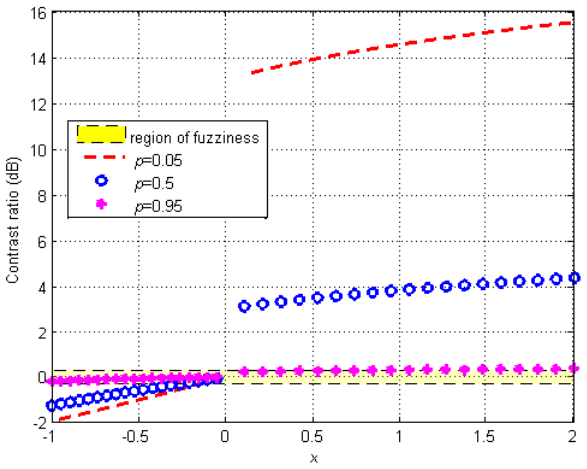
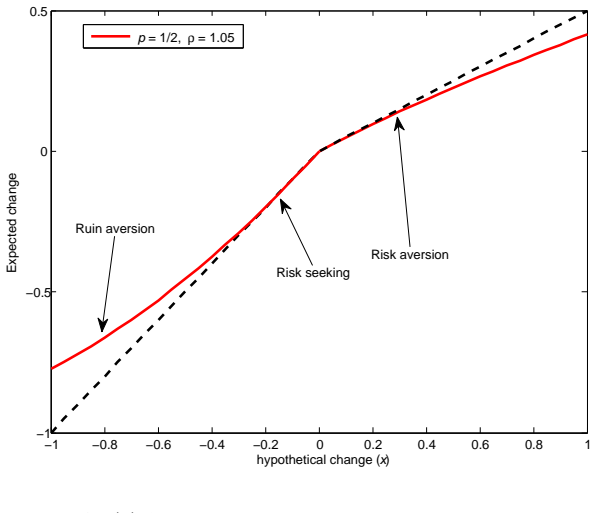
The paper's central claim is that decision-makers facing known probabilities and outcomes assume indefinite repetitions, so the proper measure of a prospect is its time-average wealth growth rather than its ensemble-average expected value. For gains, the certain option of winning a fraction $x$ is compared with the risky option of winning the same expected amount with probability $p$; the author shows the time-average growth of the risky option is $p\ln_p(1+x)$, which is always below the proportional gain $px$, yielding risk aversion. For losses, a hyperbolic construction gives $\exp_p(\rho x)-1$, which produces risk seeking for small losses but flips to ruin aversion when the potential loss is extreme. The contrast ratio between the two time-average signals, measured in decibels, defines a fuzziness region in which choices are unclear and a crisp region in which the better time-average dominates. The paper's three experimental problems, with extreme outcomes, find between 73% and 98% of 67 respondents choosing the certain option, which the author interprets as direct evidence for this time-average mechanism.
Load-bearing premise
The key assumption is that respondents' choices in the three problems came from thinking of the gambles as repeated many times and comparing long-run growth, not from the sheer size of the amounts, simple loss aversion, or a one-shot fear of ruin.
Editorial extensions
If this is right
- At extreme gains and losses, the classic risk-seeking patterns of Prospect Theory flip: people choose the certain moderate outcome over a tiny chance of a huge gain and over a small chance of total ruin.
- The S-shaped value curve of Prospect Theory can be rederived from time-average dynamics and nonextensive statistics, with the parameter $\rho$ controlling the small-loss risk-seeking region.
- The contrast ratio between time averages predicts decision crispness: low-contrast gambles produce fuzzy regions with less predictable choices, as the divided responses in one problem show.
- Losses severe enough to threaten all of a person's possessions trigger 'ruin aversion,' which the paper treats as the time-average mechanism overriding the usual risk seeking for losses.
Reading between the lines
- If repetitive time-average reasoning drives extreme-stakes choices, then explicitly framing the same gamble as a single one-shot event should substantially lower the certainty-preference rate; this is a direct test the paper does not perform.
- The fuzzy boundary of about $\pm 0.5$ dB is chosen by inspection rather than derived; a systematic experiment varying outcome magnitudes and probabilities could map decibel distance to choice-frequency curves and turn the fuzzy/crisp distinction into a quantitative psychophysical law.
- The model suggests that the probability-weighting distortions in Prospect Theory are emergent from time averaging rather than a separate cognitive bias, which would imply that option framing (repeated versus one-shot) could shift risk preferences in real financial decisions.
Signed reviews
Editorial analysis
A structured set of objections, weighed in public.
Referee Report
Summary. The paper proposes that decision-makers evaluate risky prospects by implicitly assuming indefinite repetition and comparing time-average growth rates rather than one-shot expected values. Using rhetorical devices it labels 'meiosis' for gains and 'hyperbole' for losses, the author constructs an S-shaped value function from nonextensive-statistics functions, introduces a decibel-scale 'contrast ratio' to define fuzzy and crisp regions of choice, and reports three survey problems with extreme outcomes that are claimed to show respondents choosing options with the best time average. The central conclusion is that the data provide 'strong evidence that decision-makers assume indefinite repetitions' and that time should therefore be treated as part of the physical stimulus driving choice.
Significance. The paper engages a real and timely question: whether time-average (non-ergodic) reasoning, as developed by Peters and Gell-Mann, can explain deviations from Prospect Theory for extreme outcomes. The gain-side inequality in Section 2.1, showing px >= (1+x)^p - 1, is a clean and correct mathematical observation, and the idea of testing the time-average model with extreme-outcome problems is falsifiable. However, the theoretical model is only partially derived: the loss-side S-curve depends on an ad hoc rate rho, the fuzziness threshold is postulated rather than derived, and the experimental section reports simple percentages without statistical inference or a control for one-shot motivations. If the model and experiment were properly developed, the paper could be a useful contribution, but as it stands the evidence does not support the strong conclusion drawn.
major comments (5)
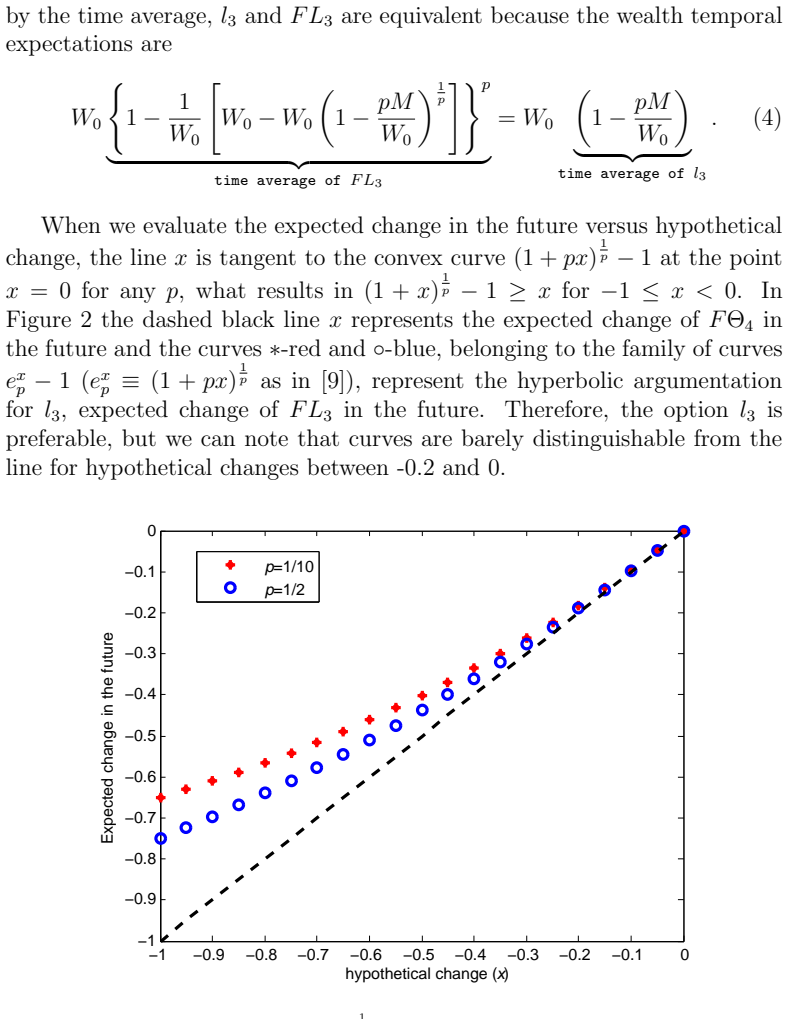
- [Section 3, Eq. (5) and Figure 2] The loss-side derivation is internally inconsistent. In Section 2.2 the hyperbolic curves are given as (1+px)^(1/p)-1 and stated to lie above the line x for -1 <= x < 0, which would make the sure-loss option l3 preferable; however, Eq. (5) defines the choice as max{e^{\rho x}_p - 1, x} and assigns 'x for small losses' and 'e^{\rho x}_p - 1 for big losses,' which reverses the ordering for rho = 1. The role of x is also ambiguous because l3 is defined as a loss of Mp, which has expected change px rather than x. This ambiguity undermines the derivation of the S-curve's loss side and must be resolved before the model can be evaluated.
- [Section 3, paragraph after Eq. (5)] The rate rho is introduced specifically to reproduce the known pattern of risk seeking for small losses: the text states 'we must insert a rate rho into the hyperbolic argumentation process' without any independent derivation or empirical justification. Because the shape of the loss-side S-curve, and hence the predicted transition from risk seeking to ruin aversion, is controlled by this free parameter, the central theoretical claim is not a derivation from time-average dynamics but a post-hoc calibration to Prospect Theory's known pattern. The manuscript would need to derive rho from a stated principle or identify it independently from data.
- [Section 4, Problems 1-3] The experimental design does not support the conclusion that respondents used implicit indefinite-repetition reasoning. The questionnaire never mentions repetition or time averaging, and no item asks respondents whether they imagined repeated plays; the only evidence offered is one quoted respondent comment. The observed choices could equally arise from one-shot loss aversion, ruin aversion, minimum-wealth constraints, or diminishing marginal utility of extreme amounts. Moreover, the paper reports only percentages for the three problems, with no confidence intervals, hypothesis tests, or baseline comparison to non-extreme versions of the same problems; the Shannon-entropy calculations in Section 4 are descriptive and do not establish statistical significance.
- [Section 3, Fig. 3 and surrounding text] The fuzziness threshold of -0.5 dB to 0.5 dB is asserted without derivation or independent measurement. The claim that this threshold 'can define a threshold between the stimuli and the sensations (or perceptions) they produce' is therefore not tested by the data. Since the paper's account of when risk seeking appears and disappears depends on this threshold, the central claim about fuzzy versus crisp regions is unsupported.
- [Section 5, Conclusion] The conclusion that the paper provides 'strong evidence that decision-makers assume indefinite repetitions' is not warranted by the reported results. Three extreme-outcome choices, without controls for rival mechanisms and without statistical testing, cannot bear the weight of this conclusion. The phrasing overstates what the data show and should be tempered substantially even if the earlier issues are addressed.
minor comments (4)
- [Title and abstract] The title on the first page is 'The Time Importance for Prospect Theory,' while the arXiv metadata title is 'Behavioral Biases and Nonadditive Dynamics in Risk Taking: An Experimental Investigation'; this inconsistency should be fixed.
- [Section 4, Problem 3] There is a typographical error 'Kahnemam' instead of 'Kahneman' in the discussion of Problem 3.
- [Section 2.2 and Figure 2] The notation in Figure 2 and the surrounding text is inconsistent: the text refers to curves (1+px)^(1/p)-1, the figure caption says '(1 + px)^{1/p}', and the expression exp is defined but not used consistently. Please harmonize the notation throughout.
- [Section 4, Problems 1-2] The sample is described as psychology students from a single institution, but no demographic or recruitment details are provided, and no ethics approval statement is included.
Circularity Check
No significant circularity: the model's predictions are derived from explicit time-average calculations and are not fitted to the experimental choices; the one discretionary parameter (rho) is openly disclosed.
full rationale
I find no circular step that meets the required standard of quoting the paper and exhibiting a reduction of a prediction to its inputs by construction. The theoretical model derives the gain-side preference from the inequality px >= (1+x)^p - 1 and the loss-side preference from a hyperbolic construction whose time average is shown to equal the sure-loss option (Eq. 4). The S-curve is then assembled from those functions. The parameter rho is explicitly introduced with the words "we must insert a rate rho into the hyperbolic argumentation process" to reproduce the known small-loss risk-seeking pattern; this is disclosed, not disguised as a prediction, and the extreme-outcome experimental results are an out-of-sample consequence of the resulting curve rather than a fit to those data. The +/-0.5 dB fuzziness threshold is labeled hypothetical, and the contrast-ratio/entropy association in Section 4 is presented as an exploratory observation. The conclusion that "decision-makers assume indefinite repetitions" is an interpretive overreach, since the questionnaire never mentions repetition and the same choices are compatible with simple loss aversion or ruin aversion; however, that is an underdetermination or validity concern, not a circular derivation. The only self-citation ([5], for meiosis and hyperbole) is not load-bearing because the paper re-derives and explains those procedures in Sections 2.1 and 2.2. No uniqueness theorem is imported, and no fitted parameter is renamed as a prediction. The paper is not circular by the definitions in the review instructions.
Assumptions & free parameters
free parameters (2)
- rho =
1.05 (illustrative, not estimated)
- fuzziness threshold =
+/-0.5 dB
assumptions (4)
- domain assumption Wealth evolves multiplicatively over repeated gambles, so the time-average growth factor after one round with win probability p is (1+x)^p.
- domain assumption Decision-makers implicitly consider indefinite repetitions of a gamble even when the stated problem is one-shot.
- domain assumption The contrast ratio in dB between time averages is the relevant psychophysical measure that determines whether two options are distinguishable.
- ad hoc to paper Meiosis (reducing gains) and hyperbole (inflating losses) are valid rhetorical models of how people evaluate certainty equivalents.
Cite this review
Pith. "Pith review of Behavioral Biases and Nonadditive Dynamics in Risk Taking: An Experimental Investigation." pith.science (2026). https://pith.science/paper/6LRIN77K
@misc{pith2026190801709,
  author       = {Pith},
  title        = {Pith review of: Behavioral Biases and Nonadditive Dynamics in Risk Taking: An Experimental Investigation},
  year         = {2026},
  howpublished = {\url{https://pith.science/paper/6LRIN77K}},
  note         = {Machine review of arXiv:1908.01709}
}
read the original abstract
This paper investigates the dynamics of gambling and how they can affect risk-taking behavior in regions not explored by Kahneman and Tversky's Prospect Theory. Specifically, it questions why extreme outcomes do not fit the theory and proposes alternative ways to measure prospects. The paper introduces a measure of contrast between gambles and conducts an experiment to test the hypothesis that individuals prospect gambles with nonadditive dynamics differently. The results suggest a strong bias towards certain options, which challenges the predictions of Kahneman and Tversky's theory.
Figures

Figures from the paper (1 more)
Reference graph
Works this paper leans on
-
[1]
Daniel Kahneman and Amos Tversky. Choices, values, and frames. In Handbook of the Fundamentals of Financial Decision Making: Part I , pages 269–278. World Scientific, 2013
work page 2013
-
[2]
Prospect theory: An analysis of decision under risk
Daniel Kahneman and Amos Tversky. Prospect theory: An analysis of decision under risk. Econometrica, 47(2):363–391, 1979
work page 1979
-
[3]
Evaluating gambles using dynamics
Ole Peters and Murray Gell-Mann. Evaluating gambles using dynamics. Chaos: An Interdisciplinary Journal of Nonlinear Science , 26(2):023103, 2016
work page 2016
-
[4]
The time interpretation of expected utility theory
Ole Peters and Alexander Adamou. The time interpretation of expected utility theory. arXiv preprint arXiv:1801.03680 , 2018. 13
arXiv 2018
-
[5]
Decision-making and Fuzzy Temporal Logic
Jos´ e Cl´ audio do Nascimento. Decision making and fuzzy temporal logic. ArXiv, abs/1901.01970, 2019
work page Pith review arXiv 1901
-
[6]
Nonextensive statistics: theoretical, experimen- tal and computational evidences and connections
Constantino Tsallis. Nonextensive statistics: theoretical, experimen- tal and computational evidences and connections. Brazilian Journal of Physics, 29(1):1–35, 1999
work page 1999
-
[7]
Possible generalization of boltzmann-gibbs statis- tics
Constantino Tsallis. Possible generalization of boltzmann-gibbs statis- tics. Journal of statistical physics , 52(1-2):479–487, 1988
work page 1988
-
[8]
Advances in prospect theory: Cu- mulative representation of uncertainty
Amos Tversky and Daniel Kahneman. Advances in prospect theory: Cu- mulative representation of uncertainty. Journal of Risk and uncertainty , 5(4):297–323, 1992
work page 1992
Show all 14 references
-
[9]
General- ized algebra within a nonextensive statistics
Laurent Nivanen, Alain Le Mehaute, and Qiuping A Wang. General- ized algebra within a nonextensive statistics. Reports on Mathematical Physics, 52(3):437–444, 2003
2003
-
[10]
Re- generative and reconfigurable all-optical logic gates for ultra-fast appli- cations
A Bogoni, L Poti, R Proietti, G Meloni, F Ponzini, and P Ghelfi. Re- generative and reconfigurable all-optical logic gates for ultra-fast appli- cations. Electronics Letters, 41(7):435–436, 2005
2005
-
[11]
Fully in- tegrated and and or optical logic gates
Raghda M Younis, Nihal FF Areed, and Salah SA Obayya. Fully in- tegrated and and or optical logic gates. IEEE Photonics Technology Letters, 26(19):1900–1903, 2014
1900
-
[12]
Elimination by aspects: A theory of choice
Amos Tversky. Elimination by aspects: A theory of choice. Psychological review, 79(4):281, 1972
1972
-
[13]
Skin in the Game: Hidden Asymmetries in Daily Life
Nassim Nicholas Taleb. Skin in the Game: Hidden Asymmetries in Daily Life. Random House, 2018
2018
-
[14]
Thinking, fast and slow (kindle edition), 2011
Daniel Kahneman. Thinking, fast and slow (kindle edition), 2011. 14
2011
Reviewed August 14, 2026 · model on record in the stance chip above.
Discussion (0). Continue with ORCID to comment.