REVIEW 3 major objections 6 minor 19 references
Transversely polarized Drell-Yan measurements at COMPASS
T0 review · 3 major / 6 minor · reviewed 2026-08-14 · deepseek-v4-flash
Pith's one-line read Drell-Yan data point to the Sivers sign QCD predicts
desk verdict Preliminary COMPASS DY update: Sivers asymmetry positive at ~1σ, with an unquantified twist-3 F2_UT assumption as the main caveat. read the letter →
The pith
A machine-rendered reading of the paper's core claim, the machinery that carries it, and where it could break.
The reading
What carries the argument
The central object is the Sivers transverse-momentum-dependent parton distribution function, $f_{1T}^{\perp}$: a function describing how the intrinsic transverse momentum of quarks inside a transversely polarized nucleon correlates with the nucleon spin. The load-bearing identity is the QCD prediction of its process dependence: the same naive-time-reversal-odd distribution is expected to appear with opposite signs in SIDIS and in Drell-Yan, a consequence of the gauge-link (Wilson line) structure of TMD operators. The measurement isolates the effect by extracting the $\sin\phi_S$ azimuthal modulation in the Drell-Yan cross section off a transversely polarized target, using an unbinned maximum-likelihood fit of five target-spin-dependent asymmetries simultaneously, and by choosing a hard-scale range matched to earlier COMPASS SIDIS measurements.
What would settle it
A concrete test: re-extract $A_T^{\sin\phi_S}$ without assuming $F_2^{UT}=0$, for instance by including a model estimate of $F_2^{UT}$ or by studying the asymmetry at lower $q_T$ where higher-twist effects grow; if the sign ceases to be positive or the amplitude departs from the SIDIS-opposite expectation, the claim that the data are consistent with the Sivers sign change would be contradicted.
Extended reading notes
Core claim
The paper claims that the combined 2015 plus partial 2018 Drell-Yan data from a $\pi^-$ beam on a transversely polarized NH$_3$ target yield a positive average Sivers asymmetry $A_T^{\sin\phi_S}$, at about one standard deviation of the total uncertainty, whose sign and magnitude match the predicted change of sign of the quark Sivers function between SIDIS and Drell-Yan. It further reports that the TSA $A_T^{\sin(2\phi_{CS}-\phi_S)}$ is negative with about two standard-deviation significance, consistent with model calculations and relevant to the universality of nucleon transversity, and that the pretzelosity-related asymmetry $A_T^{\sin(2\phi_{CS}+\phi_S)}$ and the two subleading-twist asymmetries are compatible with zero. The author presents these as the first and only currently available data on transverse-spin-dependent azimuthal asymmetries in the Drell-Yan process, and notes that analysis of the remaining 2018 data is ongoing and should improve statistical precision.
Load-bearing premise
The extraction assumes that the subleading background structure function $F_2^{UT}$ is zero; if a nonzero $F_2^{UT}$ contributes measurably at the COMPASS kinematics, the measured $\sin\phi_S$ asymmetry would contain an extra twist-3 piece and would no longer provide a clean test of the leading-order Sivers sign change.
Editorial extensions
If this is right
- If the sign change is real, the Sivers function extracted from COMPASS Drell-Yan data should be the negative of the SIDIS-extracted function at the same hard scale, giving a direct experimental test of QCD gauge invariance.
- The negative two-standard-deviation signal in $A_T^{\sin(2\phi_{CS}-\phi_S)}$ provides a new constraint on the nucleon transversity TMD PDF when compared with model calculations.
- Comparing SIDIS and Drell-Yan data at matched hard scale sidesteps much of the TMD-evolution uncertainty that complicates comparisons with the much higher-scale STAR W/Z measurements.
- The pretzelosity-related asymmetry and the two subleading-twist asymmetries being compatible with zero supports the leading-twist interpretation of the measured TSAs.
Reading between the lines
- Beyond the paper: extracting the $\cos 2\phi_{CS}$ Boer-Mulders asymmetry from the same dataset would test a second naive-T-odd sign-flip prediction; a sign reversal relative to SIDIS would extend the universality test beyond the Sivers function.
- Beyond the paper: because the 2018 sample is only about half-processed, the full dataset plausibly shrinks statistical uncertainties by roughly $\sqrt{2}$, which could move the Sivers asymmetry from about one to about two standard deviations; this is an extrapolation, not a claim in the paper.
- Beyond the paper: binning the asymmetry in $q_T$ and $M_{\mu\mu}$ while estimating $F_2^{UT}$ would directly test the assumption on which the sign-change comparison rests, since a $q_T$-dependent rise of the $\sin\phi_S$ amplitude would signal twist-3 contamination.
Signed reviews
Editorial analysis
A structured set of objections, weighed in public.
Referee Report
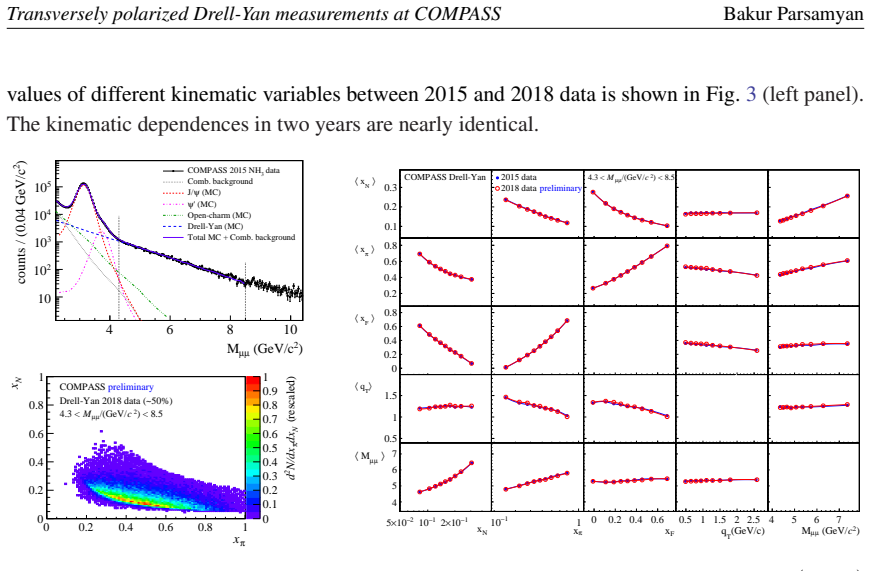
Summary. This proceedings paper reports preliminary COMPASS measurements of the five target transverse-spin asymmetries in pion-nucleon Drell-Yan production at 190 GeV/c, combining the published 2015 data with about 50% of the 2018 data. The analysis uses an extended unbinned maximum likelihood fit in the dimuon mass range 4.3 < M_mumu < 8.5 GeV/c^2 and q_T > 0.4 GeV/c, with a total background estimated below 4%. Kinematic dependences in x_N, x_pi, x_F, q_T, and M_mumu are presented together with the integrated values. The central physics statement is that the integrated Sivers asymmetry A_T^{sin phi_S} is above zero at about one standard deviation of the total uncertainty, and that this positive sign and amplitude are consistent with the predicted QCD sign change of the Sivers function between SIDIS and Drell-Yan. The other four TSAs are also reported; one is approximately two standard deviations below zero, one is compatible with zero, and the two subleading-twist asymmetries are compatible with zero.
Significance. If the interpretation holds, these data provide one of the only direct experimental probes of the predicted universality properties of TMD parton distributions, and the Sivers sign-change test is a central prediction of QCD factorization. The paper has several strengths: it uses a standard unbinned maximum-likelihood estimator with simultaneous extraction of all five TSAs, it cross-checks 2015 and 2018 kinematic distributions, it estimates background at the few-percent level, and it reports point-to-point systematic uncertainties as bands. However, the statistical power is currently limited: the Sivers asymmetry is only about one standard deviation above zero, and the extraction relies on an unquantified assumption about a twist-3 structure function. The result is therefore best viewed as a preliminary consistency check rather than a precision test of the sign-change prediction.
major comments (3)
- [Section 1, footnote 2 and Eq. (1.1)] The interpretation of the measured A_T^{sin phi_S} as the leading-twist Sivers asymmetry depends on the assumption that the twist-3 structure function F2_UT is zero, stated in footnote 2. At the COMPASS hard scale, 4.3 < M_mumu < 8.5 GeV/c^2, twist-3 admixtures need not be negligible compared with the measured asymmetry size, and the paper provides no numerical estimate, model calculation, or kinematic argument showing that F2_UT is small in the x_N, x_pi, q_T region considered. Because the sign-change comparison is the central claim of the paper, I ask that the authors either quantify the expected size of the twist-3 contamination or explicitly state in the conclusions that the sign-change interpretation holds only under this assumption.
- [Section 3, integrated results] The paper states that the positive sign and amplitude of the integrated Sivers asymmetry are consistent with the predicted sign change, but it does not quote the numerical value of A_T^{sin phi_S} or its statistical and systematic uncertainties, nor does it show the range expected from the SIDIS-based Sivers extraction. With the integrated value only about one standard deviation above zero, the evidence is weak; the text should report the central value and uncertainty and frame the statement as a consistency check rather than a confirmation of the sign-change prediction.
- [Section 2, systematics] The point-to-point systematic uncertainties are stated to be about 0.7 times the statistical uncertainties, but no decomposition or method is described. Since the key Sivers result is significant at only about one standard deviation of the total uncertainty, the way the systematic contribution is evaluated directly affects the central claim; please provide at least a summary of the sources entering this factor.
minor comments (6)
- [Title/header] The running title in the full text reads "COMP ASS" due to a spacing error; it should read "COMPASS".
- [Abstract] The abstract mentions spin-(in)dependent azimuthal asymmetries, but this paper reports only transverse-spin asymmetries; the wording could be tightened to avoid implying spin-independent results are included.
- [Equation (1.1)] The quantities F1_U and F2_U are used to define sigma_hat_U, but the symbols are not defined directly after the equation; a one-sentence definition would improve readability.
- [Footnote 2] The assumption that F2_UT is zero is attributed to Ref. [3]; a physics reference or a short justification would be more informative than a citation to the COMPASS-II proposal.
- [Section 3] The asymmetry A_T^{sin(2 phi_CS - phi_S)} is reported as being below zero with a significance of about two standard deviations; because five asymmetries are extracted simultaneously, the discussion would benefit from a note on whether the significance accounts for the multiple-comparison/trial factor.
- [Figures] The integrated values shown in the rightmost panel of Fig. 4 are difficult to read without numerical values; a small table or numeric labels would help the reader assess the amplitudes and uncertainties.
Circularity Check
No significant circularity: the Sivers asymmetry is a measured observable compared with an external QCD prediction.
full rationale
The paper reports measured transverse-spin asymmetries from COMPASS Drell-Yan data. The central statement—that the average Sivers asymmetry A_T^{sin phi_S} is positive at about one standard deviation and consistent with the predicted sign change of the Sivers function—is an empirical result compared with an external theoretical prediction (Collins' sign-change argument, Ref. [12]). No parameter is fitted to the data and then renamed as a prediction; the asymmetry amplitudes are extracted by an unbinned maximum likelihood fit directly from the measured angular distributions. The comparison to the SIDIS-based Sivers extraction and to the QCD sign-change prediction is an external benchmark, not an input of the extraction. The only potentially load-bearing assumption is footnote 2, where the twist-3 structure function F2_UT is assumed to be zero following Ref. [3] (the COMPASS-II proposal). This is an explicitly stated physics assumption about the kinematic regime, not a circular step: it does not define the measured asymmetry in terms of the prediction, nor does it use a fitted value to force the result. Even if the assumption were questioned on kinematic grounds, that would be a correctness or systematics concern, not circularity. The paper is self-contained as an experimental report, and no derivation chain reduces to its own inputs.
Assumptions & free parameters
assumptions (2)
- domain assumption TMD factorization applies at the COMPASS hard scale (Q between 4.3 and 8.5 GeV/c^2).
- domain assumption The twist-3 structure function F2_UT is assumed to be zero (footnote 2).
Cite this review
Pith. "Pith review of Transversely polarized Drell-Yan measurements at COMPASS." pith.science (2026). https://pith.science/paper/JUMBWODB
@misc{pith2026190801727,
  author       = {Pith},
  title        = {Pith review of: Transversely polarized Drell-Yan measurements at COMPASS},
  year         = {2026},
  howpublished = {\url{https://pith.science/paper/JUMBWODB}},
  note         = {Machine review of arXiv:1908.01727}
}
abstract
The exploration of the transverse spin structure of the nucleon by measuring spin (in)dependent azimuthal asymmetries in semi-inclusive DIS (SIDIS) and in Drell-Yan processes is one of the main objectives of the COMPASS experiment at CERN (SPS, M2 beamline). During the first phase of the experiment (2002-2011) a series of SIDIS measurements were performed, using a longitudinally polarized muon beam impinging on transversely polarized $^6$LiD or NH$_3$ targets. As a part of the COMPASS-II programme, in 2015 and 2018 the experiment performed Drell-Yan measurements with a $\pi^-$ beam interacting with a transversely polarized NH$_3$. The measurement of the Sivers and other azimuthal asymmetries at the same hard scale in polarized SIDIS and Drell-Yan provides a unique possibility to test predicted in QCD (pseudo-)universal features of transverse momentum dependent parton distribution functions.
Figures


Figures from the paper (1 more)

Reference graph
Works this paper leans on
-
[1]
Collins, F oundations of perturbative QCD
J. Collins, F oundations of perturbative QCD. Cambridge University Press, 2013
2013
- [2]
-
[3]
Gautheron et al., COMPASS-II Proposal, SPSC-P-340, CERN-SPSC-2010-014 (2010)
COMPASS COLLABORATION collaboration, F. Gautheron et al., COMPASS-II Proposal, SPSC-P-340, CERN-SPSC-2010-014 (2010) . 5 Transversely polarized Drell-Yan measurements at COMPASS Bakur Parsamyan
work page 2010
-
[4]
A. Bacchetta, M. Diehl, K. Goeke, A. Metz, P. J. Mulders and M. Schlegel, Semi-inclusive deep inelastic scattering at small transverse momentum , JHEP 02 (2007) 093, [hep-ph/0611265]
arXiv 2007
-
[5]
A. Kotzinian, New quark distributions and semiinclusive electroproduction on the polarized nucleons , Nucl. Phys. B441 (1995) 234–248, [hep-ph/9412283]
arXiv 1995
-
[6]
COMPASS COLLABORATION collaboration, C. Adolph et al., Experimental investigation of transverse spin asymmetries in muon-proton SIDIS processes: Sivers asymmetries , Phys. Lett. B717 (2012) 383–389, [1205.5122]
arXiv 2012
-
[7]
COMPASS COLLABORATION collaboration, C. Adolph et al., Experimental investigation of transverse spin asymmetries in muon-p SIDIS processes: Collins asymmetries , Phys. Lett. B717 (2012) 376–382, [1205.5121]
work page Pith review arXiv 2012
-
[8]
Airapetian et al., Observation of the Naive-T-odd Sivers Effect in Deep-Inelastic Scattering , Phys
HERMES COLLABORATION collaboration, A. Airapetian et al., Observation of the Naive-T-odd Sivers Effect in Deep-Inelastic Scattering , Phys. Rev. Lett. 103 (2009) 152002, [0906.3918]
arXiv 2009
Show all 19 references
-
[9]
Adolph et al., Sivers asymmetry extracted in SIDIS at the hard scale of the Drell-Yan process at COMPASS, Phys
COMPASS collaboration, C. Adolph et al., Sivers asymmetry extracted in SIDIS at the hard scale of the Drell-Yan process at COMPASS, Phys. Lett. B770 (2017) 138–145, [1609.07374]
2017 arXiv
-
[10]
beyond Collins and Sivers
COMPASS COLLABORATION collaboration, B. Parsamyan, Six “beyond Collins and Sivers” transverse spin asymmetries at COMPASS, Phys. Part. Nucl. 45 (2014) 158–162, [1301.6615]
2014 arXiv
-
[11]
D. W. Sivers, Single Spin Production Asymmetries from the Hard Scattering of Point-Like Constituents, Phys. Rev. D41 (1990) 83
1990
-
[12]
J. C. Collins, Leading twist single transverse-spin asymmetries: Drell-Yan and deep inelastic scattering, Phys. Lett. B536 (2002) 43–48, [hep-ph/0204004]
2002 arXiv
-
[13]
Qian et al., Single Spin Asymmetries in Charged Pion Production from Semi-Inclusive Deep Inelastic Scattering on a Transversely Polarized 3He Target, Phys
J EFFERSON LAB HALL A collaboration, X. Qian et al., Single Spin Asymmetries in Charged Pion Production from Semi-Inclusive Deep Inelastic Scattering on a Transversely Polarized 3He Target, Phys. Rev. Lett. 107 (2011) 072003, [1106.0363]
2011 arXiv
-
[14]
Anselmino, M
M. Anselmino, M. Boglione, U. D’Alesio, F. Murgia and A. Prokudin, Study of the sign change of the Sivers function from STAR Collaboration W/Z production data , JHEP 04 (2017) 046, [1612.06413]
2017 arXiv
-
[15]
M. G. Echevarria, A. Idilbi, Z.-B. Kang and I. Vitev, QCD Evolution of the Sivers Asymmetry , Phys. Rev. D89 (2014) 074013, [1401.5078]
2014 arXiv
-
[16]
Sun and F
P. Sun and F. Yuan, Transverse momentum dependent evolution: Matching semi-inclusive deep inelastic scattering processes to Drell-Yan and W/Z boson production , Phys. Rev. D88 (2013) 114012, [1308.5003]
2013 arXiv
-
[17]
Adamczyk et al., Measurement of the transverse single-spin asymmetry in p↑ + p→ W±/Z0 at RHIC, Phys
STAR COLLABORATION collaboration, L. Adamczyk et al., Measurement of the transverse single-spin asymmetry in p↑ + p→ W±/Z0 at RHIC, Phys. Rev. Lett. 116 (2016) 132301, [1511.06003]
2016 arXiv
-
[18]
Aghasyan et al., First measurement of transverse-spin-dependent azimuthal asymmetries in the Drell-Yan process, Phys
COMPASS collaboration, M. Aghasyan et al., First measurement of transverse-spin-dependent azimuthal asymmetries in the Drell-Yan process, Phys. Rev. Lett. 119 (2017) 112002, [1704.00488]
2017 arXiv
-
[19]
A. N. Sissakian, O. Yu. Shevchenko, A. P. Nagaitsev and O. N. Ivanov, Polarization effects in Drell-Yan processes, Phys. Part. Nucl. 41 (2010) 64–100. 6
2010
Reviewed August 14, 2026 · model on record in the stance chip above.
Discussion (0). Continue with ORCID to comment.