REVIEW 4 major objections 4 minor 2 cited by
A Triple AGN in a Mid-Infrared Selected Late Stage Galaxy Merger
T0 review · 4 major / 4 minor · reviewed 2026-08-14 · deepseek-v4-flash
Pith's one-line read This paper reports that the merging galaxy system SDSS J084905.51+111447.2 contains three distinct nuclei, each showing X-ray and optical-spectroscopic evidence of an actively accreting supermassive black hole, with mutual separations of…
desk verdict A credible but not watertight case for a triple AGN; Galaxy 1 is secure, Galaxies 2 and 3 need more data or more conservative language. read the letter →
The pith
A machine-rendered reading of the paper's core claim, the machinery that carries it, and where it could break.
The reading
What carries the argument
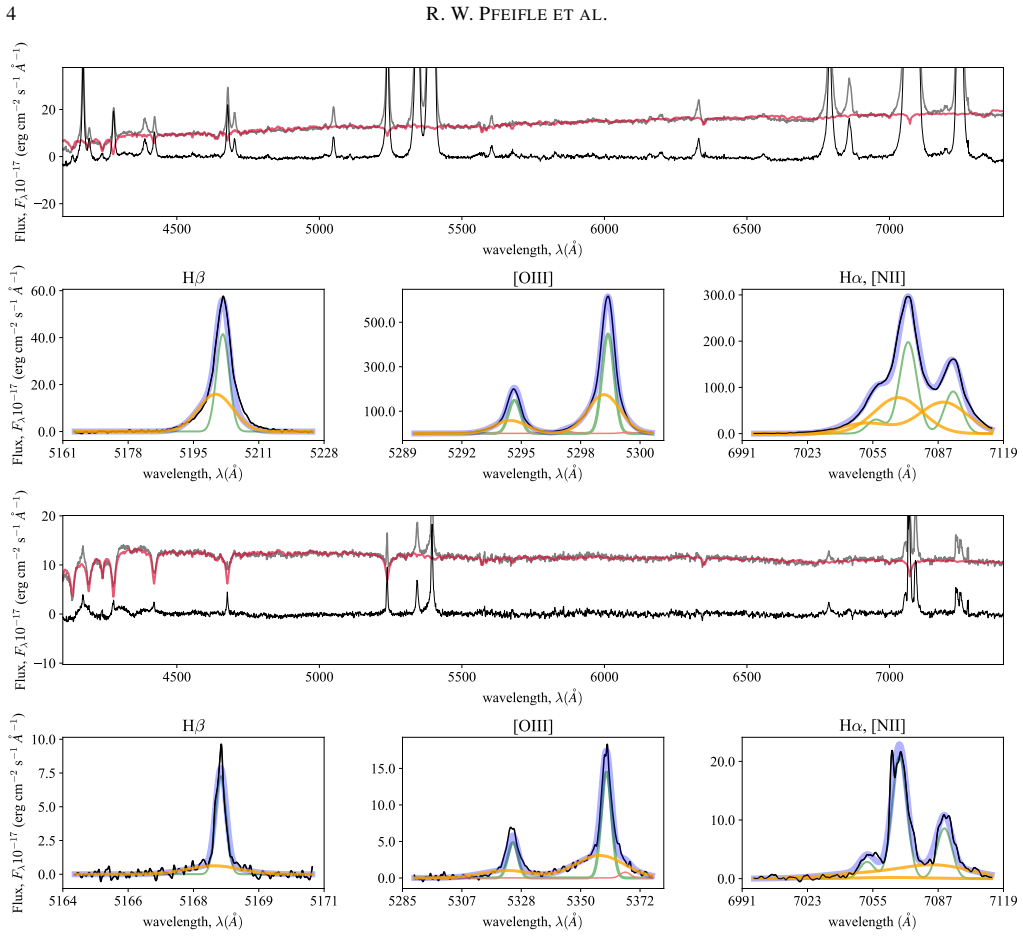
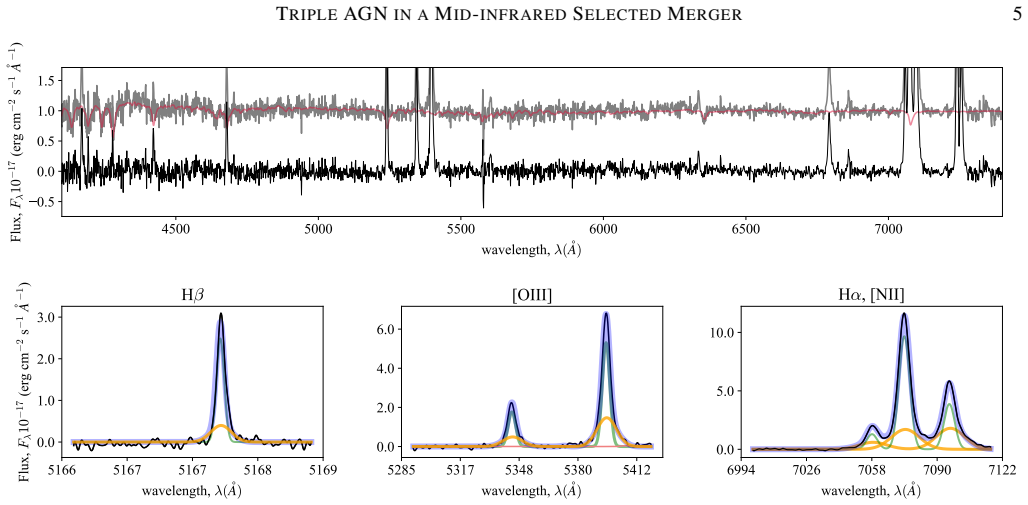
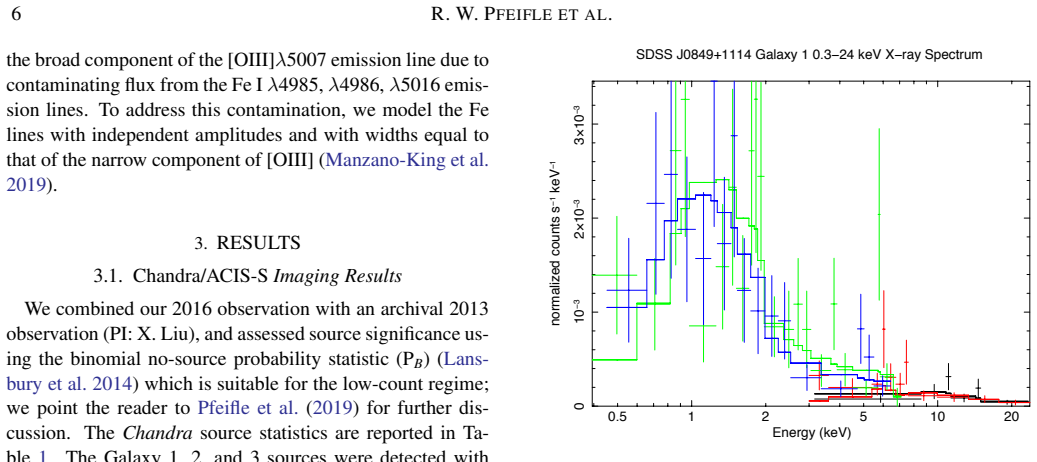
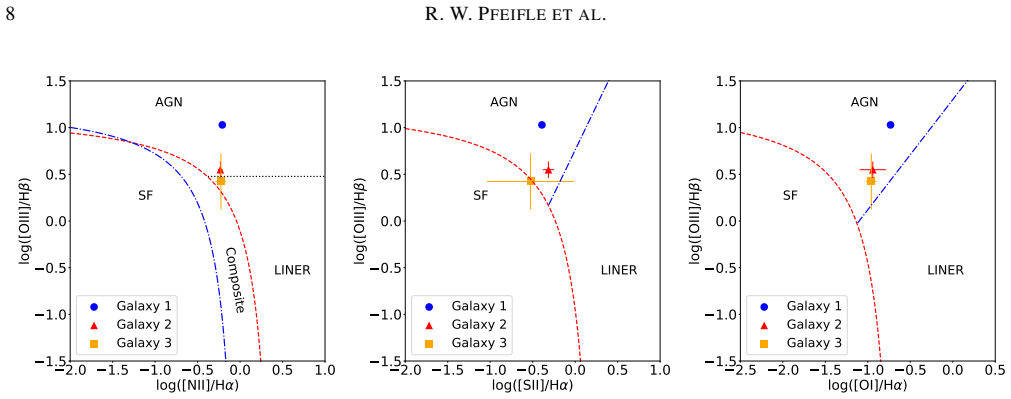
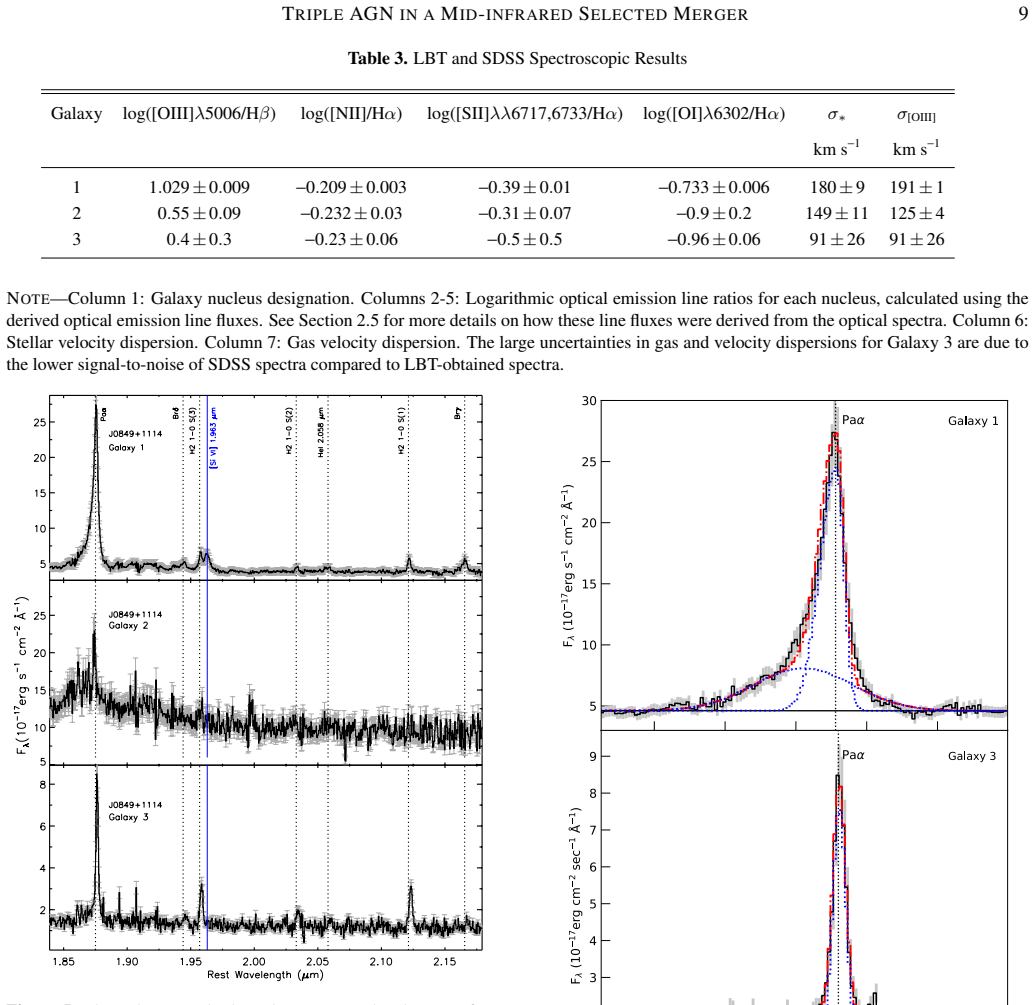
The carrying object is the triple merger itself, with three nuclei resolved in archival space-based imaging at projected separations of $2.3''$, $3.6''$, and $5.0''$ (3.4, 5.3, and 7.3 kpc). The argument is built from a multi-wavelength diagnostic chain: (1) X-ray imaging that detects point sources at all three nuclei, with the significance of the two faintest detections assessed through a binomial no-source probability appropriate for low counts; (2) Baldwin-Phillips-Terlevich (BPT) optical line-ratio diagrams, which separate AGN photoionization from star-forming and shock-dominated regions; (3) near-infrared spectroscopy that finds a high-ionization coronal line ([Si VI]) in Galaxy 1 and broad Pa$\alpha$ emission in Galaxies 1 and 3, direct tracers of an active nucleus; and (4) joint soft-plus-hard X-ray spectral fitting with a torus reprocessing model, which measures the absorbing column and intrinsic luminosity. Each link rules out a specific alternative, and the paper’s conclusion depends on the whole chain holding together.
What would settle it
Take a deep X-ray spectrum of each of the two faint nuclei, accumulating enough counts to distinguish an absorbed power law with an Fe Kα line from a thermal or high-mass X-ray-binary spectrum; if either nucleus lacks a compact power-law component, or if very long baseline radio imaging resolves fewer than three compact cores at the nuclei, the triple-AGN interpretation would be falsified.
Extended reading notes
Core claim
On the paper’s own terms, SDSS J0849+1114 is a triple AGN: three spatially resolved nuclei, with mutual separations of 3.4, 5.3, and 7.3 kpc, each harbor an X-ray source in the 2–10 keV band with luminosity above what the measured star formation rate can supply (Galaxy 1: $2.4\times10^{41}$ erg s$^{-1}$; Galaxies 2 and 3: $\sim1$–$2\times10^{40}$ erg s$^{-1}$ after only Galactic absorption corrections). Optical spectra of all three nuclei fall in the AGN region of BPT diagnostic diagrams; the near-infrared spectrum of Galaxy 1 shows a high-ionization [Si VI] coronal line, and broad Pa$\alpha$ components (FWHM $>2400$ km s$^{-1}$) appear in Galaxies 1 and 3. Simultaneous fitting of soft and hard X-ray spectra of the brightest nucleus yields a line-of-sight column density $\log N_{\rm H} \approx 23.9$ cm$^{-2}$ and an unabsorbed 2–10 keV luminosity of $\sim4.6\times10^{42}$ erg s$^{-1}$, consistent with a heavily obscured AGN. The paper therefore concludes that explanations requiring fewer than three AGNs, or purely stellar or shock emission, are ruled out.
Load-bearing premise
The load-bearing premise is that the two faintest X-ray sources—Galaxy 2 at 3.5 sigma with 15 counts and Galaxy 3 at 2.9 sigma with 13 counts—are genuine accreting supermassive black holes rather than X-ray binaries, ultraluminous X-ray sources, or background fluctuations, and their AGN classification via BPT line ratios is not backed by coronal or broad-line confirmation.
Editorial extensions
If this is right
- If the triple-AGN interpretation is correct, the system represents the first observed case of three simultaneously accreting supermassive black holes in an advanced merger with separations under 10 kpc, placing it one merger stage before a gravitationally bound triple SMBH system.
- A bound triple SMBH phase can shorten the binary inspiral that otherwise stalls at parsec scales, so this system is a direct empirical precedent for a dynamical route around the “final parsec problem” and for enhanced low-frequency gravitational-wave emission.
- The fact that the system was found through mid-infrared color selection rather than optical selection suggests that many dual and triple AGNs in obscured, late-stage mergers are being missed by optical surveys.
- The measured high column density toward the brightest nucleus, with an intrinsic 2–10 keV luminosity around $4.6\times10^{42}$ erg s$^{-1}$, supports the picture that late-stage mergers contain heavily absorbed AGNs that dominate the accreting population.
Reading between the lines
- Extension: a deeper X-ray observation of Galaxies 2 and 3, if it showed their spectra to be dominated by thermal or high-mass X-ray binary emission rather than absorbed power laws, would demote the system to a dual AGN; this is a testable risk rather than a contradiction of the paper.
- Extension: if triple AGNs occur at the rate implied by one case in a small mid-infrared-selected sample, the fraction of SMBH binaries that interact with a third black hole before coalescence could be higher than the roughly 16 percent quoted from cosmological simulations, with correspondingly higher gravitational-wave event rates.
- Extension: applying the same mid-infrared preselection plus high-resolution X-ray and near-infrared follow-up to larger samples of triple-merger candidates should reveal whether this system is a freak or the tip of a population.
- Extension: very long baseline radio imaging that resolves compact radio cores at all three nuclei would provide an independent, absorption-free test of the triple-AGN scenario and could measure the three-dimensional velocity differences that determine whether the black holes are already dynamically interacting.
Signed reviews
Editorial analysis
A structured set of objections, weighed in public.
Referee Report
Summary. The paper reports multiwavelength follow-up of SDSS J0849+1114, a z=0.077 late-stage galaxy merger preselected by WISE colors. Using combined 2013+2016 Chandra imaging, NuSTAR spectroscopy, LBT near-IR/optical spectra, and archival SDSS data, it identifies three nuclear X-ray sources coincident with three optical nuclei. Galaxy 1 is a strong X-ray source (13.8σ, 196 counts) with a hard X-ray spectrum fitted with the BORUS model (log NH = 23.9), a [SiVI] coronal line, and broad Paα; Galaxies 2 and 3 are weak X-ray sources (3.5σ/15 counts and 2.9σ/13 counts) with BPT ratios classified as AGN-like, and Galaxy 3 shows broad Paα. The authors conclude that this is a compelling triple AGN and claim to rule out star formation, shocks, and emission from fewer than three AGNs. They then discuss implications for triple SMBH evolution and the final parsec problem.
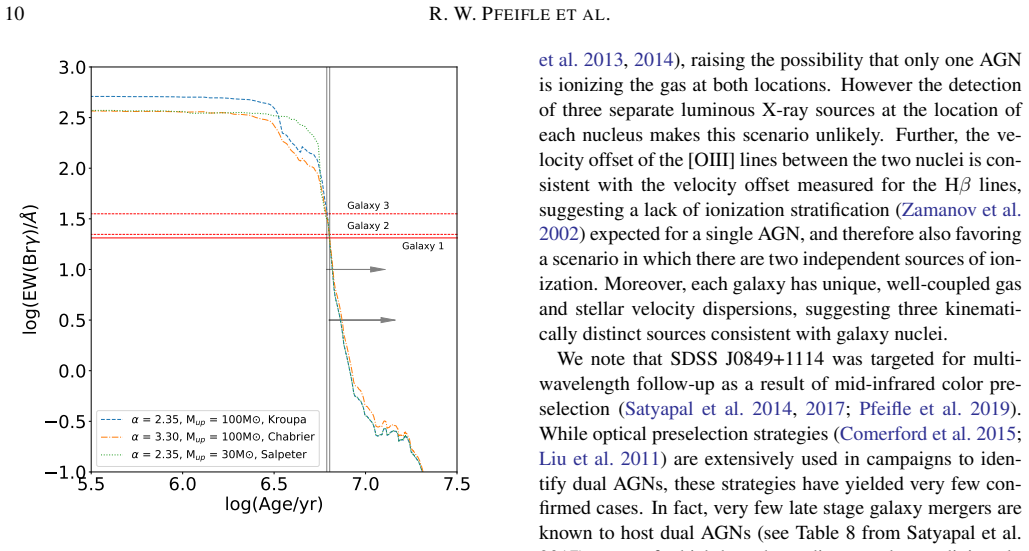
Significance. If confirmed, this would be one of the first robust triple AGNs in a late-stage merger with nuclear separations below 10 kpc, directly relevant to hierarchical black hole growth, triple-SMBH dynamics, and the final parsec problem. The characterization of Galaxy 1 is convincing, and the paper's multiwavelength approach—X-ray spectral fitting with an external torus model, stellar-population subtraction with pPXF, BPT diagnostics, and Starburst99 age constraints—uses standard, non-circular diagnostics. The central claim is weakened, however, by the marginal nature of the Galaxy 2 and 3 X-ray detections and by the large uncertainties in their BPT classifications. As presented, the system is best regarded as a strong triple-AGN candidate rather than a confirmed triple AGN.
major comments (4)
- [§4 / Abstract / Conclusion] The statement that the data rule out emission from fewer than three AGNs is stronger than the reported evidence supports. In Table 1, Galaxies 2 and 3 have only 15 and 13 net counts with formal significances of 3.5σ and 2.9σ, and their hardness ratios (−0.76 and −0.84) correspond to just 2 and 1 hard-band counts, respectively. Such soft, few-count sources are not uniquely identified as AGNs; luminous X-ray binaries, ULXs, or unrelated background sources remain viable alternatives. The paper's own caveats—no [SiVI] in Galaxies 2/3 and no near-IR decomposition for Galaxy 2—leave the classification of these two nuclei resting largely on low-S/N BPT diagnostics. Please provide a quantitative assessment of the false-source/background probability and of the X-ray binary luminosity function, or explicitly reclassify the system as a strong triple-AGN candidate and remove the 'rule out fewer than three' claim.
- [§3.1, Table 1] The quoted 2–10 keV luminosities for Galaxies 2 and 3 are derived assuming Γ = 1.9 and only Galactic absorption along the line of sight. For sources with 13–15 counts, the photon index and intrinsic column density are unconstrained, so the claimed luminosity excess over star formation used in §4 is not a robust discriminator. Please present the range of luminosities allowed by plausible spectral slopes and intrinsic columns, or state explicitly that the quoted values are order-of-magnitude estimates.
- [§3.3, Table 3, Figure 4] The AGN classification of Galaxy 3 is not secure. Its BPT ratios have large uncertainties (log([OIII]/Hβ) = 0.4 ± 0.3; log([SII]/Hα) = −0.5 ± 0.5), so the plotted position in the AGN region and the statement that all three nuclei display AGN-like line ratios are overstated. Please show error bars in Figure 4 and quantify the probability that each nucleus falls within the AGN, LINER, or star-forming regions given the line-ratio uncertainties.
- [§4, shock discussion] The exclusion of shock-driven emission for all three nuclei is too strong given the uncertainties on [SII]/Hα and [OI]/Hα for Galaxies 2 and 3. For Galaxy 3 in particular, the large errors allow a LINER- or shock-contaminated classification from the optical data alone, and the presence of soft X-ray point sources does not resolve the ambiguity because those point sources are themselves not firmly established as AGNs.
minor comments (4)
- [§3.3 / Figure 5 caption] The [SiVI] detection in Galaxy 1 is quoted as σ = 2.3, which is near the conventional detection threshold; describing it in the text as 'robust confirmation' is misleading. Please qualify the significance, even though the AGN in Galaxy 1 is independently supported by the X-ray spectrum and broad Paα.
- [Appendix] The Appendix refers to Section 2.6.1 for the pPXF fitting procedure, but the procedure is actually described in Section 2.5; please correct the cross-reference.
- [Table 2] The text refers to a '3–24 keV' band while the table lists count columns in '3–8 keV' and '8–24 keV'; please make the band definitions consistent across the text and table.
- [§2.2] The paper notes that Galaxies 2 and 3 could contribute appreciably to the NuSTAR flux. Please clarify how the conclusion that only Galaxy 1 contributes appreciably was quantified, since the simulated fluxes depend on the assumed grid of Γ and NH values.
Circularity Check
No significant circularity: the triple-AGN claim is an observational classification supported by new multiwavelength data and external diagnostics, not by a fitted parameter or self-citation chain.
full rationale
The paper's central claim is that SDSS J0849+1114 hosts three active nuclei. Each supporting diagnostic is anchored to external, independently established frameworks rather than derived from the paper's own fitted parameters. The Chandra source significances use the binomial no-source statistic of Lansbury et al. (2014); the optical AGN classifications use standard BPT demarcations from Kewley et al. (2001), Kauffmann et al. (2003), and Ho et al. (1997); the X-ray spectral fitting uses the externally published BORUS reprocessing model of Balokovic et al. (2018); the starburst-age and X-ray binary luminosity comparisons use Starburst99 models and published XRB scaling relations. The authors' prior WISE color preselection and earlier Pfeifle et al. (2019) detection of three X-ray sources are cited as the route by which the target was identified, but the triple-AGN conclusion does not reduce to that preselection: it is carried by new NuSTAR data, combined Chandra data, new LBT optical and near-IR spectroscopy, and archival SDSS spectra interpreted with external diagnostic diagrams. The X-ray excess over star formation is a comparison between independently measured Pa-alpha-derived star formation limits and Chandra luminosities, not a fit that is then relabeled as a prediction. No equation in the paper defines the conclusion in terms of its own inputs, no fitted parameter is renamed as a prediction, and no load-bearing uniqueness theorem is imported from the authors' prior work. The marginal significance of the Galaxy 2 and 3 X-ray detections is a legitimate scientific concern about the strength of the evidence, but it is a question of data quality and statistical robustness, not circularity. Accordingly, the paper is self-contained against external benchmarks and receives a circularity score of 0.
Assumptions & free parameters
free parameters (1)
- Photon index Gamma (assumed for luminosity estimates) =
1.9
assumptions (5)
- domain assumption BPT line-ratio diagrams separate AGN from star-forming regions and shocks for all three nuclei using standard demarcation lines (Kewley et al. 2001; Kauffmann et al. 2003; Kewley et al. 2006).
- domain assumption The BORUS torus reprocessing model correctly characterizes the X-ray continuum and absorption of heavily obscured AGN.
- domain assumption X-ray emission from high-mass X-ray binaries in star-forming regions can be estimated from star formation rate via the scaling relation used in Satyapal et al. 2017 and Pfeifle et al. 2019.
- domain assumption Starburst99 model predictions of Br gamma equivalent width as a function of stellar population age apply to the nuclear stellar populations of these late-stage merger remnants.
- domain assumption The three optical and near-infrared nuclei are physically associated and at a common distance given by z = 0.077, rather than a chance line-of-sight projection.
Cite this review
Pith. "Pith review of A Triple AGN in a Mid-Infrared Selected Late Stage Galaxy Merger." pith.science (2026). https://pith.science/paper/DTYTRQ3D
@misc{pith2026190801732,
  author       = {Pith},
  title        = {Pith review of: A Triple AGN in a Mid-Infrared Selected Late Stage Galaxy Merger},
  year         = {2026},
  howpublished = {\url{https://pith.science/paper/DTYTRQ3D}},
  note         = {Machine review of arXiv:1908.01732}
}
abstract
The co-evolution of galaxies and the supermassive black holes (SMBHs) at their centers via hierarchical galaxy mergers is a key prediction of $\Lambda$CDM cosmology. As gas and dust are funneled to the SMBHs during the merger, the SMBHs light up as active galactic nuclei (AGNs). In some cases, a merger of two galaxies can encounter a third galaxy, leading to a triple merger, which would manifest as a triple AGN if all three SMBHs are simultaneously accreting. Using high-spatial resolution X-ray, near-IR, and optical spectroscopic diagnostics, we report here a compelling case of an AGN triplet with mutual separations < 10 kpc in the advanced merger SDSS J084905.51+111447.2 at z = 0.077. The system exhibits three nuclear X-ray sources, optical spectroscopic line ratios consistent with AGN in each nucleus, a high excitation near-IR coronal line in one nucleus, and broad Pa$\alpha$ detections in two nuclei. Hard X-ray spectral fitting reveals a high column density along the line of sight, consistent with the picture of late-stage mergers hosting heavily absorbed AGNs. Our multiwavelength diagnostics support a triple AGN scenario, and we rule out alternative explanations such as star formation activity, shock-driven emission, and emission from fewer than three AGN. The dynamics of gravitationally bound triple SMBH systems can dramatically reduce binary SMBH inspiral timescales, providing a possible means to surmount the "Final Parsec Problem." AGN triplets in advanced mergers are the only observational forerunner to bound triple SMBH systems and thus offer a glimpse of the accretion activity and environments of the AGNs prior to the gravitationally-bound triple phase.
Figures

Figures from the paper (4 more)
Forward citations
Cited by 2 Pith papers
-
Cosmic Pairs: A DESI Census of Dual and Offset AGN as Precursors to Massive Black Hole Binaries
DESI DR1 spectroscopy yields >7,000 candidate dual-AGN pairs, expanding the known kpc-scale census by ~4x and linking host-galaxy demographics to LISA-detectable massive black hole mergers.
-
XMM-Newton and Swift Unveil Another X-Ray Transient in NGC 4945, XMM J130514.64-493311.27
A previously undetected X-ray transient, XMM J130514.64-493311.27, was discovered in NGC 4945 with properties consistent with an X-ray binary caught in outburst.
Reference graph
Works this paper leans on
-
[1]
Kewley, L. J. 2008, The Astrophysical Journal Supplement Series, 178, 20
2008
-
[2]
2017, arXiv e-prints, arXiv:1702.00786 [astro-ph.IM]
Amaro-Seoane, P., Audley, H., Babak, S., et al. 2017, arXiv e-prints, arXiv:1702.00786 [astro-ph.IM]
arXiv 2017
-
[3]
Arnaud, K. A. 1996, in Astronomical Society of the Pacific Conference Series, V ol. 101, Astronomical Data Analysis Software and Systems V , ed. G. H. Jacoby & J. Barnes, 17 Balokovi´c, M., Brightman, M., Harrison, F. A., et al. 2018, ApJ, 854, 42
work page 1996
-
[4]
E., & Hernquist, L
Barnes, J. E., & Hernquist, L. 1992, ARA&A, 30, 705
1992
-
[5]
2006, New Astronomy Reviews, 50, 708
Bennert, N., Jungwiert, B., Komossa, S., Haas, M., & Chini, R. 2006, New Astronomy Reviews, 50, 708
work page 2006
-
[6]
F., Satyapal, S., & Ellison, S
Blecha, L., Snyder, G. F., Satyapal, S., & Ellison, S. L. 2018, ArXiv e-prints, arXiv:1711.02094
arXiv 2018
-
[7]
Bonetti, M., Perego, A., Capelo, P. R., Dotti, M., & Miller, M. C. 2018, PASA, 35, e017
work page 2018
-
[8]
Bonetti, M., Sesana, A., Haardt, F., Barausse, E., & Colpi, M. 2019, MNRAS, 877
work page 2019
Show all 73 references
-
[9]
2011, MNRAS, 413, 1206
Brightman, M., & Nandra, K. 2011, MNRAS, 413, 1206
2011
-
[10]
2017, MNRAS, 466, 798
Cappellari, M. 2017, MNRAS, 466, 798
2017
-
[11]
2005, ApJ, 621, 725
Colina, L., Arribas, S., & Monreal-Ibero, A. 2005, ApJ, 621, 725
2005
-
[12]
M., Pooley, D., Barrows, R
Comerford, J. M., Pooley, D., Barrows, R. S., et al. 2015, ApJ, 806, 219
2015
-
[13]
P., Paragi, Z., Jarvis, M
Deane, R. P., Paragi, Z., Jarvis, M. J., et al. 2014, Nature, 511, 57
2014
-
[14]
G., Courbin, F., Meylan, G., et al
Djorgovski, S. G., Courbin, F., Meylan, G., et al. 2007, ApJ, 662, L1
2007
-
[15]
L., Kartaltepe, J., Kocevski, D., et al
Donley, J. L., Kartaltepe, J., Kocevski, D., et al. 2018, ApJ, 853, 63
2018
-
[16]
A., & Sutherland, R
Dopita, M. A., & Sutherland, R. S. 1995, ApJ, 455, 468
1995
-
[17]
L., Secrest, N
Ellison, S. L., Secrest, N. J., Mendel, J. T., Satyapal, S., & Simard, L. 2017, MNRAS, 470, L49
2017
-
[18]
L., Viswanathan, A., Patton, D
Ellison, S. L., Viswanathan, A., Patton, D. R., et al. 2019, MNRAS, 487, 2491
2019
-
[19]
P., Montuori, C., Decarli, R., & Fumagalli, M
Farina, E. P., Montuori, C., Decarli, R., & Fumagalli, M. 2013, MNRAS, 431, 1019
2013
-
[20]
W., Lang, D., & Goodman, J
Foreman-Mackey, D., Hogg, D. W., Lang, D., & Goodman, J. 2013, PASP, 125, 306
2013
-
[21]
D., Greene, J
Goulding, A. D., Greene, J. E., Bezanson, R., et al. 2018, PASJ, 70, S37
2018
-
[22]
C., Greene, J
Hainline, K., Hickox, R. C., Greene, J. E., et al. 2014, in American Astronomical Society Meeting Abstracts, V ol. 223, American Astronomical Society Meeting Abstracts #223, 126.04
2014
-
[23]
Zakamska, N. L. 2013, ApJ, 774, 145
2013
-
[24]
M., Miley, G
Heckman, T. M., Miley, G. K., van Breugel, W. J. M., & Butcher, H. R. 1981, ApJ, 247, 403
1981
-
[25]
E., & van Gorkom, J
Hibbard, J. E., & van Gorkom, J. H. 1996, AJ, 111, 655
1996
-
[26]
C., Filippenko, A
Ho, L. C., Filippenko, A. V ., & Sargent, W. L. W. 1997, The Astrophysical Journal Supplement Series, 112, 315
1997
-
[27]
2007, MNRAS, 377, 957
Hoffman, L., & Loeb, A. 2007, MNRAS, 377, 957
2007
-
[28]
F., Cox, T
Hopkins, P. F., Cox, T. J., Kereš, D., & Hernquist, L. 2008, ApJS, 175, 390
2008
-
[29]
2017, ApJ, 851, L15
Kalfountzou, E., Santos Lleo, M., & Trichas, M. 2017, ApJ, 851, L15
2017
-
[30]
M., Tremonti, C., et al
Kauffmann, G., Heckman, T. M., Tremonti, C., et al. 2003, MNRAS, 346, 1055
2003
-
[31]
Z., Blecha, L., Hernquist, L., Sesana, A., & Taylor, S
Kelley, L. Z., Blecha, L., Hernquist, L., Sesana, A., & Taylor, S. R. 2017, MNRAS, 471, 4508
2017
-
[32]
2001, ApJ, 556, 121
Trevena, J. 2001, ApJ, 556, 121
2001
-
[33]
J., Groves, B., Kauffmann, G., & Heckman, T
Kewley, L. J., Groves, B., Kauffmann, G., & Heckman, T. 2006, MNRAS, 372, 961
2006
-
[34]
D., Brightman, M., Nandra, K., et al
Kocevski, D. D., Brightman, M., Nandra, K., et al. 2015, ApJ, 814, 104
2015
-
[35]
2012, ApJL, 746, L22
Koss, M., Mushotzky, R., Treister, E., et al. 2012, ApJL, 746, L22
2012
-
[36]
J., Blecha, L., Bernhard, P., et al
Koss, M. J., Blecha, L., Bernhard, P., et al. 2018, Nature, 563, 214
2018
-
[37]
B., Alexander, D
Lansbury, G. B., Alexander, D. M., Del Moro, A., et al. 2014, ApJ, 785, 17
2014
-
[38]
2018, MNRAS, 480, 2578
Lanzuisi, G., Civano, F., Marchesi, S., et al. 2018, MNRAS, 480, 2578
2018
-
[39]
2014, The Astrophysical Journal Supplement Series, 212, 14
Leitherer, C., Ekström, S., Meynet, G., et al. 2014, The Astrophysical Journal Supplement Series, 212, 14
2014
-
[40]
D., et al
Leitherer, C., Schaerer, D., Goldader, J. D., et al. 1999, ApJS, 123, 3
1999
-
[41]
A., & Hao, L
Liu, X., Shen, Y ., Strauss, M. A., & Hao, L. 2011, The Astrophysical Journal, 737, 101
2011
-
[42]
2019, arXiv e-prints, arXiv:1905.09287
Manzano-King, C., Canalizo, G., & Sales, L. 2019, arXiv e-prints, arXiv:1905.09287
2019 arXiv
-
[43]
2018, ApJ, 854, 49
Marchesi, S., Ajello, M., Marcotulli, L., et al. 2018, ApJ, 854, 49
2018
-
[44]
C., & Hernquist, L
Mihos, J. C., & Hernquist, L. 1996, ApJ, 464, 641
1996
-
[45]
Mingarelli, C. M. F., Lazio, T. J. W., Sesana, A., et al. 2017, Nature Astronomy, 1, 886
2017
-
[46]
H., & Whittle, M
Nelson, C. H., & Whittle, M. 1996, ApJ, 465, 96 Pfeifle, R. W., Satyapal, S., Secrest, N. J., et al. 2019, ApJ, 875, 117
1996
-
[47]
E., Treister, E., et al
Ricci, C., Bauer, F. E., Treister, E., et al. 2016, ApJ, 819, 4 —. 2017, MNRAS, 468, 1273
2016
-
[48]
A., Kewley, L
Rich, J. A., Kewley, L. J., & Dopita, M. A. 2011, ApJ, 734, 87
2011
-
[49]
2012, APLpy: Astronomical Plotting Library in Python, Astrophysics Source Code Library, ascl:1208.017 Rodríguez Zaurín, J., Tadhunter, C
Robitaille, T., & Bressert, E. 2012, APLpy: Astronomical Plotting Library in Python, Astrophysics Source Code Library, ascl:1208.017 Rodríguez Zaurín, J., Tadhunter, C. N., Rose, M., & Holt, J. 2013, MNRAS, 432, 138
2012
-
[50]
Rothberg, B., & Joseph, R. D. 2004, AJ, 128, 2098
2004
-
[51]
P., & Stone, N
Ryu, T., Perna, R., Haiman, Z., Ostriker, J. P., & Stone, N. C. 2018, MNRAS, 473, 3410 TRIPLE AGN IN A MID-INFRARED SELECTED MERGER 15
2018
-
[52]
L., McAlpine, W., et al
Satyapal, S., Ellison, S. L., McAlpine, W., et al. 2014, MNRAS, 441, 1297
2014
-
[53]
J., Ricci, C., et al
Satyapal, S., Secrest, N. J., Ricci, C., et al. 2017, ApJ, 848, 126
2017
-
[54]
2012, MNRAS, 425, L61
Glikman, E. 2012, MNRAS, 425, L61
2012
-
[55]
1982, ApJ, 252, 455 —
Schweizer, F. 1982, ApJ, 252, 455 —. 1996, AJ, 111, 109
1982
-
[56]
J., Satyapal, S., Gliozzi, M., et al
Secrest, N. J., Satyapal, S., Gliozzi, M., et al. 2015, ApJ, 798, 38
2015
-
[57]
2004, ApJ, 611, 623
Sesana, A., Haardt, F., Madau, P., & V olonteri, M. 2004, ApJ, 611, 623
2004
-
[58]
J., Benford, D
Stern, D., Assef, R. J., Benford, D. J., et al. 2012, ApJ, 753, 30
2012
-
[59]
R., & Canalizo, G
Stickley, N. R., & Canalizo, G. 2014, ApJ, 786, 12
2014
-
[60]
Scott, A. E. 2012, MNRAS, 423, 1154
2012
-
[61]
Taylor, M. B. 2005, in Astronomical Society of the Pacific Conference Series, V ol. 347, Astronomical Data Analysis Software and Systems XIV , ed. P. Shopbell, M. Britton, & R. Ebert, 29 The Astropy Collaboration, Price-Whelan, A. M., Sip˝ocz, B. M., et al. 2018, ArXiv e-prints...
2005 arXiv
-
[62]
1972, ApJ, 178, 623
Toomre, A., & Toomre, J. 1972, ApJ, 178, 623
1972
-
[63]
D., Cushing, M
Vacca, W. D., Cushing, M. C., & Rayner, J. T. 2003, Publications of the Astronomical Society of the Pacific, 115, 389
2003
-
[64]
A., Singh, H
Valdes, F., Gupta, R., Rose, J. A., Singh, H. P., & Bell, D. J. 2004, The Astrophysical Journal Supplement Series, 152, 251
2004
-
[65]
Veilleux, S., Cecil, G., Bland-Hawthorn, J., & Shopbell, P. L. 2002, in Revista Mexicana de Astronomia y Astrofisica Conference
2002
-
[66]
Verbiest, J. P. W., Lentati, L., Hobbs, G., et al. 2016, MNRAS, 458, 1267 Véron-Cetty, M. P., Joly, M., & Véron, P. 2004, A&A, 417, 515 von der Linden, A., Wild, V ., Kauffmann, G., White, S. D. M., &
2016
-
[67]
2010, MNRAS, 404, 1231
Weinmann, S. 2010, MNRAS, 404, 1231
2010
-
[68]
E., McIntosh, D
Weston, M. E., McIntosh, D. H., Brodwin, M., et al. 2017, MNRAS, 464, 3882
2017
-
[69]
2016, ApJ, 817, 108
Woo, J.-H., Bae, H.-J., Son, D., & Karouzos, M. 2016, ApJ, 817, 108
2016
-
[70]
Wright, E. L. 2006, PASP, 118, 1711
2006
-
[71]
M., Walker, R
Wrobel, J. M., Walker, R. C., & Fu, H. 2014, ApJ, 792, L8
2014
-
[72]
Wyithe, J. S. B., & Loeb, A. 2003, ApJ, 590, 691
2003
-
[73]
W., et al
Zamanov, R., Marziani, P., Sulentic, J. W., et al. 2002, ApJ, 576, L9
2002
Reviewed August 14, 2026 · model on record in the stance chip above.
Discussion (0). Continue with ORCID to comment.