REVIEW 3 major objections 4 minor 280 references
A single wide-area spectroscopic survey has produced the largest uniform census of galaxy pairs with two active supermassive black holes—7,125 dual AGN candidates out to redshift 3.6—and connects them to the mergers that LISA could detect.
Reviewed by Pith at T0; open to challenge. T0 means a machine referee read the full paper against a public rubric. the ladder, T0–T4 →
T0 review · deepseek-v4-flash
2026-08-01 08:14 UTC pith:3WFAESKP
load-bearing objection A large, carefully built dual-AGN candidate catalog that will be a reference for the field, but the demographic and LISA claims are shakier than the census itself. the 3 major comments →
Cosmic Pairs: A DESI Census of Dual and Offset AGN as Precursors to Massive Black Hole Binaries
The pith
A machine-rendered reading of the paper's core claim, the machinery that carries it, and where it could break.
Core claim
The central discovery is a catalog: 7,125 dual AGN candidates and 27,345 one-AGN pairs, selected from a uniformly processed spectroscopic dataset with projected separations below 50 kpc and line-of-sight velocity differences below 600 km/s (2000 km/s for high-redshift quasar pairs). AGN identification combines optical emission-line diagnostics (BPT, WHAN, MEx, KEx, He II, [Ne V]) with WISE mid-infrared colors, and pair statistics are corrected for fiber-assignment incompleteness using pairwise inverse-probability weighting. The catalog establishes that dual AGN are preferentially found at separations of 5-12 kpc, that the secondary hosts are ~0.3 dex above matched controls in star-formation
What carries the argument
The load-bearing machinery is the pair-catalog construction: a wide-field fiber-fed spectroscopic survey whose 1.6-arcsec fiber diameter sets the resolution floor; a pair selection cut of 50 kpc and 600 km/s; AGN classification from optical emission-line diagrams plus WISE mid-infrared colors; and pairwise inverse-probability weighting that corrects for fiber collisions and restores close-pair statistics. The second component is a large cosmological hydrodynamical simulation (ASTRID) matched to the survey's tracer selection, which is used to forward-model the observed duals, track their black holes to merger, and compute LISA signal-to-noise ratios.
Load-bearing premise
The entire sample stands on the assumption that objects separated by at least 1.6 arcseconds are truly two distinct galaxies with two genuinely active nuclei, not fragments of one galaxy or light from a single AGN leaking into a companion's spectrum.
What would settle it
Take a random subset of a few hundred candidates in the 1.6-2.0 arcsecond separation bin and image them with sub-arcsecond resolution; if most resolve into a single galaxy or a shredded source rather than two distinct nuclear regions, the census's close-pair counts and all demographic conclusions would be substantially revised. Likewise, if the dual-to-single AGN fraction does not decline with redshift after applying the simulation-based angular-resolution correction, the claimed separation trend would be falsified.
If this is right
- The known population of kpc-scale active black hole pairs grows from about 1,754 spatially resolved systems to 7,125 candidates, with the largest gains at 0.2<z<0.4 (~70x) and at z>2 (~3x).
- Dual AGN cluster at projected separations of 5-12 kpc, supporting merger-driven triggering of simultaneous black hole accretion.
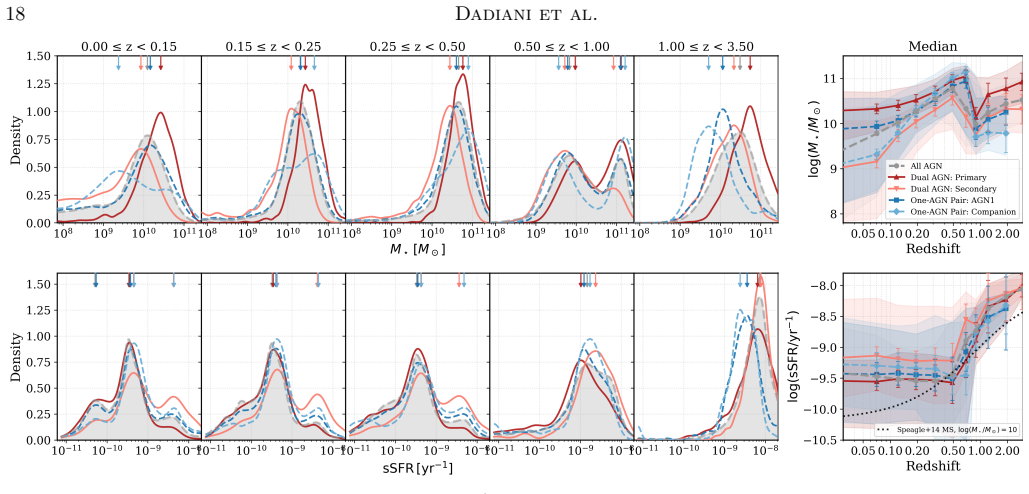
- The lower-mass member of a dual pair is ~0.3 dex above matched inactive and one-AGN companions in main-sequence offset, indicating a real but modest star-formation enhancement in the secondary.
- Simulation-matched predictions say the merger fraction of DESI duals rises with redshift to ~76% at z~2, while the LISA-detectable fraction peaks at ~37% near z~0.9; most of the integrated dual-merger rate comes from z<=0.3.
- The ~50 dwarf dual AGN candidates and 121 high-redshift (z>2) candidates open regimes where only a handful of systems were known before.
Where Pith is reading between the lines
- If the closest pairs (1.6-2.0 arcsec, where ~80% have FRACFLUX>0.5) turn out to be mostly blends or shredded galaxies, the true dual fraction could be lower; a sub-arcsecond imaging campaign on a few hundred such pairs would calibrate this contamination and could revise the headline sample size.
- Because the survey selection is uniform, the catalog can be used to design follow-up targeting: one testable prediction is that the dual fraction measured by high-resolution imaging will decline with redshift as the 1.6-arcsec floor excludes an increasing fraction of close physical pairs.
- The asymmetric star-formation response (secondary enhanced, primary flat) suggests that comparisons of resolved gas kinematics in paired galaxies will show the starburst concentrated in the lower-mass companion; spatially resolved IFU observations could confirm this.
- If the dwarf dual AGN candidates are confirmed with X-ray or radio follow-up, they would put the occupation fraction of central black holes in dwarf pairs on firmer ground and sharpen LISA event-rate estimates from low-mass hosts.
Editorial analysis
A structured set of objections, weighed in public.
Referee Report
Summary. The paper constructs a spectroscopic census of kpc-scale dual and offset AGN candidates from DESI DR1, combining galaxy/QSO pair selection (projected separation <50 kpc, velocity window <600 km/s, or <2000 km/s for high-redshift QSOs) with optical emission-line, broad-line, and WISE mid-infrared AGN diagnostics. It reports 7,125 dual AGN, 27,345 one-AGN pairs, and 50,866 inactive pairs over 0<z<3.6, claiming a factor ~4 increase over 1,754 spatially resolved literature systems and a factor ~70 increase at 0.2<z<0.4. The central demographic results are that dual AGN are preferentially found at small separations and that dual secondaries lie ~0.3 dex above matched inactive and one-AGN companions in main-sequence offset. Using an ASTRID-based mock matched to the DESI selection, the paper further predicts merger fractions and LISA-detectable merger fractions as a function of redshift.
Significance. If the demographic claims are robust, this would be an important advance: it provides the largest uniformly selected spectroscopic sample of dual/offset AGN, fills a previously sparse intermediate-redshift interval, and connects observed AGN pairs to predicted massive black hole mergers accessible to LISA. The paper is notable for its detailed attention to selection systematics: PIP+U(theta) fiber-assignment corrections, WISE-blending exclusion, visual shredding checks, explicit caveats on CIGALE SFRs, and a conservative high-purity subset defined by multiple independent AGN diagnostics. At the same time, the two headline demographic results—small-separation preference and the secondary Delta_MS excess—are exactly the quantities most sensitive to false close pairs, and the manuscript does not yet provide the quantitative contamination control needed to make those results load-bearing.
major comments (3)
- [§3.3, Figs. 5 and 9] Contamination from WISE blending and photometric shredding is acknowledged but not quantified, and it directly affects the two headline demographic results. The text states that WISE-only duals with Δθ<6″ are excluded, yet a pair with one optical AGN and one WISE-only companion at Δθ<6″ remains classified as dual; with ~25% of AGN classifications coming from WISE (Fig. 2), such mixed pairs may be a non-negligible source of false secondaries. Separately, §3.1 reports that ~5.2% of the sample at 1.6″–2.0″ has FRACFLUX>0.5 in all grz bands for at least one component. Both classes are preferentially close, so the 41%/32%/30% small-separation excess in Fig. 5 and the ~0.3 dex secondary ΔMS excess in Fig. 9 may be inflated by false pairs. I request a quantitative false-positive estimate or, at minimum, a demonstration that both trends persist in the conservative subset with multiple independen
- [§3.2, Fig. 5] Completeness corrections are applied only when comparing with theory, but the small-separation statistics underlying the main demographic claims are raw. The paper states that raw counts are used for descriptive statistics, and Fig. 5's normalized separation distributions and the 41% vs 32% vs 30% numbers are not PIP+U-weighted. Because fiber-assignment incompleteness is tracer- and separation-dependent (ELG close pairs ~35% complete, QSO ~88%), the relative shapes of dual, one-AGN, and inactive pair distributions can be biased. The central claim that dual AGN are preferentially found at small separations should be demonstrated with the same PIP+U weights used in Fig. 12, or the authors should justify that the bias cannot change the ordering.
- [§4.5.1, Fig. 12] The correction for the 1.6″ angular-separation floor is a model output, not a direct measurement. The gray shaded region multiplies the observed dual fraction by f_corr from ASTRID, reaching factors 4.7–5.6 at z~0.5–0.8. Since the companion ASTRID mock (Chen et al. 2025) is validated by matching the observed DESI dual fraction and separation distribution, using the same mock to correct those measurements for resolution incompleteness is partly circular and relies on sub-1.6″ pair statistics that have not been independently verified. The gray band should be labeled clearly as a model-dependent systematic, and the conclusion that the dual fraction declines with redshift should be based on the observed (cut) values as well. The LISA predictions in §4.5.2 inherit this dependence.
minor comments (4)
- [§4.1 vs §5] The one-AGN pair count is given as 27,345 in §4.1 and 27,347 in §5; reconcile.
- [Fig. 2] The KS/AD tests are quoted only through D_KS effect sizes; report p-values and sample sizes for all diagnostics, not only for He II.
- [Data availability] The manuscript does not state where the final dual/one-AGN/inactive catalogs will be released; specify a data-access statement.
- [§4.5.2] Clarify the denominator of the 'LISA-detectable fraction' (all duals vs mergers) to avoid confusion with Fig. 13's upper-left panel.
Circularity Check
Observational census is independent, but the LISA/merger predictions rest on a companion ASTRID mock by overlapping authors that is validated on the very DESI observables it is then used to interpret.
specific steps
-
self citation load bearing
[Section 1 (Introduction); used in Section 4.5.2]
"is used to construct a DESI-like mock dual AGN catalog by applying the same selection functions and observational constraints as used here (Chen et al. 2025). The mock sample reproduces the observed dual fraction, separation distribution, and host galaxy and AGN properties, validating ASTRID as a reliable forward-modeling tool for the observed population."
The LISA/merger predictions are not derived from DESI data in this paper; they are imported from Chen et al. (2025), a companion paper with overlapping authorship (Chen, Zhou, Dadiani, Di Matteo). The credibility of that mock is established here by stating that it reproduces the observed dual fraction, separation distribution, and host properties — i.e., it is calibrated/validated against the very DESI observables it is then used to interpret. The predicted 'fraction of DESI dual AGN whose central black holes will merge' is therefore a property of a simulation already matched to the input sample, not an independent first-principles prediction. This is a self-citation chain rather than an equation-level equivalence: the census itself is not circular, but the theoretical predictions reduce t
full rationale
The central observational census — 7,125 dual AGN and 27,345 one-AGN pairs from DESI DR1 — is built from public DESI spectroscopy, WISE photometry, and external value-added catalogs, and is benchmarked against literature compilations; that part is self-contained and not circular. The main circularity concern is confined to the theoretical forward-modeling section: the ASTRID-based merger/LISA predictions are justified by a companion paper (Chen et al. 2025) whose authors overlap substantially with the present work, and the mock is validated by reproducing the observed dual fraction and separation distribution before being used to predict merger fractions and LISA detectability. The predicted merger fraction is not literally equal to the fitted dual fraction, so this is not a pure fit-renamed-as-prediction, but the load-bearing support for the theoretical claims is a self-citation chain that uses the same DESI observables as its anchor. The paper also uses the same mock to correct the observed dual fraction for the 1.6 arcsecond angular-separation cut, further coupling the 'observed' corrected trend to the model. I therefore score 4: some self-citation, with the central observational claim still having independent content.
Axiom & Free-Parameter Ledger
free parameters (4)
- Projected separation limit Δr < 50 kpc =
50 kpc
- Line-of-sight velocity window Δv < 600 km/s (2000 km/s for QSOs at z>0.5) =
600 / 2000 km/s
- Minimum angular separation 1.6 arcsec =
1.6 arcsec
- LISA detection SNR threshold =
10
axioms (5)
- domain assumption DESI DR1 redshifts and Redrock/QSO classifications are accurate enough for pair selection, including the relaxed 2000 km/s window for high-z QSOs.
- domain assumption CIGALE SED fits provide unbiased stellar masses and SFRs for paired galaxies, including low-mass secondaries and AGN hosts.
- domain assumption ASTRID's Tremmel et al. (2017) dynamical-friction subgrid model correctly describes MBH sinking and merging in galaxy mergers.
- domain assumption The Speagle et al. (2014) star-forming main-sequence calibration is valid over the sample's mass/redshift range.
- ad hoc to paper The Chen et al. (2025) DESI-mock reproduces the DESI selection function and observed dual fraction.
read the original abstract
We present a systematic census of dual and offset active galactic nuclei (AGN) using spectroscopic data from the first data release (DR1) of the Dark Energy Spectroscopic Instrument (DESI). After correcting for observational systematics, our final sample contains $>7,000$ dual AGN and 27,000 galaxy pairs containing one AGN over the redshift range $0 \lesssim z \lesssim 3.6$. This sample expands the known dual AGN sample by $\sim 1-2$ orders of magnitude at $0.2 \lesssim z \lesssim 0.4$, includes $\sim 50$ dwarf dual AGN candidates in a regime where only a handful were previously known, and triples the census at $z>2$. Dual AGN are preferentially found at small separations, consistent with merger-driven triggering of AGN activity. The two members of a pair differ in their star formation response: the more massive (primary) host changes little with separation, while the less massive (secondary) lies $\sim 0.3$ dex above matched inactive and one-AGN companions at the same projected separation in main-sequence offset. Using ASTRID simulations, we predict that the fraction of DESI dual AGN whose central black holes will merge by $z \sim 0$ increases with redshift, reaching $\sim 76\%$ by $z \sim 2$, while the fraction producing LISA-detectable mergers peaks at $\sim 37\%$ near $z \sim 0.9$. These results provide the largest uniformly selected spectroscopic sample of kpc-scale dual and offset AGN candidates from a single survey, connecting their host-galaxy and AGN demographics to the progenitor population of massive black hole mergers detectable by LISA.
Figures




Reference graph
Works this paper leans on
-
[2]
Masses of quasars. , keywords =. doi:10.1093/mnras/200.1.115 , adsurl =
-
[3]
A Cosmological Framework for the Co-Evolution of Quasars, Supermassive Black Holes, and Elliptical Galaxies. I. Galaxy Mergers and Quasar Activity. , keywords =. doi:10.1086/524362 , archivePrefix =. 0706.1243 , primaryClass =
-
[4]
Dynamical Evolution of Cosmic Supermassive Binary Black Holes and Their Gravitational-wave Radiation. , keywords =. doi:10.3847/1538-4357/ab9594 , archivePrefix =. 2005.10818 , primaryClass =
Pith/arXiv arXiv 2005
-
[5]
A hidden population of high-redshift double quasars unveiled by astrometry. Nature Astronomy , keywords =. doi:10.1038/s41550-021-01323-1 , archivePrefix =. 2105.03298 , primaryClass =
-
[6]
Statistics of Galactic-scale Quasar Pairs at Cosmic Noon. , keywords =. doi:10.3847/1538-4357/aca662 , archivePrefix =. 2208.04979 , primaryClass =
-
[7]
A Catalog of 204 Offset and Dual Active Galactic Nuclei (AGNs): Increased AGN Activation in Major Mergers and Separations under 4 kpc. , keywords =. doi:10.3847/1538-4357/ac0bbf , archivePrefix =. 2011.10051 , primaryClass =
Pith/arXiv arXiv 2011
-
[8]
A Candidate Kiloparsec-scale Quasar Pair at z = 5.66. , keywords =. doi:10.3847/2041-8213/ac31a9 , archivePrefix =. 2110.12315 , primaryClass =
Pith/arXiv arXiv 2041
-
[9]
Optical Spectroscopy of Dual Quasar Candidates from the Subaru HSC-SSP program. , keywords =. doi:10.3847/1538-4357/ac1ff0 , archivePrefix =. 2105.10163 , primaryClass =
-
[10]
Origin and properties of dual and offset active galactic nuclei in a cosmological simulation at z=2. , keywords =. doi:10.1093/mnras/stw316 , archivePrefix =. 1510.08465 , primaryClass =
-
[12]
Formation of Galactic Nuclei. , keywords =. doi:10.1086/323830 , archivePrefix =. astro-ph/0103350 , primaryClass =
-
[13]
Long-Term Evolution of Massive Black Hole Binaries. , keywords =. doi:10.1086/378086 , archivePrefix =. astro-ph/0212459 , primaryClass =
-
[14]
Multiple supermassive black holes in galactic bulges. , keywords =. doi:10.1046/j.1365-8711.2002.06056.x , archivePrefix =. astro-ph/0208215 , primaryClass =
arXiv 2002
-
[15]
The Assembly and Merging History of Supermassive Black Holes in Hierarchical Models of Galaxy Formation. , keywords =. doi:10.1086/344675 , archivePrefix =. astro-ph/0207276 , primaryClass =
-
[16]
The Relation between Quasar and Merging Galaxy Luminosity Functions and the Merger-driven Star Formation History of the Universe. , keywords =. doi:10.1086/508503 , archivePrefix =. astro-ph/0602290 , primaryClass =
-
[17]
Coevolution (Or Not) of Supermassive Black Holes and Host Galaxies. , keywords =. doi:10.1146/annurev-astro-082708-101811 , archivePrefix =. 1304.7762 , primaryClass =
-
[18]
Dynamical Friction. I. General Considerations: the Coefficient of Dynamical Friction. , year = 1943, month = mar, volume =. doi:10.1086/144517 , adsurl =
doi:10.1086/144517 1943
-
[19]
A Systematic Search for Dual Active Galactic Nuclei in Merging Galaxies (ASTRO-DARING) II: First Results from Long-slit Spectroscopic Observations. , keywords =. doi:10.3847/1538-3881/ac2deb , archivePrefix =. 2111.00635 , primaryClass =
-
[20]
Merger-driven Fueling of Active Galactic Nuclei: Six Dual and Offset AGNs Discovered with Chandra and Hubble Space Telescope Observations. , keywords =. doi:10.1088/0004-637X/806/2/219 , archivePrefix =. 1504.01391 , primaryClass =
-
[21]
Rapid Formation of Supermassive Black Hole Binaries in Galaxy Mergers with Gas. Science , keywords =. doi:10.1126/science.1141858 , archivePrefix =. 0706.1562 , primaryClass =
-
[22]
Advances in Astronomy , keywords =
Massive Black Hole Binaries: Dynamical Evolution and Observational Signatures. Advances in Astronomy , keywords =. doi:10.1155/2012/940568 , archivePrefix =. 1111.0664 , primaryClass =
Pith/arXiv arXiv 2012
-
[24]
Hydrodynamics of galaxy mergers with supermassive black holes: is there a last parsec problem?. , keywords =. doi:10.1093/mnras/sts568 , archivePrefix =. 1110.6086 , primaryClass =
-
[27]
Swift Coalescence of Supermassive Black Holes in Cosmological Mergers of Massive Galaxies. , keywords =. doi:10.3847/0004-637X/828/2/73 , archivePrefix =. 1604.00015 , primaryClass =
-
[28]
Living Reviews in Relativity , keywords =
New horizons for fundamental physics with LISA. Living Reviews in Relativity , keywords =. doi:10.1007/s41114-022-00036-9 , archivePrefix =. 2205.01597 , primaryClass =
-
[29]
Living Reviews in Relativity , keywords =
Astrophysics with the Laser Interferometer Space Antenna. Living Reviews in Relativity , keywords =. doi:10.1007/s41114-022-00041-y , archivePrefix =. 2203.06016 , primaryClass =
-
[31]
Comparing recent PTA results on the nanohertz stochastic gravitational wave background. arXiv e-prints , keywords =. doi:10.48550/arXiv.2309.00693 , archivePrefix =. 2309.00693 , primaryClass =
-
[32]
The NANOGrav 12.5 yr Data Set: Search for an Isotropic Stochastic Gravitational-wave Background. , keywords =. doi:10.3847/2041-8213/abd401 , archivePrefix =. 2009.04496 , primaryClass =
Pith/arXiv arXiv 2041
-
[33]
Multimessenger Gravitational-wave Searches with Pulsar Timing Arrays: Application to 3C 66B Using the NANOGrav 11-year Data Set. , keywords =. doi:10.3847/1538-4357/ababa1 , archivePrefix =. 2005.07123 , primaryClass =
Pith/arXiv arXiv 2005
-
[34]
Constraining the Orbit of the Supermassive Black Hole Binary 0402+379. , keywords =. doi:10.3847/1538-4357/aa74e1 , archivePrefix =. 1705.08556 , primaryClass =
-
[36]
UGC 4211: A Confirmed Dual Active Galactic Nucleus in the Local Universe at 230 pc Nuclear Separation. , keywords =. doi:10.3847/2041-8213/aca8f0 , archivePrefix =. 2301.03609 , primaryClass =
Pith/arXiv arXiv 2041
-
[37]
Dynamics of interacting galaxies. , keywords =. doi:10.1146/annurev.aa.30.090192.003421 , adsurl =
-
[38]
Black Holes in Galaxy Mergers: The Formation of Red Elliptical Galaxies. , keywords =. doi:10.1086/428772 , archivePrefix =. astro-ph/0409436 , primaryClass =
-
[39]
A Merger-driven Scenario for Cosmological Disk Galaxy Formation. , keywords =. doi:10.1086/504412 , archivePrefix =. astro-ph/0503369 , primaryClass =
-
[40]
American Astronomical Society Meeting Abstracts \#223 , year = 2014, series =
Electromagnetic Counterparts to massive black hole mergers. American Astronomical Society Meeting Abstracts \#223 , year = 2014, series =
2014
-
[41]
Living Reviews in Relativity , keywords =
Electromagnetic counterparts to massive black-hole mergers. Living Reviews in Relativity , keywords =. doi:10.1007/s41114-022-00037-8 , archivePrefix =. 2109.03262 , primaryClass =
-
[42]
Multimessenger time-domain signatures of supermassive black hole binaries. , keywords =. doi:10.1093/mnras/stab3713 , archivePrefix =. 2110.14661 , primaryClass =
-
[43]
Mass Flow through Gaps in Circumbinary Disks. , keywords =. doi:10.1086/310200 , adsurl =
-
[44]
Observational Signatures of Supermassive Black Hole Binaries. arXiv e-prints , keywords =. doi:10.48550/arXiv.2310.16896 , archivePrefix =. 2310.16896 , primaryClass =
-
[45]
Relativistic boost as the cause of periodicity in a massive black-hole binary candidate. , keywords =. doi:10.1038/nature15262 , archivePrefix =. 1509.04301 , primaryClass =
-
[46]
A systematic search for close supermassive black hole binaries in the Catalina Real-time Transient Survey. , keywords =. doi:10.1093/mnras/stv1726 , archivePrefix =. 1507.07603 , primaryClass =
-
[47]
A possible close supermassive black-hole binary in a quasar with optical periodicity. , keywords =. doi:10.1038/nature14143 , archivePrefix =. 1501.01375 , primaryClass =
-
[48]
A population of short-period variable quasars from PTF as supermassive black hole binary candidates. , keywords =. doi:10.1093/mnras/stw1838 , archivePrefix =. 1604.01020 , primaryClass =
-
[49]
American Astronomical Society Meeting Abstracts \#231 , year = 2018, series =
Supermassive Black Hole Binary Candidates from the Pan-STARRS1 Medium Deep Survey. American Astronomical Society Meeting Abstracts \#231 , year = 2018, series =
2018
-
[50]
Candidate periodically variable quasars from the Dark Energy Survey and the Sloan Digital Sky Survey. , keywords =. doi:10.1093/mnras/staa2957 , archivePrefix =. 2008.12329 , primaryClass =
Pith/arXiv arXiv 2008
-
[51]
False periodicities in quasar time-domain surveys. , keywords =. doi:10.1093/mnras/stw1412 , archivePrefix =. 1606.02620 , primaryClass =
-
[52]
Searching for quasar candidates with periodic variations from the Zwicky Transient Facility: results and implications. , keywords =. doi:10.1093/mnras/stad3981 , archivePrefix =. 2206.11497 , primaryClass =
-
[53]
Spectral properties and evolution
The nature of massive black hole binary candidates - I. Spectral properties and evolution. , keywords =. doi:10.1093/mnras/stt831 , archivePrefix =. 1305.4941 , primaryClass =
-
[54]
Emergence of Double-peaked Emission Lines in the Broad-Line Radio Galaxy Pictor A. , keywords =. doi:10.1086/187537 , adsurl =
-
[55]
Journal of Physics: Conference Series , abstract =
D Ilić and L Č Popović , title =. Journal of Physics: Conference Series , abstract =. 2014 , month =. doi:10.1088/1742-6596/548/1/012002 , url =
-
[56]
Observable Signatures of a Black Hole Ejected by Gravitational-Radiation Recoil in a Galaxy Merger. , keywords =. doi:10.1103/PhysRevLett.99.041103 , archivePrefix =. astro-ph/0703722 , primaryClass =
-
[57]
Identifying Supermassive Black Hole Binaries with Broad Emission Line Diagnosis. , keywords =. doi:10.1088/0004-637X/725/1/249 , archivePrefix =. 0912.0541 , primaryClass =
-
[58]
Electromagnetic signatures from accreting massive black hole binaries in time domain photometric surveys. , keywords =. doi:10.1051/0004-6361/202449598 , archivePrefix =. 2402.05175 , primaryClass =
-
[59]
Emission lines as a tool in search for supermassive black hole binaries and recoiling black holes. , keywords =. doi:10.1016/j.newar.2009.09.005 , archivePrefix =. 0909.0516 , primaryClass =
Pith/arXiv arXiv 2009
-
[60]
The Peculiar Optical Spectrum of 4C+22.25: Imprint of a Massive Black Hole Binary?. , keywords =. doi:10.1088/2041-8205/720/1/L93 , archivePrefix =. 1007.3738 , primaryClass =
Pith/arXiv arXiv 2041
-
[61]
A Systematic Search for Massive Black Hole Binaries in the Sloan Digital Sky Survey Spectroscopic Sample. , keywords =. doi:10.1088/0004-637X/738/1/20 , archivePrefix =. 1106.1180 , primaryClass =
-
[62]
A Large Systematic Search for Close Supermassive Binary and Rapidly Recoiling Black Holes. , keywords =. doi:10.1088/0067-0049/201/2/23 , archivePrefix =. 1106.2952 , primaryClass =
-
[63]
Incidence of WISE -selected obscured AGNs in major mergers and interactions from the SDSS. , keywords =. doi:10.1093/mnras/stw2620 , archivePrefix =. 1609.04832 , primaryClass =
-
[64]
The power of infrared AGN selection in mergers: a theoretical study. , keywords =. doi:10.1093/mnras/sty1274 , archivePrefix =. 1711.02094 , primaryClass =
-
[65]
WISE J233237.05-505643.5: A Double-peaked, Broad-lined Active Galactic Nucleus with a Spiral-shaped Radio Morphology. , keywords =. doi:10.1088/0004-637X/779/1/41 , archivePrefix =. 1310.2257 , primaryClass =
-
[66]
SDSSJ092712.65+294344.0: a candidate massive black hole binary. , keywords =. doi:10.1111/j.1745-3933.2009.00714.x , archivePrefix =. 0809.3446 , primaryClass =
arXiv 2009
-
[67]
A candidate sub-parsec supermassive binary black hole system. , keywords =. doi:10.1038/nature07779 , archivePrefix =. 0901.3779 , primaryClass =
-
[68]
Constraining Sub-parsec Binary Supermassive Black Holes in Quasars with Multi-epoch Spectroscopy. II. The Population with Kinematically Offset Broad Balmer Emission Lines. , keywords =. doi:10.1088/0004-637X/789/2/140 , archivePrefix =. 1312.6694 , primaryClass =
-
[69]
Rejection of the Binary Broad-Line Region Interpretation of Double-peaked Emission Lines in Three Active Galactic Nuclei. , keywords =. doi:10.1086/304859 , archivePrefix =. astro-ph/9706222 , primaryClass =
-
[70]
Polarization of Line Emission from an Accretion Disk and Application to Arp 102B. , keywords =. doi:10.1086/304224 , adsurl =
-
[71]
A fast test for the identification and confirmation of massive black hole binaries. , keywords =. doi:10.1051/0004-6361/202346916 , archivePrefix =. 2310.06896 , primaryClass =
-
[72]
Optical follow-up of the tick-tock massive black hole binary candidate. , keywords =. doi:10.1093/mnras/stac3344 , archivePrefix =. 2205.06275 , primaryClass =
-
[73]
Spectroscopic Indication of a Centi-parsec Supermassive Black Hole Binary in the Galactic Center of NGC 5548. , keywords =. doi:10.3847/0004-637X/822/1/4 , archivePrefix =. 1602.05005 , primaryClass =
-
[74]
Variation of Broad Emission Lines from QSOs with Optical/UV Periodicity to Test the Interpretation of Supermassive Binary Black Holes. , keywords =. doi:10.3847/1538-4357/abe386 , archivePrefix =. 2103.16448 , primaryClass =
-
[75]
Differential Interferometric Signatures of Close Binaries of Supermassive Black Holes in Active Galactic Nuclei. , keywords =. doi:10.3847/1538-4357/ab2e00 , archivePrefix =. 1903.08067 , primaryClass =
Pith/arXiv arXiv 1903
-
[76]
Testing the relativistic Doppler boost hypothesis for supermassive binary black holes candidates via broad emission line profiles. , keywords =. doi:10.1093/mnras/stz3354 , archivePrefix =. 1912.00560 , primaryClass =
Pith/arXiv arXiv 1912
-
[77]
Broad-line region configuration of the supermassive binary black hole candidate PG1302-102 in the relativistic Doppler boosting scenario. , keywords =. doi:10.1051/0004-6361/202039300 , archivePrefix =. 2010.07512 , primaryClass =
Pith/arXiv arXiv 2010
-
[78]
Variations of light curves and broad emission lines for periodic QSOs from co-rotating supermassive binary black holes in elliptical orbits. , keywords =. doi:10.1051/0004-6361/202348303 , archivePrefix =. 2404.05975 , primaryClass =
-
[79]
A Spectroscopic Road Map for Cosmic Frontier: DESI, DESI-II, Stage-5. arXiv e-prints , keywords =. doi:10.48550/arXiv.2209.03585 , archivePrefix =. 2209.03585 , primaryClass =
-
[80]
Target Selection and Validation of DESI Quasars. , keywords =. doi:10.3847/1538-4357/acb3c2 , archivePrefix =. 2208.08511 , primaryClass =
-
[81]
Target Selection and Sample Characterization for the DESI LOW-Z Secondary Target Program. , keywords =. doi:10.3847/1538-4357/ace902 , archivePrefix =. 2212.07433 , primaryClass =
-
[82]
Ultra-short-period massive black hole binary candidates in LSST as LISA 'verification binaries'. , keywords =. doi:10.1093/mnras/stab1856 , archivePrefix =. 2105.00005 , primaryClass =
-
[83]
The LSST Dark Energy Science Collaboration (DESC) Science Requirements Document. arXiv e-prints , keywords =. doi:10.48550/arXiv.1809.01669 , archivePrefix =. 1809.01669 , primaryClass =
-
[84]
Core Cosmology Library: Precision Cosmological Predictions for LSST. , keywords =. doi:10.3847/1538-4365/ab1658 , archivePrefix =. 1812.05995 , primaryClass =
-
[85]
LSST: From Science Drivers to Reference Design and Anticipated Data Products. , keywords =. doi:10.3847/1538-4357/ab042c , archivePrefix =. 0805.2366 , primaryClass =
-
[86]
Euclid preparation. VII. Forecast validation for Euclid cosmological probes. , keywords =. doi:10.1051/0004-6361/202038071 , archivePrefix =. 1910.09273 , primaryClass =
Pith/arXiv arXiv 1910
-
[87]
Living Reviews in Relativity , keywords =
Cosmology and fundamental physics with the Euclid satellite. Living Reviews in Relativity , keywords =. doi:10.1007/s41114-017-0010-3 , archivePrefix =. 1606.00180 , primaryClass =
discussion (0)
Sign in with ORCID, Apple, or X to comment. Anyone can read and Pith papers without signing in.