REVIEW 4 major objections 6 minor 38 references
Visual-Relation Conscious Image Generation from Structured-Text
T0 review · 4 major / 6 minor · reviewed 2026-08-14 · deepseek-v4-flash
Pith's one-line read Relation-by-relation box refinement yields layouts that preserve the scene structure in generated images.
desk verdict A useful, incremental layout-to-image paper whose per-relation refinement module helps empirically, but whose claim to 'surely preserve' relations is not actually enforced by the loss, and whose abstract overstates the SOTA comparison. read the letter →
The pith
A machine-rendered reading of the paper's core claim, the machinery that carries it, and where it could break.
The reading
What carries the argument
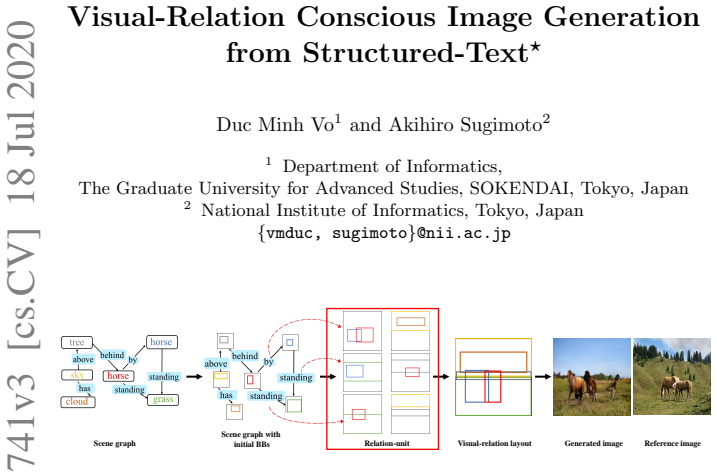
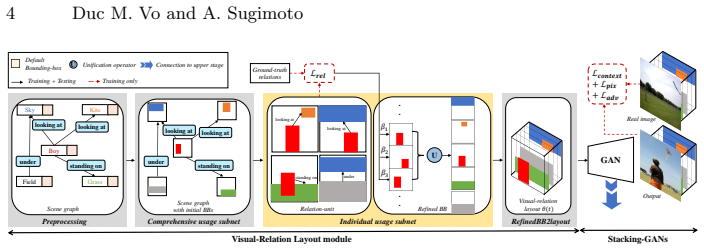
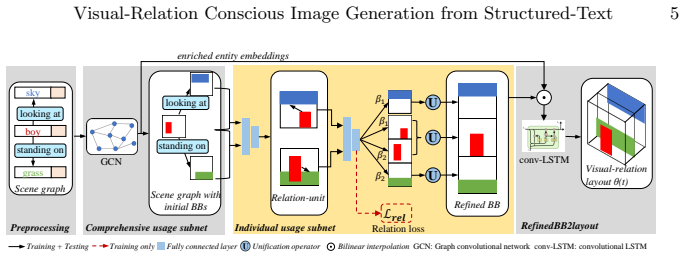
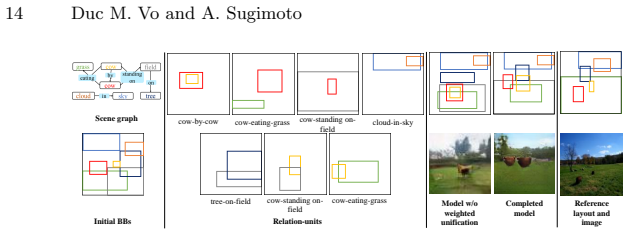
The load-bearing mechanism is the individual-usage subnet together with weighted unification. For each edge (subject, predicate, object), the subnet takes the initial bounding boxes and enriched embeddings of the two entities and outputs a relation-unit: a pair of boxes whose relative position and size are meant to satisfy that predicate. A relation auxiliary classifier scores each relation-unit against the predicate, and its softmax weight is used to merge all units for the same entity into one refined bounding box. This per-relation refinement is what distinguishes the method from prior layout predictors that average relation information inside a graph convolution.
What would settle it
Train the same model on a scene-graph dataset in which most predicates are non-spatial, such as wearing or has, and compare the full model against the variant without the individual-usage subnet on relation score and rIoU; if the full model is not better, the central claim that individual relation refinement preserves visual relations fails for such predicates. A second check is whether the relation auxiliary classifier can predict the predicate from a relation-unit pair of boxes at above-chance accuracy; if it cannot, the weighted unification receives no informative signal.
Extended reading notes
Core claim
The central claim is that a layout built from individual subject-predicate-object relations preserves the visual relations among entities more faithfully than a layout built only by aggregating all relations. The procedure is: a graph convolutional network produces initial bounding boxes for all entities using all relations at once; then an individual-usage subnet takes each scene-graph edge separately and predicts a relation-unit, a pair of adjusted boxes meant to embody that single relation; because one entity can appear in several relation-units, the units are merged into one refined bounding box per entity using weights produced by a relation classifier; and the refined boxes are aggregated by a conv-LSTM into the visual-relation layout. The generators are then conditioned on this layout and on the previous stage's output. The paper claims that this two-way use of relations makes the predicted layout preserve the relations in the input text, and that the resulting images keep the scene structure at high resolution.
Load-bearing premise
The load-bearing premise is that the input text has already been converted into a scene graph and that every predicate in it corresponds to a consistent geometric arrangement of two bounding boxes.
Editorial extensions
If this is right
- If the layout preserves relations, generated images should keep the arrangement of entities even when the input text contains many entities and relations.
- The layout module can be trained end-to-end without ground-truth bounding boxes; the relation loss and downstream image losses provide the learning signal.
- Using the ground-truth layout in the same generator gives scores comparable to layout-conditioned baselines, which the paper reads as evidence that layout quality is the main bottleneck.
- The three stacked generators progressively improve image quality at 64, 128, and 256 pixel resolutions while the same visual-relation layout is preserved.
- Replacing only the image generator of a scene-graph baseline improves its results less than the full method, supporting the paper's claim that the layout module is the source of the gain.
Reading between the lines
- An extension the paper does not test is whether per-relation refinement helps when predicates are non-spatial, such as wearing or holding; the relation score is defined only for geometric relations, so the method's advantage may shrink on such predicates.
- The relation-unit and weighted-unification idea could transfer to other structured-output tasks, such as layout-conditioned video generation or multi-object scene editing, where each relation acts as a separate constraint.
- The layout module could be evaluated as a standalone relation-aware predictor on unseen predicate types; if the relation classifier generalizes, weighted unification might improve zero-shot layout prediction.
Signed reviews
Editorial analysis
A structured set of objections, weighed in public.
Referee Report
Summary. The paper proposes an end-to-end network for generating images from structured-text (scene graphs). The visual-relation layout module first uses a GCN to predict initial bounding boxes for all entities from all relations jointly (comprehensive usage), then processes each subject-predicate-object relation individually to refine a pair of boxes into a relation-unit, unifies all relation-units into refined bounding boxes using weights from an auxiliary relation classifier, and finally produces a 64x64x128 layout through a conv-LSTM. A pyramid of three GANs (Stacking-GANs) conditioned on the layout generates images at 64, 128, and 256 resolution. The model is trained end-to-end with a relation classification loss, pixel loss, contextual loss, and adversarial losses. Experiments on COCO-Stuff and Visual Genome evaluate image quality (IS, FID) and layout quality (R@tau, rIoU, RS, coverage), reporting favorable results on layout metrics and FID, while noting that AttnGAN achieves higher IS on COCO-Stuff.
Significance. The main contribution is the individual usage of relations for bounding-box refinement, which is a plausible mechanism for improving scene-structure fidelity in text-to-image generation. The paper provides extensive ablations, a new layout construction with learned unification, and evaluates layout quality directly. If the central claim is sound, the method is a useful step for scene-graph-conditioned image synthesis. However, the significance is currently tempered by the lack of a formal or empirical demonstration that the relation loss actually enforces geometric relations, and by an overbroad state-of-the-art claim that contrasts with the reported IS numbers.
major comments (4)
- [Section 4.3, Table 1] The abstract and conclusion state that the method outperforms state-of-the-art methods, but in Table 1, AttnGAN (Xu+) achieves IS 25.89 on COCO-Stuff at 256x256 versus 14.20 for the proposed method. The text acknowledges this and attributes it to entity-focused generation and simpler relations on COCO-Stuff, but this explanation does not reconcile the unqualified headline claim. Please qualify the claim by metric and dataset, and report comparisons under a common evaluation protocol.
- [Section 3.3, relation loss] The claim that minimizing L_rel encourages relation-units to adjust their locations and sizes to meet the 'predicate' relation is not supported by the loss formulation. L_rel is a cross-entropy classification loss over an auxiliary classifier whose input is the concatenation [e'_s, b_s, e'_o, b_o]. The embeddings e'_s and e'_o are produced by the GCN and encode entity category and graph context; for many predicates in Visual Genome (e.g., 'wearing', 'holding', 'eating'), the subject-object category pair is strongly predictive of the predicate. The classifier can therefore achieve low L_rel using the embedding part alone, and the gradient with respect to b_s and b_o may be negligible. There is no spatial template, no regression target for the boxes, and no geometric prior in the objective; RS is only used for evaluation, not training. The statement 'the relation reflects the relative spatial locations among its associated relation-units' is an assumption about the data, not a property enforced by the loss. Please provide evidence that the relation loss actually drives the box coordinates (e.g., gradient statistics, or an ablation that removes the box inputs from the classifier), or modify the loss to include an explicit geometric relation constraint.
- [Section 4.1, comparison protocol] The paper compares against text-conditioned baselines Zhang+ and Xu+ but does not specify how the scene-graph input is converted to natural language for training these models on GENOME and for computing their results on COCO-Stuff. Without this protocol, the comparison is not reproducible and may be unfair. Please describe the conversion process, or restrict comparisons to methods that consume scene graphs.
- [Section 4.1, Table 2, layout metrics for non-layout baselines] For Zhang+ and Xu+, layout metrics are computed from Faster-RCNN detections on generated images, whereas layout-based methods directly output boxes. Detection errors and the fixed number of detected boxes (set to the number of entities) likely bias the comparison. Please detail the detection and matching procedure, and discuss the effect of this asymmetry on the layout metrics.
minor comments (6)
- [Introduction and Conclusion] The wording 'surely preserves' is too strong given the probabilistic nature of the training; suggest 'encourages preserving'.
- [Table 1 caption] The caption should define groups (A), (B), and (C) and indicate which scores are from original papers and which are re-computed.
- [Section 4.1] The preprocessing for COCO-Stuff sets |R|=6; please list the six predicates and explain why only these are used.
- [Section 3.1, refined BB formula] The refined BB formula uses weights beta_i_nu from the relation classifier; the paper should clarify that these weights are normalized across relations for each entity, and how they are obtained at test time.
- [References] Reference [17] is listed as 'Wei, S., Tianfu, W.' but the in-text citation is Sun+[17]; please correct the author list.
- [Figure 4 caption] The caption says 'from second to the last rows' but the row order is not clearly indicated; please label rows.
Circularity Check
No significant circularity: the layout module is trained end-to-end from relation-label and image losses, and the contribution is supported by ablations rather than being forced by construction.
full rationale
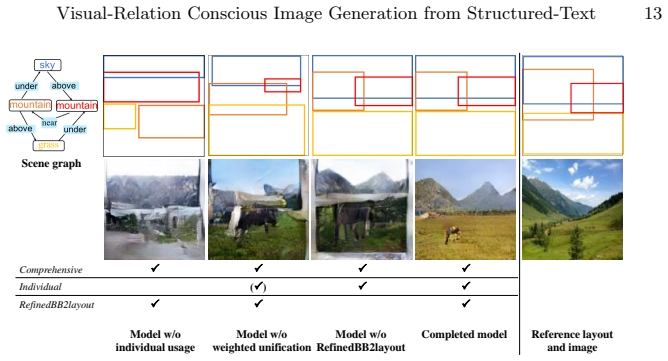
Walking the paper's derivation chain, the visual-relation layout module first obtains initial bounding-boxes through a GCN-based comprehensive usage subnet, then passes each subject-predicate-object relation through an individual-usage subnet to produce relation-units, and finally merges them into refined BBs with weights taken from the softmax of a relation auxiliary classifier (Sec. 3.3). The only relation supervision in training is the cross-entropy loss L_rel over the concatenated inputs [e'_s_k, b_s_k, e'_o_k, b_o_k]; the evaluation metrics RS, rIoU, R@tau, and coverage are computed after training and are not terms in the objective. The learned weights beta_i are outputs of a classifier trained jointly with the network, not a fitted constant that is later relabeled as a prediction. The statement that 'the relation reflects the relative spatial locations among its associated relation-units' is a modeling assumption about the dataset, not a definition that makes the predicted layout equal to the training target. The GCN design follows Johnson et al. and the CRN-based stacking-GANs follow Chen and Koltun, but these are externally validated baselines, not self-citations carrying the paper's central claim; the paper contains no self-citation chain and imports no uniqueness theorem from the authors. The ablations (w/o individual usage, w/o weighted unification, w/o refinedBB2layout) show that the proposed components change the measured outputs, so the central claim is empirically testable rather than circular. No equation or design step reduces by construction to its own input, so the appropriate score is 0.
Assumptions & free parameters
free parameters (1)
- Loss weights lambda_1..lambda_4 =
1, 1, 1, 1
assumptions (4)
- domain assumption The input structured text is already converted into a scene graph (E,P) with a fixed set of categories C and relations R.
- domain assumption Each predicate in the scene graph corresponds to a consistent geometric relationship between object bounding boxes.
- ad hoc to paper The probability output of the relation auxiliary classifier is a valid weight for relation-units during unification.
- standard math The pre-trained VGG-19 network provides a good perceptual feature space for the contextual loss.
Cite this review
Pith. "Pith review of Visual-Relation Conscious Image Generation from Structured-Text." pith.science (2026). https://pith.science/paper/OTMY2I75
@misc{pith2026190801741,
  author       = {Pith},
  title        = {Pith review of: Visual-Relation Conscious Image Generation from Structured-Text},
  year         = {2026},
  howpublished = {\url{https://pith.science/paper/OTMY2I75}},
  note         = {Machine review of arXiv:1908.01741}
}
read the original abstract
We propose an end-to-end network for image generation from given structured-text that consists of the visual-relation layout module and the pyramid of GANs, namely stacking-GANs. Our visual-relation layout module uses relations among entities in the structured-text in two ways: comprehensive usage and individual usage. We comprehensively use all available relations together to localize initial bounding-boxes of all the entities. We also use individual relation separately to predict from the initial bounding-boxes relation-units for all the relations in the input text. We then unify all the relation-units to produce the visual-relation layout, i.e., bounding-boxes for all the entities so that each of them uniquely corresponds to each entity while keeping its involved relations. Our visual-relation layout reflects the scene structure given in the input text. The stacking-GANs is the stack of three GANs conditioned on the visual-relation layout and the output of previous GAN, consistently capturing the scene structure. Our network realistically renders entities' details in high resolution while keeping the scene structure. Experimental results on two public datasets show outperformances of our method against state-of-the-art methods.
Figures
Figures from the paper (3 more)

Reference graph
Works this paper leans on
- [1]
- [2]
- [3]
- [4]
- [5]
- [6]
- [7]
- [8]
Show all 38 references
-
[9]
In: CVPR
Xu, T., Zhang, P., Huang, Q., Zhang, H., Gan, Z., Huang, X., He, X.: Attngan: Fine-grained text to image generation with attentional generative adversarial net- works. In: CVPR. (2018) 2, 3, 8, 9, 10, 11, 12
2018
-
[10]
In: CVPR
Li, Y., Ma, T., Bai, Y., Duan, N., Wei, S., Wang, X.: Pastegan: A semi-parametric method to generate image from scene graph. In: CVPR. (2019) 2, 3, 4, 5, 6, 8, 11
2019
-
[11]
In: ICCV
Ashual, O., Wolf, L.: Specifying object attributes and relations in interactive scene generation. In: ICCV. (2019) 2, 3, 4, 5, 6, 8, 9, 10, 11, 12
2019
-
[12]
In: CVPR
Hong, S., Yang, D., Choi, J., Lee, H.: Inferring semantic layout for hierarchical text-to-image synthesis. In: CVPR. (2018) 2, 3, 5, 8, 11, 12
2018
-
[13]
In: CVPR
Caesar, H., Uijlings, J., Ferrari, V.: Coco-stuff: Thing and stuff classes in context. In: CVPR. (2018) 3, 8, 9, 10, 11, 12
2018
-
[14]
In: IJCV
Krishna, R., Zhu, Y., Groth, O., Johnson, J., Hata, K., Kravitz, J., Chen, S., Kalantidis, Y., Li, L.J., Shamma, D.A., Bernstein, M., Fei-Fei, L.: Visual genome: Connecting language and vision using crowdsourced dense image annotations. In: IJCV. (2017) 3, 8, 9, 10, 11
2017
-
[15]
In: NIPS
Reed, S., Akata, Z., Mohan, S., Tenka, S., Schiele, B., Lee, H.: Learning what and where to draw. In: NIPS. (2016) 3
2016
-
[16]
In: CVPR
Zhao, B., Meng, L., Yin, W., Sigal, L.: Image generation from layout. In: CVPR. (2019) 3, 8, 11, 12
2019
-
[17]
In: ICCV
Wei, S., Tianfu, W.: Image synthesis from reconfigurable layout and style. In: ICCV. (2019) 3, 8, 11, 12
2019
-
[18]
In: ICCV
Chen, Q., Koltun, V.: Photographic image synthesis with cascaded refinement networks. In: ICCV. (2017) 3, 7
2017
-
[19]
In: ICML
Nair, V., Hinton, G.E.: Rectified linear units improve restricted boltzmann ma- chines. In: ICML. (2010) 6
2010
-
[20]
In: NIPS
Shi, X., Chen, Z., Wang, H., Yeung, D.Y., Wong, W., Woo, W.: Convolutional lstm network: A machine learning approach for precipitation nowcasting. In: NIPS. (2015) 7
2015
-
[21]
In: NIPS
Jaderberg, M., Simonyan, K., Zisserman, A., Kavukcuoglu, K.: Spatial transformer networks. In: NIPS. (2015) 7 16 Duc M. Vo and A. Sugimoto
2015
-
[22]
In: ECCV
Mechrez, R., Talmi, I., Zelnik-Manor, L.: The contextual loss for image transfor- mation with non-aligned data. In: ECCV. (2018) 8
2018
-
[23]
8 https://github.com/hanzhanggit/StackGAN-Pytorch
-
[24]
8 https://github.com/taoxugit/AttnGAN
-
[25]
In: NIPS
Salimans, T., Goodfellow, I., Zaremba, W., Cheung, V., Radford, A., Chen, X., Chen, X.: Improved techniques for training gans. In: NIPS. (2016) 8
2016
-
[26]
In: NIPS
Heusel, M., Ramsauer, H., Unterthiner, T., Nessler, B., Hochreiter, S.: Gans trained by a two time-scale update rule converge to a local nash equilibrium. In: NIPS. (2017) 8
2017
-
[27]
8 https://github.com/openai/improved-gan/tree/master/inception_score
-
[28]
8 https://github.com/bioinf-jku/TTUR
-
[29]
In: CVPRW (WiCV)
Tripathi, S., Bhiwandiwalla, A., Bastidas, A., Tang, H.: Using scene graph context to improve image generation. In: CVPRW (WiCV). (2019) 8, 9
2019
-
[30]
Papineni, K., Roukos, S., Ward, T., Zhu, W.J.: Bleu: A method for automatic evaluation of machine translation. In: ACL. (2002) 8
2002
-
[31]
Lavie, A., Agarwal, A.: Meteor: An automatic metric for mt evaluation with improved correlation with human judgments. In: ACL. (2005) 8
2005
-
[32]
In: CVPR
Vedantam, R., Zitnick, C.L., Parikh, D.: Cider: Consensus-based image description evaluation. In: CVPR. (2015) 8
2015
-
[33]
In: CVPR
Zhang, R., Isola, P., Efros, A.A., Shechtman, E., Wang, O.: The unreasonable effectiveness of deep features as a perceptual metric. In: CVPR. (2018) 8, 12
2018
-
[34]
8 https://github.com/richzhang/PerceptualSimilarity
-
[35]
9 https://pytorch.org/
-
[36]
In: ICLR
Kingma, D.P., Welling, M.: Auto-encoding variational bayes. In: ICLR. (2014) 9
2014
-
[37]
In: ICLR
Simonyan, K., Zisserman, A.: Very deep convolutional networks for large-scale image recognition. In: ICLR. (2015) 9
2015
-
[38]
In: NIPS
Ren, S., He, K., Girshick, R., Sun, J.: Faster R-CNN: Towards real-time object detection with region proposal networks. In: NIPS. (2015) 12
2015
Reviewed August 14, 2026 · model on record in the stance chip above.
Discussion (0). Continue with ORCID to comment.