REVIEW 2 major objections 5 minor 34 references
A Graph Theoretic Approach to Non-Anticipativity Constraint Generation in Multistage Stochastic Programs with Incomplete Scenario Sets
T0 review · 2 major / 5 minor · reviewed 2026-08-14 · deepseek-v4-flash
Pith's one-line read This paper proves that a greedy spanning-tree algorithm produces a minimum-cardinality set of non-anticipativity constraints for multistage stochastic programs with gradual uncertainty and incomplete scenario sets.
desk verdict Useful NAC-reduction algorithm for gradual uncertainty on incomplete scenario sets, but the minimum-cardinality theorem is not proved and the greedy choice can matter. read the letter →
The pith
A machine-rendered reading of the paper's core claim, the machinery that carries it, and where it could break.
The reading
What carries the argument
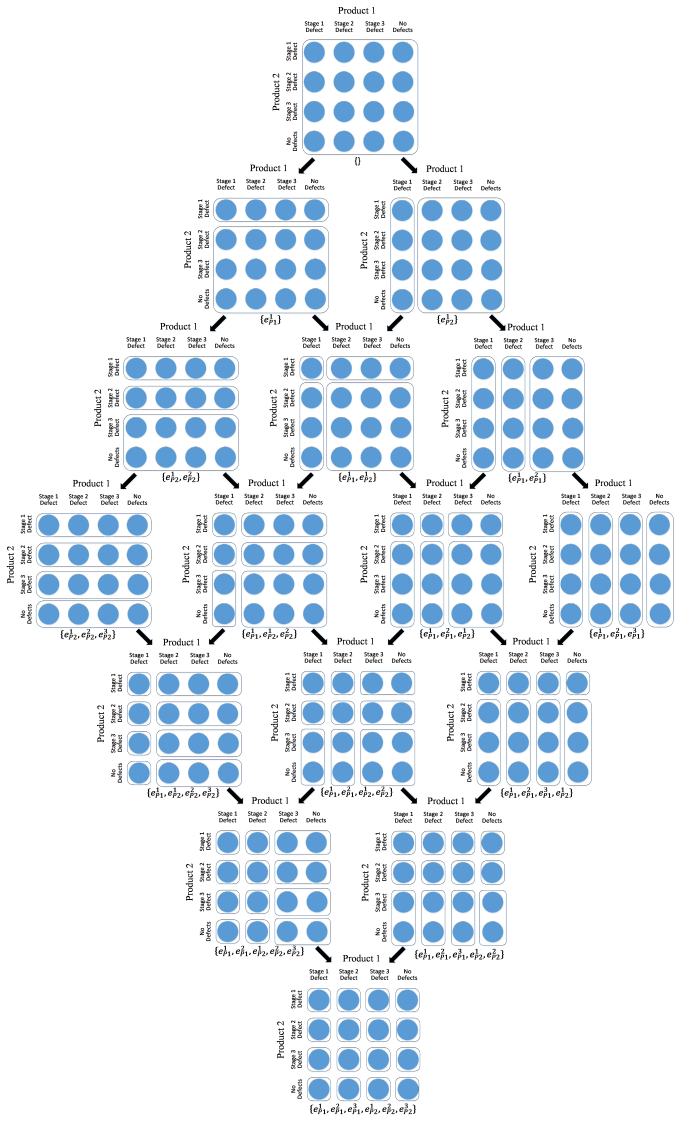
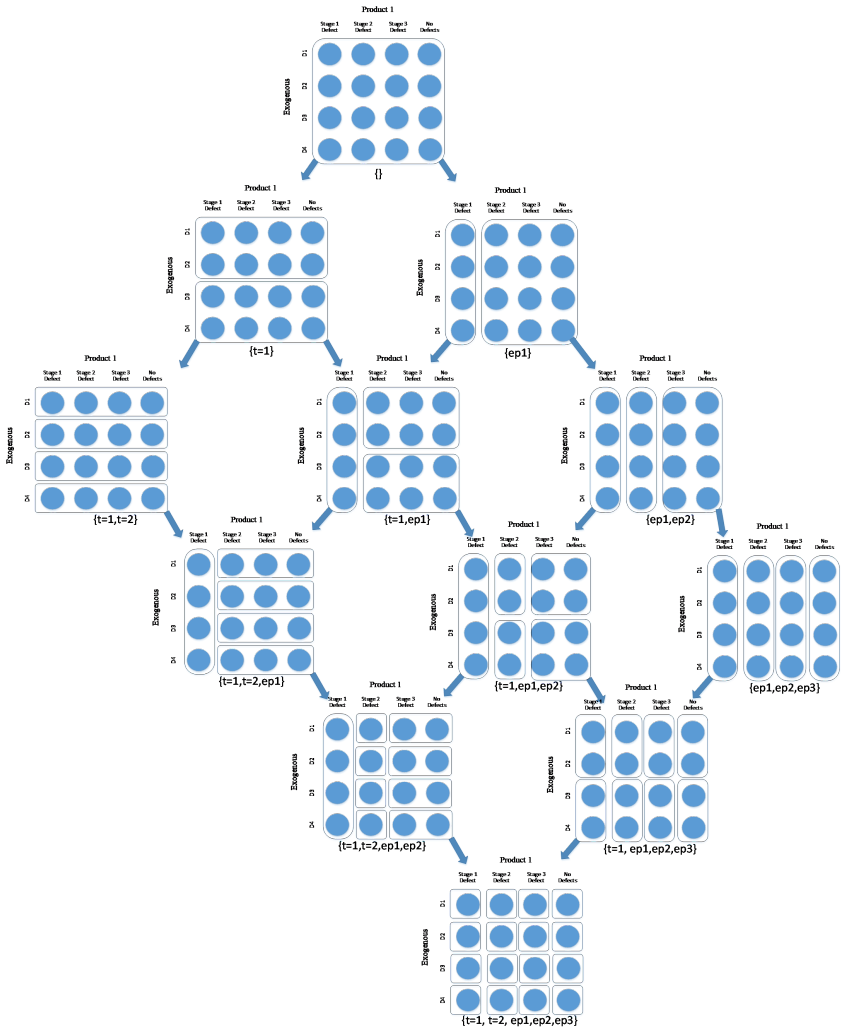
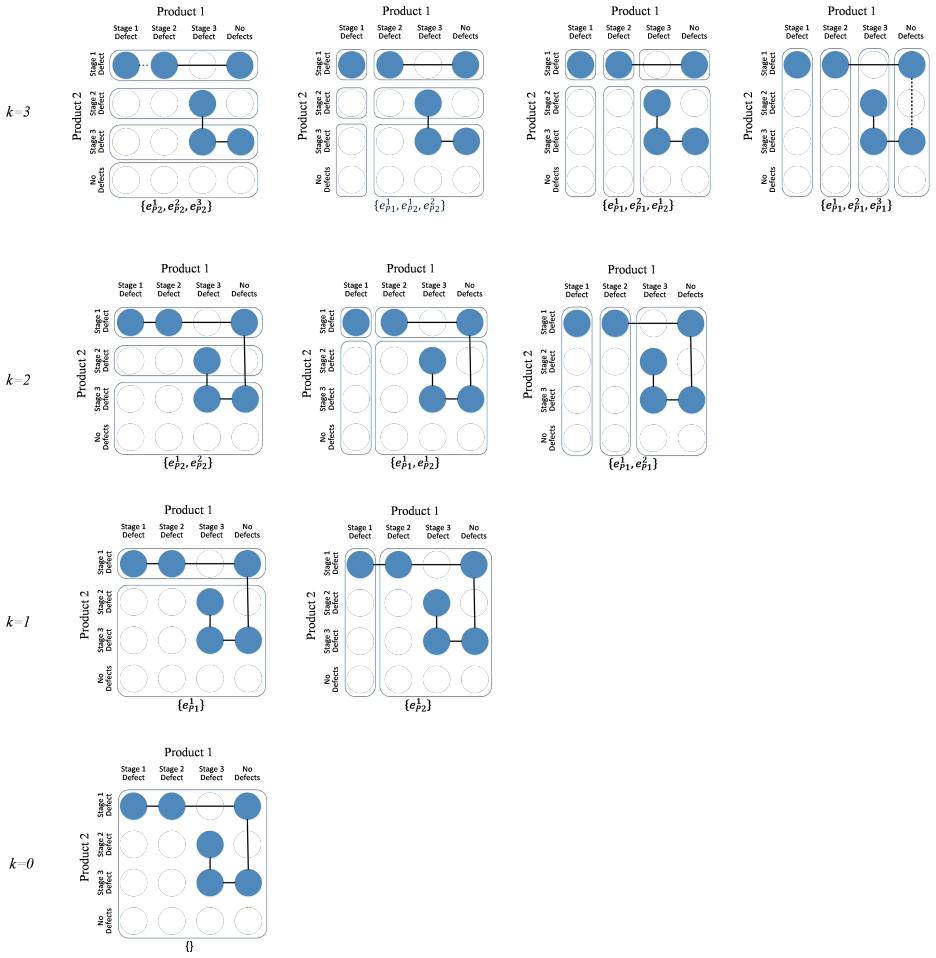
The central object is the scenario graph $G=(S,E)$ whose vertices are scenarios and whose edges are NAC pairs, together with the family of partitions $\Pi(c)$ induced by permissible event sets $c\in C$, called cuts. Lemma 2 converts non-anticipativity into a connectivity condition: a NAC set is sufficient exactly when every block $S^c_j$ is connected in the graph restricted to that block. SNAC works from the finest cuts (largest $|c|$) down to the coarsest, adding a spanning tree within each block where needed; the downward order and the necessity argument in Definition 1 ensure every added edge is necessary, so no edge can be removed without breaking connectivity, hence the set is minimum.
What would settle it
Take a small incomplete scenario set with two information states having the same number of realized events whose scenario groups are not nested; run SNAC under all tie-breaking orders of these two states and compare the number of scenario pairs in the output. If any order yields strictly more pairs than another, Theorem 3's guarantee of a minimum-cardinality NAC set fails for that instance.
Extended reading notes
Core claim
The central claim is Theorem 3: Algorithm 1 terminates with a subset of edges that corresponds to a set of NACs enforced on the minimum number of pairs of scenarios, with an implementation running in $O(|C||S|^3)$ time as the scenario set $S$ and event-set family $C$ grow. The proof rests on two structural facts. First, for every permissible set of realized events $c\in C$, the partition $\Pi(c)$ divides scenarios into groups $S^c_j$ that are still indistinguishable, and a NAC set is sufficient iff each such group is connected in the induced subgraph of $G=(S,E)$ (Lemma 2). Second, because a coarser information state is refined by later states (Lemma 1), any edge needed to connect a group at a coarser state cannot be implied by edges added at finer states; SNAC's downward sweep over $|c|$ therefore adds only necessary edges, and the spanning-tree construction keeps each added edge necessary. The paper generalizes prior minimum-NAC-set results, which required instantaneous uncertainty realization or the full Cartesian-product scenario set, to gradual realizations with arbitrary scenario subsets.
Load-bearing premise
The proof that the greedy order yields the fewest constraints rests on the claim that, when several information states have the same number of realized events, the choice of order in which they are processed does not change how many connections are needed at coarser states later; for non-nested equal-size states this claim is assumed rather than proved.
Editorial extensions
If this is right
- A user can compute the minimal NAC pair count once for a given scenario structure and reuse it across instances that differ only in objective coefficients, since SNAC reads only the uncertainty structure, not costs or revenues.
- The sufficiency condition in Lemma 2 gives a cheap certificate: to check whether any proposed NAC set is sufficient, verify that every information-state group is connected in the graph; no optimization solve is needed.
- For fixed numbers of uncertain parameters and events, the running-time bound $O(|C||S|^3)$ means the method remains practical as the scenario sample grows, which is the typical scaling regime for incomplete scenario sets.
- In the reported case studies, SNAC preserved the optimal objective value in all instances while reducing scenario-pair counts sharply; for example, at 1,024 scenarios the full model's 523,776 pairs fell to 3,840, and total solution time dropped by roughly 30 percent for that instance.
Reading between the lines
- Editorial inference: because Lemma 2 reduces NAC sufficiency to a connectivity check, any heuristic that removes NACs can be audited by testing each block's connectivity; the paper does not present this as a standalone verification routine, but it follows directly.
- Editorial inference: the same graph and partition construction should apply to any nested family of information states, not only those derived from Cartesian products of independent uncertain parameters; SNAC's correctness depends on Lemma 1's nesting, not on the product structure.
- Editorial inference: the minimal scenario-pair set produced by SNAC is a natural set to dualize in Lagrangean or progressive-hedging decompositions, since those methods dualize NACs and benefit from fewer linking constraints; the paper's experiments only use SNAC to build and solve the full model.
- Editorial inference: if the equal-cardinality order assumption in Theorem 3 is false for some incomplete scenario set, the algorithm would still output a sufficient NAC set, but not necessarily a minimum one; a counterexample would appear as an order-dependent edge count in a small exhaustive search.
Signed reviews
Editorial analysis
A structured set of objections, weighed in public.
Referee Report
Summary. The paper proposes a graph-based algorithm (SNAC) for generating a set of non-anticipativity constraints (NACs) in multistage stochastic programs with gradual uncertainty realization and incomplete scenario sets. Scenarios are vertices and NACs are edges; Lemma 2 characterizes feasibility of a NAC set as connectivity of every block of every partition induced by each permissible event set. Algorithm 1 iterates from fine to coarse event sets, adding spanning-tree edges to connect each block, and Theorem 3 claims that the output is a minimum-cardinality edge set with running time O(|C||S|^3). The paper illustrates the algorithm on a manufacturing example and reports computational experiments on clinical-trial planning instances, comparing the SNAC-reduced formulation with the full pairwise NAC formulation.
Significance. The paper addresses a relevant and practically motivated problem: reducing the number of non-anticipativity constraints in multistage stochastic programs with gradual uncertainty realization and incomplete scenario sets. Its reformulation of the NAC-enforcement condition as block connectivity (Lemma 2) is a useful observation, and the SNAC algorithm is simple and clearly structured, with a plausible polynomial bound when the number of uncertain parameters is fixed. The computational case study demonstrates that the SNAC-based formulation can substantially reduce model generation and solution times relative to the full pairwise formulation, and the observation that SNAC can be run once for a family of instances sharing a scenario structure is a genuine practical advantage. However, the central theoretical result, the assertion of minimum-cardinality output, is not established and is in fact false for the algorithm as stated. If corrected and properly validated, the idea could serve as a useful heuristic; as it stands, the main contribution of the paper is not supported.
major comments (2)
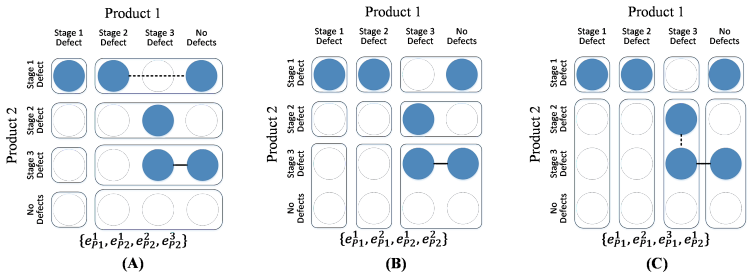
- [Section 3.1, Theorem 3 and Algorithm 1] The optimality claim in Theorem 3 is false as stated. Consider S={1,2,3,4,5,6}, C={c1,c2} with |c1|=|c2|=1, Π(c1)={A={1,5,6}, B={2,3,4}}, and Π(c2)={C={1,2,3}, D={4,5,6}}. This instance is realizable in the paper's framework (e.g., the manufacturing example of Section 2.2 with two products and the cuts corresponding to the first completion event for each product). A feasible set must connect A, B, C, and D. The minimum cardinality is 6: the edges (5,6),(1,5),(2,3),(2,4),(1,2),(4,5) achieve this, and no 5-edge set can, because the four 3-vertex blocks require at least 8 block-edge incidences while only the two edges (5,6) and (2,3) can be shared between two blocks, giving at most 7 incidences with 5 edges. If Algorithm 1 processes c1 first and at step 6 chooses the spanning trees (1,5),(1,6) on A and (2,4),(3,4) on B, then c2 has no previously added edges inside C or D, and the algorithm adds (1,2),(2,3),(4,5),(5,6), for a total of 8 edges. If instead c1's trees are (1,5),(5,6) and (2,3),(2,4), then c2 needs only (1,2) and (4,5), for a total of 6 edges. Since Algorithm 1 does not specify how the spanning tree at step 6 is constructed, both outputs are valid executions, and the theorem's 'minimum number of pairs' claim is contradicted. The proof's assertion that the spanning-tree choice 'has no effect on the number of arcs needed to be included at future iterations' is false: the choice at c1 changes the number of edges required at the same-iteration cut c2. More generally, the proof's necessity argument establishes only inclusion-minimality relative to the previously added edges, not minimum cardinality, and it does not account for alternate paths created by edges added later or at the same iteration.
- [Section 4, Tables 2 and 3] The computational study does not test the optimality claim. Tables 2 and 3 compare the SNAC formulation only with the full pairwise NAC formulation, reporting reductions in the number of scenario pairs and in model generation and CPLEX times. No comparison is made against an exact minimum-cardinality NAC set (e.g., the MILP of Hooshmand and MirHassani (2016) or an exhaustive enumeration on the smallest instances), and no non-trivial lower bound is computed. The observed reductions are consistent with a heuristic that generates a feasible but not necessarily minimum set, so the experiments cannot substitute for a valid proof of Theorem 3.
minor comments (5)
- [Section 3.1, Algorithm 1 and Remark 1] The treatment of cuts of the same cardinality is ambiguous: the for-loop in Algorithm 1 updates N after each c, so a later cut at the same level sees edges added for an earlier cut, whereas Remark 1 states that components are treated 'in parallel' without regard to edges added at the same iteration. This distinction matters for correctness, and the manuscript should specify the intended semantics and state the corresponding proof obligations.
- [Section 3.2] The formula for the number of pairs in the full formulation is typeset with an extra space as '0 .5[|S|(|S|− 1)]'.
- [Section 4] There are several typos, including 'suprizing' for 'surprising', 'teh' for 'the', and 'allied' for 'applied' in Remark 2.
- [Abstract and Section 3.1] The abstract's statement that the algorithm 'scales polynomially in the number of scenarios' should carry the qualifier 'for a fixed number of uncertain parameters and events' that appears later in Section 3.1, since the running time is O(|C||S|^3) and |C| can be exponential in the number of events.
- [Section 2.1] The displayed definition of the permissible event set C contains a malformed union expression; it should be written as a standard set comprehension.
Circularity Check
No significant circularity: SNAC is a self-contained combinatorial construction whose optimality gap is a proof-validity concern, not an input-output loop.
full rationale
The paper's central claim is that Algorithm 1 generates a minimum-cardinality set of non-anticipativity constraints for multistage stochastic programs with incomplete scenario sets and gradual uncertainty realization. The derivation is a direct graph-theoretic construction: Lemma 2 characterizes sufficient NAC sets as those that make every scenario subset S^c_j connected in the induced subgraph, and Algorithm 1 greedily builds spanning trees over these subsets from the finest cuts downward. No parameter is fitted to data, no prediction is statistically forced, and no external result is imported from the authors' prior work to define the output. The cited prior work by Christian, Cremaschi, and Zeng appears only as background on decomposition heuristics and is not load-bearing for the optimality proof. The proof of Theorem 3 instead relies on Lemma 1, Lemma 2, and the construction of the algorithm itself. The only passage that warrants scrutiny is the unproven assertion in the proof of Theorem 3 that the choice of spanning tree for a cut 'has no effect on the number of arcs needed to be included at future iterations.' This is a potential correctness gap in the minimality argument, because equal-cardinality cuts need not be nested and the proof establishes inclusion-minimality rather than cardinality-minimality. However, that is a mathematical proof-validity problem, not circularity: the theorem's conclusion is not assumed in its premises, and the algorithm's output is not defined as 'the optimum' by construction. The computational study compares SNAC against the full pairwise NAC formulation, which tests constraint reduction and solution-time savings but not optimality; again, this is an empirical-validation limitation, not a circular derivation. No self-definitional, fitted-input, self-citation, imported-uniqueness, or ansatz-smuggling pattern is present. The algorithm is deterministic from the scenario set and event structure, and its claimed optimality is an independent combinatorial statement, even if that statement may require a more careful proof.
Assumptions & free parameters
assumptions (2)
- domain assumption The information structure is fully captured by a finite set C of permissible event sets, and each event set c in C induces a partition of the scenario set into groups that are indistinguishable given the realized events.
- domain assumption Non-anticipativity for a set of scenarios is equivalent to enforcing connectivity of the graph restricted to each cut subset, using transitivity of equality constraints.
Cite this review
Pith. "Pith review of A Graph Theoretic Approach to Non-Anticipativity Constraint Generation in Multistage Stochastic Programs with Incomplete Scenario Sets." pith.science (2026). https://pith.science/paper/IAECNQVY
@misc{pith2026190801792,
  author       = {Pith},
  title        = {Pith review of: A Graph Theoretic Approach to Non-Anticipativity Constraint Generation in Multistage Stochastic Programs with Incomplete Scenario Sets},
  year         = {2026},
  howpublished = {\url{https://pith.science/paper/IAECNQVY}},
  note         = {Machine review of arXiv:1908.01792}
}
read the original abstract
We propose an algorithm for generating a minimum-cardinality set of non-anticipativity constraints (NAC) for scenario-based multistage-stochastic programming (MSSP) problems with both endogenous and exogenous uncertainties which allow for gradual realizations. Recently several authors have considered approaches to generate the minimum cardinality NAC set for MSSPs for various scenario set structures. However, these approaches have been limited to uncertain parameters where the realizations occur instantaneously or the full set of scenarios is required. The proposed algorithm, referred to as Sample Non-Anticipativity Constraint algorithm (SNAC) relaxes this requirement. We show that as long as the number of uncertain parameters and parameter values are kept constant, the algorithm scales polynomially in the number of scenarios.
Figures

Figures from the paper (4 more)

Reference graph
Works this paper leans on
-
[1]
, " * write output.state after.block = add.period write newline
ENTRY address author booktitle chapter edition editor howpublished institution journal key month note number organization pages publisher school series title type url volume year label extra.label sort.label short.list INTEGERS output.state before.all mid.sentence after.sentence after.block FUNCTION init.state.consts #0 'before.all := #1 'mid.sentence := ...
-
[2]
write newline
" write newline "" before.all 'output.state := FUNCTION n.dashify 't := "" t empty not t #1 #1 substring "-" = t #1 #2 substring "--" = not "--" * t #2 global.max substring 't := t #1 #1 substring "-" = "-" * t #2 global.max substring 't := while if t #1 #1 substring * t #2 global.max substring 't := if while FUNCTION word.in bbl.in capitalize ":" * " " *...
-
[3]
write newline
" write newline "" before.all 'output.state := FUNCTION n.dashify 't := "" t empty not t #1 #1 substring "-" = t #1 #2 substring "--" = not "--" * t #2 global.max substring 't := t #1 #1 substring "-" = "-" * t #2 global.max substring 't := while if t #1 #1 substring * t #2 global.max substring 't := if while FUNCTION word.in bbl.in ":" * " " * FUNCTION f...
-
[4]
write newline
" write newline "" before.all 'output.state := FUNCTION n.dashify 't := "" t empty not t #1 #1 substring "-" = t #1 #2 substring "--" = not "--" * t #2 global.max substring 't := t #1 #1 substring "-" = "-" * t #2 global.max substring 't := while if t #1 #1 substring * t #2 global.max substring 't := if while FUNCTION word.in bbl.in ":" * " " * FUNCTION f...
-
[5]
Apap, R. M., Grossmann, I. E., 2017. Models and computational strategies for multistage stochastic programming under endogenous and exogenous uncertainties. Computers & Chemical Engineering 103, 233--274
work page 2017
-
[6]
Birge, J. R., Louveaux, F., 2011. Introduction to stochastic programming. Springer Science & Business Media
work page 2011
-
[7]
Boland, N., Dumitrescu, I., Froyland, G., 2008. A multistage stochastic programming approach to open pit mine production scheduling with uncertain geology. Optimization online, 1--33
work page 2008
-
[8]
Minimum cardinality non-anticipativity constraint sets for multistage stochastic programming
Boland, N., Dumitrescu, I., Froyland, G., Kalinowski, T., 2016. Minimum cardinality non-anticipativity constraint sets for multistage stochastic programming. Mathematical Programming 157 (1), 69--93
work page 2016
Show all 34 references
-
[9]
Heuristic solution approaches to the pharmaceutical r&d pipeline management problem
Christian, B., Cremaschi, S., 2015. Heuristic solution approaches to the pharmaceutical r&d pipeline management problem. Computers & Chemical Engineering 74, 34--47. ://www.sciencedirect.com/science/article/pii/S0098135414003433
2015
-
[10]
Variants to a knapsack decomposition heuristic for solving r&d pipeline management problems
Christian, B., Cremaschi, S., 2017. Variants to a knapsack decomposition heuristic for solving r&d pipeline management problems. Computers & Chemical Engineering 96, 18--32. ://www.sciencedirect.com/science/article/pii/S0098135416303271
2017
-
[11]
A branch and bound algorithm to solve large-scale multistage stochastic programs with endogenous uncertainty
Christian, B., Cremaschi, S., 2018 a . A branch and bound algorithm to solve large-scale multistage stochastic programs with endogenous uncertainty. AIChE Journal 64 (4), 1262--1271
2018
-
[12]
A multistage stochastic programming formulation to evaluate feedstock/process development for the chemical process industry
Christian, B., Cremaschi, S., 2018 b . A multistage stochastic programming formulation to evaluate feedstock/process development for the chemical process industry. Chemical Engineering Science 187, 223--244. ://www.sciencedirect.com/science/article/pii/S0009250918302148
2018
-
[13]
T., 2008
Colvin, M., Maravelias, C. T., 2008. A stochastic programming approach for clinical trial planning in new drug development. Computers & Chemical Engineering 32 (11), 2626--2642
2008
-
[14]
T., 2009
Colvin, M., Maravelias, C. T., 2009. Scheduling of testing tasks and resource planning in new product development using stochastic programming. Computers & Chemical Engineering 33 (5), 964--976. ://www.sciencedirect.com/science/article/B6TFT-4TK47C6-1/2/a31964976caa32338309a80...
2009
-
[15]
T., 2010 a
Colvin, M., Maravelias, C. T., 2010 a . Modeling methods and a branch and cut algorithm for pharmaceutical clinical trial planning using stochastic programming. European Journal of Operational Research 203 (1), 205--215. ://www.sciencedirect.com/science/article/B6VCT-4WXBM84-1...
2010
-
[16]
T., 2010 b
Colvin, M., Maravelias, C. T., 2010 b . Modeling methods and a branch and cut algorithm for pharmaceutical clinical trial planning using stochastic programming. European Journal of Operational Research 203 (1), 205--215
2010
-
[17]
A new class of planning models for option valuation of storage technologies under decision-dependent innovation uncertainty
Giannelos, S., Konstantelos, I., Strbac, G., 2017. A new class of planning models for option valuation of storage technologies under decision-dependent innovation uncertainty. In: 2017 IEEE Manchester PowerTech. pp. 1--6
2017
-
[18]
E., 2004
Goel, V., Grossmann, I. E., 2004. A stochastic programming approach to planning of offshore gas field developments under uncertainty in reserves. Computers & chemical engineering 28 (8), 1409--1429
2004
-
[19]
E., Sep 2006
Goel, V., Grossmann, I. E., Sep 2006. A class of stochastic programs with decision dependent uncertainty. Mathematical Programming 108 (2), 355--394. ://doi.org/10.1007/s10107-006-0715-7
2006 doi
-
[20]
E., El-Bakry, A
Goel, V., Grossmann, I. E., El-Bakry, A. S., Mulkay, E. L., 2006. A novel branch and bound algorithm for optimal development of gas fields under uncertainty in reserves. Computers & Chemical Engineering 30 (6-7), 1076--1092. ://www.sciencedirect.com/science/article/B6TFT-4JVTC...
2006
-
[21]
E., 2014
Gupta, V., Grossmann, I. E., 2014. A new decomposition algorithm for multistage stochastic programs with endogenous uncertainties. Computers & Chemical Engineering 62 (0), 62--79. ://www.sciencedirect.com/science/article/pii/S0098135413003621
2014
-
[22]
Efficient constraint reduction in multistage stochastic programming problems with endogenous uncertainty
Hooshmand, F., MirHassani, S., 2016. Efficient constraint reduction in multistage stochastic programming problems with endogenous uncertainty. Optimization Methods and Software 31 (2), 359--376. ://dx.doi.org/10.1080/10556788.2015.1088850
2016
-
[23]
A., 2016
Hooshmand Khaligh, F., MirHassani, S. A., 2016. A mathematical model for vehicle routing problem under endogenous uncertainty. International Journal of Production Research 54 (2), 579--590. ://doi.org/10.1080/00207543.2015.1057625
2016
-
[24]
W., Wets, R
Jonsbr ten, T. W., Wets, R. J.-B., Woodruff, D. L., Aug 1998. A class of stochastic programs withdecision dependent random elements. Annals of Operations Research 82 (0), 83--106. ://doi.org/10.1023/A:1018943626786
1998 doi
-
[25]
H., Woodruff, D
Jorjani, S., Scott, C. H., Woodruff, D. L., 1999. Selection of an optimal subset of sizes. International journal of production research 37 (16), 3697--3710
1999
-
[26]
Amsaa : A Multistep Anticipatory Algorithm for Online Stochastic Combinatorial Optimization
Mercier, L., Van Hentenryck, P., 2008. Amsaa : A Multistep Anticipatory Algorithm for Online Stochastic Combinatorial Optimization. pp. 173--187. ://dx.doi.org/10.1007/978-3-540-68155-7_15
2008 doi
-
[27]
Efficient solution procedures for multistage stochastic formulations of two problem classes
Solak, S., 2007. Efficient solution procedures for multistage stochastic formulations of two problem classes. Ph.D. thesis, GEORGIA INSTITUTE OF TECHNOLOGY
2007
-
[28]
B., Johnson, E
Solak, S., Clarke, J.-P. B., Johnson, E. L., Barnes, E. R., 2010. Optimization of r&d project portfolios under endogenous uncertainty. European Journal of Operational Research 207 (1), 420 -- 433. ://www.sciencedirect.com/science/article/pii/S0377221710003516
2010
-
[29]
E., 2008
Tarhan, B., Grossmann, I. E., 2008. A multistage stochastic programming approach with strategies for uncertainty reduction in the synthesis of process networks with uncertain yields. Computers & Chemical Engineering 32 (4-5), 766--788. ://www.sciencedirect.com/science/article/...
2008
-
[30]
E., Goel, V., 2009
Tarhan, B., Grossmann, I. E., Goel, V., 2009. Stochastic programming approach for the planning of offshore oil or gas field infrastructure under decision-dependent uncertainty. industrial & Engineering Chemistry Research 48 (6), 3078--3097. ://dx.doi.org/10.1021/ie8013549
2009 doi
-
[31]
E., Goel, V., 2013
Tarhan, B., Grossmann, I. E., Goel, V., 2013. Computational strategies for non-convex multistage minlp models with decision-dependent uncertainty and gradual uncertainty resolution. Annals of Operations Research 203 (1), 141--166. ://www.scopus.com/inward/record.url?eid=2-s2.0...
2013
-
[32]
Decision rules for information discovery in multi-stage stochastic programming
Vayanos, P., Kuhn, D., Rustem, B., 2011. Decision rules for information discovery in multi-stage stochastic programming. In: Proceedings of the IEEE Conference on Decision and Control. pp. 7368--7373. ://www.scopus.com/inward/record.url?eid=2-s2.0-84860672073&partnerID=40&md5=...
2011
-
[33]
A generalized knapsack-problem based decomposition heuristic for solving multistage stochastic programs with endogenous and or exogenous uncertainties
Zeng, Z., Christian, B., Cremaschi, S., 2018. A generalized knapsack-problem based decomposition heuristic for solving multistage stochastic programs with endogenous and or exogenous uncertainties. industrial & Engineering Chemistry Research 57 (28), 9185--9199. ://doi.org/10....
2018 doi
-
[34]
Artificial lift infrastructure planning for shale gas producing horizontal wells
Zeng, Z., Cremaschi, S., 2017. Artificial lift infrastructure planning for shale gas producing horizontal wells. Proceedings of the FOCAPO/CPC, Tuscan, AZ, USA, 8--12
2017
Reviewed August 14, 2026 · model on record in the stance chip above.
Discussion (0). Continue with ORCID to comment.