REVIEW 1 major objections 5 minor 1 references
ESA Voyage 2050 White Paper: Detecting life outside our solar system with a large high-contrast-imaging mission
T0 review · 1 major / 5 minor · reviewed 2026-08-14 · deepseek-v4-flash
Pith's one-line read This paper argues that detecting signs of life on Earth-like exoplanets will require a large space telescope that can directly image and take spectra of those planets, and it calls on Europe to help build one.
desk verdict A clear, well-referenced advocacy white paper for a direct-imaging life-finder; no new science, but honest about the unvalidated 10^-10 contrast gap. read the letter →
The pith
A machine-rendered reading of the paper's core claim, the machinery that carries it, and where it could break.
The reading
What carries the argument
The load-bearing mechanism is high-contrast imaging in space: a diffraction-limited telescope combined with a coronagraph (an optic that blocks the star's light while transmitting planet light) and, in the preferred internal-coronagraph designs, two deformable mirrors plus focal-plane wavefront sensing to dig a 'dark hole' in the residual starlight. This combination is what allows a raw contrast of $10^{-10}$ at separations down to roughly $2.5\lambda/D$, a level that only the stable space environment can provide. A starshade—an external occulter flying far from the telescope—is the alternative that relaxes the demands on telescope optics at the cost of formation flying. The same instrument is also designed to feed a spectrograph and, optionally, a polarimeter, because molecular absorption bands (water, oxygen, ozone, methane, carbon dioxide) and the polarization of scattered light are the actual carriers of the biological information.
What would settle it
A single controlled measurement would settle the central assumption: put a flight-like coronagraph on a space-like testbed and measure the deepest raw contrast at an inner working angle of about $2.5\lambda/D$. If that contrast cannot reach $10^{-10}$ with the stability needed for a multi-hour spectral exposure—or does so only by moving the inner working angle out beyond 100 milliarcseconds—the paper's survey of Sun-like stars collapses, and the mission would need a starshade or a larger telescope to survive.
Extended reading notes
Core claim
On the paper's own terms, the central claim is that direct imaging with a large space telescope is not one option among many but the only systematic route to atmospheric spectra of rocky planets in the habitable zones of Sun-like stars. Reflected or scattered starlight from a twin Earth is about ten billion times fainter than its host star, so the instrument must deliver a raw contrast near $10^{-10}$ while still separating the planet at an inner working angle of roughly 80–100 milliarcseconds. Reaching that performance would enable a survey of 75–150 FGK stars within about 10–13 parsecs, yielding spectra of ten to twenty temperate rocky planets and the other planets in their systems. The paper treats this as a feasibility roadmap rather than as an accomplished fact: the mission concept exists in current design studies, and the remaining gap is technological.
Load-bearing premise
The load-bearing premise is that an internal coronagraph on a large space telescope can be made stable enough to hold raw contrast at $10^{-10}$ while still working at the small inner working angle; the paper itself reports that today's best testbeds are at $10^{-9}$, a factor of ten short of the requirement.
Editorial extensions
If this is right
- If the required contrast is reached, the mission would deliver the first spectroscopic census of temperate rocky planets around the nearest Sun-like stars, not just a handful of special cases.
- The same observations would determine planetary-system architectures, orbits, climates, and water content, providing the contextual information needed to interpret any biomarker signal.
- The strategy treats molecular oxygen as the most detectable biosignature, with environmental context such as water abundance, methane, and carbon dioxide depth used to rule out abiotic oxygen production.
- A successful mission would extend atmospheric characterization from the few M-dwarf planets accessible from the ground to a statistically meaningful family of true Earth analogs.
- If the proposed technology program begins immediately, an intermediate small mission could validate the key technologies and produce its own exoplanet science before the flagship launches in the 2040s.
Reading between the lines
- The paper does not say this, but the same $10^{-10}$ contrast capability would also bring mature M-dwarf planets into reflected-light spectroscopy; the sample could grow beyond the 10–20 Sun-like targets if the false-positive problem around active M dwarfs is solved.
- A testable extension of the technology roadmap is that a small off-axis precursor telescope on a balloon or small satellite could demonstrate dark-hole control in a realistic space environment, and a successful demonstration would retire most of the risk in the large mission.
- The biomarker strategy implicitly assumes that clouds and hazes do not erase molecular features in reflected light; if haze proves common on temperate rocky planets, the mission would need polarization or longer-wavelength channels to recover the signal.
Signed reviews
Editorial analysis
A structured set of objections, weighed in public.
Referee Report
Summary. This white paper, prepared for the ESA Voyage 2050 planning cycle, advocates that ESA take a proactive role in developing a large space-based high-contrast-imaging mission to be launched in the 2040s. The central scientific goal is to characterize a statistically meaningful sample of temperate Earth-like planets in the habitable zones of nearby Sun-like stars and to search for biosignatures. The paper reviews the current state and near-future (2020-2035) exoplanet discovery and characterization landscape, derives a set of science requirements (contrast 10^-10 at an inner working angle of 80-100 mas, optical-to-near-infrared spectral coverage with resolving power sufficient for unique molecular identification, and a survey of 75-150 stars), and maps these onto the HabEx and LUVOIR mission concepts. It also provides an overview of relevant European technological expertise and proposes a staged technology development roadmap leading to the large mission. The paper is explicitly an advocacy and programmatic document rather than a technical design study.
Significance. If the technological goals are met, the proposed mission would represent a transformative step in exoplanet science: the first systematic spectroscopic survey of Earth-analog planets and a direct search for extraterrestrial biological activity. The paper's strength lies in its clear, logical flow-down from science questions to instrument requirements, and its grounding in independent, recent literature (NAS Exoplanet Science Strategy, Meadows et al. 2018, Stark et al. 2019). It also usefully compiles European expertise and provides a concrete development path. The paper is transparent about the gap between currently demonstrated high-contrast performance and the required performance, though the implications of this gap for the science case could be discussed more explicitly. As a white paper, it is a valuable contribution to the Voyage 2050 process and to the broader discussion of future flagship observatories.
major comments (1)
- [Section 5.2.2 / Section 5.1] The paper's pivotal technical assumption is that a raw contrast of 10^-10 can be reached with an internal coronagraph in space. Section 5.1 states that the stable space environment and long exposure times 'enable a raw contrast as deep as ~10^-10', while Section 5.2.2 reports that the highest contrast measured to date at JPL testbeds is 10^-9, and Section 5.2.1 cites a HabEx raw contrast of 10^-10 as a design prediction rather than a measurement. Because the projected sample of 10-20 Earth twins and the 'only way' claim in Section 4.3 rest directly on this contrast requirement, the paper should explicitly and prominently state that 10^-10 is an unvalidated development goal, not a demonstrated capability, and should discuss what would happen to the science case if only 10^-9 is achieved (e.g., reduced sample size, stronger reliance on a starshade, or need for longer integration times). This is not a fatal flaw for an advocacy white paper, but it is the single most important risk and deserves more than the current brief acknowledgment in Section 5.4.
minor comments (5)
- [Reference list and text] In Section 5.2.1, the HabEx reference is cited as 'Gaudi et al. 2028' but appears in the reference list as 'Gaudi et al. 2018'; this is presumably a typographical error and should be corrected.
- [Reference list] In the reference list, 'Mawet et al. 20016' should read 'Mawet et al. 2006'.
- [Section 5.1] In the text, 'Jovanonic et al.' should be 'Jovanovic et al.', and in the reference list 'Lasandes et al. 2017' should be 'Laslandes et al. 2017'.
- [Support list] In the census of support, 'Markus Jason' should be 'Markus Janson', matching the reference list entry for Janson 2007.
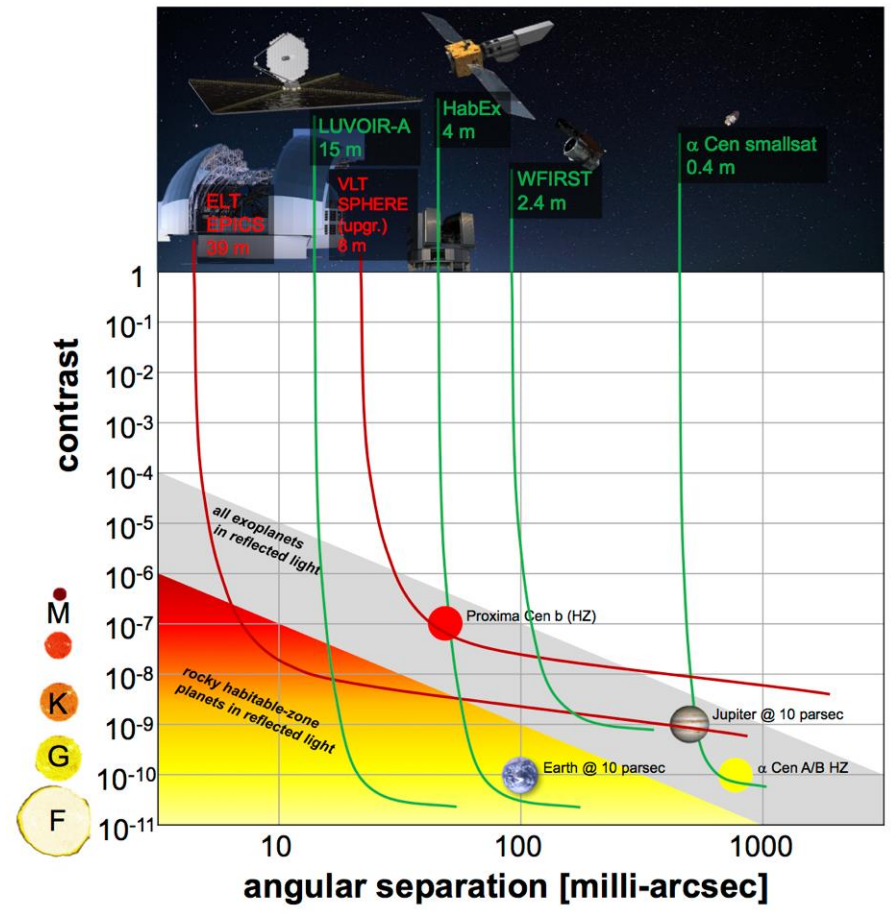
- [Section 5.1, Figure 5] The caption of Figure 5 notes that the curves are approximate and for illustration, which is helpful; consider adding a similar caution in the text when Figure 5 is invoked to support the claim that space enables 10^-10 contrast, since the figure does not itself demonstrate this.
Circularity Check
No significant circularity: the white paper's science requirements and feasibility discussion rest on external mission studies, external yield modeling, and independent biosignature literature, with author self-citations limited to expertise inventories.
full rationale
The paper is an advocacy white paper, not a derivation. It defines a science requirement (contrast 10^-10 at 80-100 mas) from an independent estimate of Earth-twin reflected-light contrast and target distances, then surveys existing NASA concept studies (HabEx, LUVOIR) and external yield modeling (Stark et al. 2019) to argue feasibility. The gap between demonstrated 10^-9 testbed contrast and required 10^-10 is explicitly acknowledged and framed as a technology development goal, not as a validated prediction. Biosignature interpretation is grounded in external literature (Meadows et al. 2018). Author self-citations appear only in lists of European expertise and in descriptions of prior instrument techniques; none of these citations supplies the central science requirement or the feasibility claim in place of independent evidence. No fitted parameter is renamed as a prediction, and no uniqueness theorem from the authors' prior work is invoked. The central claim is conditional advocacy: if such a contrast can be developed, then a sample of Earth twins could be characterized. That conditional is not circular.
Assumptions & free parameters
free parameters (1)
- eta_Earth (occurrence rate of temperate Earth-size planets) =
0.24
assumptions (5)
- domain assumption A twin Earth around a Sun-like star has a reflected-light contrast of at least 1e-10 (Section 4.3).
- domain assumption An internal coronagraph on a 4 to 8 m space telescope can be engineered to reach raw contrast 1e-10 at 2.5 lambda/D (Sections 4.3 and 5.2.2).
- domain assumption The nearby FGK star population contains enough temperate Earth-size planets for a survey of 75 to 150 stars to yield 10 to 20 targets (Section 4.3).
- domain assumption O2, water and methane can serve as biosignatures once abiotic production mechanisms are ruled out by environmental context (Section 4.2).
- domain assumption Ground-based ELTs cannot characterize Earth twins around solar-type stars (Sections 3.2 and 4).
Cite this review
Pith. "Pith review of ESA Voyage 2050 White Paper: Detecting life outside our solar system with a large high-contrast-imaging mission." pith.science (2026). https://pith.science/paper/AGABEOG4
@misc{pith2026190801803,
  author       = {Pith},
  title        = {Pith review of: ESA Voyage 2050 White Paper: Detecting life outside our solar system with a large high-contrast-imaging mission},
  year         = {2026},
  howpublished = {\url{https://pith.science/paper/AGABEOG4}},
  note         = {Machine review of arXiv:1908.01803}
}
read the original abstract
In this white paper, we recommend the European Space Agency plays a proactive role in developing a global collaborative effort to construct a large high-contrast imaging space telescope, e.g. as currently under study by NASA. Such a mission will be needed to characterize a sizable sample of temperate Earth-like planets in the habitable zones of nearby Sun-like stars and to search for extraterrestrial biological activity. We provide an overview of relevant European expertise, and advocate ESA to start a technology development program towards detecting life outside the Solar system.
Figures


Figures from the paper (4 more)


Reference graph
Works this paper leans on
-
[1]
Polarimetry of Stars and Planetary Systems
Alonso et al. 2004, ApJ, 613, L153 Amara & Quanz, 2012, MNRAS, 427, 948 Anglada-Escudé et al. 2016, Nature, 536, 437 Bakos et al. 2002, PASP, 114, 974 Batalha et al. 2011, ApJ, 729, 27 Baudoz et al. 2006a, Proc. IAU 200, 553 Baudoz et al. 2006b, PASP, 118, 765 Baudoz et al. 2018, Proc. SPIE, 107062O Beuzit et al. 2019 A&A submitted Boccaletti et al. 2004,...
arXiv 2004
Reviewed August 14, 2026 · model on record in the stance chip above.
Discussion (0). Continue with ORCID to comment.