REVIEW 3 major objections 4 minor 25 references
Jenny 5 -- the robot
T0 review · 3 major / 4 minor · reviewed 2026-08-14 · deepseek-v4-flash
Pith's one-line read The paper reports a working, fully open-source almost-humanoid robot and claims its complete build data is public.
desk verdict A transparent build report for an open-source hobby/research robot; useful as documentation, but not a research paper, and the reproducibility claim is unverified. read the letter →
The pith
A machine-rendered reading of the paper's core claim, the machinery that carries it, and where it could break.
The reading
What carries the argument
The central object is Jenny 5 v3 itself, an almost-humanoid robot whose design is meant to be the reusable artifact. The load-bearing mechanism is the complete open-source hardware and software stack: parameterized geometry files that let joint angles be edited and re-rendered; the asynchronous Scufy firmware, which turns each motor and sensor into a command-response controller over serial; the Scufy Lib C++ library that wraps those firmware messages in events; and the motor-control boards with their library for the platform and leg. Together these components make every degree of freedom addressable by software, which is what lets the paper's claims about rebuildability and programmability be tested by a third party.
What would settle it
Attempt a from-scratch rebuild using only the posted files and listed materials; if a builder cannot assemble a working tracked robot with two independently movable 7-DOF arms, a compressible leg, and a responsive head without consulting the designer, the core claim would be falsified. A quicker check is to load the CAD project and verify that every stated degree of freedom, including the leg, shoulder, elbow, gripper, and head, appears as a movable joint in the rendered model.
Extended reading notes
Core claim
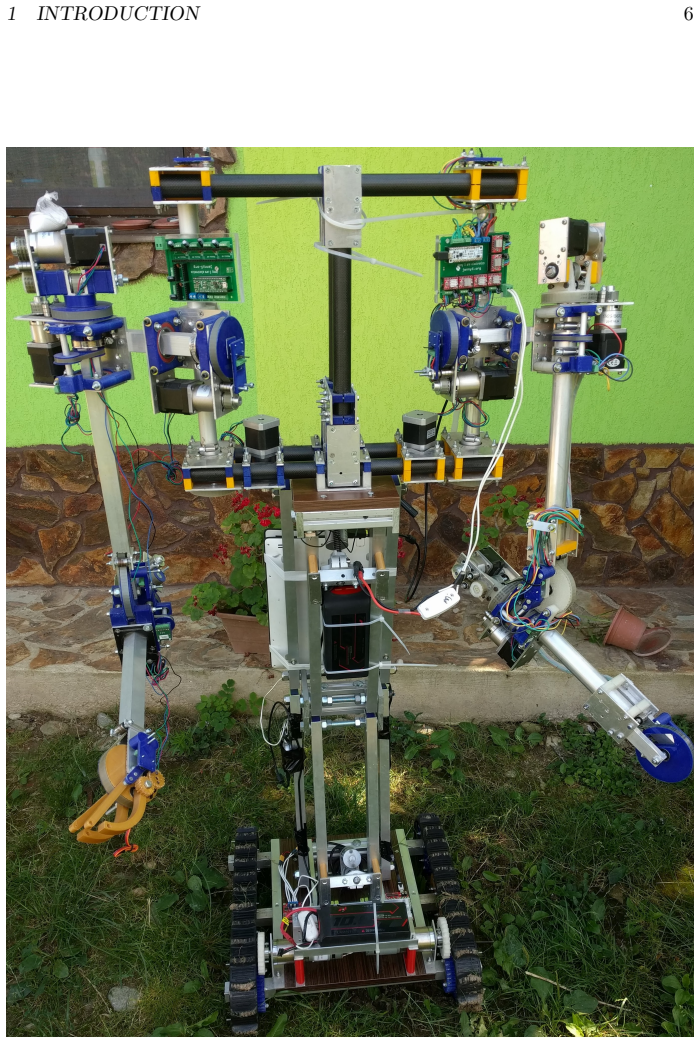
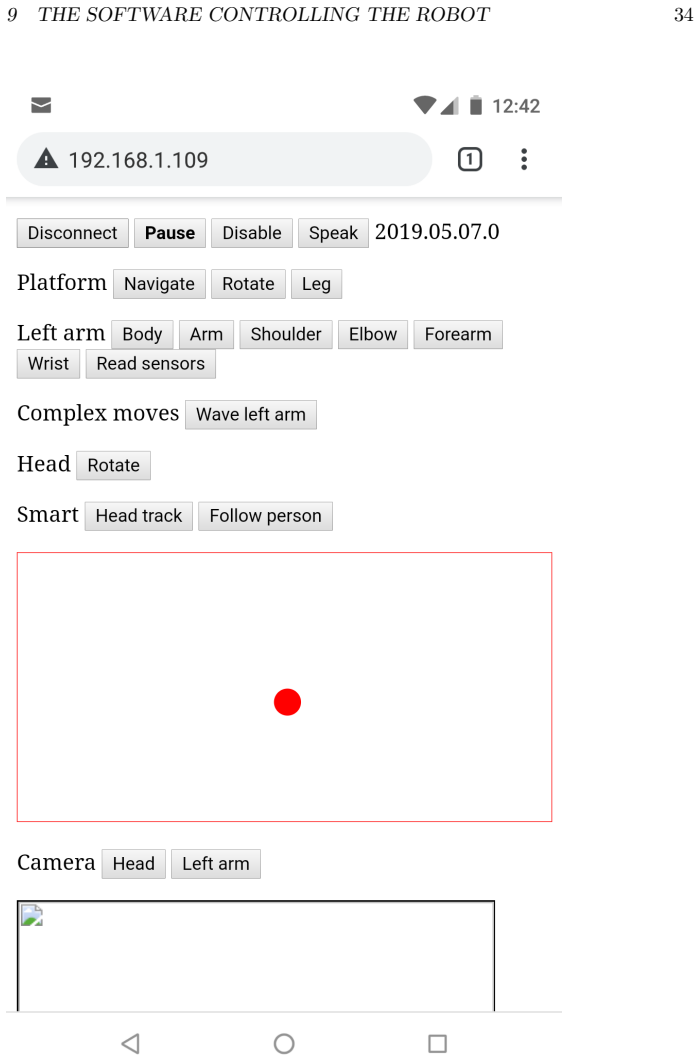
On its own terms, the paper establishes that the current iteration (v3) of Jenny 5 is a working open-source robot with a rubber-tracked platform driven by two DC gearmotors, a leg powered by two 750 N linear actuators, two 7-DOF arms with magnetic rotary encoders at each joint, grippers, a two-axis head with a camera and ultrasonic sensor, and a laptop acting as the brain. It claims the complete design is freely available: parameterized CAD models, custom PCB layouts, the Scufy Arduino firmware and the Scufy Lib PC library, a WebSocket server with an HTML5 client that can be driven by a smartphone's gyroscope or voice, and a bill of materials. The paper also reports measured performance, such as a roughly 11-second full up-down arm move and the ability to lift over 3.5 kg at 40 cm, and identifies stability and back-drive limitations that currently constrain the design.
Load-bearing premise
The load-bearing premise is that the publicly released CAD files, electronics, firmware, and bill of materials are complete and consistent enough for someone else to rebuild the robot; the paper's own note that the assembly manual is still under construction and that some quantities are approximate makes this the fragile point.
Editorial extensions
If this is right
- A third party with access to the public files and the listed materials can assemble a 40 kg tracked robot with two 7-DOF arms and a head for under $2500, excluding the onboard computer.
- Each layer, CAD, firmware, PC library, and web client, can be reused independently; the Scufy firmware in particular is a general stepper, servo, and sensor controller rather than a Jenny 5-specific program.
- The measured arm performance, lifting more than 3.5 kg at 40 cm and taking about 11 seconds for a full up-down sweep, gives a concrete baseline for robotic-arm design comparisons.
- The face-centering and person-following behaviors demonstrate that the robot can execute closed-loop, vision-guided motion using its existing sensors and webcams.
Reading between the lines
- If the files are as complete as claimed, Jenny 5 could serve as a reproducible baseline platform in robotics education, letting many labs start from identical hardware; the paper does not itself draw this conclusion.
- Because the CAD geometry is parameterized in terms of joint angles, one could generate the robot's configuration space as a set of rendered poses and use those images for simulation-to-real transfer; this is an extension beyond the text.
- The documented trade-off between gearbox reduction, back-drive resistance, and speed suggests a testable design rule: replacing the 50:1 gearboxes with 27:1 ones should reduce actuation time while preserving similar torque limits, a change the paper lists as planned future work.
- The stated instability when the leg is extended implies that adding a controllable center-of-mass shift would be a natural next step toward faster and safer locomotion; the paper lists body movement as a future task.
Signed reviews
Editorial analysis
A structured set of objections, weighed in public.
Referee Report
Summary. The paper describes Jenny 5, an open-source, quasi-humanoid mobile robot developed by the author. The robot consists of a tracked mobile platform, a two-motor telescoping leg, two 7-DOF arms with grippers, a 2-DOF head, and an onboard laptop as its computing brain. The paper's central claim is that the complete design—OpenSCAD CAD files, Arduino firmware (Scufy), a PC control library (Scufy Lib), custom PCB layouts (Fritzing), an HTML5/WebSocket control interface, a bill of materials (BOM), and an assembly manual—is freely available under an open license, and that the robot can be built for less than 2500 USD in materials. The text provides a component-by-component hardware description, electronics list, software command reference, and some design calculations (e.g., arm torque and speed). The paper is written as a project snapshot and does not present experimental validation, measured performance data, or a comparison with other robotic platforms.
Significance. If the repository and documentation are complete and accurate, the paper would provide a useful open-source reference design for a low-cost 20-motor humanoid research platform. The author has made a commendable effort to share CAD, firmware, library, PCB, and client code under the MIT license, and the included torque and speed calculations give a concrete quantitative basis for the design's capabilities. The paper also ships pointers to publicly accessible repositories and datasheets, which aids reproducibility in principle. The main significance, therefore, hinges on whether a third party can actually rebuild the robot from the provided materials; this is exactly the point that the manuscript itself leaves unverified.
major comments (3)
- [Section 2 and Section 5.1] The central claim of the paper is that Jenny 5 is a fully open-source, low-cost, rebuildable robot, but the manuscript explicitly states that the assembly manual 'is under construction and will not be completed until the robot is completed' (§2) and that the BOM quantities 'are not always exact' with details deferred to that same unavailable manual (§5.1). Because a third-party build depends on exactly this documentation—assembly sequence, wiring, calibration, and a known-good build log—the load-bearing reproducibility claim is not currently supported by the evidence in the paper. The manuscript should either provide a completed assembly manual and an itemized, exact BOM, or the claims should be narrowed to describe a documented design snapshot rather than a complete reproducible build.
- [Section 1 and Section 5.1/Table 2] The '<2500 USD' materials cost claim has no auditable basis: the BOM is a Google Spreadsheet but no itemized cost breakdown or per-part pricing is given, and Table 2 lists quantities only as 'Many', 'Several', or 'About 2 kgs'. Since low cost is a central advertised property of the robot, the paper should include a concrete cost table (with unit prices and totals, or a date-stamped price list from the referenced suppliers). Without this, the low-cost claim is not verifiable.
- [Section 3 and Section 5.5] The arm lifting specification in Table 1 ('<1kg when fully extended') appears inconsistent with the statement in §5.5 that experiments lifted 'more than 3.5kg at 40cm' and that a motor can 'lift about 9kgs at 70cm' as a theoretical upper bound. The paper should reconcile these numbers by explicitly giving the torque-vs-distance relationship (e.g., a two-point torque estimate) and clarifying which value is measured, which is theoretical, and how the spring assistance affects the specification. Also, the torque calculation of '91 N.cm' at a 70 cm arm length has a unit error: 6370 N.cm divided by 70 cm is 91 N, not 91 N.cm.
minor comments (4)
- [Section 5.5] There is a grammatical typo: 'it means that we can about 7.5 complete rotations in 1 second' should read 'we can make about 7.5 complete rotations in one second.' The following speed calculation is otherwise consistent.
- [Table 2] The entry 'About 2 kgs' for PLA is informally worded; use 'approximately 2 kg' for consistency with technical writing.
- [Figure 4 and Figure 8] These figures contain multiple panels (lateral/frontal view; design/implementation) but the sub-panels are not labeled (a), (b), etc., which makes it hard to reference specific views in the text.
- [Section 9.2.9] The code example contains a hard-coded timeout 'NUMSECONDSTO WAITFORCONNECTION' and a 'Game over' message in strings; these are acceptable in source code but should be formatted consistently in the paper (e.g., as a listing with proper font).
Circularity Check
No circularity found: the paper is a descriptive engineering report with no predictive derivation, fitted model, or load-bearing self-citation chain that reduces to its own inputs.
full rationale
This paper contains no derivation chain, model fitting, or predictive claim that could be circular. It is a direct description of an engineered robot, its CAD files, firmware, electronics, and bill of materials, with citations to external component datasheets and third-party software tools. The only self-referential items are pointers to the author's own GitHub repositories and website, which serve as the open-source deliverables rather than as evidence for a derived result. The reader's skepticism about reproducibility, such as the assembly manual being 'under construction' and BOM quantities being approximate, is a completeness or verification concern, not a circularity concern, because no result is claimed to follow from those documents by construction. Therefore, no circular step can be identified under the stated criteria, and the appropriate score is 0.
Assumptions & free parameters
assumptions (2)
- domain assumption Cited datasheet values for motors, gearboxes, and sensors are accurate (e.g., [24] torque and efficiency figures).
- domain assumption The provided CAD and firmware files are internally consistent and correspond to the described physical build.
Cite this review
Pith. "Pith review of Jenny 5 -- the robot." pith.science (2026). https://pith.science/paper/PPPDVVDY
@misc{pith2026190801826,
  author       = {Pith},
  title        = {Pith review of: Jenny 5 -- the robot},
  year         = {2026},
  howpublished = {\url{https://pith.science/paper/PPPDVVDY}},
  note         = {Machine review of arXiv:1908.01826}
}
read the original abstract
Jenny 5 is a fully open-source robot intended to be used mainly for research but can also act as a human assistant. It has a mobile platform with rubber tracks, a flexible leg, two arms with 7 degrees of freedom each and head with 2 degrees of freedom. The robot is actuated by 20 motors (DC, steppers and servos) and its state is read with the help of many sensors. The robot also has 3 webcams for computer vision tasks. In this paper the current state of the robot is described.
Figures


Figures from the paper (6 more)


Reference graph
Works this paper leans on
-
[1]
github.io, last accessed on 2019.06.10
Jenny 5 website, https://jenny5.org or https://jenny5-robot. github.io, last accessed on 2019.06.10
work page 2019
-
[2]
Source code for Jenny 5 robot on GitHub, https://github.com/ jenny5-robot, last accessed on 2019.06.10
work page 2019
-
[3]
Scufy - the Arduino firmware, https://github.com/jenny5-robot/ Scufy, last accessed on 2019.06.10
work page 2019
-
[4]
Scufy Lib, https://github.com/jenny5-robot/Scufy-Lib, last accessed on 2018.11.18
work page 2018
-
[5]
RoboClaw control library, https://github.com/jenny5-robot/ jenny5-control-module, last accessed on 2018.11.18
work page 2018
-
[6]
Short circuit movie, https://www.imdb.com/title/tt0091949/, last ac- cessed on 2017.04.15
work page 2017
-
[7]
OpenSCAD, https://www.openscad.org, last accessed on 2018.11.18
work page 2018
-
[8]
Arduino, https://www.arduino.cc, last accessed on 2017.04.15
work page 2017
Show all 25 references
-
[9]
Arduino Nano, https://www.arduino.cc/en/Guide/ArduinoNano, last access on 2018.11.10
2018
-
[10]
Pololu A-Star, https://pololu.com/product/3145, last accessed on 2018.11.10
2018
-
[11]
Terra Ranger One, https://teraranger.com/, last accessed on 2017.04.15
2017
-
[12]
OpenCV library, https://opencv.org, last accessed on 2017.04.15
2017
-
[13]
A4988 Stepper Motor Driver Carrier, https://pololu.com/product/ 1182, last accessed on 2018.11.10
2018
-
[14]
RoboClaw website, http://www.basicmicro.com/, last accessed on 2019.06.10
2019
-
[15]
Sharp GP2Y0D805Z0F senzor, https://pololu.com/product/1132, last accessed on 2018.11.10
2018
-
[16]
Rotary Position Sensor, Magnetic, https://digikey.com/ product-detail/en/ams/AS5147-TS_EK_AB/AS5147-TS_EK_AB-ND/ 5452350, last accessed on 2018.11.10
2018
-
[17]
Eduard S, uic˘ a’s repositories on GitHub,https://github.com/eduardsui, last accessed on 2019.06.20
2019
-
[18]
TLSe, https://github.com/eduardsui/tlse, last accessed on 2019.06.20 REFERENCES 39
2019
-
[19]
Speech Recognition in HTML5, https://developer.mozilla.org/ en-US/docs/Web/API/Web_Speech_API, last accessed on 2018.11.18
2018
-
[20]
Fritzing, electronics designed software, http://fritzing.org/home/, last accessed on 2018.11.19
2018
-
[21]
Raspberry Pi, https://www.raspberrypi.org/, last accessed on 2018.11.19
2018
-
[22]
Generating certificates for iOS, https://github.com/mattdesl/ budo/blob/dcbc05866f583e172d6b46c898048436ab84ddae/docs/ command-line-usage.md#ssl-on-ios , last accessed on 2018.11.19
2018
-
[23]
MIT license, https://opensource.org/licenses/MIT, , last accessed on 2019.07.08
2019
-
[24]
Stepper Online website, https://www.omc-stepperonline.com, last ac- cessed on 2019.07.08
2019
-
[25]
Nick Johantgen, Torque vs speed of stepper motors, Oriental Motor USA Corporation, https://www.orientalmotor.com/stepper-motors/ technology/speed-torque-curves-for-stepper-motors.html , last ac- cessed on 2019.07.08
2019
Reviewed August 14, 2026 · model on record in the stance chip above.
Discussion (0). Continue with ORCID to comment.