REVIEW 2 major objections 3 minor 27 references
Overview of Gluon Helicity Measurements at STAR
T0 review · 2 major / 3 minor · reviewed 2026-08-14 · deepseek-v4-flash
Pith's one-line read STAR's measurements of the double-spin asymmetry $A_{LL}$ provide evidence that gluons carrying a large momentum fraction of the proton are positively polarized, and extend sensitivity to previously unexplored low-$x$ gluons.
desk verdict A faithful, readable STAR status summary with no new physics; its real problem is unattributed borrowed passages, not the science. read the letter →
The pith
A machine-rendered reading of the paper's core claim, the machinery that carries it, and where it could break.
The reading
What carries the argument
The central object is the longitudinal double-spin asymmetry $A_{LL} = (\sigma^{++} - \sigma^{+-})/(\sigma^{++} + \sigma^{+-})$, whose numerator is sensitive to the polarized gluon distribution $\Delta g(x)$ through the collinearly factorized expression in Eq.~1.3, which convolves helicity parton distribution functions, the perturbatively calculable parton-level asymmetry $\hat{a}_{LL}$, and fragmentation functions. The argument works because inclusive jet, dijet, and pion production at STAR's kinematics are dominated by quark-gluon and gluon-gluon subprocesses, so a positive measured $A_{LL}$ at high jet transverse momentum maps onto positive $\Delta g$ at the corresponding $x$; forward pion production, where a soft low-$x$ gluon scatters off a hard mid/high-$x$ quark, extends the $x$ reach down to about $10^{-3}$.
What would settle it
If a future forward dijet $A_{LL}$ measurement at the upgraded STAR, which reconstructs the parton momentum fractions $x_1$ and $x_2$ directly, found $\Delta g(x)$ consistent with zero in the $x \sim 0.001$--$0.01$ region while the forward pion $A_{LL}$ stayed positive, the quark-gluon dominance assumption in that region would be falsified.
Extended reading notes
Core claim
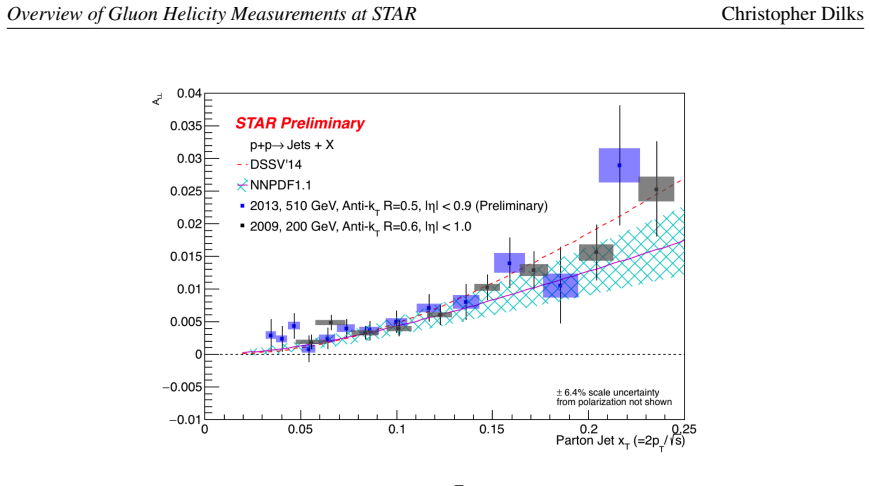
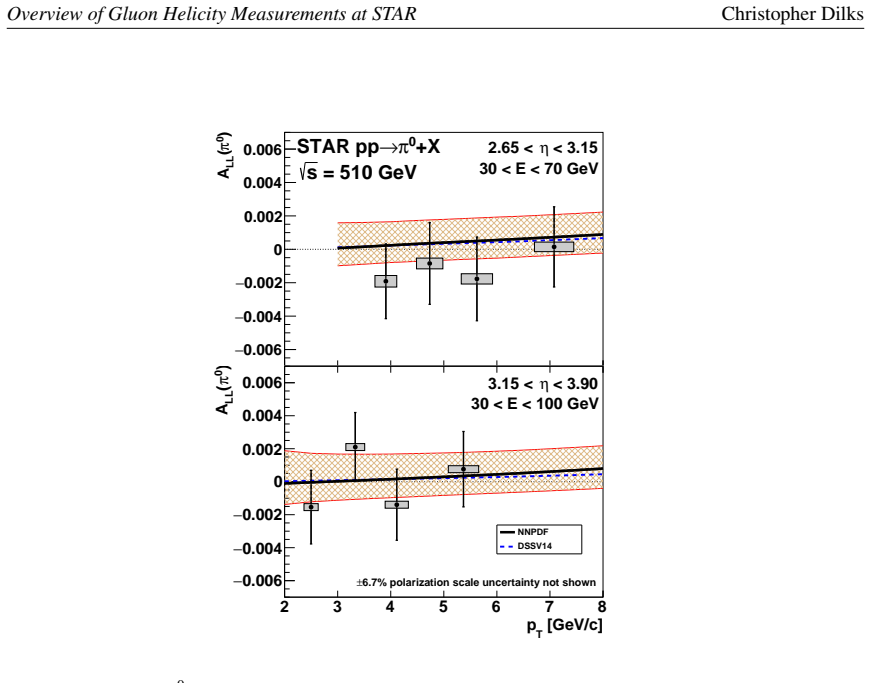
The central discovery claimed is that STAR's $A_{LL}$ measurements give evidence for a positive gluon helicity distribution at high momentum fraction: inclusive jet and dijet asymmetries at central rapidity at $\sqrt{s} = 200$ and 510 GeV lie systematically above the earlier DSSV08 prediction, indicating $\Delta g(x) > 0$ for $x > 0.05$. For forward neutral pion production at $2.65 < \eta < 3.9$ at $\sqrt{s} = 510$ GeV, where the dominant subprocess is a soft low-$x$ gluon scattering off a hard mid-to-high-$x$ quark, the measured $A_{LL}$ agrees with the DSSV14 and NNPDFpol1.1 extrapolations and provides the first experimental glance at gluons with $x$ down to about $10^{-3}$. Because each measured bin is dominated by quark-gluon and gluon-gluon subprocesses, the paper concludes the data will help constrain the size and, in the intermediate-rapidity dijet case, the shape of $\Delta g(x)$.
Load-bearing premise
The whole interpretation depends on collinear factorization and on each measured $A_{LL}$ bin being dominated by quark-gluon and gluon-gluon subprocesses, so that the asymmetry can be read as reporting on $\Delta g(x)$; if higher-order corrections, fragmentation effects, or non-factorizing contributions are large in the forward region, the claimed $x$ reach and $\Delta g$ sensitivity would not hold.
Editorial extensions
If this is right
- The existing STAR measurements support a positive $\Delta g(x)$ for $x > 0.05$ and will tighten global constraints on the size and shape of the gluon helicity distribution.
- Intermediate-rapidity dijets at $\sqrt{s} = 200$ and 510 GeV probe $x$ down to about 0.01 and 0.004, respectively, giving the first shape information in a region where $\Delta g$ was poorly constrained.
- The forward $\pi^0$ $A_{LL}$ result at $\sqrt{s} = 510$ GeV provides the first sensitivity to gluons at $x \sim 10^{-3}$; its agreement with global-fit extrapolations means the next global analyses can incorporate this region.
- The planned STAR forward tracking and calorimeter upgrade will make forward jet and dijet measurements possible, which will probe $x \sim 10^{-3}$ with direct parton kinematics rather than through fragmentation assumptions.
- Taken together, the measurements are expected to yield a more accurate determination of the gluon helicity contribution $\Delta G$ to the proton spin.
Reading between the lines
- If the low-$x$ agreement between forward pion data and current extrapolations holds as statistics grow, the proton spin puzzle would shift from the gluon term $\Delta G$ to the orbital angular momentum term $L$, which remains unmeasured.
- The claim that the forward pion asymmetry reports on gluon polarization rests on the dominance of quark-gluon scattering; a decisive cross-check would be forward dijet $A_{LL}$ after the STAR upgrade, since dijets reconstruct partonic $x$ directly.
- A further testable extension would be to measure forward $\pi^0$ $A_{LL}$ at $\sqrt{s} = 200$ GeV, where the reach in $x$ differs, to verify the $x$-scaling implied by the factorized formula in Eq.~1.3.
Signed reviews
Editorial analysis
A structured set of objections, weighed in public.
Referee Report
Summary. This paper is a conference overview from the STAR Collaboration summarizing recent measurements of the longitudinal double-spin asymmetry A_LL in polarized proton-proton collisions at RHIC. It covers inclusive jet and dijet measurements at central and intermediate pseudorapidity at sqrt(s)=200 and 510 GeV, as well as forward pi0 measurements at sqrt(s)=510 GeV, and relates these to constraints on the gluon helicity distribution Delta g(x). The paper claims that positive gluon polarization is established for x above about 0.05, that intermediate-rapidity and forward measurements extend sensitivity toward x~0.01 and x~1e-3, and that the forward pi0 results, while consistent with current global-fit extrapolations, will help constrain Delta g in future global analyses. No new data or derivations are presented; the paper is a status report with a summary table of analyses.
Significance. As an overview of the published and preliminary STAR spin-physics results, the paper is a useful and, in its qualitative statements, accurate record. The physics content is consistent with the cited peer-reviewed measurements, and the paper is careful in Section 4 to describe the forward pi0 results as agreeing with extrapolations and as inputs to future global fits rather than as an immediate low-x constraint. The paper explicitly credits many primary measurements and includes a helpful table of analysis statuses. Its value is, however, limited by the lack of any new quantitative material and, more importantly, by the extensive unattributed verbatim reuse of material from another talk, which makes the manuscript unsuitable as a standalone document until that is fixed.
major comments (2)
- [Sections 2–4] Large portions of Sections 2 through 4 are taken verbatim from A. Quintero, PoS DIS2018, 144 [22], including the running header 'Gluon polarization measurements at STAR Amilkar Quintero', Quintero's figure captions, and a compile timestamp 'Fri Mar 16 15:07:53 2018'. These passages appear without quotation marks or body-text attribution. This is not a mere typographical issue: it makes the provenance of the summary unclear and prevents the reader from treating the manuscript as an independent account of the STAR results. The affected text must be rewritten in the author's own words or explicitly attributed to [22] with quotation marks.
- [Section 2 vs. Section 5] The inserted Quintero passages create internal inconsistencies in the analysis-status summary, which is the paper's main content. For example, the Quintero text in Section 2 states that the analysis of the 2015 sqrt(s)=200 GeV data 'is being finalized for a preliminary release,' while Section 5 and Table 1 list the 2015 analyses as 'Underway.' After the provenance cleanup, the statuses must be harmonized so that the table and the text describe the same state of each analysis.
minor comments (3)
- [Abstract and Section 4] The abstract says the program will 'for the first time provide insight into the low-x contribution,' while Section 4 more cautiously says the forward pi0 results 'agree with the extrapolated theory curves' and 'will help constrain' Delta g in a future global analysis. The wording should be aligned so that the abstract does not overstate the published status of the low-x constraint.
- [Table 1] Table 1 is difficult to parse because the row labels 'Jets Dijets Dijets Pions Pions Dijets' are repeated across the columns without clear correspondence to the year/energy rows. Restructure the table so each observable is identified explicitly for each energy and year, or split it into separate tables for 200 GeV and 510 GeV.
- [References] The reference list is inconsistent in formatting: some entries include the full collaboration 'et al. [STAR Collaboration]' and others do not, and entry [24] is cited as 'in these proceedings (2018)' without a title or page number. Standardize the reference style.
Circularity Check
No circularity: the overview compares published STAR asymmetries to external global fits; no in-paper fit or derivation reduces to its own inputs.
full rationale
The paper is a conference overview with no new fit or derivation. Eq. (1.3) is the standard collinear-factorization expression for A_LL; it is used to interpret published STAR asymmetries, not derived from them. The central physics statements compare STAR data to external global fits (DSSV08/DSSV14, NNPDFpol1.1) that are not fitted in this paper: Section 2 states that the 2009 inclusive-jet A_LL is 'systematically above the DSSV08 global analysis fit', and Section 4 states that forward pi0 data 'agree with the extrapolated theory curves, within statistical and systematic uncertainties' and 'will help constrain the size of Delta g(x)' in a future global analysis. The low-x-reach claim is therefore an explicit forward-looking sensitivity statement, not a retrofitted prediction. The paper does invoke STAR self-citations for the underlying measurements, but these are primary published results with independently computed external theory curves; the self-citations are descriptive and not load-bearing. The unattributed verbatim passage from A. Quintero's talk [22] (including 'Gluon polarization measurements at STAR Amilkar Quintero' and a compile timestamp) is a serious provenance/completeness defect in the manuscript, but it provides no circular reduction of the physics claims. No fitted parameter is renamed as a prediction, and no quantity in Eq. (1.3) is defined in terms of the measured A_LL. Score 0.
Assumptions & free parameters
assumptions (4)
- domain assumption Collinear factorization of the proton-proton cross section (Eq. 1.3)
- domain assumption Jaffe-Manohar spin sum rule (Eq. 1.1)
- domain assumption Dominance of quark-gluon and gluon-gluon subprocesses in STAR kinematics
- domain assumption DSSV14 and NNPDFpol1.1 global fits provide reliable benchmark extrapolations
Cite this review
Pith. "Pith review of Overview of Gluon Helicity Measurements at STAR." pith.science (2026). https://pith.science/paper/ZDG7I22P
@misc{pith2026190801830,
  author       = {Pith},
  title        = {Pith review of: Overview of Gluon Helicity Measurements at STAR},
  year         = {2026},
  howpublished = {\url{https://pith.science/paper/ZDG7I22P}},
  note         = {Machine review of arXiv:1908.01830}
}
abstract
The contribution to the spin of the proton from the gluon helicity is starting to come into focus: for gluons carrying a large fraction $x$ of the proton momentum, evidence of positive gluon polarization has been observed, via measurements of the longitudinal double-spin asymmetry $A_{LL}$ for inclusive jet and dijet production. $A_{LL}$ is sensitive to the polarized gluon distribution function, $\Delta g(x)$, and while it is positive at high $x$, it is not well constrained for $x<0.05$. Recent measurements at STAR of observables originating dominantly from quark-gluon and gluon-gluon subprocesses aim to improve the precision of $\Delta g(x)$ at high $x$, as well as for the first time provide insight into the low-$x$ contribution. $A_{LL}$ measurements of inclusive jets and dijets at midrapidity $(|\eta|<1)$ and intermediate rapidity $(0.8<\eta<2)$ at STAR at $\sqrt{s}=200$ and $510$ GeV will be shown, along with the statuses of ongoing analyses; these measurements will help improve the $\Delta g(x)$ precision for $x\gtrsim 0.01$. Recent $\pi^0$ $A_{LL}$ measurements in the forward region $(2.65<\eta<3.9)$ at $\sqrt{s}=510$ GeV will also be presented, which probe $\Delta g(x)$ down to $x{\sim}10^{-3}$. Comparisons of these results to recent global analyses and extrapolations will be discussed.
Figures

Reference graph
Works this paper leans on
- [22]
- [1]
-
[2]
D. de Florian, R. Sassot, M. Stratmann and W. V ogelsang,Phys. Rev. Lett. 101, 072001 (2008)
work page 2008
-
[3]
D. de Florian, R. Sassot, M. Stratmann and W. V ogelsang,Phys. Rev. D 80, 034030 (2009)
work page 2009
- [4]
- [5]
-
[6]
R. D. Ball et al. [NNPDF Collaboration], Nucl. Phys. B 874, 36 (2013)
work page 2013
- [7]
Show all 27 references
-
[8]
de Florian, R
D. de Florian, R. Sassot, M. Stratmann and W. V ogelsang,Phys. Rev. Lett. 113, 012001 (2014)
2014
-
[9]
E. C. Aschenauer, R. Sassot and M. Stratmann, Phys. Rev. D 92, 094030 (2015)
2015
-
[10]
Adam et al
J. Adam et al. [STAR Collaboration], Phys. Rev. D 98, 032013 (2018)
2018
-
[11]
Adam et al
J. Adam et al. [STAR Collaboration], Phys. Rev. D 98, 032011 (2018)
2018
-
[12]
Bunce, N
G. Bunce, N. Saito, J. Soffer and W. V ogelsang,Ann. Rev. Nucl. Part. Sci. 50, 525 (2000)
2000
-
[13]
Dulat et al., Phys
S. Dulat et al., Phys. Rev. D 93, 033006 (2016)
2016
-
[14]
Babcock, E
J. Babcock, E. Monsay and D. W. Sivers, Phys. Rev. D 19, 1483 (1979)
1979
-
[15]
N. S. Craigie, K. Hidaka, M. Jacob and F. M. Renard, Phys. Rept. 99, 69 (1983)
1983
-
[16]
C. W. Kao, S. I. Nam, F. J. Jiang and D. J. Yang, EPJ Web Conf. 66, 06008 (2014)
2014
-
[17]
Kretzer, Acta Phys
S. Kretzer, Acta Phys. Polon. B36, 179 (2005)
2005
-
[18]
Aschenauer et al., The RHIC spin program: achievements and future opportunities, (2015)
E.C. Aschenauer et al., The RHIC spin program: achievements and future opportunities, (2015)
2015
-
[19]
Aidala, G
C. Aidala, G. Bunce et al., Research plan for spin physics at RHIC, (2005)
2005
-
[20]
Adamczyk et al., Phys
L. Adamczyk et al., Phys. Rev. Lett. 115, 092002 (2015)
2015
-
[21]
Chang, Int
Z. Chang, Int. J. Mod. Phys. Conf. Ser . 40, 1660021 (2016)
2016
-
[23]
Adamczyk et al., Phys
L. Adamczyk et al., Phys. Rev. D 95, 071103 (2017)
2017
-
[24]
Lin, in these proceedings (2018)
T. Lin, in these proceedings (2018)
2018
-
[25]
Adamczyk et al
L. Adamczyk et al. [STAR Collaboration], Phys. Rev. D 89, 012001 (2014)
2014
-
[26]
STAR Collaboration, The star forward calorimeter system and forward tracking system proposal, STAR Note SN0648, (2017)
2017
-
[27]
Barish, in these proceedings (2018)
K. Barish, in these proceedings (2018). 6
2018
Reviewed August 14, 2026 · model on record in the stance chip above.
Discussion (0). Continue with ORCID to comment.