REVIEW 3 major objections 4 minor 40 references
Neuroscience-inspired online unsupervised learning algorithms
T0 review · 3 major / 4 minor · reviewed 2026-08-14 · deepseek-v4-flash
Pith's one-line read Similarity-matching objectives make online unsupervised learning local and biologically plausible, unifying PCA, sparse coding, nonnegative ICA, clustering, and manifold tiling.
desk verdict A clear, well-written survey of the authors' own similarity-matching framework; the central 'solve' claim outruns the proof status, which the authors themselves concede. read the letter →
The pith
A machine-rendered reading of the paper's core claim, the machinery that carries it, and where it could break.
The reading
What carries the argument
The central object is the similarity-matching objective, in which the squared difference between input pair similarities $x_t^\top x_{t'}$ and output pair similarities $y_t^\top y_{t'}$ is minimized. The load-bearing step is the variable-substitution trick: completing the square in this pairwise objective introduces an auxiliary feedforward matrix $W$ and a lateral matrix $M$, converting the pairwise problem into a minimax problem whose per-time-step terms factorize. Gradient descent on $W$ and gradient ascent on $M$ yield local, Hebbian/anti-Hebbian learning rules, and the recurrent activity dynamics $\dot{y}_t = W x_t - M y_t$ map onto a single-layer network with lateral inhibition. This trick is what makes the pairwise objective amenable to online learning.
What would settle it
Run the online similarity-matching algorithm on a single long, slowly varying stimulus sequence rather than shuffled i.i.d. samples, and observe whether the output stays in the principal subspace and whether the weights converge; clear divergence or drift under correlation would falsify the biological reach of the claims.
Extended reading notes
Core claim
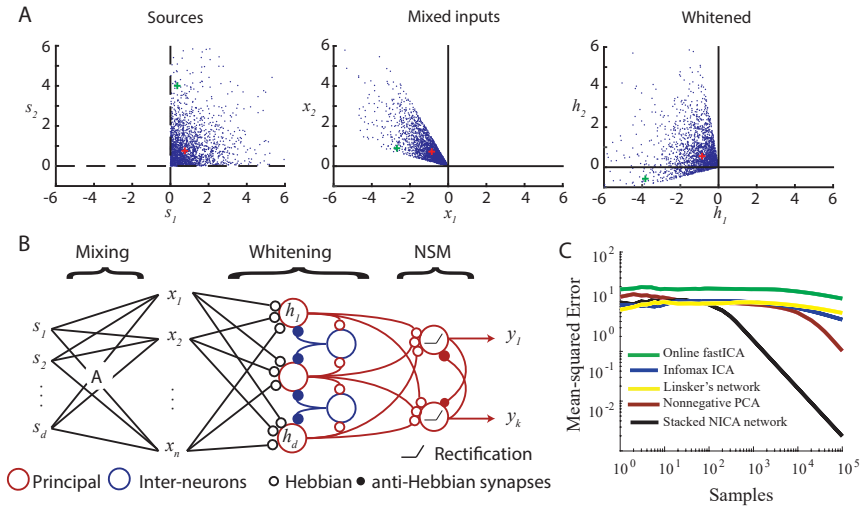
The central claim is that similarity-based cost functions, whose first term aligns pairwise similarities of outputs with pairwise similarities of inputs, provide a unified normative framework for biologically plausible online unsupervised learning. The key discovery is that a variable-substitution trick rewrites the pairwise objective into an online minimax problem in which output activities settle by recurrent dynamics and the synaptic weights update by purely local rules. Depending on the constraints and regularizers chosen, the same machinery yields PCA, sparse and nonnegative feature extraction, independent component analysis for nonnegative sources, clustering, and manifold-tiling receptive fields. Because each algorithm is derived from an explicit objective, the offline solution is known, and the network architecture, activation functions, activity dynamics, and learning rules are all prescribed by the optimization.
Load-bearing premise
The online convergence and performance claims assume each data point is drawn independently from a stationary distribution; if real sensory streams are correlated in time, the derivations and benchmark results may not transfer.
Editorial extensions
If this is right
- If similarity matching is normative for cortex, then single-layer excitatory-inhibitory circuits are sufficient for a broad set of unsupervised tasks, including PCA, nonnegative ICA, clustering, and manifold learning.
- The same optimization procedure gives a design recipe: choose a similarity-based objective with biological constraints, and the minimax reformulation hands you a network architecture and local learning rules.
- Because the offline optimum is known for these objectives, the derived networks inherit guarantees that heuristically constructed local circuits lack, such as the principal-subspace solution for unconstrained similarity matching.
- Benchmarks on datasets such as MNIST, CIFAR-10, and forest-cover data indicate these algorithms are competitive with state-of-the-art online PCA and kernel clustering methods, not merely biologically suggestive.
- Extending the family to spiking neurons and to supervised or reinforcement learning settings is the natural next step the authors flag for making the approach useful for general-purpose learning.
Reading between the lines
- If locality always follows from similarity-based objectives, then the search for biologically plausible learning rules can be recast as a search for objectives whose pairwise term is alignable, and non-alignable objectives become a useful diagnostic for non-biological models.
- The same variable-substitution trick may apply to objective functions beyond dot-product similarities, such as kernel- or graph-based pairwise losses, yielding novel online local rules for structured prediction.
- A testable extension is to ask whether correlated temporal streams break convergence; if they do, augmenting the objective with a temporal smoothing term could restore robustness and make the family applicable to natural video.
- The hard- and soft-clustering results suggest a continuum from clustering to dimensionality reduction, and a future theory could quantify how receptive-field overlap depends on the threshold $\alpha$ and the output capacity.
Signed reviews
Editorial analysis
A structured set of objections, weighed in public.
Referee Report
Summary. This paper presents a review and synthesis of the authors' work on "similarity-based" objective functions for unsupervised learning. The central idea is to define unsupervised tasks as matching pairwise input similarities to pairwise output similarities, and then derive online neural-network algorithms via alternating stochastic gradient descent/ascent. The paper derives the PCA case in detail: Eq. (6) is transformed by a variable-substitution trick into the minimax problem (9), whose iterative solution yields the Hebbian/anti-Hebbian network (11)-(12). It then surveys extensions to whitening with interneurons, nonnegative similarity matching for sparse feature extraction and nonnegative ICA, clustering, manifold tiling, and kernelized variants. The abstract claims that this family of objectives and networks "solves" tasks such as linear dimensionality reduction, sparse/nonnegative feature extraction, blind nonnegative source separation, clustering, and manifold learning.
Significance. If the claims were fully established, this would be a valuable unifying normative account of biologically plausible online unsupervised learning, connecting local Hebbian/anti-Hebbian plasticity to a single objective family. The paper's strengths are the clean algebraic derivation of the PCA network from Eq. (6), the locality of the resulting learning rules (12), the explicit links to benchmarks (Figure 1D, Table 1, Figure 3C, Figure 4D), and the candid discussion of open problems. The significance is reduced by the gap between the abstract's "solve" and the proof status reported in the paper itself: global convergence of the online algorithms is not established, and for the PCA network only local linear stability is claimed. The value of the paper is therefore as a programmatic review and derivation template rather than as a proof that the listed tasks are solved by these networks.
major comments (3)
- [Abstract; §1; §3.3; §6] The statement that similarity-based cost functions and associated NNs "solve" unsupervised learning tasks is not supported by the proof status reported in the paper itself. Section 3.3 states: "Although no proof of convergence exists in the online setting, algorithm (11),(12) performs well on large-scale data," and Discussion challenge 1 states: "most of them lack global convergence proofs. Even for PCA networks we can only prove linear stability of the desired solution in the stochastic approximation setting." Since Eq. (9) is a nonconvex-nonconcave minimax problem, the offline uniqueness of the principal-subspace solution does not automatically transfer to the online gradient descent-ascent dynamics (11)-(12); stable spurious equilibria or limit cycles are not ruled out even under the i.i.d. assumption. The abstract and Section 1 should be revised to say that the framework provides normative derivations and empirical demonstrations, with convergence proven only locally, or a convergence proof must be supplied.
- [§3.2 (near Eq. (9)); §6] The sentence "This competition in a gradient descent/ascent algorithm results in the principal subspace projection which is the only stable fixed point of the corresponding dynamics [17]" is stronger than what the paper later claims. Discussion challenge 1 limits the result to "linear stability of the desired solution in the stochastic approximation setting." These two statements are not equivalent. Please state precisely which dynamical system (deterministic ODE, stochastic approximation, or the discrete-time update (11)-(12)) enjoys which stability property, and with what basin of attraction.
- [§4; §5.2; Discussion challenge 3] The central claim about biological online learning depends on the i.i.d. stationary-stream assumption that is acknowledged in Discussion challenge 3. The paper notes that real sensory streams are correlated time series, but the abstract and Section 1 do not qualify the "solve" claim accordingly. Since the algorithms are intended for online biological settings, the validity of the derived networks under temporal correlations is part of the load-bearing claim. Please either restrict the abstract's claim to the i.i.d. setting or provide experimental evidence on temporally correlated streams; without this, the extrapolation from the benchmarks to biological plausibility is not demonstrated.
minor comments (4)
- [Footnote 1 (Section 3.3)] The URLs in footnote 1 contain spaces ("online psp") and are not valid as printed; please correct them to the actual repository names.
- [§3.4, Eq. (14)] Equation (14) is presented as the Lagrange-multiplier form of the whitening constraint in Eq. (13), but (14) appears to involve a pairwise output-Gramian constraint rather than the average covariance constraint written in Eq. (13). Please clarify the derivation or correct the equation, since the emergence of interneurons is one of the paper's stated selling points.
- [§5.2, after Eq. (18)] The sentence "We can prove this result analytically" should be qualified by the conditions stated immediately after: the proof is for the limit k→∞ and for symmetric datasets such as the circle, sphere, and SO(3). As written, the claim is easy to over-read as applying to arbitrary datasets.
- [Table 2] The entry "Copositive output Grammian" uses a term that is never defined in the text; please define it or add a reference for readers unfamiliar with copositive matrices.
Circularity Check
No significant circularity: the similarity-matching network is derived by explicit algebraic identities and benchmarked against external algorithms.
full rationale
The central derivation is self-contained. Equations (7) and (8) are exact algebraic identities: the optimal W is W* = (1/T) Σ_t y_t x_t^T and the optimal M is M* = (1/T) Σ_t y_t y_t^T, so substituting them into the similarity-matching objective (6) yields the minimax objective (9)-(10) and, by gradient descent-ascent, the online network (11)-(12). No fitted parameter is relabeled as a prediction; the identification of (6) with PCA is a classical result supported also by external work [15], and the cited numerical comparisons (MNIST, CIFAR-10, Forest Cover Type) are against independent algorithms. The paper explicitly flags its own main limitation in the Discussion, stating that 'most of them lack global convergence proofs,' which shows that no convergence theorem is being smuggled in by citation. The many citations to the authors' prior work for the non-PCA extensions are pointers to previously published derivations and experiments, not definitions of the target results in terms of themselves. Thus there is no circular step under the required standard.
Assumptions & free parameters
free parameters (3)
- similarity threshold alpha =
not fitted; user-chosen
- learning rate eta =
not specified
- output dimensionality k =
user-chosen
assumptions (5)
- domain assumption Data points are independent across time and drawn from a stationary distribution.
- domain assumption Biological plausibility requires online, memory-limited processing and local synaptic update rules.
- domain assumption A threshold alpha exists that separates within-cluster from between-cluster pairwise similarities.
- domain assumption For NICA, the sources are nonnegative, independent, well-grounded, and the mixing matrix is full rank; whitening then produces an orthogonal rotation of the sources.
- standard math The similarity-matching objective (6) has no local minima other than the principal subspace solution.
Cite this review
Pith. "Pith review of Neuroscience-inspired online unsupervised learning algorithms." pith.science (2026). https://pith.science/paper/GKSDDXIS
@misc{pith2026190801867,
  author       = {Pith},
  title        = {Pith review of: Neuroscience-inspired online unsupervised learning algorithms},
  year         = {2026},
  howpublished = {\url{https://pith.science/paper/GKSDDXIS}},
  note         = {Machine review of arXiv:1908.01867}
}
read the original abstract
Although the currently popular deep learning networks achieve unprecedented performance on some tasks, the human brain still has a monopoly on general intelligence. Motivated by this and biological implausibility of deep learning networks, we developed a family of biologically plausible artificial neural networks (NNs) for unsupervised learning. Our approach is based on optimizing principled objective functions containing a term that matches the pairwise similarity of outputs to the similarity of inputs, hence the name - similarity-based. Gradient-based online optimization of such similarity-based objective functions can be implemented by NNs with biologically plausible local learning rules. Similarity-based cost functions and associated NNs solve unsupervised learning tasks such as linear dimensionality reduction, sparse and/or nonnegative feature extraction, blind nonnegative source separation, clustering and manifold learning.
Figures


Figures from the paper (2 more)


Reference graph
Works this paper leans on
-
[17]
C. Pehlevan, T. Hu, and D. Chklovskii, “A hebbian/anti-hebbian neural network for linear subspace learning: A derivation from multidimensional scaling of streaming data,” Neural Comput., vol. 27, pp. 1461–1495, 2015
work page 2015
-
[1]
The perceptron: a probabilistic model for information storage and organization in the brain
F. Rosenblatt, “The perceptron: a probabilistic model for information storage and organization in the brain.” Psychol. Rev., vol. 65, no. 6, p. 386, 1958
work page 1958
-
[2]
Loihi: A neuromorphic manycore processor with on-chip learning,
M. Davies, N. Srinivasa, T.-H. Lin, G. Chinya, Y. Cao, S. H. Choday, G. Dimou, P. Joshi, N. Imam, S. Jain et al. , “Loihi: A neuromorphic manycore processor with on-chip learning,” IEEE Micro, vol. 38, no. 1, pp. 82–99, 2018
work page 2018
-
[3]
A mixed-mode array computing architecture for online dictio- nary learning,
J. H. Poikonen and M. Laiho, “A mixed-mode array computing architecture for online dictio- nary learning,” in ISCAS. IEEE, 2017, pp. 1–4
work page 2017
-
[4]
Emergence of simple-cell receptive field properties by learning a sparse code for natural images,
B. A. Olshausen and D. J. Field, “Emergence of simple-cell receptive field properties by learning a sparse code for natural images,” Nature, vol. 381, pp. 607–609, 1996
work page 1996
-
[5]
Simplified neuron model as a principal component analyzer,
E. Oja, “Simplified neuron model as a principal component analyzer,” J. Math. Biol. , vol. 15, no. 3, pp. 267–273, 1982
work page 1982
-
[6]
M. Udell, C. Horn, R. Zadeh, S. Boyd et al., “Generalized low rank models,” Foundations and TrendsR© in Machine Learning , vol. 9, no. 1, pp. 1–118, 2016
work page 2016
-
[7]
A normative theory of adaptive dimensionality reduction in neural networks,
C. Pehlevan and D. Chklovskii, “A normative theory of adaptive dimensionality reduction in neural networks,” in NeurIPS, 2015, pp. 2260–2268
work page 2015
Show all 40 references
-
[8]
Stochastic optimization for pca and pls,
R. Arora et al. , “Stochastic optimization for pca and pls,” in ACSSC. IEEE, 2012, pp. 861–868. 19
2012
-
[9]
Candid covariance-free incremental principal compo- nent analysis,
J. Weng, Y. Zhang, and W.-S. Hwang, “Candid covariance-free incremental principal compo- nent analysis,” IEEE TPAMI, vol. 25, no. 8, pp. 1034–1040, 2003
2003
-
[10]
Efficient principal subspace projection of streaming data through fast similarity matching,
A. Giovannucci et al. , “Efficient principal subspace projection of streaming data through fast similarity matching,” IEEE Big Data , 2018
2018
-
[11]
Learning the parts of objects by non-negative matrix factoriza- tion,
D. D. Lee and H. S. Seung, “Learning the parts of objects by non-negative matrix factoriza- tion,” Nature, vol. 401, no. 6755, pp. 788–791, 1999
1999
-
[12]
Adaptive network for optimal linear feature extraction,
P. F¨ oldiak, “Adaptive network for optimal linear feature extraction,” in Int. Joint Conf. on Neural Networks. IEEE, 1989, pp. 401–405
1989
-
[13]
K. I. Diamantaras and S. Y. Kung, Principal component neural networks: theory and applica- tions. John Wiley & Sons, Inc., 1996
1996
-
[14]
Sparse coding with an overcomplete basis set: A strategy employed by v1?
B. A. Olshausen and D. J. Field, “Sparse coding with an overcomplete basis set: A strategy employed by v1?” Vision research, vol. 37, no. 23, pp. 3311–3325, 1997
1997
-
[15]
Matrix completion has no spurious local minimum,
R. Ge, J. D. Lee, and T. Ma, “Matrix completion has no spurious local minimum,” in NeurIPS, 2016, pp. 2973–2981
2016
-
[16]
Why do similarity matching objectives lead to hebbian/anti-hebbian networks?
C. Pehlevan, A. M. Sengupta, and D. B. Chklovskii, “Why do similarity matching objectives lead to hebbian/anti-hebbian networks?” Neural Comput., vol. 30, no. 1, pp. 84–124, 2018
2018
-
[18]
A correlation game for unsupervised learning yields computational interpretations of hebbian excitation, anti-hebbian inhibition, and synapse elimination,
H. S. Seung and J. Zung, “A correlation game for unsupervised learning yields computational interpretations of hebbian excitation, anti-hebbian inhibition, and synapse elimination,” arXiv preprint arXiv:1704.00646, 2017
2017 arXiv
-
[19]
Optimization theory of hebbian/anti-hebbian networks for pca and whitening,
C. Pehlevan and D. B. Chklovskii, “Optimization theory of hebbian/anti-hebbian networks for pca and whitening,” in Allerton. IEEE, 2015, pp. 1458–1465
2015
-
[20]
Biologically plausible online pca without recurrent dynamics,
V. Minden, C. Pehlevan, and D. B. Chklovskii, “Biologically plausible online pca without recurrent dynamics,” in ACSSC. IEEE, 2018. 20
2018
-
[21]
A hebbian/anti-hebbian network derived from online non- negative matrix factorization can cluster and discover sparse features,
C. Pehlevan and D. B. Chklovskii, “A hebbian/anti-hebbian network derived from online non- negative matrix factorization can cluster and discover sparse features,” in ACSSC. IEEE, 2014, pp. 769–775
2014
-
[22]
Online representation learning with single and multi-layer hebbian networks for image classification,
Y. Bahroun and A. Soltoggio, “Online representation learning with single and multi-layer hebbian networks for image classification,” in ICANN, 2017, pp. 354–363
2017
-
[23]
An analysis of single-layer networks in unsupervised feature learning,
A. Coates, A. Ng, and H. Lee, “An analysis of single-layer networks in unsupervised feature learning,” in AISTATS, 2011, pp. 215–223
2011
-
[24]
Convolutional deep belief networks on cifar-10,
A. Krizhevsky and G. Hinton, “Convolutional deep belief networks on cifar-10,” Unpublished manuscript, vol. 40, no. 7, 2010
2010
-
[25]
Blind nonnegative source separation using biological neural networks,
C. Pehlevan, S. Mohan, and D. B. Chklovskii, “Blind nonnegative source separation using biological neural networks,” Neural Comput., vol. 29, pp. 2925–2954, 2017
2017
-
[26]
A spiking neural network with local learning rules derived from nonnegative similarity matching,
C. Pehlevan, “A spiking neural network with local learning rules derived from nonnegative similarity matching,” in ICASSP, 2019, pp. 7958–7962
2019
-
[27]
Building efficient deep hebbian networks for image classification tasks,
Y. Bahroun, E. Hunsicker, and A. Soltoggio, “Building efficient deep hebbian networks for image classification tasks,” in ICANN, 2017, pp. 364–372
2017
-
[28]
The “independent components
A. J. Bell and T. J. Sejnowski, “The “independent components” of natural scenes are edge filters,” Vision research, vol. 37, no. 23, pp. 3327–3338, 1997
1997
-
[29]
Conditions for nonnegative independent component analysis,
M. Plumbley, “Conditions for nonnegative independent component analysis,”Signal Processing Letters, IEEE, vol. 9, no. 6, pp. 177–180, 2002
2002
-
[30]
Symmetric nonnegative matrix factorization for graph clustering,
D. Kuang, C. Ding, and H. Park, “Symmetric nonnegative matrix factorization for graph clustering,” in SDM. SIAM, 2012, pp. 106–117
2012
-
[31]
Manifold-tiling localized receptive fields are optimal in similarity- preserving neural networks,
A. Sengupta et al. , “Manifold-tiling localized receptive fields are optimal in similarity- preserving neural networks,” in NeurIPS, 2018
2018
-
[32]
Neural networks for efficient nonlinear online clustering,
Y. Bahroun, E. Hunsicker, and A. Soltoggio, “Neural networks for efficient nonlinear online clustering,” in ICONIP. Springer, 2017, pp. 316–324. 21
2017
-
[33]
Random features for large-scale kernel machines,
A. Rahimi and B. Recht, “Random features for large-scale kernel machines,” in NeurIPS, 2008, pp. 1177–1184
2008
-
[34]
Berman and N
A. Berman and N. Shaked-Monderer, Completely positive matrices . World Scientific, 2003
2003
-
[35]
Robust and computationally feasible community detection in the presence of arbitrary outlier nodes,
T. T. Cai, X. Li et al. , “Robust and computationally feasible community detection in the presence of arbitrary outlier nodes,” Ann. Stat., vol. 43, no. 3, pp. 1027–1059, 2015
2015
-
[36]
A clustering neural network model of insect olfaction,
C. Pehlevan, A. Genkin, and D. B. Chklovskii, “A clustering neural network model of insect olfaction,” in ACSSC. IEEE, 2017, pp. 593–600
2017
-
[37]
Semi-supervised graph clustering: a kernel approach,
B. Kulis et al. , “Semi-supervised graph clustering: a kernel approach,” Machine learning , vol. 74, no. 1, pp. 1–22, 2009
2009
-
[38]
Clustering is semidefinitely not that hard: Nonnegative sdp for manifold disentangling,
M. Tepper, A. M. Sengupta, and D. Chklovskii, “Clustering is semidefinitely not that hard: Nonnegative sdp for manifold disentangling,” JMLR, vol. 19, pp. 1–30, 2018
2018
-
[39]
On kernel-target alignment,
N. Cristianini et al. , “On kernel-target alignment,” in NeurIPS, 2002, pp. 367–373
2002
-
[40]
A hebbian/anti-hebbian network for online sparse dictionary learning derived from symmetric matrix factorization,
T. Hu, C. Pehlevan, and D. B. Chklovskii, “A hebbian/anti-hebbian network for online sparse dictionary learning derived from symmetric matrix factorization,” in ACSSC. IEEE, 2014, pp. 613–619. 22
2014
Reviewed August 14, 2026 · model on record in the stance chip above.
Discussion (0). Continue with ORCID to comment.