REVIEW 3 major objections 5 minor 57 references
High-fidelity measurement of qubits encoded in multilevel superconducting circuits
T0 review · 3 major / 5 minor · reviewed 2026-08-14 · deepseek-v4-flash
Pith's one-line read Encoding a qubit across widely spaced multilevel states suppresses relaxation-induced measurement errors, giving logical assignment infidelity as low as $5.8\times10^{-5}$ and resolving transmon gate errors near $1.4\times10^{-3}$.
desk verdict A real experimental advance in multilevel readout, but the headline 5.8e-5 infidelity may be limited by unmodeled 0.2% stuck reset events rather than relaxation. read the letter →
The pith
A machine-rendered reading of the paper's core claim, the machinery that carries it, and where it could break.
The reading
What carries the argument
The carrying object is the code distance $L$ between the logical codewords with respect to the photon-loss channel: for Fock codes the codewords are $\lvert 0\rangle$ and $\lvert L\rangle$, and the measured subspace $S$ is chosen so that losing or gaining a small number of photons does not move a state across the $\{S,\bar S\}$ partition. The readout is formalized as a projective measurement of membership in $S$, with fidelity $F=1-P(S\mid \lvert 1_L\rangle)-P(\bar S\mid \lvert 0_L\rangle)$, and the repeated-readout protocol combines a dispersive storage–ancilla map that flips the ancilla only when the storage state lies in $S$, a real-time ancilla reset that makes the readout effectively repeatable, and a hidden Markov maximum-likelihood classifier that weighs all votes against the growing chance of relaxation. The theoretical infidelity, Eq. (4), splits into majority-vote terms that fall with the number of readouts and transition terms proportional to $(\kappa_\downarrow\tau)^{L-1}$ and $(\kappa_\uparrow\tau)^2$ that rise as the code distance grows.
What would settle it
Prepare the same storage codewords with an independent tomographic verification rather than the heralded number-selective checks, then measure the logical assignment infidelity while scanning the storage loss rate $\kappa_\downarrow$ or the readout drive power; if the error does not follow the predicted $(\kappa_\downarrow\tau)^L$ scaling, or if the inferred demolition probability rises above $0.02\%$ with drive power, the central claim is false.
Extended reading notes
Core claim
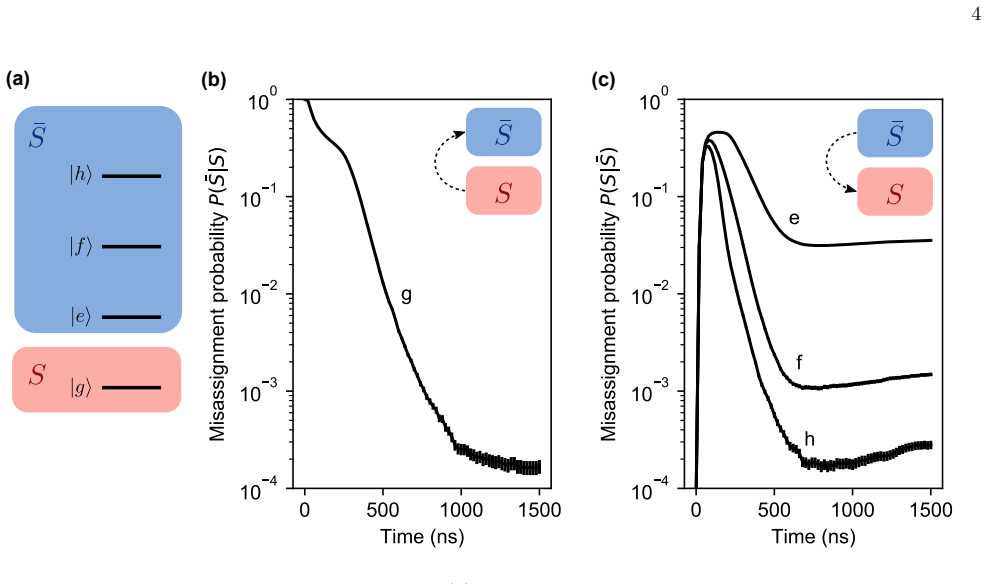
The central discovery is that the leading relaxation error is promoted to a higher order when codewords are separated by $L$ photon-number steps: the probability that relaxation corrupts the measurement scales like $(\kappa_\downarrow \tau)^L$ rather than $\kappa_\downarrow \tau$, so a code of distance $L$ is robust until $L$ errors accumulate. On the transmon, this means reading out the $\lvert g\rangle$–$\lvert h\rangle$ manifold instead of $\lvert g\rangle$–$\lvert e\rangle$; applying an $e$–$f$ shelving pulse turns the usual qubit measurement into a higher-distance measurement and exposes gate errors of order $10^{-3}$ that ordinary readout hides. In the storage cavity, a number-selective pulse maps the encoded bit onto a transmon ancilla, the ancilla is read out and reset by real-time feedback, and the sequence of outcomes is classified by a maximum-likelihood hidden Markov model. The reported best logical assignment infidelities are $5.8\times10^{-5}$ for the Fock encoding $\lvert 0\rangle$ versus $\lvert 5\rangle$ and $4.2\times10^{-3}$ for the $S=2,N=1$ binomial code.
Load-bearing premise
The entire result rests on the repeated readout being essentially state-preserving and on independent photon loss and gain being the only significant error processes; if a readout or reset event occasionally shuffles the storage state in a way not captured by Eq. (4), then the quoted infidelities no longer describe errors about the true initial state.
Editorial extensions
If this is right
- If the central claim is right, relaxation no longer sets the practical floor for superconducting-qubit readout; the floor moves to state preparation, ancilla reset, and the state-preserving quality of each readout.
- Gate and state-preparation characterization can be made an order of magnitude more precise, because shelved readout resolves transmon gate errors directly at the $1.4\times10^{-3}$ level instead of hiding them behind larger measurement errors.
- For bosonic encodings, logical assignment infidelity should continue to improve roughly exponentially with $L$, so larger-distance Fock codes or higher-order binomial codes should push below $10^{-5}$ on the same hardware.
- Repeated state-preserving readout with real-time reset is directly applicable to error-syndrome extraction, where the same ancilla must be reused many times without destroying the logical information.
- Because the mechanism is generic to multilevel systems with a one-photon loss channel, the same encoding-and-voting strategy should transfer to other qubit platforms with relaxation-limited readout.
Reading between the lines
- If the per-readout demolition probability could be pushed below the calibrated $0.02\%$, the same protocol should reach assignment errors set by preparation and reset rather than by relaxation; this can be tested by measuring the $\lvert 0\rangle$–$\lvert L\rangle$ infidelity at still larger $L$.
- The gap between the Fock result ($5.8\times10^{-5}$) and the binomial result ($4.2\times10^{-3}$) suggests that photon gain and single-round readout errors, not code distance, are the next limit; reducing the storage thermal excitation should narrow that gap.
- A direct test of the model would vary $\kappa_\downarrow\tau$ (by changing readout duration or cavity lifetime) and check that the optimal number of votes and the infidelity scale as Eq. (4) predicts.
- Codes whose logical states share photon-number support would require a phase-respecting map, because the photon-number-selective flip used here only measures membership in a number subspace; extending the scheme to such codes is a nontrivial next step.
Signed reviews
Editorial analysis
A structured set of objections, weighed in public.
Referee Report
Summary. The paper demonstrates that encoding a qubit in multilevel states suppresses relaxation-induced measurement errors in superconducting circuits. Two experimental settings are studied: (i) a transmon whose higher excited states |f> and |h> are used to improve readout contrast, including a shelving technique that directly resolves g–e gate errors at the level of about 1.4e-3; and (ii) a bosonic storage mode measured through a transmon ancilla with repeated map–measure–reset cycles. For the bosonic encodings, the authors report logical assignment infidelities of 5.8e-5 for the Fock encoding |0> vs |5> and 4.2e-3 for the S=2,N=1 binomial code, obtained with a hidden-Markov-model/MLE classifier. The paper also proposes Eq. (4) to describe the tradeoff between repeated readouts and state relaxation and compares Fig. 5 data to this model. The central claim is that multilevel encoding plus repeated readout yields record-level measurement fidelities in circuit QED.
Significance. If the reported numbers are robust, this is an important experimental advance: the 5.8e-5 assignment infidelity and the 1.4e-3 direct resolution of gate errors are substantially better than standard transmon readout, and the multilevel-encoding principle is general and applicable to other platforms. The strength of the paper is that the headline infidelities are direct experimental assignments with error bars, not theory extrapolations; the QND-ness of the readout is separately calibrated (PD = 0.02%); and the shelving demonstration cleanly separates measurement error from gate error in a way that is useful for SPAM characterization. The main caveats concern the treatment of rare reset failures and the circularity of the model comparison, as detailed below.
major comments (3)
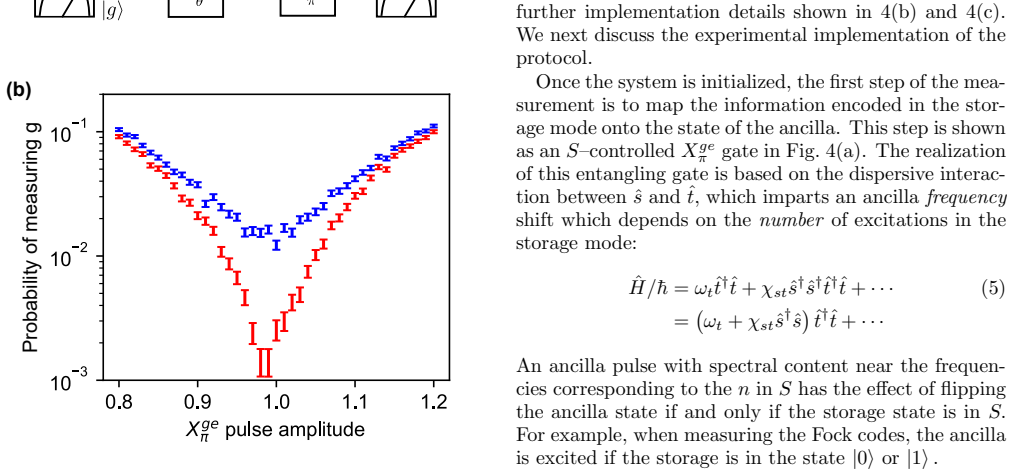
- [Supplemental Material, 'Reset errors'; main text §IV, Fig. 6 and Table I] The paper explicitly states that 0.2% of 1.8 million repeated-measurement experiments contain a 'stuck' ancilla reset requiring five or more feedforward iterations, and that the mechanism of these high-level excitations is not apparent from the measurements. These events are not modeled in the hidden-Markov-model transition matrix, whose emission matrix is calibrated only for g/e/f/h readouts. Since the results in Fig. 6 and Table I are not postselected, the reported Fock-code infidelity of 5.8e-5 is about 34 times smaller than the 2e-3 stuck-event rate. If even a few percent of stuck events corrupt the MLE assignment, these rare correlated events would account for essentially the entire reported error budget. The authors should provide a conditional breakdown of misassignments by reset history (e.g., with and without stuck events), or otherwise demonstrate that the headline infidelities are not dominated by this unmodeled process. As written, the central quantitative claim is not yet supported.
- [§IV, Eq. (4); Supplemental Material, 'System parameters'] The theory curves in Fig. 5 are not an independent test of the photon-loss model: delta0 and delta1 are taken as the first points of the same curves being compared, and kappa_up tau is fitted to the 1-photon curve. The abstract's statement that the tradeoff is 'shown to be consistent with the photon-loss model' should therefore be qualified. The measured infidelities themselves are direct assignments and are not invalidated by this circularity, but the model agreement in Fig. 5 does not add independent confirmation. The authors should either refit the model to independent calibration measurements or explicitly state which parameters are fixed a priori.
- [Supplemental Material, 'State preparation'] The argument that preparation errors can be neglected relies on the assumption that the only significant residual error is photon loss during the final check measurement, which the protocol is robust to. This is plausible for the Fock and binomial codes studied, where a single loss event from |L> or |2>/|3> does not cross the S/ar S boundary. However, the argument is not fully quantitative: the paper does not provide an upper bound on other preparation errors (e.g., residual thermal population or mapping-pulse miscalibration) that could enter the reported infidelity. Adding an explicit error budget for state preparation would strengthen the claim that the quoted infidelities are measurement infidelities.
minor comments (5)
- [Fig. 2 caption] Typo: 'beloning' should be 'belonging'.
- [Supplemental Material, 'Simultaneous number-selective pulses'] Typo: 'simulataneous' should be 'simultaneous'.
- [§IV, Fig. 5] The caption mentions dashed and dash-dotted lines but does not define which is which in terms of the two contributions (majority-vote vs. state-transition). Please add a legend or textual description.
- [Table I] The notation 'S=2,N=1 binomial code' is used without a definition in the main text; a brief sentence citing Ref. [25] and explaining S and N would help readers.
- [§III] The phrase 'the measurement is only corrupted when multiple errors occur' is slightly imprecise for the transmon case, where a single relaxation event from |f> still leaves the state in the excited manifold; consider rewording to 'a single relaxation event does not corrupt the encoded bit' for clarity.
Circularity Check
Theory-curve agreement in Fig. 5 is partly a fit because δ0, δ1, and κ↑τ are taken from the same curves, but the headline Table I infidelities are measured assignments and not circular.
-
fitted input called prediction
[Section IV, Fig. 5 discussion; Supplemental Material, 'System parameters']
"These trends are captured by their theoretical description [26] and follow the predictions of Eq. (4), shown in dashed and dash-dotted lines. ... The parameters used in the theory curves in Fig. 5 of the main text were determined as follows: δ0 = 5.2×10⁻² and δ1 = 1.5×10⁻³ were taken as the first point in the 0-photon and 5-photon curve, respectively. κ↑τ = 2.7×10⁻⁴ was obtained by fitting to the 1-photon curve."
In Eq. (4), the terms (N choose ceil(N/2)) δ0^{ceil(N/2)} and (N choose ceil(N/2)) δ1^{ceil(N/2)} reduce at N=1 to just δ0 and δ1. Setting δ0 and δ1 to the first data points of the 0-photon and 5-photon curves forces the N=1 theoretical points to coincide with those measurements, and fitting κ↑τ to the 1-photon curve forces the shape of that curve. The resulting dashed and dash-dotted lines are therefore partly a re-plotting of the data used to set the parameters, not an independent test of the photon-loss model. The abstract's statement that the tradeoff is 'shown to be consistent with the photon-loss model' is thus partially circular, although the measured infidelities in Table I and Fig. 6 do not themselves derive from Eq. (4).
full rationale
The main circularity is confined to the paper's theory-comparison claim. The supplemental material explicitly discloses that δ0 and δ1 are taken as the first points of the very curves being compared and that κ↑τ is fitted to the 1-photon curve; since Eq. (4) contains δ0 and δ1 linearly at N=1, the agreement with Eq. (4) is partly forced by construction. This is a real, but partial, circularity: it affects the 'consistency with the photon-loss model' statement in the abstract, not the central measured infidelities. The Table I numbers (5.8×10⁻⁵ for Fock |0> vs |5> and 4.2×10⁻³ for the S=2,N=1 binomial code) are obtained from actual MLE assignments of the recorded readout sequences and do not reduce to the fitted parameters of Eq. (4). The multilevel-suppression argument is also supported by a simple heuristic (robustness to L relaxation events) that does not depend on the self-cited proposal. Separately, the paper itself flags a non-circular limitation: 0.2% of reset attempts are 'stuck' due to high ancilla levels whose 'detailed mechanism ... is not apparent from our measurements,' and these events are postselected away only for the theory comparison. That is a validity concern for the headline number, but it is a correctness risk rather than a circularity. Overall, one secondary prediction is partially circular, while the primary experimental claims retain independent content, giving a score of 6.
Assumptions & free parameters
free parameters (3)
- delta0 (single-round readout error for |0> state) =
5.2e-2
- delta1 (single-round readout error for |1> state) =
1.5e-3
- kappa_up tau (photon gain per readout cycle) =
2.7e-4
assumptions (4)
- domain assumption The storage mode evolution between readouts is governed by independent photon loss and gain with rates kappa_down and kappa_up, with no other decoherence.
- domain assumption The ancilla readout is quantum nondemolition with respect to the storage mode, with a per-readout demolition probability PD=0.02% that is negligible.
- domain assumption Number-selective pulses can implement the conditional map U_map (Eq. S4) with negligible leakage outside the desired photon-number subspace.
- domain assumption Heralded state preparation leaves residual errors only of the form of photon loss during the final check, which the encoded measurement is robust to.
Cite this review
Pith. "Pith review of High-fidelity measurement of qubits encoded in multilevel superconducting circuits." pith.science (2026). https://pith.science/paper/ECUSL6JB
@misc{pith2026190801869,
  author       = {Pith},
  title        = {Pith review of: High-fidelity measurement of qubits encoded in multilevel superconducting circuits},
  year         = {2026},
  howpublished = {\url{https://pith.science/paper/ECUSL6JB}},
  note         = {Machine review of arXiv:1908.01869}
}
abstract
Qubit measurements are central to quantum information processing. In the field of superconducting qubits, standard readout techniques are not only limited by the signal-to-noise ratio, but also by state relaxation during the measurement. In this work, we demonstrate that the limitation due to relaxation can be suppressed by using the many-level Hilbert space of superconducting circuits: in a multilevel encoding, the measurement is only corrupted when multiple errors occur. Employing this technique, we show that we can directly resolve transmon gate errors at the level of one part in $10^3.$ Extending this idea, we apply the same principles to the measurement of a logical qubit encoded in a bosonic mode and detected with a transmon ancilla, implementing a proposal by Hann et al. [Phys. Rev. A \textbf{98} 022305 (2018)]. Qubit state assignments are made based on a sequence of repeated readouts, further reducing the overall infidelity. This approach is quite general and several encodings are studied; the codewords are more distinguishable when the distance between them is increased with respect to photon loss. The tradeoff between multiple readouts and state relaxation is explored and shown to be consistent with the photon-loss model. We report a logical assignment infidelity of $5.8\times 10^{-5}$ for a Fock-based encoding and $4.2\times 10^{-3}$ for a QEC code (the $S=2,N=1$ binomial code). Our results will not only improve the fidelity of quantum information applications, but also enable more precise characterization of process or gate errors.
Figures


Figures from the paper (4 more)


Reference graph
Works this paper leans on
- [1]
-
[2]
Peter W. Shor. Scheme for reducing decoherence in quan- tum computer memory. Phys. Rev. A , 52(R2493(R)), 1995
work page 1995
-
[3]
E. Knill and R. Laflamme. Theory of quantum error- correcting codes. Phys. Rev. A , 55(2), 1997
work page 1997
-
[4]
J. Chiaverini, D. Leibfried, T. Schaetz, M. D. Barrett, R. B. Blakestad, J. Britton, W. M. Itano, J. D. Jost, E. Knill, C. Langer, R. Ozeri, and D. J. Wineland. Real- ization of quantum error correction. Nature, 432, 2004
work page 2004
-
[5]
Nissim Ofek, Andrei Petrenko, Reinier Heeres, Philip Reinhold, Zaki Leghtas, Brian Vlastakis, Yehan Liu, Luigi Frunzio, S. M. Girvin, L. Jiang, Mazyar Mirrahimi, M. H. Devoret, and R. J. Schoelkopf. Extending the life- time of a quantum bit with error correction in supercon- ducting circuits. Nature, 536, 2016
work page 2016
-
[7]
Charles H. Bennett and Gilles Brassard. Quantum cryp- tography: Public key distribution and coin tossing. In Proceedings of IEEE International Conference on Com- puters, Systems and Signal Processing , volume 175, 1984
work page 1984
-
[8]
Quantum-enhanced measurements: Beating the stan- dard quantum limit
Vittorio Giovannetti, Seth Lloyd, and Lorenzo Maccone. Quantum-enhanced measurements: Beating the stan- dard quantum limit. Science, 306(5700), 2004
work page 2004
-
[9]
Bennett, Gilles Brassard, Claude Cr´ epeau, Richard Jozsa, Asher Peres, and William K
Charles H. Bennett, Gilles Brassard, Claude Cr´ epeau, Richard Jozsa, Asher Peres, and William K. Wootters. Teleporting an unknown quantum state via dual classical and einstein-podolsky-rosen channels. Phys. Rev. Lett. , 70(13), 1993
work page 1993
Show all 57 references
-
[10]
M. D. Barrett, J. Chiaverini, T. Schaetz, J. Britton, W. M. Itano, J. D. Jost, E. Knill, C. Langer, D. Leibfried, R. Ozeri, and D. J. Wineland. Determinsitic quantum teleportation of atomic qubits. Nature, 429, 2004
2004
-
[11]
Chou, Jacob Z
Kevin S. Chou, Jacob Z. Blumoff, Christopher S. Wang, Philip C. Reinhold, Christopher J. Axline, Yvonne Y. Gao, L. Frunzio, M. H. Devoret, Liang Jiang, and R. J. Schoelkopf. Deterministic teleportation of a quantum gate between two logical qubits. Nature, 561, 2019
2019
-
[12]
Ex- perimental realization of einstein-podolsky-rosen-bohm Gedankenexperiment: A new violation of bell’s inequali- ties
Alain Aspect, Philippe Grangier, and G´ erard Roger. Ex- perimental realization of einstein-podolsky-rosen-bohm Gedankenexperiment: A new violation of bell’s inequali- ties. Phys. Rev. Lett. , 49(91), 1982
1982
-
[13]
Ex- perimental test of bell’s inequalities using time-varying analyzers
Alain Aspect, Jean Dalibard, and G´ erard Roger. Ex- perimental test of bell’s inequalities using time-varying analyzers. Phys. Rev. Lett. , 49(1804), 1982
1982
-
[14]
Knill, D
E. Knill, D. Leibfried, R. Reichle, J. Britton, R. B. Blakestad, J. D. Jost, C. Langer, R. Ozeri, S. Seidelin, and D. J. Wineland. Randomized benchmarking of quan- tum gates. Phys. Rev. A , 77(012307), 2008
2008
-
[15]
D. B. Hume, T. Rosenband, and D. J. Wineland. High- fidelity adaptive qubit detection through repetitive quan- tum nondemolition measurements. Phys. Rev. Lett. , 99(120502), 2007
2007
-
[16]
A. H. Myerson, D. J. Szwer, S. C. Webster, D. T. C. Allcock, M. J. Curtis, G. Imreh, J. A. Sherman, D. N. Stacey, A. M. Steane, and D. M. Lucas. High- fidelity readout of trapped-ion qubits. Phys. Rev. Lett. , 100(200502), 2008
2008
-
[17]
Machine learning assisted readout of trapped-ion qubits
Alireza Seif, Kevin A Landsman, Norbert M Linke, Caro- line Figgatt, C Monroe, and Mohammad Hafezi. Machine learning assisted readout of trapped-ion qubits. J. Phys. B: At. Mol. Opt. Phys. , 51(174006), 2018
2018
-
[18]
Tobias Jacobson, Jason Dominguez, Gre- gory A
Patrick Harvey-Collard, Benjamin D’Anjou, Martin Rudolph, N. Tobias Jacobson, Jason Dominguez, Gre- gory A. Ten Eyck, Joel R. Wendt, Tammy Pluym, Michael P. Lilly, William A. Coish, Michel Pioro- Ladri` ere, and Malcolm S. Carroll. High-fidelity single- shot readout for a spin ...
2018
-
[19]
Pla, Floris A
Andrea Morello, Jarryd J. Pla, Floris A. Zwanenburg, Kok W. Chan, Kuan Y. Tan, Hans Huebl, Mikko M¨ ott¨ onen, Christopher D. Nugroho, Changyi Yang, Jes- sica A. van Donkelaar, Andrew D. C. Alves, David N. Jamieson, Christopher C. Escott, Lloyd C. L. Hollen- berg, Robert G. Cl...
2010
-
[20]
Hanson, L
R. Hanson, L. P. Kouwenhoven, J. R. Petta, S. Tarucha, and L. M. K. Vandersypen. Spins in few-electron quan- tum dots. Rev. Mod. Phys. , 79(1217), 2007
2007
-
[21]
Wallraff, D
A. Wallraff, D. I. Schuster, A. Blais, L. Frunzio, J. Ma- jer, M. H. Devoret, S. M. Girvin, and R. J. Schoelkopf. Approaching unit visibility for control of a supercon- ducting qubit with dispersive readout. Phys. Rev. Lett. , 95(060501), 2005
2005
-
[22]
Walter, P
T. Walter, P. Kurpiers, S. Gasparinetti, P. Mag- nard, A. Potoˇ cnik, Y. Salath´ e, M. Pechal, M. Mondal, M. Oppliger, C. Eichler, and A. Wallraff. Rapid high- fidelity single-shot dispersive readout of superconducting qubits. Phys. Rev. Applied , 7(054020), 2017
2017
-
[23]
Jay Gambetta, W. A. Braff, A. Wallraff, S. M. Girvin, and R. J. Schoelkopf. Protocols for optimal readout of qubits using a continuous quantum nondemolition mea- surement. Phys. Rev. A , 76(012325), 2007
2007
-
[24]
D. I. Schuster, A. A. Houck, J. A. Schreier, A. Wallraff, J. M. Gambetta, A. Blais, L. Frunzio, J. Majer, B. John- son, M. H. Devoret, S. M. Girvin, and R. J. Schoelkopf. Resolving photon number states in a superconducting cir- cuit. Nature, 445, 2007
2007
-
[25]
Michael, Matti Silveri, R
Marios M. Michael, Matti Silveri, R. T. Brierley, Vic- tor V. Albert, Juha Salmilehto, Liang Jiang, and S. M. Girvin. New class of quantum error-correcting codes for a bosonic mode. Phys. Rev. X , 6(031006), 2016
2016
-
[26]
Hann, Salvatore S
Connor T. Hann, Salvatore S. Elder, Christopher S. Wang, Kevin Chou, Robert J. Schoelkopf, and Liang Jiang. Robust readout of bosonic qubits in the dispersive coupling regime. Phys. Rev. A , 98(022305), 2018
2018
-
[27]
Yu, Jay Gambetta, A
Jens Koch, Terri M. Yu, Jay Gambetta, A. A. Houck, D. I. Schuster, J. Majer, Alexandre Blais, M. H. Devoret, S. M. Girvin, and R. J. Schoelkopf. Charge-insensitive qubit design derived from the cooper pair box. Phys. Rev. A, 76(042319), 2007
2007
-
[28]
J. A. Schreier, A. A. Houck, Jens Koch, D. I. Schus- ter, B. R. Johnson, J. M. Chow, J. M. Gambetta, J. Majer, L. Frunzio, M. H. Devoret, S. M. Girvin, and R. J. Schoelkopf. Suppressing charge noise deco- herence in superconducting charge qubits. Phys. Rev. B , 77(180502(R)), 2008. 10
2008
-
[29]
En- coding a qubit in an oscillator
Daniel Gottesman, Alexei Kitaev, and John Preskill. En- coding a qubit in an oscillator. Phys. Rev. A , 64(012310), 2001
2001
-
[30]
Schoelkopf, Michel H
Zaki Leghtas, Gerhard Kirchmair, Brian Vlastakis, Robert J. Schoelkopf, Michel H. Devoret, and Maz- yar Mirrahimi. Hardware-efficient autonomous quantum memory protection. Phys. Rev. Lett. , 111(120501), 2013
2013
-
[31]
Albert, Kyungjoo Noh, Kasper Duivenvoor- den, Dylan J
Victor V. Albert, Kyungjoo Noh, Kasper Duivenvoor- den, Dylan J. Young, R. T. Brierley, Philip Reinhold, Christophe Vuillot, Linshu Li, Chao Shen, S. M. Girvin, Barbara M. Terhal, and Liang Jiang. Performance and structure of single-mode bosonic codes. Phys. Rev. A , 97(032346), 2018
2018
-
[32]
Young, Victor V
Linshu Li, Dylan J. Young, Victor V. Albert, Kyungjoo Noh, Chang-Ling Zou, and Liang Jiang. Designing good bosonic quantum codes via creating destructive interfer- ence, 2019. arXiv:1901.05358 [quant-ph]
2019 arXiv
-
[33]
Chuang, and Jeffrey H
Murphy Yuezhen Niu, Isaac L. Chuang, and Jeffrey H. Shapiro. Hardware-efficient bosonic quantum error- correcting codes based on symmetry operators. Phys. Rev. A, 97(032323), 2018
2018
-
[34]
Chuang, Debbie W
Isaac L. Chuang, Debbie W. Leung, and Yoshihisa Ya- mamoto. Bosonic quantum codes for amplitude damping. Phys. Rev. A , 56(1114), 1997
1997
-
[35]
P. T. Cochrane, G. J. Milburn, and W. J. Munro. Macroscopically distinct quantum-superposition states as a bosonic code for amplitude damping. Phys. Rev. A , 59(2631), 1999
1999
-
[36]
Nielsen and Isaac L
Michael A. Nielsen and Isaac L. Chuang. Quantum Com- putation and Quantum Information . Cambridge Univer- sity Press, 2010
2010
-
[37]
In this context the expression (tm/T1)n must be regarded as a rule of thumb and not an exact value
An anharmonic oscillator is not necessarily characterized by a single T1 value [49]. In this context the expression (tm/T1)n must be regarded as a rule of thumb and not an exact value
-
[38]
D’Anjou and W
B. D’Anjou and W. A. Coish. Enhancing qubit readout through dissipative sub-poissonian dynamics. Phys. Rev. A, 96(052321), 2017
2017
-
[39]
This method of state preparation is analogous to the one described in the supplemental material
-
[40]
Ong, Agustin Palacios-Laloy, Fran¸ cois Nguyen, Patrice Bertet, Denis Vion, and Daniel Esteve
Fran¸ cois Mallet, Florian R. Ong, Agustin Palacios-Laloy, Fran¸ cois Nguyen, Patrice Bertet, Denis Vion, and Daniel Esteve. Single-shot qubit readout in circuit quantum elec- trodynamics. Nat. Phys. , 5, 2009
2009
-
[41]
J. R. Johansson, P. D. Nation, and F. Nori. Qutip 2: A python framework for the dynamics of open quantum systems. Comp. Phys. Comm. , 184(1234), 2013
2013
-
[42]
See the supplemental material
-
[43]
Dynamically protected cat-qubits: a new paradigm for universal quantum computation
Mazyar Mirrahimi, Zaki Leghtas, Victor V Albert, Steven Touzard, Robert J Schoelkopf, Liang Jiang, and Michel H Devoret. Dynamically protected cat-qubits: a new paradigm for universal quantum computation. New J. Phys. , 16, 2014
2014
-
[44]
Pechal, L
M. Pechal, L. Huthmacher, C. Eichler, S. Zeytino˘ glu, Jr. A. A. Abdumalikov, S. Berger, A. Wallraff, and S. Fil- ipp. Microwave-controlled generation of shaped single photons in circuit quantum electrodynamics. Phys. Rev. X, 4(041010), 2014
2014
-
[45]
See the supplemental material for a detailed discussion of ancilla reset errors
-
[46]
L. Hu, Y. Ma, W. Cai, X. Mu, Y. Xu, W. Wang, Y. Wu, H. Wang, Y. P. Song, C.-L. Zou, S. M. Girvin, L-M. Duan, and L. Sun. Quantum error correction and uni- versal gate set operation on a binomial bosonic logical qubit. Nat. Phys. , 15, 2019
2019
-
[47]
Achieving the heisenberg limit in quantum metrol- ogy using quantum error correction
Sisi Zhou, Mengzhen Zhang, John Preskill, and Liang Jiang. Achieving the heisenberg limit in quantum metrol- ogy using quantum error correction. Nat. Commun. , 9(78), 2018
2018
-
[48]
Taylor, Anders S
Liang Jiang, Jacob M. Taylor, Anders S. Sørensen, and Mikhail D. Lukin. Distributed quantum computa- tion based on small quantum registers. Phys. Rev. A , 76(062323), 2007
2007
-
[49]
High-fidelity measurement of qubits encoded in multilevel superconducting circuits
R. J. Schoelkopf, A. A. Clerk, S. M. Girvin, K. W. Lehn- ert, and M. H. Devoret. Quantum Noise in Mesoscopic Physics, chapter Qubits as Spectrometers of Quantum Noise, pages 175–203. Springer, 2003. Supplemental material for “High-fidelity measurement of qubits encoded in multi...
2003 arXiv
-
[50]
Nigg, Hanhee Paik, Brian Vlastakis, Gerhard Kirchmair, S
Simon E. Nigg, Hanhee Paik, Brian Vlastakis, Gerhard Kirchmair, S. Shankar, Luigi Frunzio, M. H. Devoret, R. J. Schoelkopf, and S. M. Girvin. Black-box superconducting circuit quantization. Phys. Rev. Lett , 108(240502), 2012
2012
-
[51]
D. H. Slichter, R. Vijay, S. J. Weber, S. Boutin, M. Bois- sonneault, J. M. Gambetta, A. Blais, and I. Siddiqi. Measurement-induced qubit state mixing in circuit qed from up-converted dephasing noise. Phys. Rev. Lett. , 109(153601), 2012
2012
-
[52]
S. O. Mundhada, S. Shankar, A. Narla, E. Zalys-Geller, S. M. Girvin, and M. H. Devoret. Dependence of transmon qubit relaxation rate on readout drive power. In APS Meeting Abstracts, 2016
2016
-
[53]
Maxime Boissonneault, J. M. Gambetta, and Alexandre Blais. Dispersive regime of circuit qed: Photon-dependent qubit dephasing and relaxation rates. Phys. Rev. A , 79(013819), 2009
2009
-
[54]
Kelly, R
Daniel Sank, Zijun Chen, Mostafa Khezri, J. Kelly, R. Barends, B. Campbell, Y. Chen, B. Chiaro, A. Dunsworth, A. Fowler, E. Jeffrey, E. Lucero, A. Megrant, J. Mutus, M. Neeley, C. Neill, P. J. J. O’Malley, C. Quintana, P. Roushan, A. Vainsencher, T. White, J. Wenner, Alexander ...
2016
-
[55]
L. Sun, A. Petrenko, Z. Leghtas, B. Vlastakis, G. Kirch- mair, K. M. Sliwa, A. Narla, M. Hatridge, S. Shankar, J. Blumoff, L. Frunzio, M. Mirrahimi, M. H. Devoret, and R. J. Schoelkopf. Tracking photon jumps with repeated quantum non-demolition parity measurements. Nature, 511, 2014
2014
-
[56]
Hann, Salvatore S
Connor T. Hann, Salvatore S. Elder, Christopher S. Wang, Kevin Chou, Robert J. Schoelkopf, and Liang Jiang. Ro- bust readout of bosonic qubits in the dispersive coupling regime. Phys. Rev. A , 98(022305), 2018
2018
-
[57]
W. H. Press, S. A. Teukolsky, W. T. Vetterling, and B. P. Flannery. Numerical Recipes. Cambridge University Press, 3rd edition, 2007
2007
-
[58]
Rosenblum, P
S. Rosenblum, P. Reinhold, M. Mirrahimi, Liang Jiang, L. Frunzio, and R. J. Schoelkopf. Fault-tolerant detection of a quantum error. Science, 361(6399), 2018
2018
Reviewed August 14, 2026 · model on record in the stance chip above.
Discussion (0). Continue with ORCID to comment.