REVIEW 3 major objections 5 minor 69 references
Influence of the Vacuum Polarization Effect on the Motion of Charged Particles in the Magnetic Field around a Schwarzschild Black Hole
T0 review · 3 major / 5 minor · reviewed 2026-08-14 · deepseek-v4-flash
Pith's one-line read Vacuum polarization, through a non-minimal coupling to gravity, can significantly change the motion of charged particles around a Schwarzschild black hole, altering scattering angles and turning unbound trajectories into bound ones.
desk verdict A first, honest parameter study of vacuum-polarized charged orbits around Schwarzschild, but a singular term in the printed equations and an unanchored coupling value keep it from being usable as written. read the letter →
The pith
A machine-rendered reading of the paper's core claim, the machinery that carries it, and where it could break.
The reading
What carries the argument
The load-bearing object is the non-minimally coupled electromagnetic Lagrangian $\mathcal{L} = \frac{R}{\kappa} + \frac{1}{2}F_{\mu\nu}F^{\mu\nu} + \frac{1}{2}\mathcal{R}_{\mu\nu\rho\sigma}F^{\mu\nu}F^{\rho\sigma}$, where $\mathcal{R}_{\mu\nu\rho\sigma}$ is built from the Ricci and Riemann tensors with coupling constants $q_1, q_2, q_3$. In a Schwarzschild spacetime with an asymptotically dipole field, this produces a radial equation whose denominator contains $r^3 - 2M q_3$; that term is where the vacuum-polarization coupling becomes strong and drives the near-horizon field amplification. The paper feeds the resulting modified $B_{\mathrm{rad}}(r)$ into the Lorentz equation on the Schwarzschild metric and integrates the coupled system numerically.
What would settle it
A first-principles calculation of $q_3$ for macroscopic magnetic fields in curved spacetime that yields $|\tilde q| \ll 1$ for a $10^6 M_\odot$ black hole would falsify the observable part of the claim. Observationally, measuring the scattering angle or the bound or unbound boundary for electrons near a magnetized Schwarzschild black hole and checking whether the $r_0$-$v_{r,0}$ phase boundary shifts with $\tilde q$ as shown would settle it; the absence of the predicted bound region for $r_0 \le 2(2M)$ would also do so.
Extended reading notes
Core claim
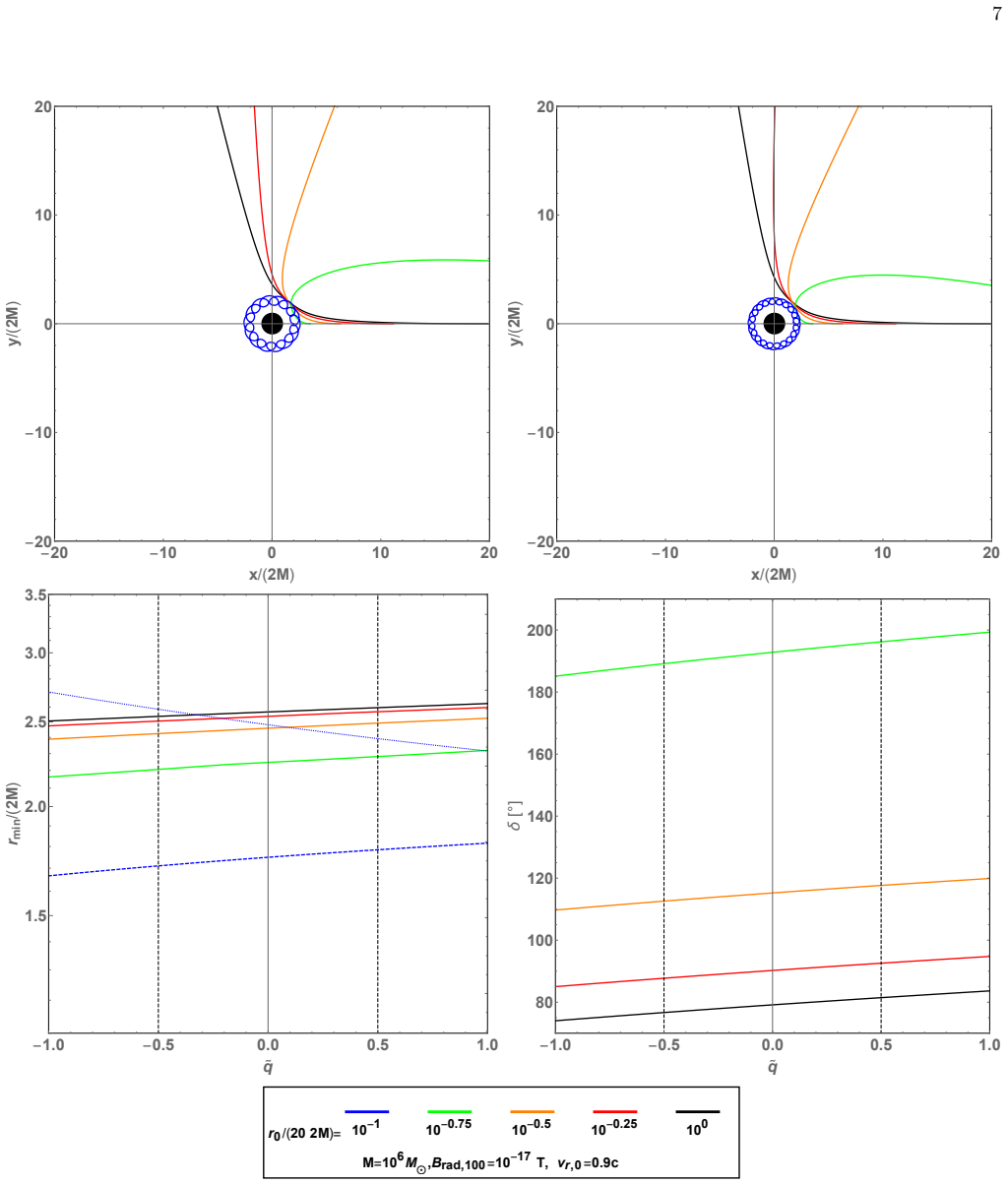
The central claim is that the non-minimal coupling induced by vacuum polarization, encoded in the single parameter $q_3$, can materially change the dynamics of charged particles around a Schwarzschild black hole even when the electromagnetic field is too weak to back-react on the spacetime. Starting from the asymptotically dipole magnetic-field solution derived in their earlier work, the paper integrates the full Lorentz equation for electrons in the equatorial plane. The $q_3$-dependent field grows or shrinks near the horizon; positive dimensionless $\tilde q = q_3/(2M)^2$ amplifies it, negative $\tilde q$ suppresses it. The numerical results show that this changes the deflection angle $\delta$ and the minimum distance $r_{\min}$, most strongly for small asymptotic field strengths and small black-hole masses where the particle penetrates closer to the horizon. For small initial radii the trajectories become bound, with the particle circling the hole in loops set by the Larmor radius, where the minimally coupled dipole would only deflect it, and in some parameter regions the bound or unbound character is fixed by $\tilde q$ alone. The paper maps the $r_0$-$v_{r,0}$ plane into bound and unbound phases, showing that vacuum polarization enlarges the region from which particles cannot escape.
Load-bearing premise
The load-bearing premise is that the coupling constant $q_3$ can be large enough in dimensionless units ($|\tilde q| \sim 1$) to reshape the magnetic field near the horizon; if the true value is as small as the electron Compton scale suggests, all the claimed trajectory changes would be negligible for ordinary astrophysical black holes.
Editorial extensions
If this is right
- For a fixed asymptotic dipole field, varying $\tilde q$ between $-1$ and $1$ changes the electron deflection angle $\delta$ and closest approach $r_{\min}$, with the effect largest when the particle reaches close to the horizon, i.e. for weak fields and low black-hole masses.
- Trajectories starting within roughly $2(2M)$ of the center become bound in all simulated cases, whereas a minimally coupled dipole would only deflect or plunge the particle, because the strong near-horizon field creates tight Larmor loops.
- In some regions of the $r_0$-$v_{r,0}$ initial-condition plane, the bound or unbound outcome is set by $\tilde q$ alone, making the phase boundary a potential observable for constraining the coupling.
- The flux of particles escaping from the vicinity of a magnetized black hole should be suppressed, since for small starting radii particles cannot escape regardless of their initial velocity.
- The magnetic-field and mass scaling law, $F_L/F_G \sim M B$, is unchanged by vacuum polarization, so the new effects appear as changes in magnitude and in phase boundaries rather than in the overall scaling.
Reading between the lines
- If the phase-boundary shift is as sharp as the figures suggest, counting escaping electrons or their synchrotron secondaries as a function of launch radius around a magnetized black hole would offer a cleaner $\tilde q$ diagnostic than single deflection angles, since the bound or unbound distinction is binary.
- The same modified field would change synchrotron emissivity and polarization maps of near-horizon emission; extending the single-particle calculation to a velocity distribution and including radiative losses is a natural next step that could make the effect visible in images rather than individual orbits.
- If the physical $q_3$ is as small as the electron Compton scale, the mechanism would not disappear but would move to primordial black holes, whose tiny Schwarzschild radii can make $|\tilde q|$ order one even for small $q_3$, potentially leaving an imprint on primordial magnetic fields.
Signed reviews
Editorial analysis
A structured set of objections, weighed in public.
Referee Report
Summary. The paper studies the motion of charged particles around a Schwarzschild black hole in an asymptotically dipole magnetic field that is modified by the non-minimal coupling between gravity and electromagnetism, interpreted as a vacuum-polarization effect. After writing the Lorentz equations on the Schwarzschild background with the modified field, the authors integrate the equations numerically and report that the dimensionless coupling parameter q~ changes the scattering angle, the minimum approach distance, and the bound/unbound character of orbits for a range of initial conditions. The paper concludes that these effects could serve as observational signatures of vacuum polarization and could constrain the coupling parameter.
Significance. The topic is timely and of potential astrophysical relevance: charged-particle dynamics around magnetized black holes is an active area, and a genuine vacuum-polarization-induced modification of the effective magnetic field near the horizon would be an interesting strong-field QED/gravity effect. The paper also has strengths in that it considers a nontrivial field configuration rather than the often-used uniform field and it provides a clear parameter scan together with phase diagrams. However, the significance is conditional on the scanned values of the coupling parameter being physically realizable, and the manuscript does not provide a quantitative bridge from the QED value toward the values used in the simulations. In addition, the printed equations of motion contain a singular term that prohibits reproduction of the numerical results as written.
major comments (3)
- [Sec. III, Eqs. (12), (19), and (23)] The printed system of equations is singular as written. Equation (19) contains the term -2 v_r(τ) v_θ(τ)/t(τ), and Eq. (12) contains the analogous -2 r'(τ) θ'(τ)/t(τ), while the initial condition (23) sets t(0)=0. Even though v_θ(0)=0 makes these terms formally 0/0 at the initial instant, the denominator t(τ) starts at zero and becomes nonzero during the integration, so the system is not well posed without regularization or a statement of how the singularity is handled. No code or numerics details are provided. The θ-equation of the standard Lorentz force on Schwarzschild would naturally contain a 2r'θ'/r term, so these appear to be typos, but as printed the numerical results in Sec. IV are not reproducible.
- [Sec. IV (Figs. 1-4) and Sec. V] The central claim that vacuum polarization significantly affects charged-particle motion is obtained by scanning the dimensionless coupling q~ = q3/r_s^2 over the interval [-1,1] for a fiducial mass M=10^6 M_sun. For the QED value of the non-minimal coupling parameter from the Drummond-Hathrell Lagrangian, q3 ~ α λ_C^2 ≈ 10^-23 cm^2, while r_s^2 ≈ 10^23 cm^2, giving q~ ≈ 10^-46. At such values the q3-dependent terms in Eq. (4) and in Eqs. (17)-(21) are completely negligible and the magnetic field reduces to the standard dipole. The paper acknowledges in Sec. V that if the actual value is very small the effects will not be empirically obvious, but it provides no quantitative demonstration that primordial black holes or any other scenario can bring q~ to order unity. Therefore the abstract's and conclusions' statements about observational signatures and constraints on q3 are not supported by the calculations presented.
- [Sec. II, Eq. (4)] The modified magnetic field is imported from the authors' previous work [15] without an independent derivation or explicit justification of its validity for the entire scanned range of q3. Since the field configuration is the main input whose modification drives all the reported dynamical changes, the manuscript should either reproduce the derivation of the radial equation for Brad or clearly state the assumptions, existence properties, and limitations of that solution. As it stands, a central ingredient of the paper is taken from a self-cited source and is not verifiable from the present text.
minor comments (5)
- [Sec. II, Eq. (2)] In the q2 term of Eq. (2), the index structure appears to be incorrect: the expression "Rνρ gνσ" should presumably read "Rµρ gνσ" (or the analogous symmetric combination). Please correct this typo.
- [Sec. II, Eq. (4) and Sec. III, Eq. (22)] The radial equation for Brad is printed without a clear bracket structure in the numerator; the intended factor is presumably [A1(r) + C A2(r)] / [r(r-2M)(r^3-2M q3)] Brad(r), but the current notation is ambiguous and should be cleaned up.
- [Sec. IV, Fig. 4 caption] The sign convention for vr,0 in the caption of Fig. 4 conflicts with the main text around Eq. (26), where vr,0<0 denotes a velocity initially pointing toward the black hole; the caption states the opposite. Please unify the convention.
- [Sec. IV, Eq. (28)] The scaling estimate in Eq. (28) contains symbols "vs" and "G" that are not defined in the text and the chain of equalities is dimensionally unclear. Please rewrite this estimate with defined quantities.
- [Sec. V] There is a typo in Sec. V: "once can see" should be "one can see."
Circularity Check
No circular derivation: the orbital changes are genuine numerical consequences of the assumed q3-modified field, though the paper's observational claim is conditional on an unconstrained free parameter.
full rationale
The paper imports the modified magnetic field, Eq. (4) (restated as Eq. (22)), from the authors' prior paper [15] and then integrates the Lorentz equations (10)-(13)/(17)-(21). This is a self-citation, but it does not make the derivation circular. The field equation is presented as a solution of the field equations obtained from the Drummond-Hathrell Lagrangian [40], and the present paper's new outputs—scattering angles, rmin, and the bound/unbound phase boundaries in Figs. 1-4—are computed numerically from that assumed input rather than being restatements of it. The dependence of the dynamics on q~ is loaded in by hand through q3, but a parameter scan is not a fit disguised as a prediction: no data are fitted, and no observed quantity is 'predicted' after fitting. The main weakness is physical rather than logical. Sec. V explicitly states that 'if its actual value is very small, the discussed effects will not be empirically obvious,' and no independent measurement anchors q3, so the observational-signature claim is conditional. The only serious technical defect is the printed Eq. (19), which contains a 1/t(τ) term with initial condition t0=0 and is therefore singular as written; this is an implementation or typographical problem, not evidence of circularity. Overall, the derivation chain is self-contained apart from the cited field solution, and the conclusion is a conditional parameter study rather than a circular prediction. Score 2 reflects the reliance on the authors' prior self-citation without treating that reliance as a circular reduction.
Assumptions & free parameters
free parameters (1)
- q3 (non-minimal coupling parameter)
assumptions (4)
- domain assumption The effective Lagrangian (1) with non-minimal coupling from vacuum polarization is valid for macroscopic astrophysical fields.
- domain assumption Backreaction of the magnetic field on the Schwarzschild metric is negligible.
- domain assumption The modified dipole field satisfies Eqs. (4)-(7) from the authors' prior work [15], with separation constant C = -1.
- domain assumption Numerical integration of the ODE system (14)-(22) accurately represents the intended Lorentz force dynamics.
Cite this review
Pith. "Pith review of Influence of the Vacuum Polarization Effect on the Motion of Charged Particles in the Magnetic Field around a Schwarzschild Black Hole." pith.science (2026). https://pith.science/paper/MLLE73G5
@misc{pith2026190801888,
  author       = {Pith},
  title        = {Pith review of: Influence of the Vacuum Polarization Effect on the Motion of Charged Particles in the Magnetic Field around a Schwarzschild Black Hole},
  year         = {2026},
  howpublished = {\url{https://pith.science/paper/MLLE73G5}},
  note         = {Machine review of arXiv:1908.01888}
}
read the original abstract
The consequences of the vacuum polarization effect in magnetic fields around a Schwarzschild Black Hole on the motion of charged particles are investigated in this work. Using the weak electromagnetic field approximation, we discuss the non-minimal coupling between magnetic fields and gravity caused by the vacuum polarization and study the equations of motion for the case of a magnetic field configuration which asymptotically approaches a dipole magnetic field. It is shown that the presence of non-minimal coupling can significantly influence the motion of charged particles around Black Holes. In particular, the vacuum polarization effect, leading to strong amplification or suppression of the magnetic field strength around the event horizon (depending on the sign of the coupling parameter), can affect the scattering angle and minimal distance for the electrons moving in the gravitational field of the Black Hole as well as the dependence of these parameters on the asymptotic magnetic field strength, initial distance and the Black Hole mass. It is further demonstrated that the non-minimal coupling between gravity and astrophysical magnetic fields, caused by the vacuum polarization, can cause significant changes of the parameter space corresponding to bound trajectories around the Black Hole. In certain cases, the bounded or unbounded character of a trajectory is determined solely by the presence of non-minimal coupling and its strength. These effects could in principle be used as observational signatures of the vacuum polarization effect and also to constrain the value of the coupling parameter.
Figures


Figures from the paper (1 more)

Reference graph
Works this paper leans on
-
[15]
The effect of vacuum polarization on the magnetic fields around a Schwarzschild black hole
P. Pavlovi´ c and M. Sossich, Phys. Rev. D 99, 024011 (2019), arXiv:1809.06054 [gr-qc]
work page Pith review arXiv 2019
-
[1]
B. P. Abbott et al. (LIGO Scientific, Virgo), Phys. Rev. Lett. 116, 061102 (2016), arXiv:1602.03837 [gr-qc]
arXiv 2016
-
[2]
B. P. Abbott et al. (LIGO Scientific, Virgo), Phys. Rev. Lett. 116, 241103 (2016), arXiv:1606.04855 [gr-qc]
arXiv 2016
-
[3]
B. P. Abbott et al. (LIGO Scientific, Virgo), (2018), arXiv:1811.12907 [astro-ph.HE]
arXiv 2018
-
[4]
K. Akiyama et al. (Event Horizon Telescope), Astrophys. J. Lett. 875, L1 (2019), arXiv:1906.11238 [astro-ph.GA]
arXiv 2019
-
[5]
K. Akiyama et al. (Event Horizon Telescope), Astrophys. J. Lett. 875, L4 (2019), arXiv:1906.11241 [astro-ph.GA]
arXiv 2019
-
[6]
K. Akiyama et al. (Event Horizon Telescope), Astrophys. J. Lett. 875, L6 (2019), arXiv:1906.11243 [astro-ph.GA]
arXiv 2019
- [7]
Show all 69 references
-
[8]
Vainio and I
J. Vainio and I. Vilja, Gen. Rel. Grav. 49, 99 (2017), arXiv:1603.09551 [astro-ph.CO]
2017 arXiv
-
[9]
Manfredi, J
L. Manfredi, J. Mureika, and J. Moffat, Phys. Lett. B 779, 492 (2018), arXiv:1711.03199
2018 arXiv
-
[10]
Wei and Y.-X
S.-W. Wei and Y.-X. Liu, Phys. Rev. D 98, 024042 (2018), arXiv:1803.09530 [gr-qc]
2018 arXiv
-
[11]
De Laurentis, O
M. De Laurentis, O. Porth, L. Bovard, B. Ahmedov, and A. Abdujabbarov, Phys. Rev. D 94, 124038 (2016), arXiv:1611.05766 [gr-qc]
2016 arXiv
-
[12]
Haroon, M
S. Haroon, M. Jamil, K. Lin, P. Pavlovic, M. Sos- sich, and A. Wang, Eur. Phys. J. C 78, 519 (2018), arXiv:1712.08762 [gr-qc]
2018 arXiv
-
[13]
Bambi, K
C. Bambi, K. Freese, S. Vagnozzi, and L. Visinelli, (2019), arXiv:1904.12983 [gr-qc]. 12
2019 arXiv
-
[14]
Vagnozzi and L
S. Vagnozzi and L. Visinelli, Phys. Rev. D 100, 024020 (2019), arXiv:1905.12421 [gr-qc]
2019 arXiv
-
[16]
C. J. Hogan, Phys. Rev. Lett. 51, 1488 (1983)
1983
-
[17]
J. M. Quashnock, A. Loeb, and D. N. Spergel, Astro- phys. J. Lett. 344, L49 (1989)
1989
-
[18]
Ratra, Astrophys
B. Ratra, Astrophys. J. 391, L1 (1992)
1992
-
[19]
Vachaspati, Phys
T. Vachaspati, Phys. Lett. B 265, 258 (1991)
1991
-
[20]
Brandenburg, K
A. Brandenburg, K. Enqvist, and P. Olesen, Phys. Rev. D 54, 1291 (1996), arXiv:astro-ph/9602031
1996 arXiv
-
[21]
G. Baym, D. B¨ odeker, and L. McLerran, Phys. Rev. D 53, 662 (1996), arXiv:hep-ph/9507429
1996 arXiv
-
[22]
Grasso and A
D. Grasso and A. Riotto, Phys. Lett. B 418, 258 (1998), arXiv:hep-ph/9707265
1998 arXiv
-
[23]
Banerjee and K
R. Banerjee and K. Jedamzik, Phys. Rev. D 70, 123003 (2004), arXiv:astro-ph/0410032
2004 arXiv
-
[24]
G. Sigl, A. V. Olinto, and K. Jedamzik, Phys. Rev. D 55, 4582 (1997), astro-ph/9610201
1997 arXiv
-
[25]
Hindmarsh and A
M. Hindmarsh and A. Everett, Phys. Rev. D 58, 103505 (1998), arXiv:astro-ph/9708004
1998 arXiv
-
[26]
Demozzi, V
V. Demozzi, V. Mukhanov, and H. Rubinstein, J. Cos- mol. Astropart. Phys. 0908, 025 (2009), arXiv:0907.1030 [astro-ph.CO]
2009 arXiv
-
[27]
K. E. Kunze, Phys. Rev. D 81, 043526 (2010), arXiv:0911.1101 [astro-ph.CO]
2010 arXiv
-
[28]
L. M. Widrow, D. Ryu, D. R. G. Schleicher, K. Subra- manian, C. G. Tsagas, and R. A. Treumann, Space Sci. Rev. 166, 37 (2012), arXiv:1109.4052 [astro-ph.CO]
2012 arXiv
-
[29]
Kahniashvili, A
T. Kahniashvili, A. Brandenburg, L. Campanelli, B. Ra- tra, and A. G. Tevzadze, Phys. Rev. D 86, 103005 (2012), arXiv:1206.2428 [astro-ph.CO]
2012 arXiv
-
[30]
A. G. Tevzadze, L. Kisslinger, A. Brandenburg, and T. Kahniashvili, Astrophys. J. 759, 54 (2012), arXiv:1207.0751 [astro-ph.CO]
2012 arXiv
-
[31]
Saveliev, K
A. Saveliev, K. Jedamzik, and G. Sigl, Phys. Rev. D 86, 103010 (2012), arXiv:1208.0444 [astro-ph.CO]
2012 arXiv
-
[32]
Kahniashvili, A
T. Kahniashvili, A. G. Tevzadze, A. Brandenburg, and A. Neronov, Phys. Rev. D 87, 083007 (2013), arXiv:1212.0596 [astro-ph.CO]
2013 arXiv
-
[33]
Saveliev, K
A. Saveliev, K. Jedamzik, and G. Sigl, Phys. Rev. D 87, 123001 (2013), arXiv:1304.3621 [astro-ph.CO]
2013 arXiv
-
[34]
Durrer and A
R. Durrer and A. Neronov, Astron. Astrophys. Rev. 21, 62 (2013), arXiv:1303.7121 [astro-ph.CO]
2013 arXiv
-
[35]
C. G. Tsagas, Phys. Rev. D 93, 103529 (2016), arXiv:1603.05209 [astro-ph.CO]
2016 arXiv
-
[36]
Leite and P
N. Leite and P. Pavlovic, Class. Quant. Grav. 35, 215005 (2018), arXiv:1805.06036 [gr-qc]
2018 arXiv
- [37]
-
[38]
Onofrio and G
R. Onofrio and G. A. Wegner, Astrophys. J. 791, 125 (2014), arXiv:1409.8546 [hep-ph]
2014 arXiv
-
[39]
G. A. Wegner and R. Onofrio, Eur. Phys. J. C 75, 307 (2015), arXiv:1503.01738 [astro-ph.IM]
2015 arXiv
-
[40]
I. T. Drummond and S. J. Hathrell, Phys. Rev. D 22, 343 (1980)
1980
-
[41]
M. S. Turner and L. M. Widrow, Phys. Rev. D 37, 2743 (1988)
1988
-
[42]
A. B. Balakin and J. P. S. Lemos, Class. Quant. Grav. 22, 1867 (2005), arXiv:gr-qc/0503076 [gr-qc]
2005 arXiv
-
[43]
Bamba and S
K. Bamba and S. D. Odintsov, J. Cosmol. Astropart. Phys. 0804, 024 (2008), arXiv:0801.0954 [astro-ph]
2008 arXiv
-
[44]
A. R. Prasanna, Phys. Lett. A 37, 331 (1971)
1971
-
[45]
A. R. Prasanna, Lett. Nuovo Cim. 6, 420 (1973)
1973
-
[46]
Dereli and ¨O
T. Dereli and ¨O. Sert, Phys. Rev. D 83, 065005 (2011), arXiv:1101.1177 [gr-qc]
2011 arXiv
- [47]
-
[48]
¨O. Sert, J. Math. Phys. 57, 032501 (2016), arXiv:1512.01172 [gr-qc]
2016 arXiv
-
[49]
Dereli and ¨O
T. Dereli and ¨O. Sert, Eur. Phys. J. C 71, 1589 (2011), arXiv:1102.3863 [gr-qc]
2011 arXiv
-
[50]
R. P. Eatough et al. , Nature 501, 391 (2013), arXiv:1308.3147 [astro-ph.GA]
2013 arXiv
-
[51]
M. D. Johnson et al. , Science 350, 1242 (2015), arXiv:1512.01220 [astro-ph.HE]
2015 arXiv
-
[52]
Del Santo, J
M. Del Santo, J. Malzac, R. Belmont, L. Bouchet, and G. De Cesare, Mon. Not. R. Astron. Soc.430, 209 (2013), arXiv:1212.2040 [astro-ph.HE]
2013 arXiv
-
[53]
Dallilar et al
Y. Dallilar et al. , Science 358, 1299 (2017)
2017
-
[54]
R. D. Blandford and R. L. Znajek, Mon. Not. R. Astron. Soc. 179, 433 (1977)
1977
-
[55]
Shiose, M
R. Shiose, M. Kimura, and T. Chiba, Phys. Rev. D 90, 124016 (2014), arXiv:1409.3310 [gr-qc]
2014 arXiv
- [56]
-
[57]
A. N. Aliev and N. ¨Ozdemir, Mon. Not. R. Astron. Soc. 336, 241 (2002), arXiv:gr-qc/0208025 [gr-qc]
2002 arXiv
-
[58]
Tursunov, M
A. Tursunov, M. Koloˇ s, Z. Stuchl´ ık, and D. V. Gal’tsov, Astrophys. J. 861, 2 (2018), arXiv:1803.09682 [gr-qc]
2018 arXiv
-
[59]
A. N. Aliev and D. V. Galtsov, Sov. Phys. Usp. 32, 75 (1989)
1989
-
[60]
Preti, Class
G. Preti, Class. Quant. Grav. 21, 3433 (2004)
2004
-
[61]
V. P. Frolov, A. A. Shoom, and C. Tzounis, Phys. Rev. D 90, 024027 (2014), arXiv:1405.4899 [gr-qc]
2014 arXiv
-
[62]
V. P. Frolov, A. A. Shoom, and C. Tzounis, J. Cosmol. Astropart. Phys. 1407, 059 (2014), arXiv:1405.0510 [gr- qc]
2014 arXiv
-
[63]
V. P. Frolov and A. A. Shoom, Phys. Rev. D 82, 084034 (2010), arXiv:1008.2985 [gr-qc]
2010 arXiv
-
[64]
Koloˇ s, Z
M. Koloˇ s, Z. Stuchl´ ık, and A. Tursunov, Class. Quant. Grav. 32, 165009 (2015), arXiv:1506.06799 [gr-qc]
2015 arXiv
-
[65]
Jamil, S
M. Jamil, S. Hussain, and B. Majeed, Eur. Phys. J. C 75, 24 (2015), arXiv:1404.7123 [gr-qc]
2015 arXiv
-
[66]
Shaymatov, B
S. Shaymatov, B. Ahmedov, Z. Stuchl´ ık, and A. Abdu- jabbarov, Int. J. Mod. Phys. D27, 1850088 (2018)
2018
-
[67]
Tursunov, Z
A. Tursunov, Z. Stuchl´ ık, and M. Koloˇ s, Phys. Rev. D 93, 084012 (2016), arXiv:1603.07264 [gr-qc]
2016 arXiv
-
[68]
Koloˇ s, A
M. Koloˇ s, A. Tursunov, and Z. Stuchl´ ık, Eur. Phys. J. C 77, 860 (2017), arXiv:1707.02224 [astro-ph.HE]
2017 arXiv
-
[69]
Petzold, SIAM J
L. Petzold, SIAM J. Sci. Stat. Comp. 4, 136 (1983)
1983
Reviewed August 14, 2026 · model on record in the stance chip above.
Discussion (0). Continue with ORCID to comment.