REVIEW 4 major objections 5 minor 30 references
$\Xi$ hyperons in the nuclear medium described by chiral NLO interactions
T0 review · 4 major / 5 minor · reviewed 2026-08-14 · deepseek-v4-flash
Pith's one-line read The paper claims that the NLO chiral effective field theory interaction in the strangeness S=-2 sector, run through a coupled-channel G-matrix in nuclear matter and a Gaussian-folded local-density approximation for finite nuclei, produces…
desk verdict Useful exploratory Xi-hypernucleus calculation, but the claimed binding-energy agreement is partly circular and partly interpolation-dependent. read the letter →
The pith
A machine-rendered reading of the paper's core claim, the machinery that carries it, and where it could break.
The reading
What carries the argument
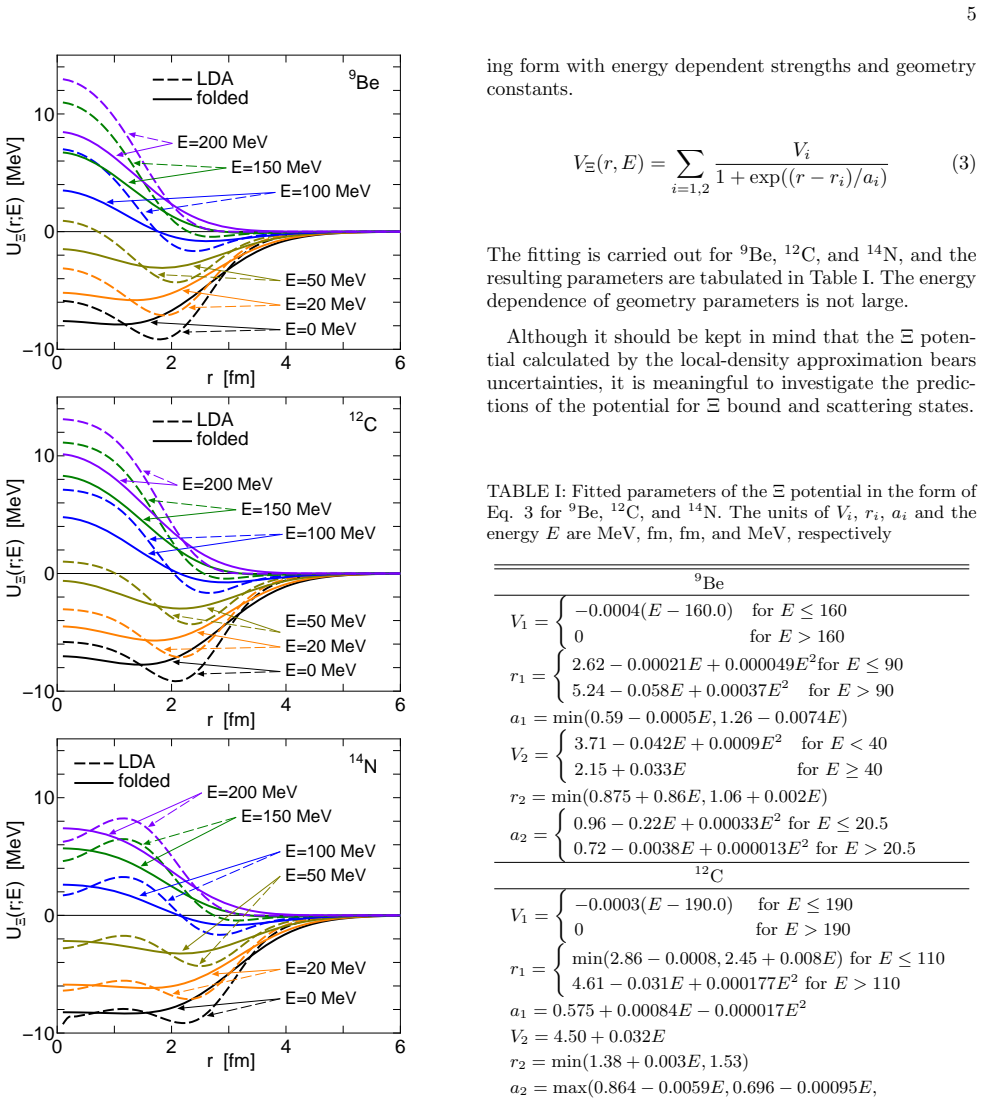
The load-bearing machinery is the coupled-channel G-matrix equation of lowest-order Brueckner theory, a resummation that handles short-range correlations, applied to the NLO ChEFT S=-2 interaction: the XiN channel is coupled nonperturbatively to Lambda-Lambda, Lambda-Sigma, and Sigma-Sigma channels, and this coupling is what turns an otherwise repulsive Xi potential into a weakly attractive one at low momentum. To reach finite nuclei, the density-dependent potential is converted to an energy-dependent coordinate-space optical potential by the local-density approximation and smoothed with a Gaussian form factor of range 1 fm to restore finite-range effects. The resulting numerically calculated potential is well reproduced by a sum of attractive and repulsive Woods-Saxon parts, and that parametrized potential is what carries the bound-state and (K-,K+) cross-section calculations.
What would settle it
A high-resolution measurement of the 12C(K-,K+)Xi- spectrum near threshold would settle it: the calculation predicts a bump from the 0s bound state around -4 MeV, whereas a null or purely repulsive potential shows no such bump; likewise, if the quasi-free peak in 9Be(K-,K+) is measured at the position the data already indicate rather than at the lower Xi energy this calculation gives, the repulsive-core/attractive-surface picture would need revision.
Extended reading notes
Core claim
Using the NLO ChEFT S=-2 baryon-baryon interaction with the updated parameters and a 550 MeV cutoff, the paper computes Xi single-particle potentials in symmetric nuclear matter by solving the baryon-channel coupled G-matrix equation in lowest-order Brueckner theory. The resulting potential is weakly attractive at low momenta, an effect generated by coupling to Lambda-Lambda, Lambda-Sigma, and Sigma-Sigma channels, most notably in the T=1 3S1 XiN-LambdaSigma-SigmaSigma channel. Transformed to finite nuclei through a local-density approximation with a Gaussian folding of 1 fm range, the potential is repulsive in the central region and attractive in the surface at low Xi energy. It produces Xi- 0s states at about -4.2 MeV in 12C and -5.4 MeV in 14N, values the paper judges conformable with the emulsion binding energies of about 3.9 and 4.4 MeV; the alternative higher-energy assignments correspond to the 0p state, which is only slightly shifted from the atomic level. The same parametrized potential, used in a semiclassical distorted-wave calculation, reproduces the absolute magnitude of the 9Be inclusive spectrum but places the quasi-free peak lower than measured, and for 12C it predicts a near-threshold bump whose location is sensitive to the potential strength.
Load-bearing premise
The surface attraction that creates the bound states comes from the Xi potential at low nuclear density (Fermi momentum below about 0.8 $fm^{-1}$), where the G-matrix self-consistency is not reliable and the potential is filled in by interpolation; the two natural interpolation choices, as a function of density or of Fermi momentum, give different low-density attractions and therefore different bound-state energies.
Editorial extensions
If this is right
- The NLO ChEFT Xi-nucleus potential supports a Xi- 0s bound state in both 12C and 14N, so the emulsion binding energies can be explained without invoking an ad hoc deep attractive well.
- No 0p bound state is predicted; the 0p state is only slightly shifted downward from the atomic level, so an experiment that can distinguish orbital assignments would separate the two possible readings of the 14N event.
- The canonical Woods-Saxon potential with depth 14 MeV gives deeper 0s states than the emulsion candidates, so unless deeper states are found, that standard depth is disfavored by this calculation.
- The near-threshold 12C(K-,K+) cross section is sensitive to the strength of the Xi potential, so the forthcoming higher-resolution data can discriminate between the ChEFT potential, a null potential, and a deep attractive well.
- In symmetric nuclear matter the weak attraction is generated by baryon-channel coupling, while at higher densities the T=0 s-wave attraction is absent, so the same interaction implies a repulsive Xi potential in neutron-rich high-density matter.
Reading between the lines
- If the repulsive-core/attractive-surface shape is confirmed, fitting Xi-nucleus data with a single Woods-Saxon well of around 14 MeV would misrepresent the interaction: the same shallow bound states can come from a surface pocket rather than a deep central attraction.
- The interpolation ambiguity at low density could be tested theoretically by computing the Xi potential directly in finite nuclei, bypassing the homogeneous-matter assumption where G-matrix self-consistency is lost.
- Because the attractive T=0 s-wave contribution is absent in neutron-rich matter, this mechanism implies that Xi hyperons may be less abundant in neutron star interiors than models with universally attractive Xi potentials assume, with consequences for the equation of state.
- The Gaussian-folded local-density approach used here could be extended to heavier nuclei such as 40Ca once the non-monotonic density distributions are handled, giving predictions for Xi- atomic level shifts and bound states that the paper leaves for future work.
Signed reviews
Editorial analysis
A structured set of objections, weighed in public.
Referee Report
Summary. The manuscript by M. Kohno calculates Ξ single-particle potentials in symmetric nuclear matter by solving the baryon-channel coupled G-matrix equation with the chiral NLO S = −2 baryon-baryon interactions of Ref. [5] using the updated parameters of Ref. [15]. The momentum-dependent nuclear-matter potential is converted to an energy-dependent coordinate-space optical potential for finite nuclei via a local-density approximation followed by Gaussian folding with β = 1 fm, and is then parametrized as a sum of attractive and repulsive Woods-Saxon terms. The resulting Ξ− potentials in 12C and 14N yield 0s bound states at about −4 and −5 MeV, respectively, which the paper argues are conformable with KEK emulsion binding-energy determinations, and also produce 0p shifts of the atomic states. The same parametrized potentials are used in a semiclassical distorted-wave calculation of K+ spectra for (K−,K+) Ξ production on 9Be and 12C; the 9Be spectrum reproduces the absolute magnitude of the data but places the quasi-free peak at a lower K+ momentum (higher Ξ energy) than observed, while the 12C spectrum is presented as a prediction for upcoming KEK data.
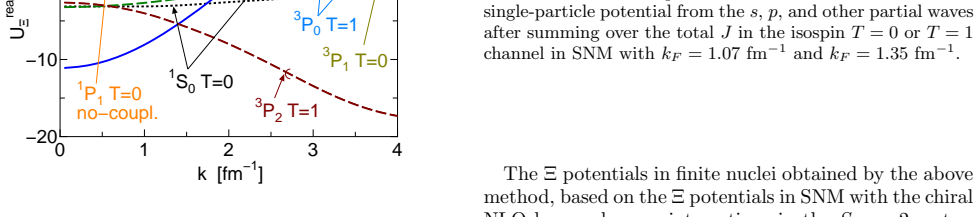
Significance. If the results are robust, this would be one of the first nuclear-medium Ξ potentials derived from chiral NLO S = −2 interactions, connecting the microscopic interaction to emulsion bound states and (K−,K+) spectra. The partial-wave decomposition in Fig. 2 and the identification of the T = 1 3S1 baryon-channel coupling as the source of weak attraction are informative, and the paper is transparent about its approximations: the angle-averaged Pauli operator, the cutoff factor, the on-shell treatment, and the local-density convolution. The parametrized potentials in Table I are a practical output for future experimental comparisons. However, the central quantitative claim of agreement with the KEK binding energies currently rests on an unvalidated low-density interpolation, and part of the 14N agreement follows from the input parametrization having been tuned to that datum. These issues limit the conclusiveness of the 'conformable' statement and require quantification before the central claim can be accepted.
major comments (4)
- [Sec. III, Fig. 6 and Table II] The quantitative claim of agreement with the KEK emulsion binding energies rests on the extrapolation of U_Ξ(E,k_F) below k_F ≈ 0.8 fm^-1, where the G-matrix calculation is not self-consistent and the potential is obtained by interpolating computed points to U=0 at k_F=0. The paper itself shows in Fig. 6 that a cubic-spline interpolation in density ρ differs from one in k_F, the latter being more attractive at low densities, and states that with the k_F interpolation the 0s and 0p bound states appear at lower energies than in Table II. Because the bound-state energies (e.g., 14N 0s at −5.40 MeV, close to the experimental 4.38 ± 0.25 MeV) are presented as a main result, the sensitivity of Table II to the interpolation choice must be quantified. Please recompute the bound states with the k_F interpolation and report both sets of energies, or otherwise justify the choice of the density interpolation as the physical one.
- [Sec. I and Sec. III.B] The parameters of the chiral NLO S = −2 interactions were updated in Ref. [15] by considering the experimental evidence for a Ξ− bound state in 14N (Nakazawa et al. [9]). The present calculation uses these parameters and then finds a 14N 0s state at about −5.4 MeV, which the paper describes as 'nearly matching' the same experimental value. This comparison is not independent: the agreement is partially built into the input interaction. The manuscript should explicitly acknowledge this circularity and base its claim of conformability on the 12C states and the (K−,K+) spectra, treating the 14N comparison as a consistency check rather than an independent validation.
- [Sec. IV, Eq. (10)] The Gaussian resolution function in Eq. (10) as written is not normalized: its integral over E is π/ln2 ≈ 4.53, not 1. The correct normalization factor for the kernel exp(−ln2 (E/∆E)^2) is (1/∆E)√(ln2/π), not 1/(∆E√(ln2/π)). Since the 9Be spectrum is compared with data 'without any multiplicative factor' in Sec. IV.A, this normalization error directly affects the claimed reproduction of the absolute cross section in Fig. 7. Please correct Eq. (10), rerun the spectra, and confirm that the absolute normalization remains consistent with the experimental data.
- [Sec. IV.A, Fig. 7] The computed quasi-free peak for 9Be sits at a lower K+ momentum (higher Ξ energy) than the data, and the paper concludes that 'the ChEFT potential may need more repulsive character.' This introduces a tension with the attractive surface potential that generates the bound states in Table II. The author should discuss whether the additional repulsion suggested by the 9Be spectrum would materially change the predicted 12C and 14N bound-state energies, and ideally quantify this with a test case, since the same potential is used for both the bound-state and the quasi-free analyses.
minor comments (5)
- [Abstract and Introduction] The word 'Physiks' appears twice and should be 'Physics'.
- [Table I] Several entries appear to contain typographical errors: for 12C, 'r1 = {min(2.86−0.0008, 2.45+0.008E)' should likely be 'min(2.86−0.0008E, 2.45+0.008E)'; for 14N, 'a1 = 0.55 + 0.00038' should likely be '0.55 + 0.00038E'; similar missing E factors may affect other lines and should be checked.
- [Sec. III.B] In the sentence 'It is possible for the NLO ChEFT Ξ potential to generate a 0s Ξ0 bound state in 12C and 14N, but no 0p bound state exists', the phrase 'no 0p bound state exists' refers only to Ξ0, since Table II lists a Ξ− 0p state. The wording should be made unambiguous.
- [Sec. IV.A] Please state explicitly how the momentum resolution (∆p/p)_K+ = 1% is converted to the energy resolution ∆E = 6.1 MeV used in Eq. (10), so that readers can reproduce the smearing.
- [Captions of Figs. 8 and 9] The captions contain '∆E−2 MeV', which should read '∆E = 2 MeV'.
Circularity Check
The 14N 'conformable' binding energy recycles a datum already used to update the S=-2 interaction; the 12C bound-state comparison and K+ spectra remain independent checks.
-
fitted input called prediction
[Sec. I (input setup) and Sec. III.B (validation of 14N bound state)]
"The parameters of the chiral NLO interactions in the strangeness S =−2 sector were recently updated [15] by considering the recent experimental evidence of a Ξ− bound state in 14N. In the present calculations, these parameters with a cutoff scale of 550 MeV are employed. ... It is interesting to observe that the deeply bound Ξ− state of the Ξ−-14N system at 4.38±0.25 MeV found in Ref. [9] nearly matches the 0s state in the present calculation."
The 14N binding energy is presented as a successful prediction ('nearly matches', 'conformable'), but the input S=-2 interaction parameters were themselves updated in Ref. [15] by considering the same 14N bound-state evidence. Importing those parameters and then finding a 14N 0s state near the fitted datum is not an independent confirmation; the agreement is partly built into the input. This is a mild form of fitted-input-as-prediction: the calculation is a many-body evaluation, so it is not strictly identical to the fit, but the empirical quantity used for validation is the same one that constrained the parametrization. The 12C comparison and the K+ spectra are not affected by this particular recycling and provide independent, albeit weaker or mixed, checks.
full rationale
The paper's central chain — chiral NLO S=-2 interaction, G-matrix in symmetric nuclear matter, LDA plus Gaussian folding, bound-state and K+ spectrum calculation — is otherwise self-contained and does not reduce to its inputs by definition. The one genuine circular element is the 14N validation: the interaction parameters were updated in Ref. [15] with the 14N Ξ− bound state in mind, and Sec. III.B then uses those parameters to recover a 14N bound state 'conformable' with the same datum. This lowers the independent evidential weight of the 14N agreement, but does not vitiate the whole paper because the 12C bound-state comparison and the 9Be/12C K+ spectra are not fitted quantities. The interpolation ambiguity admitted in Sec. III (Fig. 6) is a substantial robustness concern — the low-density potential, and hence the surface pocket, depends on whether one splines in ρ or kF — but it is not circularity: both interpolations are extrapolations of the same computed G-matrix points and are not fitted to the emulsion binding energies. Overall, the central derivation retains independent content, so a moderate score of 4 is appropriate rather than a higher 'forced by construction' verdict.
Assumptions & free parameters
free parameters (4)
- ChEFT S=-2 NLO LECs (updated in Ref. [15]) =
Not tabulated; fixed by fit to scattering and the 14N Xi- bound state
- Gaussian folding range beta =
1.0 fm
- Lorentz smearing half-width Gamma/2 =
5 MeV (2 MeV near threshold)
- Woods-Saxon parametrization (V1, V2, r1, r2, a1, a2) =
Tabulated in Table I for 9Be, 12C, 14N
assumptions (5)
- domain assumption Bethe-Goldstone G-matrix with continuous choice and angle-averaged Pauli operator is a valid lowest-order Brueckner treatment for the XiN in-medium interaction.
- domain assumption LDA with Gaussian convolution (beta=1 fm) translates SNM potentials to finite nuclei.
- ad hoc to paper The low-density part of U_Xi(E,kF) (kF<0.8 fm^-1) is obtained by interpolating computed points to U=0 at kF=0; the interpolation variable is chosen as density rather than kF.
- domain assumption The imaginary part of the Xi potential is negligible for bound-state energies.
- domain assumption The semiclassical distorted wave method with on-shell K-p -> K+Xi- amplitude provides reliable K+ spectra.
Cite this review
Pith. "Pith review of $\Xi$ hyperons in the nuclear medium described by chiral NLO interactions." pith.science (2026). https://pith.science/paper/KYT3E3G3
@misc{pith2026190801934,
  author       = {Pith},
  title        = {Pith review of: $\Xi$ hyperons in the nuclear medium described by chiral NLO interactions},
  year         = {2026},
  howpublished = {\url{https://pith.science/paper/KYT3E3G3}},
  note         = {Machine review of arXiv:1908.01934}
}
abstract
Properties of the baryon-baryon interactions in the strangeness $S=-2$ sector of chiral effective field theory at the next-to-leading order (NLO) level are explored by calculating $\Xi$ single-particle potentials in symmetric nuclear matter. The results are transformed to the $\Xi$ potential in finite nuclei by a local-density approximation with convolution by a Gaussian form factor to simulate finite-range effects. The $\Xi$ potential is repulsive in a central region, and attractive in a surface area when the $\Xi$ energy is low. The attractive pocket can lower the $\Xi^-$ $s$ and $p$ atomic states. The obtained binding energies in $^{12}$C and $^{14}$N are found to be conformable with those found in emulsion experiments at Japan's National Laboratory for High Energy Physics (KEK). $K^+$ spectra of $(K^-, K^+)$ $\Xi$ production inclusive processes on $^9$Be and $^{12}$C are also evaluated, using a semi-classical distorted wave method. The absolute values of the cross section are properly reproduced for $^9$Be, but the peak locates at a lower energy position than that of the experimental data. The calculated spectrum of $^{12}$C should be compared with the forthcoming result from the new experiments recently carried out at KEK with better resolution than before. The comparison would be valuable to improve the understanding of the $\Xi N$ interaction, the parametrization of which has still large uncertainties.
Figures


Figures from the paper (4 more)


Reference graph
Works this paper leans on
-
[15]
J. Haidenbauer and U.-G. Meißner, Euro. Phys. J. A 55, 23 (2019)
work page 2019
-
[5]
J. Haidenbauer, U.-G. Meißner, and S. Petschauer, Nucl. Phys. A 954, 273 (2016)
work page 2016
- [9]
-
[1]
Epelbaum, H.-W
E. Epelbaum, H.-W. Hammer, and U.-G. Meisner, Rev. Mod. Phys. 81, 1773 (2009)
2009
- [2]
-
[3]
H. Polinder, J. Haidenbauer, and U.-G. Meissner, Nucl. Phys. A779, 244 (2006)
work page 2006
-
[4]
J. Haidenbauer, S. Petschauer, N. Kaiser, U.-G. Meißner, A. Nogga, and W. Weise, Nucl. Phys. A 915, 24 (2013)
work page 2013
-
[6]
S. Petschauer, N. Kaiser, J. Haidenbauer, U.-G. Meißner, and W. Weise, Phys. Rev. C 93, 014001 (2016)
work page 2016
Show all 30 references
-
[7]
Haidenbauer, U.-G
J. Haidenbauer, U.-G. Meißner, N. Kaiser, and W. Weise, Eur. Phys. J. A 53, 121 (2017)
2017
-
[8]
Kohno, Phys
M. Kohno, Phys. Rev. C 97, 035206 (2018)
2018
-
[10]
Aoki et al
S. Aoki et al. , Nucl. Phys. A 828, 191 (2009)
2009
-
[11]
Fukuda et al
T. Fukuda et al. , Phys. Rev. C 58, 1306 (1998)
1998
-
[12]
Khaustov et al
P. Khaustov et al. , Phys. Rev. C61, 054603 (2000)
2000
-
[13]
Kohno and S
M. Kohno and S. Hashimoto, Prog. Theor. Phys. 123, 1 (2010)
2010
-
[14]
Nagae, 13th Int
T. Nagae, 13th Int. Conf. Hyp. Str. Phys., June 24-29, 2018, Portsmouth, USA
2018
-
[16]
Kohno, Phys
M. Kohno, Phys. Rev. C 88, 064005 (2013); 96, 059903(E) (2017)
2013
-
[17]
Epelbaum, W
E. Epelbaum, W. Gl¨ ockle, and U.-G. Meißner, Nucl. Phys. A 747, 362 (2005)
2005
-
[18]
Epelbaum, A
E. Epelbaum, A. Nogga, W. Gl¨ ockle, H. Kamada, Ulf-G. Meißner, and H. Wita la, Phys. Rev. C66, 064001 (2002)
2002
-
[19]
Fujiwara, Y
Y. Fujiwara, Y. Suzuki, and C Nakamoto, Prog. Part. 11 Nucl. Phys. 58, 439 (2007)
2007
- [20]
-
[21]
Kohno and Y
M. Kohno and Y. Fujiwara, Phys. Rev. C 79, 054318 (2009)
2009
-
[22]
Yamamoto, T
Y. Yamamoto, T. Motoba, and Th.A. Rijken, Prog. Theor. Phys. Suppl. 185, 72 (2010),
2010
-
[23]
Jeukenne, A
J.-P. Jeukenne, A. Lejeune, and C. Mahaux, Phys. Rev C 16, 80 (1977)
1977
-
[24]
Toyokawa, M
M. Toyokawa, M. Yahiro, T. Matsumoto, and M. Kohno, Prog. Theor. Exp. Phys. 2018, 023D03 (2018)
2018
-
[25]
Campi and D.W
X. Campi and D.W. Sprung, Nucl. Phys. A 194, 401 (1972)
1972
-
[26]
Tamagawa, Ph.D
T. Tamagawa, Ph.D. Thesis, University of Tokyo, 2000 (unpublished)
2000
-
[27]
Hashimoto, M
S. Hashimoto, M. Kohno, K. Ogata, and M. Kawai, Prog. Theor. Phys. 119, 1 (2008)
2008
-
[28]
9 1000 1200 14000 0.1 0.2 0.3 0.4 Γ/2=5 MeV pK+ [MeV/c] d2σ/(dΩLdpK) [μb/sr/(MeV c−1)] threshold 9Be(K−,K+) pK−=1.8 GeV/c θK+=5 deg
for these hadrons are worthwhile to investigate in the future analysis. 9 1000 1200 14000 0.1 0.2 0.3 0.4 Γ/2=5 MeV pK+ [MeV/c] d2σ/(dΩLdpK) [μb/sr/(MeV c−1)] threshold 9Be(K−,K+) pK−=1.8 GeV/c θK+=5 deg. W−S (r1=2.20 fm, a1=0.65 fm) V1=−14 MeV 0 MeV +14 MeV ChEFT FIG. 7: K+ s...
2000
-
[29]
Kohno, Nucl
M. Kohno, Nucl. Phys. A 410, 349 (1983)
1983
-
[30]
Sasaki et al
K. Sasaki et al. , EPJ Web Conf. 175, 05010 (2018)
2018
Reviewed August 14, 2026 · model on record in the stance chip above.
Discussion (0). Continue with ORCID to comment.