REVIEW 4 major objections 7 minor 56 references
View N-gram Network for 3D Object Retrieval
T0 review · 4 major / 7 minor · reviewed 2026-08-14 · deepseek-v4-flash
Pith's one-line read View N-gram Network claims that dividing a 3D object's ordered rendered views into overlapping visual n-grams and aggregating them with a parameterless attention mechanism produces state-of-the-art retrieval accuracy and partial rotation…
desk verdict A solid, incremental multi-view retrieval paper whose aligned-benchmark results are credible; the rotation-robustness claim is undercut by an unspecified view ordering on the perturbed dataset. read the letter →
The pith
A machine-rendered reading of the paper's core claim, the machinery that carries it, and where it could break.
The reading
What carries the argument
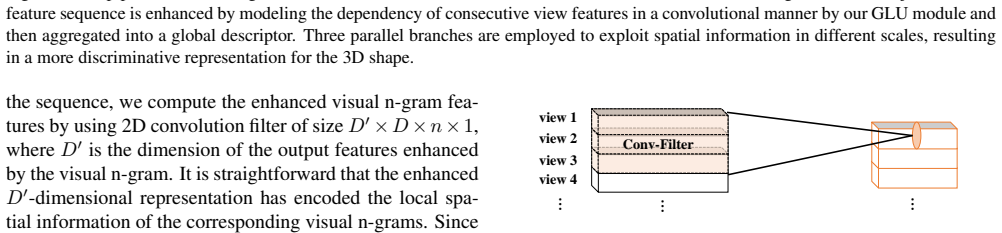
The n-Gram Learning Unit (n-GLU) is a 2D convolution filter of size $D'\\times D \\times n \\times 1$ applied to the $|V|\\times D$ matrix of view features arranged in rendering order, so that a sliding window of $n$ consecutive views produces $(|V|-n+1)\\times D'$ enhanced local features. It carries the argument by encoding spatial context within short runs of adjacent views while remaining parallelizable, and the parameterless attention aggregator then selects and combines these local windows into one global descriptor.
What would settle it
Render the same ModelNet40 objects but shuffle the order of the 12 views before forming the n-grams while keeping every other training detail fixed; if retrieval mAP stays near the reported 88.9%, the visual n-gram's claimed spatial-context mechanism is not what drives the performance, and the gain would come from feature aggregation alone.
Extended reading notes
Core claim
The paper's central claim is that an ordered sequence of rendered views can be treated like a sentence and decomposed into overlapping visual n-grams, and that encoding each n-gram with a 2D convolution over the view-feature matrix captures local spatial relationships among consecutive views. VNN builds one branch per n-gram size, here 3, 5, and 7, and each branch ends in a parameterless attentional aggregator: max-pool the n-gram features into a proxy global vector, score each n-gram by a scaled inner product with that vector, take a softmax, form a weighted sum, then add a residual connection and layer-normalize. Concatenating the branch outputs gives a compact descriptor that the paper reports as 89.6% AUC and 88.9% mAP on ModelNet40, 93.5% AUC and 92.8% mAP on ModelNet10, and leading F-measure, mAP, and NDCG on the aligned ShapeNetCore55 benchmark, with competitive results on its arbitrarily oriented version. The paper argues that the local adjacent relationship captured by visual n-grams is robust to rotation, and that the parameterless attention aggregator is a better aggregation method than max-pooling for multi-view features.
Load-bearing premise
The entire method depends on the rendering order making consecutive views true spatial neighbors, so that a sliding window of n consecutive views describes a connected local region of the object; if the view order is shuffled or rotations break that adjacency, the n-gram windows lose their geometric meaning.
Editorial extensions
If this is right
- View-based 3D retrieval can reach top accuracy without recurrent sequential processing, because n-gram windows can be computed in parallel.
- A parameter-free attention module over n-gram features is a workable alternative to max-pooling for aggregating multi-view representations.
- Combining several n-gram sizes is complementary: fusing 3-, 5-, and 7-gram branches consistently improves over any single window size.
- The learned descriptor carries some rotation robustness, since local adjacent view relationships survive object rotation, as shown by the competitive results on the perturbed ShapeNetCore55 version.
- The framework composes with metric learning: adding triplet-center loss to the softmax objective further improves retrieval.
Reading between the lines
- Beyond the paper, the same sliding-window idea could transfer to other ordered multi-image inputs, such as video frames or 360-degree panoramas, wherever consecutive images are true spatial neighbors.
- The paper leaves implicit that the parameterless aggregator could be attached to any CNN feature extractor without retraining the aggregator itself, which may make it useful in few-shot retrieval settings.
- A natural stress test of the rotation-robustness claim would be to rotate a fixed set of objects by arbitrary angles and measure how stable the resulting descriptors are, rather than relying only on the perturbed benchmark.
- One could also test whether the learned attention weights correlate with view informativeness, effectively making the model explain which viewing directions matter most for a given shape.
Signed reviews
Editorial analysis
A structured set of objections, weighed in public.
Referee Report
Summary. The paper introduces View N-gram Network (VNN), a multi-view 3D object retrieval method. Given an ordered sequence of rendered views of a 3D object, VNN extracts per-view features with a shared CNN, then slides a convolutional window of size n over the feature sequence (n-GLU) to produce visual n-gram features that encode local spatial context. Three parallel branches with n-gram sizes 3, 5, and 7 are fused by concatenation after each branch aggregates its n-gram features with a proposed parameterless attention mechanism (max-pooling proxy, inner-product scores, weighted sum, residual layer norm). A two-layer classifier with softmax loss is trained on the fused descriptor. Experiments on ModelNet40, ModelNet10, and ShapeNetCore55 (normal and perturbed) report improvements over prior view-based and model-based methods, including 89.6% AUC and 88.9% mAP on ModelNet40 and 92.8% mAP on ModelNet10.
Significance. If the reported results are robust, VNN is a meaningful contribution: it offers a computationally efficient alternative to RNN-based view aggregation, captures local view dependencies without extra parameters (modulo the layer-norm point), and improves retrieval accuracy over strong baselines on aligned benchmarks. The parameter-free attention aggregator is a neat idea that performs better than max-pooling in the ablation. The paper ships a clear description of the architecture, a thorough ablation over n-gram sizes and combinations, and comparisons on three standard benchmarks. However, the magnitude of the claimed advantages is uncertain in several places: the n-gram sizes are selected on the test set, the perturbed-dataset experiment does not specify the view order that the n-gram mechanism receives, and the margins over the strongest baseline (TCL) on perturbed ShapeNetCore55 are zero for mAP. Thus the central claims of state-of-the-art performance and rotation robustness are not yet established at the reported level of confidence.
major comments (4)
- [Sec. 4.3 and Sec. 3.2] The rendering protocol for the perturbed ShapeNetCore55 dataset specifies 80 views as 20 icosahedron vertices times 4 in-plane rotations per camera, but the paper never states the order in which these views are fed to the n-GLU. If the views are ordered by camera and then by rotation (the natural implementation), consecutive views in a 3-, 5-, or 7-gram are mostly images from the same camera direction differing by in-plane rotation, rather than spatially adjacent views around the object. Since Section 3.2 grounds the rotation robustness of visual n-grams in the 'local adjacent relation of views,' the perturbed experiments in Table 2 would then not test that mechanism at all. Please specify the exact view ordering and, ideally, report the perturbed results for two different orderings to show the claimed robustness.
- [Sec. 4.5, Table 3] The final architecture uses n-gram sizes {3,5,7}, which are chosen from the ablation on the ModelNet40 test set, and the main results in Table 1 are reported on that same test set. This is a form of test-set overfitting: the hyperparameters are selected on the evaluation set, so the reported 89.6 AUC/88.9 mAP are optimistically biased and the comparison with prior work is not a fair out-of-sample comparison. Please use a validation split for hyperparameter selection and report test results for the resulting model, or use nested cross-validation.
- [Sec. 3.3, Eq. (1)-(3)] The paper states in Section 3.3 that 'the full pipeline of our attentional feature aggregation does not involve any learnable parameters,' yet the residual stage applies layer normalization [1], which in the standard formulation contains learnable scale and bias parameters. Either specify that a non-affine layer normalization without learnable parameters is used, or revise the claims in Sections 1 and 4.5 that the attention model is parameter-free. This is directly relevant to contribution 3.
- [Sec. 4.4, Table 2 (perturbed)] On the perturbed ShapeNetCore55 set, VNN's mAP is 81.2 vs. TCL's 81.2 and NDCG is 88.3 vs. 88.2, so the stated superiority over TCL rests entirely on F1 (60.7 vs. 55.9). With no error bars or significance tests, the conclusion that VNN 'can be naturally extended to the cases where orientations of 3D shapes are agnostic' is not strongly supported. Please report multiple runs (with mean and std) for at least the main comparisons, and moderate the claim accordingly.
minor comments (7)
- [Sec. 4.4, ModelNet10 paragraph] The sentence 'VNN significantly boosts the mAP of MCNNN by 12.7%' appears to contain a typo: 'MCNNN' should be 'MVCNN'.
- [Sec. 3.4] The sentence 'we use three n-gram branches with n-gram sizes of 3, 5 and 7' states the final choice without justification, which is only provided later in the Section 4.5 ablation; consider noting that the choice is empirically validated there.
- [Fig. 3 caption] The caption refers to the module as 'GLU' while the text defines 'n-GLU'; please make the terminology consistent throughout.
- [Sec. 4.3] The rendered images are described as greyscale 224x224, but the pre-trained VGG-A expects RGB input; please specify how the greyscale images are converted to three channels or whether the first convolutional layer was modified.
- [Table 2] The column 'microALL + macroALL' appears to be an average of the microALL and macroALL columns, but the averaging formula is not defined; please state whether this is the official SHREC evaluation protocol.
- [Eq. (1)] The summation in the denominator of Eq. (1) is written as summing over i without explicit bounds; it should be i=1 to |V|+1-n for clarity.
- [Sec. 4.2] The definition 'AUC is the mean area under the PR curve' is unusual for the term AUC, which commonly refers to the ROC curve; please clarify that the PR-curve AUC is intended.
Circularity Check
No significant circularity: VNN is an empirical architecture whose gains are measured against external benchmarks; self-citations are not load-bearing.
full rationale
VNN is an empirical architecture paper. The central mechanism (n-GLU) is a 2D convolution over a sequence of view features; the reported gains are measured against external benchmarks with fixed splits (ModelNet40/10, ShapeNetCore55) and compared with published baselines. No parameter is fitted to the target metric and then reported as a prediction: n-gram sizes (3, 5, 7) are selected by ablations and reported as such, and the attention aggregator is parameter-free and computed directly from the features being aggregated, which is a standard self-attention-style operation rather than a logical dependency. Self-citations (e.g., TCL [19]) are confined to a complementary metric-learning ablation and do not carry the central claim. The only substantive concern is the unspecified ordering of the 80 perturbed ShapeNetCore55 views, which could undermine the rotation-robustness interpretation, but this is an experimental-validity issue, not a circular reduction: no equation in the paper defines the outcome in terms of the input. Therefore no circular step meets the quoted-evidence bar.
Assumptions & free parameters
free parameters (3)
- n-gram sizes {3,5,7} =
3, 5, 7
- n-GLU output dimension D' =
512
- Rendering view count and protocol =
12 views for aligned, 80 for perturbed
assumptions (4)
- domain assumption 3D shapes from the same category share similar n-gram patterns, while different categories differ.
- domain assumption The local adjacent relationship captured by visual n-grams is robust to rotation.
- domain assumption A fixed rendering order (every 30 degrees, or icosahedron plus in-plane rotations) produces a sequence where consecutive views are spatially adjacent.
- domain assumption Pretrained VGG-11 on ImageNet provides transferable features for rendered view images.
Cite this review
Pith. "Pith review of View N-gram Network for 3D Object Retrieval." pith.science (2026). https://pith.science/paper/JX62IXT6
@misc{pith2026190801958,
  author       = {Pith},
  title        = {Pith review of: View N-gram Network for 3D Object Retrieval},
  year         = {2026},
  howpublished = {\url{https://pith.science/paper/JX62IXT6}},
  note         = {Machine review of arXiv:1908.01958}
}
read the original abstract
How to aggregate multi-view representations of a 3D object into an informative and discriminative one remains a key challenge for multi-view 3D object retrieval. Existing methods either use view-wise pooling strategies which neglect the spatial information across different views or employ recurrent neural networks which may face the efficiency problem. To address these issues, we propose an effective and efficient framework called View N-gram Network (VNN). Inspired by n-gram models in natural language processing, VNN divides the view sequence into a set of visual n-grams, which involve overlapping consecutive view sub-sequences. By doing so, spatial information across multiple views is captured, which helps to learn a discriminative global embedding for each 3D object. Experiments on 3D shape retrieval benchmarks, including ModelNet10, ModelNet40 and ShapeNetCore55 datasets, demonstrate the superiority of our proposed method.
Figures


Figures from the paper (3 more)


Reference graph
Works this paper leans on
-
[1]
Jimmy Lei Ba, Jamie Ryan Kiros, and Geoffrey E Hin- ton. Layer normalization. arXiv preprint arXiv:1607.06450,
-
[2]
Gift: A real-time and scalable 3d shape search engine
Song Bai, Xiang Bai, Zhichao Zhou, Zhaoxiang Zhang, and Longin Jan Latecki. Gift: A real-time and scalable 3d shape search engine. In CVPR, pages 5023–5032, 2016. 1, 3, 6, 7
work page 2016
-
[3]
Re-ranking via metric fusion for object retrieval and per- son re-identification
Song Bai, Peng Tang, Philip HS Torr, and Longin Jan Late- cki. Re-ranking via metric fusion for object retrieval and per- son re-identification. In Proc. CVPR, pages 740–749, 2019. 1
work page 2019
-
[4]
Ensemble diffusion for retrieval
Song Bai, Zhichao Zhou, Jingdong Wang, Xiang Bai, Longin Jan Latecki, and Qi Tian. Ensemble diffusion for retrieval. In Proc. ICCV, pages 774–783, 2017. 6, 7
work page 2017
-
[5]
Shape con- text: A new descriptor for shape matching and object recog- nition
Serge Belongie, Jitendra Malik, and Jan Puzicha. Shape con- text: A new descriptor for shape matching and object recog- nition. In Proc. NIPS, pages 831–837, 2001. 1
work page 2001
-
[6]
Leila Bergamasco, Karla Lima, Carlos Rochitte, and F ´atima de Lourdes dos Santos Nunes. 3d medical objects retrieval approach using spharms descriptor and network flow as sim- ilarity measure. In 2018 31st SIBGRAPI Conference on Graphics, Patterns and Images (SIBGRAPI), pages 329–336. IEEE, 2018. 1
work page 2018
-
[7]
Alexander M. Bronstein, Michael M. Bronstein, Leonidas J. Guibas, and Maks Ovsjanikov. Shape google: Geometric words and expressions for invariant shape retrieval. Acm Transactions on Graphics, 30(1):1–20, 2011. 2
work page 2011
-
[8]
Shapenet: An information-rich 3d model repository
Angel X Chang, Thomas Funkhouser, Leonidas Guibas, Pat Hanrahan, Qixing Huang, Zimo Li, Silvio Savarese, Manolis Savva, Shuran Song, Hao Su, et al. Shapenet: An information-rich 3d model repository. arXiv preprint arXiv:1512.03012, 2015. 1, 5
arXiv 2015
Show all 56 references
-
[9]
Group consistent similarity learning via deep crf for person re-identification
Dapeng Chen, Dan Xu, Hongsheng Li, Nicu Sebe, and Xi- aogang Wang. Group consistent similarity learning via deep crf for person re-identification. In Proc. CVPR, pages 8649– 8658, 2018. 3
2018
-
[10]
On visual similarity based 3d model retrieval
Ding-Yun Chen, Xiao-Pei Tian, Yu-Te Shen, and Ming Ouhyoung. On visual similarity based 3d model retrieval. In Comput. Graph. Forum, pages 223–232, 2003. 1, 2, 6
2003
-
[11]
Veram: View-enhanced recurrent attention model for 3d shape classification
Songle Chen, Lintao Zheng, Yan Zhang, Zhixin Sun, and Kai Xu. Veram: View-enhanced recurrent attention model for 3d shape classification. IEEE Trans. Vis. Comput. Graphics,
-
[12]
Siamese cnn-bilstm ar- chitecture for 3d shape representation learning
Guoxian Dai, Jin Xie, and Yi Fang. Siamese cnn-bilstm ar- chitecture for 3d shape representation learning. In Proc. IJ- CAI, 2018. 1, 3
2018
-
[13]
3d deep shape descriptor
Yi Fang, Jin Xie, Guoxian Dai, Meng Wang, Fan Zhu, Tiantian Xu, and Edward Wong. 3d deep shape descriptor. In Proc. CVPR, pages 2319–2328, 2015. 2
2015
-
[14]
Gvcnn: Group-view convolutional neural networks for 3d shape recognition
Yifan Feng, Zizhao Zhang, Xibin Zhao, Rongrong Ji, and Yue Gao. Gvcnn: Group-view convolutional neural networks for 3d shape recognition. In Proc. CVPR, pages 264–272,
-
[15]
Deep aggregation of local 3d geometric features for 3d model retrieval
Takahiko Furuya and Ryutarou Ohbuchi. Deep aggregation of local 3d geometric features for 3d model retrieval. InProc. BMVC, 2016. 6, 7
2016
-
[16]
3d object retrieval with bag-of-region-words
Yue Gao, You Yang, Qionghai Dai, and Naiyao Zhang. 3d object retrieval with bag-of-region-words. In Proc. ACM Int. Conf. Multimedia, pages 955–958, 2010. 1
2010
-
[17]
Seqviews2seqlabels: Learning 3d global features via aggregating sequential views by rnn with atten- tion
Zhizhong Han, Mingyang Shang, Zhenbao Liu, Chi-Man V ong, Yu-Shen Liu, Matthias Zwicker, Junwei Han, and CL Philip Chen. Seqviews2seqlabels: Learning 3d global features via aggregating sequential views by rnn with atten- tion. IEEE Trans. Image Process., 28(2):658–672, 2018. 1...
2018
-
[18]
Deep residual learning for image recognition
Kaiming He, Xiangyu Zhang, Shaoqing Ren, and Jian Sun. Deep residual learning for image recognition. In Proc. CVPR, pages 770–778, 2016. 3, 8
2016
-
[19]
Triplet-center loss for multi-view 3d object retrieval
Xinwei He, Yang Zhou, Zhichao Zhou, Song Bai, and Xiang Bai. Triplet-center loss for multi-view 3d object retrieval. Proc. CVPR, 2018. 6, 7, 8
2018
-
[20]
Interactive retrieval of 3d virtual shapes using physical objects
Hiroyasu Ichida, Yuichi Itoh, Yoshifumi Kitamura, and Fu- mio Kishino. Interactive retrieval of 3d virtual shapes using physical objects. In IEEE Virtual Reality 2004, pages 231–
2004
-
[21]
Deep structured output learning for uncon- strained text recognition
Max Jaderberg, Karen Simonyan, Andrea Vedaldi, and An- drew Zisserman. Deep structured output learning for uncon- strained text recognition. arXiv preprint arXiv:1412.5903 ,
-
[22]
Exploring the limits of language modeling
Rafal Jozefowicz, Oriol Vinyals, Mike Schuster, Noam Shazeer, and Yonghui Wu. Exploring the limits of language modeling. arXiv preprint arXiv:1602.02410, 2016. 3
2016 arXiv
-
[23]
Rotationnet: Joint object categorization and pose estimation using multiviews from unsupervised viewpoints
Asako Kanezaki, Yasuyuki Matsushita, and Yoshifumi Nishida. Rotationnet: Joint object categorization and pose estimation using multiviews from unsupervised viewpoints. In Proc. CVPR, pages 5010–5019, 2018. 1
2018
-
[24]
Rotation invariant spherical harmonic repre- sentation of 3 d shape descriptors
Michael Kazhdan, Thomas Funkhouser, and Szymon Rusinkiewicz. Rotation invariant spherical harmonic repre- sentation of 3 d shape descriptors. In Symposium on geom- etry processing, volume 6, pages 156–164, 2003. 1, 2, 3, 6
2003
-
[25]
Statistical frame- work for model-based image retrieval in medical applica- tions
Daniel Keysers, J ¨org Dahmen, Hermann Ney, Berthold B Wein, and Thomas Martin Lehmann. Statistical frame- work for model-based image retrieval in medical applica- tions. Journal of Electronic Imaging, 12(1):59–69, 2003. 1
2003
-
[26]
Anatomical 2d/3d shape-matching in virtual reality: A user interface for quantifying joint kinematics with radiographic imaging
Kyungyoon Kim, Rebekah L Lawrence, Nikki Kyllonen, Paula M Ludewig, Arin M Ellingson, and Daniel F Keefe. Anatomical 2d/3d shape-matching in virtual reality: A user interface for quantifying joint kinematics with radiographic imaging. In 2017 IEEE Symposium on 3D User Interfac...
2017
-
[27]
Convolutional neural networks for sentence clas- sification
Yoon Kim. Convolutional neural networks for sentence clas- sification. arXiv preprint arXiv:1408.5882, 2014. 1, 3
2014 arXiv
-
[28]
Character-aware neural language models
Yoon Kim, Yacine Jernite, David Sontag, and Alexander M Rush. Character-aware neural language models. In Proc. AAAI, 2016. 3
2016
-
[29]
Escape from cells: Deep kd-networks for the recognition of 3d point cloud mod- els
Roman Klokov and Victor Lempitsky. Escape from cells: Deep kd-networks for the recognition of 3d point cloud mod- els. In Proc. ICCV, pages 863–872, 2017. 2, 7
2017
-
[30]
Imagenet classification with deep convolutional neural net- works
Alex Krizhevsky, Ilya Sutskever, and Geoffrey E Hinton. Imagenet classification with deep convolutional neural net- works. In Proc. NIPS, pages 1097–1105, 2012. 3
2012
-
[31]
Learning discriminative 3d shape representations by view discerning networks
Biao Leng, Cheng Zhang, Xiaochen Zhou, Cheng Xu, and Kai Xu. Learning discriminative 3d shape representations by view discerning networks. IEEE transactions on visual- ization and computer graphics, 2018. 3
2018
-
[32]
Weighted neural bag-of-n-grams model: New baselines for text classification
Bofang Li, Zhe Zhao, Tao Liu, Puwei Wang, and Xiaoyong Du. Weighted neural bag-of-n-grams model: New baselines for text classification. In Proceedings of COLING 2016, the 26th International Conference on Computational Linguis- tics: Technical Papers, pages 1591–1600, 2016. 1, 3
2016
-
[33]
N-gram-based machine translation
Jos ´e B Marino, Rafael E Banchs, Josep M Crego, Adri `a de Gispert, Patrik Lambert, Jos ´e AR Fonollosa, and Marta R Costa-Juss`a. N-gram-based machine translation. Computa- tional linguistics, 32(4):527–549, 2006. 1
2006
-
[34]
V oxnet: A 3d con- volutional neural network for real-time object recognition
Daniel Maturana and Sebastian Scherer. V oxnet: A 3d con- volutional neural network for real-time object recognition. In Proc. Int. Conf. Intell. Robots Syst., pages 922–928, 2015. 1, 2
2015
-
[35]
Automatic differentiation in pytorch
Adam Paszke, Sam Gross, Soumith Chintala, Gregory Chanan, Edward Yang, Zachary DeVito, Zeming Lin, Al- ban Desmaison, Luca Antiga, and Adam Lerer. Automatic differentiation in pytorch. In NIPS-W, 2017. 6
2017
-
[36]
Cnn-n-gram for handwriting word recognition
Arik Poznanski and Lior Wolf. Cnn-n-gram for handwriting word recognition. In Proc. CVPR, pages 2305–2314, 2016. 3
2016
-
[37]
Pointnet: Deep learning on point sets for 3d classification and segmentation
Charles R Qi, Hao Su, Kaichun Mo, and Leonidas J Guibas. Pointnet: Deep learning on point sets for 3d classification and segmentation. In Proc. CVPR, pages 652–660, 2017. 1, 2
2017
-
[38]
V olumetric and multi-view cnns for object classification on 3d data
Charles R Qi, Hao Su, Matthias Nießner, Angela Dai, Mengyuan Yan, and Leonidas J Guibas. V olumetric and multi-view cnns for object classification on 3d data. In Proc. CVPR, pages 5648–5656, 2016. 2
2016
-
[39]
Pointnet++: Deep hierarchical feature learning on point sets in a metric space
Charles Ruizhongtai Qi, Li Yi, Hao Su, and Leonidas J Guibas. Pointnet++: Deep hierarchical feature learning on point sets in a metric space. In Proc. NIPS, pages 5099– 5108, 2017. 1, 2
2017
-
[40]
Discrimi- native n-gram language modeling
Brian Roark, Murat Saraclar, and Michael Collins. Discrimi- native n-gram language modeling. Computer Speech & Lan- guage, 21(2):373–392, 2007. 1
2007
-
[41]
Imagenet large scale visual recognition challenge
Olga Russakovsky, Jia Deng, Hao Su, Jonathan Krause, San- jeev Satheesh, Sean Ma, Zhiheng Huang, Andrej Karpathy, Aditya Khosla, Michael Bernstein, et al. Imagenet large scale visual recognition challenge. International journal of computer vision, 115(3):211–252, 2015. 3
2015
-
[42]
Shrec16 track: largescale 3d shape retrieval from shapenet core55
Manolis Savva, Fisher Yu, Hao Su, M Aono, B Chen, D Cohen-Or, W Deng, Hang Su, Song Bai, Xiang Bai, et al. Shrec16 track: largescale 3d shape retrieval from shapenet core55. In Proc. EG Workshop 3D Object Recognit., 2016. 7
2016
-
[43]
Ensemble of panorama-based convolutional neural networks for 3d model classification and retrieval
Konstantinos Sfikas, Ioannis Pratikakis, and Theoharis Theo- haris. Ensemble of panorama-based convolutional neural networks for 3d model classification and retrieval. Comput- ers & Graphics, 71:208–218, 2018. 3
2018
-
[44]
Deeppano: Deep panoramic representation for 3-d shape recognition
Baoguang Shi, Song Bai, Zhichao Zhou, and Xiang Bai. Deeppano: Deep panoramic representation for 3-d shape recognition. IEEE Signal Process. Lett., 22(12):2339–2343,
-
[45]
Very deep convo- lutional networks for large-scale image recognition
Karen Simonyan and Andrew Zisserman. Very deep convo- lutional networks for large-scale image recognition. arXiv preprint arXiv:1409.1556, 2014. 3
2014 arXiv
-
[46]
Multi-view convolutional neural networks for 3d shape recognition
Hang Su, Subhransu Maji, Evangelos Kalogerakis, and Erik Learned-Miller. Multi-view convolutional neural networks for 3d shape recognition. In Proc. CVPR, pages 945–953,
-
[47]
Going deeper with convolutions
Christian Szegedy, Wei Liu, Yangqing Jia, Pierre Sermanet, Scott Reed, Dragomir Anguelov, Dumitru Erhan, Vincent Vanhoucke, and Andrew Rabinovich. Going deeper with convolutions. In Proc. CVPR, pages 1–9, 2015. 3
2015
-
[48]
Outdoors aug- mented reality on mobile phone using loxel-based visual fea- ture organization
Gabriel Takacs, Vijay Chandrasekhar, Natasha Gelfand, Yin- gen Xiong, Wei-Chao Chen, Thanos Bismpigiannis, Radek Grzeszczuk, Kari Pulli, and Bernd Girod. Outdoors aug- mented reality on mobile phone using loxel-based visual fea- ture organization. In Proceedings of the 1st ACM...
2008
-
[49]
3d print- ing of cardiac structures from medical images: an overview of methods and interactive tools
Francesca Uccheddu, Monica Carfagni, Lapo Governi, Rocco Furferi, Yary V olpe, and Erica Nocerino. 3d print- ing of cardiac structures from medical images: an overview of methods and interactive tools. International Journal on Interactive Design and Manufacturing (IJIDeM), 12(...
2018
-
[50]
Attention is all you need
Ashish Vaswani, Noam Shazeer, Niki Parmar, Jakob Uszko- reit, Llion Jones, Aidan N Gomez, Łukasz Kaiser, and Illia Polosukhin. Attention is all you need. In Proc. NIPS, pages 5998–6008, 2017. 1, 4, 5
2017
-
[51]
Dominant set clustering and pooling for multi-view 3d object recogni- tion
Chu Wang, Marcello Pelillo, and Kaleem Siddiqi. Dominant set clustering and pooling for multi-view 3d object recogni- tion. In Proc. BMVC, volume 12, 2017. 1, 3
2017
-
[52]
O-cnn: Octree-based convolutional neu- ral networks for 3d shape analysis
Peng-Shuai Wang, Yang Liu, Yu-Xiao Guo, Chun-Yu Sun, and Xin Tong. O-cnn: Octree-based convolutional neu- ral networks for 3d shape analysis. ACM Trans. Graph. , 36(4):72, 2017. 2
2017
-
[53]
3d shapenets: A deep representation for volumetric shapes
Zhirong Wu, Shuran Song, Aditya Khosla, Fisher Yu, Lin- guang Zhang, Xiaoou Tang, and Jianxiong Xiao. 3d shapenets: A deep representation for volumetric shapes. In Proc. CVPR, pages 1912–1920, 2015. 1, 2, 5, 6
1912
-
[54]
Deepshape: Deep-learned shape descriptor for 3d shape retrieval
Jin Xie, Guoxian Dai, Fan Zhu, Edward K Wong, and Yi Fang. Deepshape: Deep-learned shape descriptor for 3d shape retrieval. IEEE Trans. Pattern Anal. Mach. Intell. , 39(7):1335–1345, 2017. 1, 2
2017
-
[55]
Multi-view har- monized bilinear network for 3d object recognition
Tan Yu, Jingjing Meng, and Junsong Yuan. Multi-view har- monized bilinear network for 3d object recognition. In Proc. CVPR, pages 186–194, 2018. 1, 3
2018
-
[56]
Semi-supervised 3d ab- dominal multi-organ segmentation via deep multi-planar co- training
Yuyin Zhou, Yan Wang, Peng Tang, Song Bai, Wei Shen, Elliot Fishman, and Alan Yuille. Semi-supervised 3d ab- dominal multi-organ segmentation via deep multi-planar co- training. In Proc. WACV, pages 121–140, 2019. 1
2019
Reviewed August 14, 2026 · model on record in the stance chip above.
Discussion (0). Continue with ORCID to comment.