REVIEW 3 major objections 6 minor 36 references
Optimal Sliced Latin Hypercube Designs with Slices of Arbitrary Run Sizes
T0 review · 3 major / 6 minor · reviewed 2026-08-14 · deepseek-v4-flash
Pith's one-line read Sliced Latin hypercube designs can now have slices of arbitrary run sizes.
desk verdict Plausible extension to unequal slice sizes, but the central existence proof is incomplete and the empirical section has an impossible table entry; still worth a serious referee. read the letter →
The pith
A machine-rendered reading of the paper's core claim, the machinery that carries it, and where it could break.
The reading
What carries the argument
The load-bearing construction is a greedy allocation rule in Step 2 of Section 2. For each j from 1 to n, the rule computes how many slices 'claim' the interval around j/n according to the ceiling differences ceil(n_i(j+1)/n) - ceil(n_i j/n), then assigns the smallest available unused integer r that keeps the slice's count aligned with its target proportion. The claimed theorem rests on this allocation always succeeding and leaving each slice H_i with exactly n_i elements. Once the integer levels are assigned, each column is formed by mapping level h to L h/n and jittering by uniform noise, which is what makes the univariate projections uniform at both the whole-design and slice scales.
What would settle it
Run the Step 2 allocation exhaustively over small run-size vectors, such as all triples with n up to 20, and check whether at any step the set {r in R_{j,k-1} : ceil(n_l r / n) = ceil(n_l j / n)} is empty when slice l requires a point; a single empty set would disprove Theorem 1 as stated.
Extended reading notes
Core claim
The paper claims that for any positive integers n_1,...,n_u with n = sum n_i, the stepwise construction in Section 2 produces a flexible sliced Latin hypercube design (FSLHD) such that the whole design is a Latin hypercube and each slice is itself a Latin hypercube. The construction assigns each integer level from 1 to n to one of the u slices according to ceiling-function counts, then scales the assigned levels by L/n, where L is the least common multiple of n_1,...,n_u and n, and adds independent uniform jitter. Theorem 1 asserts that after this scaling, exactly one point of the full column lies in each interval of length 1/n and exactly one point of slice i lies in each interval of length 1/n_i. This gives a direct, parameter-free way to build sliced Latin hypercube designs with arbitrary slice sizes, which the paper argues existing methods do not provide.
Load-bearing premise
The construction rests on the unproven assumption that the greedy allocation in Step 2 never gets stuck: at every step an unused integer r exists to fill the next required slice, so all n integers are eventually assigned and each slice ends with exactly n_i elements.
Editorial extensions
If this is right
- If Theorem 1 holds, experimenters can build sliced Latin hypercube designs with any prescribed slice sizes, so multi-fidelity experiments can allocate more runs to cheaper, lower-accuracy codes without sacrificing the Latin hypercube property.
- The combined space-filling measure (CSM) gives a single objective that balances global spread and within-slice spread, so optimal FSLHDs can be searched by adapting existing optimization algorithms such as the enhanced stochastic evolutionary algorithm.
- The proposed two-part algorithm offers a faster route to space-filling FSLHDs when the number of runs or factors is large, at some cost in objective value compared with the full search.
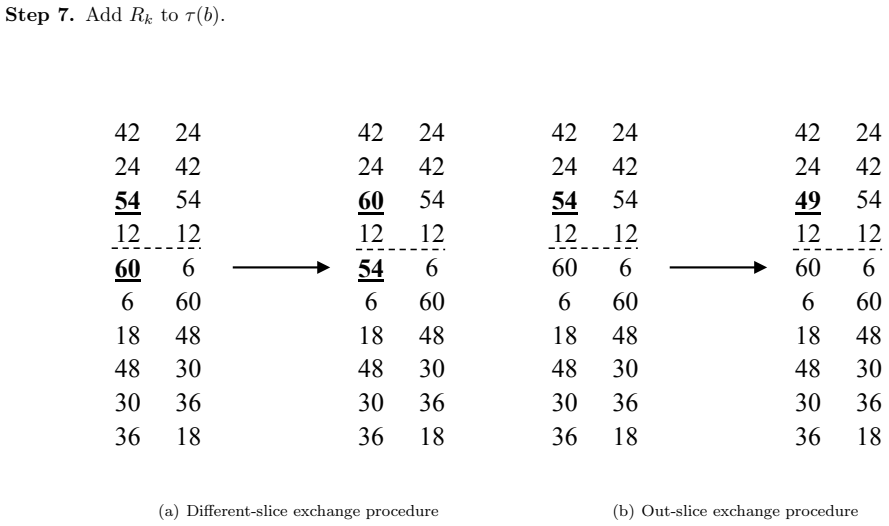
- The whole design and each slice remain Latin hypercubes after optimization, because the exchange procedures are designed to preserve the sliced structure.
- The construction can be paired with other space-filling criteria, such as centered L2 discrepancy, through the same combined-measure template.
Reading between the lines
- Beyond the paper: the greedy allocation in Step 2 resembles a generalized Beatty-sequence partition of {1,...,n} into slices with densities n_i/n, and one could test whether it always succeeds by exhaustive search over small run-size tuples; the paper's proof does not settle this.
- Beyond the paper: if a counterexample to the allocation rule exists, the construction would still work for many practical run-size choices, and a characterization of the tuples where it succeeds would be a useful follow-up.
- Beyond the paper: the combined space-filling measure weights the whole design and the slices equally when w = 1/2, but the paper does not explore how sensitive the resulting optimal designs are to this choice; other weights could be tuned for applications where global spread matters more or less.
- Beyond the paper: the two-part algorithm's stopping rules (100 iterations) and threshold settings appear heuristic, so a sensitivity analysis of those parameters is a natural testable extension.
Signed reviews
Editorial analysis
A structured set of objections, weighed in public.
Referee Report
Summary. The paper proposes a construction of sliced Latin hypercube designs (FSLHDs) in which the slice run sizes n_1,...,n_u are arbitrary, together with a combined space-filling measurement (CSM) and two stochastic optimization algorithms (SESE and a two-part algorithm) for finding space-filling FSLHDs. The main theoretical result, Theorem 1, asserts that the construction yields optimal univariate uniformity both for the whole design and for every slice. The paper also derives fast updating formulas for the CSM under the proposed exchange procedures and reports simulation comparisons.
Significance. If Theorem 1 is correct, the construction fills a genuine gap: existing SLHD constructions largely require equal slice sizes or handle only two distinct sizes, whereas multi-fidelity experiments often need unequal slice sizes. The CSM is a natural weighted scalarization, and the exchange procedures plus updating formulas are practical algorithmic contributions. The paper is well structured and includes a worked example. However, the central construction currently rests on an unproved combinatorial feasibility claim, so the significance is contingent on completing the proof.
major comments (3)
- [Section 2, Step 2 and Theorem 1 proof (ii)] The greedy allocation in Step 2 asserts without proof that at every step a suitable unused integer r exists: for a trigger of slice l at step j, the algorithm chooses r = min{r : ceil(n_l r / n) = ceil(n_l j / n), r in R_{j,k-1}}. The proof of Theorem 1(ii) says only that 'it is clear' that card(H_i) = n_i and that each needed h exists, but this requires that R_{j,k-1} always intersects the interval I_{l,j} = {r : ceil(n_l r / n) = ceil(n_l j / n)}. No feasibility argument is given, and this property is load-bearing because the whole FSLHD guarantee and the later optimization algorithms depend on it. Please supply a rigorous lemma proving that the greedy rule never dead-ends, or modify the construction so the property is evident.
- [Theorem 1 proof (ii)] The proof contains the assertion that ceil(n_i j / n) < ceil(n_i (j+1) / n) for every j = 1,...,n, which is false in general; for example, with n_1 = 2, n_2 = 3, n = 5 and j = 1, both sides equal 1. The proof must be corrected, for instance by using the non-strict inequality and then arguing that the map j -> ceil(n_i j / n) takes every value in {1,...,n_i} at least once because it starts at 1, ends at n_i, and increments by at most 1 at each step.
- [Table 1, Section 4.2] The row for 'Part-I + Part-II FSLHD(5,10,15,30;4,6)' reports Min = 1.9041, Mean = 2.2424, and Max = 2.0394, which is impossible because the mean cannot exceed the maximum. This indicates a data error or typo in a table that is central to the empirical comparison between the SESE and two-part algorithms. Please correct the entry and re-evaluate the conclusions drawn from it in Section 4.2.
minor comments (6)
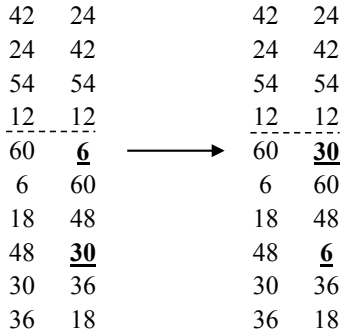
- [Example 2.1] In the text accompanying Example 2.1, 'ceil(n_l(j+1)/n) - ceil(n_L j / n)' should read 'ceil(n_l(j+1)/n) - ceil(n_l j / n)'.
- [Section 3.4] The sentence 'Recall that t_i = lcm(n_1,...,n_u,n)/n_i, for i =,...,u - 1' is missing the starting index; it should be 'for i = 1,...,u - 1'.
- [Section 3.2.2] The phrase 'MN(1 : n, j) still satisfies Theorem (i)' should reference 'Theorem 1(i)'.
- [Example 1, Section 4.1] The phi_CSM values in the text (14.4740 and 5.7958) do not match the values in the captions of Figure 5 (14.4223 and 5.6844); please reconcile these numbers.
- [Throughout] The manuscript contains numerous typographical and grammatical errors, including 'descibe' and 'effective' in the abstract, 'desigh' in the Figure 1 caption, 'φtheCSM' in Algorithm 1, and incomplete reference information (e.g., Huang et al. 2015, '0–00'); a careful language edit is needed.
- [Equation (8)] The centered L2-discrepancy formula uses m for the number of factors while the design is described with q factors; please make the notation consistent.
Circularity Check
No circular derivation: the FSLHD construction and CSM-based optimization are self-contained; the greedy-allocation proof gap is a correctness issue, not circularity.
full rationale
The paper's central construction is an explicit greedy algorithm (Section 2, Steps 1-4) that assigns integers 1,...,n to slices with prescribed run sizes. Theorem 1 then claims that the resulting column and each slice have optimal univariate uniformity. This is a stated property of the constructed object, not an input to the construction, so it is not circular. The proof of Theorem 1 does contain an unproved feasibility assertion ('it is clear that card(H_i) = ...') and a false displayed inequality, but those are mathematical rigor gaps about whether the greedy allocation always succeeds; they do not make the theorem equivalent to its assumptions by construction. The optimality claims are also explicit: 'optimal' is defined as minimizing the combined space-filling measurement phi_CSM(D) = w phi_t(D) + (1-w) sum lambda_i phi_t(D(i)) in equation (6), with D* = argmin_D phi_t(D) in equation (5). No parameter is fitted to a subset of data and then renamed a prediction, and the CSM is a stated criterion rather than an output smuggled from the data. Self-citations appear only as context (e.g., Xu et al. 2019 for prior arbitrary-run-size work, Jin et al. 2016 for ESE parameter conventions) and are not load-bearing for the existence or uniformity claims. The construction is self-contained against the paper's own definitions, so no significant circularity is present.
Assumptions & free parameters
free parameters (3)
- w =
1/2
- t =
50
- SESE tuning constants =
beta1=0.8, beta2=0.7, beta3=0.9, tol=0.1, N=10
assumptions (4)
- ad hoc to paper The greedy allocation in Step 2 of Section 2 always finds a valid r for each assignment, so R_n is empty and card(H_i)=n_i for all i.
- domain assumption phi_t and the derived CSM are appropriate measures of space-filling quality for FSLHDs.
- ad hoc to paper The scalarization with lambda_i = n_i/n and w=1/2 preserves the relevant multi-objective trade-off between whole-design and slice space-filling.
- domain assumption ESE threshold-adaptation parameters transfer from LHD to sliced-LHD optimization.
Cite this review
Pith. "Pith review of Optimal Sliced Latin Hypercube Designs with Slices of Arbitrary Run Sizes." pith.science (2026). https://pith.science/paper/Y5UAGXOP
@misc{pith2026190801976,
  author       = {Pith},
  title        = {Pith review of: Optimal Sliced Latin Hypercube Designs with Slices of Arbitrary Run Sizes},
  year         = {2026},
  howpublished = {\url{https://pith.science/paper/Y5UAGXOP}},
  note         = {Machine review of arXiv:1908.01976}
}
read the original abstract
Sliced Latin hypercube designs (SLHDs) are widely used in computer experiments with both quantitative and qualitative factors and in batches. Optimal SLHDs achieve better space-filling property on the whole experimental region. However, most existing methods for constructing optimal SLHDs have restriction on the run sizes. In this paper, we propose a new method for constructing SLHDs with arbitrary run sizes, and a new combined space-filling measurement describing the space-filling property for both the whole design and its slices. Furthermore, we develop general algorithms to search the optimal SLHD with arbitrary run sizes under the proposed measurement. Examples are presented to illustrate that effectiveness of the proposed methods.
Figures
Figures from the paper (2 more)

Reference graph
Works this paper leans on
-
[1]
McKay, M.D.; Beckman, R.J.; Conover, W.J. A Comparison of Three Methods for Selecting Values of Input Variables in the Analysis of Output From a Computer Code. Technometrics 1979 , 21 , 381--402
work page 1979
-
[2]
Sliced Latin Hypercube Designs
Qian, P.Z.G. Sliced Latin Hypercube Designs. Journal of the American Statistical Association 2012 , 107 , 393--399
work page 2012
-
[3]
A central limit theorem for nested or sliced Latin hypercube designs
He, X.; Qian, P.Z. A central limit theorem for nested or sliced Latin hypercube designs. Statistica Sinica 2016 , pp. 1117--1128
work page 2016
-
[4]
Gaussian Process Models for Computer Experiments with Qualitative and Quantitative Factors
Qian, P.Z.G.; Wu, H.; Wu, C.F.J. Gaussian Process Models for Computer Experiments with Qualitative and Quantitative Factors. Technometrics 2008 , 50 , 383--396
work page 2008
-
[5]
Prediction for Computer Experiments Having Quantitative and Qualitative Input Variables
Gang, H.; Santner, T.J.; Notz, W.I.; Bartel, D.L. Prediction for Computer Experiments Having Quantitative and Qualitative Input Variables. Technometrics 2009 , 51 , 278--288
work page 2009
-
[6]
Additive Gaussian Process for Computer Models With Qualitative and Quantitative Factors
Deng, X.; Lin, C.D.; Liu, K.W.; Rowe, R.K. Additive Gaussian Process for Computer Models With Qualitative and Quantitative Factors. Technometrics A Journal of Statistics for the Physical Chemical Engineering Sciences 2017 , 59 , 283--292
work page 2017
-
[7]
Sliced orthogonal array-based Latin hypercube designs
Hwang, Y.; He, X.; Qian, P.Z. Sliced orthogonal array-based Latin hypercube designs. Technometrics 2016 , 58 , 50--61
work page 2016
-
[8]
Sliced Latin hypercube designs via orthogonal arrays
Yin, Y.; Lin, D.K.; Liu, M.Q. Sliced Latin hypercube designs via orthogonal arrays. Journal of Statistical Planning and Inference 2014 , 149 , 162--171
work page 2014
Show all 36 references
-
[9]
General sliced Latin hypercube designs
Xie, H.; Xiong, S.; Qian, P.Z.; Wu, C.J. General sliced Latin hypercube designs. Statistica Sinica 2014 , pp. 1239--1256
2014
-
[10]
Construction of sliced maximin-orthogonal Latin hypercube designs
Yang, J.; Chen, H.; Lin, D.K.; Liu, M.Q. Construction of sliced maximin-orthogonal Latin hypercube designs. Statistica Sinica 2016 , pp. 589--603
2016
-
[11]
Computer Experiments With Both Qualitative and Quantitative Variables
Huang, H.; Lin, D.K.J.; Liu, M.Q.; Yang, J.F. Computer Experiments With Both Qualitative and Quantitative Variables. Technometrics 2015 , 58 , 0--00
2015
-
[12]
Predicting the Output from a Complex Computer Code When Fast Approximations Are Available
Kennedy, M.C.; O'Hagan, A. Predicting the Output from a Complex Computer Code When Fast Approximations Are Available. Biometrika 2000 , 87 , 1--13
2000
-
[13]
Building surrogate models based on detailed and approximate simulations
Qian, Z.; Seepersad, C.C.; Joseph, V.R.; Allen, J.K.; Wu, C.F.J. Building surrogate models based on detailed and approximate simulations. Journal of Mechanical Design 2006 , 128 , 668
2006
-
[14]
Optimal Sliced Latin Hypercube Designs
Ba, S.; Myers, W.R.; Brenneman, W.A. Optimal Sliced Latin Hypercube Designs. Technometrics 2015 , 57 , 479--487
2015
-
[15]
Uniform sliced Latin hypercube designs
Chen, H.; Huang, H.; Lin, D.K.; Liu, M.Q. Uniform sliced Latin hypercube designs . Applied Stochastic Models in Business and Industry 2016 , 32 , 574--584
2016
-
[16]
Flexible sliced designs for computer experiments
Kong, X.; Ai, M.; Tsui, K.L. Flexible sliced designs for computer experiments. Annals of the Institute of Statistical Mathematics 2018 , 70 , 631--646
2018
-
[17]
Sliced Latin Hypercube Designs for Computer Experiments With Unequal Batch Sizes
Xu, J.; He, X.; Duan, X.; Wang, Z. Sliced Latin Hypercube Designs for Computer Experiments With Unequal Batch Sizes. IEEE Access 2018 , 6 , 60396--60402
2018
-
[18]
Sliced Latin hypercube designs with arbitrary run sizes
Xu , J.; He , X.; Duan , X.; Wang , Z. Sliced Latin hypercube designs with arbitrary run sizes . arXiv e-prints 2019 , p. arXiv:1905.02721, http://xxx.lanl.gov/abs/1905.02721 [arXiv:math.ST/1905.02721]
2019 arXiv
-
[19]
Minimax and maximin distance designs
Johnson, M.E.; Moore, L.M.; Ylvisaker, D. Minimax and maximin distance designs. Journal of Statistical Planning Inference 1990 , 26 , 131--148
1990
-
[20]
Finding maximin latin hypercube designs by Iterated Local Search heuristics
Grosso, A.; Jamali, A.R.M.J.U.; Locatelli, M. Finding maximin latin hypercube designs by Iterated Local Search heuristics. European Journal of Operational Research 2009 , 197 , 541--547
2009
-
[21]
Maximin Latin Hypercube Designs in Two Dimensions
Dam, E.R.; M., H.B.G.; Hertog, D.D.; Melissen, H. Maximin Latin Hypercube Designs in Two Dimensions. Operations Research 2007 , 55 , 158--169
2007
-
[22]
Bounds for Maximin Latin Hypercube Designs
Dam, E.R.V.; Rennen, G.; Husslage, B.G.M. Bounds for Maximin Latin Hypercube Designs. Operations Research 2009 , 57 , 595--608
2009
-
[23]
An efficient algorithm for constructing optimal design of computer experiments
Jin, R.; Chen, W.; Sudjianto, A. An efficient algorithm for constructing optimal design of computer experiments. Journal of Statistical Planning Inference 2016 , 134 , 268--287
2016
-
[24]
Exploratory designs for computational experiments
Morris, M.D.; Mitchell, T.J. Exploratory designs for computational experiments. Journal of Statistical Planning Inference 1995 , 43 , 381--402
1995
-
[25]
Algorithmic construction of optimal symmetric Latin hypercube designs
Ye, K.Q.; Li, W.; Sudjianto, A. Algorithmic construction of optimal symmetric Latin hypercube designs. Journal of Statistical Planning Inference 2000 , 90 , 145--159
2000
-
[26]
An algorithm for fast optimal Latin hypercube design of experiments
Viana, F.A.C.; Venter, G.; Balabanov, V. An algorithm for fast optimal Latin hypercube design of experiments. International Journal for Numerical Methods in Engineering 2010 , 82 , 135--156
2010
-
[27]
A generalized discrepancy and quadrature error bound
Hickernell, F. A generalized discrepancy and quadrature error bound. Mathematics of Computation 1998 , 67 , 299--322
1998
-
[28]
Centered L2-Discrepancy of Random Sampling and Latin Hypercube Design, and Construction of Uniform Designs
Fang, K.T.; Ma, C.X.; Winker, P. Centered L2-Discrepancy of Random Sampling and Latin Hypercube Design, and Construction of Uniform Designs. Mathematics of Computation 2002 , 71 , 275--296
2002
-
[29]
Optimizing Latin hypercube designs by particle swarm
Chen, R.B.; Hsieh, D.N.; Ying, H.; Wang, W. Optimizing Latin hypercube designs by particle swarm. Statistics Computing 2013 , 23 , 663--676
2013
-
[30]
Particle swarm optimization
Kennedy, J.; Eberhart, R. Particle swarm optimization. Icnn95-international Conference on Neural Networks, 1995, pp. 1942--1948
1995
-
[31]
A study on algorithms for optimization of Latin hypercubes
Liefvendahl, M.; Stocki, R. A study on algorithms for optimization of Latin hypercubes. Journal of Statistical Planning Inference 2006 , 136 , 3231--3247
2006
-
[32]
Formulation of the optimal Latin hypercube design of experiments using a permutation genetic algorithm
Bates, S.; Sienz, J.; Toropov, V. Formulation of the optimal Latin hypercube design of experiments using a permutation genetic algorithm. In: 45th AIAA/ASME/ASCE/AHS/ASC Structures, Structural Dynamics Materials Conference, 2004, pp. 1--7
2004
-
[33]
Flexible Nested Latin Hypercube Designs for Computer Experiments
Chen, D.; Xiong, S. Flexible Nested Latin Hypercube Designs for Computer Experiments. Journal of Quality Technology A Quarterly Journal of Methods Applications Related Topics 2017 , 49 , 337--353
2017
-
[34]
Construction of sliced orthogonal Latin hypercube designs
Yang, J.F.; Lin, C.D.; Qian, P.Z.; Lin, D.K. Construction of sliced orthogonal Latin hypercube designs. Statist. Sinica 2013 , 23 , 7--1130
2013
-
[35]
Construction of sliced (nearly) orthogonal Latin hypercube designs
Huang, H.; Yang, J.F.; Liu, M.Q. Construction of sliced (nearly) orthogonal Latin hypercube designs. Journal of Complexity 2014 , 30 , 355--365
2014
-
[36]
Construction of second-order orthogonal sliced Latin hypercube designs
Cao, R.Y.; Liu, M.Q. Construction of second-order orthogonal sliced Latin hypercube designs. Journal of Complexity 2015 , 31 , 762--772
2015
Reviewed August 14, 2026 · model on record in the stance chip above.
Discussion (0). Continue with ORCID to comment.