REVIEW 3 major objections 3 minor 17 references
Reply to "Comment on `R\'enyi entropy yields artificial biases not in the data and incorrect updating due to the finite-size data' "
T0 review · 3 major / 3 minor · reviewed 2026-08-14 · deepseek-v4-flash
Pith's one-line read Rényi entropy violates the subset-independence axiom in maximum-entropy inference.
desk verdict The reply's new continuous example is built on incorrect subset posteriors—the q_S1 in Eq. (5) doesn't have the mean U_1 it claims—so the central demonstration of Rényi subset-independence violation does not hold up. read the letter →
The pith
A machine-rendered reading of the paper's core claim, the machinery that carries it, and where it could break.
The reading
What carries the argument
The load-bearing object is the Shore–Johnson subset-independence identity $q_D(x)=m(S_1)q_{S_1}(x)+m(S_2)q_{S_2}(x)$ with $m(S_i)=\int_{S_i}q_D(x)\,dx$, together with the distinction between choosing an entropy before maximization (the axiom stage) and comparing entropies after maximization. The paper's explicit check uses the continuous MaxEnt posteriors: ordinary exponentials for the logarithmic entropy, and $q$-exponentials $e_x^q=[1+(q-1)q^{-1}x]^{1/(q-1)}$ for Rényi entropy. The identity fails because the Rényi mixing coefficients in Eq. (6) contain $U$, the global mean, and this $U$-dependence is the mechanism that creates artificial subset bias. The reply also uses the normalization conditions $q<1$ and $q>\beta U/(1+\beta U)$ (and analogously for subset means) to reject $q>1$ values admitted by the Comment's concavity-under-majorization criterion.
What would settle it
Directly solve the constrained Rényi maximization for $D=[0,\infty)$ with mean $U$ without assuming the paper's $q$-exponential form, for example by numerical optimization over a fine grid, and test whether the resulting $q_D$, $q_{S_1}$, $q_{S_2}$ satisfy $q_D=m(S_1)q_{S_1}+m(S_2)q_{S_2}$ with $m(S_i)=\int_{S_i}q_D\,dx$. If the true maximizers satisfy the identity, or if the coefficients turn out not to depend on $U$, the central claim is refuted. A simpler check: determine whether Eq. (5) satisfies the Euler–Lagrange stationarity condition for Rényi entropy with the linear mean constraint at the stated $q$ values.
Extended reading notes
Core claim
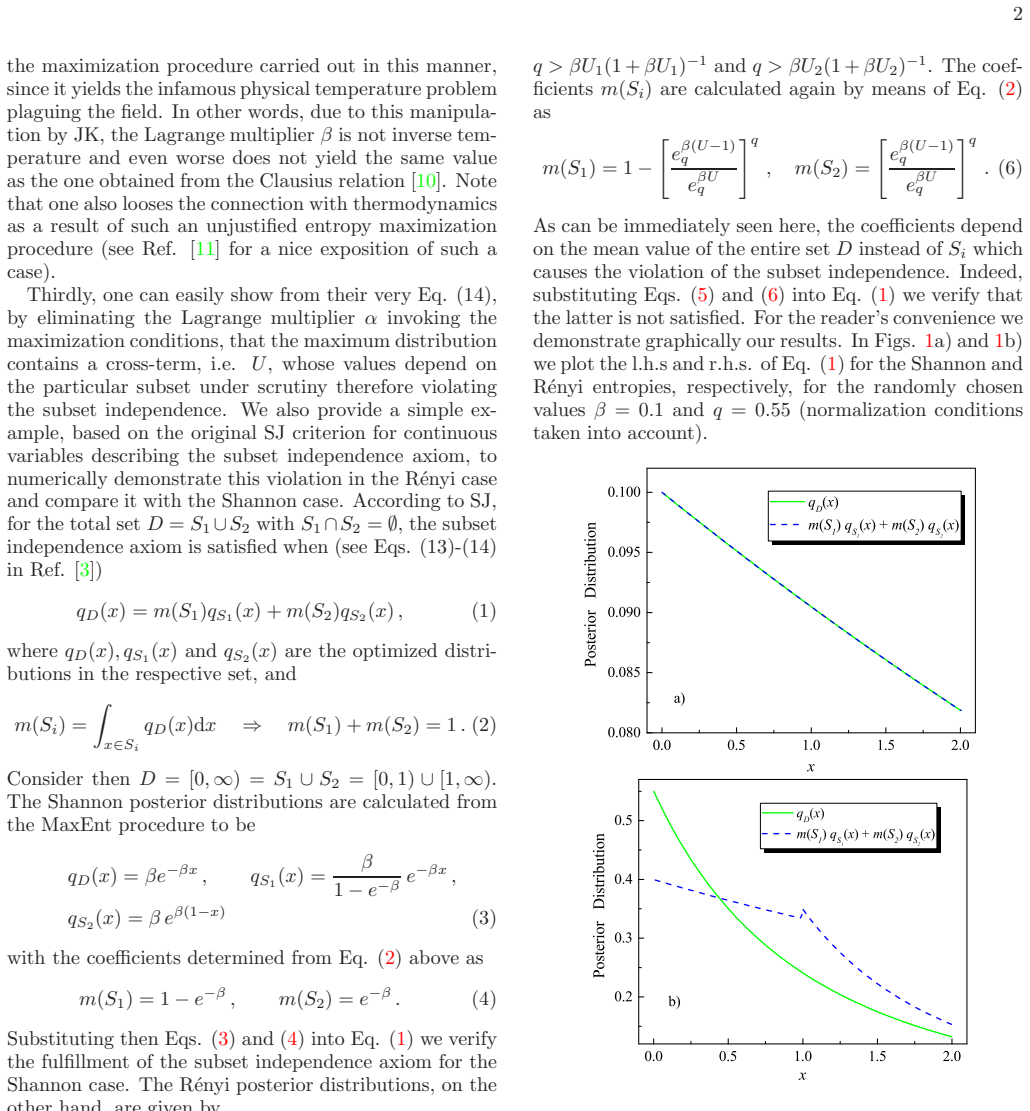
The central claim is a violation, not a mathematical contradiction: when Rényi entropy is maximized under a linear mean constraint, the optimized distribution $q_D(x)$ on a set $D$ split into disjoint subsets $S_1$ and $S_2$ cannot be written as $q_D(x)=m(S_1)q_{S_1}(x)+m(S_2)q_{S_2}(x)$, where $m(S_i)$ is the probability mass the full optimum assigns to $S_i$. The paper computes the Rényi posteriors for $D=[0,\infty)$, $S_1=[0,1)$, $S_2=[1,\infty)$ in terms of $q$-exponentials, and finds that the coefficients $m(S_1)$ and $m(S_2)$ depend on the mean $U$ of the whole set $D$, not on the means of the subsets. Substituting the expressions into the axiom equation fails numerically at representative parameters ($\beta=0.1$, $q=0.55$), whereas the analogous logarithmic-entropy posteriors satisfy the identity exactly. The reply reads the Shore–Johnson axioms as pre-maximization requirements: they constrain which functional may be maximized in the first place, so an equivalence that holds only after maximization, as in the Comment, is not sufficient.
Load-bearing premise
The argument assumes that the $q$-exponential expressions in Eq. (5) are the true Rényi maximum-entropy distributions under the linear mean constraint and the stated normalization conditions; if another distribution maximizes Rényi entropy for those constraints, the $U$-dependence of the computed coefficients would not establish a violation of subset independence.
Editorial extensions
If this is right
- Under linear mean constraints, Rényi-entropy maximum-entropy inference cannot be used for subset-consistent updating: the posterior for a part of the space depends on the global mean of the whole space.
- The ordinary logarithmic (trace-form) entropy satisfies the subset-independence identity in the same example, so the paper supports the conclusion that for linear constraints it is the unique consistent choice.
- The Comment's modified composition rule $g(p_{ij})=g(u_i)g(v_j)$ forces $g(x)\sim x^q$, so the distribution is fixed before maximization; this makes the entropy maximization procedure redundant rather than a derivation.
- The admissible $q>1$ range for Rényi maximizers should be discarded because $q$ then encodes the data interval $x_{\max}$, making the deformation parameter data-dependent and not independent of the mathematical variable $x$.
- Because Rényi entropy is monotonically related to Tsallis entropy yet only Rényi violates both subset and system independence under linear constraints, monotone equivalence does not preserve consistency properties.
Reading between the lines
- The same two-subset test could be run as a general diagnostic on any candidate entropy: compute the true maximizers and compare $m(S_1)q_{S_1}+m(S_2)q_{S_2}$ with $q_D$. This would convert the paper's single example into a family of falsifiable checks for deformed entropies.
- Because the paper finds that mixing coefficients carry the global mean $U$, a practical finite-sample signature is that Rényi-maximum-entropy fits will shift when the sampled range expands, even if the underlying distribution is unchanged; the paper argues this conceptually but does not present sample-size simulations.
- The reply's pre-maximization reading of the axioms suggests a general principle: two entropies that are monotonically related can receive different consistency verdicts, so ordering entropies by information content alone does not settle which one may be maximized for inference.
Signed reviews
Editorial analysis
A structured set of objections, weighed in public.
Referee Report
Summary. This manuscript is a reply to Jizba and Korbel's Comment on the authors' earlier claim that Rényi entropy yields artificial biases in maximum-entropy inference. The reply makes three main points: first, that Schur-concavity, as used by JK, does not correctly identify the normalizable range of the Rényi parameter q; second, that the Rényi entropy violates the Shore-Johnson subset-independence axiom, with a new continuous example comparing Rényi and Shannon posteriors; and third, that JK's modified composition rule for system independence makes the entropy-maximization procedure redundant and introduces biases. The paper concludes that only trace-form entropies satisfy subset independence per the Livesey-Skilling criterion, though it states that the proof of this criterion is deferred to a separate paper.
Significance. If the central claim is correct, the reply would substantially strengthen the case that Rényi entropy is unsuitable for maximum-entropy inference under linear constraints, directly rebutting JK's defense. The paper's explicit continuous example in Eqs. (5)-(6) and Fig. 1 is a concrete attempt to test the Shore-Johnson subset-independence axiom, and the identification of the dependence of the coefficients m(Si) on the whole-set mean U is a useful diagnostic. However, the central numerical demonstration is invalid as written because the subset posteriors in Eq. (5) are not the actual Rényi maximum-entropy distributions for the stated subset means, and the key Livesey-Skilling assertion is explicitly unproved in this reply. The significance is therefore conditional on correction of the demonstration and on resolution of the interpretive dispute over the SJ axioms.
major comments (3)
- [3. Subset independence axiom, Eqs. (5)-(6)] The distributions qS1(x) and qS2(x) in Eq. (5) are not the Rényi maximum-entropy posteriors for the subsets S1 and S2 with means U1 and U2. For q=0.55 and β=0.1, using the value U1 ≈ 0.43 that follows from Eq. (6) and the global mean U=10, direct integration gives ∫0^1 x qS1(x) dx ≈ 0.49, not U1. The reason is that the parameter a=(1-q)β/q in Eq. (5) is inherited from the global problem; the true subset maximizer must have a subset-specific parameter determined by the constraint ∫x p = U1, which is generically different. Therefore the comparison of the l.h.s. and r.h.s. of Eq. (1) in Fig. 1b does not test the subset-independence axiom as the authors intend; the claimed violation is an artifact of using subset posteriors that do not satisfy the mean constraints stated in the paper.
- [3. Subset independence axiom, final paragraph] The assertion that the Livesey-Skilling criterion shows that only trace-form entropies satisfy subset independence is explicitly stated to be outside the scope of this reply and deferred to a separate publication. This assertion is one of the main conclusions of the paper (item (ii) in the summary), and the reply does not provide the promised proof or a reference to an existing proof. Without this support, the paper's central claim is not established, and the conclusion should be weakened or the proof included.
- [4. System independence axiom] The criticism that JK 'are forced to change the Lagrange multipliers' is not a technical demonstration of an error. In the standard maximum-entropy formalism, Lagrange multipliers are determined by the constraints and are allowed to differ when the domain or the constraint set changes. Requiring the same β for the whole set and for subsets is a strong conditional-preservation property that is not a general requirement of the maximum-entropy method. The reply therefore does not substantively rebut JK's treatment of system independence; it merely restates a preference for a particular interpretation of how multipliers should behave.
minor comments (3)
- [1. Uniqueness axiom] The claim that q > 1 values are 'irrelevant' because 'the deformation parameter carries information about x' conflates the domain of the random variable with finite-size data; the normalization bound 0 < q < 1 + 1/xmax depends on the domain, not on the data set, so this argument needs clarification.
- [3. Subset independence axiom, Eq. (5)] The notation for the q-exponential, ex_q := [1+(q-1)q^{-1}x]^{1/(q-1)}, uses x both as the function argument and as a subscript, which is confusing; consider writing exp_q(x) for clarity.
- [3. Subset independence axiom, Fig. 1] The values of U, U1, and U2 used in the figure are not given explicitly; the text only states that β=0.1 and q=0.55 were chosen, so the reader cannot reproduce the plot without additional computation.
Circularity Check
No construction-level circularity: the subset-independence counterexample is a direct calculation, but the reply leans on the authors' own prior papers and defers the Livesey-Skilling proof.
full rationale
The central check in Eqs. (1)-(6) is not circular. The paper inserts the stated Shannon and Rényi maximum-entropy posteriors into the Shore-Johnson subset-independence equality, computes the coefficients from Eq. (2), and verifies numerically whether Eq. (1) holds. There is no fitted parameter renamed as a prediction: the means U, U1, U2 are properties of the chosen posteriors, and the claimed violation is a computed consequence of those formulas. The Shannon case is a positive control, not an input. The principal weakness is evidentiary rather than definitional: the reply opens by presenting the violation as already shown in Ref. [2] (same authors), Eq. (5)'s q-exponential forms are asserted without derivation in this reply, and the paper concedes that the Livesey-Skilling justification "will be demonstrated by the current authors separately." Those self-referential supports reduce the independent weight of the reply, but they do not make Eq. (1) hold or fail by construction. Since the core derivation is self-contained algebra once Eq. (5) is granted, this is at most a minor self-citation concern, not a circularity in the derivation chain.
Assumptions & free parameters
free parameters (2)
- beta (inverse temperature) =
0.1
- q (Renyi parameter) =
0.55
assumptions (4)
- domain assumption Shore-Johnson axioms should be applied at the pre-maximization stage, i.e., to the functional being maximized, before maximization.
- domain assumption For q>1, the Renyi parameter is not independent of the support bound xmax, so q>1 values are invalid in the MaxEnt context.
- ad hoc to paper Only trace-form entropies satisfy the subset-independence axiom via the Livesey-Skilling criterion.
- domain assumption For linearly averaged constraints, the Shannon entropy is the unique consistent choice.
Cite this review
Pith. "Pith review of Reply to "Comment on `R\'enyi entropy yields artificial biases not in the data and incorrect updating due to the finite-size data' "." pith.science (2026). https://pith.science/paper/PBJWNSNI
@misc{pith2026190802003,
  author       = {Pith},
  title        = {Pith review of: Reply to "Comment on `R\'enyi entropy yields artificial biases not in the data and incorrect updating due to the finite-size data' "},
  year         = {2026},
  howpublished = {\url{https://pith.science/paper/PBJWNSNI}},
  note         = {Machine review of arXiv:1908.02003}
}
read the original abstract
We reply to the Comment by Jizba and Korbel [arXiv:1905.00729v1] by first pointing out that the Schur-concavity proposed by them falls short of identifying the correct intervals of normalization for the optimum probability distribution even though normalization is a must ingredient in the entropy maximization procedure. Secondly, their treatment of the subset independence axiom requires a modification of the Lagrange multipliers one begins with thereby rendering the optimization less trustworthy. We also explicitly demonstrate that the R\'enyi entropy violates the subset independence axiom and compare it with the Shannon entropy. Thirdly, the new composition rule offered by Jizba and Korbel are shown to yield probability distributions even without a need for the entropy maximization procedure at the expense of creating artificial bias in the data.
Figures
Reference graph
Works this paper leans on
-
[1]
Uniqueness axiom : In our assessment of this axiom, we have used the concavity as a criterion which led us to the q interval being (0 , 1). Inspecting the R´ enyi maxi- mum distribution one can see that for a variable interval x ∈ (xmin, x max) with a proper xmin the distribution is normalizable for 0 < q < 1 + ( xmax)− 1. Apparently, in this inequality w...
- [2]
-
[3]
Subset independence axiom : JK, contrary to our opinion, argue that the R´ enyi entropy satisfies this ax- iom. The crux of their argument can be traced back to the idea that the maximization of f (∑ i g(pi)) should yield the same result as ∑ i g(pi). This certainly looks ∗ Electronic address: thomas.oikonomou@nu.edu.kz correct prima facie when one conside...
-
[4]
strong system independence is added to the SJ desiderata
System independence axiom : First of all, JK in this part of their comment compare our discussion with their modified SJ axiom in Ref. [ 5] (“... strong system independence is added to the SJ desiderata”) and not with the original SJ axiom in [ 3]. In this sense their comment is irrelevant for our discussion in [ 2]. Albeit, let us closely inspect the modi...
work page 2018
-
[5]
( 1) we verify that the latter is not satisfied
and ( 6) into Eq. ( 1) we verify that the latter is not satisfied. For the reader’s convenience we demonstrate graphically our results. In Figs. 1a) and 1b) we plot the l.h.s and r.h.s. of Eq. ( 1) for the Shannon and R´ enyi entropies, respectively, for the randomly chosen values β = 0 . 1 and q = 0 . 55 (normalization conditions taken into account). /s32...
-
[6]
P. Jizba and J. Korbel, arXiv:1905.00729v1, Accepted in Phys. Rev. E (2019)
work page Pith review arXiv 2019
-
[7]
J. E. Shore and R. W. Johnson, IEEE Trans. Inf. Theory IT-26, 26 (1980)
work page 1980
-
[8]
Our result is valid whenever one optimizes the R´ enyi en- tropy. Hence, it does not impose any restrictions on the quantum information theoretical applications of this en- tropy as long as entropy optimization is not included
Show all 17 references
-
[9]
Jizba and J
P. Jizba and J. Korbel, Phys. Rev. Lett. 122 (2019), 120601
2019
-
[10]
Press´ e, K
S. Press´ e, K. Ghosh, J. Lee and K. A. Dill, Entropy 17 (2015), 5043
2015
-
[11]
Press´ e, K
S. Press´ e, K. Ghosh, J. Lee and K. A. Dill, Phys. Rev. Lett. 111 (2013), 180604
2013
-
[12]
Karabulut, Eur
H. Karabulut, Eur. J. Phys. 27 (2006), 709
2006
-
[13]
Oikonomou and G.B
T. Oikonomou and G.B. Bagci, Phys. Lett. A 381 (2017), 207
2017
-
[14]
S. Abe, S. Mart ´ ınez, F. Pennini and A. Plastino, Phys. 4 Lett. A 281 (2001) 126; S. Abe, Physica A 368 (2006) 430
2001
-
[15]
Plastino, M
A. Plastino, M. C. Rocca and F. Pennini, Phys. Rev. E 94 (2016) 012145
2016
-
[16]
Hanel and S
R. Hanel and S. Thurner, Eur. Phys. Lett. 93 (2011), 20006
2011
-
[17]
Oikonomou and G.B
T. Oikonomou and G.B. Bagci, Phys. Rev. E 97 (2018), 012104
2018
Reviewed August 14, 2026 · model on record in the stance chip above.
Discussion (0). Continue with ORCID to comment.