REVIEW 2 major objections 4 minor 12 references
Many-impurity phonon Casimir effect in atomic chains
T0 review · 2 major / 4 minor · reviewed 2026-08-14 · deepseek-v4-flash
Pith's one-line read Phonon-mediated forces between any number of impurities in a one-dimensional chain are captured by a single determinant formula, and they are not pairwise additive.
desk verdict A genuinely new determinant formula for many-impurity phonon Casimir interactions in 1D chains, with a real validation gap at finite temperature for more than two impurities, but worth a referee's time. read the letter →
The pith
A machine-rendered reading of the paper's core claim, the machinery that carries it, and where it could break.
The reading
What carries the argument
The load-bearing object is the matrix $\Delta_{\omega_n}=1+P(i\omega_n)\alpha$ in Eq. (9), whose entries $P_{jk}(i\omega_n)$ are phonon propagators between impurities $j$ and $k$; for a one-dimensional chain they reduce to $P_{jk}=-\left[\delta_{k,j}-e^{-2D_{jk}\theta}\tanh\theta\right]$ after the substitution $\omega_n\to\Omega\sinh\theta$. The determinant of this matrix, inserted into the free energy through $F_I=\frac{T}{2}\sum_{\omega_n}\ln|\cdots|$, generates all multi-impurity correlations at once. The argument works because the impurity coupling factorizes as $Y_{q,l}\alpha_l Y^\dagger_{q',l}$, so the full impurity Green's function is an inversion of a low-rank perturbation rather than an infinite diagram series. Matsubara summation then converts the frequency sums into integrals over real frequencies, enabling numerical evaluation at zero and finite temperature.
What would settle it
Perform exact diagonalization of the Hamiltonian in Eq. (1) for a heavy-light-heavy chain with three impurities and compare the interaction energy at several temperatures and separations to the determinant formula in Eq. (12). The central claim predicts both a temperature-induced sign change at fixed separation and a non-pairwise three-body contribution; if the diagonalized energy is reproduced by summing pairwise terms, or if the sign change is absent, Eq. (12) fails for multi-impurity configurations.
Extended reading notes
Core claim
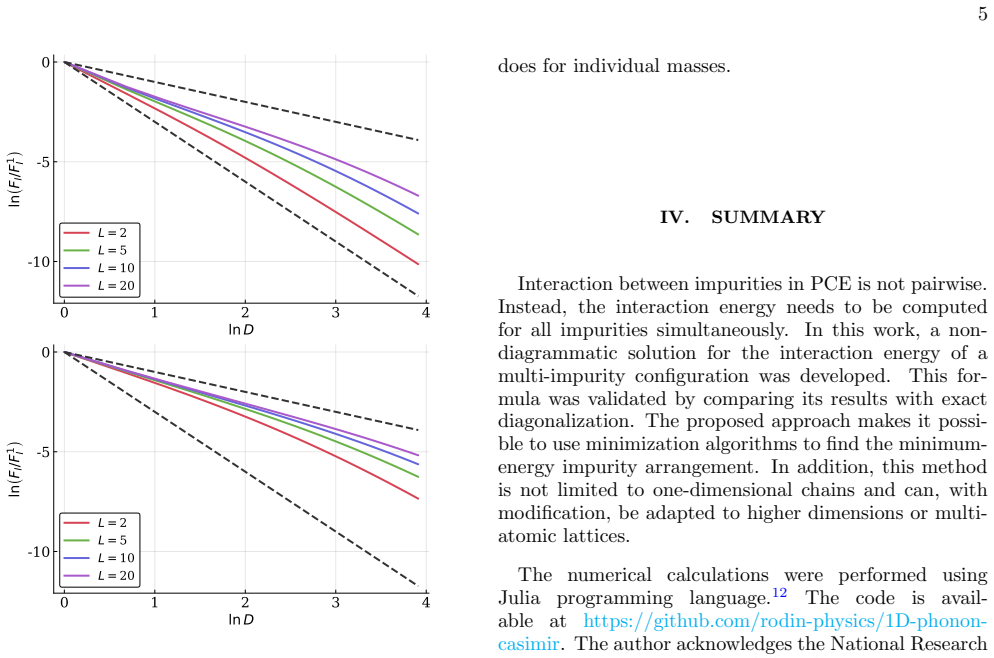
The paper claims that for a chain of identical atoms with spring constant $K$ and mass $m$, with impurities of mass $M_l$ at arbitrary positions, the full interaction free energy is given by $$F_I = \frac{T}{2}\sum_{\omega_n}\ln\left|\left(\mathrm{diag}_l(1+\alpha_l P_{ll}(i\omega_n))\right)^{-1}\Delta_{\omega_n}\right|,$$ where $\alpha_l=1-m/M_l$ and the matrix $\Delta_{\omega_n}$ has entries built from the impurity separation matrix $D_{jk}$. This determinant captures all phonon-mediated couplings simultaneously; it is not the sum of pairwise terms. At zero temperature the two-impurity interaction follows a quasi-power law that crosses from $D^{-1}$ to $D^{-3}$ with increasing separation, and at finite temperature it decays exponentially. Because the sign of each impurity's contribution is fixed by $\alpha_l$, identical impurities attract and opposite-sign impurities repel; the paper demonstrates a heavy-light-heavy arrangement where raising the temperature at fixed separation turns attraction into repulsion. The paper also shows that cluster-cluster interactions saturate as clusters grow, since heavy clusters increasingly decouple the chain segments between them.
Load-bearing premise
The derivation assumes each impurity is a structureless point mass moving only along the chain, ignoring internal impurity dynamics and transverse phonon modes; if those degrees of freedom matter, the predicted interaction energies will not match experiment.
Editorial extensions
If this is right
- For more than two impurities, the interaction energy must be computed from the full determinant; summing pair interactions gives only a qualitative guide, never the exact energy.
- At zero temperature, two-impurity interactions follow a quasi-power law with exponent evolving from $-1$ to $-3$ as separation grows; at finite temperature the decay becomes exponential.
- The sign of the interaction between two impurities is set by the product of their $\alpha$'s: like signs attract, opposite signs repel, with the strongest attraction between heavy impurities.
- In mixed-mass chains, temperature can reverse the net force: a heavy-light-heavy configuration is attractive at low temperature and repulsive at higher temperature for the same separation.
- Because the formula is closed and non-diagrammatic, it can be used inside minimization routines to find minimum-energy impurity arrangements, and the same construction can be adapted to higher-dimensional or multi-atomic lattices.
Reading between the lines
- The non-pairwise character implies a genuine three-body (and $N$-body) correction that can be isolated by subtracting all pair terms; a testable prediction is that this correction grows with mass mismatch and is largest at intermediate separations where propagators overlap.
- The $\alpha$-as-charge picture suggests a natural analogy to electrostatics in one dimension, but with like charges attracting; one could look for screening of impurity charges by other impurities in dense clusters, an effect not explored explicitly in the paper.
- Since only one longitudinal phonon branch is kept, adding transverse or optical branches should introduce additional scattering channels; the resulting interaction may acquire oscillatory or sign-changing corrections, a direct extension of the determinant method.
- At finite temperature the exponential decay length is set by the thermal phonon wavelength; this could allow experimental tuning of impurity clustering in nanowires or adsorbate chains by changing temperature, provided anharmonicity and substrate effects are weak enough.
Signed reviews
Editorial analysis
A structured set of objections, weighed in public.
Referee Report
Summary. The paper develops a path-integral approach to the phonon Casimir interaction among an arbitrary number of impurities in a one-dimensional harmonic chain, at both zero and finite temperature. The central result is Eq. (12), a determinant formula for the impurity-interaction free energy FI that is derived from the Hamiltonian (Eq. (1)) without fitted parameters. The two-impurity limit is validated against exact diagonalization (Fig. 1), and the paper uses the formula to compute three-impurity finite-temperature interactions (Fig. 3) and zero-temperature cluster interactions (Fig. 4). The text argues that the interaction is not pairwise and that the charge-like mass parameter α governs attraction or repulsion.
Significance. If the claims hold, the paper provides a parameter-free, non-diagrammatic method for computing many-impurity phonon Casimir interactions in one-dimensional systems, going beyond the existing pair-only treatments. The derivation is internally coherent, the code is publicly available, and the two-impurity results agree with an independent exact-diagonalization check. The charge analogy for α is a useful interpretive tool. The main weakness is that the finite-temperature many-impurity results, which are central to the headline claim, are not independently validated, and the paper itself flags numerical precision issues in the relevant integration method.
major comments (2)
- [§III.B, Eqs. (12)–(13), Fig. 3] The finite-temperature many-impurity results shown in Fig. 3 are computed from the contour integral in Eq. (13) without any independent validation for more than two impurities. The paper itself notes immediately after Eq. (13) that the integrand “becomes increasingly oscillatory as the number of impurities increases which can result in a loss of numerical precision,” and in Sec. III.B the cluster analysis is restricted to zero temperature “because of the numerical issues mentioned above.” No exact-diagonalization comparison, convergence study, or cross-check against Eq. (12) in the zero-temperature limit is provided for the three-impurity configuration, so the finite-temperature portion of the headline claim is not currently supported. Please add such a validation, at least for the M=3 case, or report a controlled numerical estimate of the error.
- [§III.B] The claim that the interaction is not pairwise is stated as a consequence of Eq. (12), but no numerical illustration is given. For a three-impurity configuration such as the one in Fig. 3, the authors should compare FI with the sum of the three pair interactions to quantify the non-additivity; this would directly support the central claim and help readers assess the magnitude of the effect.
minor comments (4)
- [Introduction] In the Introduction, the citations to Refs. [2] and [3] appear as “2? ,3” and “2?”; the cross-reference labels are broken and need to be fixed.
- [Fig. 3 caption] In the caption of Fig. 3, the temperature axis label is given as “ln(T/ )” with a blank denominator; it should presumably read “ln(T/Ω).”
- [References] Ref. [9] is missing the article title; please provide the full reference.
- [Eq. (10)] The text after Eq. (10) defines Djk only after it is used in the formula; moving the definition before Eq. (10) would improve readability.
Circularity Check
No circularity: the many-impurity free-energy formula is derived first-principles and benchmarked independently.
full rationale
The paper's central result, Eq. (12), is obtained by Gaussian integration of a bilinear phonon action, giving Z = product over Matsubara frequencies of det[-beta Gamma^{-1}]^{-1/2} and then F = -T ln Z. The interaction free energy F_I is the difference between the full impurity free energy and the single-impurity self-energy terms F^0_imp; this is an algebraic decomposition, not a fit. No parameter is adjusted against the data being predicted; the figures compare Eq. (12) with independent exact diagonalization of a finite chain (Eq. (15)), which is an external benchmark. The 'charge' analogy in Sec. III is interpretive and does not enter the derivation. References to the author's prior work (e.g., Ref. 9 in a list of bulk-mediated electron interactions, and Ref. 11 in an unrelated experimental context) are not load-bearing. The paper itself flags a numerical-precision issue with the oscillatory integrand in Eq. (13) and restricts the cluster analysis to T=0 'because of the numerical issues mentioned above'; this is a validation limitation for finite-temperature multi-impurity curves, not a circularity. The derivation chain is self-contained and does not reduce any prediction to its inputs.
Assumptions & free parameters
assumptions (3)
- domain assumption The 1D chain is described by a nearest-neighbor harmonic Hamiltonian with scalar displacements (Eq. 1).
- domain assumption Impurities are structureless point masses; internal dynamics of host-impurity subsystems are ignored (Sec. II).
- standard math Standard path integral and Matsubara frequency summation techniques are valid for this problem.
Cite this review
Pith. "Pith review of Many-impurity phonon Casimir effect in atomic chains." pith.science (2026). https://pith.science/paper/W7KERXPI
@misc{pith2026190802006,
  author       = {Pith},
  title        = {Pith review of: Many-impurity phonon Casimir effect in atomic chains},
  year         = {2026},
  howpublished = {\url{https://pith.science/paper/W7KERXPI}},
  note         = {Machine review of arXiv:1908.02006}
}
read the original abstract
Phonon Casimir effect is the long-range interaction between impurities in condensed matter systems, mediated by vacuum fluctuations of the phonon field. For pairs of impurities, this interaction has been shown to follow a quasi-power law at zero-temperature and evolve into an exponentially decaying form as the temperature is increased. This work introduces an approach to deal with systems of more than two impurities, both at zero and finite temperatures.
Figures


Reference graph
Works this paper leans on
-
[1]
author author J. Bardeen , author L. N. \ Cooper , \ and\ author J. R. \ Schrieffer ,\ 10.1103/PhysRev.108.1175 journal journal Physical Review \ volume 108 ,\ pages 1175 ( year 1957 ) NoStop
-
[2]
author author M. Schecter \ and\ author A. Kamenev ,\ 10.1103/PhysRevLett.112.155301 journal journal Physical Review Letters \ volume 112 ,\ pages 155301 ( year 2014 ) NoStop
-
[3]
author author A. I. \ Pavlov , author J. Van Den Brink , \ and\ author D. V. \ Efremov ,\ 10.1103/PhysRevB.98.161410 journal journal Physical Review B \ volume 98 ,\ pages 161410(R) ( year 2018 ) NoStop
-
[4]
author author H. B. G. \ Casimir ,\ http://www.dwc.knaw.nl/DL/publications/PU00018547.pdf journal journal Proc. K. Ned. Akad. B-Ph. \ volume 51 ,\ pages 793 ( year 1948 ) NoStop
work page 1948
-
[5]
author author A. V. \ Shytov , author D. A. \ Abanin , \ and\ author L. S. \ Levitov ,\ 10.1103/PhysRevLett.103.016806 journal journal Physical Review Letters \ volume 103 ,\ pages 016806 ( year 2009 ) ,\ http://arxiv.org/abs/0812.4970 arXiv:0812.4970 NoStop
arXiv 2009
-
[6]
author author S. LeBohec , author J. Talbot , \ and\ author E. G. \ Mishchenko ,\ 10.1103/PhysRevB.89.045433 journal journal Physical Review B - Condensed Matter and Materials Physics \ volume 89 ,\ pages 045433 ( year 2014 ) ,\ http://arxiv.org/abs/1311.1796 arXiv:1311.1796 NoStop
arXiv 2014
-
[7]
Potential and spin-exchange interaction between Anderson impurities in graphene
author author M. Agarwal \ and\ author E. G. \ Mishchenko ,\ 10.1103/PhysRevB.95.075411 journal journal Physical Review B \ volume 95 ,\ pages 075411 ( year 2017 ) ,\ http://arxiv.org/abs/1802.06171 arXiv:1802.06171 NoStop
work page Pith review arXiv 2017
-
[8]
author author M. Agarwal \ and\ author E. G. \ Mishchenko ,\ 10.1103/PhysRevB.99.085439 journal journal Phys. Rev. B \ volume 99 ,\ pages 085439 ( year 2019 ) NoStop
Show all 12 references
-
[9]
Rodin , author K
author author A. Rodin , author K. Noori , \ and\ author S. Y. \ Quek ,\ http://arxiv.org/abs/1906.09752 \ ( year 2019 ) ,\ http://arxiv.org/abs/1906.09752 arXiv:1906.09752 NoStop
1906 arXiv
-
[10]
Bruus \ and\ author K
author author H. Bruus \ and\ author K. Flensberg ,\ @noop title Many-body quantum theory in condensed matter physics: An Introduction ,\ edition 1st \ ed.,\ Oxford Graduate Texts\ ( publisher Oxford University Press ,\ year 2004 ) NoStop
2004
-
[11]
Dai , author Z
author author S. Dai , author Z. Fei , author Q. Ma , author A. S. \ Rodin , author M. Wagner , author A. S. \ McLeod , author M. K. \ Liu , author W. Gannett , author W. Regan , author K. Watanabe , author T. Taniguchi , author M. Thiemens , author G. Dominguez , author A. H....
-
[12]
Bezanson , author A
author author J. Bezanson , author A. Edelman , author S. Karpinski , \ and\ author V. B. \ Shah ,\ 10.1137/141000671 journal journal Society for Industrial and Applied Mathematics \ volume 59 ( year 2017 ),\ 10.1137/141000671 NoStop
2017 doi
Reviewed August 14, 2026 · model on record in the stance chip above.
Discussion (0). Continue with ORCID to comment.