REVIEW 3 major objections 6 minor 80 references
Harvesting the electromagnetic energy confined close to a hot body
T0 review · 3 major / 6 minor · reviewed 2026-08-14 · deepseek-v4-flash
Pith's one-line read A photovoltaic cell placed within a thermal wavelength of a hot body can harvest the evanescent electromagnetic field and, for the hBN/InSb model, convert it to electricity at about 25% efficiency with about $220\,\mathrm{kW\,m^{-2}}$ of…
desk verdict A competent, readable review of near-field TPV whose idealized efficiency numbers are overstated in the conclusion, though the body includes the necessary caveats. read the letter →
The pith
A machine-rendered reading of the paper's core claim, the machinery that carries it, and where it could break.
The reading
What carries the argument
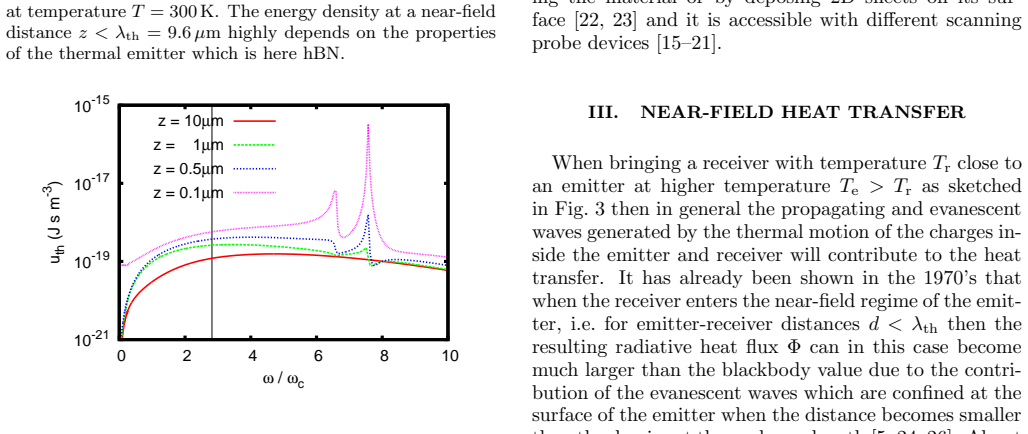
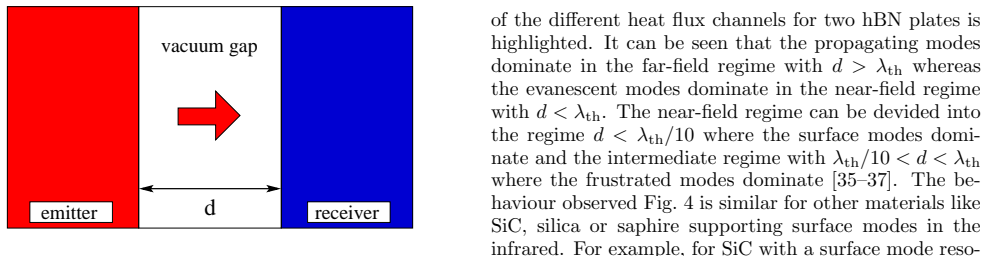
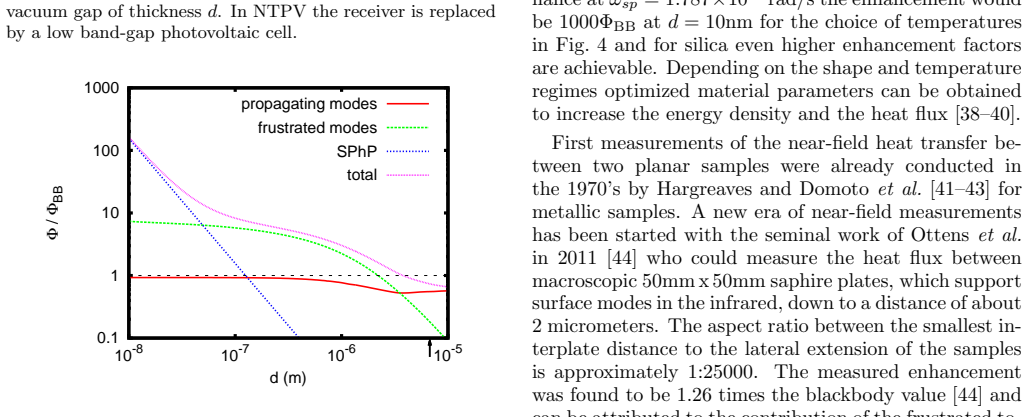
The working machinery is fluctuational electrodynamics cast in a Landauer-like form: the heat flux is the integral over frequency and transverse wavevectors of the thermal photon energy difference times a mode transmission factor $\mathcal{T}_j(\omega,\mathbf{k}_\perp;d)$. The key ingredient is that for transverse wavevectors larger than $k_0=\omega/c$ the modes are evanescent; they add flux channels that do not exist in the far field. When the emitter supports surface-phonon polaritons, these channels concentrate the spectrum near the surface-mode resonance, and at small gaps the flux can exceed the blackbody value by orders of magnitude. The PV cell converts this flux through the number of modes per unit area weighted by the Landauer transmission probability, with the cell's bandgap selecting which frequencies contribute.
What would settle it
Measure the electric power and efficiency of a macroscopic near-field TPV device at a controlled gap around 100 nm, using a low-bandgap cell with measured quantum efficiency and including parasitic absorption and cell-cooling power in the balance; if the net power per area does not exceed a classical TPV device at the same emitter temperature, the central claim is refuted. A cheaper check is to compute the same hBN/InSb system with a realistically absorbing cell rather than 100% quantum efficiency and see whether the 25% efficiency survives.
Extended reading notes
Core claim
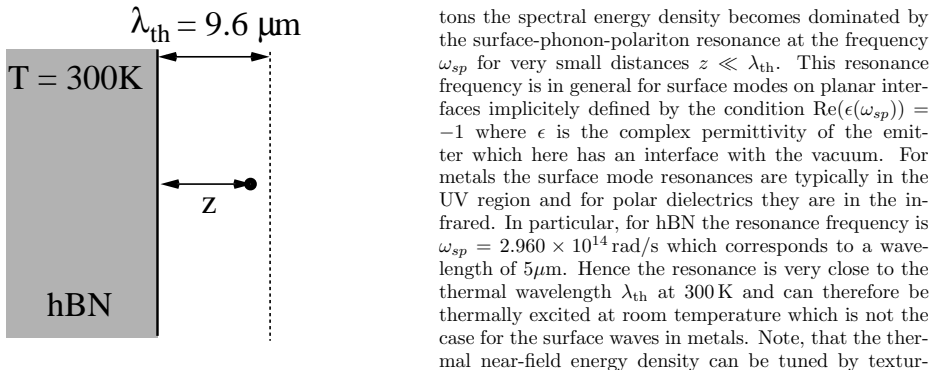
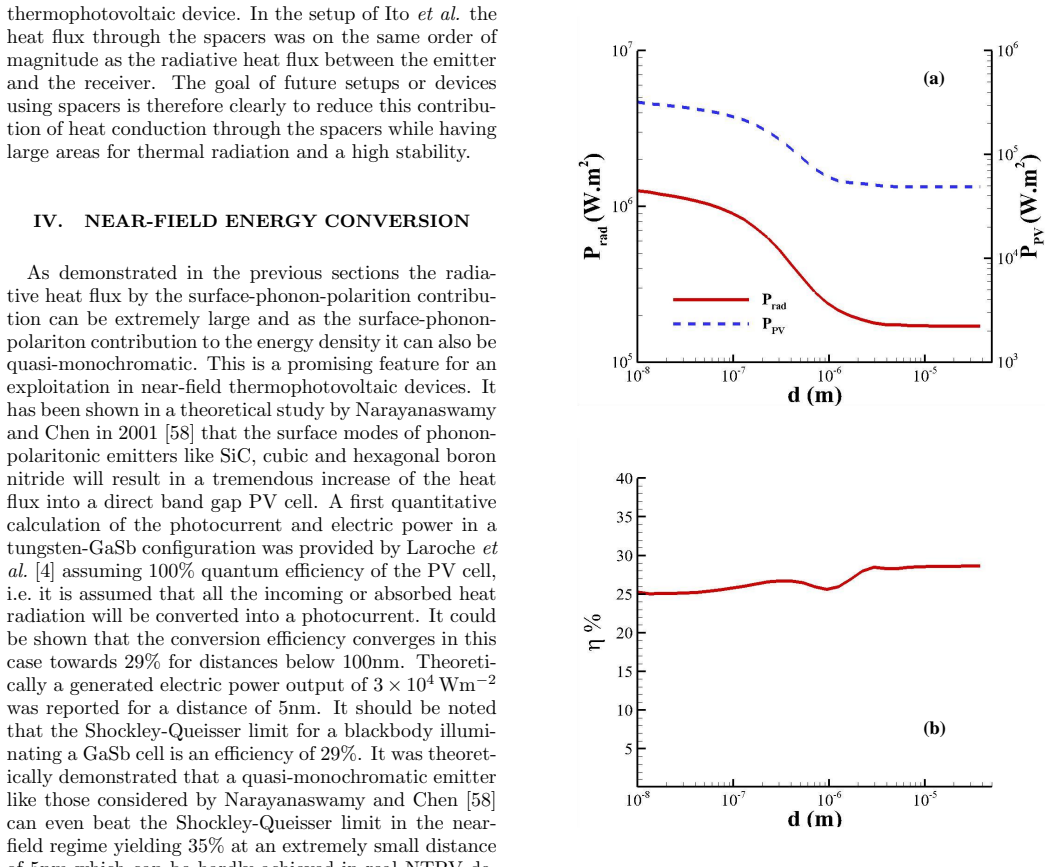
The central claim is that the near-field energy density close to a hot body—normally invisible to a distant receiver—can be directly converted into electricity by bringing a low-bandgap photovoltaic cell into the gap region. The excess energy is carried by evanescent modes, which tunnel to the cell and, when the emitter supports surface-phonon polaritons, arrive in a quasi-monochromatic band matched to the cell gap. For the paper's hBN/InSb example at a 100 nm gap, the calculated efficiency is about 25% and the electric power about $220\,\mathrm{kW\,m^{-2}}$, nearly an order of magnitude above the far-field power at the same temperatures. A fair reading is that this near-field technology allows to largely surpass the performances of classical TPV technology.
Load-bearing premise
The headline numbers assume that every photon absorbed by the PV cell produces one electron-hole pair (100% quantum efficiency); realistic cells absorb evanescent waves so close to the surface that much of that energy is lost, dropping the efficiency to about 20% at 10 nm and undermining the 'largely surpass' conclusion.
Editorial extensions
If this is right
- At a 100 nm vacuum gap, the paper's model gives about $220\,\mathrm{kW\,m^{-2}}$ of electric power and about 25% efficiency, so a cell of $25\,\mathrm{cm^2}$ could in principle deliver on the order of $500\,\mathrm{W}$.
- Near-field TPV can in principle beat the single-junction thermodynamic efficiency limit when the emitter's surface-mode resonance is tuned to the cell gap.
- The main barriers are practical: maintaining a stable nanoscale gap over large areas, keeping spacer heat conduction low, and rejecting the heat the cell cannot convert.
- Adding graphene layers or hyperbolic materials is predicted to raise the flux and efficiency further in the extreme near field.
- The single experimental NTPV demonstration to date produced $6\,\mathrm{W\,m^{-2}}$ and about 0.02% efficiency at a 60 nm gap, so the theoretical numbers still await a large-area experimental confirmation.
Reading between the lines
- The near-field 'efficiency gain' is modest in the paper's own numbers, so the technology's real edge is power density, pointing toward compact high-power heat-to-electricity converters rather than efficiency records.
- If evanescent modes deposit their energy within a shallow skin depth at the cell surface, then cell architectures that move absorption deeper—back reflectors, thin absorbing layers, hyperbolic materials—may matter as much as the emitter design.
- The mismatch between the hBN surface-phonon resonance (about 5 µm) and the InSb bandgap (about 7.3 µm) implies that tuning the emitter resonance to the cell gap would improve performance, a lever the review mentions only in passing.
Signed reviews
Editorial analysis
A structured set of objections, weighed in public.
Referee Report
Summary. This manuscript reviews near-field thermophotovoltaic (NTPV) energy harvesting. It introduces the local density of states near a hot body, presents the Polder–van Hove fluctuational electrodynamics expression for radiative heat transfer, and illustrates near-field energy density and heat flux for hBN. The central illustrative calculation considers an hBN emitter at 1500 K and an InSb cell at 300 K, reporting an efficiency of about 25% and an electric power of about 220 kW/m^2 at a 100 nm gap, about an order of magnitude above the far-field value. The paper then reviews the state of the art, including realistic device modeling and the only experimental NTPV demonstration, and concludes that near-field technology can largely surpass classical TPV technology.
Significance. If the ideal performance numbers were realistic, the paper would make a strong case for NTPV as a disruptive energy-conversion technology. The strengths of the manuscript are its use of the standard, externally benchmarked fluctuational electrodynamics formalism, its reliance on published material data for hBN and InSb with no fitted free parameters, and its comprehensive and mostly honest review of experimental near-field heat-transfer milestones and device challenges. However, the headline conclusion rests on an idealized 100% quantum-efficiency assumption that the paper itself later contradicts with cited realistic modeling. The central claim is therefore not supported as stated, though it can likely be repaired by a caveated conclusion and a realistic-loss estimate.
major comments (3)
- [Section IV, Eq. (14)] The electric power P_PV is computed under the explicit assumption of 100% quantum efficiency, and this calculation produces the paper's headline numbers of 25% efficiency and 220 kW/m^2 at d=100 nm. Section V immediately reviews Park et al., who find for a comparable near-field cell an efficiency of about 20% at d=10 nm, and lists further loss channels: sub-bandgap parasitic absorption, series resistance, photon recycling, and cell cooling. Since a 100%-QE cell is not a realistic benchmark, the claim that the near-field power 'is almost an order of magnitude larger than in far-field' is not established for a real device. The authors should either repeat the illustrative calculation with a realistic external quantum efficiency for InSb, or explicitly present the Section IV numbers as an upper bound and adjust the abstract and conclusion accordingly.
- [Section VI, Concluding remarks] The statement that this near-field technology 'allows to largely surpass the performances of the classical TPV technology' is difficult to reconcile with the state of the art described in Section V. The only NTPV experiment (Fiorino et al.) produced about 6 W/m^2 at roughly 0.02% efficiency, and the more realistic theoretical model of Park et al. gives about 20% efficiency at 10 nm. The comparison with classical TPV is not defined: the baseline should be a specified far-field TPV system with the same cell temperature, loss mechanisms, and system-level parasitic loads. As written, the conclusion overstates what the evidence in the paper supports.
- [Section IV, efficiency definition] The efficiency η = P_PV/P_rad is a radiative-conversion efficiency computed with P_rad as the net radiative transfer across the vacuum gap. It does not include the power consumed by cell cooling, the parasitic heat conduction through spacers that Section III discusses, or electrical losses in the cell (series resistance, fill factor). These omissions are acknowledged qualitatively in Section VI, but the 25% figure is then used without qualification in the conclusion. The manuscript should state explicitly that η is an upper-bound radiative efficiency, not a system efficiency, so that it is not compared with system-level performances of classical TPV.
minor comments (6)
- [Section IV, Eq. (11)] Equation (11) is typeset ambiguously: the expression 'ni = α0c 2ω' does not clearly show whether the prefactor is α0 c/(2ω) or α0 c^2 ω; please correct the display and define α0.
- [Figure 2 caption] The vertical axis label 'uth' should be 'u_ω' to match the notation in Eq. (4).
- [Throughout] Please correct typographical errors: 'dominat' (Section II), 'devided' (Section III), 'saphire' (Figure 4 caption), 'achieavable' (Section V), and 'pioner' and 'emiter' (Section V).
- [Reference [13]] Reference [13] is dated '3003'; this should be '2003'.
- [Section IV, Eq. (12)] The Heaviside factor H(ω − ω_g) multiplies only the back-emission term, which is physically reasonable because the cell absorbs/emits only above the band gap, but the placement is easy to misread; clarify the range of integration for each term.
- [Section IV, Fig. 5] Since Figure 5 presents an original illustrative calculation, the manuscript should state the numerical integration parameters (frequency and wave-vector ranges, number of quadrature points, and convergence checks) or provide a reproducibility appendix.
Circularity Check
No significant circularity: the central calculation is conditional on an explicitly stated 100% quantum-efficiency assumption, and the underlying fluctuational-electrodynamics formalism and material data come from external benchmarks.
full rationale
The paper is a review with one illustrative near-field thermophotovoltaic calculation. The derivation chain is not circular. The heat-flux expression in Eq. (6) is the Polder-van Hove fluctuational-electrodynamics result, originally external (Ref. [5]), and the Landauer-like form attributed to Refs. [33,34] is a published, parameter-free rearrangement rather than a conclusion whose premises include the paper's target numbers. Material properties entering the calculation come from Palik (Ref. [14]) and Forouhi-Bloomer (Ref. [59]), i.e. external tabulated optical constants. The electric-power formula in Eq. (14) explicitly states 'assuming a quantum efficiency of 100%'; the reported 220 kW/m^2 and 25% efficiency are therefore conditional idealizations, not fitted parameters renamed as predictions. The paper itself, in Section V, cites Park et al. (Ref. [63]) to show that realistic modeling lowers the efficiency to about 20% at 10 nm, and the concluding remarks acknowledge that cooling and other losses further reduce performance. That tension weakens the strength of the concluding claim, but it is a correctness or overstatement concern, not a circular-reasoning concern. No parameter is fitted to the target output, no uniqueness theorem is imported from the authors' prior work to force a choice, and no known result is merely renamed. The self-citations that occur (Refs. [33,34,61]) are not load-bearing in a circular sense: they point to independently published derivations and model choices, not to an unverified private loop. Hence no circular step is present and the score is 0.
Assumptions & free parameters
assumptions (4)
- standard math Fluctuational electrodynamics (Rytov formalism) provides the thermal emission and heat transfer between bodies.
- standard math The local density of states formulation for the near-field energy density, Eq. (4), is valid.
- domain assumption The photovoltaic cell operates with 100% quantum efficiency above the band gap, and the simplified cell model of Eq. (9)-(11) captures the dielectric response.
- domain assumption The cell operating voltage is set to V0 = hbar * omega_g * (1 - Tr/Te) / e, following Ref. [61].
Cite this review
Pith. "Pith review of Harvesting the electromagnetic energy confined close to a hot body." pith.science (2026). https://pith.science/paper/KC4PZNKS
@misc{pith2026190802011,
  author       = {Pith},
  title        = {Pith review of: Harvesting the electromagnetic energy confined close to a hot body},
  year         = {2026},
  howpublished = {\url{https://pith.science/paper/KC4PZNKS}},
  note         = {Machine review of arXiv:1908.02011}
}
read the original abstract
In the close vicinity of a hot body, at distances smaller than the thermal wavelength, a high electromagnetic energy density exists due to the presence of evanescent fields radiated by the partial charges in motion around its surface. This energy density can surpass the energy density in vacuum by several orders of magnitude. By approaching a PV cell with a band gap in the infrared frequency range this non-radiative energy can be transferred to it by photon tunneling and surface mode coupling. Here we review the basic ideas and recent progress in near-field energy harvesting.
Figures
Figures from the paper (2 more)
Reference graph
Works this paper leans on
-
[1]
Coutts, Renewable and Sustainable Energy Review 3, 77-184 (1999)
T.J. Coutts, Renewable and Sustainable Energy Review 3, 77-184 (1999)
work page 1999
-
[2]
A. Lenert, D.M. Bierman, Y. Nam, W.R. Chan, I. Celanovic, M. Soljacic, and E.N. Wang, Nat. Nanotech- nol. 9, 126 (2014)
work page 2014
- [3]
- [4]
- [5]
-
[6]
Planck, The theory of heat radiation, (Forgotten Books, Leipzig, 2010)
M. Planck, The theory of heat radiation, (Forgotten Books, Leipzig, 2010)
work page 2010
-
[7]
O. Ilic, M. Jablan, J. D. Joannopoulos, I. Celanovic, M. Soljacic, Opt. Expr. 20, A366 (2012)
work page 2012
-
[8]
Energy Information Administration, Househod Electric- ity Reports (2005)
work page 2005
Show all 80 references
-
[9]
Agarwal, Phys
G.S. Agarwal, Phys. Rev A 11, 253 (1975)
1975
-
[10]
Eckhardt, Z
W. Eckhardt, Z. Phys. B 46, 85 (1982)
1982
-
[11]
I. A. Dorofeyev and E. A. Vinogradov, Phys. Rep. 504, 75 (2011)
2011
-
[12]
A. V. Shchegrov, K. Joulain, R. Carminati, and J.-J. Greffet, Phys. Rev. Lett. 85, 1548 (2000)
2000
-
[13]
Joulain and R
K. Joulain and R. Carminati and J.-P. Mulet and J.-J. Greffet, Phys. Rev. B 68, 245405 (3003)
-
[14]
Palik (Academic, New York, 1998)
Handbook of Optical Constants of Solids, edited by E. Palik (Academic, New York, 1998)
1998
-
[15]
Formanek, R
Y De Wilde, F. Formanek, R. Carminati, B. Gralak, P.- A. Lemoine,; K. Joulain, J.-P. Mulet, Y. Chen, and J.-J. Greffet, Nature 444, 740 (2006)
2006
-
[16]
Babuty, K
A. Babuty, K. Joulain, P.-O. Chapuis, J.-J. Greffet, Y. D. Wilde, Phys. Rev. Lett. 110, 146103 (2013)
2013
-
[17]
Kittel, U
A. Kittel, U. Wischnath, J. Welker, O. Huth, F. R¨ uting, and S.-A. Biehs, Appl. Phys. Lett. 93, 193109 (2008)
2008
-
[18]
F. Huth, M. Schnell, J. Wittborn, N. Ocelic, and R. Hil- lenbrand, Nat. Mat. 10, 352 (2011)
2011
-
[19]
A. C. Jones and M. B. Raschke, Nano Lett. 12, 1475 (2012)
2012
-
[20]
Q. Weng, S. Komiyama, L. Yang, Z. An, P. Chen, S.-A. Biehs, Y. Kajihara, W. Lu, Science 360, 775 (2018)
2018
-
[21]
Komiyama, J
S. Komiyama, J. Appl. Phys. 125, 010901 (2019)
2019
-
[22]
Ben-Abdallah, K Joulain, J
P. Ben-Abdallah, K Joulain, J. Drevillon and G. Domingues, Appl. Phys. Lett. 94, 15,153117 (2009)
2009
-
[23]
Messina, J.-P
R. Messina, J.-P. Hugonin, J.-J. Greffet, F. Marquier, Y. De Wilde, A. Belarouci, L. Frechette, Y. Cordier and P. Ben-Abdallah, Phys. Rev. B 87, 085421 (2013)
2013
-
[24]
E. G. Cravalho and C. L. Tien and R. P. Caren, J. Heat Transf. 89, 351 (1967)
1967
-
[25]
G. A. Domoto and C. L. Tien, J. Heat Transf. 92, 399 (1970)
1970
-
[26]
R. F. Boehm and C. L. Tien, J. Heat Transf. 92, 405 (1970)
1970
-
[27]
R. S. DiMatteo, Masters thesis, Massachusetts Institute of Technology (June 1996)
1996
-
[28]
M. D. Whale, Masters thesis, Massachusetts Institute of 6 Technology (June 1996)
1996
-
[29]
Pan, Opt
J. Pan, Opt. Lett. 25, 369 (2000)
2000
-
[30]
Whale and E
M.D. Whale and E. G. Cravalho, IEEE Trans. Energy Convers. 17, 130 (2002)
2002
-
[31]
S. M. Rytov, Y. A. Kravtsov, and V. I. Tatarskii, Principles of Statistical Radiophysics, Vol. 3 (Springer, New York, 1989)
1989
-
[32]
R. S. DiMatteo, P. Greiff, S. L. Finberg, K. A. Young- Waithe, H. K. Choy, M. M. Masaki, and C. G. Fonstad, Appl. Phys. Lett. 79, 1894 (2001)
2001
-
[33]
Ben-Abdallah and K
P. Ben-Abdallah and K. Joulain, Phys. Rev. B(R) 82, 121419 (2010)
2010
-
[34]
Biehs, E
S.-A. Biehs, E. Rousseau, and J.-J. Greffet, Phys. Rev. Lett. 105, 234301 (2010)
2010
-
[35]
Biehs, P
S.-A. Biehs, P. Ben-Abdallah, and F. S. S. Rosa, Nanoscale Radiative Heat Transfer and Its Applications, Infrared Radiation, Vasyl Morozhenko (Ed.), ISBN: 978- 953-51-0060-7, InTech (2012)
2012
-
[36]
Volokitin and B.N.J
A.I. Volokitin and B.N.J. Persson, Rev. Mod. Phys. 79, 1291 (2007)
2007
-
[37]
Pendry, J
J. Pendry, J. Phys. 11, 6621 (1999)
1999
-
[38]
O. D. Miller, S. G. Johnson, and A. W. Rodriguez, Phys. Rev. Lett. 115, 204302 (2015)
2015
-
[39]
H. Shim, L. Fan, S. G. Johnson, and O. D. Miller, Phys. Rev. X 9, 011043 (2019)
2019
-
[40]
W. Jin, R. Messina, A. W. Rodriguez, Opt. Exp. 25, 14746 (2017)
2017
-
[41]
E. G. Cravalho, G. A. Domoto, C. L. Tien, Progr. Aeron. Astro. 21, 531 (1968)
1968
-
[42]
C.M Hargreaves, Phys. Lett. A 30, 491 (1969)
1969
-
[43]
G. A. Domoto and R. F. Boehm and C. L. Tien, J. Heat Transf. 92, 412 (1970)
1970
-
[44]
Ottens, V
R. Ottens, V. Quetschke, S. Wise, A. Alemi, R. Lundock, G. Mueller, D. H. Reitze, D. B. Tanner, B. F. Whiting, preprint arXiv:1103.2389 (2011)
2011 arXiv
-
[45]
L. Hu, A. Narayanaswamy, X. Chen, and G. Chen, Appl. Phys. Lett. 92, 133106 (2008)
2008
-
[46]
Kralik and P
T. Kralik and P. Hanzelka and M. Zobac and V. Musilova and T. Fort and M. Horak, Phys. Rev. Lett. 109, 224302 (2012)
2012
-
[47]
St-Gelais, B
R. St-Gelais, B. Guha, L. Zhu, S. Fan, and M. Lipson, Nano Lett. 14, 6971 (2014)
2014
-
[48]
B. Song, Y. Ganjeh, S. Sadat, D. Thompson, A. Fiorino, V. Fern´ andez-Hurtado, J. Feist, F. J. Garcia-Vidal, J. C. Cuevas, P. Reddy, E. Meyhofer, Nat. Nanotech. 10, 253 (2015)
2015
-
[49]
M. Lim, S. S. Lee, and B. J. Lee, Phys. Rev. B91, 195136 (2015)
2015
-
[50]
K. Ito, A. Miura, H. Iizuka, and H. Tosiyoshi, Appl. Phys. Lett. 106, 083504 (2015)
2015
-
[51]
J. I. Watjen, B. Zhao, Z. M. Zhang, Appl. Phys. Lett. 109, 203112 (2016)
2016
-
[52]
B. Song, D. Thompson, A. Fiorino, Y. Ganjeh, P. Reddy, E. Meyhofer, Nat. Nanotech. 11, 509 (2016)
2016
-
[53]
M. P. Bernardi, D. Milovich & M. Francoeur, Nat. Comm. 7, 12900 (2016)
2016
-
[54]
S. Lang, G. Sharma, S. Molesky, P. U. Kr¨ anzien, T. Jalas, Z. Jacob, A. Yu. Petrov, and M. Eich, Sci. Rep. 7, 13916 (2017)
2017
-
[55]
Ghashami, H
M. Ghashami, H. Geng, T. Kim, N. Iacopino, S. K. Cho, and K. Park, Phys. Rev. Lett. 120, 175901 (2018)
2018
-
[56]
M. Lim, J. Song, S. S. Lee, B. J. Lee, Nat. Comm. 9, 4302 (2018)
2018
-
[57]
Fiorino, D
A. Fiorino, D. Thompson, L. Zhu, B. Song, P. Reddy, and E. Meyhofer, Nano Lett. 18, 3711 (2018)
2018
-
[58]
Narayanaswamy and G
A. Narayanaswamy and G. Chen, Appl.Phys. Lett. 82, 3544 (2003)
2003
-
[59]
A. R. Forouhi and I. Bloomer, Phys. Rev. B 38, 1865 (1988)
1988
-
[60]
Bernardi, O
M.P. Bernardi, O. Dupr´ e, E. Blandre, P.-O. Chapuis, R. Vaillon, and M. Francoeur, Sci. Rep. 5, 11626 (2015)
2015
-
[61]
Messina and P
R. Messina and P. Ben-Abdallah, Sci. Rep. 3, 1383 (2012)
2012
-
[62]
Svetovoy and G
- V.B. Svetovoy and G. Palasantzas, Phys. Rev. Applied 2, 034006 (2014)
2014
-
[63]
K. Park, S. Basu, W. P. King, and Z. M. Zhang, JQSRT 109, 305 (2008)
2008
-
[64]
Basu and Z
S. Basu and Z. M. Zhang, Appl. Phys. Lett. 95, 133104 (2009)
2009
-
[65]
S. Basu, Z. M. Zhang, C. J. Fu, Int. J. En. Res. 33, 1203 (2009)
2009
-
[66]
K. Chen, P. Santhanam, and S. Fan, Apl. Phys. Lett. 107, 091106 (2015)
2015
-
[67]
Blandre, P.-O
E. Blandre, P.-O. Chapuis, and R. Vaillon, Sci. Rep. 7, 15860 (2017)
2017
-
[68]
DeSutter, R
J. DeSutter, R. Vaillon, and M. Francoeur, Phys. Rev. Applied 8, 014030 (2017)
2017
-
[69]
Vaillon, J.-P
R. Vaillon, J.-P. Perez, C. Lucchesi, D. Cakiroglu, P.- O. Chapuis, T. Taliercio, and E. Tournie, Opt. Exp. 27, 347515 (2019)
2019
-
[70]
M. S. Mirmoosa and C. R. Simovski, Phot. Nanostruct. Fundam. Appl. 13, 20 (2015)
2015
-
[71]
I. S. Nefedov and C. Simovski, Phys. Rev. B 84, 195459 (2011)
2011
-
[72]
C. R. Simovski, S. Maslovski, I. Nefedov, and S. Tretyakov, Opt. Exp. 21, 14988 (2013)
2013
-
[73]
M. S. Mirmoosa, S.-A. Biehs, and C. R. Simovski, Phys. Rev. Appl. 8, 054020 (2017)
2017
-
[74]
Biehs, M
S.-A. Biehs, M. Tschikin, and P. Ben-Abdallah, Phys. Rev. Lett. 109, 104301 (2012)
2012
-
[75]
Biehs, S
S.-A. Biehs, S. Lang, A. Yu. Petrov, M. Eich, and P. Ben-Abdallah, Phys. Rev. Lett. 115, 174301 (2015)
2015
-
[76]
Liu and S
B. Liu and S. Shen, Phys. Rev. B 87, 115403 (2013)
2013
-
[77]
S. Jin, M. Lim, S. S. Lee, and B. J. Lee, Opt. Exp. 24, A635 (2016)
2016
-
[78]
S. Lang, M. Tschikin, S.-A. Biehs, A. Yu. Petrov, and M. Eich, Appl. Phys. Lett. 104, 121903 (2014)
2014
-
[79]
Tschikin, S.-A
M. Tschikin, S.-A. Biehs, P. Ben-Abdallah, S. Lang, A. Yu. Petrov, and M. Eich, JQSRT 158, 17 (2015)
2015
-
[80]
Fiorino, L
A. Fiorino, L. Zhu, D. Thompson, R. Mittapally, P. Reddy, and E. Meyhofer, Nat. Nanotechn. 13, 806 (2018). 7
2018
Reviewed August 14, 2026 · model on record in the stance chip above.
Discussion (0). Continue with ORCID to comment.