REVIEW 3 major objections 6 minor 41 references
Electric-circuit simulation of the Schr\"{o}dinger equation and non-Hermitian quantum walks
T0 review · 3 major / 6 minor · reviewed 2026-08-14 · deepseek-v4-flash
Pith's one-line read A one-dimensional LC circuit obeys the Schrödinger equation, so its measured voltages and currents are an exact quantum-walk simulator.
desk verdict The LC-to-Schrödinger mapping and exact Bessel solution are clean and correct, but the nonreciprocal section is a gauge transformation, not a physical nonreciprocal circuit, and the variance has a factor-of-two error. read the letter →
The pith
A machine-rendered reading of the paper's core claim, the machinery that carries it, and where it could break.
The reading
What carries the argument
The load-bearing object is the two-component wavefunction $\psi_x=(I_x,V_x)$ built from node current and node voltage, which turns Kirchhoff's laws into a tight-binding Schrödinger equation with a uniform imaginary on-site potential. Exact solvability comes from Bessel functions: $\psi_x=e^{-Rt}J_{|x|}(2t/\sqrt{LC})$, and the generating function $G(k)=e^{-2Rt}I_0(2t\sqrt{2(\cosh k-1)/LC})$ yields all moments of the walk. A position-dependent rescaling of voltages and currents maps arbitrary hopping amplitudes $t_x$ to specific inductor and capacitor values through product formulas, and a rescaling with a factor $\gamma^{-2x}$ makes the hoppings asymmetric by $\gamma$ in one direction and $1/\gamma$ in the other, producing the non-Hermitian nonreciprocal walk.
What would settle it
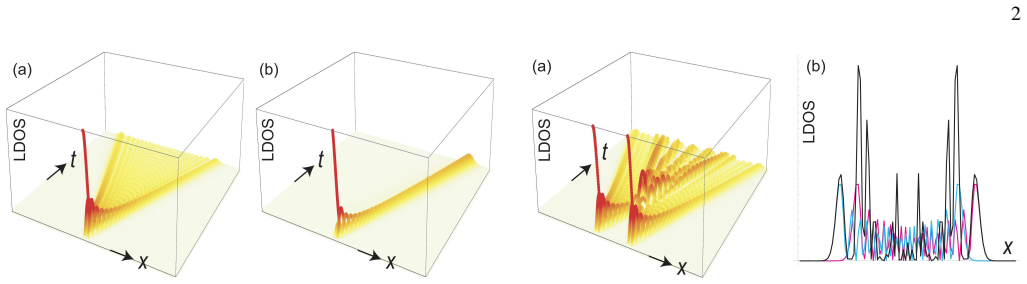
On a physical lossless LC chain with $L=C=1$ and an initial excitation localized at one node, record the voltage at every node over time; the claim predicts peaks at $|x|\approx 2t$ following $J_{|x|}(2t)$, and for two starting nodes an interference fringe between them. Absence of this Bessel pattern, or of the interference, would falsify the equivalence. A second test uses nonreciprocal elements and checks the predicted drift $M(\Psi)\sim (\gamma^2-1/\gamma^2)t/(\gamma^2+1/\gamma^2-2)^{3/2}$ and the linear variance of Eq. (35).
Extended reading notes
Core claim
The paper proves an exact one-dimensional equivalence between Kirchhoff's laws for an LC chain and the Schrödinger equation. Writing the wavefunction as $\psi_x=(I_x,V_x)$, the circuit dynamics becomes $i\partial_t\psi_x = i(1/\sqrt{LC})\psi_{x-1}-iR\psi_x - i(1/\sqrt{LC})\psi_{x+1}$, whose solution for a walker starting at $x=0$ is $\psi_x=e^{-Rt}J_{|x|}(2t/\sqrt{LC})$. This is a genuine quantum walk: in the lossless case the variance is $4t^2/LC$, so the standard deviation grows linearly in time, and two walkers launched from different nodes produce an interference pattern. The same reformulation, with position-dependent rescalings, yields an inhomogeneous chain that realizes the SSH model, where a walker starting at an edge remains localized in the topological phase but not in the trivial phase. With an additional nonreciprocal rescaling, the chain realizes a non-Hermitian walk whose mean position drifts and whose variance grows only linearly in time.
Load-bearing premise
The proposal assumes that a real chain of inductors, capacitors, and resistors is exactly described by the ideal Kirchhoff equations (1)-(2), with no parasitic capacitance, stray inductance, radiation loss, or frequency-dependent response.
Editorial extensions
If this is right
- An LC chain is a direct physical realization of a quantum walk: node voltages evolve as $J_{|x|}(2t/\sqrt{LC})$, so ballistic spreading and two-source interference are measurable in a tabletop circuit.
- The inversion formulas (24) turn any one-dimensional tight-binding hopping sequence into specific capacitor and inductor values, making the circuit a programmable platform for tight-binding dynamics.
- In the SSH circuit, a walker launched from an edge remains localized in the topological phase but spreads in the trivial phase, giving an electrical observable that distinguishes the two phases.
- Introducing nonreciprocity removes left-right symmetry from the hoppings; the walker acquires a net drift and its variance grows only linearly in time, in contrast to the quadratic growth of a lossless reciprocal walk.
- Adding resistors introduces a controlled uniform loss while preserving the exact Bessel structure, so dissipative and non-Hermitian effects can be studied continuously.
Reading between the lines
- The same Kirchhoff-to-Schrödinger rewriting could be extended to two- or three-dimensional circuit lattices, where higher-dimensional quantum walks and topological band structures could be simulated; the paper constructs only the one-dimensional chain.
- The drift of the nonreciprocal walker is the circuit counterpart of the non-Hermitian skin effect, so a finite chain with open boundaries should show voltage accumulation at one edge; the paper does not compute this boundary profile.
- Because the exact Bessel solution is parameter-free, any residual discrepancy in a real circuit gives a quantitative measure of parasitic effects, providing a calibration test for circuit simulators.
Signed reviews
Editorial analysis
A structured set of objections, weighed in public.
Referee Report
Summary. The manuscript proposes that the Kirchhoff laws for a one-dimensional LC circuit, after a rescaling of current and voltage, can be written in the form of a Schrödinger equation, and uses this correspondence to simulate quantum walks. For a homogeneous lossy circuit, it derives the exact solution ψ_x = e^{-Rt} J_{|x|}(2t/√LC), computes the spreading width via a generating function, analyzes a two-walker interference experiment, maps inhomogeneous circuits to the SSH model, and finally introduces a 'nonreciprocity' parameter γ through a scale transformation, claiming a non-Hermitian quantum walk whose variance grows only linearly in time. The paper is entirely theoretical; no experimental data are presented.
Significance. If correct, the paper would provide an analytically solvable classical-circuit platform for quantum-walk dynamics and a constructive way to distinguish topological phases in an SSH circuit, which is relevant to the growing field of circuit quantum simulation. The strengths are the explicit closed-form solution (9), the use of exact Bessel-function identities for the generating function, and the constructive mapping (24) from hopping parameters to L and C values. However, the significance is moderated by two substantive concerns: the reported variance in Eq. (15) contains a factor-of-two error, and, more importantly, the nonreciprocal Hamiltonian (29) is obtained by a position-dependent non-unitary rescaling of the same reciprocal LC circuit, so the claimed nonreciprocal quantum walk is not realized by the proposed physical circuit. These issues affect two of the paper's headline claims and require correction before the results can be accepted as stated.
major comments (3)
- [Non-Hermitian nonreciprocal quantum walk, Eqs. (18), (28)-(35)] The nonreciprocity in this section is introduced through the scale transformation (18) with (28), which is a position-dependent non-unitary rescaling of the same reciprocal LC circuit, not the addition of a nonreciprocal circuit element. For the homogeneous case this transformation is a similarity transformation, D H_0 D^{-1} with D = diag(γ^x), of the Hermitian LC Hamiltonian (apart from the dissipative -iR term), so the spectrum and the physical dynamics are unchanged; the physical voltage and current corresponding to a point excitation remain the symmetric Bessel walk up to the fixed position-dependent prefactors γ^{-2x} or γ^{-2x+1}. The solution (31) and the asymptotic mean and variance (34)-(35) are properties of the unweighted norm in the rescaled basis, not of the voltages and currents of the proposed circuit. To claim an electric-circuit simulation of a non-Hermitian nonreciprocal quantum walk, the authors must either specify a real nonreciprocal element such as a gyrator or a negative impedance converter, or explicitly state that the model is a gauge-transformed mathematical description with a weighted inner product and identify which observable, if any, corresponds to the plotted LDOS.
- [Quantum walk based on LC electric circuits, Eq. (15)] The variance reported in Eq. (15) is a factor of two too large. Expanding the generating function (12) for small k gives G(k) = I_0(z√(2(cosh k - 1))) = 1 + z² k²/4 + O(k^4) with z = 2t/√LC, so ⟨x²⟩ = 2t²/LC e^{-2Rt}, not 4t²/LC e^{-2Rt}. This is also consistent with the standard Bessel identity ∑ n² J_n(z)² = z²/2. The qualitative conclusion of ballistic spreading remains correct, but the quantitative coefficient must be corrected.
- [Quantum walk based on LC electric circuits, Eqs. (5)-(9)] There is an inconsistency in the mapping between the circuit equations and the Schrödinger equation. The two-component Hamiltonian (5), for R_L/L = 1/(C R_C) = R, has eigenvalues -iR ± (2/√LC)|sin(k/2)|, whereas Eq. (6) and the plane-wave dispersion of the scalar equation (7) contain sin² k (or |sin k|). In addition, Eq. (8) defines ψ_x as the full chain vector (..., I_{x-1}, V_{x-1}, I_x, V_x, ...), but Eq. (7) treats ψ_x as a scalar component, so the index x in the exact solution (9) is the index of the staggered chain of alternating I and V, not the physical cell index. The authors should clarify the relation between the physical lattice and the staggered chain, correct Eq. (6), and specify how the physical voltage and current at a given cell are obtained from the solution (9); as written, the physical interpretation of the simulated lattice and of the variance (15) is ambiguous.
minor comments (6)
- [Eq. (8)] The notation ψ_x = (..., I_{x-1}, V_{x-1}, I_x, V_x, I_{x+1}, V_{x+1}, ...)^t is mathematically malformed because the left-hand side is indexed by x while the right-hand side contains the entire chain; please define a single vector ψ or use a different index for the components.
- [Fig. 2 caption] The caption states that the plotted LDOS is the square of voltage, but the wavefunction (8) contains both currents and voltages; please specify whether the plot shows |V_x|², |I_x|², or |ψ_x|², since the normalization and variance formulas depend on this choice.
- [Eq. (33) and following text] For γ ≠ 1 and R = 0, the unweighted total LDOS in Eq. (33) grows exponentially in time, which is a direct consequence of the non-unitary rescaling; if the rescaled-basis interpretation is retained, this should be discussed explicitly.
- [References] Several references are arXiv preprints without journal citations (Refs. 13-16 and 41); please update them to the published versions where available.
- [Text after Eq. (15)] The phrase 'the variance diffuses quadratically' is imprecise; the variance grows quadratically in time, while the standard deviation grows linearly.
- [SSH section, Eq. (24)] It would be helpful to state explicitly that the reconstructed L_x and C_x in Eq. (24) are positive, so that the proposed circuit is physically realizable for the SSH hopping parameters considered.
Circularity Check
Nonreciprocal quantum walk section is a gauge-transformed reciprocal walk; the predicted drift and linear variance are artifacts of the coordinate rescaling.
-
renaming known result
[Non-Hermitian nonreciprocal quantum walk, Eqs. (28)-(31)]
"Next, by choosing αx =γ−2x √ C1 Cx , βx =γ−2x+1 √ C1 Lx (28) in (18), we construct a non-Hermitian nonreciprocal model... The telegrapher equation is given by i d dtψx = iγ√ LC ψx−1− iRψx− i γ √ LC ψx+1. (30) We find an analytic solution Ψx (t) =γxe−RtJ|x| ( 2√ LC t ) . (31)"
For the homogeneous circuit (Lx=L, Cx=C), the transformation (18) with (28) reduces to the diagonal gauge change Ψ_x = γ^x ψ_x. Substituting into the reciprocal equation (7) (which has solution e^{-Rt}J_{|x|}(2t/√LC)) yields exactly the 'nonreciprocal' equation (30), and the solution (31) is merely the original Bessel solution multiplied by γ^x. The moments (34)-(35) are computed from |Ψ_x|^2 in the rescaled basis; in physical voltage and current variables, a point-source excitation still evolves as the symmetric Bessel walk e^{-Rt}J_{|x|}. Thus the claimed nonreciprocal drift and linear variance are not properties of the proposed circuit but artifacts of the chosen coordinate rescaling: the 'nonreciprocal quantum walk' is the same reciprocal walk presented in a new representation.
full rationale
The main derivation is self-contained: it starts from the Kirchhoff laws (1)-(2), applies the uniform rescaling (3), and obtains the Schrödinger-form equation (4)-(5); the analytic solution (9) follows by direct Fourier solving, and the Bessel sum formula (11) is cited from independent quantum-walk literature (Konno, ben-Avraham et al.) only as a mathematical identity, not as the target result. The SSH section is a constructive mapping between hopping parameters and circuit elements via (24), with no fitted inputs. The only significant circularity is in the nonreciprocal section: the nonreciprocity is introduced by the position-dependent scale transformation (18)+(28), which for the homogeneous circuit is exactly a non-unitary diagonal gauge transformation mapping the reciprocal equation (7) to (30). The solution (31) and the moments (34)-(35) therefore describe the same Bessel walk in a rescaled basis, so the predicted drift and linear variance reduce by construction to the gauge choice rather than representing a distinct physical nonreciprocal circuit behavior. This partial circularity affects one of the paper's headline claims, giving an overall score of 6.
Assumptions & free parameters
free parameters (3)
- R (dissipation rate) =
Tunable, e.g., 0.4 in figures
- γ (nonreciprocity parameter) =
Tunable, e.g., 1.1 or 1.25 in figures
- λ (SSH dimerization) =
±0.5 in figures
assumptions (5)
- domain assumption Kirchhoff's voltage and current laws govern the circuit dynamics.
- domain assumption Ideal lumped elements with no parasitic capacitance, inductance, or radiation losses.
- standard math Bessel function sum identity Σ_x J_{|x|}(z)^2 e^{kx} = I_0(z√(2(cosh k - 1))).
- standard math Modified Bessel asymptotic I_0(t) ~ e^t/√(2πt) as t→∞.
- standard math The scale transformations (3) and (18) preserve the physics while redefining the wavefunction components.
Cite this review
Pith. "Pith review of Electric-circuit simulation of the Schr\"{o}dinger equation and non-Hermitian quantum walks." pith.science (2026). https://pith.science/paper/QVI7ZUOP
@misc{pith2026190802020,
  author       = {Pith},
  title        = {Pith review of: Electric-circuit simulation of the Schr\"odinger equation and non-Hermitian quantum walks},
  year         = {2026},
  howpublished = {\url{https://pith.science/paper/QVI7ZUOP}},
  note         = {Machine review of arXiv:1908.02020}
}
abstract
Recent progress has witnessed that various topological physics can be simulated by electric circuits under alternating current. However, it is still a nontrivial problem if it is possible to simulate the dynamics subject to the Schr\"{o}dinger equation based on electric circuits. In this work, we reformulate the Kirchhoff law in one dimension in the form of the Schr\"{o}dinger equation. As a typical example, we investigate quantum walks in $LC$ circuits. We also investigate how quantum walks are different in topological and trivial phases by simulating the Su-Schrieffer-Heeger model in electric circuits. We then generalize them to include dissipation and nonreciprocity by introducing resistors, which produce non-Hermitian effects. We point out that the time evolution of one-dimensional quantum walks is exactly solvable with the use of the generating function made of the Bessel functions.
Figures


Figures from the paper (1 more)

Reference graph
Works this paper leans on
-
[1]
C. H. Lee , S. Imhof, C. Berger, F. Bayer, J. Brehm, L. W. Molenkamp, T. Kiessling and R. Thomale, Communications Physics, 1, 39 (2018)
work page 2018
- [2]
-
[3]
M. S.-Garcia, R. Susstrunk and S. D. Huber, Phys. Rev. B 99, 020304 (2019)
work page 2019
- [4]
-
[5]
Y. Lu, N. Jia, L. Su, C. Owens, G. Juzeliunas, D. I. Schuster and J. Simon, Phys. Rev. B 99, 020302 (2019)
work page 2019
- [6]
-
[7]
T. Hofmann, T. Helbig, C. H. Lee, M. Greiter, R. Thomale, Phys. Rev. Lett. 122, 247702 (2019)
work page 2019
-
[8]
K. Luo, R. Yu and H. Weng, Research (2018), ID 6793752
work page 2018
Show all 41 references
-
[9]
Ezawa, Phys
M. Ezawa, Phys. Rev. B 99, 201411(R) (2019)
2019
-
[10]
Ezawa, Phys
M. Ezawa, Phys. Rev. B 99, 121411(R) (2019)
2019
-
[11]
Ezawa, Phys
M. Ezawa, Phys. Rev. B 100, 081401(R) (2019)
2019
-
[12]
Ezawa, Phys
M. Ezawa, Phys. Rev. B 100, 045407 (2019)
2019
-
[13]
Helbig, T
T. Helbig, T. Hofmann, S. Imhof, M. Abdelghany, T. Kiessling, L. W. Molenkamp, C. H. Lee, A. Szameit, M. Greiter, R. Thomale, arXiv:1907.11562
1907 arXiv
- [14]
-
[15]
Jiang, L.-J
H. Jiang, L.-J. Lang, C Yang, S.-L. Zhu and S. Chen, Phys. Rev. B 100, 054301 (2019)
2019
-
[16]
C. H. Lee, T. Hofmann, T. Helbig, Y. Liu, X. Zhang, M. Greiter and R. Thomale, cond-mat/arXiv:1904.10183
1904 arXiv
-
[17]
Aharonov, L
Y. Aharonov, L. Davidovich and N. Zagury, Phys. Rev. A, 48, 1687 (1993)
1993
-
[18]
Farhi and S
E. Farhi and S. Gutmann, Phys. Rev. A 58, 915 (1998)
1998
-
[19]
Ambainis, Int
A. Ambainis, Int. J. Quantum Information, 1, 507 (2003)
2003
-
[20]
S. E. Venegas-Andraca, Quantum Information Processing, 11, 1015 (2012)
2012
-
[21]
Kempe, Contemporary Physics 44, 307 (2003)
J. Kempe, Contemporary Physics 44, 307 (2003)
2003
-
[22]
M. S. Rudner and L. S. Levitov, Phys. Rev. Lett. 102, 065703 (2009)
2009
-
[23]
ben-Avraham, E
D. ben-Avraham, E. M. Bollt and C. Tamon, Quantum Information Processing, 3, 1 (2004)
2004
-
[24]
Konno, Phys
N. Konno, Phys. Rev. E, 72 026113 (2005)
2005
-
[25]
Szegedy, in Proceedings of the 45th IEEE Symposium on Foundations of Computer Science (IEEE, New York, 2004), pp
M. Szegedy, in Proceedings of the 45th IEEE Symposium on Foundations of Computer Science (IEEE, New York, 2004), pp. 32-41
2004
-
[26]
A. M. Childs and J. Goldstone, Phys. Rev. A 70, 022314 (2004)
2004
-
[27]
A. M. Childs, Phys. Rev. Lett. 102, 180501 (2009)
2009
-
[28]
A. M. Childs, D. Gosset, Z. Webb, Science 339, 791 (2013)
2013
-
[29]
Z. H. Bian, J. Li, H. Qin, X. Zhan, R. Zhang, B. C. Sanders, and P. Xue, Phys. Rev. Lett. 114, 203602 (2015)
2015
-
[30]
Peruzzo, M
A. Peruzzo, M. Lobino, J. C. F. Matthews, N. Matsuda, A. Politi, K. Poulios, X.-Q. Zhou, Y. Lahini, N. Ismail, K. Worhoff, Y. Bromberg, Y. Silberberg, M. G. Thompson, J. L. O'Brien, Science, 329(5998):1500, (2010)
2010
-
[31]
A. A. Guzik and P. Walther, Nature Physics 8, 285 (2012)
2012
-
[32]
Kitagawa, M
T. Kitagawa, M. A. Broome, A. Fedrizzi, M. S. Rudner, E. Berg, I. Kassal, A. Aspuru-Guzik, E. Demler and A. G. White, Nature Communications 3, 882 (2012)
2012
-
[33]
L. Xiao, X. Zhan, Z. H. Bian, K. K. Wang, X. Zhang, X. P. Wang, J. Li, K. Mochizuki, D. Kim, N. Kawakami, W. Yi, H. Obuse, B. C. Sanders, and P. Xue, Nat. Physics 13, 1117 (2017)
2017
-
[34]
H. B. Perets, Y. Lahini, F. Pozzi, M. Sorel, R. Morandotti and Y. Silberberg, Phys. Rev. Lett. 100, 170506 (2008)
2008
-
[35]
J. Du, H. Li, X. Xu, M. Shi, J. Wu, X. Zhou and R. Han, Phys. Rev. A 67, 042316 (2003)
2003
-
[36]
M. S. Rudner and L. S. Levitov, Phys. Rev. B 82, 155418 (2010)
2010
-
[37]
E. I. Rosenthal, N. K. Ehrlich, M. S. Rudner, A. P. Higginbotham, and K. W. Lehnert, Phys. Rev. B 97, 220301(R) (2018)
2018
-
[38]
Hatano and D
N. Hatano and D. R. Nelson, Phys. Rev. Lett. 77, 570 (1996): Phys. Rev. B 56, 8651 (1997): Phys. Rev. B 58, 8384 (1998)
1996
-
[39]
Z. Gong, Y. Ashida, K. Kawabata, K. Takasan, S. Higashikawa and M. Ueda, Phys. Rev. X 8, 031079 (2018)
2018
-
[40]
C. H. Lee, L. Li and J. Gong, Phys. Rev. Lett. 123, 016805 (2019)
2019
-
[41]
D. S. Simon, S. Osawa, A. V. Sergienko, arXiv:1808.10066
Reviewed August 14, 2026 · model on record in the stance chip above.
Discussion (0). Continue with ORCID to comment.