REVIEW 3 major objections 4 minor 37 references
Statistical analysis of Curiosity data shows no evidence for a strong seasonal cycle of Martian methane
T0 review · 3 major / 4 minor · reviewed 2026-08-14 · deepseek-v4-flash
Pith's one-line read The Curiosity rover's methane measurements are not statistically consistent with a strong seasonal cycle, a Gaussian-process reanalysis finds.
desk verdict A useful negative reanalysis of the Curiosity methane seasonal claim, but missing statistical details make the headline numbers hard to trust as written. read the letter →
The pith
A machine-rendered reading of the paper's core claim, the machinery that carries it, and where it could break.
The reading
What carries the argument
The central object is a Gaussian-process regression with a covariance kernel that acts like a stochastically driven damped simple harmonic oscillator; depending on the damping it produces smooth quasi-periodic or aperiodic stochastic functions. Because the kernel is fit to the time series without fixing any period in advance, the posterior distribution over periods and timescales is the evidence: if seasonal variation were strongly present in data of sufficient quality, the posterior should concentrate near 668.6 sols. The authors further select only the posterior samples that display periodic behavior, about half, to ask whether periodicity itself, when assumed, favors the Martian year.
What would settle it
Take a simulated strictly seasonal signal, a sinusoid with a 668.6-sol period sampled exactly at the ten enrichment-protocol epochs with the reported error bars, and run the same Gaussian-process analysis. If the posterior again fails to favor 668.6 sols, the method lacks power to detect a true seasonal cycle, and the paper's 'no support' conclusion would not be a test of seasonality. Conversely, a future extension of the same data over three or more Martian years that still spreads the posterior across many periods would strengthen the claim.
Extended reading notes
Core claim
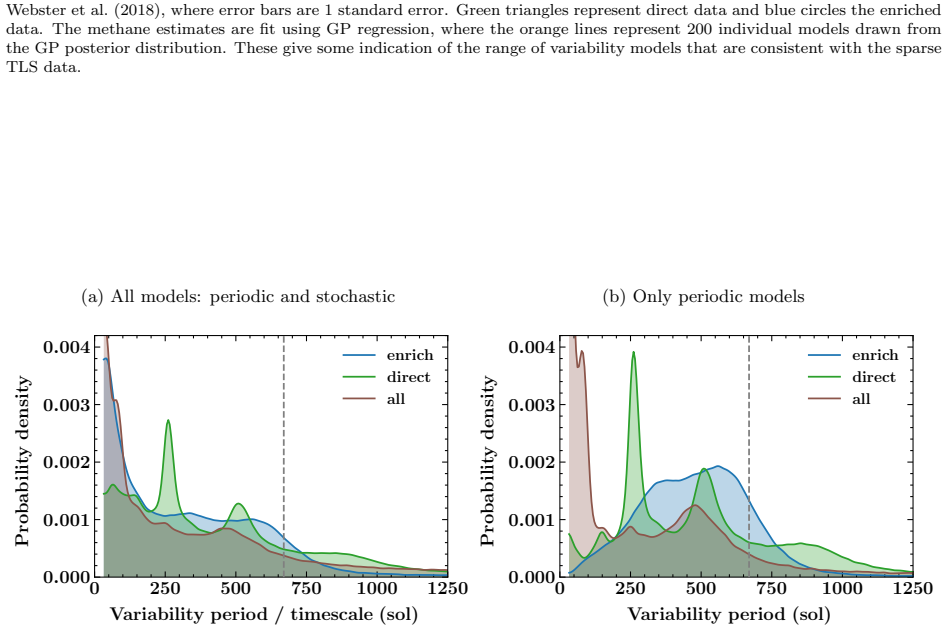
The paper's claim, stated plainly, is that the data used to claim a strong seasonal Martian methane cycle do not actually support that claim once the period is not assumed in advance. Fitting the original time series with a Gaussian process whose covariance kernel is a damped simple harmonic oscillator, a family that can produce either periodic quasi-sinusoidal or stochastic variations, yields posterior period distributions that are broad for all data subsets. For the 10 enrichment-protocol measurements, the posterior is spread across periods from roughly 100 to 900 sols, and only about 9 percent of the periodic models, about 5 percent of all models, fall within 5 percent of the 668.6-sol Martian year. The authors therefore conclude that the hypothesis of strong seasonal variability is unsupported, although they are careful to note that the data do not rule out seasonal variation either.
Load-bearing premise
The conclusion depends on the assumption that the damped-oscillator Gaussian-process model, together with its priors, is an unbiased and flexible enough description of how Martian methane actually varies; with only ten enrichment points, the broad posterior could reflect the model's prior assumptions rather than a genuine absence of seasonality.
Editorial extensions
If this is right
- The reported strong seasonal cycle in Gale crater background methane should no longer be treated as established from the TLS data alone.
- Explanations built around a seasonal cycle, such as rapid near-surface methane destruction or adsorption-regolith cycling tuned to the seasons, are not required by Curiosity's current record.
- The apparent tension between Curiosity's roughly 0.4 ppbv background and the Trace Gas Orbiter's upper limit below 0.05 ppbv does not need to be reconciled by a seasonal, Mars-specific sink.
- Future searches for periodicity should avoid folding data onto an assumed Martian-year period; model comparison that lets the period float is needed before claiming a cycle.
- At least three full Martian years of denser surface measurements would be required for periodic and stochastic explanations to be distinguished.
Reading between the lines
- Editorial inference: the breadth of the posteriors means the analysis is more decisive as a critique of the phase-folding method than as proof that Martian methane is non-seasonal.
- Editorial inference: a validation experiment on synthetic seasonal data with the same sampling pattern would directly measure the false-negative rate of the damped-oscillator Gaussian-process approach.
- Editorial inference: because the priors on the kernel hyperparameters are not fixed by the data, re-running the analysis with wider or narrower priors would show how much of the conclusion is prior-driven.
- Editorial inference: if future nadir observations from the Trace Gas Orbiter detect methane, applying the same floating-period Gaussian process to both data sets could indicate whether Gale crater is a local anomaly rather than part of a globally seasonal source.
Signed reviews
Editorial analysis
A structured set of objections, weighed in public.
Referee Report
Summary. The paper reanalyzes the Curiosity TLS methane time series reported by Webster et al. (2018) using Gaussian process regression with a stochastically driven damped simple harmonic oscillator kernel and MCMC sampling. Three data selections are considered: the full combined direct-plus-enriched dataset, the direct data alone, and the enriched data alone, the last being the subset used to claim a strong seasonal cycle. The authors report posterior distributions for the variability period/timescale and find that no single period is strongly favored. In the enriched data, only 9% of the models classified as periodic fall within 5% of the Martian year, and only 5% of all models do; removing the sol 965 point raises this to 7%. They conclude that the TLS data provide no evidence for a strong seasonal cycle and that the data are too sparse to distinguish periodic from stochastic variability.
Significance. If its quantitative claims were fully supported, this paper would be a valuable and timely caution against the phase-folding analysis in Webster et al. (2018), with direct implications for the ongoing debate about Martian methane. The authors deserve credit for avoiding a posteriori period selection, for considering all TLS data rather than only the enrichment subset, and for explicitly acknowledging the sparsity of the data and the multimodal nature of the posterior period distributions. The central negative conclusion is plausible and the analysis framework is appropriate in principle. However, the paper's load-bearing statistics depend on prior distributions and classification thresholds that are never stated, and the abstract's wording overstates what the analysis can show. These issues are fixable, but they currently prevent the results from being reproducible and from supporting the strongest form of the conclusion.
major comments (3)
- [§2, §3 (Fig. 2, Table 1)] The prior distributions on the GP hyperparameters (period P, quality factor Q, amplitude S0, and jitter sigma) are never specified. The statement in §2 that 'we make no assumptions about which periods or timescales the data are allowed to vary on' is not a substitute for priors, since any Bayesian MCMC analysis requires them and the NUTS sampler needs proper, implementable priors. With only 10 enrichment points spread over 1136 sols, the likelihood is weak and the posterior period distribution in Fig. 2 will be strongly influenced by the prior. The 'only 5% of all models are seasonal with 5% tolerance' statistic in §3 is worryingly close to the ~5.6% prior mass that a uniform prior in linear period over 0–1250 sol would assign to the ±33-sol seasonal window. Please report the exact priors and, crucially, compare the posterior probability of the seasonal window to its prior probability (e.g., via a Savage–Dickey ratio or Bayes factor).
- [§3, Table 1] The criterion used to classify a GP draw as 'periodic' rather than 'stochastic' is not defined. The statement that periodic models amount to ~50% of the full posterior, and the subsequent 9%, 5%, and 7% seasonal fractions, all depend on an unstated threshold (presumably on the SHO quality factor Q). Without this threshold, the analysis cannot be reproduced and the quoted fractions have no well-defined meaning. Please state the threshold explicitly, justify it, and test the sensitivity of the seasonal fractions to reasonable variations of that threshold.
- [Abstract, §3, §4] The abstract's claim that the TLS data 'are not statistically consistent with seasonal variability' is stronger than what the analysis actually supports. The paper does not perform a formal model comparison (e.g., a Bayes factor or information criterion) between a fixed seasonal-period model, a free-period periodic model, and a stochastic model; it only reports posterior period distributions. The Discussion itself states that the parameters 'must be better constrained by the addition of more surface data before anything definitive about the variability of background methane can be claimed,' which directly contradicts the abstract's wording. Please soften the abstract and conclusions to 'no evidence favoring' seasonal variability, or add a formal model comparison that would justify the stronger claim.
minor comments (4)
- [§4, Conclusion] There is a typo in §4 ('dataet' should be 'dataset') and in the Conclusion ('the the TLS data' should be 'the TLS data').
- [§3] The phrase 'only 5% of all models are seasonal with 5% tolerance' is ambiguous: it should be stated explicitly whether the 5% tolerance means ±33 sols around 668.6 sols, and whether the percentage is computed over the full posterior or over the periodic subset only. The current text gives both 9% (of periodic models) and 5% (of all models), but the connection between the two is not spelled out cleanly.
- [Table 1] Median ± 1σ summaries are presented for highly multimodal posterior distributions. The authors already caution against overinterpretation, but expressing the results as highest posterior density intervals or providing the full distributions in machine-readable form would reduce the risk of misuse.
- [§2] No code or seed is provided, and the exact priors are absent; making the analysis script and prior definitions available would substantially improve reproducibility, especially given that the central numbers depend on the unstated choices identified above.
Circularity Check
No circularity: the GP analysis is a data-driven test, not a fit-then-predict construction; the central negative claim is an honest statement of what sparse data can support.
full rationale
The paper's central claim is a negative statistical finding derived by sampling a Gaussian-process posterior over damped-SHO functions, not by fitting a target quantity and then re-predicting it. The analysis explicitly does not fold data on an a priori period ('we model the data in time to search for the presence of periodicity in the data, rather than folding the data on an already-determined period'), and the key percentages (e.g., 'only 5% of all models are seasonal with 5% tolerance') are posterior summaries, not fitted parameters renamed as predictions. The only self-citation (Gillen et al. 2019) is invoked merely as an example application of GP regression to time series; the substantive methodology is external (Celerite, PyMC3, Rasmussen and Williams). The admitted sparseness limitation ('the data are too sparse over too limited a timespan to favor a seasonally cyclic explanation') actually supports the honest negative conclusion rather than masking circular logic. The absence of explicit hyperparameter priors is a reproducibility weakness, but without the priors being specified it would be speculation to assert that the 5% statistic is a restatement of the prior by construction.
Assumptions & free parameters
free parameters (4)
- SHO quality factor Q
- SHO variability period or timescale P =
321 +349/-246 sol (enriched, full posterior)
- GP amplitude S0
- White noise jitter sigma
assumptions (4)
- domain assumption The TLS methane values and 1-sigma errors reported by Webster et al. (2018) are accurate and are appropriate inputs for the analysis.
- domain assumption The SHO kernel as implemented in Celerite can represent all plausible variability processes in the methane time series.
- standard math The MCMC chains have converged and provide an unbiased sample of the posterior.
- ad hoc to paper A model draw is classified as periodic based on a threshold in the damping parameter Q, and seasonal is defined as within 5% of the 668.6-sol Martian year.
Cite this review
Pith. "Pith review of Statistical analysis of Curiosity data shows no evidence for a strong seasonal cycle of Martian methane." pith.science (2026). https://pith.science/paper/VZOOUI7I
@misc{pith2026190802041,
  author       = {Pith},
  title        = {Pith review of: Statistical analysis of Curiosity data shows no evidence for a strong seasonal cycle of Martian methane},
  year         = {2026},
  howpublished = {\url{https://pith.science/paper/VZOOUI7I}},
  note         = {Machine review of arXiv:1908.02041}
}
read the original abstract
Using Gaussian Process regression to analyze the Martian surface methane Tunable Laser Spectrometer (TLS) data reported by Webster (2018), we find that the TLS data, taken as a whole, are not statistically consistent with seasonal variability. The subset of data derived from an enrichment protocol of TLS, if considered in isolation, are equally consistent with either stochastic processes or periodic variability, but the latter does not favour seasonal variation.
Figures

Reference graph
Works this paper leans on
-
[1]
, " * write output.state after.block = add.period write newline
ENTRY address author booktitle chapter edition editor howpublished institution journal key month note number organization pages publisher school series title type url volume year label extra.label sort.label short.list INTEGERS output.state before.all mid.sentence after.sentence after.block FUNCTION init.state.consts #0 'before.all := #1 'mid.sentence := ...
-
[2]
write newline
" write newline "" before.all 'output.state := FUNCTION n.dashify 't := "" t empty not t #1 #1 substring "-" = t #1 #2 substring "--" = not "--" * t #2 global.max substring 't := t #1 #1 substring "-" = "-" * t #2 global.max substring 't := while if t #1 #1 substring * t #2 global.max substring 't := if while FUNCTION word.in bbl.in capitalize ":" * " " *...
-
[3]
Atreya , S. K., Mahaffy , P. R., Wong , A.-S., 2007. Methane and related trace species on Mars: Origin, loss, implications for life, and habitability . Planetary and Space Science 55, 358
work page 2007
-
[4]
Chemical kinetics and photochemical data for use in atmospheric studies: evaluation number 18
Burkholder, J., Sander, S., Abbatt, J., et al., 2015. Chemical kinetics and photochemical data for use in atmospheric studies: evaluation number 18. Tech. rep., Pasadena, CA: Jet Propulsion Laboratory, National Aeronautics and Space Administration
work page 2015
-
[5]
Revisiting the identification of methane on Mars using TES data
Fonti , S., Mancarella , F., Liuzzi , G., et al., 2015. Revisiting the identification of methane on Mars using TES data . 581, A136
work page 2015
- [6]
-
[7]
Scalable Backpropagation for Gaussian Processes using Celerite
Foreman-Mackey , D., 2018. Scalable Backpropagation for Gaussian Processes using Celerite . Research Notes of the American Astronomical Society 2 (1), 31
work page 2018
-
[8]
Foreman-Mackey , D., Agol , E., Ambikasaran , S., Angus , R., Dec. 2017. Fast and Scalable Gaussian Process Modeling with Applications to Astronomical Time Series . 154, 220
work page 2017
Show all 37 references
-
[9]
and Barentsen, G., Jan
Foreman-Mackey, D. and Barentsen, G., Jan. 2019. Software repository: exoplanet v0.1.3. ://doi.org/10.5281/zenodo.2536576
2019 doi
-
[10]
Detection of Methane in the Atmosphere of Mars
Formisano , V., Atreya , S., Encrenaz , T., Ignatiev , N., Giuranna , M., 2004. Detection of Methane in the Atmosphere of Mars . Science 306, 1758
2004
-
[11]
Mapping methane in Martian atmosphere with PFS-MEX data
Geminale , A., Formisano , V., Sindoni , G., 2011. Mapping methane in Martian atmosphere with PFS-MEX data . 59, 137
2011
-
[12]
T., Hodgkin , S
Gillen , E., Briegal , J. T., Hodgkin , S. T., et al. , 2019. NGTS clusters survey. I . Rotation in the young benchmark open cluster Blanco 1. Monthly Notices of the Royal Astronomical Society, submitted
2019
-
[13]
Independent confirmation of a methane spike on mars and a source region east of gale crater
Giuranna, M., Viscardy, S., Daerden, F., et al., 2019. Independent confirmation of a methane spike on mars and a source region east of gale crater. Nature Geoscience, 1
2019
-
[14]
V., Tolbert , M
Gough , R. V., Tolbert , M. A., McKay , C. P., Toon , O. B., 2010. Methane adsorption on a martian soil analog: An abiogenic explanation for methane variability in the martian atmosphere . 207, 165
2010
-
[15]
D., Gelman, A., 2014
Hoffman, M. D., Gelman, A., 2014. The no-u-turn sampler: adaptively setting path lengths in hamiltonian monte carlo. Journal of Machine Learning Research 15 (1), 1593
2014
-
[16]
A., Gao , P., Miller , C
Hu , R., Bloom , A. A., Gao , P., Miller , C. E., Yung , Y. L., 2016. Hypotheses for Near-Surface Exchange of Methane on Mars . Astrobiology 16, 539
2016
-
[17]
The Atmospheric Chemistry Suite (ACS) of Three Spectrometers for the ExoMars 2016 Trace Gas Orbiter
Korablev , O., Montmessin , F., Trokhimovskiy , A., et al., 2018. The Atmospheric Chemistry Suite (ACS) of Three Spectrometers for the ExoMars 2016 Trace Gas Orbiter . Space Sci. Rev. 214, 7
2018
-
[18]
C., Montmessin , F., et al., 2019
Korablev , O., Vandaele , A. C., Montmessin , F., et al., 2019. No detection of methane on Mars from early ExoMars Trace Gas Orbiter observations . 568, 517
2019
-
[19]
A., 2012
Krasnopolsky , V. A., 2012. Search for methane and upper limits to ethane and SO _ 2 on Mars . 217, 144
2012
-
[20]
A., Maillard , J
Krasnopolsky , V. A., Maillard , J. P., Owen , T. C., 2004. Detection of methane in the martian atmosphere: evidence for life? 172, 537
2004
-
[21]
The Enigma of Methane on Mars
Lef \`e vre , F., 2019. The Enigma of Methane on Mars . In: Cavalazzi , B., Westall , F. (Eds.), Biosignatures for Astrobiology. Springer, 253
2019
-
[22]
Observed variations of methane on Mars unexplained by known atmospheric chemistry and physics
Lef \`e vre , F., Forget , F., 2009. Observed variations of methane on Mars unexplained by known atmospheric chemistry and physics . 460, 720
2009
-
[23]
Y., Gough , R., Lef \`e vre , F., Forget , F., 2011
Meslin , P. Y., Gough , R., Lef \`e vre , F., Forget , F., 2011. Little variability of methane on Mars induced by adsorption in the regolith . Planetary and Space Science 59, 247
2011
-
[24]
S., McCabe , G
Moore , D. S., McCabe , G. P., Craig , B. A., 2009. Introduction to the Practice of Statistics . 6th ed. New York: W. H. Freeman
2009
-
[25]
E., Gough , R
Moores , J. E., Gough , R. V., Martinez , G. M., et al., 2019. Methane seasonal cycle at Gale Crater on Mars consistent with regolith adsorption and diffusion . Nature Geoscience 12, 321
2019
-
[26]
J., Villanueva , G
Mumma , M. J., Villanueva , G. L., Novak , R. E., et al., 2009. Strong Release of Methane on Mars in Northern Summer 2003 . Science 323, 1041
2009
-
[27]
J., Holmes , C
Prather , M. J., Holmes , C. D., Hsu , J., 2012. Reactive greenhouse gas scenarios: Systematic exploration of uncertainties and the role of atmospheric chemistry . 39, L09803
2012
-
[28]
E., Williams , C
Rasmussen , C. E., Williams , C. K. I., 2006. Gaussian processes for machine learning. Gaussian Processes for Machine Learning MIT Press
2006
-
[29]
Gaussian processes for time-series modelling
Roberts, S., Osborne, M., Ebden, M., et al., 2012. Gaussian processes for time-series modelling. Phil. Trans. R. Soc. A. 371, 1984 20110550
2012
-
[30]
V., Fonnesbeck, C., 2016
Salvatier, J., Wiecki, T. V., Fonnesbeck, C., 2016. Probabilistic programming in python using pymc3. PeerJ Computer Science 2, e55
2016
-
[31]
E., Lieb , B
Summers , M. E., Lieb , B. J., Chapman , E., Yung , Y. L., 2002. Atmospheric biomarkers of subsurface life on Mars . 29, 2171
2002
-
[32]
L., Mumma , M
Villanueva , G. L., Mumma , M. J., Novak , R. E., et al., 2013. A sensitive search for organics (CH _ 4 , CH _ 3 OH, H _ 2 CO, C _ 2 H _ 6 , C _ 2 H _ 2 , C _ 2 H _ 4 ), hydroperoxyl (HO _ 2 ), nitrogen compounds (N _ 2 O, NH _ 3 , HCN) and chlorine species (HCl, CH _ 3 Cl) on...
2013
-
[33]
R., Mahaffy , P
Webster , C. R., Mahaffy , P. R., 2011. Determining the local abundance of Martian methane and its' 13C/12C and D/H isotopic ratios for comparison with related gas and soil analysis on the 2011 Mars Science Laboratory (MSL) mission . 59, 271
2011
-
[34]
R., Mahaffy , P
Webster , C. R., Mahaffy , P. R., Atreya , S. K., et al., 2013. Low Upper Limit to Methane Abundance on Mars . Science 342, 355
2013
-
[35]
R., Mahaffy , P
Webster , C. R., Mahaffy , P. R., Atreya , S. K., et al., 2015. Mars methane detection and variability at Gale crater . Science 347, 415
2015
-
[36]
R., Mahaffy , P
Webster , C. R., Mahaffy , P. R., Atreya , S. K., et al., 2018. Background levels of methane in Mars atmosphere show strong seasonal variations . Science 360, 1093
2018
-
[37]
S., Catling , D
Zahnle , K., Freedman , R. S., Catling , D. C., 2011. Is there methane on Mars? 212, 493
2011
Reviewed August 14, 2026 · model on record in the stance chip above.
Discussion (0). Continue with ORCID to comment.