REVIEW 2 major objections 4 minor 1 cited by
Transient grating spectroscopy: An ultrarapid, nondestructive materials evaluation technique
T0 review · 2 major / 4 minor · reviewed 2026-08-14 · deepseek-v4-flash
Pith's one-line read Transient grating spectroscopy nondestructively reads elasticity, thermal diffusivity, and energy dissipation in microseconds at tunable depth.
desk verdict Useful, readable TGS review that sells the technique hard; its depth-isolation claim for ion-irradiated layers rests on unvalidated probe-depth rules, but the review earns peer review. read the letter →
The pith
A machine-rendered reading of the paper's core claim, the machinery that carries it, and where it could break.
The reading
What carries the argument
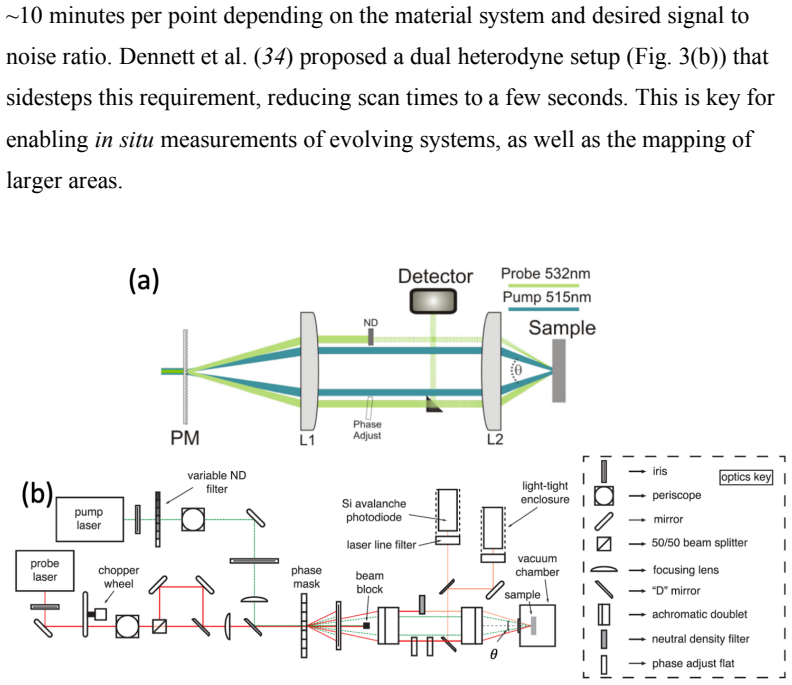
The central object is the transient grating: two short excitation pulses overlapped at angle $\theta$ create a sinusoidal intensity pattern of wavelength $L = \lambda/(2\sin(\theta/2))$ on the sample surface. Absorption writes a periodic temperature profile, and rapid thermal expansion both distorts the surface and launches two counter-propagating surface acoustic waves of wavelength $L$. A probe beam diffracts from these gratings and is heterodyned with a reference reflection; the resulting time trace contains a thermal component $T(t) \propto \exp(-q^2 \alpha t)$ and an oscillating SAW component whose frequency $f$ gives the SAW velocity $c_R = fL \approx (0.874+0.196\nu-0.043\nu^2-0.055\nu^3)\sqrt{E/(\rho(1+\nu))}$. The carrier of depth tunability is the grating wavelength itself: the thermal decay draws from a depth of about $L/\pi$, and the SAW displacement from a depth of about $L/2$, so changing the mask period changes which subsurface layer is interrogated.
What would settle it
Compare TGS results against a known damage-depth profile: irradiate identical samples to the same dose with different ion energies so that the damage occupies layers of different thickness, then measure each with several grating spacings. If the depth-attribution claim is right, the inferred surface-layer properties should be independent of grating spacing once that spacing is smaller than the damage depth; systematic drift with spacing, or disagreement with cross-sectional TEM or nanoindentation profiles, would falsify the claim.
Extended reading notes
Core claim
The paper's central claim is that TGS is a quantitative, non-destructive evaluation technique that measures both the velocity of laser-generated surface acoustic waves and the decay of a laser-written temperature grating in a single time trace on the sub-microsecond scale. From the SAW frequency the Rayleigh-wave relation gives Young's modulus and Poisson's ratio; from the thermal decay, $\exp(-q^2\alpha t)$, comes the thermal diffusivity; and the decay of the oscillations carries information about acoustic energy dissipation. The grating wavelength $L$ acts as the depth selector: thermal information comes predominantly from a layer of thickness $L/\pi$ and the SAW signal from a layer of thickness $L/2$, so choosing $L$ lets the user probe a chosen subsurface depth. Applications to helium-implanted tungsten, self-ion irradiated copper and nickel, niobium, colloidal monolayers, and semiconductors are presented as evidence that TGS can detect point defects that are too dilute for TEM, catch void-swelling onset, follow defect clustering through thermal diffusivity, and expose micron-scale non-diffusive phonon transport.
Load-bearing premise
The depth attribution rests on the assumptions that the thermal decay is sensitive to material only to a depth of about $L/\pi$ and the SAW signal only to a depth of about $L/2$, and that these weightings remain valid in damaged, inhomogeneous, or anisotropic materials; if the true probing volume reaches deeper or couples to the substrate, the measured changes can no longer be assigned to the irradiated surface layer alone.
Editorial extensions
If this is right
- In situ TGS during ion irradiation can map SAW velocity versus dose with roughly 0.04 dpa resolution, a thousand-fold improvement over conventional post-irradiation sampling, revealing both pre-swelling stiffening and the onset of void swelling.
- Because the grating wavelength selects the probed depth, TGS can extract the properties of a thin ion-irradiated layer without a large substrate contribution, which bulk techniques such as laser flash cannot do.
- Thermal diffusivity measured by TGS can act as a rapid indicator of point-defect accumulation and clustering, as in niobium where it dropped fourfold and then partially recovered before larger clusters formed.
- Varying the grating wavelength provides a direct window onto phonon mean-free-path distributions, showing reduced effective thermal diffusivity when the grating spacing becomes comparable to long-mean-free-path phonons.
- TGS operates in air, vacuum, or transparent fluids and at high or low temperature, so the same instrument can monitor corrosion, actuation, or irradiation in operando where optical access exists.
Reading between the lines
- If the $L/\pi$ and $L/2$ depth-weighting relations survive in anisotropic or heavily damaged materials, TGS could become a depth-profiling tool that deconvolves layered damage from measurements at several grating spacings; the review only gestures at this possibility.
- The strong monotonic links between dose and SAW speed or thermal diffusivity suggest a calibrated inverse problem: TGS could estimate accumulated displacement damage from a measured property change, acting as a nondestructive dosimeter.
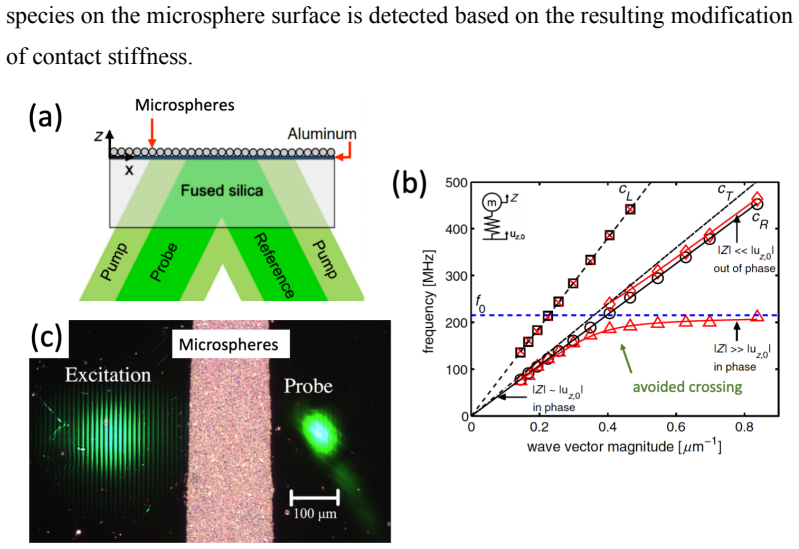
- The colloidal-microsphere results imply that TGS measures contact stiffness at engineered interfaces; extending the measurement to functionalized or stimuli-responsive particles could yield reconfigurable acoustic filters and adsorption sensors.
- Pairing TGS with simultaneous mechanical, electrical, or chemical driving forces could generate multi-property evolution maps that indicate when and where to deploy microscopy, a workflow the review describes but does not formalize.
Signed reviews
Editorial analysis
A structured set of objections, weighed in public.
Referee Report
Summary. This review article describes transient grating spectroscopy (TGS), a laser-based technique that generates surface acoustic waves (SAWs) and thermal gratings on a material surface and monitors their evolution with a heterodyned probe beam. It covers the physical principle (Eqs. 1-4), instrumentation including dual-heterodyne detection, and a range of applications: elastic constant measurement, ion-irradiation-induced property changes in W, Cu, Ni, and Nb, thermal transport in semiconductors, colloidal crystal dynamics, and phonon-mediated thermal transport. The central claim is that TGS is an ultrarapid, nondestructive probe of elasticity, thermal diffusivity, and energy dissipation at micrometer depths, with a tunable probe depth that can isolate ion-irradiated surface layers and enable in situ monitoring of microstructural evolution.
Significance. If the central claims hold, TGS is a genuinely valuable characterization tool: it is contact-free, fast (seconds per measurement), and can provide repeated in situ measurements during ion irradiation, as demonstrated by the 1000x dose-resolution improvement quoted for the Ni experiment. The review is useful as a synthesis, and the technical descriptions of heterodyne detection and fitting procedures are consistent with the cited literature. Independent applications by other groups (e.g., the colloidal-crystal work of Boechler et al. and the silicon-membrane thermal transport work of Johnson et al.) support the general utility of TGS. The main weakness is the depth-sensitivity argument used to claim that TGS isolates ion-irradiated layers; as presented, that argument is not quantitatively supported and affects several of the quantitative conclusions in the irradiation section.
major comments (2)
- [Depth dependence of the measured signal (p. 9) and in situ Ni experiment (p. 16, Fig. 6(b))]
- [Thermal decay depth sensitivity (Eq. (3), p. 9; Figs. 8 and 9)] The L/π rule for thermal sensitivity is likewise derived for a homogeneous medium; in a damaged-layer-on-substrate geometry, the measured thermal decay depends on the substrate thermal properties and the interface between layer and substrate, not simply on a layer of thickness L/π. The review uses thermal diffusivity changes to infer defect populations in He-implanted tungsten (Fig. 8(a)) and ion-irradiated niobium (Fig. 9(a)), but it does not discuss how substrate contributions enter the measured decay or what systematic error they introduce. Without such an analysis, the quantitative thermal-diffusivity values and the inferred defect concentrations are not fully supported. Adding a discussion of expected errors or a simple layered thermal model would address this load-bearing gap.
minor comments (4)
- [Abstract and colloidal-crystal section] The abstract lists 'energy dissipation' as a quantity revealed by TGS, but the body does not describe a quantitative measurement of energy dissipation in homogeneous materials; the only attenuation analysis is for SAWs crossing a colloidal monolayer (p. 18). The abstract should be qualified or a discussion of damping measurements should be added.
- [References 32 and 45] References 32 and 45 are cited with 'in press' and DOIs but without complete journal information or volume/page numbers; these citations should be completed before publication.
- [Equation (2)] Equation (2) has typesetting errors: the ν^3 term and the denominator are garbled. The formula should be checked against the original source and corrected.
- [p. 2] The word 'millenia' should be 'millennia'.
Circularity Check
No significant circularity: the review's claims rest on independent citations and are corroborated by external measurements, not on self-referential fits.
full rationale
This is a review article rather than a derivation in which an output is constructed from its own assumptions. The quantitative core (Eq. 1 for grating wavelength, Eq. 2 for Rayleigh-wave velocity, Eqs. 3-4 for thermal and displacement grating decay) is presented as standard and is cited to independent sources (Maznev/Nelson/Rogers, Peter, Johnson, Kading). The depth-isolation statement used for ion-irradiation applications cites Kading's L/pi thermal depth and Royer's L/2 SAW depth rule, both external to the author group; even if those cutoffs are only approximate and should be replaced by a full layered dispersion analysis, that is a correctness or validation concern, not a circular one. The more first-principles-looking elements in the review are explicitly benchmarked against external results: the MD TGS simulations reproduce the Dienes vacancy-modulus relation and prior contact-ultrasonics measurements; the helium-implantation tungsten work is tied to X-ray diffraction, DFT defect energetics, and independent thermal-transport arguments; the void-swelling studies are corroborated with TEM; and the dislocation-pinning interpretation is supported by in situ TEM and references to Friedel and Parkin. The authors do cite their own papers extensively (e.g., 34, 35, 43, 48, 56, 60, 61, 62), but these citations report measurements and methods that are independently evidenced or externally corroborated, rather than serving as an unverified uniqueness theorem. No fitted parameter is renamed as a prediction, and no equation reduces to its own input by construction. The review is therefore self-contained against external benchmarks, and the appropriate circularity finding is no significant circularity.
Assumptions & free parameters
assumptions (4)
- domain assumption Surface acoustic wave velocity in an isotropic material is related to E, nu, and rho by the approximate Rayleigh solution given in Eq (2); for anisotropic materials, published algorithms (refs 39,40) give the direction-dependent velocity.
- domain assumption Thermal grating decay follows a diffusive exponential, T(t) ~ exp(-q^2 alpha t) (Eq 3), and the surface displacement decays as erfc(q sqrt(alpha t)) (Eq 4), with thermal and displacement contributions separable through heterodyne phase (refs 32,43).
- domain assumption Silicon and other semiconductors have phonon mean free paths that vary by orders of magnitude, with a small population of long-MFP phonons contributing substantially to thermal conductivity at micron length scales (ref 83).
- domain assumption The molecular dynamics and DFT simulations in refs 35,48,56 correctly predict defect populations and their effect on elastic and thermal properties.
Cite this review
Pith. "Pith review of Transient grating spectroscopy: An ultrarapid, nondestructive materials evaluation technique." pith.science (2026). https://pith.science/paper/XZQN46Q6
@misc{pith2026190802051,
  author       = {Pith},
  title        = {Pith review of: Transient grating spectroscopy: An ultrarapid, nondestructive materials evaluation technique},
  year         = {2026},
  howpublished = {\url{https://pith.science/paper/XZQN46Q6}},
  note         = {Machine review of arXiv:1908.02051}
}
read the original abstract
Structure-property relationships are the foundation of materials science. Linking microstructure and material properties is essential for predicting material response to driving forces, managing in-service material degradation, and engineering materials for optimal performance. Elastic, thermal, and acoustic properties provide a convenient gateway to directly or indirectly probe material structure across multiple length scales. We review how using the laser-induced transient grating spectroscopy (TGS) technique, which uses a transient diffraction grating to generate surface acoustic waves (SAWs) and temperature gratings on a material surface, non-destructively reveals the material elasticity, thermal diffusivity, and energy dissipation on the sub-microsecond timescale, within a tunable sub-surface depth. This technique has already been applied to many challenging problems in materials characterization, from analysis of radiation damage, to colloidal crystals, to phonon-mediated thermal transport in nanostructured systems, to crystal orientation and lattice parameter determination. Examples of these applications, as well as inferring aspects of microstructural evolution, illustrate the wide potential reach of TGS to solve old materials challenges, and to uncover new science. We conclude by looking ahead at the tremendous potential of TGS for materials discovery and optimization when applied in situ to dynamically evolving systems.
Figures


Figures from the paper (6 more)




Forward citations
Cited by 1 Pith paper
-
HEP High Power Targetry Roadmap -- Workshop Report
A community roadmap for the materials, modeling, instrumentation, irradiation, and post-irradiation facilities needed to build reliable multi-MW accelerator targets.
Reference graph
Works this paper leans on
-
[8]
Status of Metallic Structural Materials for Molten Salt Reactors
H. Bei, S. Shim, E. P. George, M. K. Miller, E. G. Herbert, G. M. Pharr, Compressive strengths of molybdenum alloy micro-pillars prepared using a new technique. Scr. Mater. 57, 397–400 (2007). 9. N. De Jonge, F. M. Ross, Electron microscopy of specimens in liquid. Nat. Nanotechnol. 6, 695–704 (2011). 10. F. Hofmann, E. Tarleton, R. J. Harder, N. W. Philli...
work page 2007
-
[38]
N. Favretto-Cristini, D. Komatitsch, J. M. Carcione, F. Cavallini, Elastic surface waves in crystals. Part 1: Review of the physics. Ultrasonics. 51 (2011), pp. 653–660. 39. X. Du, J. C. Zhao, Facile measurement of single-crystal elastic constants from polycrystalline samples. npj Comput. Mater. 3 (2017), doi:10.1038/s41524-017-0019-x. 40. A. G. Every, A....
-
[67]
P. H. Otsuka, S. Mezil, O. Matsuda, M. Tomoda, A. A. Maznev, T. Gan, N. Fang, N. Boechler, V. E. Gusev, O. B. Wright, Time-domain imaging of gigahertz surface waves on an acoustic metamaterial. New J. Phys. 20 (2018), doi:10.1088/1367-2630/aa9298. 68. M. Hiraiwa, M. Abi Ghanem, S. P. Wallen, A. Khanolkar, A. A. Maznev, N. Boechler, Complex Contact-Based D...
-
[76]
K. Nordlund, S. J. Zinkle, A. E. Sand, F. Granberg, R. S. Averback, R. E. Stoller, T. Suzudo, L. Malerba, F. Banhart, W. J. Weber, F. Willaime, S. L. Dudarev, D. Simeone, Primary radiation damage: A review of current understanding and models. J. Nucl. Mater. 512 (2018), pp. 450–479. 77. A. E. Sand, J. Byggmästar, A. Zitting, K. Nordlund, Defect structures...
work page 2018
Reviewed August 14, 2026 · model on record in the stance chip above.
Discussion (0). Continue with ORCID to comment.