REVIEW 3 major objections 6 minor 15 references
Practical Speech Recognition with HTK
T0 review · 3 major / 6 minor · reviewed 2026-08-14 · deepseek-v4-flash
Pith's one-line read This paper reports a practical HTK workflow for small-vocabulary speech recognition and a 100% command completion rate on an Indonesian voice-controlled electrical switch.
desk verdict A practical HTK tutorial with real field experience, but its 100% accuracy claim is circular because Section IV.G retrains on test errors. read the letter →
The pith
A machine-rendered reading of the paper's core claim, the machinery that carries it, and where it could break.
The reading
What carries the argument
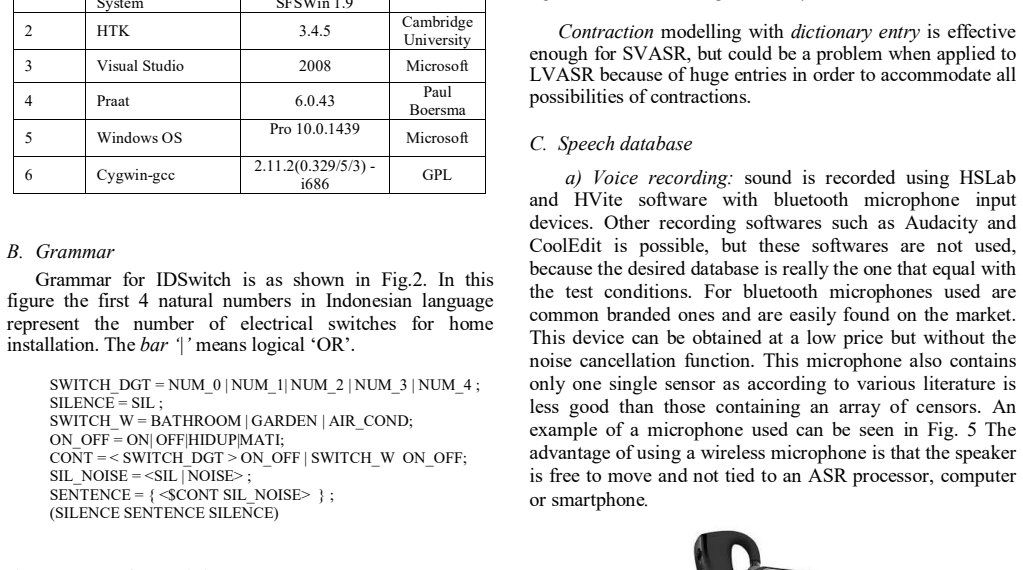
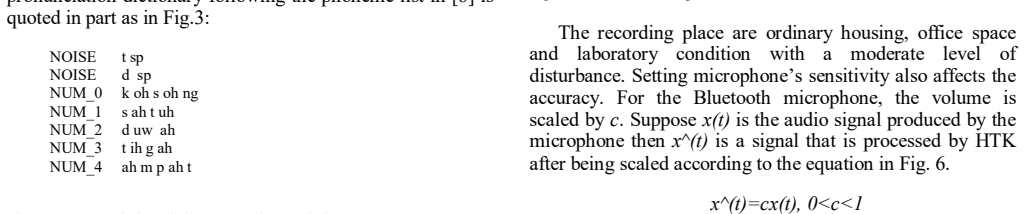
The load-bearing mechanism is a matched-condition training loop built around HTK's HVite program: HVite records the training audio, HCopy extracts MFCC_0_D_A features, HTK's HInit and HRest train phone-level HMM-GMM acoustic models, and HVite decodes live commands. Because the same decoder, microphone, room, and gain setting appear in training and testing, the model does not have to generalize across acoustic conditions. Supporting mechanisms are the volume-scaling rule $\hat{x}(t)=c x(t)$ with $0<c<1$, labeled NOISE entries in the pronunciation dictionary, and contraction entries such as NUM_3_4 to prevent word deletion.
What would settle it
Record a fresh set of Indonesian switch commands from the same speaker in the same room with the same microphone, run the finished HTK system on them without adding any of them to the training database or dictionary, and count completions. A completion rate below 100% would show that the reported figure reflects memorized training examples rather than generalization to new utterances.
Extended reading notes
Core claim
The core claim is that HTK, used with the right data-collection discipline, is enough to build a noise-tolerant small-vocabulary recognizer quickly. The decisive move is to record the training database with the same program that will perform live testing, HVite, under the same microphone, room, and gain conditions, instead of relying on clean speech corpora recorded in quiet studios. The paper further shows that reducing microphone gain by a factor $c$ with $0<c<1$ prevents everyday noises from being misread as words, and that including noise segments in the training database as explicitly labeled entries such as NOISE makes the recognizer robust to them. Indonesian cross-word contractions are handled by adding combined dictionary entries such as NUM_3_4. With this workflow, the paper finds that the Indonesian switch recognizer completed 100% of spoken commands, whether spoken as a switch number or as a named switch.
Load-bearing premise
The 100% completion rate assumes the test commands were not also training examples; the paper's refinement step, however, adds each failed sentence to the training database and retrains until it is recognized.
Editorial extensions
If this is right
- A small-vocabulary recognizer for Indonesian can be built and deployed on an ordinary PC or smartphone with low-cost tools and a cheap Bluetooth microphone.
- Recording training audio through the same decoder used for testing, in the same room, is the main route to reliable command recognition under noise.
- Lowering microphone gain is enough to stop everyday noises from triggering HTK's silence detector and creating spurious words.
- Adding dictionary entries for cross-word contractions removes a common word-deletion error in Indonesian digit sequences.
- Residual online errors can be corrected by recording the failed sentence, labeling it, retraining, and adding variant pronunciations to the dictionary.
Reading between the lines
- A fair multi-speaker evaluation would probably lower the completion rate, because the procedure as written ties the model to one speaker, one microphone, and one room; extending it would require per-speaker retraining or speaker adaptation.
- The dictionary-entry fix for contractions is a workaround that grows combinatorially with vocabulary size, so a larger Indonesian recognizer would need a real lexicon or language model rather than more dictionary entries.
- Because the underlying HTK algorithms are standard, the recipe's real contribution is data-collection discipline; a direct test would compare this matched-condition loop against a clean-trained baseline on the same held-out commands to quantify the gain.
Signed reviews
Editorial analysis
A structured set of objections, weighed in public.
Referee Report
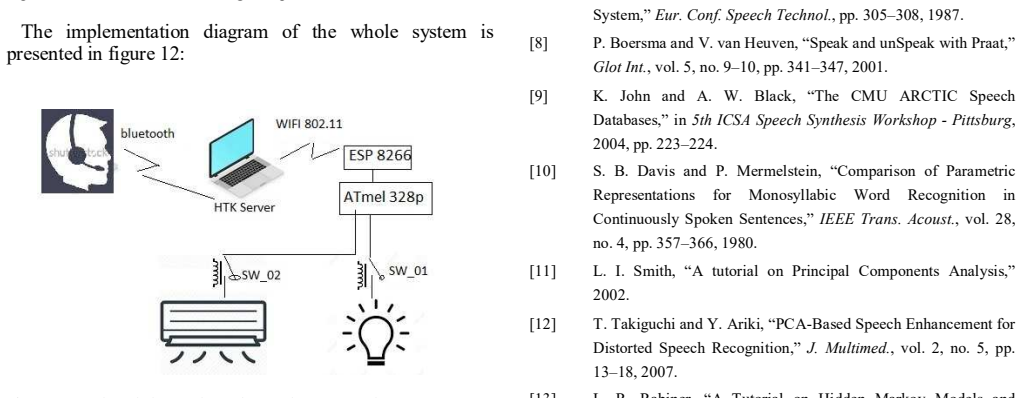
Summary. The paper proposes a practical procedure for building a small-vocabulary automatic speech recognition (SVASR) system with the Hidden Markov Model Toolkit (HTK). The procedure covers grammar and pronunciation dictionary design, recording a training database under conditions matched to the target environment, MFCC feature extraction with optional PCA, HMM-GMM acoustic model training, online testing with HVite, a refinement step that retrains on newly observed errors, and deployment via an Arduino-based electrical switch. The method is illustrated with an Indonesian-language voice-controlled electrical switch (IDSwitch) system. The central empirical claim, stated in the abstract and conclusion, is a 100% command completion rate for this system.
Significance. If the central claim were validated, the paper would offer a useful practical recipe for rapidly building small-vocabulary ASR systems in moderately noisy environments. The paper gives explicit credit for several practical ideas: representing noise as a word in the dictionary, scaling microphone volume to reduce silence-detector false triggers, modeling cross-word contractions via dictionary entries, and recording training data with the same program (HVite) used for testing. These are concrete and potentially helpful for practitioners. However, the reported 100% command completion rate is not supported by a valid evaluation. The refinement procedure described in Section IV.G explicitly adds each failed test utterance to the training database, retrains the model, and retests the same utterance until it is recognized; the paper also permits adding the wrongly detected phoneme sequence to the dictionary. Consequently, the reported accuracy measures memorization of the test items rather than generalization to unseen commands.
major comments (3)
- [Section IV.G] The central claim of 100% command completion rate is invalid as an accuracy measurement because the evaluation is circular. Section IV.G states that when an error occurs in online testing, the sentence is taken, labelled, added to the database, and then retested after retraining. This means the utterances used to measure the final accuracy were included in the training set of the model that produced the reported result. The same section also permits adding wrongly detected phoneme sequences to the pronunciation dictionary, so the lexicon is adapted to the test items as well. The reported 100% therefore reflects the system's ability to memorize the specific test sentences, not its ability to generalize to unseen commands. To support the claim, the authors must freeze the acoustic model and dictionary after training and then evaluate on a separate set of previously unseen recordings, with no refinement applied after the evaluation begins.
- [Section IV.F and IV.H] The evaluation is under-specified in load-bearing ways. No number of test utterances, number of speakers, number of repetitions per command, or per-condition accuracy breakdown is given. The deployment section mentions a 'frame probability' threshold that revalidates recognition results, but the threshold value is never reported, so the reader cannot know how many ambiguous results were discarded before computing the 100% completion rate. Without these details, even a held-out evaluation would not be interpretable. The authors should report the test protocol, the test set size, the threshold used, and accuracy per command and per noise condition.
- [Section IV.D] The feature extraction parameters as written are internally inconsistent with the stated 16 kHz sampling rate. The text says 'windowing of 250 ms (400 samples)' and 'striding of 100ms (160 samples) and overlapping of 150 ms (240 samples)'. At 16 kHz, 400 samples correspond to 25 ms, not 250 ms, and 160 samples correspond to 10 ms, not 100 ms. This appears to be a factor-of-ten error that affects the reproducibility of the described procedure. The authors should correct the stated window length, frame shift, and overlap values to be consistent with the sampling rate.
minor comments (6)
- [Section III.F vs IV.G] The refinement step is described twice (Section III.F 'Refinement' and Section IV.G 'Refining') with slightly different wording; the relationship between these descriptions should be clarified to avoid confusion about when refinement is applied.
- [Table II] Table II has duplicate row numbers ('5' appears twice) and skips numbers 3 and 4. The table should be renumbered consecutively.
- [Figure 3] The caption contains a typo: 'Pronounciation' should be 'Pronunciation'.
- [Figure 5 caption] The caption text 'contains only one single sensor' presumably means 'sensor' rather than 'censor'.
- [Author biography] The biography says 'he thought computer science' but should read 'he taught computer science'.
- [References] Several references are incomplete or lack page numbers (e.g., [11] and [14]); the authors should verify that all citations follow a consistent format.
Circularity Check
The reported 100% command completion rate is produced by retraining on each failed test utterance until it is recognized, so the accuracy claim measures memorization rather than generalization.
-
fitted input called prediction
[Section IV.G Refining; echoed in Section VI Conclusion]
"If in online testing an error occurs in the sentence that is spoken, then the sentence is taken and labelled and added to the database, then retest the sentence again. After that, it is examined whether the previous sentence can be recognized correctly now. The results showed that this method succeeded in correcting the errors of online testing."
The paper's central claim is the '100% command completion rate' reported in the abstract and conclusion. That rate is achieved only after a refinement loop in which every utterance that fails online testing is labeled, inserted into the training database, and the model is retrained; the same utterance is then retested until it is recognized. The test utterances are therefore part of the training data by the paper's own description, so the final accuracy figure is a measure of the model's ability to reproduce previously seen examples, not its ability to generalize to unseen commands. The same section also allows adding the wrongly detected phoneme sequence to the dictionary, adapting the lexicon to the very test errors.
full rationale
The paper is mostly a practical tutorial on building an HTK-based Indonesian small-vocabulary ASR, and most of its methodological statements are not circular: grammar design, MFCC feature extraction, HMM-GMM training, and environment-matched recording are standard practices described without importing the result. The circularity is concentrated in the empirical claim. The abstract and conclusion assert a '100% command completion rate' for the IDSwitch system, but Section IV.G explicitly describes retraining on every sentence that failed online testing and retesting that same sentence until it is recognized. Under that protocol, the final test set is included in the training set, so the reported 100% rate is a fitting outcome of the refinement loop rather than an independent measure of recognition performance. The paper also states that unsuccessful entries can be added to the pronunciation dictionary as explicit words, which adapts the recognizer's lexicon to the test errors. No held-out partition, cross-validation, or evaluation on previously unseen recordings is reported, and no data or code are provided for external verification. Because the central accuracy result reduces by construction to the refinement procedure described in the paper's own text, a high circularity score is appropriate; this is not merely a self-citation issue or a difference from standard consensus.
Assumptions & free parameters
free parameters (6)
- Volume scaling factor c =
not reported (stated 0<c<1)
- MFCC window/hop sizes =
250 ms window, 100 ms stride, 150 ms overlap (400/160/240 samples at 16 kHz)
- PCA dimension after MFCC_0_D_A =
not specified (only 'reduced')
- Frame probability threshold for command acceptance =
not specified
- HMM state and Gaussian mixture counts =
not specified
- Number of training utterances per word/noise label =
not specified
assumptions (5)
- domain assumption HMM-GMM acoustic models are an adequate representation for sub-word speech recognition.
- domain assumption MFCC features (with delta and acceleration) capture speech information needed for this task.
- domain assumption Matched training and testing environments and microphone are necessary and sufficient for good performance.
- ad hoc to paper Noise can be represented as a word with a phoneme sequence in the dictionary.
- ad hoc to paper Test utterances used to measure the 100% rate are independent of the training data.
Cite this review
Pith. "Pith review of Practical Speech Recognition with HTK." pith.science (2026). https://pith.science/paper/M3ODAPTP
@misc{pith2026190802119,
  author       = {Pith},
  title        = {Pith review of: Practical Speech Recognition with HTK},
  year         = {2026},
  howpublished = {\url{https://pith.science/paper/M3ODAPTP}},
  note         = {Machine review of arXiv:1908.02119}
}
read the original abstract
The practical aspects of developing an Automatic Speech Recognition System (ASR) with HTK are reviewed. Steps are explained concerning hardware, software, libraries, applications and computer programs used. The common procedure to rapidly apply speech recognition system is summarized. The procedure is illustrated, to implement a speech based electrical switch in home automation for the Indonesian language. The main key of the procedure is to match the environment for training and testing using the training data recorded from the testing program, HVite. Often the silence detector of HTK is wrongly triggered by noises because the microphone is too sensitive. This problem is mitigated by simply scaling down the volume. In this sub-word phone-based speech recognition, noise is included in the training database and labelled particularly. Illustration of the procedure is applied to a home automation application. Electrical switches are controlled by Indonesian speech recognizer. The results show 100% command completion rate.
Figures


Figures from the paper (5 more)


Reference graph
Works this paper leans on
-
[1]
The HTK Book version 3.5 alpha,
S. Young, E. Gunnar, G. Mark, T. Hain, and D. K ershaw, “The HTK Book version 3.5 alpha,” Cambridge University, 2015
2015
-
[2]
Phone Recognition on the TIMIT Database,
C. Lopes and F. Perdigão, “Phone Recognition on the TIMIT Database,” 2009
work page 2009
-
[3]
A large vocabulary continuous speech recognition system for Indonesian language,
D. P. Lestari, K. Iwano, and S. Furui, “A large vocabulary continuous speech recognition system for Indonesian language,” 15th Indones. Sci. Conf. Japan Proc. , pp. 17–22, 2006
work page 2006
-
[4]
Robust Sp eech Recognition for Car Environment Noise,
H. Kokubo, A. Amano, and N. Hataoka, “Robust Sp eech Recognition for Car Environment Noise,” Electron. Commun. Japan, Part 3 , vol. 85, no. 11, pp. 2190–2197, 2002
work page 2002
-
[5]
Illustration of the IPA: Indonesian,
C. D. Soderberg and K. S. Olson, “Illustration of the IPA: Indonesian,” J. Int. Phon. Assoc. , vol. 38, no. 2, pp. 209–213, 2008
work page 2008
-
[6]
Speaker-Independent Phon e Recognition Using Hidden Markov Models,
K. Lee and H.-W. Hon, “Speaker-Independent Phon e Recognition Using Hidden Markov Models,” IEEE Trans. Acoust. , vol. 37, no. 11, pp. 1641–1648, 1989
work page 1989
-
[7]
The SPAR Speech Fil ing System,
M. A. Huckvale, D. M. Brookes, L. T. Dworkin, M . E. Johnson, D. J. Pearce, and L. Whitaker, “The SPAR Speech Fil ing System,” Eur. Conf. Speech Technol. , pp. 305–308, 1987
work page 1987
-
[8]
Speak and unSpea k with Praat,
P. Boersma and V. van Heuven, “Speak and unSpea k with Praat,” Glot Int. , vol. 5, no. 9–10, pp. 341–347, 2001
work page 2001
Show all 15 references
-
[9]
The CMU ARCTIC Speech Databases,
K. John and A. W. Black, “The CMU ARCTIC Speech Databases,” in 5th ICSA Speech Synthesis Workshop - Pittsburg , 2004, pp. 223–224
2004
-
[10]
Comparison of Parametric Representations for Monosyllabic Word Recognition i n Continuously Spoken Sentences,
S. B. Davis and P. Mermelstein, “Comparison of Parametric Representations for Monosyllabic Word Recognition i n Continuously Spoken Sentences,” IEEE Trans. Acoust. , vol. 28, no. 4, pp. 357–366, 1980
1980
-
[11]
A tutorial on Principal Componen ts Analysis,
L. I. Smith, “A tutorial on Principal Componen ts Analysis,” 2002
2002
-
[12]
PCA-Based Speech E nhancement for Distorted Speech Recognition,
T. Takiguchi and Y. Ariki, “PCA-Based Speech E nhancement for Distorted Speech Recognition,” J. Multimed. , vol. 2, no. 5, pp. 13–18, 2007
2007
-
[13]
A Tutorial on Hidden Markov Mo dels and Selected Applications in Speech Recognition,
L. R. Rabiner, “A Tutorial on Hidden Markov Mo dels and Selected Applications in Speech Recognition,” in Proceedings of the IEEE , 1989, vol. 77, no. 2, pp. 257–286
1989
-
[14]
ATmega328P 8-bit AVR Microcontroll er with 32K Bytes In-System Programmable Flash DATASHEET
Microchip, “ATmega328P 8-bit AVR Microcontroll er with 32K Bytes In-System Programmable Flash DATASHEET.”
-
[15]
ESP8266EX Version 6.0 Data sheets,
Espressif Systems, “ESP8266EX Version 6.0 Data sheets,” 2018. Zulkarnaen Hatala was born in Ambon, on 19 Agustus 1977. He received Sarjana Teknik on Informatics at 2002 and Master Teknik on Telecommunications at 2005. Both degress are from Telkom University, Bandung Indonesia....
2018
Reviewed August 14, 2026 · model on record in the stance chip above.
Discussion (0). Continue with ORCID to comment.