REVIEW 2 major objections 8 minor 37 references
Recurrence Network Analysis of Exoplanetary Observables
T0 review · 2 major / 8 minor · reviewed 2026-08-14 · deepseek-v4-flash
Pith's one-line read Transit timings alone reveal a planet's chaotic dynamics.
desk verdict Solid synthetic proof-of-concept for recurrence network analysis of exoplanet time series, but the Kepler-36 conclusion picks the measure that fits the prior result. read the letter →
The pith
A machine-rendered reading of the paper's core claim, the machinery that carries it, and where it could break.
The reading
What carries the argument
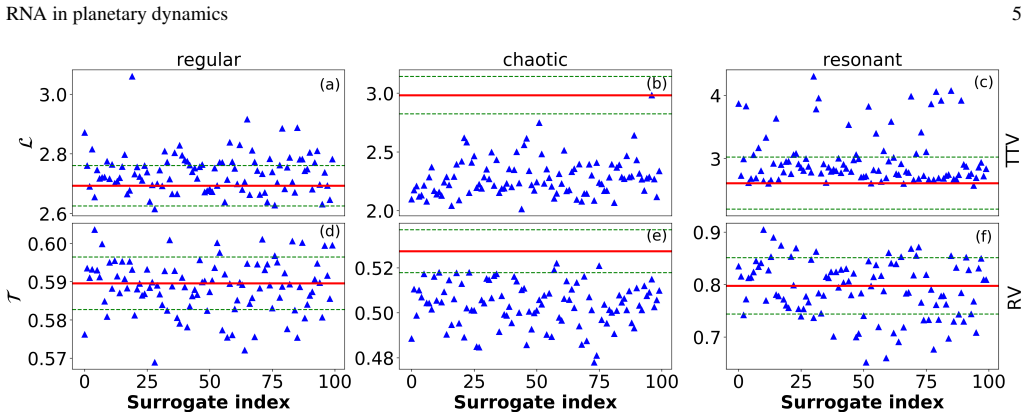
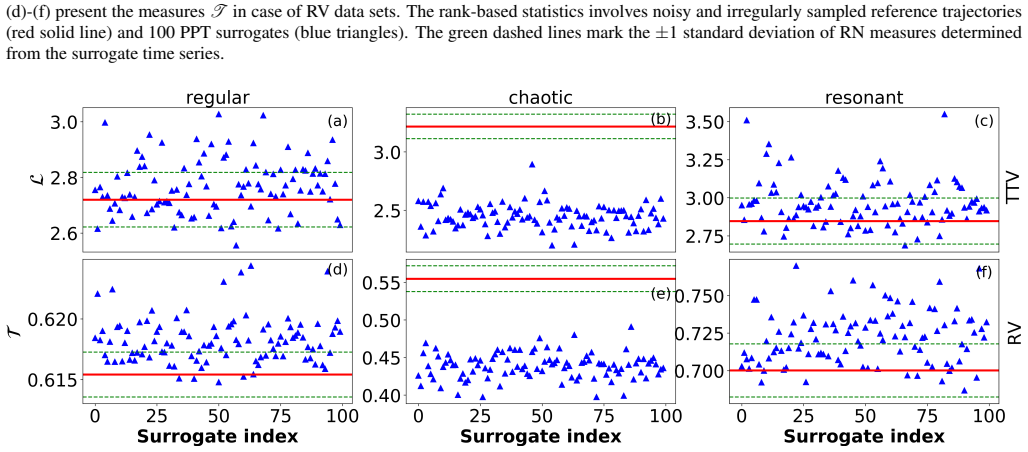
The central object is the recurrence network (RN), obtained from the recurrence plot by deleting the diagonal: the adjacency matrix is $A_{ij} = R_{ij} - \delta_{ij}$, so that nodes are reconstructed phase-space vectors and edges connect vectors that lie within an $\epsilon$-ball at different times. Two network statistics carry the classification: the average path length $L$, which grows with chaotic spreading, and the transitivity $T$, the fraction of closed triangles, which is high for coherent, regular motion. The test of significance is provided by pseudo-periodic twin surrogates (PPTS), which scramble the signal while preserving its quasi-periodic structure; comparing the network measures of the original series to the surrogate ensemble yields a rank-based one-sided hypothesis test at the 99% level.
What would settle it
Generate many synthetic, genuinely quasi-periodic RV/TTV time series from a stable two-planet model with the same length, noise level, and ~15% missing-data pattern as the Kepler-36 observations, run the PPTS surrogate test at the 99% level, and count the false rejections; a rejection rate clearly above 1% would show that rejecting quasi-periodicity does not reliably imply chaos.
Extended reading notes
Core claim
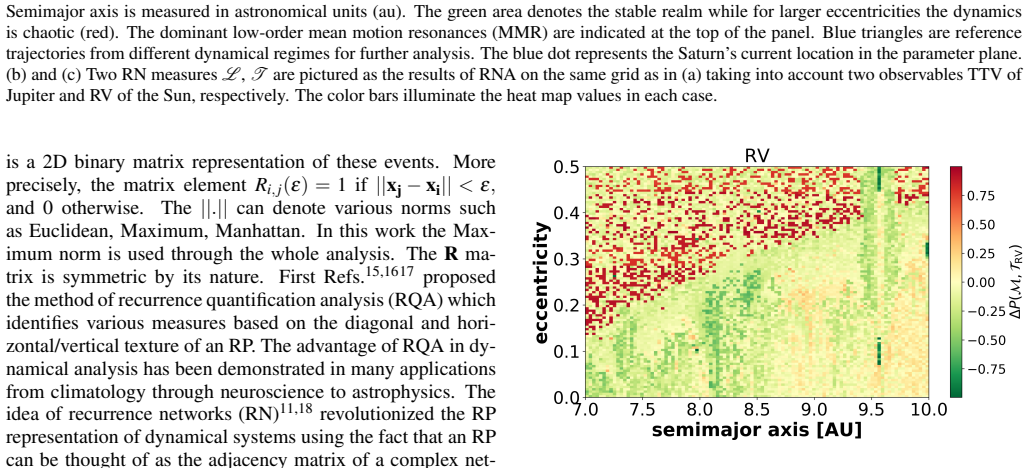
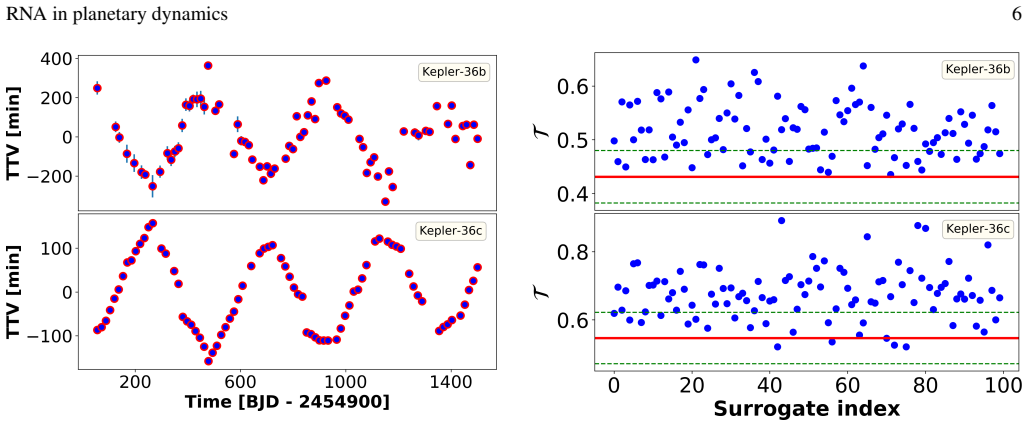
On the paper's own terms, the central discovery is that the topology of a recurrence network built from a scalar observable preserves the underlying dynamics of the planetary system, so that the network measures average path length L and transitivity T can serve as proxies for regular versus chaotic motion. In a 100×100 grid of initial conditions for a Sun–Jupiter–Saturn model, the maps of L and T reproduce the MEGNO stability map, with chaotic regions corresponding to high L and low T, and the same measures classify individual trajectories when tested against pseudo-periodic twin surrogates with a one-sided 99% significance level. The method survives the addition of Gaussian noise and systematic deletion of up to 15% of the data, after spline interpolation. For the real Kepler-36 TTV series, the transitivity measure rejects the quasi-periodic null hypothesis for the inner planet Kepler-36b while the outer planet Kepler-36c is regular; the average path length measure, however, does not reject the null for either planet. The paper interprets this as evidence of stable chaos near the edge of the 7:6 resonance, in line with earlier dynamical analyses.
Load-bearing premise
The load-bearing premise is that, for planetary signals, rejecting the quasi-periodic null hypothesis in the surrogate test can be taken to mean the underlying dynamics is chaotic.
Editorial extensions
If this is right
- RNA can serve as a computationally cheap screening tool for planetary stability, since it needs only the measured time series and avoids n-body integration; a 950-point series with its 100 surrogates is analyzed in under ten minutes on a desktop machine.
- The method works with both radial-velocity and transit-timing observables and remains reliable when the data are noisy and up to 15% of the points are missing, so it is applicable to current ground- and space-based surveys.
- For Kepler-36, the RNA result supports the picture of the inner planet being dynamically irregular, with stable chaos near the 7:6 resonance, and the outer planet regular.
- The scheme generalizes to systems with more than two planets, so it can be applied to the longer TTV and RV time series expected from future surveys.
Reading between the lines
- The leap from 'rejecting quasi-periodicity' to 'the dynamics is chaotic' is only valid under the assumption that planetary signals are deterministic and that no other non-quasi-periodic process is at play; in other fields a rejected PPTS null could also be produced by a slowly varying frequency, so the diagnostic label should be validated against independent Lyapunov estimates on a few well-known
- The disagreement between transitivity and average path length for Kepler-36b hints that the two measures probe different geometric aspects of the recurrence network; a combined statistic or a measure that is independent of the embedding parameters might sharpen the classification for short, gappy series.
- The method is presented for RV and TTV, but the same construction applies to astrometric time series; it would be interesting to test whether astrometric data with similar noise levels yield comparable classification power.
Signed reviews
Editorial analysis
A structured set of objections, weighed in public.
Referee Report
Summary. The paper proposes recurrence network analysis (RNA) as a method to classify exoplanetary dynamics from observed scalar time series (radial velocity and transit timing variations). After time-delay embedding and recurrence-network construction, two network measures—average path length L and transitivity T—are used as dynamical indicators. On a synthetic Sun–Jupiter–Saturn (SJS) system, these measures reproduce the MEGNO stability map on a 100×100 grid, with false-grouping errors below 10%. Hypothesis tests using pseudo-periodic twin surrogates at the 1% significance level correctly identify regular, chaotic, and resonant trajectories, including robustness to noise and 15% missing data. Applied to Kepler-36 TTV data, transitivity rejects the quasi-periodic null for the inner planet while average path length does not; the paper interprets this disagreement as 'stable chaos' and claims consistency with earlier studies. The central claim is that RNA can determine exoplanetary dynamics from observed data, but the real-data demonstration is compromised by the conflicting measures and by the untested transfer of synthetic validation to much shorter and more incomplete real series.
Significance. If the synthetic results are representative, RNA offers a fast, parameter-light complement to n-body stability analysis, using directly observed time series without orbital fitting or integration. The synthetic validation is a genuine strength: the network measures recover the MEGNO map, surrogate tests are calibrated at the 1% level, and the method is tested on regular, chaotic, and resonant regimes. However, the real-data inference is not yet established: the two RN measures contradict each other on Kepler-36, the leap from rejecting quasi-periodicity to asserting chaos is unjustified, and the validation was performed at longer series lengths and smaller missing fractions than the real data. The paper introduces an interesting framework but overstates its current applicability to observational data; the contribution is promising but requires additional statistical work to support the central claim.
major comments (2)
- [III.A, surrogate hypothesis paragraph] The paper asserts that rejecting the PPTS null implies chaotic dynamics because planetary motion is deterministic, high-dimensional, and nonlinear. This is an assumption, not a demonstrated property. A non-quasi-periodic signal may also arise from measurement noise, systematic errors, non-stationarity, or an inappropriate null model; the surrogate test alone does not distinguish these possibilities. This assumption is load-bearing because it is used to convert the T-based rejection for Kepler-36b into a conclusion about chaos. A concrete test would be to apply the same procedure to synthetic non-chaotic but non-quasi-periodic signals (e.g., slowly drifting periodic signals, chirps, or noise-corrupted periodic signals) and show that the rejection rate remains at the nominal level. Without such a test, the inference from rejecting quasi-periodicity to chaos remains unsubstantiated for short, noisy, unevenly sampled real series.
- [Table I and Section III.B] The embedding parameters for Kepler-36 (d = 6, τ = 4 and 5, ε = 165.0 and 52.90) are stated without justification, whereas for the synthetic series the parameters are selected via standard criteria (false nearest neighbors and mutual information). Since RN measures depend on ε—the paper itself acknowledges this in Section III.A—the lack of a sensitivity analysis for the real data leaves open the possibility that the T/L contradiction is a parameter artifact. The authors should explain how the real-data embedding parameters were chosen and show that the hypothesis-test conclusions remain stable over a plausible range of d, τ, and ε.
minor comments (8)
- [Abstract and Section IV] The phrase 'consistent with earlier studies' overstates the case because the two RN measures give opposite conclusions for the inner planet; suggest softening to 'partially consistent' or explicitly reporting the discrepancy.
- [Eq. (2)] The abbreviation 'CPD' appears to be a typo for 'CDF' (cumulative distribution function), as used in the surrounding text.
- [Fig. 1 caption] The caption says '(b) and (c) Two RN measures L, T are pictured ... taking into account two observables TTV of Jupiter and RV of the Sun,' but it does not say which measure appears in which panel; the text indicates panel (b) is L for TTV and panel (c) is T for RV, so the caption should be explicit.
- [References 8 and 20] The journal name 'Mothly Notices' should be 'Monthly Notices.'
- [Section II] The sentence 'First Refs. 15,1617 proposed the method...' has a formatting error in the reference list; it should read 'Refs. 15–17' and the verb should be 'proposed' (or 'have proposed').
- [Section III.B] The term 'stable chaos' is used without a definition or a supporting citation in the immediate context; define it or explicitly cite the earlier works that introduce it (e.g., stable chaos as bounded chaotic motion with positive short-time Lyapunov exponents).
- [Section IV] The phrase 'the conclusions drawn from the analysis should be treated in place' is unclear; 'in place' is likely a typo for 'in plane' or 'with care,' and the sentence should be rephrased.
- [Section IV and reference [36]] The statement that the method 'can be generalized to more than two planets' cites a paper 'in preparation'; if that work is not yet available, the generalization remains unverified and the citation should be updated or the statement hedged.
Circularity Check
No circular derivation: RNA is validated against external MEGNO benchmarks and public Kepler-36 data; the only self-citation is non-load-bearing.
full rationale
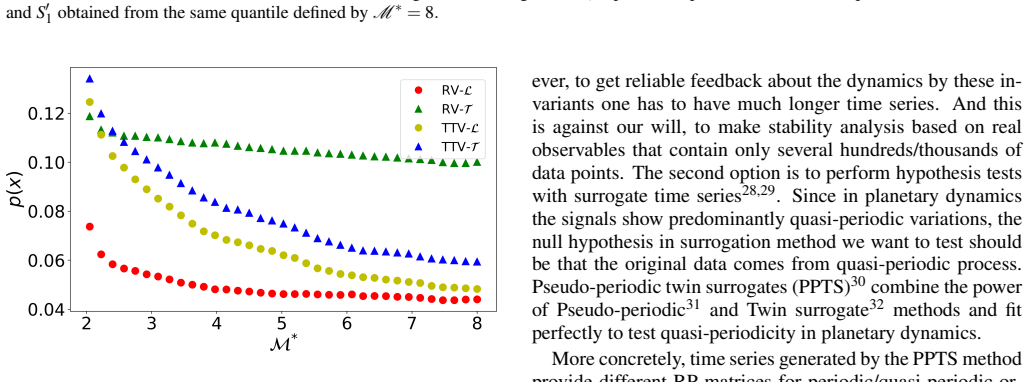
The paper's central claim is that recurrence network measures computed from scalar RV/TTV time series recover regular-versus-chaotic dynamical classification. This is established on the synthetic Sun-Jupiter-Saturn system, where the RNA stability maps are compared pointwise with the independent MEGNO indicator (Figs. 1, 2), and quantile-based grouping errors are shown to stay below 10% (Fig. 4). The real-data Kepler-36 analysis uses a prespecified 1%-level pseudo-periodic twin surrogate test; no network parameter or threshold is fitted to make the inner planet come out irregular. The admitted disagreement between the two measures (T rejects quasi-periodicity for Kepler-36b while L is consistent with quasi-periodicity for both planets) is presented explicitly and interpreted as 'stable chaos'; however debatable, that is an interpretive choice, not a reduction of the conclusion to a fitted input. The method depends on standard embedding and recurrence-network constructions, not on the target result. The only self-citation is Ref. 36, an in-preparation paper by the same author cited for the non-central remark that the scheme can be generalized to more than two planets; it does not support any load-bearing step. Because the derivation is independently benchmarked and the real-data conclusion is not constructed from its own expected outcome, the paper exhibits no significant circularity beyond the minor non-load-bearing self-citation.
Assumptions & free parameters
free parameters (4)
- Embedding dimension d =
4-18 depending on time series (Table I)
- Time delay tau =
2-19 depending on time series (Table I)
- Recurrence threshold epsilon =
Varies per time series; e.g., 2.1e-4 for RV-Syna 950
- Critical M* for grouping =
8
assumptions (5)
- standard math Takens' embedding theorem ensures a scalar time series can reconstruct the underlying phase space.
- domain assumption The observed RV or TTV signal is generically coupled to the full system dynamics.
- domain assumption Recurrence network topology preserves regular vs chaotic distinctions.
- ad hoc to paper Pseudo-periodic twin surrogates are a valid null model for quasi-periodic planetary signals, and rejecting them implies chaos.
- domain assumption The planetary system is effectively deterministic and low-dimensional enough for recurrence analysis on short time series.
Cite this review
Pith. "Pith review of Recurrence Network Analysis of Exoplanetary Observables." pith.science (2026). https://pith.science/paper/C2IZXR4D
@misc{pith2026190802158,
  author       = {Pith},
  title        = {Pith review of: Recurrence Network Analysis of Exoplanetary Observables},
  year         = {2026},
  howpublished = {\url{https://pith.science/paper/C2IZXR4D}},
  note         = {Machine review of arXiv:1908.02158}
}
read the original abstract
Recent advancements of complex network representation among several disciplines motivated the investigation of exoplanetary dynamics by means of recurrence networks. We are able to recover different dynamical regimes by means of various network measures obtained from synthetic time series of a model planetary system. The framework of complex networks is also applied to real astronomical observations acquired by recent state-of-the-art surveys. The outcome of the analysis is consistent with earlier studies opening new directions to investigate planetary dynamics.
Figures


Figures from the paper (5 more)

Reference graph
Works this paper leans on
-
[1]
merlin.mbs apsrev4-1.bst 2010-07-25 4.21a (PWD, AO, DPC) hacked
FUNCTION id.bst "merlin.mbs apsrev4-1.bst 2010-07-25 4.21a (PWD, AO, DPC) hacked" ENTRY address archive archivePrefix author bookaddress booktitle chapter collaboration doi edition editor eid eprint howpublished institution isbn issn journal key language month note number organization pages primaryClass publisher school SLACcitation series title translati...
2010
-
[2]
author author D. Foreman-Mackey , author D. W. \ Hogg , author D. Lang , \ and\ author J. Goodman ,\ title title emcee: The MCMC Hammer , \ 10.1086/670067 journal journal Publications of the ASP \ volume 125 ,\ pages 306 ( year 2013 ) ,\ http://arxiv.org/abs/1202.3665 arXiv:1202.3665 [astro-ph.IM] NoStop
-
[3]
author author D. C. \ Fabrycky ,\ title title Non-Keplerian Dynamics of Exoplanets , \ in\ @noop booktitle Exoplanets ,\ editor edited by\ editor S. Seager \ ( year 2010 )\ pp.\ pages 217--238 NoStop
work page 2010
-
[4]
author author P. M. \ Cincotta \ and\ author C. Sim \'o ,\ title title Simple tools to study global dynamics in non-axisymmetric galactic potentials - I , \ 10.1051/aas:2000108 journal journal Astronomy and Astrophysics, Supplement \ volume 147 ,\ pages 205--228 ( year 2000 ) NoStop
-
[5]
author author E. J. \ Rivera \ and\ author J. J. \ Lissauer ,\ title title Dynamical Models of the Resonant Pair of Planets Orbiting the Star GJ 876 , \ 10.1086/322477 journal journal The Astrophysical Journal \ volume 558 ,\ pages 392--402 ( year 2001 ) NoStop
-
[6]
author author D. J. \ Armstrong , author A. Santerne , author D. Veras , author S. C. C. \ Barros , author O. Demangeon , author J. Lillo-Box , author J. McCormac , author H. P. \ Osborn , author M. Tsantaki , author J.-M. \ Almenara , author D. Barrado , author I. Boisse , author A. S. \ Bonomo , author D. J. A. \ Brown , author G. Bruno , author J. Rey ...
-
[7]
author author K. Batygin , author K. M. \ Deck , \ and\ author M. J. \ Holman ,\ title title Dynamical Evolution of Multi-resonant Systems: The Case of GJ876 , \ 10.1088/0004-6256/149/5/167 journal journal The Astronomical Journal \ volume 149 ,\ eid 167 ( year 2015 ) ,\ http://arxiv.org/abs/1504.00051 arXiv:1504.00051 [astro-ph.EP] NoStop
-
[8]
author author K. M. \ Deck , author M. J. \ Holman , author E. Agol , author J. A. \ Carter , author J. J. \ Lissauer , author D. Ragozzine , \ and\ author J. N. \ Winn ,\ title title RAPID DYNAMICAL CHAOS IN AN EXOPLANETARY SYSTEM , \ @noop journal journal The Astrophysical Journall \ volume 755 ,\ pages 21 ( year 2012 ) NoStop
work page 2012
Show all 37 references
-
[9]
Panichi , author K
author author F. Panichi , author K. Go \'z dziewski , \ and\ author G. Turchetti ,\ title title The reversibility error method (REM): a new, dynamical fast indicator for planetary dynamics , \ 10.1093/mnras/stx374 journal journal Mothly Notices of the Royal Astronomical Socie...
-
[10]
note As a consequence of the mutual gravitational interaction of the planets one might observe slight deviations in orbital periods called transit timing variation. Stop
-
[11]
Kantz \ and\ author T
author author H. Kantz \ and\ author T. Schreiber ,\ @noop title Nonlinear Time Series Analysis, by Holger Kantz , Thomas Schreiber, Cambridge, UK: Cambridge University Press, 2003 \ ( publisher Cambridge University Press ,\ year 2003 ) NoStop
2003
-
[12]
author author R. V. \ Donner , author Y. Zou , author J. F. \ Donges , author N. Marwan , \ and\ author J. Kurths ,\ title title Recurrence networks a novel paradigm for nonlinear time series analysis , \ 10.1088/1367-2630/12/3/033025 journal journal New Journal of Physics \ v...
-
[13]
author author F. Takens ,\ title title Detecting strange attractors in turbulence , \ 10.1007/BFb0091924 journal journal Lecture Notes in Mathematics, Berlin Springer Verlag \ volume 898 ,\ pages 366 ( year 1981 ) NoStop
1981 doi
-
[14]
author author J. L. \ Semmlow \ and\ author B. Griffel ,\ @noop title Biosignal and medical image processing \ ( publisher CRC Press ,\ year 2014 )\ p.\ pages 608 NoStop
2014
-
[15]
\ Eckmann , author S
author author J.-P. \ Eckmann , author S. Oliffson Kamphorst , \ and\ author D. Ruelle ,\ title title Recurrence plots of dynamical systems , \ 10.1209/0295-5075/4/9/004 journal journal EPL (Europhysics Letters) \ volume 4 ,\ pages 973 ( year 1987 ) NoStop
-
[16]
author author J. P. \ Zbilut \ and\ author C. L. \ Webber ,\ title title Embeddings and delays as derived from quantification of recurrence plots , \ 10.1016/0375-9601(92)90426-M journal journal Physics Letters A \ volume 171 ,\ pages 199--203 ( year 1992 ) NoStop
-
[17]
author author C. L. \ Webber \ and\ author J. P. \ Zbilut ,\ title title Dynamical assessment of physiological systems and states using recurrence plot strategies. \ @noop journal journal Journal of applied physiology \ volume 76 2 ,\ pages 965--73 ( year 1994 ) NoStop
1994
-
[18]
note The visual interpretation of the matrix R can achieved by plotting a dot when the matrix element is 1 and leave it empty otherwise. Stop
-
[19]
author author R. V. \ Donner , author J. Heitzig , author J. F. \ Donges , author Y. Zou , author N. Marwan , \ and\ author J. Kurths ,\ title title The geometry of chaotic dynamics – a complex network perspective , \ 10.1140/epjb/e2011-10899-1 journal journal Eur. Phys. J. B ...
-
[20]
Zou , author R
author author Y. Zou , author R. V. \ Donner , author N. Marwan , author J. F. \ Donges , \ and\ author J. Kurths ,\ title title Complex network approaches to nonlinear time series analysis , \ 10.1016/j.physrep.2018.10.005 journal journal Physics Reports \ volume 787 ,\ pages...
2018 doi
-
[21]
Rein \ and\ author D
author author H. Rein \ and\ author D. Tamayo ,\ title title WHFAST: a fast and unbiased implementation of a symplectic Wisdom-Holman integrator for long-term gravitational simulations , \ 10.1093/mnras/stv1257 journal journal Mothly Notices of the Royal Astronomical Society \...
-
[22]
Gillon , author A
author author M. Gillon , author A. H. M. J. \ Triaud , author B.-O. \ Demory , author E. Jehin , author E. Agol , author K. M. \ Deck , author S. M. \ Lederer , author J. de Wit , author A. Burdanov , author J. G. \ Ingalls , author E. Bolmont , author J. Leconte , author S. ...
-
[23]
Deleuil , author J.-M
author author M. Deleuil , author J.-M. \ Almenara , author A. Santerne , author S. C. C. \ Barros , author M. Havel , author G. H \'e brard , author A. S. \ Bonomo , author F. Bouchy , author G. Bruno , author C. Damiani , author R. F. \ D \' az , author G. Montagnier , \ and...
-
[24]
Hegger , author H
author author R. Hegger , author H. Kantz , \ and\ author T. Schreiber ,\ title title Practical implementation of nonlinear time series methods: The TISEAN package , \ 10.1063/1.166424 journal journal Chaos \ volume 9 ,\ pages 413--435 ( year 1999 ) NoStop
-
[25]
author author J. F. \ Donges , author J. Heitzig , author B. Beronov , author M. Wiedermann , author J. Runge , author Q. Y. \ Feng , author L. Tupikina , author V. Stolbova , author R. V. \ Donner , author N. Marwan , author H. A. \ Dijkstra , \ and\ author J. Kurths ,\ title...
-
[26]
Zou , author R
author author Y. Zou , author R. V. \ Donner , author M. Thiel , \ and\ author J. Kurths ,\ title title Disentangling regular and chaotic motion in the standard map using complex network analysis of recurrences in phase space , \ 10.1063/1.4942584 journal journal Chaos \ volum...
-
[27]
Contopoulos ,\ @noop title Order and chaos in dynamical astronomy \ ( publisher Springer ,\ year 2002 ) NoStop
author author G. Contopoulos ,\ @noop title Order and chaos in dynamical astronomy \ ( publisher Springer ,\ year 2002 ) NoStop
2002
-
[28]
Zou , author R
author author Y. Zou , author R. V. \ Donner , author J. F. \ Donges , author N. Marwan , \ and\ author J. Kurths ,\ title title Identifying complex periodic windows in continuous-time dynamical systems using recurrence-based methods , \ 10.1063/1.3523304 journal journal Chaos...
-
[29]
Schreiber \ and\ author A
author author T. Schreiber \ and\ author A. Schmitz ,\ title title Surrogate time series , \ @noop journal journal Physica D: Nonlinear Phenomena \ volume 142 ,\ pages 346--382 ( year 2000 ) NoStop
2000
-
[30]
Luo , author T
author author X. Luo , author T. Nakamura , \ and\ author M. Small ,\ title title Surrogate test to distinguish between chaotic and pseudoperiodic time series , \ 10.1103/PhysRevE.71.026230 journal journal Physical Review E \ volume 71 ,\ eid 026230 ( year 2005 ) ,\ http://arx...
-
[31]
Carri \'o n \ and\ author R
author author A. Carri \'o n \ and\ author R. Miralles ,\ title title New Insights for Testing Linearity and Complexity with Surrogates: A Recurrence Plot Approach , \ in\ 10.1007/978-3-319-29922-8_5 booktitle Recurrence Plots and Their Quantifications: Expanding Horizon: Proc...
-
[32]
Small , author D
author author M. Small , author D. Yu , \ and\ author R. G. \ Harrison ,\ title title Surrogate Test for Pseudoperiodic Time Series Data , \ 10.1103/PhysRevLett.87.188101 journal journal Physical Review Letters \ volume 87 ,\ eid 188101 ( year 2001 ) NoStop
-
[33]
Thiel , author M
author author M. Thiel , author M. C. \ Romano , author J. Kurths , author M. Rolfs , \ and\ author R. Kliegl ,\ title title Twin surrogates to test for complex synchronisation , \ 10.1209/epl/i2006-10147-0 journal journal Europhysics Letters \ volume 75 ,\ pages 535--541 ( ye...
-
[34]
Lekscha \ and\ author R
author author J. Lekscha \ and\ author R. V. \ Donner ,\ title title Phase space reconstruction for non-uniformly sampled noisy time series , \ 10.1063/1.5023860 journal journal Chaos \ volume 28 ,\ eid 085702 ( year 2018 ) ,\ http://arxiv.org/abs/1801.09517 arXiv:1801.09517 [...
2018 arXiv
-
[35]
Holczer , author T
author author T. Holczer , author T. Mazeh , author G. Nachmani , author D. Jontof-Hutter , author E. B. \ Ford , author D. Fabrycky , author D. Ragozzine , author M. Kane , \ and\ author J. H. \ Steffen ,\ title title Transit Timing Observations from Kepler. IX. Catalog of th...
-
[36]
author author J. A. \ Carter , author E. Agol , author W. J. \ Chaplin , author S. Basu , author T. R. \ Bedding , author L. A. \ Buchhave , author J. Christensen-Dalsgaard , author K. M. \ Deck , author Y. Elsworth , author D. C. \ Fabrycky , author E. B. \ Ford , author J. J...
-
[37]
Kov\'acs, MNRAS (2019) in preparation NoStop
note T. Kov\'acs, MNRAS (2019) in preparation NoStop
2019
Reviewed August 14, 2026 · model on record in the stance chip above.
Discussion (0). Continue with ORCID to comment.