REVIEW 3 major objections 3 minor 34 references
Statistical Arbitrage for Multiple Co-Integrated Stocks
T0 review · 3 major / 3 minor · reviewed 2026-08-14 · deepseek-v4-flash
Pith's one-line read For risk-averse investors, optimal multi-stock arbitrage portfolios are bounded and stable, and backtests show they profit most in volatile markets.
desk verdict The unconstrained HJB solution is a solid, useful extension of the Avellaneda–Lee model, but the market-neutral stability proof rests on a rank condition that is algebraically impossible for any nontrivial factor count, so the constrained claims currently lack proof. read the letter →
The pith
A machine-rendered reading of the paper's core claim, the machinery that carries it, and where it could break.
The reading
What carries the argument
The load-bearing object is the exponential ansatz $g(t,z)=\exp(a(t)+b(t)^\top z+z^\top C(t)z)$, which converts the nonlinear HJB PDE into a system of ODEs: a matrix Riccati equation for $C(t)$, a linear ODE for $b(t)$, and a scalar ODE for $a(t)$. Stability of the whole system is governed by the Riccati equation; the proof applies Wonham's existence-and-boundedness theorem for matrix Riccati equations, whose hypotheses for $\gamma<0$ reduce to the coefficient matrix $Q$ being symmetric positive definite and $-P$ being symmetric positive (semi)definite. For the constrained portfolio the same structure appears with $\Sigma_1^{-1}$ replaced by $\Sigma_1^{-1}-\Sigma_c$, and the observability half of Wonham's conditions is what forces the rank condition on $\beta$ and $\delta$. The optimal portfolio is then the myopic term plus a hedging term proportional to $\Sigma_1^{-1}\Sigma_2(2C(t)z+b(t))$.
What would settle it
Estimate $\beta$ and $\delta$ on any sliding-window training set of S&P 500 returns and check whether $\beta^\top\beta$ has full rank and whether $\delta-\beta(\beta^\top\beta)^{-1}\beta^\top\delta$ has rank $d$; if either fails, the constrained portfolio's boundedness theorem does not apply, and the Riccati ODE can be solved numerically to see whether $C(t)$ remains bounded or blows up.
Extended reading notes
Core claim
The paper's central claim is that for $\gamma<0$, the HJB equations for both the unconstrained and the market-neutral constrained portfolio have global, bounded solutions, which the authors interpret as absence of arbitrage and stable long-term growth. Proposition 2.3 uses Wonham's theorem on matrix Riccati equations to establish that $C(t)$ is unique, negative semi-definite, and bounded on $(-\infty,T]$, with a unique limit $\bar C$; Remark 2.3 states that this stability rules out finite-time singularities that would correspond to a 'Nirvana' arbitrage. For the constrained case, Proposition 2.8 proves the same boundedness provided the rank conditions in (2.42) hold. The paper further shows that the long-term certainty-equivalent growth rate is a constant, and that the market-neutral constraint $\pi^\top\beta=0$ makes the portfolio adapted to the spread processes and therefore immunised against factor moves. In backtests, optimal portfolios are reported to be more profitable and more volatile than myopic ones, while constrained portfolios reduce risk relative to unconstrained ones.
Load-bearing premise
The stability claim for the market-neutral portfolio rests on the rank condition in (2.42), which the paper assumes but never verifies on data; if real S&P 500 estimates violate it, the proof of boundedness and stable growth for the constrained strategy no longer holds.
Editorial extensions
If this is right
- If the stability theorem is correct, neither the unconstrained nor the market-neutral model can produce a finite-time blow-up in the value function for $\gamma<0$, so the 'Nirvana' arbitrage is excluded within the model.
- The steady-state limits $\bar C$ and $\bar b$ give explicit long-run optimal portfolios that can be computed by solving an algebraic Riccati equation, which is what the backtests use.
- The market-neutral constraint lowers volatility, maximum drawdown, and profit relative to the unconstrained strategy, but still outperforms the S&P 500 ETF in high-volatility subperiods.
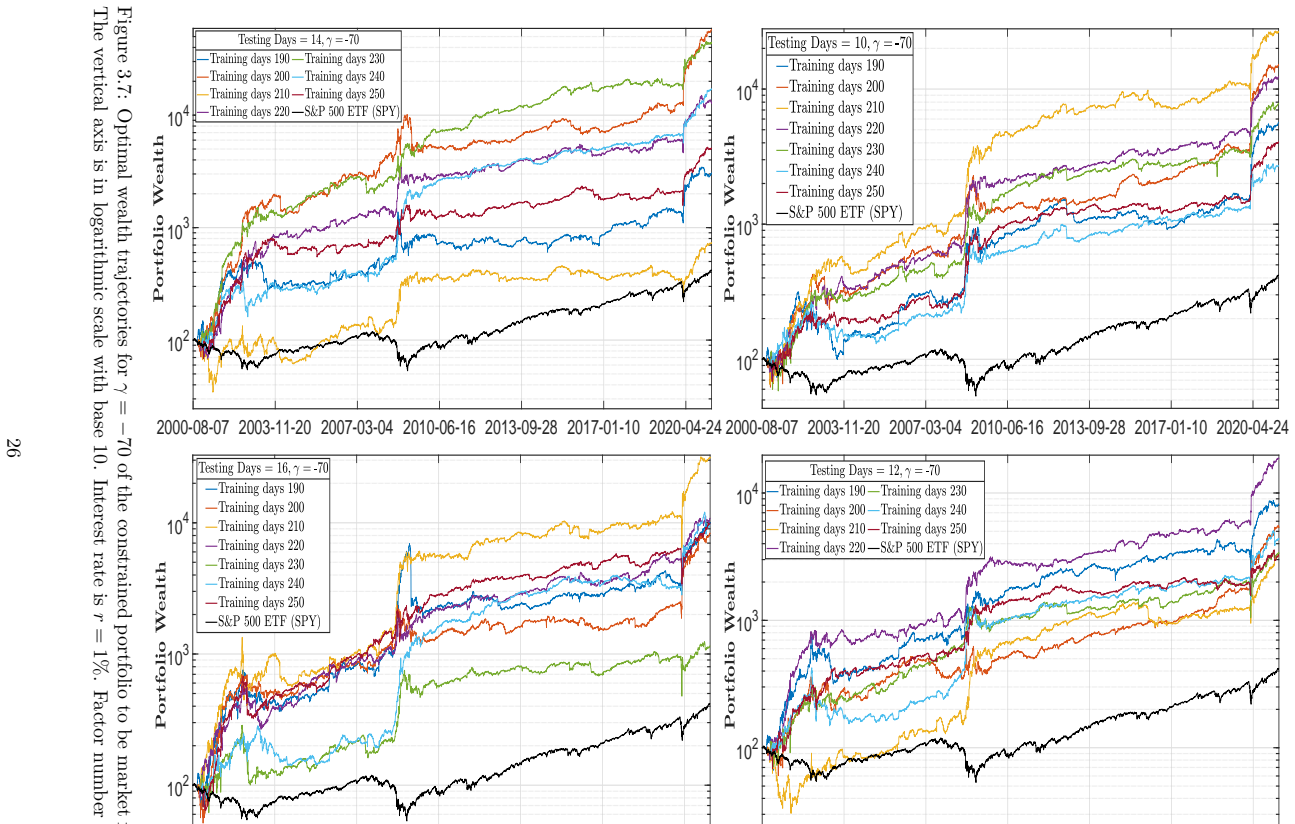
- Backtest results vary substantially with training and testing window lengths, which the authors read as sensitivity to parameter estimation.
- High-volatility periods, including 2000--2003, 2008, 2010--2012, and 2020, are where the strategies show their best relative performance against the ETF.
Reading between the lines
- A natural next step, not taken in the paper, is to test the constrained theorem's rank condition on each sliding-window estimate; if it fails often, the boundedness guarantee for market-neutral portfolios would not apply to real data.
- Because the stability proof relies mainly on $\gamma<0$ and on sign properties of diffusion matrices, the same Riccati-based argument could be carried over to other state dynamics, such as Ornstein-Uhlenbeck processes with stochastic volatility, provided the analogous coefficient matrices keep their signs.
- The backtests deliberately exclude transaction costs and liquidity constraints; adding a 5--10 basis point penalty, which the paper notes is feasible, would show whether the high-volatility outperformance survives realistic frictions.
- The paper's sensitivity finding implies that choosing window lengths and factor counts is itself a risk factor; an adaptive hyperparameter rule, rather than a fixed grid, is the implicit practical recommendation.
Signed reviews
Editorial analysis
A structured set of objections, weighed in public.
Referee Report
Summary. The paper develops optimal statistical arbitrage strategies for multiple co-integrated stocks whose spreads are driven by untradeable eigenportfolio factors. The authors derive HJB equations for both an unconstrained portfolio and a market-neutral constrained portfolio, reduce them via an exponential ansatz to a matrix Riccati ODE plus two linear ODEs, and claim long-term stability and absence of arbitrage for risk aversion gamma<0. They then present sliding-window backtests on S&P 500 constituents from 2000 to 2021, reporting that the strategies are sensitive to parameter estimation and more profitable in high-volatility periods.
Significance. If the theoretical claims were valid, the paper would provide a multivariate extension of Avellaneda-Lee co-integration trading with explicit optimal controls and sufficient conditions for long-term stable growth in both unconstrained and market-neutral settings. The unconstrained HJB reduction and the use of Wonham's theorem for the unconstrained Riccati equation are standard and mostly correct, and the empirical study is transparent about data cleaning, eigenportfolio construction, survivorship adjustment, and hyperparameter sensitivity. The paper also honestly acknowledges transaction costs, liquidity, and practical implementation issues. However, the constrained market-neutral stability theorem rests on an impossible rank condition, so the paper's central theoretical contribution for the constrained portfolio is not established as written.
major comments (3)
- [§2.4, Proposition 2.8 and Eq. (2.42)] The first full-rank condition in (2.42) is impossible for any m >= 1. Since beta(beta^T beta)^{-1} beta^T is the orthogonal projection onto the column space of beta, it has rank m, so I - beta(beta^T beta)^{-1} beta^T has rank d - m. Because delta is diagonal and invertible (delta_i > 0 by the OU stationarity assumption), rank((I - beta(beta^T beta)^{-1} beta^T) delta) = rank(I - beta(beta^T beta)^{-1} beta^T) = d - m. Hence rank(delta - beta(beta^T beta)^{-1} beta^T delta) = d requires m = 0, contradicting the factor model with m >= 1. Consequently Proposition 2.8 is vacuous, and the boundedness, observability, and convergence conclusions for the constrained Riccati equation are unproved for every nontrivial factor model. The necessary condition stated in Remark 2.7 is also inaccurate: non-commutation of the projection with delta does not change the rank of (I - P)delta.
- [§2.4, Proposition 2.9] The conclusion that R_c(t) has all positive eigenvalues because it is 'the summations and produces of positive semi-definite matrices' is not a valid inference. Products of positive semi-definite matrices are not generally symmetric positive semi-definite, and even when each term has nonnegative eigenvalues, the eigenvalues of a sum of non-normal matrices cannot be inferred from the eigenvalues of the summands. A separate argument is needed. Since this proposition underpins the finite steady state of b(t) and hence the constrained long-term growth claim, the constrained stability analysis is not established even if the issues with Proposition 2.8 were resolved.
- [§2.3, Proposition 2.4] A similar gap appears in the unconstrained analysis. The proof that R_u(t) has all positive eigenvalues relies on the assertion that the terms are sums and products of positive semi-definite matrices and on Lemma 2.1. This is not sufficient: -C(t) Q_u is a product of two positive semi-definite matrices and is not symmetric, and Lemma 2.1(a) concerns the field of values rather than eigenvalue positivity of a sum. Since Proposition 2.5 uses the finite steady state of b(t) to obtain the long-term growth rate, the unconstrained long-term stability claim also needs a corrected proof.
minor comments (3)
- [§2.4, Eq. (2.37)] The myopic control for the constrained portfolio is stated as pi_m^* = (1/(1-gamma))(Sigma_1^{-1} - Sigma_c)(mu + delta z). Substituting C = b = 0 into Eq. (2.36) gives the same expression with mu - delta z, matching the unconstrained myopic control in Eq. (2.21). The plus sign appears to be a typo; please correct it and verify which version was used in the backtests.
- [§2.4, Eq. (2.29)] In the wealth dynamics display, the risk-free contribution is written with an extra factor W_t after dividing by W_t; it should be r(1 - pi^T 1) dt, not r(1 - pi^T 1) W_t dt.
- [§2.4, Proof of Proposition 2.8] The proof contains notational slips: after defining A_c, the text refers to Gamma(A_u^T, E_u^T) and to (A_u^T, E_u^T) instead of A_c in the controllability/observability discussion. These should be corrected.
Circularity Check
No significant circularity: the paper's derivations are self-contained or externally supported; the flagged rank-condition issue is a correctness problem, not circularity.
full rationale
The derivation chain is not circular. Starting from the assumed SDEs (2.1)-(2.4), the HJB equation (2.11), the power-utility ansatz (2.12), the exponential ansatz (2.16), and the resulting ODE system (2.17)-(2.19) are all derived in the paper. The unconstrained Riccati stability proof uses Proposition 2.2 (Q_u positive definite, P_u negative definite) and Wonham's theorem (1968), an external mathematical result. The constrained case similarly derives its ODEs (2.38)-(2.40) and invokes Wonham's theorem with a stated rank condition; this is a mathematical hypothesis, not a renaming or fitting of the desired boundedness conclusion. The empirical claims about parameter sensitivity and high-volatility profitability come directly from the sliding-window backtests in Section 3, not from the model assumptions. The self-citations (Yeo and Papanicolaou 2017; Lee and Papanicolaou 2016) provide empirical context and a conceptual 'Nirvana' interpretation, but the central stability derivations do not reduce to those papers. Separate from circularity, there is a serious correctness concern: the first condition in (2.42) is algebraically impossible for m>0 when delta is invertible, since (I-P)delta has rank d-m with P=beta(beta^T beta)^{-1}beta^T a rank-m projection. This would make the constrained stability theorem vacuous as stated, but that is a mathematical error rather than a circular derivation.
Assumptions & free parameters
free parameters (7)
- risk aversion gamma =
-70 (backtests), -100 (Figures 3.4 and 3.5)
- number of factors m =
6
- number of stocks d =
<=15
- training window length =
190, 200, 210, 220, 230, 240, 250 days
- testing window length =
10, 12, 14, 16 days
- interest rate r =
0.01
- survivorship bias parameter alpha_b =
estimated via regression of principal eigenportfolio returns on SPY
assumptions (6)
- domain assumption Spreads Z_i follow stationary OU processes with delta_i > 0 (equation 2.4)
- domain assumption Diffusion matrix Sigma_1 is symmetric positive definite and invertible
- domain assumption gamma < 0 for all stability and no-arbitrage results
- ad hoc to paper Full-rank conditions (2.42) for constrained stability
- domain assumption Market neutrality is equivalent to pi^T beta = 0
- ad hoc to paper No transaction costs, leverage limits, or short-sale constraints in backtests
Cite this review
Pith. "Pith review of Statistical Arbitrage for Multiple Co-Integrated Stocks." pith.science (2026). https://pith.science/paper/QAZE5RQP
@misc{pith2026190802164,
  author       = {Pith},
  title        = {Pith review of: Statistical Arbitrage for Multiple Co-Integrated Stocks},
  year         = {2026},
  howpublished = {\url{https://pith.science/paper/QAZE5RQP}},
  note         = {Machine review of arXiv:1908.02164}
}
read the original abstract
In this article, we analyse optimal statistical arbitrage strategies from stochastic control and optimisation problems for multiple co-integrated stocks with eigenportfolios being factors. Optimal portfolio weights are found by solving a Hamilton-Jacobi-Bellman (HJB) partial differential equation, which we solve for both an unconstrained portfolio and a portfolio constrained to be market neutral. Our analyses demonstrate sufficient conditions on the model parameters to ensure long-term stability of the HJB solutions and stable growth rates for the optimal portfolios. To gauge how these optimal portfolios behave in practice, we perform backtests on historical stock prices of the S&P 500 constituents from year 2000 through year 2021. These backtests suggest three key conclusions: that the proposed co-integrated model with eigenportfolios being factors can generate a large number of co-integrated stocks over a long time horizon, that the optimal portfolios are sensitive to parameter estimation, and that the statistical arbitrage strategies are more profitable in periods when overall market volatilities are high.
Figures

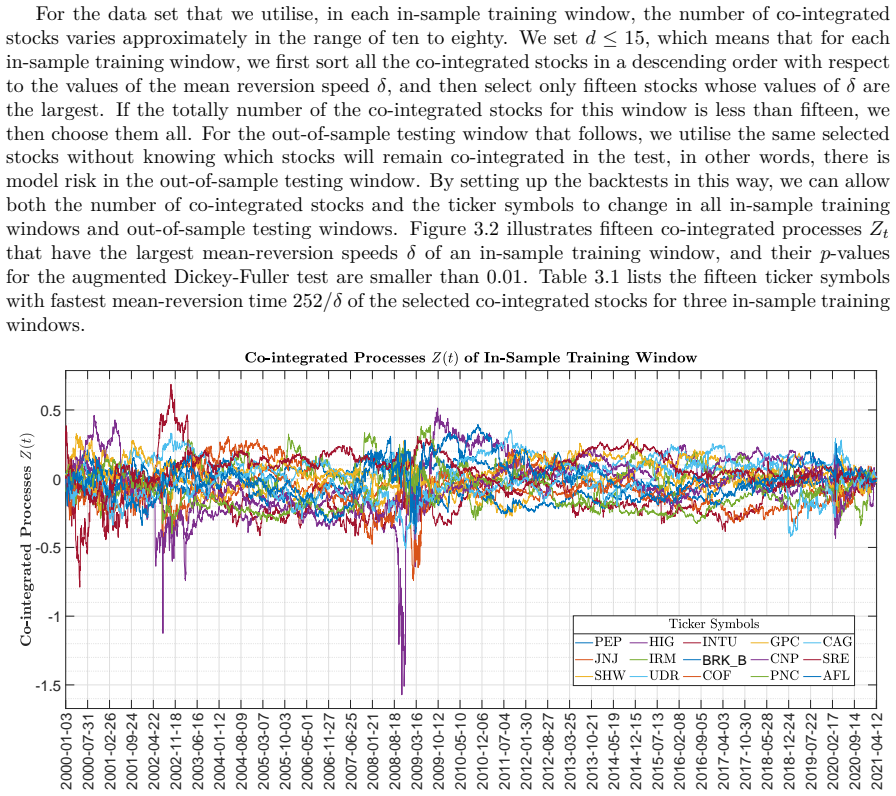
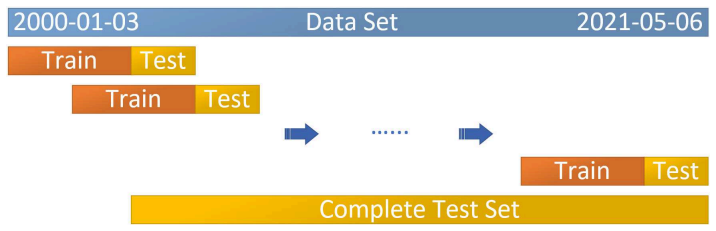
Figures from the paper (4 more)


Reference graph
Works this paper leans on
-
[1]
Outperformance and tracking: Dynamic asset allocation for active and passive portfolio management
Ali Al-Aradi and Sebastian Jaimungal. Outperformance and tracking: Dynamic asset allocation for active and passive portfolio management. Applied Mathematical Finance, 25 0 (3): 0 268--294, 2018. ISSN 1350-486X
work page 2018
-
[2]
Stochastic modeling and methods for portfolio management in cointegrated markets
Bahman Angoshtari. Stochastic modeling and methods for portfolio management in cointegrated markets. PhD thesis, University of Oxford, 2014
work page 2014
-
[3]
William F. Arnold and Alan J. Laub. A generalized eigenvalue approach for solving riccati equations. Proceedings of the IEEE, 72 0 (12): 0 1746--1754, 1984. ISSN 0018-9219
work page 1984
-
[4]
Statistical arbitrage in the US equities market
Marco Avellaneda and Jeong-Hyun Lee. Statistical arbitrage in the US equities market. Quantitative Finance, 10 0 (7): 0 761--782, August 2010. ISSN 1469-7688
work page 2010
-
[5]
Principal eigenportfolios for us equities
Marco Avellaneda, Brian Healy, Andrew Papanicolaou, George Papanicolaou, and Tony Xu. Principal eigenportfolios for us equities. Social Science Research Network, 2020. URL https://papers.ssrn.com/sol3/papers.cfm?abstract_id=3738769
work page 2020
-
[6]
Phelim P. Boyle. Positive weights on the efficient frontier. North American Actuarial Journal, 18 0 (4): 0 462--477, 2014. ISSN 1092-0277
work page 2014
-
[7]
Empirical investigation of an equity pairs trading strategy
Huafeng (Jason) Chen, Shaojun (Jenny) Chen, Zhuo Chen, and Feng Li. Empirical investigation of an equity pairs trading strategy. Management Science, Articles in Advance: 0 1--20, September 2017. ISSN 0025-1909
work page 2017
-
[8]
Optimal investment for an insurer with cointegrated assets: Crra utility
Mei Choi Chiu and Hoi Ying Wong. Optimal investment for an insurer with cointegrated assets: Crra utility. Insurance: Mathematics and Economics, 52 0 (1): 0 52--64, 2013
work page 2013
Show all 34 references
-
[9]
Risk-sensitive benchmarked asset management
Mark Davis and S\' e bastien Lleo. Risk-sensitive benchmarked asset management. Quantitative Finance, 8 0 (4): 0 415–426, June 2008. ISSN 1469-7688
2008
-
[10]
Mark H. A. Davis and S\' e bastien Lleo. Risk-sensitive investment management, volume 19 of Advanced Series on Statistical Science & Applied Probability. World Scientific Publishing, September 2014. ISBN 978-981-4578-03-5
2014
-
[11]
A generalized eigenvalue approach for solving riccati equations
Paul Van Dooren. A generalized eigenvalue approach for solving riccati equations. SIAM Journal on Scientific and Statistical Computing, 2 0 (2): 0 121–135, 1981. ISSN 0196-5204
1981
-
[12]
Elliott, John Van Der Hoek, and William P
Robert J. Elliott, John Van Der Hoek, and William P. Malcolm. Pairs trading. Quantitative Finance, 5 0 (5): 0 271--276, June 2005. ISSN 1469-7688
2005
-
[13]
Engle and C
Robert F. Engle and C. W. J. Granger. Co-integration and error correction representation estimation and testing. Econometrica, 55 0 (02): 0 251--276, 1987. ISSN 0012-9682
1987
-
[14]
Pairs trading strategy optimization using the reinforcement learning method: a cointegration approach
Saeid Fallahpour, Hasan Hakimian, Khalil Taheri, and Ehsan Ramezanifar. Pairs trading strategy optimization using the reinforcement learning method: a cointegration approach. Soft Computing, 20 0 (12): 0 5051--5066, December 2016. ISSN 1432-7643
2016
-
[15]
Fleming and Halil Mete Soner
Wendell H. Fleming and Halil Mete Soner. Controlled Markov processes and viscosity solutions, volume 25 of Stochastic modelling and applied probability. Springer-Verlag, 2nd edition, 2006. ISBN 978-0-387-26045-7
2006
-
[16]
Trading in the presence of co-integration
Alexander Galenko, Elmira Popova, and Ivilina Popova. Trading in the presence of co-integration. Journal of Alternative Investments, 15 0 (1): 0 85--97, 2012. ISSN 1520-3255
2012
-
[17]
Gatev, William N
Evan G. Gatev, William N. Goetzmann, and K. Geert Rouwenhorst. Pairs trading: performance of a relative average arbitrage rule. The Review of Financial Studies, 19 0 (3): 0 797--827, October 2006. ISSN 0893-9454
2006
-
[18]
Testing market efficiency using statistical arbitrage with applications to momentum and value strategies
Steve Hogan, Robert Jarrow, Melvyn Teo, and Mitch Warachka. Testing market efficiency using statistical arbitrage with applications to momentum and value strategies. Journal of Financial Economics, 73 0 (3): 0 525--565, 2004. ISSN 0304-405X
2004
-
[19]
Horn and Charles R
Roger A. Horn and Charles R. Johnson. Topics in Matrix Analysis. Cambridge University Press, New York, NY, 1994. ISBN 978-0-521-46713-1
1994
-
[20]
Khandani and Andrew W
Amir E. Khandani and Andrew W. Lo. What happened to the quants in august 2007? evidence from factors and transactions data. Journal of Financial Markets, 14 0 (1): 0 1--46, 2011. ISSN 1386-4181
2007
-
[21]
Kutoyants
Yury A. Kutoyants. Statistical Inference for Ergodic Diffusion Processes. Springer Series in Statistics. Springer-Verlag London, 2004. ISBN 978-1-85233-759-9
2004
-
[22]
Honey I shrunk the sample covariance matrix
Olivier Ledoit and Michael Wolf. Honey I shrunk the sample covariance matrix. The Journal of Portfolio Management, 30 0 (4): 0 110--119, July 2004. ISSN 0095-4918
2004
-
[23]
Pairs trading of two assets with uncertainty in co-integration's level of mean reversion
Sangmin Lee and Andrew Papanicolaou. Pairs trading of two assets with uncertainty in co-integration's level of mean reversion. International Journal of Theoretical and Applied Finance, 19 0 (8), November 2016. ISSN 0219-0249
2016
-
[24]
Costly arbitrage through pairs trading
Yaoting Lei and Jing Xu. Costly arbitrage through pairs trading. Journal of Economic Dynamics and Control, 56: 0 1--19, July 2015. ISSN 0165-1889
2015
-
[25]
Optimal mean reversion trading with transaction costs and stoploss exit
Tim Leung and Xin Li. Optimal mean reversion trading with transaction costs and stoploss exit. International Journal of Theoretical and Applied Finance, 18 0 (3), May 2015. ISSN 0219-0249
2015
-
[26]
Optimal pairs trading with time-varying volatility
Thomas Nanfeng Li and Agn\` e s Tourin. Optimal pairs trading with time-varying volatility. International Journal of Financial Engineering, 03 0 (02), 2016. ISSN 2424-7863
2016
-
[27]
Optimal investment and consumption under a continuous-time cointegration model with exponential utility
Guiyuan Ma and Song-Ping Zhu. Optimal investment and consumption under a continuous-time cointegration model with exponential utility. Quantitative Finance, 19 0 (7): 0 1135--1149, 2019. ISSN 1469-7688
2019
-
[28]
Primbs, and Wilfred Wong
Supakorn Mudchanatongsuk, James A. Primbs, and Wilfred Wong. Optimal pairs trading: a stochastic control approach. In Proceedings of 2008 American Control Conference. Institute of Electrical and Electronics Engineers, June 2008
2008
-
[29]
Stambaugh
Lubo s P\' a stor and Robert F. Stambaugh. Liquidity risk and expected stock returns. Journal of Political Economy, 111 0 (3): 0 642--685, 2003. ISSN 0022-3808
2003
-
[30]
Dynamic pairs trading using the stochastic control approach
Agn\` e s Tourin and Raphael Yan. Dynamic pairs trading using the stochastic control approach. Journal of Economic Dynamics and Control, 37 0 (10): 0 1947--2156, 2013. ISSN 0165-1889
1947
-
[31]
Pairs trading quantitative methods and analysis
Ganapathy Vidyamurthy. Pairs trading quantitative methods and analysis. Wiley Finance. John Wiley & Sons, Inc., Hoboken, New Jersey, U.S.A., August 2004. ISBN 978-0-471-46067-1
2004
-
[32]
On the eigenvalues of A + B and AB
Helmut Wielandt. On the eigenvalues of A + B and AB . Journal of Research of the National Bureau of Standards, Section B: Mathematical Sciences, 77B 0 (1 and 2): 0 61--72, January 1973. ISSN 0098-8979
1973
-
[33]
W. M. Wonham. On a matrix R iccati equation of stochastic control. SIAM Journal on Control, 6 0 (4): 0 681--697, 1968. ISSN 0036-1402
1968
-
[34]
Risk control of mean-reversion time in statistical arbitrage
Joongyeub Yeo and George Papanicolaou. Risk control of mean-reversion time in statistical arbitrage. Risk and Decision Analysis, 6 0 (4): 0 263--290, 2017. ISSN 1569-7371
2017
Reviewed August 14, 2026 · model on record in the stance chip above.
Discussion (0). Continue with ORCID to comment.