REVIEW 4 major objections 5 minor 74 references
Bayesian Network Based Label Correlation Analysis For Multi-label Classifier Chain
T0 review · 4 major / 5 minor · reviewed 2026-08-14 · deepseek-v4-flash
Pith's one-line read Bayesian-network label ordering, learned from conditional-entropy dependence, makes classifier chains competitive with or better than five established methods on most of 18 datasets at plain-chain cost.
desk verdict A legitimate incremental improvement to classifier-chain ordering, with a solid empirical section and one undisclosed hyperparameter; the 'new scoring function' is BIC in disguise. read the letter →
The pith
A machine-rendered reading of the paper's core claim, the machinery that carries it, and where it could break.
The reading
What carries the argument
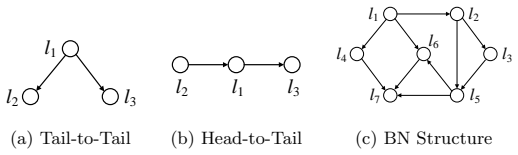
The load-bearing object is the dependence degree $I(l_k\to l_j)=1-H(l_j|l_k)$ — one minus the conditional entropy of label $l_j$ given label $l_k$ — used as the weight of every directed edge in a fully connected graph over labels. Around it the paper builds a scoring function $S_D(G)=N+\sum_{j=1}^{M}\sum_{q=1}^{Q_j}\sum_{y_j} N_{jq}^{(y_j)}\log(N_{jq}^{(y_j)}/N_{jq})-\sum_{j=1}^{M}(Q_j/2)\log N$, a cycle-breaking algorithm that deletes the lowest-weight edge in each cycle, a greedy parent-set learner capped at $\log N$ parents per node, and topological sorting to convert the learned DAG into the label order used by the chain.
What would settle it
Take a synthetic multi-label problem with a known ground-truth ordering, then add asymmetric label noise to the early-chain labels while keeping the training labels clean; if BNCC's learned order, based on clean training labels, loses to a fixed random order under that noise, the transfer-from-training-labels assumption fails. More directly, one can compute the chain's performance with the BNCC order versus a deliberately reversed order on any of the 18 datasets and check whether the gap matches the dependence degrees.
Extended reading notes
Core claim
The paper's central claim is that the label order of a classifier chain can be learned rather than guessed: the asymmetric degree to which one label reduces the conditional entropy of another is a sufficient signal for ordering the chain. BNCC first computes $I(l_k\to l_j)$ for every ordered pair of labels, builds a fully connected directed graph weighted by these degrees, iteratively removes the weakest edge in each cycle to obtain a DAG, learns optimal parent sets under a scoring function that combines the summed dependence degrees with a per-parameter complexity penalty, and finally runs topological sorting to produce the chain. The claim is that this procedure yields a chain whose extended features are informative enough to beat the random-order baseline and to match the much more expensive ensemble chain approach on most datasets.
Load-bearing premise
The BN and the label order are learned from dependencies among the true training labels, and the paper assumes that those same dependencies identify which labels will be useful as features when the chain must feed on its own predicted labels at test time.
Editorial extensions
If this is right
- On the 18 datasets, BNCC improves the three F-score metrics over the traditional random-order classifier chain on most datasets, while the Wilcoxon signed-rank tests mark it statistically different from BR, CLR, CC, GCC, and ECC on Fscore and MicF.
- BNCC does this without an ensemble: its training time sits between CC and ECC, and its testing time is on par with CC, so a learned order can substitute for the costly voting used by ensemble chains.
- Because the dependence degree uses all four joint configurations of two binary labels, the ordering exploits both positive correlations (co-occurrence and co-disappearance) and negative correlations (mutual exclusion), which co-occurrence-based methods ignore.
- The same machinery supplies a general way to turn any multi-label dataset's label statistics into a chain order, so the benefit should transfer to other base classifiers and other chain-based multi-label algorithms.
Reading between the lines
- The pair of assumptions — that dependencies estimated from true training labels transfer to test time, and that the chain's base classifier can exploit them — suggests a simple stress test: perturb early-chain labels or add label noise and check whether the learned order still beats random order.
- If the learned order is what matters, an even leaner variant could skip the Bayesian-network parent-set search and order labels by a greedy pairwise measure; comparing the two would isolate the value of the full BN structure.
- The dependency analysis could be applied to other multi-label models beyond classifier chains, such as encoder-decoder or autoregressive label predictors, where the same predecessor-feature pattern appears.
- A natural extension is to re-estimate dependence degrees using predicted labels instead of ground-truth labels during validation, which would directly address chain error propagation.
Signed reviews
Editorial analysis
A structured set of objections, weighed in public.
Referee Report
Summary. The paper proposes BNCC, a classifier-chain method that learns a label order from a Bayesian network built on conditional-entropy dependence degrees between labels. For each pair (lk, lj), the dependence is defined as I(lk→lj)=1−H(lj|lk) (Eq. 7). The method constructs a complete directed graph, repeatedly removes the minimum-weight edge in each cycle (Algorithm 1), topologically sorts the resulting DAG (Algorithm 2), greedily adds parents using a BIC-like score (Algorithm 3), refines the graph again, and uses the final topological order to train a chain of SVMs (Algorithm 4). Experiments on 18 multi-label datasets compare BNCC with BR, CLR, CC, GCC, and ECC on Hamming loss, instance F-score, macro F-score, and micro F-score, with Wilcoxon signed-rank tests and runtime comparisons. The paper reports that BNCC is competitive or better than the baselines on most datasets and improves over traditional CC with comparable complexity.
Significance. If the empirical results hold, BNCC offers a reasonable, low-overhead heuristic for ordering the labels in a classifier chain, and the experimental study is fairly extensive: 18 datasets, four metrics, statistical tests, and runtime tables. The paper also makes a useful move by using conditional entropy to capture both positive and negative label correlations. However, the claimed novelty is partially overstated: the scoring function in Eqs. (11)–(13) is algebraically identical to the standard BIC score, and the method is underspecified because the threshold n for maximum child nodes is never set. No code is provided, and the central ordering heuristic is justified only by empirical comparison. These issues make the current version unsuitable for publication without revision.
major comments (4)
- [Section 3.3, Algorithms 3–4] The threshold n for the maximum number of child nodes is an input to Algorithm 3 and Algorithm 4, but the paper never specifies its value or how it was chosen. Every experimental result in Table 4 depends on this parameter, so the method is not fully defined as presented. The authors should report the value used in the experiments and, ideally, a sensitivity analysis over n.
- [Section 3.2, Eqs. (11)–(13)] The proposed scoring function is not new: after substituting empirical frequencies, the first term in Eq. (12) is exactly the log-likelihood of the Bayesian network under the empirical distribution, and the second term in Eq. (13), (∑_j Q_j/2) log N, is the standard BIC penalty. Thus maximizing S_D(G) is equivalent to maximizing BIC up to the constant N. The claim of a 'new scoring function' should be revised. In addition, the expression in Eq. (12) is undefined when a parent configuration has zero count (N_jq=0); the paper does not specify any smoothing or zero-count handling, which is a practical concern for sparse multi-label data.
- [Section 3.4, Algorithm 4] The label order is learned from conditional entropies of the true training labels, but at test time the classifier chain uses predicted predecessor labels h_k(x), not the true y_k. The paper provides no argument or experiment showing that an order optimal for true-label conditioning remains effective when the chain is fed with noisy predictions. Since this transfer is the load-bearing premise of the whole method, the authors should address error propagation explicitly, for example by comparing against an order derived from cross-validated predicted labels, or by discussing when the true-label order may fail.
- [Section 3.3, Algorithms 1–2] The initial label order is produced by a heuristic cycle-breaking rule (removing the edge with minimum dependence degree in each cycle) followed by topological sorting with unspecified tie-breaking. There is no guarantee or analysis that this order is a good starting point for the greedy parent search of Algorithm 3, and the final result may depend on arbitrary choices among nodes with in-degree zero. The paper should at least report whether different initial orders lead to substantially different final structures, and should specify the tie-breaking rule used in the experiments.
minor comments (5)
- [Section 3.1, Eq. (8)] In the displayed formula for H(lj|L*), the logarithm argument uses 'p(yk)' but should be p(L*) (or the appropriate joint/marginal probability); this makes the equation notationally incorrect as written.
- [Table 4] The arrow symbol '↗' appears inline within numeric entries, making the table hard to parse. The note says it indicates BNCC is better than CC, but the placement relative to the values is confusing; consider a separate marker column or footnote.
- [Section 4.3] The experimental setup says σ is tuned for 'each data set' but does not clarify whether σ is tuned separately for each compared method or only once and then shared. This should be stated explicitly, because it affects the fairness of the comparison.
- [Section 3.3, line 'It is known from literature'] The statement that in the optimal BN each label has at most log N parents is not generally true for BIC-optimal structures and is given without a citation. If this bound is used as a heuristic to limit search, it should be described as such.
- [References] Several references contain typos, e.g., [45] 'Machien Learning', [42] and [69] 'Transactins', and [73] 'Transactins'. These should be corrected.
Circularity Check
No significant circularity: label-order learning is a supervised selection on training labels, and the CC is evaluated on held-out labels.
full rationale
The claimed derivation chain is: (i) Eq. (7) defines I(lk→lj) = 1 − H(lj|lk) from empirical label distributions; (ii) Algorithms 1–3 use these dependence degrees to break cycles and to optimize the structure-dependent score SD(G) (Eq. 13), which is itself a function of the same conditional-entropy terms; (iii) Algorithm 2 topologically sorts the resulting DAG to obtain a label order; (iv) CC classifiers h1..hM are trained in that order and evaluated on held-out instances (Section 4). Every fitted quantity (dependence degrees, parent sets, label order) is estimated from training labels only, and the reported HammingLoss and F-scores are computed on test folds. There is no equation in which an evaluation metric is defined in terms of I, nor any step in which the label order is derived from the CC outputs themselves. The concern that test-time CC uses predicted predecessor labels while the order is computed from true training labels is a genuine generalization assumption about error propagation, but it is not a reduction of the prediction to the input by construction. Self-citations ([4]–[8], [17]–[36], [55]–[58], [60]–[64]) are standard references or future-work pointers and do not supply the label-order criterion. The unspecified child-node threshold n in Algorithms 3–4 is a reproducibility gap, not a circularity. Therefore, no circular step is established.
Assumptions & free parameters
free parameters (3)
- Maximum number of child nodes n =
not stated
- Maximum number of parents log N =
log N (with N training instances)
- SVM kernel width sigma =
tuned per dataset from {2^-3 ... 2^9}
assumptions (5)
- standard math The BN factorization p(y) = prod_j p(y_j | Pa(y_j)) holds for the learned DAG.
- domain assumption Empirical frequencies from the training set are reliable estimates of label probabilities.
- domain assumption The optimal CC order can be found by maximizing the likelihood-based BN score.
- ad hoc to paper Removing the edge with minimum dependence degree in a cycle preserves the most informative DAG.
- domain assumption The bound |Pa(lj)| <= log N is appropriate.
Cite this review
Pith. "Pith review of Bayesian Network Based Label Correlation Analysis For Multi-label Classifier Chain." pith.science (2026). https://pith.science/paper/WULWZ2WA
@misc{pith2026190802172,
  author       = {Pith},
  title        = {Pith review of: Bayesian Network Based Label Correlation Analysis For Multi-label Classifier Chain},
  year         = {2026},
  howpublished = {\url{https://pith.science/paper/WULWZ2WA}},
  note         = {Machine review of arXiv:1908.02172}
}
read the original abstract
Classifier chain (CC) is a multi-label learning approach that constructs a sequence of binary classifiers according to a label order. Each classifier in the sequence is responsible for predicting the relevance of one label. When training the classifier for a label, proceeding labels will be taken as extended features. If the extended features are highly correlated to the label, the performance will be improved, otherwise, the performance will not be influenced or even degraded. How to discover label correlation and determine the label order is critical for CC approach. This paper employs Bayesian network (BN) to model the label correlations and proposes a new BN-based CC method (BNCC). First, conditional entropy is used to describe the dependency relations among labels. Then, a BN is built up by taking nodes as labels and weights of edges as their dependency relations. A new scoring function is proposed to evaluate a BN structure, and a heuristic algorithm is introduced to optimize the BN. At last, by applying topological sorting on the nodes of the optimized BN, the label order for constructing CC model is derived. Experimental comparisons demonstrate the feasibility and effectiveness of the proposed method.
Figures

Figures from the paper (3 more)


Reference graph
Works this paper leans on
-
[47]
L. E. Sucar, C. Bielza, E. F. Morales, P. Hernandez-Leal, J. H. Zaragoza, and P. Larranaga. Multi-label classification with bayesian network-based chain classifiers. Pattern Recognition, 41:14–22, 2014. 24
work page 2014
-
[54]
G. Varando, C. Bielza, and P. Larranaga. Decision functions for chain classifiers based on bayesian networks for multi-label classification. International Journal of Approximate Reason- ing, 68:164–178, 2016
work page 2016
-
[1]
M. T. Amin, F. Khan, and S. Imtiaz. Fault detection and pathway analysis us- ing a dynamic bayesian network. Chemical Engineering Science , in oress, DOI: https://doi.org/10.1016/j.ces.2018.10.024, 2018
-
[2]
R. R. Bouckaert. Probabilistic network construction using the minimum description length principle. In Technical Report RUU-CS-94-27, Utrecht University, Netherlands. 1994
work page 1994
-
[3]
M. R. Boutella, J. Luo, X. Shen, and C. M. Brown. Learning multi-label scene classification. Pattern Recognition, 37(9):1757–1771, 2004
work page 2004
-
[4]
A weighted voting method using minimum square error based on extreme learning machine
Jingjing Cao, Sam Kwong, Ran Wang, and Ke Li. A weighted voting method using minimum square error based on extreme learning machine. InICMLC’12: Proc. of the 2012 International Conference on Machine Learning and Cybernetics , pages 411–414, 2012
work page 2012
-
[5]
Jingjing Cao, Sam Kwong, Ran Wang, and Ke Li. AN indicator-based selection multi-objective evolutionary algorithm with preference for multi-class ensemble. In ICMLC’14: Proc. of the 2014 International Conference on Machine Learning and Cybernetics , pages 147–152, 2014. 21
work page 2014
-
[6]
Class-specific soft voting based multiple extreme learning machines ensemble
Jingjing Cao, Sam Kwong, Ran Wang, Xiaodong Li, Ke Li, and Xiangfei Kong. Class-specific soft voting based multiple extreme learning machines ensemble. Neurocomputing, 149:275–284, 2015
work page 2015
Show all 74 references
-
[7]
Dynamic multiobjectives optimization with a changing number of objectives
Renzhi Chen, Ke Li, and Xin Yao. Dynamic multiobjectives optimization with a changing number of objectives. IEEE Trans. Evolutionary Computation , 22(1):157–171, 2018
2018
-
[8]
FEMOSAA: feature-guided and knee-driven multi-objective optimization for self-adaptive software
Tao Chen, Ke Li, Rami Bahsoon, and Xin Yao. FEMOSAA: feature-guided and knee-driven multi-objective optimization for self-adaptive software. ACM Trans. Softw. Eng. Methodol. , 27(2):5:1–5:50, 2018
2018
-
[9]
G. F. Cooper and E. Herskovits. A bayesian method for the induction of probabilistic networks from data. Machine Learning, 9(4):309–347, 1992
1992
-
[10]
Drury, J
B. Drury, J. Valverde-Rebaza, M.-F. Moura, and A. de A. Lopes. A survey of the applications of bayesian networks in agriculture. Engineering Applications of Artificial Intelligence , 65:29– 42, 2017
2017
-
[11]
F¨ urnkranz, E
J. F¨ urnkranz, E. H¨ ullermeier, E. Loza Menc´ ıa, and K. Brinker. Multilabel classification via calibrated label ranking. Machine Learning, 73(2):133–153, 2008
2008
-
[12]
Guo and S
Y. Guo and S. Gu. Multi-label classification using conditional dependency networks. In 22nd IJCAI, pages 1300–1305, 2011
2011
-
[13]
Guo and D
Y. Guo and D. Schuurmans. Adaptive large margin training for multilabel classification. In 25th AAAI Conference on Artificial Intelligence , pages 374–379, 2011
2011
-
[14]
Huang, G
J. Huang, G. Li, S. Wang, W. Zhang, and Q. Huang. Group sensitive classifier chains for multi-label classification. In IEEE International Conference on Multimedia & Expo , pages 1–6, 2015
2015
-
[15]
Huang and Z.-H
S.-J. Huang and Z.-H. Zhou. Multi-label learning by exploiting label correlations locally. In Proceedings. 26th AAAI Conference on Artificial Intelligence , pages 949–955, 2012
2012
-
[16]
A. B. Kahn. Topological sorting of large networks. Communications of the ACM , 5(11):558– 562, 1962
1962
-
[17]
Two-archive evolutionary algorithm for constrained multiobjective optimization
Ke Li, Renzhi Chen, Guangtao Fu, and Xin Yao. Two-archive evolutionary algorithm for constrained multiobjective optimization. IEEE Trans. Evolutionary Computation , 23(2):303– 315, 2019
2019
-
[18]
Integration of preferences in decomposition multiobjective optimization
Ke Li, Renzhi Chen, Geyong Min, and Xin Yao. Integration of preferences in decomposition multiobjective optimization. IEEE Trans. Cybernetics, 48(12):3359–3370, 2018
2018
-
[19]
Savic, and Xin Yao
Ke Li, Renzhi Chen, Dragan A. Savic, and Xin Yao. Interactive decomposition multiobjective optimization via progressively learned value functions. IEEE Trans. Fuzzy Systems, 27(5):849– 860, 2019
2019
-
[20]
Empirical investigations of refer- ence point based methods when facing a massively large number of objectives: First results
Ke Li, Kalyanmoy Deb, Okkes Tolga Altin¨ oz, and Xin Yao. Empirical investigations of refer- ence point based methods when facing a massively large number of objectives: First results. In EMO’17: Proc. of the 9th International Conference Evolutionary Multi-Criterion Optimiza- ...
2017
-
[21]
R-metric: Evaluating the performance of preference- based evolutionary multiobjective optimization using reference points
Ke Li, Kalyanmoy Deb, and Xin Yao. R-metric: Evaluating the performance of preference- based evolutionary multiobjective optimization using reference points. IEEE Trans. Evolu- tionary Computation, 22(6):821–835, 2018
2018
-
[22]
Evolutionary multiobjective optimization with hybrid selection principles
Ke Li, Kalyanmoy Deb, and Qingfu Zhang. Evolutionary multiobjective optimization with hybrid selection principles. In CEC’15: Proc. of the 2015 IEEE Congress on Evolutionary Computation, pages 900–907, 2015
2015
-
[23]
An evolutionary many-objective optimization algorithm based on dominance and decomposition
Ke Li, Kalyanmoy Deb, Qingfu Zhang, and Sam Kwong. An evolutionary many-objective optimization algorithm based on dominance and decomposition. IEEE Trans. Evolutionary Computation, 19(5):694–716, 2015
2015
-
[24]
Efficient nondomination level update method for steady-state evolutionary multiobjective optimization
Ke Li, Kalyanmoy Deb, Qingfu Zhang, and Qiang Zhang. Efficient nondomination level update method for steady-state evolutionary multiobjective optimization. IEEE Trans. Cybernetics, 47(9):2838–2849, 2017
2017
-
[25]
Multi-objective differential evolution with adaptive control of parameters and operators
Ke Li, ´Alvaro Fialho, and Sam Kwong. Multi-objective differential evolution with adaptive control of parameters and operators. In LION5: Proc. of the 5th International Conference on Learning and Intelligent Optimization , pages 473–487, 2011
2011
-
[26]
Adaptive operator selection with bandits for a multiobjective evolutionary algorithm based on decomposition
Ke Li, ´Alvaro Fialho, Sam Kwong, and Qingfu Zhang. Adaptive operator selection with bandits for a multiobjective evolutionary algorithm based on decomposition. IEEE Trans. Evolutionary Computation, 18(1):114–130, 2014
2014
-
[27]
A general framework for evolutionary multiobjective optimization via manifold learning
Ke Li and Sam Kwong. A general framework for evolutionary multiobjective optimization via manifold learning. Neurocomputing, 146:65–74, 2014
2014
-
[28]
Achieving balance between proximity and diversity in multi-objective evolutionary algorithm
Ke Li, Sam Kwong, Jingjing Cao, Miqing Li, Jinhua Zheng, and Ruimin Shen. Achieving balance between proximity and diversity in multi-objective evolutionary algorithm. Inf. Sci., 182(1):220–242, 2012
2012
-
[29]
A dual-population paradigm for evolutionary mul- tiobjective optimization
Ke Li, Sam Kwong, and Kalyanmoy Deb. A dual-population paradigm for evolutionary mul- tiobjective optimization. Inf. Sci., 309:50–72, 2015
2015
-
[30]
JGBL paradigm: a novel strategy to enhance the ex- ploration ability of nsga-ii
Ke Li, Sam Kwong, and Kim-Fung Man. JGBL paradigm: a novel strategy to enhance the ex- ploration ability of nsga-ii. In GECCO’11: Proc. of the 13th Annual Genetic and Evolutionary Computation Conference, pages 99–100, 2011
2011
-
[31]
Ke Li, Sam Kwong, Ran Wang, Jingjing Cao, and Imre J. Rudas. Multi-objective differential evolution with self-navigation. In SMC’12: Proc. of the 2012 IEEE International Conference on Systems, Man, and Cybernetics , pages 508–513, 2012
2012
-
[32]
Learning paradigm based on jumping genes: A general framework for enhancing exploration in evolutionary multiobjec- tive optimization
Ke Li, Sam Kwong, Ran Wang, Kit-Sang Tang, and Kim-Fung Man. Learning paradigm based on jumping genes: A general framework for enhancing exploration in evolutionary multiobjec- tive optimization. Inf. Sci., 226:1–22, 2013
2013
-
[33]
Interrelationship-based selection for decomposition multiobjective optimization
Ke Li, Sam Kwong, Qingfu Zhang, and Kalyanmoy Deb. Interrelationship-based selection for decomposition multiobjective optimization. IEEE Trans. Cybernetics, 45(10):2076–2088, 2015. 23
2015
-
[34]
Variable interaction in multi- objective optimization problems
Ke Li, Mohammad Nabi Omidvar, Kalyanmoy Deb, and Xin Yao. Variable interaction in multi- objective optimization problems. In PPSN’16: Proc. of the 14th International Conference Parallel Problem Solving from Nature , pages 399–409, 2016
2016
-
[35]
Evolving extreme learning machine paradigm with adaptive operator selection and parameter control
Ke Li, Ran Wang, Sam Kwong, and Jingjing Cao. Evolving extreme learning machine paradigm with adaptive operator selection and parameter control. International Journal of Uncertainty, Fuzziness and Knowledge-Based Systems , 21:143–154, 2013
2013
-
[36]
Stable matching-based se- lection in evolutionary multiobjective optimization
Ke Li, Qingfu Zhang, Sam Kwong, Miqing Li, and Ran Wang. Stable matching-based se- lection in evolutionary multiobjective optimization. IEEE Trans. Evolutionary Computation , 18(6):909–923, 2014
2014
-
[37]
Y. Li, H. Chen, J. Zheng, and A. Ngom. The max-min high-order dynamic bayesian network for learning gene regulatory networks with time-delayed regulations. IEEE/ACM Transactions on Computational Biology and Bioinformatics , 13(4):792–803, 2016
2016
-
[38]
Madjarov, D
G. Madjarov, D. Kocev, D. Gjorgjevikj, and S. Dˇ zeroski. An extensive experimental compar- ison of methods for multi-label learning. Pattern Recognition, 45:3084–3104, 2012
2012
-
[39]
J. M. Moyano, E. L. Gibaja, K. J. Cios, and S. Ventura. Review of ensembles of multi-label classifiers: Models, experimental study and prospects. Information Fusion, 44:33–45, 2018
2018
-
[40]
Naili, M
M. Naili, M. Bourahla, M. Naili, and A. Tari. Stability-based dynamic bayesian network method for dynamic data. Engineering Applications of Artificial Intelligence , 77:283–310, 2019
2019
-
[41]
J. Pearl. Probabilistic reasoning in intelligent systems. Artificial Intelligence, 48(1):117–124, 1991
1991
-
[42]
G. J. Qi, X. S. Hua, Y. Rui, J. Tang, and H. J. Zhang. Two-dimensional multilabel active learning with an efficient online adaptation model for image classification. IEEE Transactins on Pattern Analysis & Machine Intelligence , 31(10):1880–1897, 2009
2009
-
[43]
J. Read, L. Martino, and D. Luengo. Efficient monte carlo optimization for multi-label classifier chains. In IEEE International Conference on Acoustics , pages 3457–3461, 2013
2013
-
[44]
J. Read, B. Pfahringer, G. Holmes, and E. Frank. Classifier chains for multi-label classifica- tion. In 2009 Joint European Conference on Machine Learning and Knowledge Discovery in Databases, pages 254–269, 2009
2009
-
[45]
J. Read, B. Pfahringer, G. Holmes, and E. Frank. Classifier chains for multi-label classification. Machien Learning, 85(3):333–359, 2011
2011
-
[46]
Rokach, A
L. Rokach, A. Schclar, and E. Itach. Ensemble methods for multi-label classification. Expert Systems with Applications , 41:7507–7523, 2014
2014
-
[48]
F. Sun, J. Tang, H. Li, G. Qi, and T. S. Huang. Multilabel image categorization with sparse factor representation. IEEE Transactions on Image Processing , 23(3):1028–1037, 2014
2014
-
[49]
Tamada, S
Y. Tamada, S. Imoto, H. Araki, M. Nagasaki, C. Print, D. S. Charnock-Jones, and S. Miyano. Estimating genome-wide gene networks using nonparametric bayesian network models on mas- sively parallel computers. IEEE/ACM Transactions on Computational Biology and Bioinfor- matics, 8...
2011
-
[50]
D. Tao, X. Li, and S. Maybank. Multilabel image categorization with sparse factor represen- tation. IEEE Transactions on Knowledge and Data Engineering , 19(4):568–580, 2007
2007
-
[51]
Trohidis, G
K. Trohidis, G. Tsoumakas, G. Kalliris, and I. Vlahavas. Multilabel classification of music into emotions. In Proc. of the International Conference on Music Information Retrieval , pages 325–330, 2008
2008
-
[52]
Ueda and K
N. Ueda and K. Saito. Parametric mixture for multi-labeled text. In NIPS, pages 721–728, 2003
2003
-
[53]
V. N. Vapnik. The nature of statistical learning theory . Springer Verlag, 2000
2000
-
[55]
Wang, C.-Y
R. Wang, C.-Y. Chow, and S. Kwong. Ambiguity based multiclass active learning. IEEE Transactions on Fuzzy Systems, 24(1):242–248, 2016
2016
-
[56]
R. Wang, S. Kwong, and D. Chen. Inconsistency-based active learning for support vector machines. Pattern Recognition, 45(10):3751–3767, 2012
2012
-
[57]
R. Wang, S. Kwong, D. Chen, and J. Cao. A vector-valued support vector machine model for multiclass problem. Information Sciences, 235:174–194, 2013
2013
-
[58]
Wang, X.-Z
R. Wang, X.-Z. Wang, S. Kwong, and C. Xu. Incorporating diversity and informativeness in multiple-instance active learning. IEEE Transactions on Fuzzy Systems , 25(6):1460–1475, 2018
2018
-
[59]
J. Wu, C. Ye, V. S. Sheng, J. Zhang, P. Zhao, and Z. Cui. Active learning with label correlation exploration for multi-label image classification. IET Computer Vision , 11(7):577–584, 2017
2017
-
[60]
Adaptive weights genera- tion for decomposition-based multi-objective optimization using gaussian process regression
Mengyuan Wu, Sam Kwong, Yuheng Jia, Ke Li, and Qingfu Zhang. Adaptive weights genera- tion for decomposition-based multi-objective optimization using gaussian process regression. In Proceedings of the Genetic and Evolutionary Computation Conference, GECCO 2017, Berlin, Germany...
2017
-
[61]
Two-level stable matching-based selection in MOEA/D
Mengyuan Wu, Sam Kwong, Qingfu Zhang, Ke Li, Ran Wang, and Bo Liu. Two-level stable matching-based selection in MOEA/D. In SMC’15: Proc. of the 2015 IEEE International Conference on Systems, Man, and Cybernetics , pages 1720–1725, 2015. 25
2015
-
[62]
Evolutionary many-objective opti- mization based on adversarial decomposition
Mengyuan Wu, Ke Li, Sam Kwong, and Qingfu Zhang. Evolutionary many-objective opti- mization based on adversarial decomposition. IEEE Trans. Cybernetics , 2018. accepted for publication
2018
-
[63]
Learning to decompose: A paradigm for decomposition-based multiobjective optimization
Mengyuan Wu, Ke Li, Sam Kwong, Qingfu Zhang, and Jun Zhang. Learning to decompose: A paradigm for decomposition-based multiobjective optimization. IEEE Trans. Evolutionary Computation, 23(3):376–390, 2019
2019
-
[64]
Matching-based selection with incomplete lists for decomposition multiobjective optimization.IEEE Trans
Mengyuan Wu, Ke Li, Sam Kwong, Yu Zhou, and Qingfu Zhang. Matching-based selection with incomplete lists for decomposition multiobjective optimization.IEEE Trans. Evolutionary Computation, 21(4):554–568, 2017
2017
-
[65]
B. Yang, J. T. Sun, T. Wang, and Z. Chen. Effective multi-label active learning for text clas- sification. In Proceedings. ACM SIGKDD International Conference on Knowledge Discovery & Data Mining , pages 917–926, 2009
2009
-
[66]
K. Yu, S. Yu, and V. Tresp. Multi-label informed latent semantic indexing. In SIGIR, pages 258–265, 2005
2005
-
[67]
Z. Yu, Q. Wang, Y. Fan, H. Dai, and M. Qiu. An improved classifier chain algorithm for multi- label classification of big data analysis. In Proc. of the IEEE 17th International Conference on High Performance Computing and Communications , pages 1928–1301, 2015
1928
-
[68]
Zarei, V
E. Zarei, V. Khakzad, N. amd Cozzani, and G. Reniers. Safety analysis of process systems using fuzzy bayesian network (FBN). Journal of Loss Prevention in the Process Industries , 57:7–16, 2019
2019
-
[69]
Zhang, Y
B. Zhang, Y. Wang, and F. Chen. Multilabel image classification via high-order label correla- tion driven active learning. IEEE Transactins on image processing , 23(3):1430–1441, 2014
2014
-
[70]
Zhang, Y
B. Zhang, Y. Wang, and W. Wang. Batch mode active learning for multi-label image clas- sification with informative label correlation mining. In Proceedings. IEEE Workshop on the Applications of Computer Vision , pages 401–407, 2012
2012
-
[71]
Zhang and Z.-H
M.-L. Zhang and Z.-H. Zhou. Multilabel neural networks with applications to functional genomics and text categorization. IEEE Transactions on Knowledge and Data Engineering , 18(10):1338–1351, 2006
2006
-
[72]
Zhang and Z.-H
M.-L. Zhang and Z.-H. Zhou. ML-kNN: A lazy learning approach to multi-label learning. Pattern Recognition, 40(7):2038–2048, 2007
2007
-
[73]
Zhang and Z.-H
M.-L. Zhang and Z.-H. Zhou. A review on multi-label learning algorithms. IEEE Transactins on Knowledge and Data Engineering , 26(8):1819–1837, 2014
2014
-
[74]
Zhou and M.-L
Z.-H. Zhou and M.-L. Zhang. Multi-instance multi-label learning with application to scene classification. In Advances in Neural Information Processing Systems , pages 1609–1616, 2007. 26 (a) HammingLoss (b) Fscore (c) MacF (d) MicF Figure 6: Sensitivity of SVM parameters regard...
2007
Reviewed August 14, 2026 · model on record in the stance chip above.
Discussion (0). Continue with ORCID to comment.