REVIEW 3 major objections 3 minor 36 references
Invariant-mass distribution of top-quark pairs and top-quark mass determination
T0 review · 3 major / 3 minor · reviewed 2026-08-14 · deepseek-v4-flash
Pith's one-line read Resumming Coulomb and soft gluon exchanges near the top-pair threshold raises the NNLO differential cross section by about 9% and shifts the fitted top-quark mass by about 1.5 GeV toward the world average.
desk verdict Worth a serious referee: a genuinely new NLP threshold resummation for the ttbar invariant-mass spectrum, with real validation, but the unpublished hard functions and the asserted no-soft-function form need to be addressed. read the letter →
The pith
A machine-rendered reading of the paper's core claim, the machinery that carries it, and where it could break.
The reading
What carries the argument
The load-bearing object is the pNRQCD-based factorization formula $d\hat\sigma_{\rm NLP}\sim H\times J$ near threshold. The hard functions $H_{ij,\alpha}$ are Wilson coefficients of the effective theory describing exchanges and emissions of gluons with momenta of order $M_{t\bar t}$, evaluated at NLO with full kinematic dependence so that the fixed-order matching is consistent with $H_T$-dependent scales. The potential functions $J_\alpha(E)$ are related to the imaginary part of the pNRQCD Green function of the $t\bar t$ pair at the origin and encode all potential, soft, and ultrasoft interactions; the top-quark width enters through the replacement $E\to E+i\Gamma_t$. The mode separation of Eq. (5), into hard, potential, soft, and ultrasoft momentum regions, is what lets the small-$\beta$ singularities be identified and resummed, and the claimed absence of collinear modes and of a soft function at NLP is what fixes the simple $H\times J$ form.
What would settle it
Compute the complete N3LO fixed-order differential cross section in the 300–380 GeV bin and compare it with the claimed $\sim$9% enhancement; if the full third-order correction is much smaller, then the NLP resummation overestimates the missing contribution. Alternatively, repeat the kinematic top-mass fit using the NNLO+NLP prediction with the full experimental covariance of the measured distribution; if the fitted mass moves below the NLO-based value rather than up toward the world average, the claimed shift is refuted.
Extended reading notes
Core claim
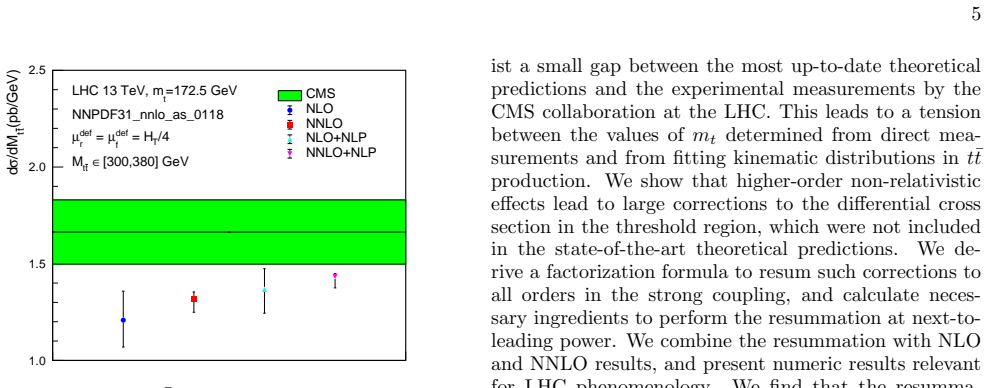
The central discovery is that previously missing non-relativistic higher-order corrections constitute the dominant missing contribution in the threshold region. The paper derives a next-to-leading-power factorization $d\hat\sigma_{\rm NLP}\sim \sum_\alpha c_{ij,\alpha}\,H_{ij,\alpha}\,J_\alpha$, in which the hard function $H$ contains all hard gluon exchanges and emissions, with explicit dependence on $z$, $M_{t\bar t}$, $Q_T$, $Y$, and the renormalization and factorization scales, and the potential function $J_\alpha(E)$ with $E=M_{t\bar t}-2m_t$ resums Coulomb, soft, and ultrasoft exchanges between the slowly moving top and antitop. At this order the formula has no collinear modes and no soft function. Matching the resummed expression to NLO and NNLO results, the paper finds the threshold cross section is enhanced by about 9% in the 300–380 GeV window, making its central prediction $1.434\,\text{pb/GeV}$ compared with the NNLO value $1.319\,\text{pb/GeV}$ and a measured value near $1.664\,\text{pb/GeV}$; it estimates that the corresponding top-mass shift would be about $+1.5\,\text{GeV}$.
Load-bearing premise
The calculation hinges on the mode separation of Eq. (5) being complete at next-to-leading power: all hard radiation must be fully absorbed into $H$, all pair interactions into $J$, and no initial-state ultrasoft interactions may contribute at this order; if any omitted mode contributes, the resummed correction is misassigned and the 1.5 GeV shift would not follow.
Editorial extensions
If this is right
- Near $M_{t\bar t}=2m_t$, the resummed result stays finite where fixed-order expansions diverge: the n3LO curve goes to $+\infty$ and the n4LO curve to $-\infty$ as $\beta\to 0$.
- The integrated cross section in the 300–380 GeV bin is insensitive to the top-quark width, even though the shape below $2m_t$ depends on it.
- Using the NNLO+NLP prediction in the mass fit shifts $m_t$ by about $+1.5\,\text{GeV}$ relative to NLO-based fits, moving the kinematic value toward the direct-measurement world average.
- The factorization can be combined with existing NNLL$'$ soft-gluon resummation and electroweak corrections to produce a precision prediction across the full phase space.
- The same formalism extends to top-quark-pair-plus-jet production, another channel used for top-mass extraction.
Reading between the lines
- If the 9% enhancement is correct, analogous threshold resummations should improve other heavy-quark observables whose fixed-order predictions fall short of measured rates, and the same shift mechanism would appear in those fits.
- The claim that no soft function exists at next-to-leading power is a power-counting statement; computing the first contribution from initial-state ultrasoft exchange would show whether the enhancement is stable or receives a large correction at the next order.
- A direct test is to extend the factorization to the normalized $M_{t\bar t}$ distribution, where scale and PDF uncertainties partially cancel; the predicted 1.5 GeV shift should become sharper and can be compared with a future higher-statistics measurement.
Editorial analysis
A structured set of objections, weighed in public.
Referee Report
Summary. The paper studies the ttbar invariant-mass distribution near the 2mt threshold at the LHC. It derives a factorization formula, Eq. (6), of the form d\hat{\sigma}_NLP ∼ H(z,QT,Y) × J(E), where H is a hard function and J is the pNRQCD potential/soft/ultrasoft Green function, and uses it to resum (αs/β)^n and ln^nβ corrections to next-to-leading power. The new NLO hard functions are announced but not displayed. The resummed result is matched to fixed-order NLO and NNLO predictions via Eq. (8), yielding NNLO+NLP = 1.434 pb/GeV averaged over M_tt in [300,380] GeV, compared with NNLO = 1.319 pb/GeV and CMS = 1.664 ± 0.166 pb/GeV. The authors claim a 9% enhancement and estimate a 1.5 GeV upward shift in the extracted top-quark mass.
Significance. If the factorization and the claimed absence of a soft function are correct, this work identifies a genuinely missing class of higher-order non-relativistic corrections that could resolve part of the longstanding discrepancy in the ttbar invariant-mass distribution, with direct consequences for top-quark mass extraction. The paper's numerical validation in Fig. 2—the β→0 limit reproducing the exact NLO correction in the [340,380] GeV window—is a strong check of the core mechanism, and Fig. 3 showing the fixed-order expansion diverging near threshold while the resummed result remains finite is compelling. The careful matching procedure and the use of external fixed-order results (MCFM, refs. [6,7]) add credibility. The main weakness is that the load-bearing 'no soft function' assertion in Eq. (6) is stated rather than derived, and the new NLO hard functions, which are essential for the product form and for the resummation, are not shown.
major comments (3)
- [Section II, after Eq. (6)] The assertion 'there is no soft function in our factorization formula' is not demonstrated for soft exchanges between the initial-state partons and the ttbar pair. The mode list in Eq. (5) includes soft modes with k∼Mtβ, and the potential function Jα(E) is defined to describe only exchanges between the top and anti-top quarks. A soft gluon of this scaling exchanged between an eikonal initial-state parton and the color-singlet or color-octet ttbar pair would have the same parametric scaling and is not shown to be power-suppressed at NLP. If such a contribution exists, Eq. (6) would need a soft function with a convolution entangling z and E, breaking the product form H×J on which the resummation, the +9% enhancement in Table I, and the 1.5 GeV mass shift all rest. The paper should either provide a power-counting derivation for why such exchanges vanish at this order, or include the soft function and redo the analysis.
- [Section II, NLO hard functions] The text states 'We have calculated the NLO corrections to the hard functions analytically' and that they involve singular distributions in 1−z, QT, and Y, but the results are not displayed anywhere in the manuscript or in an ancillary file. Since these hard functions are the new ingredient required to implement the factorization at NLP, and since they are the only way a reader can verify the cancellation of infrared divergences and the validity of the product form, they should be provided explicitly (for example, in an appendix or as a supplementary file). Without them, the central derivation of Eq. (6) is not independently checkable.
- [Section III, Table I and the 1.5 GeV estimate] The quoted central 9% enhancement and the resulting 1.5 GeV shift in mt depend entirely on the no-soft-function assumption. The uncertainty band quoted for NNLO+NLP (+0.014/−0.060 pb/GeV) accounts only for renormalization/factorization scale variation and does not include any uncertainty from the possible omitted soft contributions. At minimum, the authors should estimate the magnitude of a potential NLO soft contribution, for instance by inserting a model soft function and observing the change in the integrated cross section, and state how sensitive the 1.5 GeV shift is to this assumption.
minor comments (3)
- [Section II, Eq. (8) and surrounding text] The notation 'dσ(n)nLO' in Eq. (8) is confusing; the authors should clarify that the subtraction terms are the fixed-order expansions of the NLP resummed result to the same order as the corresponding fixed-order NLO and NNLO predictions, and align the labels with the 'niLO' notation defined in Section III.
- [Section II, after Eq. (6)] The sentence explaining that ultrasoft gluon exchanges among initial-state partons and the ttbar pair do not contribute at NLP would benefit from a one-line power-counting justification, since the mode list in Eq. (5) contains both soft and ultrasoft modes and their different treatment is not obvious.
- [Figure 3 caption] The caption appears to read 'nLO LO' which is likely a typo for 'n0LO' and 'nLO'; please ensure the labels in the figure match the niLO notation defined in the text.
Circularity Check
No significant circularity: the NNLO+NLP prediction is built from fixed external inputs, a published pNRQCD Green function, and hard functions computed in this paper, with CMS data used only for comparison.
full rationale
The central claim is that NLP resummation of non-relativistic corrections enhances the NNLO t-tbar invariant-mass distribution near threshold by about 9% and shifts the extracted top-quark mass by about 1.5 GeV. Tracing the derivation: Eq. (6) factorizes the partonic cross section as H x J, with J obtained from the pNRQCD Green function. The paper cites refs. [18,24] for J; ref. [24] has overlapping authors, but ref. [18] (Beneke et al.) is an independent published source of the same EFT Green function, and the pNRQCD framework is established in refs. [22,23]. The hard functions H are stated to be calculated analytically in this work rather than fitted; their LO values are fixed by matching to the exact LO cross section, Eq. (3). Fixed-order inputs are external: mt=172.5 GeV, Gamma_t=1.4 GeV, NNPDF3.1 NNLO PDFs, and scale HT/4, none of which are tuned to the CMS measurement. The matching formula Eq. (8) is a standard additive matching of the resummed result with fixed-order NLO/NNLO, not an identity that forces the enhancement. CMS data enter only in Fig. 4 and Table I for comparison, not as an input to the derivation. The 'no soft function' assertion after Eq. (6) is a substantive physics assumption about mode separation; it could be wrong, but that is a correctness risk, not a circular reduction. No fitted parameter is renamed as a prediction, and no load-bearing claim is justified solely by self-citation. The resummed prediction is therefore self-contained against external benchmarks, and no circularity is found.
Assumptions & free parameters
free parameters (1)
- central scale choice mu_r = mu_f = H_T/4 =
H_T/4
assumptions (4)
- domain assumption The method-of-regions scale hierarchy in Eq. (5), with hard, potential, soft and ultrasoft modes and the pNRQCD counting alpha_s ~ beta ~ 1/ln beta, applies to top-pair production near threshold.
- domain assumption At NLP no collinear modes are needed and no soft function appears: extra hard radiation is absorbed into H, and ultrasoft exchanges among initial-state partons and the ttbar pair do not contribute.
- domain assumption The finite top-quark width can be included by the replacement E to E + i Gamma_t, valid at NLP with Gamma_t/m_t ~ beta^2.
- domain assumption The matching formula Eq. (8) subtracts the fixed-order expansion of the NLP result without double counting.
Cite this review
Pith. "Pith review of Invariant-mass distribution of top-quark pairs and top-quark mass determination." pith.science (2026). https://pith.science/paper/S4FARFAT
@misc{pith2026190802179,
  author       = {Pith},
  title        = {Pith review of: Invariant-mass distribution of top-quark pairs and top-quark mass determination},
  year         = {2026},
  howpublished = {\url{https://pith.science/paper/S4FARFAT}},
  note         = {Machine review of arXiv:1908.02179}
}
abstract
We investigate the invariant-mass distribution of top-quark pairs near the $2m_t$ threshold, which has strong impact on the determination of the top-quark mass $m_t$. We show that higher-order non-relativistic corrections lead to large contributions which are not included in the state-of-the-art theoretical predictions. We derive a factorization formula to resum such corrections to all orders in the strong-coupling, and calculate necessary ingredients to perform the resummation at next-to-leading power. We combine the resummation with fixed-order results and present phenomenologically relevant numeric results. We find that the resummation effect significantly enhances the differential cross section in the threshold region, and makes the theoretical prediction more compatible with experimental data. We estimate that using our prediction in the determination of $m_t$ will lead to a value closer to the result of direct measurement.
Figures


Reference graph
Works this paper leans on
-
[1]
The β→ 0 result corresponds to the second term in the fixed-order expansion of our NLP formula (6). One can see that it provides an excellent description of the full NLO correction in the range [340 , 380] GeV. This demonstrates that our small- β approximation is indeed valid, and supports the resummation performed in this work. 2) The z→ 1 result correspo...
-
[2]
M. Aaboud et al. [ATLAS Collaboration], Phys. Rev. D 98, no. 1, 012003 (2018) [arXiv:1801.02052 [hep-ex]]
arXiv 2018
-
[3]
A. M. Sirunyan et al. [CMS Collaboration], JHEP 1902, 149 (2019) [arXiv:1811.06625 [hep-ex]]
arXiv 2019
-
[4]
A. M. Sirunyan et al. [CMS Collaboration], Phys. Rev. D 97, no. 11, 112003 (2018) [arXiv:1803.08856 [hep-ex]]
arXiv 2018
-
[5]
A. M. Sirunyan et al. [CMS Collaboration], Phys. Rev. D 100, no. 7, 072002 (2019) [arXiv:1907.03729 [hep-ex]]
arXiv 2019
- [6]
- [7]
- [8]
Show all 36 references
-
[9]
B. D. Pecjak, D. J. Scott, X. Wang and L. L. Yang, Phys. Rev. Lett. 116, no. 20, 202001 (2016) [arXiv:1601.07020 [hep-ph]]. 6
2016 arXiv
-
[10]
Czakon, A
M. Czakon, A. Ferroglia, D. Heymes, A. Mitov, B. D. Pecjak, D. J. Scott, X. Wang and L. L. Yang, JHEP 1805, 149 (2018) [arXiv:1803.07623 [hep-ph]]
2018 arXiv
-
[11]
B. D. Pecjak, D. J. Scott, X. Wang and L. L. Yang, JHEP 1903, 060 (2019) [arXiv:1811.10527 [hep-ph]]
2019 arXiv
-
[12]
Bernreuther and Z
W. Bernreuther and Z. G. Si, Nucl. Phys. B 837, 90 (2010) [arXiv:1003.3926 [hep-ph]]
2010 arXiv
-
[13]
Pagani, I
D. Pagani, I. Tsinikos and M. Zaro, Eur. Phys. J. C 76, no. 9, 479 (2016) [arXiv:1606.01915 [hep-ph]]
2016 arXiv
-
[14]
Czakon, D
M. Czakon, D. Heymes, A. Mitov, D. Pagani, I. Tsinikos and M. Zaro, JHEP 1710, 186 (2017) [arXiv:1705.04105 [hep-ph]]
2017 arXiv
-
[15]
M. L. Czakon et al. , arXiv:1901.08281 [hep-ph]
1901 arXiv
-
[16]
A. M. Sirunyan et al. [CMS Collaboration], arXiv:1904.05237 [hep-ex]
1904 arXiv
-
[17]
Hagiwara, Y
K. Hagiwara, Y. Sumino and H. Yokoya, Phys. Lett. B 666, 71 (2008) [arXiv:0804.1014 [hep-ph]]
2008 arXiv
-
[18]
Beneke, P
M. Beneke, P. Falgari and C. Schwinn, Nucl. Phys. B 842, 414 (2011) [arXiv:1007.5414 [hep-ph]]
2011 arXiv
-
[19]
Beneke, P
M. Beneke, P. Falgari, S. Klein and C. Schwinn, Nucl. Phys. B 855, 695 (2012) [arXiv:1109.1536 [hep-ph]]
2012 arXiv
-
[20]
Petrelli, M
A. Petrelli, M. Cacciari, M. Greco, F. Maltoni and M. L. Mangano, Nucl. Phys. B 514, 245 (1998) [hep- ph/9707223]
1998
-
[21]
Y. Kiyo, J. H. Kuhn, S. Moch, M. Steinhauser and P. Uwer, Eur. Phys. J. C60, 375 (2009) [arXiv:0812.0919 [hep-ph]]
2009 arXiv
- [22]
-
[23]
Brambilla, A
N. Brambilla, A. Pineda, J. Soto and A. Vairo, Nucl. Phys. B 566, 275 (2000) [hep-ph/9907240]
2000 arXiv
-
[24]
Beneke, A
M. Beneke, A. Signer and V. A. Smirnov, Phys. Lett. B 454, 137 (1999) [hep-ph/9903260]
1999 arXiv
-
[25]
W. L. Ju and L. L. Yang, JHEP 1906, 050 (2019) [arXiv:1904.08744 [hep-ph]]
2019 arXiv
-
[26]
A. H. Hoang and T. Teubner, Phys. Rev. D 60, 114027 (1999) [hep-ph/9904468]
1999 arXiv
-
[27]
Beneke, A
M. Beneke, A. P. Chapovsky, A. Signer and G. Zan- derighi, Phys. Rev. Lett. 93, 011602 (2004) [hep- ph/0312331]
2004
-
[28]
Beneke, A
M. Beneke, A. P. Chapovsky, A. Signer and G. Zan- derighi, Nucl. Phys. B 686, 205 (2004) [hep-ph/0401002]
2004 arXiv
-
[29]
Beneke, B
M. Beneke, B. Jantzen and P. Ruiz-Femenia, Nucl. Phys. B 840, 186 (2010) [arXiv:1004.2188 [hep-ph]]
2010 arXiv
-
[30]
Beneke, A
M. Beneke, A. Maier, T. Rauh and P. Ruiz-Femenia, JHEP 1802, 125 (2018) [arXiv:1711.10429 [hep-ph]]
2018 arXiv
-
[31]
J. M. Campbell and R. K. Ellis, Nucl. Phys. Proc. Suppl. 205-206, 10 (2010) [arXiv:1007.3492 [hep-ph]]
2010 arXiv
-
[32]
Ahrens, A
V. Ahrens, A. Ferroglia, M. Neubert, B. D. Pecjak and L. L. Yang, JHEP 1009, 097 (2010) [arXiv:1003.5827 [hep-ph]]
2010 arXiv
- [33]
- [34]
-
[35]
Alioli, P
S. Alioli, P. Fernandez, J. Fuster, A. Irles, S. O. Moch, P. Uwer and M. Vos, Eur. Phys. J. C 73, 2438 (2013) [arXiv:1303.6415 [hep-ph]]
2013 arXiv
-
[36]
Aad et al
G. Aad et al. [ATLAS Collaboration], JHEP 1911, 150 (2019) [arXiv:1905.02302 [hep-ex]]
2019 arXiv
Reviewed August 14, 2026 · model on record in the stance chip above.
Discussion (0). Continue with ORCID to comment.